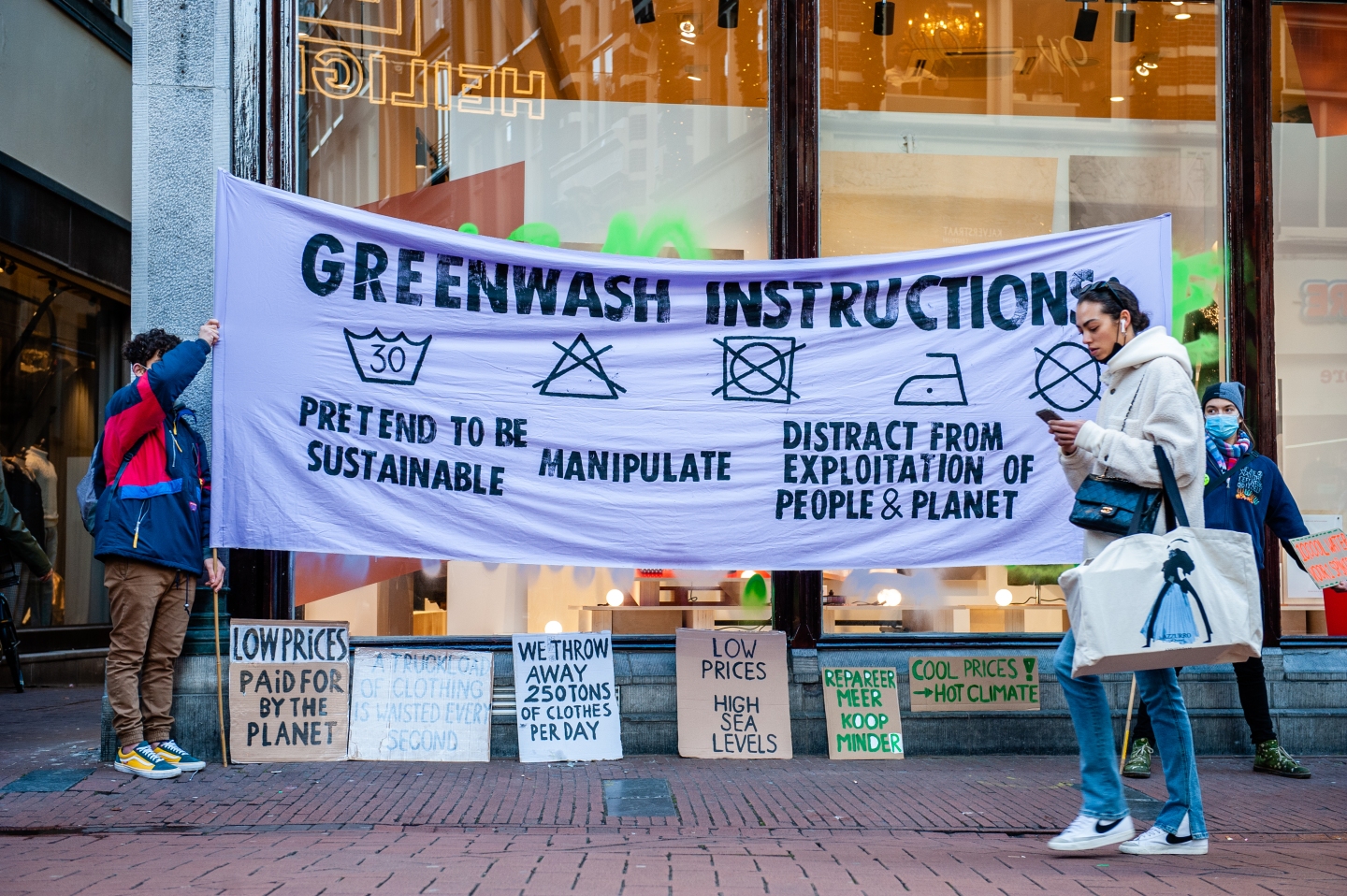
Activists protest greenwashing in Amsterdam on Nov. 25. Photo: ROMY ARROYO FERNANDEZ – NURPHOTO – GETTY IMAGES
By Andrew Martin via Fortune • Reposted: April 9, 2023
The apparel sector is responsible for between 2 and 8% of annual global greenhouse gas emissions. As one of the most polluting industries on the planet, it must urgently reduce its environmental impacts.
To date, efforts to transition to a more responsible industry are often self-policed. While real commitments to drive impact have been made, this has historically been more a result of deep commitments from some brands, retailers, and manufacturers to create positive change across the industry.
Voluntary initiatives have helped make real strides towards a more responsible sector. However, they alone cannot drive the necessary scale of change. Our own initiative, the Sustainable Apparel Coalition (SAC) represents around half of the global apparel and footwear industry. We know there are brands, retailers, and manufacturers who are already going beyond baseline standards to lower their environmental and social impacts–but now we need to see everyone working towards the same ambitious goals.
Regulation is a crucial lever for creating an apparel and footwear industry that protects both people and the planet. Unfortunately, it has lagged far behind what’s required for such a vast global industry. But this is changing, and fast.
Green and social regulation is coming for the apparel sector. In 2023, we expect momentum to build globally for the widespread policing of apparel’s sustainability claims. At the SAC, we believe this is long overdue.
The EU Commission recently proposed the hotly anticipated European Substantiating Green Claims Directive, aimed at fighting misleading advertising and stamping out greenwashing. It will require all environmental claims to be backed up with credible evidence. Legislation is in the pipeline elsewhere too. In the U.S., for example, a federal act to protect garment workers’ rights–the FABRIC Act (Fashioning Accountability and Building Real Institutional Change Act)–is in the offing. The New York Fashion Act is another proposed bill that would require companies with revenues of over $100 million doing business in the state to disclose their environmental performance and climate targets.
Due to the nature of some of the work we do at the SAC, it may come as a surprise that we don’t think voluntary action alone can solve apparel’s sustainability problems. But the situation is too urgent–and all our futures depend on it. The window in which we can act on the climate crisis is rapidly closing. Consistent, science-backed regulation is needed to help drive the tangible, industry-wide progress we need.
New laws to protect people and the environment will not render voluntary initiatives like ours obsolete, as we believe our role sits comfortably alongside legislation. Through developing tools and frameworks, and sharing knowledge, experience, and best practice, not only can we support apparel and footwear businesses to deliver against legal requirements, but also be an accelerator for positive change on a global scale with the help of smart regulation. This should be the approach for all consumer goods industries.
However, we want to highlight the need for such legislation to be harmonized and mandatory. The proposal for the EU Substantiating Green Claims Directive does not mandate a single, clearly defined framework based on scientific foundations, such as the Product Environmental Footprint (PEF), which opens the door to a range of alternative methodologies and could undermine rather than advance progress in the sector. We are concerned that the directive will create confusion for brands and retailers looking to advance their sustainability credentials, in turn leading to an increase in miscommunication to consumers.
In addition, the directive opens to door to different interpretations by member states, which risks leading to greater fragmentation when it comes to how we articulate and communicate environmental impacts in EU countries. In a climate emergency, this is not how to create the clarity we need to drive mass consumer change. As the move towards proper policing accelerates, we need to ensure a consistent approach is taken worldwide.
In the meantime, organizations must have a clear and consistent method for calculating a product’s environmental footprint. To date, the PEF still represents the most holistic, scientifically grounded method for assessing the environmental impact of a product, reducing inconsistencies in how life cycle assessments (LCAs) can be interpreted. We firmly believe action needs to start today, not further down the line while further revisions are developed, consulted on, and piloted. We need clear legislation that removes confusion and supports positive business action.
No industry can police itself. It’s time to regulate apparel and footwear’s environmental and social impacts. Strong legislation will drive everyone in our sector–as well as the wider consumer goods industry–to step up and take responsibility. At the SAC, we recognize that regulation will bring us closer to our shared goal of an industry that leaves the world in a better place. We’re calling on other voluntary organizations to do the same.
Andrew Martin is the executive vice president at the Sustainable Apparel Coalition
The opinions expressed in Fortune.com commentary pieces are solely the views of their authors and do not necessarily reflect the opinions and beliefs of Fortune.
To see the original post, follow this link: https://fortune.com/2023/04/07/global-fashion-industry-pollution-workers-planet-industry-regulation-environment-andrew-martin/

 Eric Block On Responsible Branding
You must be logged in to post a comment.