Study: Billions in Brand Value at Risk If Sustainability Perceptions, Performance Are Unaligned

23 06 2023

New research quantifies the financial value of sustainability perceptions for hundreds of the world’s biggest brands — and the substantial risks of not living up to them. From Sustainable Brands • Reposted: June 23, 2023

First launched at the World Economic Forum in Davos earlier this year, Brand Finance‘s Sustainability Perceptions Index showed that for many of the world’s most valuable businesses, there can be billions of dollars of financial value to be gained from enhanced ESG action and associated communication.

Now, for the new Sustainability Gap Index, brand-valuation consultancy has recalculated the valuations of each brand by considering its ESG performance, utilizing data from CSRHub. The newly derived values, in conjunction with the Sustainability Perceptions Scores (SPS) disclosed in the new report, expose whether public perceptions align with the actual performance of each brand — and the financial risks associated with any gap.

As Robert Haigh, Strategy & Sustainability Director at Brand Finance, explains in the report:

“Highlighting the link between finance and sustainability is timely and essential; but the message isn’t a new one. However, a sticking point has been that without articulating the case in financial terms, enabling evaluation of business cases and return on investment analysis, it can be difficult to justify the kind of investment that is required to shareholders.

“Brand Finance has sought to solve this challenge. We have quantified the financial value of sustainability perceptions for hundreds of the world’s biggest brands. Our research shows that even for individual businesses, there can be billions of dollars of financial value to be gained from enhanced action and associated communication. Equally, there can be billions at risk from insufficient action that leads to accusations of greenwashing, or even misallocated or excessive investments in sustainability communication that does not cut through. We hope this report is a useful first step in understanding the financial significance of sustainability perceptions to your business, including the value that you may stand to lose!”

Closing the perception gap

As detailed in the report, where a brand’s sustainability performance exceeds that of public perception, there is an opportunity to rapidly generate value by communicating the brand’s genuine commitment to sustainability more effectively. Conversely, where perception exceeds performance, value is at imminent risk — as brands leave themselves open to public backlash and a ‘correction’ of their sustainability perceptions value.

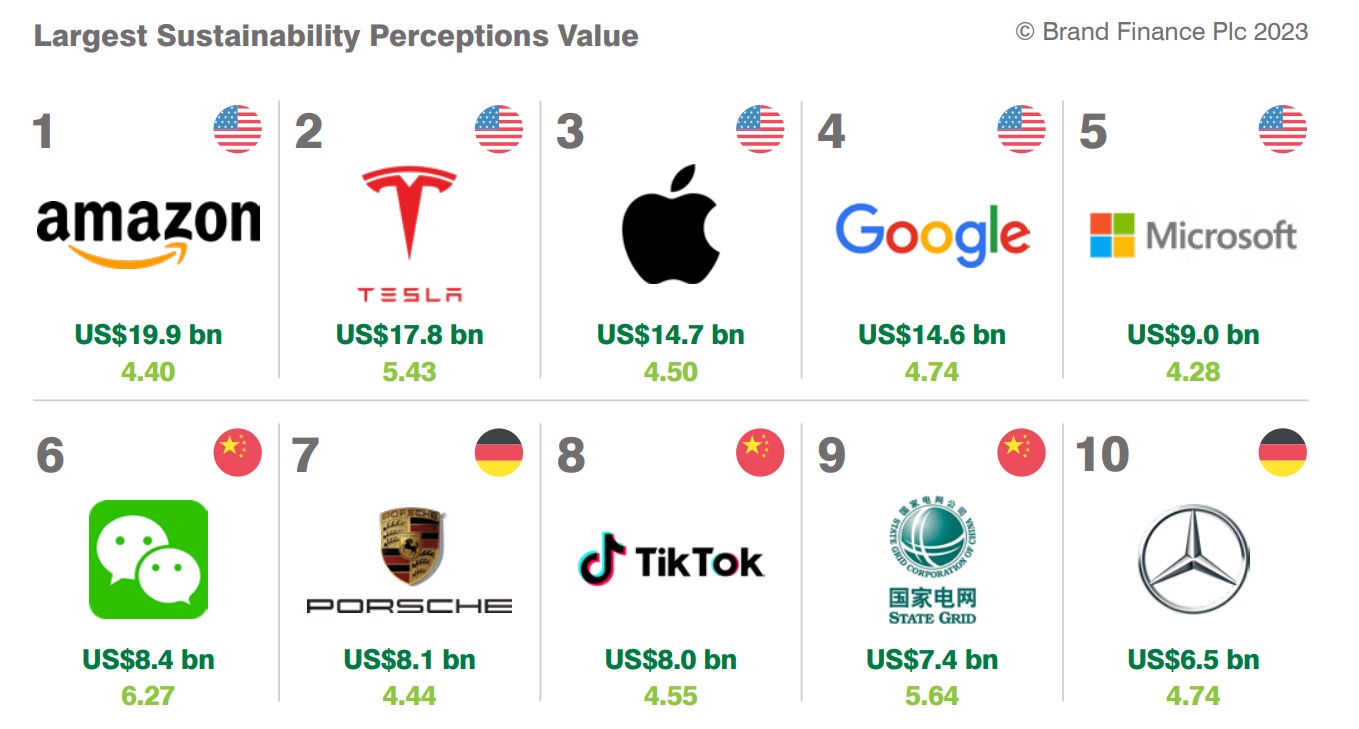
For example, Brand Finance found Amazon to have the highest sustainability perceptions value of any brand — US$19.9 billion. The ecommerce giant may not be perfect; but consumers appear to have confidence that it is committed enough to minimizing its impacts for them to continue to use its services. But if Amazon fails to keep pace with perception through a precautionary approach to improving its sustainability performance, and honest communication about its progress, those billions of dollars of value could be at risk.

View larger graphic here.

Another such brand is Tesla. Known as a pioneer of electric-vehicle, solar and battery technologies, Tesla’s image has clearly carried across into the perceptions held by global consumers. The company has the highest proportion of value underpinned by sustainability perceptions of any brand (26.9 percent) resulting in a Sustainability Perceptions Value of US$17.8 billion. However, the strength of this perception creates its own risk — because whilst Tesla performs well on environmental components of sustainability, it is weaker on governance and measures of social sustainability. Tesla’s weaker CSRHub scores therefore create a value at risk of up to US$4.1 billion — more than any other brand in the table.

Conversely, Microsoft has the highest positive gap value of any brand according to Brand Finance’s research — US$1.5 billion. This reveals that Microsoft’s sustainability performancelargely exceeds its public sustainability perception, thanks to a phenomenon on the flipside of greenwashing known as ‘greenhushing’ — in which brands under-report their sustainability progress or credentials for fear of being accused of greenwashing — which, Brand Finance posits, means there is an opportunity for Microsoft to generate up to US$1.5 billion by speaking more loudly and clearly about its sustainability initiatives and services.

View larger graphic here.

Meanwhile, luxury fashion house Chanel is an example of a brand that has both a (relatively) high Sustainability Perceptions Score (4.88/10) and a high CSRHub score. By engaging with a wide range of stakeholder groups, Chanel can better align its sustainability performance with its sustainability perception through strong, authentic sustainability communication.

Sectors as sustainability drivers

While Brand Finance found that sustainability plays a powerful role in brand perception at the premium end of all sectors, the research also found that it is more likely to act as a differentiator for brands in certain sectors. For instance, the average role of sustainability in driving choice in the luxury auto sector is 22.9 percent (which could partly explain the lasting halo effect for Tesla). It might seem counterintuitive that brands often associated with high fuel consumption are reliant on a reputation for sustainability. However, in luxury auto — where the purchase is discretionary and the brand is publicly expressed — the appeal of sustainability is further enhanced. Other sectors in which sustainability plays a powerful role are soft drinks (13.7 percent), supermarkets (12.6 percent), media (10.1 percent) and personal-care products (10 percent). For soft drinks and supermarkets, the potential impact of the products in question is a lot more tangible for consumers than in many sectors — due to growing understanding of impacts such as plastic pollutiondeforestation and other agricultural impacts, or food miles. In cosmetics, many brands have found success marketing attributes including clean and sustainable ingredientsavoidance of animal testing; and ethical supply chain initiatives.

The bottom line is, the time that companies could ignore the tangible financial link between sustainability and brand perception has come and gone — as has the era of greenwash. In the report, IAA Public Policy Council Chair Jeffrey A. Greenbaum offers brands a great starting point for proceeding authentically: “One thing that every advertiser should do is review their marketing with a view toward replacing ambiguous, general environmental benefit claims that could have the capacity to mislead consumers with claims that promote specific environmental benefits that are backed up by proper substantiation.”

To see the original post, follow this link: https://sustainablebrands.com/read/marketing-and-comms/billions-brand-value-risk-sustainability-perceptions-performance-unaligned



2 leaders on the need for organizational transformation towards sustainability

3 05 2023

Photo: WEF

By Nadine Sterley, Chief Sustainability Officer, GEA and Judith Wiese, Chief People and Sustainability Officer and Member of the Managing Board, Siemens from the World Economic Forum • Reposted: May 3, 2023

  • Corporate sustainability has become a crucial strategic imperative.
  • Sustainability leaders are pivotal in shaping organizational change.
  • Two leaders share their thoughts on how this can be achieved.

The need for critical action to achieve climate and nature goals has elevated the role of the Chief Sustainability Officer (CSO). The private sector will play a key role in multistakeholder partnerships to actualize the impact on climate and nature. 

However, this cannot be achieved without a human-centred approach, making the Chief Human Resources Officer (CHRO) role also essential for sustainability transformation.

Within the private sector, CSOs and CHROs will shape fundamental strategies for organizational change to catalyze sustainable habits in organizations and individuals. 

“Sustainability, HR and organizational change can influence companies and their value chains” 

Nadine Sterley, Chief Sustainability Officer, GEA Group

As the world is confronted with the consequences of the climate crisis and other environmental challenges, acting sustainably is becoming increasingly essential in companies. This is true both from a strategic point of view as well as with regard to innovations and successful recruiting. At the same time, the breadth of sustainability topics is increasing year-on-year. 

The growing importance for companies to act sustainably and report on their sustainability performance has elevated the role of the Chief Sustainability Officer (CSO). Sustainability has evolved from being a niche function to a strategic one. CSOs are expected to take a key role in leading their organizations towards sustainable business practices. At GEA, the CSO role belongs to the inner circle of the company’s decision-making. It plays a crucial role in helping its executives and the entire workforce to easier understand, reasonably measure and adequately report on sustainability impacts, risks and opportunities.

As sustainability has fundamental strategic importance, GEA has put the topic at the heart of its strategic approach. In fact, sustainability is the core theme in GEA’s corporate purpose, “Engineering for a better world”, from which the company’s vision is derived: “We safeguard future generations by providing sustainable solutions for the nutrition and pharmaceutical industries.”

Moreover, sustainability has its own pillar within GEA’s Mission 26 corporate strategy and underpins the other six key levers. Taken together, they form the roadmap to ensure GEA achieves its targets. Within this framework, the CSO works strategically to ensure sustainability is integrated into all business activities and the entire company. This requires adept networking and advocacy skills and the ability to connect the dots within and outside the organization to drive sustainability transformation.

However, as important as they are, neither strategy, nor the organization or the products on their own are enough to make the key difference. What matters most to achieving real transformational change and becoming a truly sustainable company is the mindset, behaviour and commitment of a company’s employees. To help their organization succeed, employees need to be engaged, empowered, and assume a key role in the transformation. And this is where the human resources function must become part of the game. It can create a supportive environment that fosters a sustainable mindset and behaviour. It also plays a critical role in hiring and helping ensure new employees understand and embrace company values.

GEA is taking this aspect very seriously. Of GEA’s five values, the first one is: “Responsibility: We care for people and planet.” Internally and externally, our CEO, Stefan Klebert, has made it his personal mission to promote this value, thus setting the tone for all employees.

The clarity and importance placed on caring for people and planet, reinforced by GEA’s corporate purpose: “Engineering for a better world”, serve as a promise to current and future employees. This has already had a positive impact on our goal to become “Employer of Choice” in our industry. Likewise, our values and purpose set a clear expectation toward all employees and, consequently, any people-related decisions.

In addition to requesting a driving mindset towards sustainability from all employees, GEA is significantly investing in the competency development of its business leaders. Just recently, the top 160 leaders of the company, went through a comprehensive programme with a renowned business school that was strongly focused on identifying new ways of leveraging sustainability as a source for competitive advantage.

Building on that, the company’s leadership teams are now expected to develop their own strategies to create additional value for their customers by offering products and solutions that allow a reduction of energy, water, or waste. To encourage even more innovation in these areas, we set up cross-function and cross-divisional sustainability-focused hackathons to spark creativity.

As of 2023, a significant proportion of GEA’s senior leaders will participate in a variable compensation plan which is linked to GEA achieving its sustainability-related targets. For example, the reduction of CO2 emissions in GEA’s own plants and along entire supply chains will lead to higher compensation, as will the development of more efficient products that support customers in achieving their sustainability targets.

With the support of our employees, GEA is not only driving its own sustainability transformation but also the transformation of the many industries it supports through engineering excellence.

“Being Chief People and Sustainability Officer is a game changing superpower”

Judith Wiese, Chief People and Sustainability Officer and Member of the Managing Board, Siemens

The challenges to human (co-)existence on the planet from resource depletion, climate change, and unsustainable practices of the industrial age are undeniable. In the corporate world, the broader attention needed to handle sustainability issues is generally allocated to the role of the Chief Sustainability Officer (CSO). There are, however, no universal standards for what this function does or how much authority it has to be effective. At Siemens, the CSO role has been a board-level position since 2008, underscoring the importance of sustainability as a building block of our DNA and setting a strong foundation to build on. And that’s what we do, every day.

As Chief People and Sustainability Officer (CPSO) at Siemens, I have the unique opportunity to wear two hats: one for ensuring the well-being of our people and nurturing our company culture, and one for advancing sustainable practices in our own operations and all aspects of our business – multiplying the impact for our customers and communities. For me, this is a superpower. It joins two powerful elements that run horizontally across all our businesses: people and sustainability – both necessary if solutions are to be found for solving the most critical issues of our time. Add in the power of technology that Siemens brings as a technology company, and you have an unstoppable combination that actively supports the mindset shift needed for achieving a more sustainable world.

At Siemens, our push for sustainable business practices is encompassed in our 360-degree framework, containing six fields of action: Decarbonization, Ethics, Governance, Resource Efficiency, Equity, and Employability or DEGREE. Our DEGREE framework is, among other things, a commitment to ethical standards based on trust and respect for human rights in the supply chain. 

DEGREE allows a holistic view of sustainability that puts people topics like employability and equity, as well as environmental and societal impact topics, in focus. We encourage continuous learning and are committed to re- and upskilling, especially green skills. In the last fiscal year, we invested €280 million in professional training and continued education to transform our workforce into sustainability ambassadors. Our highly popular Base Camp for Sustainability offers an introduction to DEGREE and 66,000 participants have completed the course already in FY23.

We value the E for Equity that helps us integrate and promote diversity, equity, and inclusion into the fabric of our company. It helps us create a workforce that reflects our customer landscape and brings a fresh perspective to the way we think about creating solutions. The intersection of people’s interests with our company values creates a sense of belonging and engagement that we both admire and appreciate.

Combining the responsibilities for sustainability and people operations allows social aspects to be complemented by proficiency in the environmental and corporate governance spheres. At Siemens, with sustainability at the core of our processes, we need relevant skillsets across our business units and corporate functions. This allows sustainable approaches to be developed in an ecosystem manner, observing the cross-functional and business governance standards required to comply with new EU Taxonomy regulations and develop non-financial reporting and accounting guidelines.

To effect change, a cultural and organizational transformation and mindset shift are necessary. The convergence of people and sustainability can be a useful tool to speed up the momentum of much-needed change in all aspects of our existence. Indeed, for a company like Siemens – undergoing the transformation from industry to global technology leader – sustainability is a tremendous opportunity. Crucially, this applies both to our own operations and to our portfolio. We have increased our CO2 reduction target from 50% to 90% by 2030, compared to 2019, and will invest €650 million in decarbonizing our activities by 2030. But our products and solutions can also help our customers with their sustainability challenges – ~150 Mio tons of emissions were avoided by customers in FY22 alone.

Those companies that recognize the power of this combination will be well positioned to be drivers of innovation and growth, increase employee engagement, and mitigate the challenges associated with rapid transformation.

As a company at the intersection of the real and digital worlds, we at Siemens believe that technology is a key driver of sustainability. Embracing a holistic view that goes beyond environmental topics, we anchor sustainability firmly in all our business and operations. We are confident that leveraging the superpower combination of technology, people and sustainability can make a difference and transform the lives of billions.

To see the original post, follow this link: https://www.weforum.org/agenda/2023/05/leaders-need-for-organizational-transformation-sustainability/