Non-binding commitments, paucity of scientific data and poor representation of global south left a lot to be desired at summit. By Nina Lakhani and Oliver Milman from the Guardian • Reposted: March 26, 2023
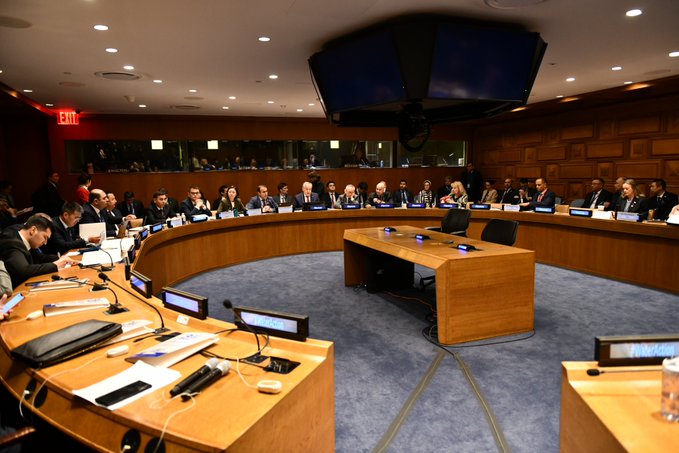
The first global water conference in almost half a century has concluded with the creation of a new UN envoy for water and hundreds of non-binding pledges that if fulfilled would edge the world towards universal access to clean water and sanitation.
The three-day summit in New York spurred almost 700 commitments from local and national governments, non-profits and some businesses to a new Water Action Agenda, and progress on the hotchpotch of voluntary pledges will be monitored at future UN gatherings. A new scientific panel on water will also be created by the UN.
Overall, organizers said they were happy that governments and representatives from academia, industries, and non-profits had come together to discuss the often neglected topic of water and to commit billions of dollars to improving water security.
But they conceded that more was needed than a set of voluntary commitments such as a formal global agreement, like the 2015 Paris climate accords and the 2022 Montreal biodiversity pact, as well as better data and an international finance mechanism to safeguard water supplies.
“This conference did not give us a mandate for this, but we brought the world together to ensure there is a follow-up,” said Henk Ovink, special envoy for water for the Netherlands, which co-hosted the conference along with Tajikistan. “We have fragmented water governance across the world, fragmented finance and not enough science and data in place.”
“We know our job is still not done and in fact we are falling behind in our task,” said Tharman Shanmugaratnam, Singapore’s senior minister and co-chair of a summit interactive dialogue. “But we know the job can be done. We must now treat water as a global common good to be protected collectively, in the interests of all nations.”
In closing the historic summit, António Guterres, the secretary general of the UN, urged everyone to turn the pledges into action. “All of humanity’s hopes for the future depend, in some way, on charting a new course to sustainably manage and conserve water … it needs to be at the centre of the political agenda.”
Talks ended with a broad agreement that water should be treated as a global common good, and that the world’s approach to water must be less siloed given its nexus with the climate crisis, and food, energy and national security. But with no internationally binding agreement, experts fear that pledges could slide as it will be hard to hold governments, industry and financial institutions to account.
On Friday morning, more than 100 water experts from research institutions and civil society groups across five continents sent a letter to the UN general secretary slamming the lack of “accountability, rigour and ambition” at the conference, arguing that the paucity of scientific rigour and binding agreements will fail to secure the more just, resilient and sustainable water future urgently needed.
“Trying to solve one of the greatest challenges facing humanity with voluntary commitments and solutions based on half-baked evidence is like taking a knife to a gunfight – it simply isn’t good enough, and represents a betrayal of the world’s poor who bear the brunt of the water crisis,” said Nick Hepworth, executive director of Water Witness.
Charles Iceland, global director for water at the World Resources Institute, said only about a third of these announcements were “gamechangers” that would substantially improve the water crisis. “I think the voluntary commitments are a good start … Each voluntary commitment has a place where you talk about how much money is available, most of them left that blank.”
“We need a Paris agreement for water globally, and national water plans for each country, and regional water plans for each shared basin and aquifer,” Iceland added.
About 90% of climate impacts are related to water – too much, too little, or too dirty – yet only 3% of climate finance is currently dedicated to the world’s water systems. Water related conflicts have risen sharply in recent years as sources dwindle, including many internal disputes between urban and rural dwellers, and pastoralists and farmers, according to research by the Pacific Institute.
Almost 7,000 people attended the conference, but the private sector and global north were far better represented than experts and water insecure communities at the frontline of the water crisis from the global south – many of whom were excluded due to visa and financial barriers. Only a dozen or so world leaders attended the conference, and there were no protests and few activists to call out government and business hypocrisies.
Mana Omar, 28, one of few activists from Fridays for Future Africa to get a visa, said: “As a young person without affiliation to a big organisation there was no opportunity to share experiences of my community,” said Omar, who is from Kenya’s arid Kajiado county where girls and women from pastoral Indigenous communities are facing worsening gender-based violence as drought forces them to travel further to find water.
“The water action agenda should include diverse experiences, but too many communities are missing, and there’s nothing legally binding so how can we hold the countries to account?” added Omar.
A UN spokesperson said they were unaware of any access issues.
The conference also failed to address the violence and threats faced by communities trying to protect dwindling water sources from mining, industrial agriculture and other polluting industries. “It is a very bureaucratic event where only large NGOs, governments and private companies could express themselves,” said Juan Gabriel Martinez, 34, a land and water defender from Manizales, Colombia, where the community is under attack by armed militias.
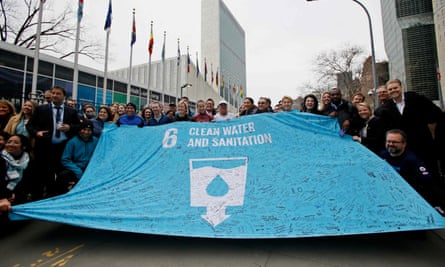
A quarter of the world’s population still does not have access to safe drinking water while half lacks basic sanitation – which is one of the sustainable development goals for 2030. Progress has been slow due to the lack of financial investment from rich countries – which has moved towards loans not grants, insufficient political will and a siloed approach to water. At the current rate, universal access to clean water and sanitation will not be achieved for decades after the 2030 target.
Samuel Godfrey, the UN Development Programme’s principal water resources advisor, said: “What’s come out of this is the need to move toward regional goals after 2030.”
And while the summit may have nudged the world in the right direction, as Musonda Mumba, secretary general for the convention on wetlands, said in her closing statement: “The crisis is everywhere … we have no time.”
To see the original post, follow this link: https://www.theguardian.com/world/2023/mar/24/united-nations-water-conference-new-york-pledges

 Eric Block On Responsible Branding
You must be logged in to post a comment.