Ana’s Playground a winner at Norwich Film Festival

24 09 2009

107_AnasPlay_Kids2

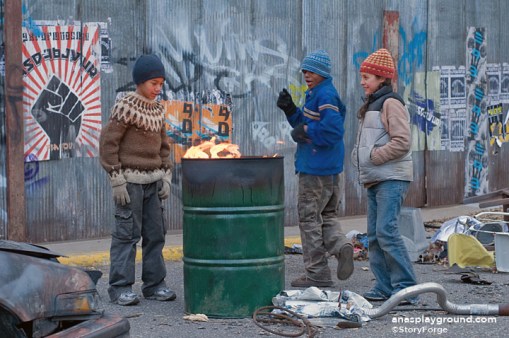
Ana’s Playground received awards for The Best Short Film and Best of The Fest this week at the Norwich Film Festival in the United Kingdom.

In its advance pre-screening at the debut Norwich Film Festival, Ana’s Playground not only won Best Short Film, but Best of The Fest – beating out all the feature films that were screened as well as more than 90 films entered in the competition.

Learn more about the Norwich Film Festival

The world premiere of Ana’s Playground is Friday, September 25 at the Calgary Film Festival.  Information on the Calgary Film Festival is available at their website.

Calgary International Film Festival

Written and directed by Minneapolis film maker Eric Howell, Ana’s Playground is a Oscar worthy story of children subjected to armed conflict.  The mission of the film is to raise awareness of children in conflict and raise funds for Right to Play, an international humanitarian organization that uses sport and play programs to improve health, develop life skills, and foster peace for children and communities in some of the most disadvantaged areas of the world.


A responsibility revolution?

21 09 2009

Picture 1A new survey by Time magazine was highlighted in a recent article written by Richard Stengel: “For American Consumers, A Responsibility Revolution.”  Could this new halo many are happy to be wearing represent some of the most compelling signs of “the new normal”?

The research indicated:

  • 82% of people consciously supported local or neighborhood businesses
  • 40% of people said they purchased a product in 2009 because they liked the political or social values of the company that produced it.
  • 60% of Americans have bought organic products since January
  • 78% of those polled said they would be willing to pay $2,000 more for a car that gets 35 m.p.g. than for a similar one that gets only 25 m.p.g

As the article says, “That’s evidence of a changing mind-set, a new kind of social contract among consumers, business and government. We are seeing the rise of the citizen consumer — and the beginnings of a responsibility revolution.”

Once again, the Time survey adds to the rapidly growing amount of data that indicate we have reached the tipping point where values based marketing and sustainable branding are beginning to rise in importance with customers from all walks of life. Companies who recognize this and infuse sustainable branding into their total customer experience will inevitably be among the winners in the age of accountability.

Read the Time magazine article


Lessons from the U.K.

15 09 2009

british_flag

“This research shows that consumer values do not change, even in a middle of a recession. They want companies to act and cut their carbon footprints, and provide transparent and accessible evidence of action.  We believe companies that take real action will seize the dual benefits of immediate cost savings and a stronger reputation, which is good for business.”

– Harry Morrison, Carbon Trust Standard

New research from the Carbon Trust Standard in the United Kingdom shows that consumers still want to buy green despite the current economic climate, with 62% of consumers saying environmental concerns influence their purchasing decisions—‘the same as a year ago’ and just over a quarter saying they influence them ‘even more’ than in 2008.

Other fun factoids from the research that marketers should be aware of:

  • 66% of U.K. consumers say it’s important to buy from environmentally responsible companies.
  • 14%  said they have voted with their feet by deciding not to buy from a company based on their environmental reputation
  • 25% decided not to buy from a company based on a company’s ethical reputation.
  • 70% of consumers do not feel confident that they can clearly identify which companies are environmentally responsible.
  • 59% are skeptical about the environmental claims companies make.
  • 44% of consumers would like more information on what companies are actually doing to be environmentally responsible.

So sustainable branding requires new forms of communications and embracing transparency and honesty in all facets of a brand presentation.  The research further demonstrated this quest for information that engaged consumers are using to understand whether or not a company is environmentally responsible.  The research indicated the most important criteria they rely on are what they read in the media (38%) and third party endorsement or accreditation (34%).

The least popular factor consumers use to judge whether a company is behaving in an environmentally responsible manner is what advertising tells them (6%).


Congrats WestPac New Zealand: Branding Beyond The Numbers

2 09 2009

We’re interested to follow the development of a new sustainable branding campaign by one of the leading banks in New Zealand – WestPac.  Rather than try to differentiate by low interest rates and car loan messaging in their brand communication, WestPac has launched a multi-media marketing effort that showcases their commitment to sustainability and social responsibility.  

The brand communication plan supports messaging around the 10 goals WestPac has established for sustainability through 2012 and customers can track the bank’s progress on their website.  In addition to tangible sustainability goals such as carbon footprint reduction, the measurement includes community outreach programs such as the volunteer programs to clean up New Zealand’s beaches.

beachclean

We further applaude the smart nature of the communication by portraying one of the bank’s employees as having to learn the new behaviors that add up to sustainability with the line “being sustainable can be tough. we know.”  It’s a great example of a company taking a thought leadership position on sustainability, helping educate their customers on what they can do in their own everyday life, and becoming a catalyst for community action.  Congrats to WestPac for thinking beyond the numbers.

Learn more about WestPac’s sustainability efforts


The Scopes Monkey Trial of the 21st Century?

27 08 2009

A report in The Los Angeles Times highlights how the U.S. Chamber of Commerce wants to put the science of global warming on trial.  

1wm_primates_009

The Chamber is pushing Environmental Protection Agency officials to hold a rare public hearing on the scientific evidence of climate change with the goal of fending off potential emissions regulations.

The article cites EPA officials as calling such a hearing “a waste of time”.  A leading climate scientist said the proposal “brings to mind for me the Salem witch trials”.

At a time when the vast majority of business leaders in the United States recognize the serious impact of climate change and are exploring and implementing innovative new sustainability practices into all facets of their operations, we cannot fathom how the U.S. Chamber can be in denial and rationalize wasting the time and money of its members by pursuing such draconian tactics.  This after the heads of the top science agencies in leading countries have recently written to world leaders that  “the need for urgent action to address climate change is now indisputable.”

Read the Los Angeles Times article.


Study underscores “socially responsible credit gap”.

17 08 2009

DSC_0588“People are willing to pay more for products from socially responsible companies, but almost no companies have any profile as socially responsible.”

PSBA Research

In a study conducted this March, Penn Schoen Berland Associates found that despite significant investments by many major corporations in corporate social responsibility initiatives, Americans have virtually no awareness of who does what, and who does things well.

Some interesting insights from the study first point to the facts that the majority of Americans (despite the recession) want to be associated with socially responsible companies.

  • 75% will pay more for a product from a socially responsible company.
  • 56% say working for a socially responsible company makes a difference.
  • 40% will take a pay cut to work for a socially responsible company.

The study also found that being “honest and trustworthy” was the most important company attribute—ranking higher than “quality” and “value”—regarding who Americans will do business with.

But the most unfortunate (and least surprising) set of findings in this research is how ill equipped Americans are to say what companies are socially responsible.  

  • 70% of those surveyed were unaware of any socially responsible activities of their own employers.
  • There was no correlation between those companies that Americans ranked as being leaders in social responsibility and the actual performance of those companies based on evaluations in the CRO 100. (conducted annually by the Corporate Responsibility Officer Association)

Clearly, this should be a wake up call to the leadership of all companies and those responsible for managing their reputation and brands.  In sum, it suggests there is a huge opportunity to use CSR efforts as a differentiator with an American audience that cares about those issues more than ever before and is placing trust at greater currency than quality and value.  

The call to action is to convert socially responsible practices into branded assets.  But this will require internal corporate silos to be broken down so people responsible for operations, HR and internal communication, PR, marketing branding, advertising, and all other forms of communication are working together around a focused and integrated CSR message.

Read the Corporate Citizenship Study


Kudos To Cub. New LEED-certified grocery store is a shining example of sustainable branding.

12 08 2009

474Cub Foods recently opened a LEED (Leadership in Energy and Environment Design) Gold Certified grocery store in the Phalen neighborhood of St. Paul, Minnesota.

Having visited the store we send big kudos to Cub.  Not only is the store a inventive and creative way of reducing the energy consumption, carbon footprint and reduced impact in construction and daily operation, but it is an excellent example of conveying the vision and possibilities to its customers.

The statitsics related to the store itself are impressive.

  • 44 skylights illuminate 75% of regularly occupied spaces using a solar powered GPS system to track and re-direct sunlight.
  • Parking lot lighting from LED lighting cutting energy consumption by 50 percent.
  • An overall saving of 35% in lighting expense compared to the average Cub store.
  • Landscape irrigation that uses 50% less water.
  • 75% of building construction waste will be recycled.

But we love how Cub has used the physical environment of the store itself to provide information about every aspect of how the store is operating in a sustainable way.  The subtle signage is designed to educate Cub customers about the important facets of the store’s operations.  

Messages conveyed include how the store uses reduced refrigerant.
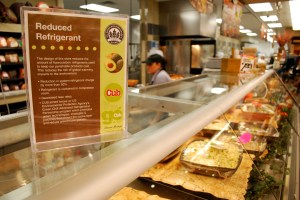
501

Use of natural light to reduce energy consumption.

508

How Cub uses packaging made from only 100% renewable resources.

524

How the overall store operates in a more energy efficient fashion.
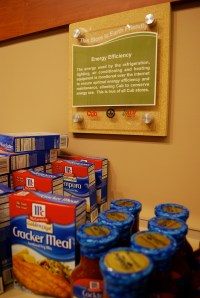
494LED refrigerator case lighting to conserve energy.

511

Special parking places reserved for customers driving fuel efficient vehicles.

517

An overall store experience which is designed to be more respectful to nature and healthy for all.
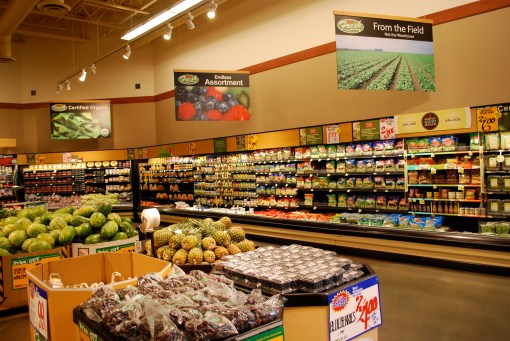
532

In additional to many of the customer facing aspects of the store, the new Cub also features creative, energy saving ideas in all aspects of its operation.  For employees, the Cub facility features men and women’s shower rooms for employees to encourage them to ride the bike to work and worked with the city of St. Paul to create an additional city bus route so their employees can take the bus to and from work versus driving.  The facility also features a white roof to reflect heat to reduce energy consumption and special landscaping to absorb rainfall.

All in all, we encourage everyone to visit this very special new store if you have the chance.  And we send our congratulations to the leadership of SuperValu (the parent of Cub Foods) for their courage and leadership in creating and building what we hope will become the role model for retailers everywhere.

Our thanks to the support of  Cub Foods—and in particular Lee Ann Jorgenson, Manager of Community Relations and Communications—for allowing us to fully understand and share all of what the new Cub store is doing to be respectful to its new home in the Phalen neighborhood. 

(Photos by P.J. Milan.  All rights reserved.)


From Buyer Beware To Seller Beware: IBM’s Study On Corporate Social Responsibility.

12 08 2009

“Three quarters of businesses admit they don’t understand their customer’s corporate social responsibility expectations well.”

 – “Attaining sustainable growth through CSR”,

IBM Institute For Business Value


An interesting study of 250 global business leaders has revealed both the business upside to corporate social responsibility and one of the vulnerabilities – companies who embark on CSR initiatives without a true understanding of the expectations of their customers of those efforts.  The report reveals:

  • 68% of companies are now utilizing CSR as a opportunity and platform for growth.
  • 75% acknowledge the number of advocacy groups collecting and reporting information on their company has increased in the last three years.
  • But only 17% of companies say they really engage and collaborate with their customers regarding CSR activities.

Companies that truly understand the corporate social responsbility expectations of their customers report increased revenues and reduced costs and better differentiated products and services.  They believe they are more effective at improving labor practices, driving sustainability initiatives and aligning philanthropy with business priorities.  They also report having more engaged employees in CSR activities.

Ironically, many companies invest millions of dollars in gaining an understanding customers reactions’ to products and services, but the majority are operating a CSR strategy without insight and collaboration with customers.  The truth is your customer feels entitled to know everything “their brand” is doing.  So we echo IBM’s point of view, today the traditional adage “buyer aware” is now reversed to be “seller beware” — especially if you are unaware of your customers’ expectations regarding your social responsibility practices.

Watch an interview with George Pohle of IBM on the CSR Study


Real World Green: Winning Retailers See Sustainability As Competitive Advantage

11 08 2009

IMG_1165“Make green an integral part of your brand promise, and don’t wait to be pushed into action by eco-savvy consumers.  The store is a great place to begin – there is something every retailer can do today to reduce the amount of energy used.  But there is not “magic bullet” tactic for buildng a “green brand.”

-Real World Green:  The Role of Environmental Savings in Retail

The Retail Industry Leaders Association just issued it 2009 Benchmark Report on environmental sustainability in retail—which demonstrates how quickly retailer attitudes toward green initiatives as both a business economic driver and brand reputation indictaor have moved in the past 12 months, despite the recession.

The survey of nearly 100 retailers across all retail categories and company sizes finds some significant new findings toward sustainability practices.  The analysis divides retailers into “winners” – those retailers who’s revenue performance is besting industry average and “laggards” – those that are obviously falling behind.

The results illuminate that the “winners” of the past year in retail are significant more enlightened and deeply committed to driving sustainability initiatives into their operations and appreciate the benefit it will provide for their brand.  Whether or not their current customers are demanding it.

Some of the interesting factoids from the research impressed us.

  • 55% of retail “winners” see environmentally sound practices as both a “ethical obligation” and “to be seen as an industry leader”.
  • 80% of retail “winners” say that their customers expecting them to act is a key influencer to pursue green initiatives
  • 71% of retailers agree that “marketing our brand as “ecologically-conscious will have a profound impact on our brand image”

To further demonstrate how sustainability is a key topic on the minds of executive leadership of these retail companies: 87% of respondents believe the CEO has the greatest future potential of influencing their company’s leadership on sustainability—followed by the VP Marketing at 64%.  This would support our belief that those executive positions most responsible for overall brand and company reputation and image are going to be driving strategic sustainability initiatives in the future.

Read the Report:  Real-World Green_ The Role of Environmental Savings in Retail