Business schools must step up on sustainable investing education

11 09 2023

Student-Managed Investment Funds provide students with experience managing real investment portfolios. But new research shows only. a small minority of funds include environmental, social and governance (ESG) factors in their mandates. Photo: Shutterstock

By Lorin Busaan, PhD Student, Gustavson School of Business, University of Victoria and Basma Majerbi, Associate Professor of Finance, Gustavson School of Business, University of Victoria via The Conversation • Reposted: September 11, 2023

Sustainable investing takes into account environmental, social and governance (ESG) factors alongside traditional financial components. While this form of investing has existed for a long time, ESG has become a hot-button issue due to recent politicization and widespread public misconceptions around what it really entails. 

ESG investing examines quantitative and qualitative non-financial data on companies. This includes environmental issues like carbon emissions, pollution and resource use; social issues like employee treatment and relationships with communities; and governance issues like diversity of corporate boards, business ethics and transparency. 

Criticisms of ESG investing have been exacerbated by post-secondary finance programs that barely touch upon these issues, resulting in a significant shortage of qualified sustainable investment professionals

Due diligence

A basic qualification for finance graduates is the ability to analyze the environmental, social or governance factors that create risks and opportunities for a given company and, in turn, affect investors’ returns. 

Unfortunately, graduates often lack even this basic qualification, in addition to more advanced expertise required to assess the investment impacts on people and the planet.

Given the climate crisis and persistent inequality, business schools must urgently and immediately tackle the sustainability deficit in finance education. Formal instruction must be enhanced with experiential learning techniques that expose students to the complexity and nuances of sustainable investing.

Our research shows that Student Managed Investment Funds (SMIFs) — currently present at many Canadian universities — are an underused, hands-on learning opportunity for training the next generation of sustainable investment professionals. 

ESG under fire

Despite the potential of sustainable investing to accelerate the net-zero carbon transition and support the UN Sustainable Development Goals (SDGs), it has come under fire in recent years. 

A dark-haired man speaks into a microphone.
The head of the Kansas Public Employees Retirement System testifies before a Kansas legislative committee in March 2023 about a bill that would bar the pension system from ESG investing. (AP Photo/John Hanna)

Politically, sustainable investing has become a flashpoint for partisan conflict in America’s culture wars. Right-wing critics argue that including ESG considerations in investment decisions is intrusive moralizing and part of a “woke capitalism” agenda

Counterparts on the left downplay concerns about economic transition costs or exaggerate the power of ESG investing to create a better world. 

Recent studies also show that third-party ESG ratings are unreliable, leaving considerable room for greenwashing or, at minimum, “greenwishing” — when companies or investors have good intentions but fail to meet their sustainability goals. 

Criticisms and politicization, combined with other factors, have curtailed flows to ESG funds. This is unfortunate given the urgent need to mobilize more financial capital to address climate change, biodiversity loss and inequality. 

Reforming business schools

Developing competence in sustainable investing requires a serious revision in business school finance programs. 

Core courses must include sustainable investing concepts and tools as part of mainstream financial education. This is especially important given fast-evolving ESG and climate-related regulations and rising global risks that pose new threats to companies and investors. 

It’s also important that students learn the limits of different forms of sustainable investing to avoid falling into the trap of greenwashing. 

Many ESG strategies primarily focus on risk mitigation with, at best, a marginal impact on people or the planet. Others, such as impact investing, focus on measurable social and environmental outcomes, often using the UN’s SDGs for their impact goals, alongside financial returns. 

Impact investing could unlock much needed capital for critical sectors in the net-zero transition that would otherwise be underfunded when using traditional financial metrics. 

In short, sustainable investing, in all its forms, requires additional skills that are currently lacking in finance education. Social and environmental impacts can be difficult to quantify and may require longer-term perspectives and qualitative judgements about potential impacts on many stakeholders. 

A lecture hall with a man at the front delivering a lecture.
It’s important that students learn the limits of different forms of sustainable investing to avoid falling into the trap of greenwashing. Image: Unsplash
Student-managed investment funds

These skills are best developed through hands-on practice that supplements formal instruction. Student-Managed Investment Funds (SMIFs) provide students with experience working together to manage real investment portfolios under the guidance of faculty supervisors and industry professionals. 

Canadian universities have established more than 30 funds that students oversee as portfolio managers, buying and selling stocks, bonds or other assets. The capital in these funds comes from a variety of sources, including donations from companies, philanthropic gifts from individuals or foundations, and in some cases from university endowments.

Unfortunately, our research shows that only a small minority of these funds include ESG considerations in their mandates. 

Of the 31 Canadian SMIFs we analyzed (totalling $79.5 million managed by students), only five (16 per cent) have some level of ESG consideration. Since business schools have long used student-managed funds to train the next generation of investment bankers, financial analysts and other financial industry professionals, this is surprising — and disappointing.

a graph shows the number of smifs in canada with esg components.
Authors’ analysis of SMIFs in Canada with ESG components based on publicly available data from major Canadian business schools’ websites as of fall 2022. Impact Investing Hub, University of Victoria

The gap is even more pronounced for impact investing, which is barely mentioned in any of the funds in our sample, despite universities’ commitments to the UN’s Sustainable Development Goals. 
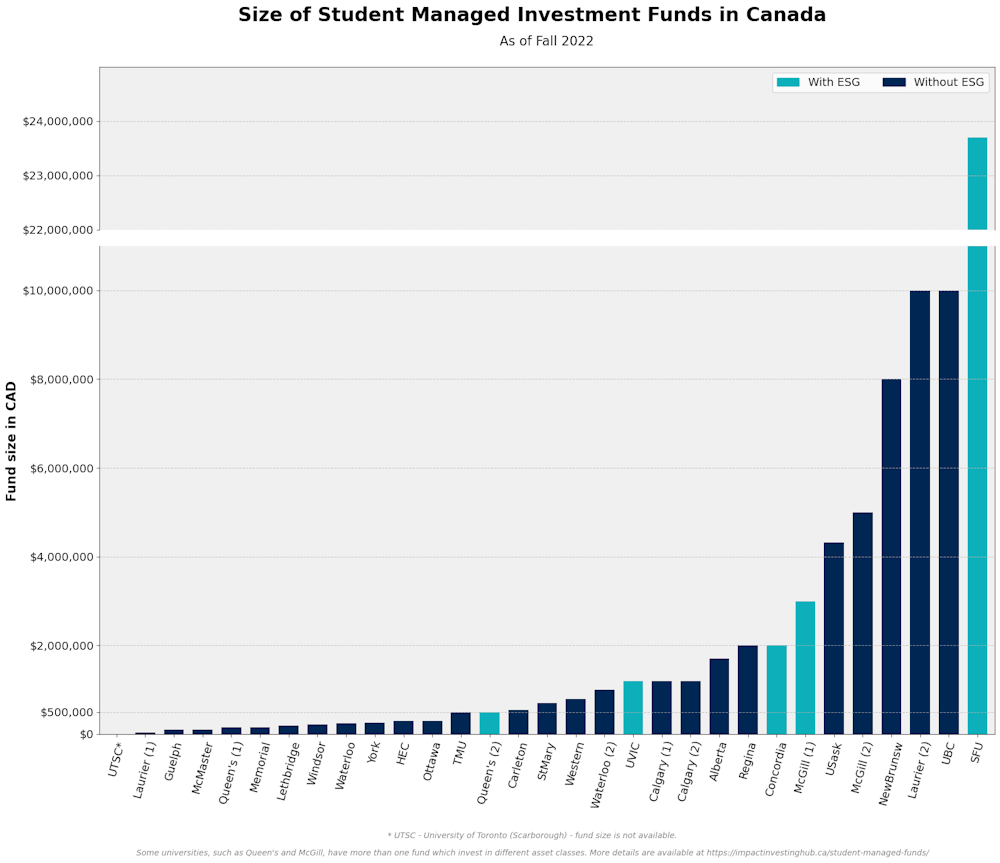
a graph shows the size of smifs in canada with and without ESG components.
Authors’ analysis of the size of SMIFs with and without ESG components, based on publicly available data from major Canadian business schools’ websites as of fall 2022. Impact Investing Hub, University of Victoria

Sustainable finance education could benefit greatly when students work together to integrate financial, environmental and social factors in student-managed investment funds. 

Learning by doing helps students develop important analytical skills, familiarizes them with key tools and data sources and helps them navigate the maze of ESG standards, frameworks and guidelines.

The role of universities

Including sustainability mandates in finance programs and student-managed investment funds will ensure Canadian universities train the next generation of sustainable investment professionals needed to accelerate the net-zero transition. 

We encourage university administrators and finance educators across the country to immediately implement ESG policies for existing student-managed investment funds. In collaboration with industry and donors, new funds could also be established that focus on particular themes, like climate solutions or nature-positive investing

One encouraging initiative in this regard is by Propel Impact, a non-profit that is collaborating with seven universities to run their own local student impact funds. 

Through creative partnerships with investors, Propel has been supporting student training while benefiting local communities, with $750,000 directed by students toward 14 Canadian social enterprises over the past three years. We offer this program to University of Victoria students and hope it expands to more Canadian universities. 

As we confront pressing social and environmental challenges, we can’t be discouraged by partisan sniping. Instead, we must build momentum for sustainable investing by training future financial professionals more effectively.

To see the original post, follow this link: https://theconversation.com/business-schools-must-step-up-on-sustainable-investing-education-208352




Busting Myths About ESG and Sustainable Investing

17 08 2023

The Manhattan Skyline: Photo: Patrick Tomasso/Unsplash

By Mary Mazzoni from Triple Pundit • August 17, 2023

“Anti-ESG” rhetoric on political campaign trails and cable news breeds misinformation and creates misunderstanding about the use of environmental, social and governance factors in business. This week we’re breaking down some of the most common myths we see out there about ESG and what it means for businesses and investors, with insight from Andrew Behar, CEO of the shareholder advocacy organization As You Sow. 

Myth: ESG is just a big greenwash. Companies aren’t really improving. 

Back in 2019, the CEO-led Business Roundtable — which represents executives at some of the largest U.S. companies —  issued a statement revising the “purpose of a corporation.” After decades of saying companies should make all of their decisions based on maximizing short-term shareholder profit, the executive group proclaimed the private sector has a duty to all of its stakeholders, including employees, customers and communities. That means considering things like environmental sustainability and social equity alongside profit — in other words, adopting ESG principles. 

Those are big words from a lobbyist group that includes executives from major financial companies like BlackRock and JPMorgan Chase, and many onlookers weren’t convinced. Environmental and social advocates said businesses weren’t living up to what they put on paper, and — particularly as the anti-ESG narrative took hold — politicians, pundits and social media warriors took aim at companies for the mere mention of considerations beyond the bottom line. The result? Companies got quieter about their work in ESG, a trend known in sustainability circles as “greenhushing.” 

“Five years ago, companies were doing nothing and taking a victory lap,” Behar said. “Right now we have companies doing stuff — and I can tell you, it’s with greater intensity, with greater depth — but they do not want to take the victory lap. It’s a better situation, because they’re actually changing their policies and practices, but it’s the greenhushing. They want to be quiet, because there are too many trolls out there.”

Behind the scenes, companies are spending more on new programming tied to sustainability and social impact. They’ve also agreed to gather more information about things like diversity, equity and inclusion (DEI) in their workforces and the ways climate change impacts their supply chains — and disclose that information to investors and shareholder groups like As You Sow. 

“When the declarations were made in 2019 about the new purpose of a corporation, that was really the moment where all of the companies said, ‘Okay, if we want to outperform, if we want to succeed, we’re going to be shifting our fundamental philosophy,'” Behar told us.

In this sense, anti-ESG critics are about four years “late to the party,” he said. “There’s no question in my mind that we are well along this implementation phase of a new purpose of a corporation and this transformation to a regenerative economy based on justice and sustainability. The extractive economy is winding down. And it’s just a question of how fast and how much pain they’re going to cause everybody else in the process.”

Myth: ESG and sustainable investing are anti-business. 

Many far-right critics characterize ESG as something brand new, a symptom of the “wokeness” and “cancel culture” they say grip modern society. But ESG isn’t new. The term was coined back in 2005. And even before the Business Roundtable’s 2019 statement, thousands of professionalswere working as “ESG analysts” across the mainstream financial sector. 

For investors, ESG is primarily a risk management and long-term growth mechanism. By understanding how companies manage their supply chains, source their ingredients and treat their workers, investors can better understand which companies are prepared for the future. Likewise, companies leverage ESG principles to manage and mitigate the risks they face. 

“Overall, what we’re seeing here is just basic good business practices being demonized for political ends and people spending a lot of money to do it. And a lot of that is trying to stop what we see as market forces that have already happened — this is way over,” Behar said. “The companies that have adopted justice and sustainability are the ones that people want to put their money in, because they know those companies are going to succeed over the next five, 10, 20 years.”

Myth: If companies embrace ESG, goods and services will become more expensive. 

Many individual products that are marketed as “sustainable” do come at higher prices. Critics often use this point to argue that the more companies consider ESG principles, the more expensive goods and services will become across the board.

But this misses critical context around the state of modern global supply chains. Social inequality and environmental crises already make it more difficult — and more expensive — to do business. ESG principles offer a way to manage and reduce that risk, which stabilizes prices over the long term. 

Take climate change as an example and what Behar refers to as “climate inflation.” His team at As You Sow aggregates news articles that cover increasing commodity prices tied to climate change. They’ve noted a clear upward pattern over recent years, with the spring heatwaves in Europe that all but decimated Spain’s olive industry among recent examples.  

“They had no olives, so olives are more expensive,” Behar explained. “Coffee‘s more expensive, chocolate‘s more expensive, cotton‘s more expensive. Cereal‘s more expensive. The boiling of the planet is really having some impacts on global commodity prices.”

Myth: You can’t invest sustainably unless you’re rich. 

Indeed, institutional investors like asset managers, endowments and foundations increasingly use ESG factors to decide where to invest their money. ESG-focused institutional investment is projected to increase by 84 percent by 2026, making up around a fifth of all assets under management. 

But you don’t have to be rich to invest sustainably, or to leverage your voting power as a shareholder in support of ESG. Last month, we outlined some simple ways for any and everyone to get involved with sustainable investing if they have the interest — from voting their proxies on individual stocks, to voicing their support for ESG in their 401(k) plans. 

“We know we’ve got this vast majority of folks who actually want to vote to get corporations to provide a livable planet,” Behar said. “It’s a matter now of just getting people to talk about it.”

To see the original post, follow this link: https://www.triplepundit.com/story/2023/busting-myths-esg/781471


ESG: Exploring The Benefits and Challenges

3 07 2023

Photo: Causeartist.com

From causeartist.com • Reposted: July 3, 2023

ESG stands for environmental, social, and governance. It is a framework for evaluating how companies manage their environmental, social, and governance risks and opportunities. ESG investing is the practice of investing in companies that have good ESG performance.

Understanding ESG

ESG encompasses a broad range of factors that evaluate a company’s performance and its impact on society and the environment.

Environmental factors focus on a company’s ecological footprint, including its carbon emissions, resource consumption, and waste management practices.

Social factors assess a company’s treatment of employees, diversity and inclusion policies, community engagement, and supply chain practices.

Governance factors examine a company’s leadership, transparency, board structure, and adherence to ethical business practices.

ESG as a Catalyst for Sustainable Change

ESG considerations are no longer just a checkbox exercise but a catalyst for positive change. Increasingly, consumers, employees, and investors are demanding accountability and transparency from companies.

Businesses that prioritize these factors are better positioned to attract and retain customers, enhance their brand reputation, and foster innovation.

Moreover, integrating this thesis into investment strategies can potentially deliver long-term financial performance, manage risks, and align portfolios with the values of investors.

Driving Responsible Business Practices

ESG considerations compel businesses to adopt responsible practices that benefit society and the environment.

Companies are now integrating sustainability initiatives into their core operations, such as implementing energy-efficient practices, reducing waste, and prioritizing renewable energysources.

Furthermore, it encourages companies to uphold strong labor rights, ensure workplace safety, and promote diversity and inclusion.

These responsible practices not only benefit the communities in which companies operate but also improve employee morale and productivity.

Risk Management and Resilience

ESG factors play a crucial role in identifying and managing risks. By assessing a company’s environmental impact, for example, investors can better understand its exposure to climate change-related risks, such as physical risks (e.g., extreme weather events) and transition risks (e.g., policy changes and market shifts).

Similarly, social factors help identify risks associated with poor labor practices, supply chain disruptions, or reputational damage due to unethical behavior. Integrating ESG into risk management strategies enhances resilience and long-term viability.

Investing for Impact

ESG investing, also known as responsible or impact investing, has gained significant traction. Investors are increasingly allocating capital to companies that align with their values and exhibit strong ESG performance.

This approach allows investors to support businesses that prioritize sustainability, social responsibility, and effective governance while pursuing financial returns.

These focused investment products, such as ESG-themed funds and green bonds, provide opportunities for individuals and institutions to drive positive change through their investment decisions.

The global ESG investment market is expected to reach $53 trillion by 2025.

The Benefits of ESG Investing

There are many benefits to ESG investing, including:

  • Potential for higher returns: ESG-focused companies tend to be more resilient and have lower risks, which can lead to higher returns for investors.
  • Reduced risk: ESG investing can help to reduce risk by mitigating environmental, social, and governance risks.
  • Positive impact: ESG investing can help to create a more sustainable future by investing in companies that are committed to environmental and social responsibility.
  • More transparency: ESG-focused companies tend to be more transparent, which can give investors more confidence in their investments.

The Challenges of ESG Investing

There are also some challenges to ESG investing, including:

  • Lack of standardization: There is no single standard for ESG reporting, which can make it difficult to compare companies.
  • Cost: ESG investments can be more expensive than traditional investments.
  • Greenwashing: Some companies may engage in greenwashing, which is the practice of making false or misleading claims about their ESG performance.

FAQs

What does ESG stand for?

Environmental, Social, and Governance

What is ESG Investing?

ESG investing, also referred to as sustainable or responsible investing, is a strategy that incorporates environmental, social, and governance factors into investment decisions. It surpasses the boundaries of conventional financial analysis to assess how companies and investments influence the environment, society, and governance practices.

To see the original post, follow this link: https://causeartist.com/esg/