How can we reimagine sustainability in the supply chain?

26 07 2023

Sustainable supply chains are vital and attainable. Image: Photo by Lenny Kuhne on Unsplash

Sustainability is not an elusive concept that competes with traditional metrics of profitability and efficiency, but one that can be measured and achieved by using what you have more intelligently. By Saar Yoskovitz, Co-Founder and Chief Executive Officer, Augury via the World Economic Forum • Reposted: July 26, 2023

Supply chain disruptions and inventory concerns continue to trouble governments, businesses and consumers worldwide. Even as supply chain bottlenecks begin to clear up, severe sustainability and supply problems remain due to the amount of waste traditionally produced by retail and manufacturing sectors and the increasingly stringent metrics by which they are judged by investors and consumers.

Moreover, with ongoing geopolitical contention in Europe and Asia, inflationary challenges and increased consumer spending, the manufacturing and supply chain industries are under pressure to navigate constant obstacles.

The interconnectedness of the supply chain

To find solutions, we need to look at the interconnectedness of the supply chain. Factories, for example, play a prominent role in mitigating a host of supply-chain problems and can help lower the impact of inflationary pricing by working more efficiently in several ways. Worn down and inefficient machinery, for instance, slows production, causing bottlenecks and wasting energy and materials.

Furthermore, labour costs increase as more people are brought in to address broken machinery and even more money is lost when the factory line pauses production. 

Where does sustainability come in?

Often, efficiency and sustainability are seen as competing interests, but what if there was a way that companies can establish both in their manufacturing processes and support supply-chain efficiencies?

A focus on sustainability on the factory floor can reduce waste (most obviously by lowering costs and increasing yields) while alleviating pressures across the supply chain. How so? When fewer materials are needed to create a product, less mining, harvesting and sourcing of these materials is required, thus involving less processing, trucking and warehousing and minimizing potential pain points in other areas of the supply chain.

And, when machines operate efficiently while producing quality goods, there is also a chance of fewer recalls around issues in the manufacturing process. This, in turn, diminishes the inventory volume of goods travelling back through the supply chain, alleviating another host of problems. These benefits compound; improvements in quality issues boost sustainability and customer service scores.

Running manufacturing assets better and more efficiently can help organizations realize their sustainability goals and serve customers better, while easing supply-chain pressures ahead of the holiday bloat.

To do so, we must consider machine and process health through a predictive lens.

Machine health

There are three key components to machine health: mechanical problems, design problems and operational problems. Every industrial leader must understand how the factory level is performing across these three measurements to ensure production runs smoothly.

Monitoring for mechanical problems includes monitoring temperature, vibration and magnetic data to identify changes ahead of complete machine failure.

Design problems come to the forefront when individual machines undergo extra amounts of stress due to an inefficiently designed production facility. By getting ahead of these issues, facilities can avoid unplanned downtime, delays, bottlenecks and inconsistent product quality, tying back to the efficiencies detailed above. 

Operational problems come into play with the human element. Even with a perfectly designed machine, people make modifications and unknowingly create additional issues.

Continuously monitoring machine health can curtail unplanned downtime and boost productivity to new heights that will be felt throughout the supply chain. According to the National Institute of Standards and Technology, running assets more efficiently can also save US manufacturers $3.3 billion in waste caused by downtime, reduce energy consumption by 12% to 15% and avoid up to 6,500 workplace accidents annually. 

But machine health is only half of the equation for solving industry concerns. Process health offers a look into the interconnected inputs and elements of a full production system and other contributing factors, which, when misaligned, become part of the industry’s sustainability problems.

Process health

Manufacturing and supply chain leaders are aware of profits left on the table, but that does not have to be an accepted standard. There is a critical measurement that can combat inefficiencies and losses. Enter process health.

According to a report by ARC Strategies, there is an estimated $1 trillion lost due to unplanned downtime in the process industries. To bridge the trillion-dollar gap, organizations can unlock productivity by honing their machine health and optimizing production by 40% and improving energy use by up to 30%. Those are significant markers.

Process health helps leadership prevent losses from occurring in the future by analysing data at every step and level of production. It can also identify optimal process settings and establish connections between dynamic and complex variables. It is a no-brainer for industry leaders who want to see significant improvements in quality, throughput, energy and reductions in CO2 emissions and waste.

Big picture vision

The supply chain is a complex structure that is the backbone of our economy. While there may not be a one-size-fits-all solution to address the dilemmas of late, repositioning our understanding of the interconnectedness – starting at the factory floor – can illuminate opportunities that may not have been as apparent. 

Continuously monitoring machine and process health can reveal untapped potential. In fact, it is estimated that 10% to 20% of manufacturing capacity is shadow capacity or production capabilities that exist within current manufacturing lines, but are going unused. Embracing shadow capacity has positive implications for onshoring, productivity and efficiency. 

As supply chain obstacles continue amid ongoing geopolitical turmoil, fluctuations in consumer spending and a possible recession, it is high time we rethink the relationship between sustainability, manufacturing and the supply chain. Sustainability is no longer an elusive concept that competes with traditional metrics of profitability and efficiency, but one that can be measured and achieved by using what you have far more intelligently.

To see the original post, follow this link: https://www.weforum.org/agenda/2023/07/how-and-why-we-must-create-sustainable-supply-chains/
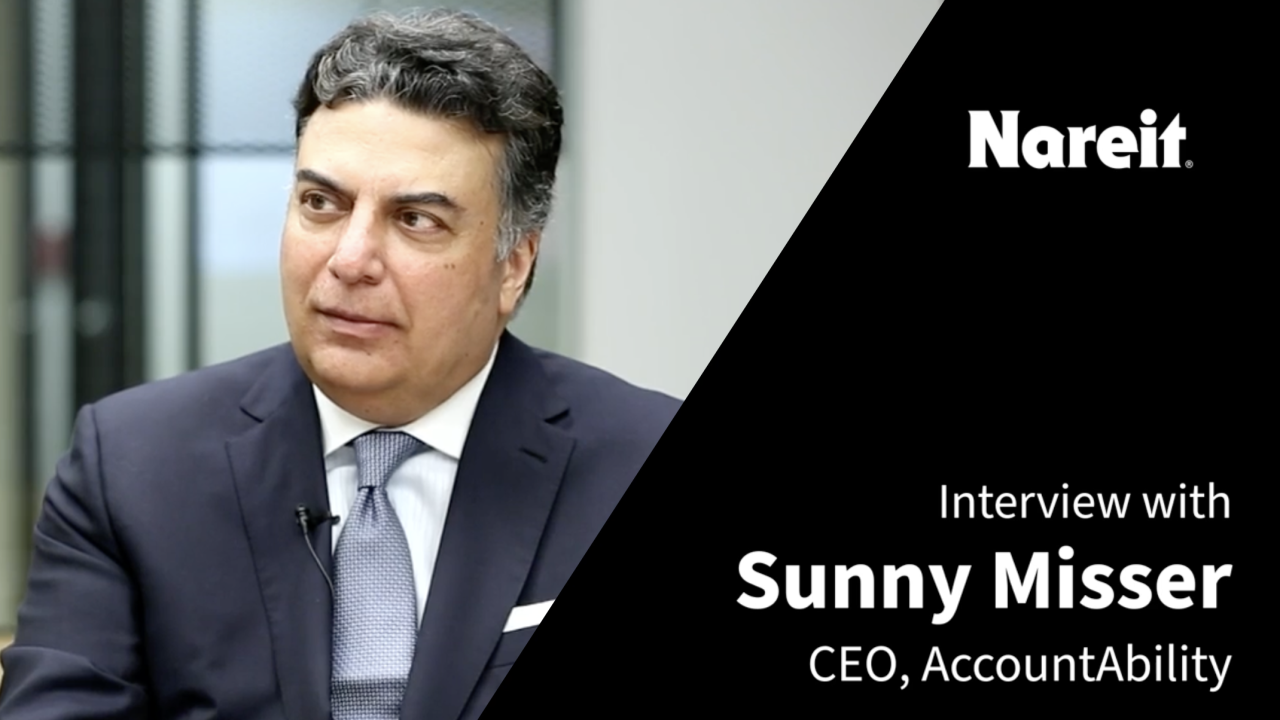


AccountAbility CEO Sees ESG Metrics as Key Predictors of Corporate Financial Health

15 07 2023

From AccountAbility • Reposted: July 15, 2023

AccountAbility, the trusted global ESG Consulting and Standards firm with a three-decade history in guiding leaders to build better companies, is pleased to announce that CEO Sunil (Sunny) A. Misser recently engaged in an exclusive interview with Nareit, the worldwide representative voice for REITs and listed real estate companies with an interest in U.S. Real Estate and Global Capital Markets.

AccountAbility, the trusted global ESG Consulting and Standards firm with a three-decade history in guiding leaders to build better companies, is pleased to announce that CEO Sunil (Sunny) A. Misser recently engaged in an exclusive interview with Nareit, the worldwide representative voice for REITs and listed real estate companies with an interest in U.S. Real Estate and Global Capital Markets.

In the interview, Mr. Misser shared insights on the latest trends in ESG practices, and the evolving landscape of sustainability within the corporate sector. This was framed against the ESG predictions and patterns observed by Mr. Misser over the past decade. Notably, the Consolidation and Standardization of ESG Frameworks and Standards at the highest level, and the significant shift as ESG metrics sit alongside financial metrics in predicting the future health of a company.

Standardization and Consolidation of ESG Standards, Frameworks, Reporting, and Disclosure has occurred. ESG Metrics are now entering the mainstream of business. With this, ESG metrics will not be used to just report and disclose a company’s financial health, but more importantly predict it,” comments AccountAbility CEO Sunil (Sunny) A. Misser.

Mr. Misser spoke in detail on emerging ESG Trends that are shaping the corporate agenda, including the impact of geopolitical disruption across all facets of the global economy: Disruption of Supply Chains, Cost of Capital, Managing Inflation, Access and Cost of Energy, and Clear Direction of Monetary Policy. Business will need to respond to this New “G” (Geopolitics) in ESG while maximizing resilience to macro shocks and prioritizing uninterrupted service delivery.

Corporate Boards have long played a key role in setting an organizations culture, values, and business practices. Now, the structure of Boards is changing. Mr. Misser spoke to this trend and the emergence of Boards that will be purpose built with diversity of thinking (beyond just diversity of pigmentation) sitting alongside gender, socio-economic, professional, and cultural backgrounds as central to effective, future-focused Boards.

These emerging trends, as detailed within the AccountAbility 7 Sustainability Trends 2023 Report, together with the economic factors impacting specific geographies and industries, make clear the need for companies to integrate sustainability into their core business strategies to remain competitive and resilient in today’s rapidly evolving global market.

The AccountAbility 7 Sustainability Trends 2023 – Highlights

  1. The Net Zero Landscape: Against an unprecedented volume of net zero commitments, what are the risks for those that fail to act, and the opportunities for businesses to lead? 
  2. Stakeholder Activism Is Getting Louder: As businesses face increasing pressure to take a stance and demonstrate actionable progress on a range of ESG issues, how best can leaders balance this with the imperative to maximize shareholder value? 
  3. Geopolitics: The New “G” In ESG: In an era of increasingly globalized business operations, how can organizations address the outsized role that the new G (Geopolitics) is playing in the business landscape? 
  4. Building an Effective, Future-Focused Board: As demands and expectations shift, how best to equip future-focused Boards to meet the requirements of the evolving business environment? 
  5. Next Generation ESG Disclosure and Reporting: A shift from voluntary to mandatory ESG Disclosure is set to heighten attention on corporate sustainability disclosure practices. How will these changes impact ESG Reporting? 
  6. The Road to a Sustainable Value Chain: How can the integration of sustainability criteria into supply chains drive organizational shifts towards a more context-aware and competitive value chain? 
  7. Nature Based Assets Will Drive Valuations: As nature-based assets are increasingly recognized for their significant impact on valuations, what steps can companies take to achieve nature-based performance goals?

AccountAbility is committed to fostering knowledge sharing and collaboration and to helping advance the Global ESG agenda. By engaging in discussions with industry leaders such as Nareit, and with their 7 Sustainability Trends 2023 Report, the firm continues to advance the collective understanding of ESG trends, challenges, and opportunities that are shaping the business landscape.

The full Nareit interview with Mr. Misser can be viewed here.

Download the AccountAbility 7 Sustainability Trends 2023 Report.

To see the original post, follow this link: https://www.csrwire.com/press_releases/778726-accountability-ceo-sees-esg-metrics-key-predictors-corporate-financial-health


Social Sustainability is the Next Supply Chain Frontier

23 04 2023

Photo: Sustainable Brands

Eliminating negatives is about to become the minimum viable approach to social performance. Companies and suppliers benefiting people and communities will see stronger corporate brands and accelerated revenue growth. By Jeff Baldassari from sustainablebrnads.com • Reposted: April 23. 2023

Fueled by an upcoming Securities and Exchange Commission rule on human capital management, increased focus on the ‘social’ element of ESG, and rising consumer awareness of supply chain issues, social sustainability in supply chains is poised to become the next frontier for brands.

The S in environmental, social and governance performance has been gaining currency over the past couple of years; and public companies will soon have to start reporting more thoroughly on their social impact. A Bloomberg Law analysis of the SEC’s direction predicts that human capital management will be a front-burner topic this year, and investors will seek more disclosures to ensure that companies are walking their talk. At the same time, pandemic-driven disruptions have sparked ongoing media coverage of supply chain issues. Consumers are seeing the sausage-making, and it isn’t always pretty.

This is all to the good. Accountability can sting; but for companies that view it as an opportunity, the new focus on social sustainability in supply chains can lead to stronger corporate brands and accelerated revenue growth for suppliers pursuing positive social impact.

Focus on social impact brings risks and opportunities

What is a socially sustainable supply chain? Certainly, it’s free of negative practices such as child labor, forced labor, unsafe working conditions, below-living wages, and racial and gender discrimination. The case for excluding suppliers that layer these social costs into a corporation’s products and services is clear from both an ethical and a business standpoint: Investors, customers and employees are buying into a brand’s reputation — and “risking that over a supplier with poor ESG credentials could cost you all three,” Moody’s observes.

Eliminating negatives is fast becoming table stakes, though. The emerging standard is net-positive impact — actively contributing to solving social problems.

“The very nature of social impact isn’t just about risk; it’s also about prosocial behavior. In other words, a company’s actions, policies and investments can and should positively impact people’s lives,” writes Jason Saul, executive director of the Center for Impact Sciences at the University of Chicago. And, he notes, these social impacts can also positively affect a company’s financial performance “through competitive advantage, business growth, market relevance, brand purpose and securing license to operate.”

Stocking the corporate supply chain with companies that are broadening workforce opportunities, contributing to stronger local economies and providing other social benefits brings real supply chain reliability and ESG benefits. Suppliers that hire from a broader talent pool and create a positive work environment that reduces churn are better able to deliver consistently. Those that also build community wealth and diversify their supply chain contribute to equity and inclusion goals.

For supplier companies, delivering these positive social impacts is a differentiator — especially where other value dimensions such as effectiveness, design and price are comparable — and it will remain so until their competitors catch up.

3 big impact areas cut across supplier types

Building a socially sustainable supply chain requires reviewing and upgrading the full spectrum of suppliers — not only suppliers of raw materials, value-added inputs and finished goods, but also professional services and technology providers. That is a big universe; but when looking at it from a positive social impact perspective, most suppliers can add value in three broad areas.

Workforce development: Companies that actively recruit, train and retain people who have been excluded from opportunities or face barriers to employment can improve the lives of whole families and communities while developing untapped talent pools that provide a hedge against tight labor markets. For example, the growing second-chance (or fair-chance) movement delivers high social returns by focusing on hiring formerly incarcerated people. Nearly 70 million Americans have a criminal record; and even after they’ve paid their debt to society, many remain marginalized. Incarceration brands those it touches, trapping them in a cycle of unemployment and poverty — which can lead to recidivism. Second-chance hiring can transform their lives. It also has multiple business benefits. At U.S. Rubber, for example, we fueled substantial growth through pandemic labor shortages by making a significant investment in second-chance hiring: Ex-felons now constitute about 60 percent of our workforce.

Community investment: Fair-trade programs that bring new resources to local supplier communitiescorporate treasury investments in community finance institutions, and other direct material contributions to customer or supplier communities can have a powerful multiplier effect. Community development financial institutions, for example, responsibly serve people and places that often don’t have access to mainstream finance — providing business loans to women, people of color and low-income entrepreneurs; funding affordable housing; and supporting climate-change resilience projects. Minority-owned banks play a similar role as community capital providers. Small and medium-sized suppliers, which have traditionally been community anchors, can expand their impact by stocking their own supply chains with small businesses that play key roles in local economies.

Diverse leadership: Diversifying the supplier pool to include more companies owned and led by women and people of color — especially in fields where they continue to face barriers to entry — contributes to corporate diversity, equity and inclusion goals and expands both opportunities for the suppliers and resources for the buyers. This is also an area where corporate commitments are under a microscope and investors, customers and employees are looking for measurable progress.

The opportunity in supply chain sustainability is huge. Eliminating negatives is about to become the minimum viable approach to social performance. Public and large private companies and their supply chain partners that go beyond that to create positive impacts will reap the benefits: stronger brands, greater customer loyalty, investor favor and the ability to attract increasingly choosy workers. And in doing so, they’ll help advance prosperity for everyone.


JEFF BALDASSARI: Jeff Baldassari is CEO of US Rubber Recycling — a triple-bottom-line business that manufactures high quality fitness flooring and acoustical underlayment by giving discarded tires a second life and providing employment to a second-chance workforce.

To see the original post, follow this link: https://sustainablebrands.com/read/organizational-change/social-sustainability-next-supply-chain-frontier