
We Asked Americans What They Think About the Term “ESG.” Their Answers Were Eye-Opening

13 09 2023

Image credit: blacksalmon/Adobe Stock

By Carol Cone from Triple Pundit • Reposted: September 13, 2023

The term ESG is fine, according to a recent poll of 1,000 Americans. Despite continued polarization related to the acronym, which stands for environmental, social and governance, the majority of Americans believe it’s the best way to describe a company’s approach to improve business, society and the environment. Before we get to the data, though, it’s important to understand why we asked this question in the first place.

How did we get here?

Over the past year, a rising chorus of conservative U.S. voices have claimed that ESG is “woke capitalism,” or corporate virtue signaling about social and environmental concerns which they see as beyond the bounds of business.

The issue drew President Joe Biden’s first presidential veto in March of this year, defending legislation related to ESG investing and bringing the issue into the national spotlight. ESG is facing such a significant backlash that BlackRock CEO Larry Fink, long one of the financial industry’s staunchest proponents for purpose and ESG, doesn’t even want to use the term — though BlackRock’s policies around society, the environment, and business governance remain unchanged.

It’s also important to establish that whatever you call them, sound ESG practices are not new, and are indeed vital to operating a responsible, ethical, and profitable business. As Fortune sustainability reporter Eamon Barrett observed, “major corporations documenting their environmental, social, and governance policies for investor scrutiny is actually a decades-old process.” At its core, ESG is a means to broaden the lens on what constitutes key drivers of business value, accompanied by efforts to measure and report on what matters for individual company operations via standardized reporting frameworks. 

Americans say ESG is a-okay

We partnered with Purpose Collaborative member Reputation Leaders, a global research and thought leadership consultancy, to ask Americans what term they feel best describes “the approach companies take to improve business, society and the environment.”
ESG and sustainability are tied for the top, at 23 percent each. Corporate social responsibility is second, at 21 percent, followed by purpose (11 percent), corporate citizenship (8 percent), stakeholder capitalism (7 percent) and stewardship (5 percent).
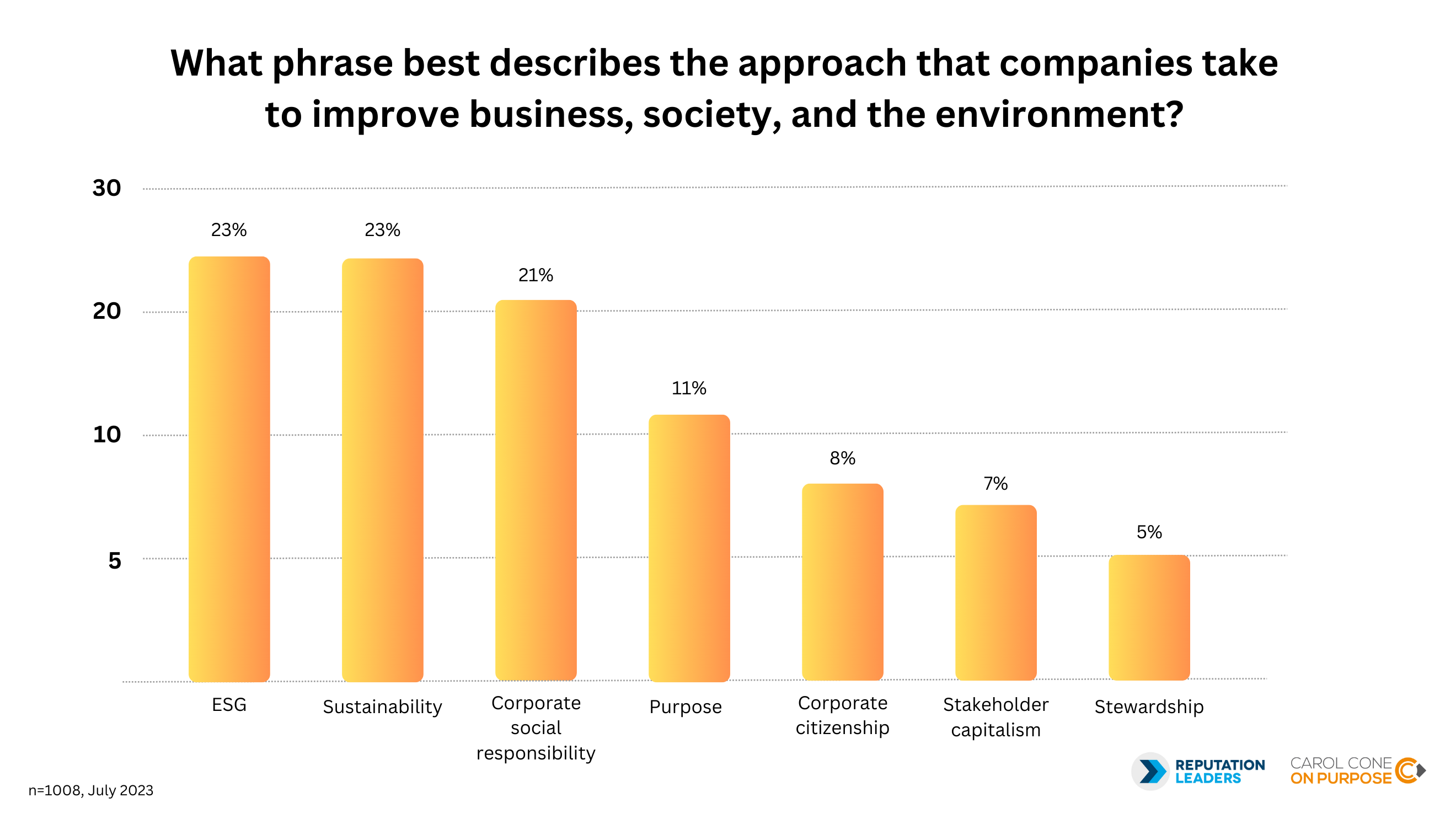
ESG research statistics — public opinion

Across demographic groups, ESG and sustainability are the favored terms among men, while women prefer “corporate social responsibility,” a phrase that connotes a sense of obligation. ESG is also the top choice for younger audiences, particularly those aged 25 to 34, while consumers aged 55 to 64, prefer the term “sustainability.” There are regional differences, as well. People living in the Northeast prefer sustainability, while their Southern and Midwestern counterparts prefer ESG.

Reputation Leaders also analyzed the tone of media coverage related to Americans’ top three terms: ESG, CSR and sustainability. CSR garnered the largest share of positive sentiment at 37 percent, with sustainability in second place at 32 percent and ESG trailing at 20 percent. ESG was the only term to have a significant amount (10 percent) of negative sentiment.

What now?

This study can help support companies in exploring the terms they will use to discuss the impact their business has on society. It is important to develop a clear, shared perspective and take a long-term view.

From the United Nations to the World Economic Forum, global leaders are advocating for businesses to embed a net-positive approach into their operating models to accelerate innovation and impact. Increasingly, employees, customers, supply chain partners, and others are asking about the ESG commitments of the companies they work for or with. Business leaders need to have answers and a strong point of view on which issues are most important to their business, and why. Our best advice? Don’t worry about what you call it — stick to your organization’s long-term, strategic commitments to stakeholders, society and the environment.

When it comes to communications, here are three ways to help depolarize the conversation:

  • Be clear about the goals of ESG. ESG is not about imposing a set of values on business. It provides a framework for companies to assess and optimize their value and impact. 
  • Increase transparency around ESG data and metrics. This will help to ensure that investors and other stakeholders are making informed decisions.
  • Embrace standardized reporting frameworks. This will make it easier to comparecompanies’ ESG performance — think: the Task Force on Climate-Related Financial Disclosures (TCFD), the Global Reporting Initiative (GRI) or the Sustainability Accounting Standards Board (SASB).

Yes, the polarization will continue, especially as the 2024 presidential election nears. As the world continues to endure climate impacts from extreme heat and flooding to record-breaking wildfires, there also will be greater demand for businesses to address environmental challenges.

Scores of studies suggest that ESG — done right — drives sustainable competitive advantage and can accelerate organizational growth over the long-term. An impressive 80 percent of investors believe that companies with strong ESG practices can generate higher returns and make for better long-term investments, according to research from Morgan Stanley.
 
By continuing to show a link between ESG issues and the business, we can help to make the debate around ESG more constructive and less polarizing. This will ultimately benefit businesses, investors and society as a whole.

To see the original post, follow this link: https://www.triplepundit.com/story/2023/americans-think-esg/783186



What to Expect From the SEC’s Climate Disclosure Rule

26 07 2023

Image credit: Ale Alvarez/Unsplash

By Mary Riddle from Triple Pundit • Reposted: July 26, 2023

The U.S. Securities and Exchange Commission (SEC) is expected to release its long-awaited climate disclosure rule this fall, and businesses are preparing for change. The intent is to create a framework for companies to make climate-related disclosures in a way that is standardized and allows for comparison

“I think it is helpful to frame the SEC proposal not as a climate proposal, but rather as a proposal to enhance and standardize climate-related financial disclosures,” said Emily Pierce, chief global policy officer at the carbon accounting firm Persefoni and a former SEC lawyer involved in developing the proposed rule. 

What’s different about the SEC climate disclosure rule?

The SEC’s forthcoming climate disclosure rule has been over a decade in the making. In 2010, SEC staff issued guidance stating that climate change could impact business operations as it carries material risks that affect financial performance, Pierce said. And anything that could impact financial performance should be communicated to investors.

Five years later, the investor demand for information was growing steadily. “By 2015, there was a collective concern about investor demand for sustainability information,” she said. “Investors were not getting the information they were asking for, and the marketplace was inefficient.” 

The Task Force on Climate-Related Financial Disclosures (TCFD) rose up to meet that demand shortly after the Paris climate agreement was adopted in 2015. “TCFD developed helpful disclosure frameworks for governance, strategy and risk management processes,” as well as metrics and targets to measure a company’s greenhouse gas footprint, Pierce said.

“TCFD is a market norm, but it wasn’t always complete and comprehensive, and it didn’t allow for comparison,” she explained. “The SEC was inspired by the TCFD framework that investors and companies have found useful.”

What do we know about the new rule?  

The SEC’s proposed rule covers how companies communicate their climate-related risks. Companies will be required to disclose material risks, including physical risks and transition risks, related to climate change. These may include sea-level rise, more frequent extreme weather events and wildfires, or changes in government regulation and consumer demand. 

Importantly, the rule will not initially apply to all companies, but will be phased in over time. “Phasing is an important part of the proposal, because it’s our way of managing implementation,” Pierce said. “We have to strike the balance between investor protection and creating a rule that is feasible for companies to implement. I think the most likely scenario is that, if it is finalized this year, companies will need to gather data next year for fiscal year 2025.”

The rule will also hold companies’ feet to the fire for claims made about net-zero and emissions reductions. If a company has a public target related to cutting emissions, the SEC will require additional disclosures and obligations related to that target. 

“A lot of companies calculate their greenhouse gas emissions today,” Pierce said. “But they do it in a way that does not have as much control over their data, calculations, and outputs compared to what they would have in their financial calculation reporting. When you’re making information investor-grade and compliance-ready, you should bring lessons you have learned from the financial space into the carbon accounting space.” 

Emissions created by a company’s direct operations — Scope 1 emissions — and emissions associated with the company’s purchase of energy — Scope 2 emissions — will need to be externally assured, Pierce said. But smaller companies will not need to disclose value chain emissions from assets the company does not own — Scope 3 emissions — unless they set an emissions target for Scope 3, she predicted. 

What’s next?

The climate disclosure rule should not contain any surprises compared to the SEC’s current proposal, Pierce said. But the timing of release will be later than anticipated, due to the unprecedented number of public comments and feedback. Many analysts agree it will be released this fall.

“To be ready for climate disclosure, companies need to bring discipline and processes to their broader corporate thinking about governance, strategy and risk management,” Pierce said. “Additional discipline and processes will help them communicate about what they’re doing.” 

A lot of companies are already thinking about these issues, calculating their emissions and gathering the necessary information, Pierce said. “There are market rewards to decarbonizing, and they see the value in that. We will see an increase in the market rewarding sustainable behavior, whether it is in access to capital, customer preference, more business-to-business relationships or consumer demand.”

To see the original post, follow this link: https://www.triplepundit.com/story/2023/sec-climate-disclosure-rule-explained/779646


Gearing Up for ESG Reporting: Insights from Public Company Executives

27 03 2023

Image credit: Andrea Piacquadio/Pexels

By Kristen Sullivan from triple pundit.com • Reposted: March 27, 2023

Committing to meet environmental, social, and governance (ESG) objectives and targets is one thing. Acting on them is quite another. What are businesses doing to prepare for high-quality sustainability and ESG reporting, and what challenges are they uncovering along the way? To find out, Deloitte surveyed 300 public company executives to get a pulse on current trends and sentiment. Here are five takeaways from the front lines of real-world change.

Embed ESG in the corporate strategy

Nearly 3 in 5 executives (57 percent) say their company has established a cross-functional working group to drive strategic attention to ESG, an increase of 21 percent since last year. Another 42 percent say they’re in the process of establishing one. 

A typical ESG working group includes executives from finance, accounting, risk, legal, sustainability, operations, supply chain and other functional areas. Increasingly, accountability for ESG performance can be most effective with an integrated governance structure that brings together all business functions. A philosophy of ownership across the business, paired with a strategic approach to governance, can establish ESG as a strategic priority highly aligned to corporate strategy. 

Assign roles and responsibilities

Only 3 percent of executives say their companies are prepared for potential increased ESG regulatory or other disclosure requirements, but many are getting ready. For instance, 81 percent of companies have created new roles or responsibilities, and 89 percent say they’ve enhanced internal goal-setting and accountability mechanisms to promote readiness. 

Who has management responsibility over ESG disclosure? Today, in many cases, it’s the chief financial officer (CFO) or chief sustainability officer (CSO), but many respondents indicate that increasingly there is shared responsibility for ESG reporting across the executive leadership team, human resources, supply chain and other functions. 

Of those executives surveyed, board-level oversight has been predominantly assigned to the nominating and governance committee, but we are seeing a trend of expanded oversight responsibility across all committees, aligned to respective remit, to drive greater integration and oversight of ESG risks and opportunities. 

Increase focus on assurance 

Nearly all (96 percent) surveyed executives plan to seek assurance for the next ESG reporting cycle. To prepare for a reasonable level of assurance, 37 percent of companies are starting to apply the Committee of Sponsoring Organizations of the Treadway Commission (COSO)’s internal control guidelines, which can help companies measure, manage and validate ESG information with the same rigor typically applied to financial reporting.  

Respondents shared that they use a range of different frameworks and standards for their disclosures. The most common is the Task Force for Climate-related Financial Disclosures (TCFD) (56 percent), closely followed by the Sustainability Accounting Standards Board (SASB) (55 percent). Around half of respondents also use standards from the Greenhouse Gas Protocol, International Integrated Reporting Council (IIRC), and Global Reporting Initiative (GRI).

For multinational firms, the rapid progress of the International Sustainability Standards Board (ISSB) signals optimism for convergence of a number of leading sustainability reporting standards and frameworks and the creation of a global baseline for sustainability reporting to help meet the information needs of the capital markets, as well as serve as the basis upon which other jurisdictions can build. 

Develop a workable solution for data gaps

When it comes to sustainability reporting, access to quality ESG data now appears to be a bigger challenge than data availability. Still, a majority (61 percent) of respondents indicate their companies are prepared to disclose details about the greenhouse gas (GHG) emissions they directly produce, known as Scope 1. Even more (76 percent) say they’re ready to disclose details of their Scope 2 GHG emissions, or emissions generated by the electricity a company purchases, a substantial increase from the 47 percent who said so the previous year. 

At the same time, Scope 3 emissions — which account for GHGs produced along a company’s entire value chain — appear to remain a challenge. Most respondents (86 percent) indicate they’ve run into challenges measuring them, and only 37 percent are prepared to disclose them in detail. 

To close any gaps, companies may consider focusing on the Greenhouse Gas Protocol, which currently serves as the leading standard for measuring greenhouse gas emissions and provides for methodologies to promote consistency of measurement with due consideration to the level of measurement uncertainty and data availability. 

Invest in technology for ESG reporting, disclosure and action

New technology is on the horizon for many companies as they embark on their ESG integration and disclosure journeys. Nearly all executives (99 percent) are somewhat likely or very likely to invest in new technology to prepare to meet stakeholder expectations and future regulatory requirements. 

Technology solutions can assist in accelerating preparedness in moving from reporting in accordance with voluntary sustainability standards and frameworks to enhanced disclosure in accordance with authoritative ESG standards and new regulation. 

No matter where a company is in their sustainability journey, strategic attention to ESG integration and disclosure today can help to deliver long term value to  stakeholders into the future. By implementing the insights shared by public company executives, companies can gear up for ESG reporting and work to meet stakeholder expectations while also creating long-term value. 

Kristen B. Sullivan is a partner with Deloitte & Touche LLP and leads Sustainability and ESG Services, working with clients to help address their sustainability and non-financial disclosure strategy needs. 

To see the original post, follow this link: https://www.triplepundit.com/story/2023/ceo-insights-esg-reporting/769591