This, Not That: More Consumers Are Switching Brands Based on Sustainability

18 03 2023

Image credit: Gustavo Fring/Pexels

By MARY RIDDLE FROM TRIPLEPUNDIT.COM • Reposted: March 18, 2023

We know shoppers are increasingly interested in more sustainable products, and new research indicates many are ready to leave their standby brands behind. Half of all U.S. consumers, including 70 percent of millennials, have changed food and grocery brands based on environmental, social and governance (ESG) considerations, according to new polling. 

For its latest sustainability benchmark report, the research technology company Glow surveyed 33,000 U.S. adults to get their take on the ESG performance of more than 150 food and grocery brands. Across the board, consumers report changing their spending habits to better align with their personal values — and forward-looking brands are reaping the benefits. Almost 90 percent of respondents believe it’s important for businesses to be environmentally and socially responsible, and two-thirds said they’re willing to pay more for products that support vulnerable groups and communities.

“It is vitally important for companies to contribute to supporting society and the planet. And there is a growing body of evidence that doing so is more than the right thing to do, it is good for business,” said Julia Collins, CEO of Planet FWD, a carbon management platform for consumer brands, in a statement. “This report provides further evidence … that those who are leading in consumers’ minds are already reaping the commercial benefits and are best placed for future success.” Indeed, 8 in 10 respondents said they feel more loyalty to purpose-driven brands.

ESG performance is correlated with revenue growth

Glow also found a positive correlation between ESG performance and revenue growth. Even in a troubled economy with a cost-of-living crisis, environmentally- and socially-responsible companies are seeing the economic benefits of standing for their values: 20 percent of consumers rank sustainability in their top three considerations when shopping at the grocery store, and 10 percent of millennials said sustainability is the single most important factor when making a purchase.

Additionally, while 70 percent of consumers are actively switching food and grocery brands to save money, many consider sustainability a key reason not to do so, particularly among younger shoppers. 

“Now more than ever, if brands want to retain and win consumers, they must stand for something,” Mike Johnston, managing director of data products at Glow, said in a statement. “All consumers are looking for ways to save money. They will need a compelling reason why they shouldn’t walk away from your brand for a cheaper alternative. Along with quality, sustainability is a key barrier to change, especially for millennials.” 

It’s worth noting that what consumers view as “sustainable” will vary based on the product. Consumers report that plastic and waste issues are of greater importance in the household goods department, for example, while health and wellbeing is a top concern for consumers when choosing beverages and beauty products. 

Still, across all categories, products with ESG-related claims on their packaging grew an average 1.7 percent faster than those without. Labels and messaging associated with regenerative agriculture, plastic-free products, cruelty-free operations, water footprint, and renewable energy caught consumers’ attention the most.

Consumer expectations are high

U.S. consumers widely perceived the food and grocery industry as a leader in corporate sustainability, Glow’s data revealed, but the industry still faces significant barriers to meeting consumer expectations in a few key areas. For example, almost a third of responding consumers are dissatisfied with the industry’s efforts to reduce emissions, mitigate climate change, protect wildlife and ensure the welfare of suppliers.

While being misaligned with consumer expectations is never ideal for a company or sector, this gap presents an opportunity for brands to re-engage with this growing segment of consumers and stakeholders. By aligning ESG priorities with consumer expectations, companies can take advantage of a growth opportunity, while reducing risk and improving impacts on the environment.

“There’s a role of education here that’s critical for businesses,” Tim Clover, founder and CEO of Glow, told TriplePundit. “Consumers really want to understand the issues in more detail, to understand some of the science and the lengths to which companies are going to solve these problems. Companies that are brave enough to go and take the time to explain the depth of these issues and educate the market, they’re leading. They’re winning.”

To see the original post, follow this link: https://www.triplepundit.com/story/2023/consumers-switching-brands-esg/768956





New PFAS guidelines – a water quality scientist explains technology and investment needed to get forever chemicals out of US drinking water

17 03 2023

Graphic: SCDHEC.GOV

By Joe Charbonnet, Assistant Professor of Environmental Engineering, Iowa State Universityvia The Conversation • Reposted: March 17, 2023

Harmful chemicals known as PFAS can be found in everything from children’s clothes to soil to drinking water, and regulating these chemicals has been a goal of public and environmental health researchers for years. On March 14, 2023, the U.S. Environmental Protection Agency proposed what would be the first set of federal guidelines regulating levels of PFAS in drinking water. The guidelines will be open to public comment for 60 days before being finalized.

Joe Charbonnet is an environmental engineer at Iowa State University who develops techniques to remove contaminants like PFAS from water. He explains what the proposed guidelines would require, how water utilities could meet these requirements and how much it might cost to get these so-called forever chemicals out of U.S. drinking water.

1. What do the new guidelines say?

PFAS are associated with a variety of health issues and have been a focus of environmental and public health researchers. There are thousands of members of this class of chemicals, and this proposed regulation would set the allowable limits in drinking water for six of them.

Two of the six chemicals – PFOA and PFOS – are no longer produced in large quantities, but they remain common in the environment because they were so widely used and break down extremely slowly. The new guidelines would allow for no more than four parts per trillion of PFOA or PFOS in drinking water.

Four other PFAS – GenX, PFBS, PFNA and PFHxS – would be regulated as well, although with higher limits. These chemicals are common replacements for PFOA and PFOS and are their close chemical cousins. Because of their similarity, they cause harm to human and environmental health in much the same way as legacy PFAS.

A few states have already established their own limits on levels of PFAS in drinking water, but these new guidelines, if enacted, would be the first legally enforceable federal limits and would affect the entire U.S. 

A water droplet sitting on a piece of fabric.
Chemicals used to create water-repellent fabrics and nonstick pans often contain PFAS and leak those chemicals into the environment. Brocken Inaglory/Wikimedia CommonsCC BY-SA

2. How many utilities will need to make changes?

PFAS are harmful even at extremely low levels, and the proposed limits reflect that fact. The allowable concentrations would be comparable to a few grains of salt in an Olympic-size swimming pool. Hundreds of utilities all across the U.S. have levels of PFAS above the proposed limits in their water supplies and would need to make changes to meet these standards. 

While many areas have been tested for PFAS in the past, many systems have not, so health officials don’t know precisely how many water systems would be affected. A recent study used existing data to estimate that about 40% of municipal drinking water supplies may exceed the proposed concentration limits.

3. What can utilities do to meet the guidelines?

There are two major technologies that most utilities consider for removing PFAS from drinking water: activated carbon or ion exchange systems

A membrane treatment system.
Water treatment systems can use activated carbon or ion exchange to remove PFAS from drinking water. Paola Giannoni/E+ via Getty Images

Activated carbon is a charcoal-like substance that PFAS stick to quite well and can be used to remove PFAS from water. In 2006, the town of Oakdale, Minnesota, added an activated carbon treatment step to its water system. Not only did this additional water treatment bring PFAS levels down substantially, there were significant improvements in birth weight and the number of full-term pregnancies in that community after the change. 

Ion exchange systems work by flowing water over charged particles that can remove PFAS. Ion exchange systems are typically even better at lowering PFAS concentrations than activated carbon systems, but they are also more expensive.

Another option available to some cities is simply finding alternative water sources that are less contaminated. While this is a wonderful, low-cost means of lowering contamination, it points to a major disparity in environmental justice; more rural and less well-resourced utilities are unlikely to have this option.

4. Is such a major transition feasible?

By law, the EPA must consider not just human health but also the feasibility of treatment and the potential financial cost when setting maximum contaminant levels in drinking water. While the proposed limits are certainly attainable for many water utilities, the costs will be high.

The federal government has made available billions of dollars in funding for treating water. But some estimates put the total cost of meeting the proposed regulations for the entire country at around US$400 billion – much more than the available funding. Some municipalities may seek financial help for treatment from nearby polluters, while others may raise water rates to cover the costs.

5. What happens next?

The EPA has set a 60-day period for public comment on the proposed regulations, after which it can finalize the guidelines. But many experts expect the EPA to face a number of legal challenges. Time will tell what the final version of the regulations may look like. 

This regulation is intended to keep the U.S. in the enviable position of having some of the highest-quality drinking water in the world. As researchers and health officials learn more about new chemical threats, it is important to ensure that every resident has access to clean and affordable tap water.

While these six PFAS certainly pose threats to health that merit regulation, there are thousands of PFAS that likely have very similar impacts on human health. Rather than playing chemical whack-a-mole by regulating one PFAS at a time, there is a growing consensus among researchers and public health officials that PFAS should be regulated as a class of chemicals.

To see the original post, follow this link: https://theconversation.com/new-pfas-guidelines-a-water-quality-scientist-explains-technology-and-investment-needed-to-get-forever-chemicals-out-of-us-drinking-water-201855


Forbes: Purpose is the next digital

16 03 2023

The Stakeholder Model of Purpose. Graphic: CONSPIRACY OF LOVE

The Stakeholder Model Of Purpose: How Cause Marketing, CSR, Sustainability, DEI And ESG Can Operate Harmoniously In This New Age Of Purpose. By Afdhel Aziz, Contributor, Co-Founder, Conspiracy Of Love, And Good Is The New Cool via Forbes. Reposted: March 16, 2023

One of the biggest questions in the global movement of business as a force for good is how the different disciplines of CSR, ESG, sustainability, cause marketing, and diversity and inclusion all fit with the idea of Purpose.

I propose this simple model to show how they can all work in harmony.

Purpose is the Next Digital

A good analogy to start with comes from the quote ‘Purpose is the next Digital’ by Max Lenderman. In the same way that businesses had to transform themselves in every aspect (from the supply chains to their marketing) with the arrival of digital technology, the same evolution is happening with the advent of Purpose.

We see the emergence of the term ‘Purpose’ – the overarching umbrella term now increasingly being used to describe the idea of business as a force for good – in much the same way as we see the term ‘Digital.’ Just as ‘Digital’ now covers a myriad of different channels and technologies (from CRM, to supply chain management, to social media), so too does Purpose now encompass a wide range of different disciplines that preceded it (like CSR, ESG, DEI, etc).

Moving from Shareholder to Stakeholder Capitalism

The evolution of business we are seeing has also often been described as a move away from purely Shareholder-driven capitalism (where only the needs of investors were taken into account) towards a more Stakeholder-driven model (where the needs of multiple stakeholders including employees, consumers, investors, communities and the planet are also considered).

As such, mapping different manifestations of Purpose against these stakeholder groups provides a simple way to understand how they can all work in harmony, towards the higher order purpose.

Purpose at the core: The higher order reason for a company’s existence that inspires action to profitably solve the problems of the world. This exists as the core organizing principle of a truly Purpose-driven company, acting as a North Star around which to align all of the following.

Diversity, Equity and Inclusivity (DEI) is an Employee-focused manifestation of Purpose, ensuring that there are systems and processes in place in order to ensure a culture of belonging and opportunity, regardless of gender, ethnicity, sexuality, disability or neurodiversity. Inclusion should be baked into every aspect of the employee experience from recruitment to retention to Governance. If done right, it can not only lead to employee motivation and engagement but also innovation that leads to inclusive growth, through identifying new opportunities that less diverse cultures cannot envision.

Of course, DEI is only one manifestation of Purpose as it pertains to employees: there are so many more avenues (from inspiring personal purpose, to volunteering, giving, innovation and more generally, building it into the talent value proposition (TVP) and activating it at every stage from recruitment to onboarding to retention and career planning.

Cause marketing (or Purpose-driven marketing) is the legacy term for the manifestation of Purpose towards Consumers. This has now blossomed into many forms beyond its original basic models of the past.

This could take the form of initiatives that engage consumers via simply buying the product (eg TOM’s famous 1 for 1 model or Product (Red) which helped raise money for HIV/AIDS prevention.

At retail, this could manifest in a portion of revenue from products going to good causes (for instance, see Chips Ahoy raising money for the Boys and Girls Clubs of America).

Or indeed in digital or physical activations (for instance, Airbnb’s Open Homes initiative which invited hosts to donate their homes to refugees and victims of natural disasters).

Corporate Social Responsibility (or CSR) is the manifestation of Purpose towards the Communities a company serves – whether they be geographically contextual (like helping communities in the cities the company is based in) or issue focused (like The North Face funding non-profits that help make the outdoors more diverse via their Explore Fund grant).

This has always been a form of corporate philanthropy that a company has practiced in a more ‘defensive’ mode to deflect criticism of them not being a good corporate citizen. But in recent years, progressive companies have seen the benefit of treating CSR in a more enlightened way. By representing the voice of community to the company, and building deep relationships with non-profits and other partners, it can become a vital force helping drive authenticity, innovation and growth.

Sustainability is the manifestation of Purpose towards the Planet, pertaining to everything from how a company utilizes resources efficiently (like reducing their carbon footprint, stripping plastic out of their supply chain or managing waste) to how it obtains the resources (eg agricultural or mineral) with an ethical supply chain that is respectful not only to the Earth but the people who help them obtain it (eg farmers)

ESG (Environmental, Social, Governance) is the manifestation of all of the above in a codified way towards Investors and Shareholders, in a transparent and measurable way, in a way that allows for comparison between companies. Despite attempts to politicize and demonize it, when done correctly it can become a useful tool to help articulate Commitments the company is making in service of environmental and social goals (people and planet) in an accountable and tangible way.

The key to success in this new world of Purpose is orchestration. When all these disparate disciplines are re-aligned around a powerful and inspiring Purpose, the effect is so much stronger than if they were focused on a myriad of different objectives and issues. They become parts of an orchestra playing a harmonious single theme rather than instruments operating on a discordant solo basis.

To see the original post, follow this link: https://www.forbes.com/sites/afdhelaziz/2023/03/14/the-stakeholder-model-of-purpose-how-cause-marketing-csr-sustainability-dei-and-esg-can-operate-harmoniously-in-this-new-age-of-purpose/?sh=27616a3af777


5 key facets of a strong sustainability strategy

15 03 2023

Image via Shutterstock/NeoLeo

Sustainability strategy can be complicated. Here are five key elements to creating a successful one. By Mike Hower from GreenBiz.com • March 14, 2023

Strategy is a term thrown around without much thought or rigor. And this sometimes seems doubly true in the world of corporate sustainability. As more companies embark on their sustainability journey, everybody seems to be talking about the importance of creating a sustainability and ESG strategy — yet what this means exactly remains nebulous. 

At its core, strategy is about choices. In a world of limited time and resources, it’s about deciding what to do and what not to do because you have a clear vision of what you want to achieve. 

To create some clarity on this important topic, I gathered several sustainability and ESG leaders from across industries for a panel at GreenBiz 23 called “The Non-Negotiables: 5 Key Facets of a Strong ESG and Sustainability Strategy.” The session included Gail Grimmett, senior vice president of sustainability and corporate iInnovation at Delta Air Lines; Annabelle Stamm, director of sustainability strategy at Edison Energy; Blake McGowan, solutions executive at VelocityEHS; and Nancy Mahon, senior vice president of global corporate citizenship and sustainability at The Esteé Lauder Companies.

The breakout room was packed (standing room only, like many of the GreenBiz 23 sessions), with hundreds of attendees curious to learn more from and help contribute to our conversation. After much debate and discussion, the panelists and I — with heavy input from the audience — discussed five key facets of a strong sustainability strategy. Here they are: 

1. Be agile, and integrate sustainability into your corporate strategy 

The best sustainability strategy is a business strategy that advances sustainability. That’s to say, in a perfect world, a company’s business strategy is focused on creating long-term social, environmental and financial value — making a separate sustainability strategy redundant. 

“We always say that we’re trying to work ourselves out of a job,” Mahon said. “But I don’t think we’ll ultimately be able to do that.” 

At The Esteé Lauder Companies, the organization integrates sustainability into its business strategy by assigning senior executives to committees covering the environmental, social and governance pillars. The head of supply chain is involved with environment, human resources with social and the CFO with governance. While the committees are led by people at the highest levels, they are made up of practitioners.

We’re all in this together, and in a role that requires some sort of disruptive thinking.

Delta also used a committee system to better align its sustainability strategy with business strategy, Grimmett said. “We’re all in this together, and in a role that requires some sort of disruptive thinking.”

While a company might have a solid sustainability strategy, the world is changing so fast that flexibility must be baked in. All of the panelists agreed that agility and adaptation is critical to sustainability strategy success. 

2. Set targets, and know how you’ll measure progress

The next non-negotiable practice is establishing clear targets and a plan for getting there. While setting targets is easy, establishing the right ones isn’t always so simple. 

Setting fuel efficiency targets, for example, can be tricky, according to Grimmett, because the airline can’t always directly control every factor impacting fuel efficiency. That’s why Delta has several different councils that encourage integration of all the players responsible for improving fuel efficiency. This could include everyone from airport operations control, which might cause an airplane to burn more fuel when requesting it fly a holding pattern, to technical operations teams that might make technical adjustments to planes to improve efficiency, 

“In some ways, we have control over nothing and influence over everything,” said Grimmett. 

While many companies set 2030 or 2050 targets, they must also remain focused on the immediate needs of running a business. Setting shorter-term milestones can help companies stay on track and also encourage disruptive technology, Grimmett said. Often, the technology doesn’t yet exist for companies to meet their ambitious sustainability targets, and creating milestones can help unlock entrepreneurial innovation to meet the moment, Grimmett said. 

3. Data quality over quantity

We live in an era where sustainability data is plentiful, but its quality is questionable. Rather than focusing on collecting as much information as possible, sustainability teams should focus on finding the right data, the panelists said. 

“Good data is fundamental to a successful sustainability strategy,” Stamm said. “Data that drives decarbonization is key.”

We don’t have decades to collect and analyze data, the panelists agreed. We need metrics that can be acted on immediately, so we can implement measures that drive decarbonization and advance sustainability goals. 

4. Bring your stakeholders along for the ride

Sustainability teams tend to be small with limited immediate spheres of influence — to be successful, they must rely on stakeholders throughout the organization. One of the best ways to do this is by engaging these folks during strategy creation. 

With the language of sustainability being wonky, sustainability leads need to translate things into a language that people understand and link it to a strong value proposition, Stamm said. It’s also important to take cultural differences into account. When it comes to sustainability action, the United States is very carrot-driven while Europe tends to be more about the stick, she added. 

The key is to identify those key people who are going to be the influencers … and who is going to be your biggest champion.

“The key is to identify those key people who are going to be the influencers … and who is going to be your biggest champion,” McGowan said. These internal champions will help ensure that your sustainability strategy is effectively implemented, he said. 

Another key point is that often when an internal stakeholder says “no” to something, it really means they need more information, McGowan added. 

5. Ensure philosophical consistency throughout the organization

Toward the end of the panel, a member of the audience suggested a fifth non-negotiable: achieving a philosophical consensus throughout your organization: To be successful, the same sustainability ethos must be maintained across departments and teams.

If, for example, a company has a strong corporate sustainability strategy yet has a government relations strategy that doesn’t match, this weakens the organization’s overall effectiveness for achieving its sustainability ambitions. 

At these words, the audience erupted into applause and the panelists nodded in agreement. Show comments for this story. 

To see the original post, follow this link: https://www.greenbiz.com/article/5-key-facets-strong-sustainability-strategy


New “Climate Forward?” Report Advocates for the Use of Climate Projection Data by Architecture and Engineering Professionals

13 03 2023

From The University of Minnesota Climate Adaptation Partnership and national design firm HGA • Reposted: March 13, 2023

The University of Minnesota Climate Adaptation Partnership and national design firm HGA present the current practice, barriers, and opportunities for use of climate projection data and climate change resilience client services. 

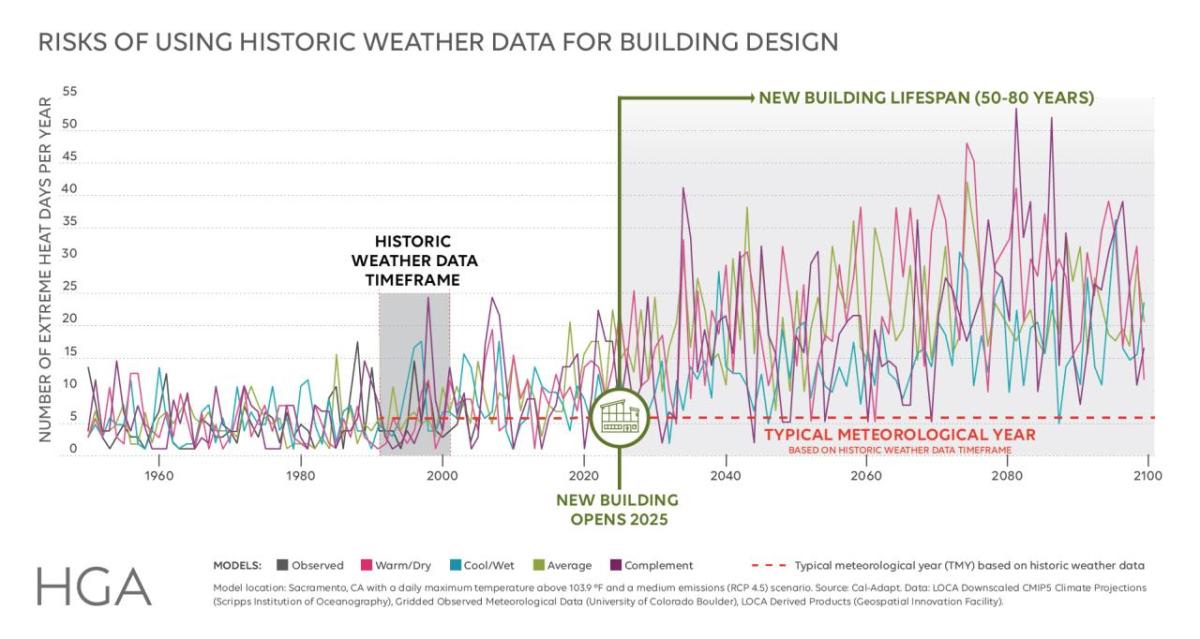
Climate change impacts are growing every year, threatening lives, business continuity, and infrastructure—costing an average of $152.9 billion dollars per year in the U.S. alone (NOAA, 2022). Yet the Architecture and Engineering (A&E) industry still relies on historical weather data as a primary resource for performance analysis, system sizing, and other design decisions, as climate projection data are not available in the formats used by A&E codes, process guidelines, and software.  

The new report “Climate Forward? How Climate Projections Are(n’t) Used to Inform Design” from the University of Minnesota Climate Adaptation Partnership (MCAP) and national interdisciplinary design firm HGA, reveals the alarming gap between the current state of A&E practice and climate science.

Currently, energy modelers most often use the Typical Meteorological Year (TMY3) dataset produced by the National Renewable Energy Laboratory (NREL)— based on past median weather conditions for a given location that is sometimes more than three decades old. Our changing climate makes ‘climate normals’ less useful for designers, poorly reflecting the range, frequency, and intensity of potential future weather conditions that a building will need to withstand during its lifespan. Key systems and infrastructure globally will continue to be vulnerable unless design standards change to account for changing climate.  

Risks of Using Historic Weather Data

“We know climate change is here and the past is no longer the best predictor of the future. As we seek to make our buildings more energy efficient and ‘climate-friendly’, we must also use climate projection data to ensure our built environment is resilient to the climate of the future.” say Dr. Heidi Roop, MCAP’s Director and a report author. “This report highlights that there is work to do by the climate science community and A&E professionals to ensure we are designing for climate resilience. Clients and professional societies also play a key role in driving a holistic, forward-looking approach to design of the buildings and infrastructure we all rely on.”

The research makes a decisive case for the development and promotion of industry standards, mandates (including building codes), guidance and training for using climate projections in A&E applications. It also articulates the critical role for boundary organizations and climate data developers to build partnerships and capacities to bridge this gap alongside A&E professionals.

“Climate Forward?” also addresses the missed opportunity to extend the life of our buildings. Today’s sustainable design efforts focus primarily on climate change mitigation—that of reducing carbon emissions. In contrast, MCAP and HGA’s research shows how the industry should also shift to design for climate change adaptation—which are a broader set of design measures that factor in the projected climate over the lifespan of the building and systems. 

Lead author of the report, Ariane Laxo, HGA’s Director of Sustainability said, “There is tremendous potential in climate resilience services—professional services related to climate change resilience and/or adaptation using climate projection data.” She continued, “identifying the right data formats and timescales to factor in the projected climate over the lifespan of the building, landscape, and systems, will dramatically change the way we design to create a more resilient future. Industry associations need to create standards for how to integrate these data into practice, so we are using consistent methodologies.”

The climate is changing rapidly. Action must be taken now, and must involve substantive collaboration with climate data developers, boundary organizations, A&E associations and professionals, policy makers, building code & standards bodies, higher education institutions, and any organization that hires A&E professionals. The report concludes with recommended actions that could close the gap between climate science and the A&E professionals who are designing buildings and infrastructure that must withstand climate change.

Read the full report, “Climate Forward? How architects and engineers are(n’t) using climate projections to inform design.” 

Report authors: Ariane Laxo, HGA, Brenda Hoppe, University of Minnesota Climate Adaptation Partnership, Heidi Roop, University of Minnesota Climate Adaptation Partnership, Patrick Cipriano, HGA and University of Minnesota Climate Adaptation Partnership

About MCAP

The University of Minnesota Climate Adaptation Partnership (MCAP) is a partnership among university, public, non-profit, and private sector groups organized to support Minnesota’s ability to adapt to a changing climate. MCAP conducts cutting-edge climate and adaptation research, champions climate leadership, develops the next generation of adaptation professionals, and advances implementation of effective, equitable adaptation actions across sectors, communities, and levels of government. Learn more about MCAP at climate.umn.edu or follow us on Twitter or LinkedIn.

About HGA 
HGA is a national interdisciplinary design firm committed to making a positive, lasting impact for our clients and communities through research-based, holistic solutions. We believe that great design requires a sense of curiosity—forming deep insight into our clients, their contexts, and the human condition. We are a collective of over 1,000 architects, engineers, interior designers, planners, researchers, and strategists. Our practice spans multiple markets, including healthcare, corporate, cultural, education, local and federal government, and science and technology. Visit HGA.com or follow us on Facebook, Twitter, LinkedIn, and  Instagram

To see the original post, follow this link: https://www.csrwire.com/press_releases/768271-new-climate-forward-report-advocates-use-climate-projection-data-architecture


Sustainability ‘not the enemy of profit’, says Capgemini

12 03 2023

By Sean Ashcroft from supplychaindigital.com • Reposted: March 12, 2023

Capgemini Global Retail Lead Lindsey Mazza says retailers need not sacrifice affordability or profitability to meet their sustainability goals. “Our own research shows 41% of consumers globally are willing to pay more for a product they believe to be sustainable,” she says. Submitted photo

Capgemini Global Retail Lead Lindsey Mazza on how a systems engineering background is helping her service the supply chain needs of value chain customers

Your professional background?

I started my career in systems engineering and, over the years, have expanded my solutions to include everything from supplier to consumer. 

I currently work with leading retailers to reimagine how they fulfil consumer promises. An exciting part of my role is leveraging AI, analytics, and emerging technology to reinvent operations and meet consumer expectations. 

What are the challenges of your Capgemini role?

I help retailers navigate today’s many challenges and transform their businesses. I rely on my systems engineering background to research and learn where opportunities exist, then collaborate with our immensely talented teams to deliver solutions that drive business outcomes. 

That might be creating intelligent, adaptive supply chain ecosystems, fulfilment options, unlocking channel growth, underpinned with technology and analytics that deliver personalised and engaging consumer experiences. 

How can retailers counter rising operational costs?

Automation, AI, and other leading technologies can make all the difference, and I am seeing the benefits with our clients. Data and analytics, AI, and automation in product and supply chain planning processes – not to mention that last-mile consumer fulfilment can support optimised costs – maximise use of labour, and further sustainability objectives. 

For example, analytics can be used to reduce inventory, identify underperforming areas, and recommend solutions to increase efficiency. Using real-time data and intelligent integrated planning, consumer products companies and retailers can customise the right assortment mix, and have the right inventory for each store or channel.

And autonomous vehicle delivery – although early in development – could transform the last-mile delivery cost model. 

How can firms best develop sustainable products? 

Sustainability can be embedded throughout the entire product lifecycle, starting from the design process and selection of materials to end-of-life management. 

To address Scope 3 emissions, businesses need to consider the system as a whole. It’s also important to conduct a life-cycle assessment to evaluate the environmental impact of a product – from raw material extraction to disposal – to identify areas where the environmental impact can be reduced.

Can retail be sustainable and affordable in today’s world?

Definitely, and it must be. Retailers need not sacrifice affordability or profitability to meet their sustainability goals. Our own research shows 41% of consumers globally are willing to pay more for a product they believe to be sustainable. 

So, while consumers are keen to buy sustainable products, they are not willing to pay more. Brands and retailers must respond to consumer concerns by keeping prices fair – providing affordable sustainability will therefore be key. Consumers are also conscious about reducing waste and mindful about consumption practices. Retailers embracing circular economy will create a brand ethos that matches the ethics of the consumer.

What advice would you give to your younger self?

I’ve had tremendous leaders and mentors throughout my career. There are two lessons I’m so grateful to have learned from them:

  • Always, always, always take the more challenging role, because you’ll learn more. I’ve built a view across the supply ecosystem by taking unexpected roles where I was able to learn. 
  • Create your next job. We can all see areas where our companies can improve. Design that role, develop a benefits case for why that role will create value, advocate for it to be in next year’s budget, and get that role.

To see the original post, follow this link: https://supplychaindigital.com/digital-supply-chain/sustainability-not-the-enemy-of-profit-says-capgemini


Know what ESG investing is . . . and isn’t

11 03 2023

Visitors to the financial district walked past the New York Stock Exchange. There are many ways to match your values and your investing. ESG is one of them, but it is a complex and evolving one. Image: MARY ALTAFFER, ASSOCIATED PRESS

By Ross Levin via Star Tribune • Reposted: March 11, 2023

It is a personal choice whether you are interested in simply having your money make money or if you want to be sure it is directed toward responsible corporate policies. But that choice is not nearly as simple as it would seem. Finance does a great job of confusing by using terms that serve as short-cuts for what you think you are getting. The current finance buzzword for corporate sustainability is ESG investing.

ESG stands for environment, social and governance and is a (sort of) objective way of looking at companies that meet standards regarding their impact on the environment, how they show up in society, and how the companies are managed. While an ESG score is supposed to be objective, there are various rating platforms and standards can vary between them. It’s important to know what ESG is, but maybe more important to know what it isn’t.

ESG is not socially responsible investing (SRI). SRI has been around for a long-time and is generally about excluding business categories that you don’t want to own. Depending on your religion or your values, you may choose to exclude anything from tobacco, fossil fuels, pharmaceutical companies, or even debt. ESG, though, may also include companies that meet its criteria in industries that you would prefer to exclude. For example, the IShares MSGI USA ESG fund has energy companies, companies that are being sued for allegedly faulty products, and companies that may simply annoy you because of how they conduct their business (think your cable company). If an extraction-based energy company is now creating a plan to move away from fossil fuels into alternative energy, is it a good company or a bad one? ESG in this example is the Schrodinger’s cat of investing.

ESG is not impact investing. Impact investing tries to make measurable differences in areas like climate while also generating a financial return, with the financial return a secondary consideration to the impact. Impact investing is often done through private investments rather than public ones with which you may be most familiar. The private markets may relieve some of the natural tension of publicly traded stocks that attempt to increase short-term shareholder value. Impact is long-term, sustainable investments that make money while serving a larger purpose. Investors have different holding periods for the stocks they own; private markets tend to allow for more patient investing.

ESG investing is not without a give-up. In theory, companies that do well should also perform well, but studies are not completely clear about this. ESG is not about exclusion. It is about choosing companies in each sector that score well on the ESG criteria. The best investment results would likely come from pairing ESG along with other technical factors.

ESG is not greenwashing. ESG investments and investing are evolving. There will inevitably be stops and starts along the way. A high profile environmentally friendly company like Tesla was recently booted from the ESG index because of poor governance and social scores. Exxon is a large holding in the S&P 500 ESG Index because it rates well compared with other energy companies. ESG is a framework for company governance and an investment framework.

ESG investing is not necessarily better than earning more and giving away more. Your values are expressed in a variety of ways, far beyond investing. How you spend your money is an obvious expression. How you give money away is also an expression. Some of our clients are charitably inclined and want their investments to grow as much as possible as a way to give more money away.

ESG investing is not insignificant. Whether you are a believer in ESG or not, there is more pressure being applied on companies to be good citizens as well as high-performing businesses. There is some evidence that the two are complementary but there is more evidence that they are not mutually exclusive. There are arguments that those who are investing on behalf of others – in vehicles such as pension funds or retirement plan options – would not be meeting their fiduciary duty by investing solely through the ESG lens. This will continue to be a layered issue.

There are many ways to match your values and your investing. ESG is one of them, but it is a complex and evolving one.

Ross Levin is founder of Accredited Investors Wealth Management in Edina. He can be reached at ross@accredited.com.

To see the original post, follow this link: https://www.startribune.com/know-what-esg-investing-is-and-isnt/600258025/