Havas Media: Only 20% of global brands contribute to a sense of wellbeing and quality of life.

8 11 2011

In releasing their latest results, Havas Media underscores how few brands are contributing meaningful experiences to people – with most people saying they would not care if 70% of brands ceased to exist.

In a press release, Sara de Dios, Global Head of Meaningful Brands at Havas Media said.  “We believe that it is likely that the next generation of brands will flourish in emerging economies – they can, from the onset, create the context that promotes the growth of meaningful brands. Companies and brands operating in emerging economies can become active in transforming their roles; they are creating new lifestyles for millions of people and their communities while contributing to the overall progress of their societies. This will continue in the future with a growing middle class emerging within these markets.”

This innovative global undertaking is able, for the first time, to connect brands with our quality of life and wellbeing. It does this by measuring the perceived impact of brands on our personal wellbeing – their influence on factors such as our health, fitness, happiness, values, social relationships, financial security, lifestyles and habits – and our collective wellbeing, that is, how brands help to improve communities, societies and the environment.

The analysis includes a measurement called The Meaningful Brand Index (MBi) that uses consumer perception to compare and track the impact brands have on our lives. Based on the views of 50,000 people in 14 countries, the results show a direct relationship between a brand’s MBi score and the level of consumer attachment. That is, the greater the contribution the brand has to our wellbeing – measured by the value it creates for individuals, communities and the environment – the larger role it will have in people’s lives and the more meaningful it becomes.

Meaningful Brand Index results:

Ikea, Google, Nestlé, Danone, Leroy Merlin, Samsung, Microsoft, Sony, Unilever and Bimbo are the top 10 global brands. These brands systematically improve our personal and collective wellbeing and are rewarded by stronger brand equity and attachment. Furthermore, the results show that we really care that these brands exist as we see that they are making a significant contribution to our lives and communities. Havas Media argues that many of the top 20 brands are helping us create a new lifestyle that’s more consistent with today’s challenges and consumer trends.

Top 20 global brands according to Havas Media’s Meaningful Brand Index:

  1. Ikea
  2. Google
  3. Nestlé
  4. Danone
  5. Leroy Merlin
  6. Samsung
  7. Microsoft
  8. Sony
  9. Unilever
  10. Bimbo
  11. LG
  12. Philips
  13. Apple
  14. P&G
  15. Mars
  16. Volkswagen
  17. L’Oreal
  18. Wal-Mart
  19. Carrefour
  20. Coca-Cola

Detailed analysis on what makes each brand meaningful

Meaningful Brands also explains what makes things meaningful to us as consumers when it comes to specific brands and sectors. For instance, 65% registered a very strong attachment to Coca-Cola worldwide. However, only 35% think the brand improves our quality of life. In fact, some consumers worldwide think it is contributing negatively to our lives, mostly due to health concerns. However, Coca-Cola has, as with many other brands in the beverage sector, been a pioneer in connecting its brand to other personal issues such as happiness and positivity which has enabled it to successfully build a positive link to our emotional wellbeing.

Sector trends

When looking into brands’ impact on our sense of collective wellbeing (communities/ societies/environment), there is a general improvement. This is the case with the automotive and public transport sectors, driven by greater environmental and product innovation (such as the hybrid and electric cars and energy efficiency). Compared to last year, brands such as Volkswagen, BMW, Toyota and Peugeot have, according to consumers, improved the most in this area.

Personal and individual wellbeing

When it comes to our expectations of improving our personal wellbeing and quality of life, the results are not so good. A staggering 80% of brands across 14 countries are underperforming. This reveals a huge opportunity for brands. To some extent this is being realised by brands in sectors such as FMCG, retail, IT and consumer electronics. According to consumers, most brands in the financial, utilities and telecommunications sectors, underperform in helping us improve our daily lives and individual wellbeing.

Despite these trends, the analysis shows that some brands have been able to break free from these industry limitations. There are brands with exceptionally high MBi scores in low scoring industries that are learning to reconnect with consumers. This is the case for Fidelity Investments in the USA, the energy brand Petrobras in Brazil, EDF in France and the telco brands 02 in the UK and Free in France. All of these register significantly higher than average MBi scores for both their sectors and countries.

Worldwide and regional comparisons:

The analysis suggests that the next generation of brands will come from emerging economies. People in fast growing economies, such as Asian and Latin American markets, record a stronger and healthier relationship with brands. The proportion of brands making a notable positive contribution to our lives increases to around 30% in Latin America, compared to 8% in European markets, where people tend to be more sceptical and less engaged with brands. In the US it’s 5%.

By contrast, the situation in developed economies is the opposite. Brands in these regions are no longer seen to improve people’s quality of life. There is an aging and increasingly poorer middle class who are demanding that brands help them to lead and create new lifestyles that fit in to their new expectations and values. In order to survive, these brands must re evaluate their definitions of success and take up the challenge to make meaningful contributions to these people’s lives.”

Hernan Sanchez Neira, CEO Havas Media Intelligence, adds:
“It’s clear from our analysis that we need to take a new look at the relationship between brands and consumers. Nowadays we want so much more from brands than just promises or stories. Brands that manage to create better relationships dominate the marketplace.”

Meaningful Brands helps us to develop this type of relationship by understanding exactly what people expect from brands. It also helps us track how successful companies are responding to these needs by understanding how these companies are contributing to our wellbeing, both as citizens and individuals, and how they communicate these values to us. It also shows us that there’s a big business opportunity for brands who are able to satisfy consumers by creating wellbeing in the context of their new values, expectations and local market realities.”

Consumer sentiment continues to shift:

  • For the 4th year running consumer expectations of companies’ responsible behaviour continues to rise
  • Nearly 85% of consumers worldwide expect companies to become actively involved in solving these issues (an increase of 15% from 2010)
  • Those prepared to reward responsible companies by choosing to buy their products is up 11% from last year to more than half of all consumers (51%)
  • Those who would pay a 10% premium for a product produced in a responsible way is up once again – from 44% last year to 53% in 2011
  • The percentage of us who would punish irresponsible companies has also increased to 44% (from 36% in 2010)
  • Only 28% of consumers worldwide think that companies today are working hard enough to solve our social and environmental challenges.
  • Only 20% trust companies when they communicate about their social/environmental commitments and initiatives

About the research:

The research was carried out from March to June 2011 across 14 markets – France, Spain, UK, Germany, Italy, USA, Mexico, Brazil, Colombia, Chile, Argentina, China, Japan and India. The research took into account the views of 50,000 consumers via online panels.

About Havas Media

Havas Media is the global media network of Havas.

Havas Media represents one of the world’s fastest growing media networks and its agencies have grown from 10 markets in 1999 to 119 markets in 2011.

Havas Media services its clients through a portfolio of specialist global networks and agencies. The group is organised to maximise local market dynamics whilst leveraging the extensive global insight and strategic support within Havas Media. The range of companies within Havas Media include: MPG (Havas Media’s global media network), Arena Media (Havas Media’s network for tailor-made communication services), Havas Digital (Havas Media’s global interactive network) and Havas Sports & Entertainment (Havas Media’s global sports and entertainment communication network).

Further information can be found at www.havasmedia.com or follow us on twitter @HavasMedia


Global Opportunity: Tell It How It Is – according to Cone Echo Research

18 10 2011

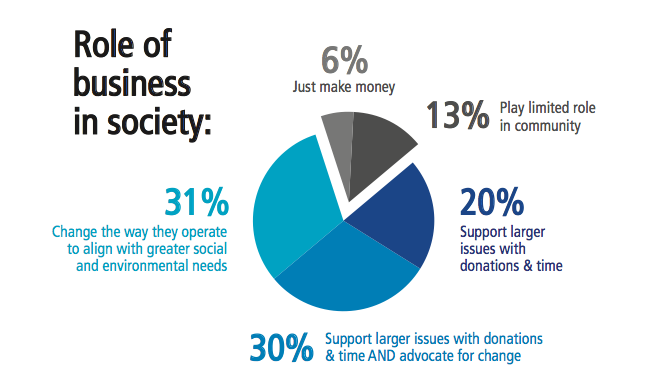
In its newly released global research report, Cone Echo Research highlight the opportunity for business to build a stronger relationship with consumers by meeting their expectations that business will address social and environmental issues through their operations, their products and services and their unique expertise.  

The trend is global as evidenced by the results in ten countries and the 10,000 people who were surveyed.  And not surprisingly, communication is critical in bridging the gap between perception and reality.

  • 93% of consumers say they want to know what companies are doing.
  • 91% of people say they want to be heard as well.

This means that reciprocal communication is more than an expectation, its essential in building a strong connection with consumers.  And critical to overcoming the confusion, skepticism and even cynicism among consumers.  

  • 89% of consumers globally believe companies share only the positive information about their efforts, while withholding the negative.
  • 71% are confused by the messages companies use to talk about their efforts and impacts.
  • 61% of consumers believe a company is telling the truth about its social and environmental efforts and impacts, but this varies widely by nationality.

Trust is more complex.

The more trusting a country’s consumers are in business, the more confused they are by a company’s messages. These consumers are putting great faith in the words of business, even though they don’t necessarily understand the messages themselves. In return, they don’t ask for perfection, simply the truth. Nearly nine-in-10 (88%) say it’s ok if a company is not perfect, as long as it is honest about its efforts. This permission presents an opportunity for companies to speak candidly about tough CR issues to build trust.

Follow this link to access the Global CR Study


American People to Corporate America: We’d Vote You Out.

30 12 2010

In a new survey issued by StrategyOne, 82% of American’s gave a “C grade or lower” on how corporate America did in 2010, with 40% of Americans assigning Corporate America a “D” or an “F”.

The wake up call is that Americans are extremely frustrated and dissatisfied with the behavior of companies in America.  Quite literally, if the leadership of American companies were politicians, there would be a landslide election of the American people voting them out of their corner offices.

“Let’s be clear, Americans are not dreaming up some far out vision of utopia,” said said Bradley Honan, senior vice president of StrategyOne. “Instead they are being realistic that Corporate America should – and indeed must – engage in important issues of the day where they can make a demonstrably positive difference.  That means the economy and jobs for starters, but also ensuring their products are safe and not harmful to use, and that they simply conduct their day to day business activities in an honest, ethical, and transparent manner.”

Other interesting facts undercovered in the StrategyOne survey included:

  • 88% of consumers said it was extremely or very important that companies help get the economy back on track in 2011.
  • 88% said it was extremely or very important to conduct business in an ethical manner in 2011, and 87% said it was a top priority to do business in an honest and moral way.
  • 85% of consumers thought it was extremely or very important for companies in 2011 to deliver high quality products and services;
  • 84% of Americans thought companies needed to demonstrate good governance in 2011.
  • 82% said it was a top priority for companies to make fewer mistakes and errors in 2011.

Let’s hope company leaders make some serious New Year’s resolutions to improve their performance and more effectively communicate with the public to show how they are being more responsbile, sustainable and ethical.  That is the only way to reduce the “trust gap”.  And it is important for corporate leaders to recognize—once and for all—that their futures are dependent on their customers….who happen to be the American people, at the end of the day.

StrategyOne Survey Methodology:

StrategyOne conducted 1,081 online interviews among a representative sampling of Americans between December 6 and 8, 2010.


Sustainability Making Business Smarter, More Competitive and More Profitable.

16 12 2010

A new report commissioned by KPMG and The Economist Intelligence Group shows that global corporate business executives are seeing positive—and potentially surprising – business benefits from their sustainability initiatives.  More than half of those surveyed represented C-Suite executives.  This week’s report is a preview of a major research paper coming from KPMG early next year.

  • 62% of company’s now claim to have a strategy for sustainability, up from just over half in early 2008.
  • 44% of business executives believe that sustainability is and will continue to be a source of innovation.
  • 39% of executives see sustainability as a source of revenue growth.
  • 41% see sustainability as a driver for brand enhancement.

Some of the other benefits cited by executives from sustainability initiatives include happier employees, better relationships with clients and suppliers, cost reduction, access to new markets, new product and service offerings and improved investor awareness.

But once again there is a gap between reality and perception, with many companies still not effectively communicating sustainability progress to investors and other stakeholders.

And the vast majority of survey respondants claim they viewed sustainability reporting as “just PR.”

It is time for business to back up their actions with transparent and authentic communication to translate their efforts into positive external perceptions and brand reputation enhancement.  The communication challenge is to be  real, believable, trusted and for the messages to be served up in digestible, understandable and emotionally inspiring ways.  And that friends, is the essence of great branding and the huge opportunity: creating responsible brands that prosper in the new age of sustainability.

Download the KMPG Research Report Preview Here


Ana’s Playground takes New Hampshire.

19 10 2009

Picture 1

Like the first important primary of a presidential election, New Hampshire represents a key milestone for another candidate.  Ana’s Playground— the short film about children as victims of armed conflict—won Best Short Drama in this past weekend’s festival in Portsmouth, New Hampshire.   More than 80 independent films were screened over the weekend.

With award winning honors in three of its first few screenings, Ana’s Playground continues its world tour.  Check out the Ana’s Playground filmmaker blog for other news and updates.

One of the largest film fests in New England, the four-day event draws celebrities, academy-award winners, film industry veterans and local film lovers. Most importantly, NHFF offers workshops and discussions for young and new filmmakers to interact with industry pros and learn the art and business of film.

Learn more about the New Hampshire Film Festival


Abandon Ship! Follow-up on U.S. Chamber…

1 10 2009

Pendleton_Sinking_Ship

The momentum of disengagement from the U.S. Chamber of Commerce based on their draconian position denying climate change continues. The chamber in recent weeks has challenged a federal Environmental Protection Act finding that greenhouse gases can be regulated by the Clean Air Act.

Nike announced Wednesday that it has resigned from the Board of Directors of the Chamber.  In a statement, Nike said “we fundamentally disagree with the U.S. Chamber of Commerce on the issue of climate change and their recent action challenging the EPA is inconsistent with our view that climate change is an issue in need of urgent action.”

Nike joins PG&E Corporation, PNM Resources and Exelon Corporation— all of whom have left the Chamber in the past week based on the Chamber’s position denying climate change.  Speculation continues that Chamber President Thomas Donohue will be forced to resign based on the defection of member companies and allegations of conflict of interest based on his board position at Union Pacific Railway, a company fighting climate change legislation in part based on the large amount of revenues they receive from the shipment of coal.


Study underscores “socially responsible credit gap”.

17 08 2009

DSC_0588“People are willing to pay more for products from socially responsible companies, but almost no companies have any profile as socially responsible.”

PSBA Research

In a study conducted this March, Penn Schoen Berland Associates found that despite significant investments by many major corporations in corporate social responsibility initiatives, Americans have virtually no awareness of who does what, and who does things well.

Some interesting insights from the study first point to the facts that the majority of Americans (despite the recession) want to be associated with socially responsible companies.

  • 75% will pay more for a product from a socially responsible company.
  • 56% say working for a socially responsible company makes a difference.
  • 40% will take a pay cut to work for a socially responsible company.

The study also found that being “honest and trustworthy” was the most important company attribute—ranking higher than “quality” and “value”—regarding who Americans will do business with.

But the most unfortunate (and least surprising) set of findings in this research is how ill equipped Americans are to say what companies are socially responsible.  

  • 70% of those surveyed were unaware of any socially responsible activities of their own employers.
  • There was no correlation between those companies that Americans ranked as being leaders in social responsibility and the actual performance of those companies based on evaluations in the CRO 100. (conducted annually by the Corporate Responsibility Officer Association)

Clearly, this should be a wake up call to the leadership of all companies and those responsible for managing their reputation and brands.  In sum, it suggests there is a huge opportunity to use CSR efforts as a differentiator with an American audience that cares about those issues more than ever before and is placing trust at greater currency than quality and value.  

The call to action is to convert socially responsible practices into branded assets.  But this will require internal corporate silos to be broken down so people responsible for operations, HR and internal communication, PR, marketing branding, advertising, and all other forms of communication are working together around a focused and integrated CSR message.

Read the Corporate Citizenship Study


What if my customers say they don’t care?

21 07 2009

  Whatever you can do or dream you can, begin it. Boldness has genius, power and magic in it.”  

                             – Johann Wolfgang von Goethe


“What if my customers say they don’t care?”  

This may be the number one question many companies are wrestling with regarding social responsibility and sustainability strategies.  And is central to the debate of whether it is possible to achive brand differentiation by infusing sustainable practices into messages directed to customers.

It is easy to appreciate how many companies over the past couple of decades have made significant investments to “stay close” to their customers. Brand attribute ratings.  Research departments rebranded as “consumer insights” groups. Tracking studies. Endless focus groups and telephone and on-line surveys.  Trend analysis and more.  Information is good and many sound business strategy decisions have been based on input on the wants and needs of the customer.  But too much information can also lead to an unhealthy paralysis.

So when the research points to data saying that customers don’t care about sustainability—corporate leaders have decisions to make.  This is especially true when we are still buffeted by an uncertain economic climate when many people are struggling financially and not in the position to make the sophie’s choice between being able to afford something they need vs. an alternative that may offer a higher degree of sustainability.  We acknowledge the cold reality that the economy may be holding back customers’ demanding sustainable behaviors, but beware the “sling shot effect” of how quickly this could change when the economic pressures ease.

This is the inflection point that is the very essence of what it means to be socially responsible.  Our way of thinking is that if you can achieve more responsible and sustainable practices (and we acknowledge the practices are not sustainable unless they are profit neutral), you have a moral obligation to do it whether or not your customer says they care.  And we further believe it is a social responsiblity to communicate what you are doing in an effort to educate and inspire your customers to not only appreciate what you are doing, but show them how they should alter their own behaviors for everyone’s benefit.

The next level of consumer insights then is to get deeper into the potential of the responsible and healthy relationship between a company and its customers. True innovation, creativity and positive social change rarely relies on permission.  It insists on the courage to do what is right and transformative and then to communicate the benefits of the innovation to the audience.

I draw the analogy to our society’s history of struggling with the knowledge that smoking tobacco has devasting health consequences.  After the Surgeon General first informed the public of the health hazards of smoking in 1964, it took decades to achieve the broad based awareness, acceptance and change of behaviors (in part because of the addictive nature of the habit).  But “responsible steps” were taken: public service campaigns, packaging warning labels, bans of advertising, bans of sale to minors, bans in public venues, legal action and consequently—millions of smokers quit and millions of non-smokers never started.  Today, some people still make the choice to smoke and to ignore the health consequences, but they are certainly aware of them.  And there is a social stigma that deeply influences healthy behavior for individuals as well as society at large.  None of this would have happened without leaders who were willing to stand up and embrace change as the right thing to do.

Fast forward to today. Even if your customers say they don’t care about sustainability, it is your responsibility to drive to achieve necessary sustainable behaviors into your organization because of your knowledge that it is the right thing to do whether or not your customer will applaud you for it.  The health and social consequences of NOT doing this is no less dramatic than pretending smoking is good for you.  And because it is the right thing to do, it is also imporant to inform your customer of what you are doing and why.  Public education is also a social responsibility.

Imagine if all the tools of today’s instantaneous communication – the internet, digital media, global connectivity, social networks – were available in 1964 when the public first learned about the dangers of smoking tobacco. How much more quickly would have behavior change been accelerated? How many millions of lives might have been improved?  How much suffering might have been avoided?  

We call on all companies to use all the tools and innovation at their disposal to drive sustainable change and communicate the efforts to their customers. Persuade your customers to care, persuade them to take care of themselves and their community.  This is how we will achieve necessary change when the clock is ticking.

There are many examples:  we are inspired by companies like Wal-mart, Tesco and Kingfisher who are driving meaningful sustainable behaviors into their organizations and then boldly yet honestly communicating what they are doing to their customers and how they should get involved.  Don’t wait for permission.


Trust Gap: A New Landmark Study

25 06 2009

“Actions speak louder than words.  If the public believes that an organization’s first priority is profit maximization, it will be difficult, if not impossible, to build public trust.” – Business Roundtable Institute for Corporate Ethics, Arthur Page Society

A landmark special report was issued today that underscores the deep loss of trust between the public and business.

Read the report 

The topline strategic recommendations provide guidelines to business leaders on the requirements to gain renewed trust with the public.  At is essence, we believe all of these strategies can be summed up as “the golden rule:  treat others as you would like to be treated”.  A timeless axiom that seems to have been forgotten by the leadership of many companies recently.  Hopefully this report will help companies get back to the fundamentals of having a trusting relationship with the public.


Trust Matters – The Edelman Trust Barometer’s Scary 2009 Report

23 06 2009


“I’m not upset that you lied to me, I’m upset that from now on I can’t believe you”
 Friedrich Nietzsche quotes

1443_2

I’m not upset that you lied to me, I’m upset that from now on I can’t believe you”  – Friedrich Nietzsche

Kudos to the Edelman Trust Barometer and their 2009 report citing the state of trust worldwide.  It dramatically underscores there is nothing short of a pandemic of lack of trust between people and companies, the media, CEOs, and experts.

Building sustainable brands will require regaining public trust and Edelman’s study reported only 38% of people 35-54 years old in the United States trusted U.S. businesses.  The report also showed that in the past year 77% of 25-to-64 year olds around the world refused to buy a product or service from a distrusted company.  

There is now a huge trust gap to overcome but those companies who aggressively recognize and embrace this new reality will be the ones that emerge from the recession with momentum and a long term competitive advantage.  

But now is the critical time to create and align sustainable and socially responsbile business practices with branding and communication programs to help your company stand apart and be among the winners in this new world where actions resonate and words alone will be ignored.


Don’t call them consumers.

22 06 2009

Originally I wrote this post at duffypov.com when I was still with Duffy & Partners more than a year ago.  But it feels more right than ever before as all of us and society at large have been forced by the recession to consider exactly what it means to consume.  And where it fits in each person’s values set.


“Consumers are statistics.  Customers are people.”  – Stanley Marcus, Neiman & Marcus

Wikipedia defines a consumer as “a person who uses any product or service. Typically when business people and economists talk of consumers they are talking about person as consumer, an aggregated commodity item with little individuality other than that expressed in the buy/not-buy decision.”

Ok, it’s a new day. The term “consumer” must be purged from any organizational lexicon.  Shame on marketers who insist on putting such an arbitrary generalized term on the people they are trying to attract. As if “consumers” live in some petri dish to be probed, prodded and tested.

The term consumer presumes people are put on this earth solely to buy stuff.  How disrespectful to only think of “consumers” in a way that would suggest what they will do for me economically, not what we can do for them.

We are people.  With laughs and tears, dreams and hopes, and a desire to express our individuality in the context of having positive relationships with others and the world around us.

Consumers?  How about people?  The best brands recognize the difference.  In a world increasingly focused on sustainability, brands that respect people as people first will be the ones that are rewarded with—yes purchases—but importantly loyal customers.