What makes a chief sustainability officer transformational?

28 12 2023

By Kate Birch from Sustainability Magazine • Reposted: December 28, 2023

CSOs must be given a strategic seat at the table and empowered to hold C-suite peers accountable, says EY Global Vice Chair Sustainability Amy Brachio

In recent years, the role of the Chief Sustainability Officer (CSO) has transitioned from the corporate side lines to the epicentre of business strategy.

While once, sustainability leaders were referred to as ‘stealth PR executives’, Robert Eccles and Alison Taylor wrote in a recent Harvard Business Review piece – the CSO role has evolved into one that is “finally becoming strategic” as the focus moves from “feel-good corporate social responsibility to hard-nosed sustainable value creation”.

More than mere organisational change, it is a transition that highlights the increasing significance of sustainability in business beyond regulation and compliance.

As Amy Brachio, EY’s Global Vice Chair of Sustainability explains in the 2023 EY Sustainable Value Study – “CSOs are being tasked with identifying the sustainability issues that have a significant impact on an organisation’s financial performance and risk profile”.

But even CSOs in the most sustainably committed organisations are struggling – given the slow pace of progress on climate action and lack of cross-function collaboration.

And this is driving concerning levels of CSO dissatisfaction.

EY data reveals only 17% of CSOs (and equivalents) are “highly satisfied” in their roles and 42% not say they aren’t committed to staying with their current employer.
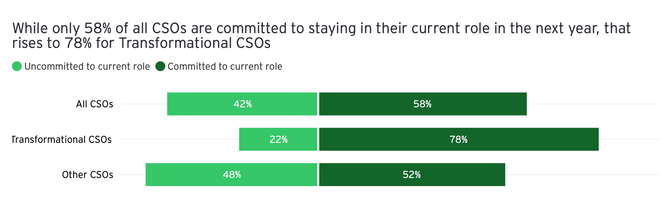
Nearly half (42%) of CSOs say they are not committed to staying with their current employer

Challenges CSOs face today

As global economic and geopolitical headwinds gain momentum, company progress on climate action is ebbing – CSOs are receiving less spend and on top of that are being pressured by C-suite peers for short-term actions and results.

EY’s study, which surveyed 520 CSOs and corporate responsibility leaders at companies with over US$1 billion in revenue across 10 industries and 23 countries, reports an average decline in GHG of 20%, down from 30% in a study last year, along with a decrease in the average number of actions organisations are taking relating to climate change to 4, from a prior average of 10.

And looking to 2024, just 34% say their organisation plans to increase spending to address climate change in the year ahead, compared to 61% last year.

“Amidst the backdrop of unprecedented geopolitical tensions, sustainability leaders are facing clear challenges with resource allocation,” says Brachio.

Their jobs are made even more challenging given that nearly half (46%) say they don’t have the authority to hold their C-suite counterparts to account for their performance on sustainability initiatives.

EY Global Vice Chair Sustainability Amy Brachio. Image: Sustainability Magazine

Which is where the ‘transformational’ CSO comes in.

Identified by EY as agents of change, the ‘transformational CSO’ is more likely to turn climate commitments into action.

While just one in five organisations employ a transformational CSO, those who do have initiated or completed 1.4X more climate actions on average than those without, finds EY.

Companies with transformational CSOs are also more committed to climate impact reductions, with half set to spend more next year, and drive higher emissions reductions. And a transformational CSO is more satisfied and less likely to consider leaving their role.

Rise of the ‘transformational’ CSO

So what makes a CSO ‘transformational”?

EY research points to both the background of the person chosen to lead an organisation’s sustainability agenda and how they are brought into the role as influential in their ability to have a meaningful impact.

Described by EY as a leader who can “influence, negotiate, broker, and listen”, the ‘transformational CSO’ has both operational background and the influence to drive business strategy and implementation.

Put simply, transformational CSOs are experienced in leading change at scale – and play a “significant role in setting company strategy and actively engaging with shareholders, investors, and customers”, according to Pilar Cruz, Cargill’s Corporate CSO.

It’s a pivotal change to the traditional CSO role that demands professionals have a deeper background in commercial, operations, finance, and business transformation.

As Dr Lutz Hegemann, the President or Global Health & Sustainability at Novartis, puts it: “You need to have someone who has a very thorough business understanding” because “you don’t want a sustainability strategy and a business strategy – you want a sustainable business strategy”.

It’s not just about a CSO having the necessary background – but the way in which are they are empowered by the C-suite to drive the strategy.

As sustainability leaders play an “increasingly strategic role” in navigating both the internal and external challenges of moving from climate ambition to climate action, Brachio says it is essential they are “not only empowered to drive sustainability initiatives but also have the operational mandate to integrate their plans into a wider business strategy.”

These ‘transformational CSOs’ have more resources at their disposal, such as a dedicated budget and team, and exert greater influence internally.

Transformational CSOs collaborate better across the C-suite / EY

So, what actions should they take to facilitate CSOs as agents of change – as transformational?

  1. Select (or develop) a CSO with a deep understanding of the business model. Empower them so their imperatives are understood as being core to business value
     
  2. Give CSOs a strategic seat at the table (i.e., reporting to the CEO and access to the board) and the ability to drive accountability for sustainability initiatives across the entire business
     
  3. Strengthen internal collaboration by creating governance structures that drive cross-functional teaming collaboration, such as business-level sustainability councils chaired by the CSO
     
  4. Empower the CSO to help set sustainability strategy and goals; build the capacity of the sustainability function to collaborate with the business on executing the strategy
     
  5. Have the CSO take point to ensure that the organiSation understands and is prepared to meet emerging policy changes and new reporting obligations across the domains where the organiSation operates.

To see the original post, follow this link: https://sustainabilitymag.com/sustainability/what-makes-a-chief-sustainability-officer-successful


More than half of the world’s largest companies don’t have a chief sustainability officer. Here’s the proof they’re missing out

5 12 2023

The words “The World Needs You” are projected on a screen at the opening ceremony of the World Climate Action Summit during COP28 in Dubai on Dec.1. Photo: Chris Jackson/Getty Images

By Sheri Hickok via Fortune.com • Reposted: December 5, 2023

The Global Stocktake is set to deliver a sobering truth–current efforts to reduce emissions are not enough to meet our goal of keeping global warming below 1.5 degrees Celsius. It is clear government commitments will not drive sufficient action–and the private sector is increasingly under pressure to close the growing emissions gap.

The corporate climate landscape is evolving quickly and is more complex today than even a year ago. New standards and guidelines, as well as regulations and reporting requirements, are raising questions about corporate integrity and ambition. The antidote to this is a chief sustainability officer–a leader who can set strategies to embed climate priorities within business goals, align purpose and profit, and navigate the plethora of new regulations and standards putting climate actions and claims under a microscope.

However, our research found that chief sustainability officers (CSOs)–or equivalent roles–do not exist at more than half of the world’s largest companies. Research from Climate Impact Partners examining the climate commitments of the Fortune Global 500 showed that companies without a CSO saw emissions increase 3% in the past year, while those with the position saw a modest decrease. This key role, despite being still relatively new, is expected to increasingly deliver a greater impact. It turns out that caring about climate change is also good for business. Among the world’s largest companies, those that reduced reported emissions from 2021 to 2022 earned on average nearly $1 billion more in profit than their peers.

CSOs must balance ambition with pragmatism. They need to set climate goals that support business growth. Fortune Global 500 companies with a CSO set carbon neutral and net zero targets seven and three years sooner respectively, compared to those without a CSO. Among those same companies, those with a 2030 or sooner target reduced operational emissions by 7% from 2021 to 2022, whereas companies without a 2030 target saw a 3% increase in emissions. This is why targets are table stakes– and the CSO is essential in setting the right ambition and path forward for the company.

The onset of standards and guidance around claims, such as the EU’s Green Claims Directive and Voluntary Carbon Markets Integrity Initiative (VCMI), is putting companies on edge as they try to avoid accusations of greenwashing. The VCMI’s latest rulebook, which provides guidance on the credible use of high-quality carbon credits and claims, is working to build integrity, end-to-end, from supply (provision of carbon credits) to demand (purchase of carbon credits). The guidance, which will be expanded later this year, will help address a critical solution that enables companies to finance emissions reductions around the world.

The tsunami of regulations is overwhelming. Starting next year, California will require companies to report on their engagement with the voluntary carbon market. Soon after, the EU will follow with their disclosure regulations, along with the U.S. Securities and Exchange Commission with their highly anticipated ESG rule. 

All of this is forcing CSOs to focus more on accounting and compliance rather than strategizing to deliver reductions. Regulation can provide structure, direction, clarity, and credibility, but corporate sustainability teams need to be prepared to find the crosswalks between the different rules and disclosure requirements. 

Everyone is going to walk out of COP28 with heavy responsibilities–corporations need a strong chief sustainability officer to succeed while taking bold climate action. But in order to reap the benefits, companies must first make the hire.

Sheri Hickok is the CEO of Climate Impact Partners.To see the original post, follow this link: https://fortune.com/2023/12/04/half-world-largest-companies-chief-sustainability-officer-proof-missing-out-climate-change-sheri-hicock/


What does it take to be a Chief Sustainability Officer?

22 08 2023

Image: Odgers Berndtson

By Lucy Buchholz from Sustainability Magazine • Reposted: August 22, 2023

Sarah Gould discusses the crucial aspects needed for Chief Sustainability Officer

Shirley Parsons’ Sarah Gould discusses the crucial aspects needed for Chief Sustainability Officer to succeed in their businesses, to make lasting change

The pressure is on businesses, governments and other enterprises to deliver on commitments to hit decarbonisation targets. An organisation’s Chief Sustainability Officer or Head of Sustainability can lead that fight, but how do you get the right person for the job?  

​In an ever-changing economic landscape, the one thing that continues to grow is the demand for sustainability professionals, which makes it imperative to choose the right individual to take the lead in implementing vital policies. 

Sustainability Magazine speaks exclusively to Sarah Gould, Principal Sustainability & ESG Consultant at Shirley Parsons, who is an expert in recruiting sustainability leaders and was recently placed as Head of Sustainability for a global logistics organisation.

What are the critical sustainability challenges for organisations?

The critical challenge for any organisation is recruiting a skilled, proactive and effective sustainability leader to drive its strategy forward. Without the right person at the helm, any sustainability drive can quickly end up on the rocks or going around in circles.

“We are seeing specialists in carbon, social values, waste, biodiversity, circular economy, energy and many other skills,” Sarah says. “Considering what an organisation wants to achieve from a senior hire helps set a clear direction and helps us effectively partner with our clients to make that match.”

Sarah continues to explain that it’s a collaboration to scope out the role and understand the purpose of the hire, as well as how it feeds into the goals and vision of the company. “It’s important to look at things from the candidate’s perspective when hiring,” she adds. “A candidate will not move just because it is a good name on their CV – they want to know what you will offer them, and they aren’t just talking about finances.”

How to attract and retain candidates

Retention and attraction are key challenges for a lot of organisations in a tight labour market. More individuals now want to know about an organisation’s mission – including their values, culture, diversity, social responsibility and career development opportunities, to name a few. That’s why it’s important to be prepared to answer their questions and provide a real sense of what it is like to work at your company. 

“A candidate going for a Chief Sustainability Officer, Head of Sustainability or ESG position will want to know how much freedom they have to drive sustainability, who they report to – which gives them an idea of the influence they will have – and whether the organisation wants to make a positive change or if they are just greenwashing,” Sarah shares.

“It’s important to always be honest with candidates about your organisation’s commitment because if something is promised and not delivered, you will likely need to start hiring again quickly. Thinking about a candidate’s aspirations and how you can help them achieve their goals will prove beneficial.”

Assessing the suitability of candidates for sustainable careers 

To identify critical personality traits and aspirations, Shirley Parsons uses MAPP (motivations, aspirations, personality and progression), a bespoke personality profiling system which is used both as part of the interview process and to assess teams ahead of future hires, determine what is missing and what is needed.

“Most suitable candidates have several options to choose from and will judge how efficient an organisation is from how you deal with them,” Sarah says. “Companies are losing candidates due to a lack of speed so consider how you can quicken your interview process. Make sure you have all the details sorted – development opportunities, training, benefits, location, and flexible working are all questions suitable candidates will ask.” 

Sarah continues to explain that many organisations expect a Head of Sustainability to have several years of experience in their sector. However, sustainability is a growing skill area and doesn’t have the candidate pool of other technical industries, such as health and safety. Therefore, sector experience can be learned.

Finally, organisations should consider what can be gained by hiring someone outside of the sector. “You are hiring the Head of Sustainability for their expertise in sustainability, leadership, commercial awareness, and personality skills,” Sarah says, “and not for their 10 years of working in the sector.”

To see the original post, follow this link: https://sustainabilitymag.com/articles/what-does-it-take-to-be-a-chief-sustainability-officer