
4 ways to become a conscious leader in sustainability

2 04 2024

Source: Shutterstock/Philip Steury Photography

By Shannon Houde from GreenBiz.com • Reposted: April 2, 2024

A conscious leader is someone who understands their role in creating a world that works for everyone and takes action to make it happen.”
— Gabrielle Bernstein

Conscious leadership connects many of the most inspiring changemakers. 

There’s former Unilever CEO and Dutch businessman Paul Polman, who prioritized social and environmental responsibility at the consumer goods giant, resolutely carving out a path for the good of the planet rather than solely commercial gain. 

Former New Zealand prime minister Jacinda Ardern, now trustee of the Earthshot Prize, called the climate crisis a matter of “life or death” as she laid out an ambitious but controversial “green” roadmap for the country. 

And Costa Rican diplomat Christiana Figueres artfully negotiated the Paris climate accord while navigating turmoil in her personal life. 

Each of these leaders embodied their values, acted with courage and prioritized empathy and humility over personal plaudits — three core components of a conscious leader. 

You can break these components down much further, of course. In fact, according to U.S. consultancy Conscious Leadership Group, 15 commitments are required to become a conscious leader, including candor, curiosity and responsibility.  However you define it, the crux of conscious leadership is acting for the good of people and the planet.  Here are four ways to become a more conscious leader. 

1. Start at home

Take the time to embed routines and rituals into your day that get you in the right mindset before you even reach the office, recommended Holley Chant, CSO at regenerative tourism company Salva, while speaking in February at an Impact Leaders Lab event, a private platform in which sustainability professionals can accelerate their professional development. “You’ve got to get up every morning and clean your slate.” For Chant that means fitness, meditation and ice baths. Seek out connection as part of these rituals, too. “The work that we’re meant to do as sustainability leaders doesn’t just happen when we’re at work with our ESG hat on. It’s also our work as humans, in the way we show up in our community, how we help both ourselves and other people to deal with the ups and downs of life. It’s how we find joy, community and those connections.” 

2. Flex your curiosity 

Conscious leaders look beyond their own role, organization and industry in their quest for inspiration. For those working within sustainable leadership, whose remit often transcends a single function, department or even sector, this willingness to cast the net wide in their hunt for relevant ideas and potential solutions is invaluable. So flex that curiosity muscle as often as you can. That could be as simple as checking out a new podcast that looks at climate developments from a brand new perspective or reading a nonfiction book by an environmental campaigner you admire. But it also means being more curious in your interactions with others. Next time you find yourself ready to disagree with a point made during a meeting, for example, take a pause and challenge yourself to understand the other person’s viewpoint. Get curious about these perspectives, rather than jumping to judgment, and you’ll find skills such as empathy, innovation and communication develop naturally. 

3. ‘Listen as if your life depended on it’

According to 2018 research by the University of Illinois, most people can recall only 20 percent of the ideas expressed by the other person in a conversation. Imagine what implications that has for a CSO looking to understand the barriers to change that are stalling progress on sustainability within an organization? Or the sheer volume of original ideas they might be missing when they fail to absorb the feedback from frontline staff? So instead, “listen as if your life depended on it,” recommended Chant. “That means turning off all your planned responses and really listening with the aim of being able to repeat back 90 percent of what they said.” As well as allowing you to tap into ideas you’d otherwise have missed, this skill of active listening helps develop all sorts of critical skills required to excel within sustainability, from communication, to engagement, curiosity and empathy.   

4. Choose gratitude 

The future of the planet can be a heavy topic, one that triggers fear, grief and anxiety. One 2021 study in The Lancet found that more than half (59 percent) of 16-25 year olds — the demographic most likely to pursue “green” jobs — were “extremely worried” about the climate crisis. But rather than wallow alongside them, conscious leaders find ways to lift others from a sense of despair and divert their attention to solutions and opportunities instead. To cultivate this skill, practice presence and gratitude. Intentionally take time to identify milestones that have been reached, progress that has been made and exciting new solutions that offer hope.

To see the original post, follow this link: https://www.greenbiz.com/article/4-ways-become-conscious-leader-sustainability




What makes a chief sustainability officer transformational?

28 12 2023

By Kate Birch from Sustainability Magazine • Reposted: December 28, 2023

CSOs must be given a strategic seat at the table and empowered to hold C-suite peers accountable, says EY Global Vice Chair Sustainability Amy Brachio

In recent years, the role of the Chief Sustainability Officer (CSO) has transitioned from the corporate side lines to the epicentre of business strategy.

While once, sustainability leaders were referred to as ‘stealth PR executives’, Robert Eccles and Alison Taylor wrote in a recent Harvard Business Review piece – the CSO role has evolved into one that is “finally becoming strategic” as the focus moves from “feel-good corporate social responsibility to hard-nosed sustainable value creation”.

More than mere organisational change, it is a transition that highlights the increasing significance of sustainability in business beyond regulation and compliance.

As Amy Brachio, EY’s Global Vice Chair of Sustainability explains in the 2023 EY Sustainable Value Study – “CSOs are being tasked with identifying the sustainability issues that have a significant impact on an organisation’s financial performance and risk profile”.

But even CSOs in the most sustainably committed organisations are struggling – given the slow pace of progress on climate action and lack of cross-function collaboration.

And this is driving concerning levels of CSO dissatisfaction.

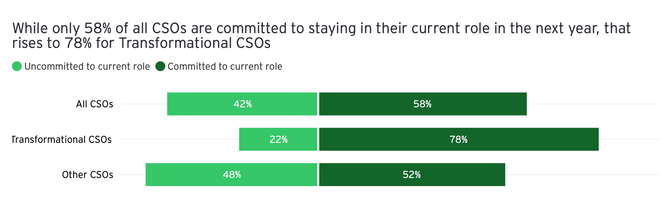
EY data reveals only 17% of CSOs (and equivalents) are “highly satisfied” in their roles and 42% not say they aren’t committed to staying with their current employer.

Nearly half (42%) of CSOs say they are not committed to staying with their current employer

Challenges CSOs face today

As global economic and geopolitical headwinds gain momentum, company progress on climate action is ebbing – CSOs are receiving less spend and on top of that are being pressured by C-suite peers for short-term actions and results.

EY’s study, which surveyed 520 CSOs and corporate responsibility leaders at companies with over US$1 billion in revenue across 10 industries and 23 countries, reports an average decline in GHG of 20%, down from 30% in a study last year, along with a decrease in the average number of actions organisations are taking relating to climate change to 4, from a prior average of 10.

And looking to 2024, just 34% say their organisation plans to increase spending to address climate change in the year ahead, compared to 61% last year.

“Amidst the backdrop of unprecedented geopolitical tensions, sustainability leaders are facing clear challenges with resource allocation,” says Brachio.

Their jobs are made even more challenging given that nearly half (46%) say they don’t have the authority to hold their C-suite counterparts to account for their performance on sustainability initiatives.

EY Global Vice Chair Sustainability Amy Brachio. Image: Sustainability Magazine

Which is where the ‘transformational’ CSO comes in.

Identified by EY as agents of change, the ‘transformational CSO’ is more likely to turn climate commitments into action.

While just one in five organisations employ a transformational CSO, those who do have initiated or completed 1.4X more climate actions on average than those without, finds EY.

Companies with transformational CSOs are also more committed to climate impact reductions, with half set to spend more next year, and drive higher emissions reductions. And a transformational CSO is more satisfied and less likely to consider leaving their role.

Rise of the ‘transformational’ CSO

So what makes a CSO ‘transformational”?

EY research points to both the background of the person chosen to lead an organisation’s sustainability agenda and how they are brought into the role as influential in their ability to have a meaningful impact.

Described by EY as a leader who can “influence, negotiate, broker, and listen”, the ‘transformational CSO’ has both operational background and the influence to drive business strategy and implementation.

Put simply, transformational CSOs are experienced in leading change at scale – and play a “significant role in setting company strategy and actively engaging with shareholders, investors, and customers”, according to Pilar Cruz, Cargill’s Corporate CSO.

It’s a pivotal change to the traditional CSO role that demands professionals have a deeper background in commercial, operations, finance, and business transformation.

As Dr Lutz Hegemann, the President or Global Health & Sustainability at Novartis, puts it: “You need to have someone who has a very thorough business understanding” because “you don’t want a sustainability strategy and a business strategy – you want a sustainable business strategy”.

It’s not just about a CSO having the necessary background – but the way in which are they are empowered by the C-suite to drive the strategy.

As sustainability leaders play an “increasingly strategic role” in navigating both the internal and external challenges of moving from climate ambition to climate action, Brachio says it is essential they are “not only empowered to drive sustainability initiatives but also have the operational mandate to integrate their plans into a wider business strategy.”

These ‘transformational CSOs’ have more resources at their disposal, such as a dedicated budget and team, and exert greater influence internally.

Transformational CSOs collaborate better across the C-suite / EY

So, what actions should they take to facilitate CSOs as agents of change – as transformational?

  1. Select (or develop) a CSO with a deep understanding of the business model. Empower them so their imperatives are understood as being core to business value
     
  2. Give CSOs a strategic seat at the table (i.e., reporting to the CEO and access to the board) and the ability to drive accountability for sustainability initiatives across the entire business
     
  3. Strengthen internal collaboration by creating governance structures that drive cross-functional teaming collaboration, such as business-level sustainability councils chaired by the CSO
     
  4. Empower the CSO to help set sustainability strategy and goals; build the capacity of the sustainability function to collaborate with the business on executing the strategy
     
  5. Have the CSO take point to ensure that the organiSation understands and is prepared to meet emerging policy changes and new reporting obligations across the domains where the organiSation operates.

To see the original post, follow this link: https://sustainabilitymag.com/sustainability/what-makes-a-chief-sustainability-officer-successful


Should You Outsource Your Chief Sustainability Officer?

23 07 2023

Image: Getty

By Shashi Menon, Member, Forbes Business Council via Forbes • Reposted:July 23, 2023

In today’s business world, many functions are outsourced. For example, at my company, we outsource payroll, IT, legal services and taxes because of the highly specialized knowledge required to do the tasks and the economies of scale achieved by the vendors. It doesn’t make sense for us to hire a full-time, in-house attorney with expertise in contracts, employment law, litigation, etc., when there is a buffet of highly specialized lawyers I can access through one relationship with a law firm—and I can rely on them as needed.

A similar theme is emerging in sustainability services. As an expert in providing outsourced CSO services, my company and others in the space help firms achieve their sustainability goals.

One of the biggest challenges faced by businesses today is finding people to assimilate all the knowledge needed to maneuver the energy transition, which places increasing pressure on businesses to reduce emissions, promote circularity and track sustainability. According to LinkedIn’s Global Green Skills Report 2022, demand for “green skills” is outpacing supply, and the specialization of “green skills” is proliferating—from climate and renewable energy to environmental awareness and corporate social responsibility.

Companies are responding to this need by appointing a chief sustainability officer, or CSO, who is expected to lead the response to the energy transition. The skills required to do this are complex, technical and often beyond the abilities of one person. It requires engineers, legal experts, market analysts, investment bankers and project managers.

Outsourcing CSO services, like outsourcing legal and accounting, allows businesses to access specialized sustainability experts. Outsourced CSOs can provide sustainability, business strategy and operational guidance related to the energy transition.

Making The Decision To Outsource

Whether you are leading a small startup or a large publicly traded firm, here are several instances where outsourcing CSO services can be an effective way to address some of today’s carbon challenges:

• New climate startups: You have launched a successful business model and are fortunate enough to be juggling multiple balls—hiring and training, sales and business development, investor relations and more. Your leadership team may not have time to keep up with global climate policies, emerging incentive programs, new competing technologies, evolving carbon markets, data standards and carbon accounting rules.

• Small or midsized privately held businesses: You have loyal customers who like your products or services, and you are growing steadily in a stable environment. Recently, these customers have been asking casual questions about the company’s sustainability efforts. The leadership team doesn’t have the time or the baseline knowledge to analyze the company’s sustainability.

• CEOs or CFOs: It’s time to update investors and shareholders about profit margins, strategic plans and key performance indicators, and they also want to see an analysis of energy transition risks and climate risks. As a believer in risk-averse governance, you know you should include this in your quarterly report, but you are not clear where to start.

• One-person sustainability departments: Pressure from the board and upper management has forced one person to research and respond to a variety of questions over the years, and their role has evolved to include “sustainability expert.” But the questions are becoming more complex and overwhelming. A climate scientist, a policy analyst and a process engineer are needed on the team to fully respond to the situation, but the budget doesn’t allow this.

Of course, outsourcing a task core to a business’ strategic direction is not always a good idea. A CSO is a part of the leadership team and has access to confidential information that is key to a company’s success and competitive advantage, which are not things that can be shared with an outside firm before establishing a high level of trust. In these cases, it is better to plan to have an in-house CSO who can incorporate these business secrets into a long-term sustainability strategy.

Getting Started With An Outsourced CSO

The CSO is usually key to building the company’s “green team” that has the passion for facilitating the energy transition and the specialized skills needed to perform the critical analysis needed. If you are outsourcing a CSO, make sure you have established an internal team with diverse skill sets; these include climate scientists, market analysts, process engineers, policy advisors, etc.

The energy transition requires a business to rethink how it’s doing business, and a CSO must frequently interact with purchasing, marketing, legal, accounting and operations, and talk their language.

A key CSO function is communicating complex technical concepts in simple language. Ask your CSO to conduct an analysis of the risks and opportunities your business faces, so when a customer or an investor casually asks what you are doing on the sustainability front, you can give a clear and confident response.

CSOs lead a company’s response to the energy transition: Look for someone who is unbiased, data-driven, aspirational in their approach, has a strong grasp of internal and external stakeholder needs, and a peer network that includes policy analysts, engineers, auditors, carbon life cycle experts, etc.

The biggest challenge in deciding whether to outsource the CSO function is how to integrate someone external into the day-to-day details of your team’s workflow. Should you give them a company email? How much confidential information should you share? Who should be the main point of contact internally for the outsourced service? Each company has to develop its own processes to govern the level of outsourcing it wishes to put in place.

Some companies starting fresh on the energy transition journey need a temporary leader with a full team of external technical resources that they can use as needed. Others, further down the path, may have an internal CSO on the team, but they need to outsource technical expertise and receive policy briefings and technical analyses, as needed.

Outsourcing the CSO function can make it easier for businesses to make sustainability and strategic decisions. An outsourced CSO can analyze the risks and opportunities a business faces due to climate policy, carbon pricing, consumer preferences or even severe weather events, so when a customer or an investor asks what you are doing on the sustainability front, you can give a clear and confident response.

To see the original post, follow this link. https://www.forbes.com/sites/forbesbusinesscouncil/2023/07/21/should-you-outsource-your-chief-sustainability-officer/?sh=786f96cc777e


Should sustainability teams report directly to the CEO?

5 04 2023

Image: GreenBiz photocollage via Shutterstock

By Lynelle Cameron & Mark Spears from Greenbiz.com • Reposted: April 5, 2023

Companies large and small are setting up internal sustainability functions. How should these teams be structured and who is accountable at the executive level varies widely depending on the company, the size, the industry, the strategy and the leadership team. What does this mean for your company and how should you set up a sustainability team to be most successful? Given that sustainability is increasingly tied directly to a company’s success, should the chief sustainability officer (CSO) necessarily report into the CEO? 

We recently posed this question to the members of Sustainability Veterans, a group of professionals who have held senior positions leading corporate sustainability teams at global brands. The group comes together regularly to leverage their collective intellectual, experiential and social capital in service of helping the next generation of sustainability leaders be successful. Collectively, the group has set up, reorganized and restructured sustainability teams at brands as diverse as Autodesk, Dell, Herman Miller and Nike. 

“CSO and innovation leader roles are combined at Dupont,” says Dawn Rittenhouse, formerly the director of sustainable development there for 20 years. “I spent much of my sustainability career reporting up through the operations function. Transitioning the focus from ‘doing less bad’ to thinking about how the company is ‘investing for the future’ was a refreshing transition and really allowed us to drive changes that would impact the company for decades to come.”

Nike was similar, shares Sarah Severn, who spent over two decades in senior sustainability roles at the apparel and footwear giant. “Until recently, the CSO had a dual reporting structure, to the president of innovation and to the CEO. The sustainability team evolved over the years as did its reporting structure.”

At EMC, the CSO reports into the general counsel. Kathrin Winkler, former CSO for EMC, co-founder of Sustainability Veterans and now an editor at large for GreenBiz, shared the following: “At EMC, I reported into the GC. We were yin and yang, which ensured my arguments were well-reasoned and honed. He taught me a ton about governance, risk and wielding influence. His remit — and therefore mine — was the entire business, which he knew cold, and he had the ear and trust of the CEO and board. For a well-established company, I’d advocate reporting to the general counsel or CFO, who would have equivalent attributes.” 

Ellen Weinreb, another co-founder of Sustainability Veterans, referenced research her firm published this month titled the 2023 Weinreb Group CSO Report. It found that roughly a third of CSOs report to the CEO and a third report to the chief operating officer or head of strategy. This finding held true in CSO surveys Weinreb Group ran in both 2011 and 2023.

CMO or CFO?

Being aligned with marketing is what has worked at other companies. Trisa Thompson, a lawyer and former chief responsibility officer at Dell Technologies, said, “My team at Dell reported into the chief marketing officer. It was very helpful because I had dedicated marketing and communications support — something we really needed to get our message out.” She went on to explain that “the CSO should regularly and necessarily interact with all of the CxOs on the executive team.”

“One strong option would be to report to the CFO since they typically own strategy and financial reporting, which enables a deeper integration with sustainability,” explains Mark Spears, a former sustainability director at The Walt Disney Company. “Integrating non-financial strategy and reporting with its financial counterpart encourages a balance of business performance, risk management and meaningful and measurable sustainability impact.” 

At Autodesk, sustainability and impact reporting shifted from the CMO to the CFO, according to Lynelle Cameron, the company’s former VP of sustainability, now an ESG adviser to regenerative companies. “The move from CMO to CFO partly reflected a natural evolution as sustainability became more tightly integrated with investor relations and the performance of all aspects of the business. At the end of the day, the key factor for us was identifying the executive who had significant clout at the executive table and would be most effective driving it forward with the CEO and the board.” 

“Good relationships across the executive team are what’s essential, regardless of where the sustainability leader reports,” explains Mark F. Buckley, former VP of sustainability at Staples and founder of One Boat Collaborative. “The final 16 years of my sustainability career at Staples, I reported into senior leaders who reported directly to the CEO and chairman, which provided good support and visibility. As a result, I had good working relationships with all functional leaders.” 

Bart Alexander, former chief corporate responsibility officer at Molson Coors, agrees that having a broad spectrum of high-level relationships is key. “The primary role of the CSO is to foster sustainable change across the enterprise, in all functions and geographies. To do so, they must have excellent and trusting relationships with senior leaders throughout the organization, as well as with key stakeholders. Engagement is fostered when staffing is detailed from the business units, since that is where the real work happens.”

Frank O’Brien-Bernini, former CSO at Owens Corning, has a slightly different perspective. CSOs, he says, should report to the executive with the most influence. “The CSO should report to the person within the company who can most directly advance the sustainability agenda being pursued, leaving no ‘go-between’ executive. At Owens Corning, the CSO reports directly to the CEO, which is consistent with the depth and breadth of the sustainability agenda, cutting across and demanding progress from all functions. In most companies, all the C-suite functions come together at the CEO, so the CSO becomes a unique and key partner in sharing and operating from that holistic perspective.”

In the end, there’s no one right answer. For example, another finding from the Weinreb Group report was that the remaining third of CSOs report all over the place: ESG; diversity; HR, supply chain; R&D; investor relations. 

Opinions, too, are varied. Alexander points out, “The formal reporting is not so important as long as the CSO has regular access to and support from the CEO and the corporate board.” Thompson believes, “In the future, the CSO should report into the CEO, as the role is becoming increasingly strategic to the entire company and to your customers.” For early-stage companies, says Winkler, “the CSO should report to the CEO.”

What matters most is access to and direct communication with the CEO and the board. “Having experienced an ever-evolving reporting structure, it is vital accountability ultimately resides with the CEO,” explains Spears. Severn agrees: “Given the broad nature of ESG requirements, I would always advocate for the CSO to have a direct line to the CEO because it avoids potential conflicts of interest if situated within other departments.” 

Cecily Joseph, former VP of corporate responsibility at Symantec, put it this way: “I don’t think it matters where the CSO/sustainability team sits in the company. Reporting into functions such as legal, marketing, finance or directly into the CEO can all be impactful. What matters is that the person overseeing the sustainability function has access to the C-suite, CEO and board, and can directly influence the company’s strategy.”

To see the original post, follow this link: https://www.greenbiz.com/article/should-sustainability-teams-report-directly-ceo


Gearing Up for ESG Reporting: Insights from Public Company Executives

27 03 2023

Image credit: Andrea Piacquadio/Pexels

By Kristen Sullivan from triple pundit.com • Reposted: March 27, 2023

Committing to meet environmental, social, and governance (ESG) objectives and targets is one thing. Acting on them is quite another. What are businesses doing to prepare for high-quality sustainability and ESG reporting, and what challenges are they uncovering along the way? To find out, Deloitte surveyed 300 public company executives to get a pulse on current trends and sentiment. Here are five takeaways from the front lines of real-world change.

Embed ESG in the corporate strategy

Nearly 3 in 5 executives (57 percent) say their company has established a cross-functional working group to drive strategic attention to ESG, an increase of 21 percent since last year. Another 42 percent say they’re in the process of establishing one. 

A typical ESG working group includes executives from finance, accounting, risk, legal, sustainability, operations, supply chain and other functional areas. Increasingly, accountability for ESG performance can be most effective with an integrated governance structure that brings together all business functions. A philosophy of ownership across the business, paired with a strategic approach to governance, can establish ESG as a strategic priority highly aligned to corporate strategy. 

Assign roles and responsibilities

Only 3 percent of executives say their companies are prepared for potential increased ESG regulatory or other disclosure requirements, but many are getting ready. For instance, 81 percent of companies have created new roles or responsibilities, and 89 percent say they’ve enhanced internal goal-setting and accountability mechanisms to promote readiness. 

Who has management responsibility over ESG disclosure? Today, in many cases, it’s the chief financial officer (CFO) or chief sustainability officer (CSO), but many respondents indicate that increasingly there is shared responsibility for ESG reporting across the executive leadership team, human resources, supply chain and other functions. 

Of those executives surveyed, board-level oversight has been predominantly assigned to the nominating and governance committee, but we are seeing a trend of expanded oversight responsibility across all committees, aligned to respective remit, to drive greater integration and oversight of ESG risks and opportunities. 

Increase focus on assurance 

Nearly all (96 percent) surveyed executives plan to seek assurance for the next ESG reporting cycle. To prepare for a reasonable level of assurance, 37 percent of companies are starting to apply the Committee of Sponsoring Organizations of the Treadway Commission (COSO)’s internal control guidelines, which can help companies measure, manage and validate ESG information with the same rigor typically applied to financial reporting.  

Respondents shared that they use a range of different frameworks and standards for their disclosures. The most common is the Task Force for Climate-related Financial Disclosures (TCFD) (56 percent), closely followed by the Sustainability Accounting Standards Board (SASB) (55 percent). Around half of respondents also use standards from the Greenhouse Gas Protocol, International Integrated Reporting Council (IIRC), and Global Reporting Initiative (GRI).

For multinational firms, the rapid progress of the International Sustainability Standards Board (ISSB) signals optimism for convergence of a number of leading sustainability reporting standards and frameworks and the creation of a global baseline for sustainability reporting to help meet the information needs of the capital markets, as well as serve as the basis upon which other jurisdictions can build. 

Develop a workable solution for data gaps

When it comes to sustainability reporting, access to quality ESG data now appears to be a bigger challenge than data availability. Still, a majority (61 percent) of respondents indicate their companies are prepared to disclose details about the greenhouse gas (GHG) emissions they directly produce, known as Scope 1. Even more (76 percent) say they’re ready to disclose details of their Scope 2 GHG emissions, or emissions generated by the electricity a company purchases, a substantial increase from the 47 percent who said so the previous year. 

At the same time, Scope 3 emissions — which account for GHGs produced along a company’s entire value chain — appear to remain a challenge. Most respondents (86 percent) indicate they’ve run into challenges measuring them, and only 37 percent are prepared to disclose them in detail. 

To close any gaps, companies may consider focusing on the Greenhouse Gas Protocol, which currently serves as the leading standard for measuring greenhouse gas emissions and provides for methodologies to promote consistency of measurement with due consideration to the level of measurement uncertainty and data availability. 

Invest in technology for ESG reporting, disclosure and action

New technology is on the horizon for many companies as they embark on their ESG integration and disclosure journeys. Nearly all executives (99 percent) are somewhat likely or very likely to invest in new technology to prepare to meet stakeholder expectations and future regulatory requirements. 

Technology solutions can assist in accelerating preparedness in moving from reporting in accordance with voluntary sustainability standards and frameworks to enhanced disclosure in accordance with authoritative ESG standards and new regulation. 

No matter where a company is in their sustainability journey, strategic attention to ESG integration and disclosure today can help to deliver long term value to  stakeholders into the future. By implementing the insights shared by public company executives, companies can gear up for ESG reporting and work to meet stakeholder expectations while also creating long-term value. 

Kristen B. Sullivan is a partner with Deloitte & Touche LLP and leads Sustainability and ESG Services, working with clients to help address their sustainability and non-financial disclosure strategy needs. 

To see the original post, follow this link: https://www.triplepundit.com/story/2023/ceo-insights-esg-reporting/769591


The 8 Responsibilities of Chief Sustainability Officers

6 03 2023

Image: Anton Vierietin/Getty Images

By Elisa Farri, Paolo Cervini, and Gabriele Rosani from Harvard Business Review • Reposted: March 6, 2023

The word “sustainability” has never been more popular in the corporate world. The number of companies appointing a chief sustainability officer (CSO) is rising rapidly: In 2021 more CSOs were hired than in the previous five years combined.

But despite good intentions — and widespread acceptance of the importance of sustainability — there is still a lack of clarity about a CSO’s tasks and accountabilities. For example, at one large European consumer goods firm we consulted with, there are numerous job titles in a variety of units that include the word “sustainability.” The result is fragmented ownership, internal competition for visibility and resources, and inefficiency with a great deal of overlap and duplication.

The confusion is not surprising. While other functions and roles, such as the CFO or CMO, are well established, the CSO role was virtually unheard of until recently. History and benchmarks are limited. This partly explains the inconsistent job descriptions, the different mandates and accountabilities, as well as the variety of reporting lines. Despite their increasing profile, only a minority (35%) of CSOs report directly to the CEO. In most cases, the person responsible for sustainability is constrained by a limited and different remit — reporting to the COO when emphasizing an efficiency role; to the CFO when the focus is on investor relations; to the chief communications officer when PR is important; or to the general counsel when attention is on compliance. In other cases, the role is distributed over two or three different departments. ESG separation is not uncommon: the “E” of environmental under the COO, the “S” of social under the CHRO, and the “G” of governance under corporate legal.

We’ve been here before. Fragmentation and a lack of clarity is common when new roles are introduced; think for example of the rise of the chief digital officer or the chief innovation officer in C-suites over the last decade or so. In the beginning their tasks and responsibilities were not well codified, creating confusion about accountabilities, fragmentations, and even tensions with other overlapping functions.

To clear the fog and help C-suites define the position and responsibilities of the CSO, we created a simple visual framework.

Eight Critical Tasks for CSOs

We originally designed our “8-task spider graph” for the role of chief innovation officer. As the tool proved powerful, we revised it for the newly created position of the CSO. It breaks the CSO role into eight distinct tasks:

  1. Ensuring regulatory compliance. Anticipate regulatory trends and their implications. Establish adherence to the sustainability laws and regulations that apply to each industry, process, and type of business. Assess risk management. Enact internal policies.
  2. ESG monitoring and reporting. Collect data and metrics following the reporting standards. Benchmark with industry peers. Prepare the completion and communications of company ESG report.
  3. Overseeing the portfolio of sustainability projects. Act as a project management office: planning, coordinating, reviewing progress, and tracking results to coordinate various operational efforts.
  4. Managing stakeholders’ relationships. Promote ongoing dialogue with internal and external stakeholders in order to develop constructive, transparent relationships.
  5. Building organizational capabilities. Identify gaps and adopt appropriate educational initiatives for upskilling and/or sourcing the missing capabilities. Identify innovative ways to scale the new capabilities. Share and disseminate knowledge and best practices.
  6. Fostering cultural change. Help define and communicate purpose to drive the transformation. Champion cultural change across the entire organization also through education. Promote mindset shifts based on concrete behaviors. Establish routines to reinforce the change, for a credible “walk the talk” from leaders.
  7. Scouting and experimenting. Promote openness toward the external innovation ecosystem. Explore emerging sustainability technologies, solutions, and practices. Test the applicability and learn from experiments. Scale up adoption in the broader organization.
  8. Embedding sustainability into processes and decision making. Revise key processes and related criteria/metrics/tools for decisions. Coach decision makers to manage complex trade-offs.

Visualizing the Eight Tasks

Spider graphs (also known as radar graphs) are often used to display data across several unique dimensions. Plotting the CSO’s eight tasks — and the amount of effort spent on each — on a spider graph can help executives figure out the actual coverage of responsibilities, where the current focus is, where there may be a need to increase efforts, and where gaps are. Visual clarity fosters strategic discussions and attention on what really counts rather than on details.

Start by positioning each of the eight tasks on the outside points of seven concentric octagons, starting at the top and working clockwise. Then have a group discussion to determine how much effort is currently being used on each task and assign them a number using the following scale:

  • 1–2: Low effort
  • 3–5: Medium effort
  • 6–7: High effort

Then for each task, position a dot on the octagon that corresponds with its level of effort. For example, if you rate task two as a four on the effort scale, position its dot on the fourth octagon from the middle.

When we worked with a German manufacturer, the executive team posed many questions about organizational details and specific procedures, but it soon became evident that they lacked focus and strategic thinking on the “what” and the “why” of the CSO role. We encouraged them to clear up the ambiguity by creating an 8-task spider graph in an executive workshop setting, before jumping into the dynamics of organizational design.

Completing the 8-task spider graph revealed that the CSO role left many areas uncovered. A spider graph, also known as a radar graph. There are seven concentric octagons, and each of the eight tasks is positioned on the outer octagon’s points, starting with task 1 at the top and going clockwise. The tasks are: 1) Ensuring regulatory compliance, 2) ESG monitoring and reporting, 3) Overseeing the portfolio of sustainability projects, 4) Managing stakeholders’ relationships, 5) Building organizational capabilities, 6) Fostering cultural change, 7) Scouting and experimenting, and 8) Embedding sustainability into processes and decision making. The level of effort spent on each task is plotted on its corresponding octagon, from 1 and 2, or low effort, at the center, to 3 through 5, or medium effort, midway between center and outer ring, to 6 and 7, or high effort, on the outermost octagon. For example, task 6, fostering cultural change, was assigned a 1, so its dot is plotted on the innermost octagon. In this example, the graph indicates that the German manufacturer is concentrating on tasks one through three but not on tasks four through eight.

See more HBR charts in Data & Visuals 

In fact, visualizing the current positioning of the role on the spider graph was an awakening exercise. The company realized that several tasks were not sufficiently covered. The CSO role appeared skewed mainly on operational and regulatory aspects. In addition, in discussing each task, they found an almost exclusive emphasis on climate change.

Once the team agreed on the actual positioning, the discussion moved on to the evolution of the CSO role and how to ensure a better balance by investing in underserved dimensions. The executive team updated the graph accordingly.

The updated 8-task spider graph shows a more balanced CSO role. Returning to the eight tasks described in the previous spider graph, the updated graph shows the desired effort to be spent on each. For example, task 6, fostering cultural change, was previously assigned level 1, or low effort, and is now assigned level 6, or high effort. In this example, the graph indicates that the German manufacturer is almost equally focused on all eight tasks.

See more HBR charts in Data & Visuals 

Putting the Graph into Practice

Here are four tips that can help executives make good use of the eight-task spider graph:

Take ownership of all eight tasks.

To lead the sustainability transformation of their companies, CSOs should be accountable for all eight items. We’ve come across a lot of organizations that are too focused on the regulatory and legal elements or external communications but overlook cultural elements or capability building.

Think beyond “E.”

Each task should be articulated not only around environmental scope (as it often happens), but should also take into consideration the other dimensions of sustainability.

Consider “Scouting & Experimenting,” (task seven on the spider graph): When determining this task’s sub-activities, companies should move beyond only looking at new technologies for CO2 reduction. For example, the CSO could test new approaches for social inclusion of the company’s target communities or new models for more transparent and fair employee compensation.

Define the phases of the evolution. 

While it’s key to have a target positioning for the mid-to-long term, it’s often not realistic to invest in all underserved tasks simultaneously. The shift does not happen overnight. Define which gaps to close first and which ones to address later, depending on the context of the company (e.g., type of culture, level of skills, organizational setup) and its sector (e.g., types of external stakeholders and regulations).

For example, a newly appointed CSO we interviewed recognized the need to cover all eight tasks to achieve a more pervasive transformation. However, pressing regulatory issues prompted her to place more emphasis on tasks one and two of the spider graph. This allowed her to concentrate organizational efforts to rapidly close the most critical gaps (skills, systems, and data) and consequently comply with the new directives without incurring significant fines.

Leverage the graph for alignment. Do not put the spider graph in a drawer. Use its visual power to communicate the evolving positioning with the executive team and other units. Transparency and simplicity will reinforce alignment and clarity within the broader organization.

. . .

In the end, CSOs and executive teams need to think very carefully about what to do — and what can be done differently — to successfully execute their company’s sustainability agenda. Taking the time to visualize the CSO’s eight tasks will help ensure that the role is balanced, covering the different dimensions of sustainability.

https://buy.tinypass.com/checkout/template/cacheableShow?aid=mbs77qtzUz&templateId=OTBSP342X41S&templateVariantId=OTVONZEJ553KR&offerId=fakeOfferId&experienceId=EXKXS3HNJTI4&iframeId=offer_4462b92d0ea4750a828e-0&displayMode=inline&widget=template&url=https%3A%2F%2Fhbr.org

Readers Also Viewed These Items

Read more on Business and society or related topicsEnvironmental sustainability,Social and global issues and Society and business relations

To see the original post, follow this link: https://hbr.org/2023/03/the-8-responsibilities-of-chief-sustainability-officers