Climate Action and the Case for Voter Engagement

22 03 2024

Image: Phillip Goldsberry/Unsplash

By Tina Casey via Triple Pundit • Reposted: March 22, 2024

Business leaders who support voting rights face a difficult challenge. Aside from overcoming new partisan laws that make voting more difficult, they need to overcome a chronic undercurrent of voter apathy in the U.S. However, now that communities in many parts of the country are feeling the impacts of climate change firsthand, voting rights supporters have a new opportunity to engage voters and encourage them to choose leadership on climate action.

On climate action, who’s elected matters

“It makes no difference who is elected president,” is the reason cited by 53 percent of voting-age adults who decided not to cast a ballot in 2020.

In terms of the climate crisis, though, the differences are all too real. Former U.S. President Donald Trump changed the game with one stroke of the pen shortly after taking office when he summarily pulled the U.S. out of the landmark Paris Agreement on climate change.

U.S. business leaders quickly allied with labor unions to advocate for the Paris Agreement and reaching net-zero greenhouse gas emissions by 2050. Ongoing federal programs also continued to support progress on decarbonization, despite the efforts of Trump appointees to the contrary.

Still, without strong White House support for climate action, the U.S. lost a key opportunity to provide global leadership at a time of looming crisis.

“While the US now represents around 15 percent of global greenhouse gas emissions, it remains the world’s biggest and most powerful economy,” BBC environment correspondent Matt McGrath observed in November of 2020. “So, when it becomes the only country to withdraw from a global solution to a global problem, it raises questions of trust.”

The leadership pendulum swings both ways

That trust cannot be restored in a single election cycle, but the current administration took a giant step in the right direction. Newly elected President Joe Biden took office in 2021 with a focus on leveraging government resources and private-sector investment to accelerate decarbonization.

In a new analysis, Carbon Brief credits President Biden with implementing new policies that bring the U.S. closer to meeting its near-term goal to halve greenhouse gas emissions by 2030, highlighted by climate provisions in the 2021 Bipartisan Infrastructure Law and the 2022 Inflation Reduction Act

In the analysis dated March 6, Carbon Brief notes that the Joe Biden administration has brought the country “close to meeting its 2030 target range.” If Biden is reelected in 2024, “emissions would fall to around 43 percent below 2005 levels” by 2030, Carbon Brief projects, though existing policies fall short of where the country needs to be to reach net-zero two decades later. 

Conversely, the alternative — a second term in office for Trump — would once again turn back the clock: “In total, the analysis suggests that U.S. greenhouse gas emissions would fall to 28 percent below 2005 levels by 2030 if Trump secures a second term and rolls back Biden’s policies — far short of the 50 to 52 percent target.”

By way of visualizing the difference, Carbon Brief projects that Trump’s second term in office would wipe “all of the [emissions] savings from deploying wind, solar and other clean technologies around the world over the past five years” off the books, twice over.

Rolling back the Inflation Reduction Act would have catastrophic consequences 

Though advising that other variables may impact the actual results, Carbon Brief anticipates a negative outcome for a second Trump term based largely on his pledge to roll back the Inflation Reduction Act (IRA).

“The IRA accounts for the most significant part of the emissions reductions expected as a result of Biden’s climate policies to date,” Carbon Brief authors led by deputy and policy editor Simon Evans explained. “This has been called the largest package of domestic climate measures in U.S. history.”

“It offers incentives covering a broad swathe of the economy from low-carbon manufacturing to clean energy, electric vehicles, ‘climate-smart’ agriculture and low-carbon hydrogen,” they added. “Regardless of the precise impact, a second Trump term that successfully dismantles Biden’s climate legacy would likely end any global hopes of keeping global warming below 1.5 degrees Celsius.”

The shield of apathy may be cracking

newly published study from the University of Colorado at Boulder indicates that climate change already impacts voter behavior, providing some basis to believe that the Inflation Reduction Act — and President Biden — will prevail for another four years.

“We find that climate change opinion has had a significant and growing effect on voting that favors the Democrats and is large enough to be pivotal to the outcomes of close elections,” the researchers concluded. “We project that climate change opinion probably cost Republicans the 2020 presidential election, all else being equal.”

Signs of growing voter engagement emerged in the 2022 midterm elections as well.  Business leaders who value both the environmental and the bottom-line benefits of the IRA can help make sure that it survives into 2025 and beyond by seizing the momentum, building on their voter registration programs, and keeping climate action front and center in the national conversation as Election Day comes closer.

Tina writes frequently for TriplePundit and other websites, with a focus on military, government and corporate sustainability, clean tech research and emerging energy technologies. To see the original post, follow this link: https://www.triplepundit.com/story/2024/climate-action-election-trump-biden/797491




Why Companies Should Understand The Importance Of Sustainability Initiatives

7 05 2023

Image: Getty

By Natalia Scherbakoff, Forbes Councils Member, Forbes Technology Council via Forbes • Reposted: May 7, 2023

The world is trying to limit the rise in global temperatures and take the necessary steps toward achieving net zero. It is important because, at least for carbon dioxide, this is the state at which global warming stops.

The US Inflation Reduction Act introduces tax incentives to encourage sustainability.

In August 2022, U.S. Congress passed the Inflation Reduction Act (IRA), which includes $369 billion of federal spending to address climate change, $270 billion of which will be delivered through tax incentives. These tax incentives, together with grants and loan guarantees, will be directed to clean-energy efforts to substantially reduce the nation’s carbon emissions by the end of the decade. Clean electricity and transmission will receive the lion’s share of the funds, followed by clean transportation, including electric vehicle (EV) incentives.

As tax credits will comprise the bulk of the IRA’s energy and climate funding, in the corporate sphere, the aim is to drive up private investment in clean energy, transport and manufacturing. On the consumer side, the tax incentives intend to reduce carbon emissions by making energy-saving products and services more affordable, such as rooftop solar panels, energy-efficient appliances, home batteries and geothermal heating.

The EU’s Green Deal Industrial Plan promotes technology advancements for sustainability.

In January 2023, the European Union (EU) unveiled its Green Deal Industrial Plan at the World Economic Forum, a set of industrial initiatives and reforms that support its target of achieving net zero by 2050. As part of the European Green Deal, the plan intends to enhance the EU’s global competitiveness as it transitions to a carbon-neutral economy. In addition to its circular economy action plan, this reinforces the EU’s mission to be a leader on the path to a net zero age.

The first step in the Green Deal Industrial Plan is to scale up the development and production of net zero products and technologies across the next decade, as well as reduce the carbon footprint of energy-intensive industries. The plan also proposes a Net-Zero Industry Act to boost the manufacturing of green technologies, such as solar panels, heat pumps, batteries and windmills, among others.

The EU has already implemented a clear policy framework in some of these areas (such as the Ecodesign for Sustainable Products Regulation) and has launched partnerships that promote the sustainable development of raw materials, solar energy and hydrogen, batteries, and circular plastics.

Is everything coming up roses?

Motivating the world to invest or engage more in sustainable product innovation and manufacturing has become more important than ever. Up to date, there is huge room for creativity in the R&D, engineering and manufacturing processes of sustainable solutions.

When the world is setting the stage with the focus and incentives such as the IRA and Green Deal Industrial Plan, financial or otherwise, being channeled to global and national initiatives, there can still be trade barriers, important decisions driven by emotions, etc., that are to be eliminated to optimize the benefits intended for programs such as IRA or Green Deal.

There will certainly be global competition for sustainable feedstocks and skilled personnel when all four corners of the world are aiming for sustainability. What should be in place are harmonized policies or regulations among countries in the trading of waste and the removal of limitations in the use of certain recyclable materials for better utilization of resources. While localization in some instances works well, the limitation of the import/export of waste and recyclable materials will hinder the efforts spent in efficiently achieving sustainability. Nations may end up not having enough waste as sustainable feedstock.

The concerted efforts for administrations, legislatures, agencies and the chemical industry to work together to develop solutions are the keys to opening doors. The existence of infrastructure also poses another major hurdle to overcome. Needless to say, it takes incredibly careful planning and deployment of resources to bring in the necessary infrastructure to build on.

Our Action Items

Actions that are particularly important for companies during these exciting times include instilling the element of sustainability as early as the product design stage, proactively building up emerging skills required in the arena of the global workforce, and collaborating with international stakeholders in developing sustainable supply chains.

It’s easier said than done, but there is no time like now for nations and value chains to really “open up” and work hand in hand instead of competing with each other for brains or resources. Let’s treat these initiatives as a need to develop actionable items to help realize a circular economy, this time for all.

Take decarbonization as an example to manage scope 1, 2 and 3 emissions. One single company cannot control all. The required collaborations, international or otherwise, are to take place upstream, downstream and horizontally along the value chains. If the world is to do it properly this time, we have to put behind us our difference and wholeheartedly utilize the benefits brought along by globalization.

The changes will not happen overnight, but the sooner we start, the merrier. Needless to say, policies play an important role in driving all these activities. When the requirements on recycled-content/biodegradable or recycling percentage become “mandatory,” the supply of sustainable feedstock and materials will be developed as the demand will increase, which eventually stimulates investment and manufacturing. On the other hand, more efforts will be put into product designs to facilitate both waste collection and recycling.

The World’s Sustainability Journey

Public perception of the world’s journey to sustainability and their behavior will reflect how successful we are in pursuing the same. Innovations utilizing scientific approaches provide objective, measurable, data-driven information, allowing us to make informed decisions. Education and collaboration are paramount. If there is one opportunity that all of us should work together to really change the fate of the next generations, the time is now.

To see the original post, follow this link: https://www.forbes.com/sites/forbestechcouncil/2023/05/05/why-companies-should-understand-the-importance-of-sustainability-initiatives/?sh=543f93207a07


New Federal Climate Laws Are Bringing U.S. Manufacturing Back

20 04 2023

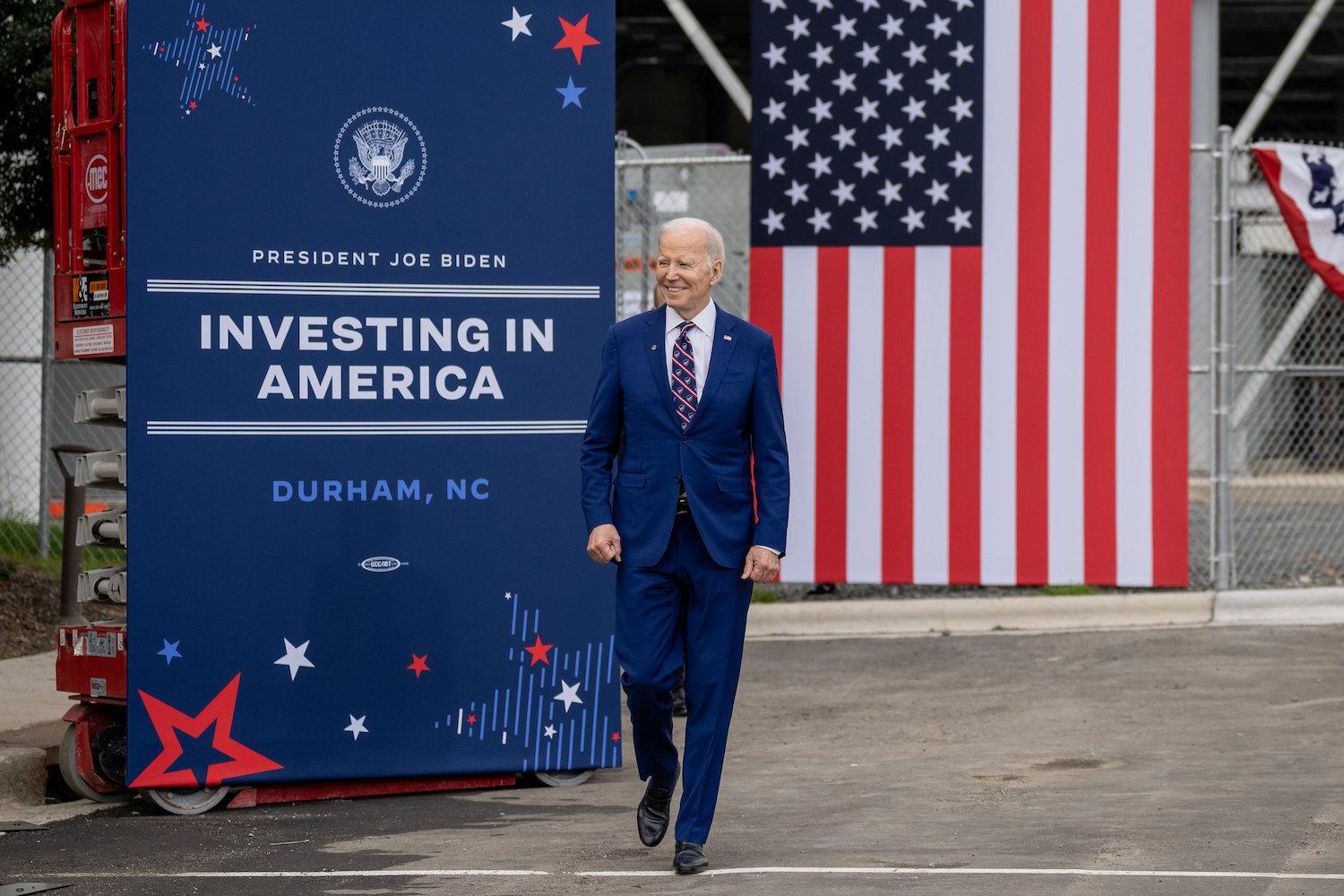
U.S. President Joe Biden arrives at the Wolfspeed semiconductor manufacturing plant in Durham, North Carolina, for the kickoff of his “Investing in America” tour last month. (Image credit: Official White House Photo by Adam Schultz)

By Tina Casey from triple pundit.com • Reposted: April 20, 2023

The Joe Biden administration fought tooth and nail to pass new laws that transform the carbon-heavy U.S. economy into a climate action hero. The results are beginning to show. Both the Inflation Reduction Act and the CHIPS and Science Act provide federal tax credits for manufacturers to onshore their operations in the U.S. Red states are benefitting from the renewed U.S. manufacturing boom as well as blue states, further undercutting the anti-ESG movement promoted by high-profile Republican office holders.

U.S. drops the ball on climate action

Ironically, the U.S. sparked the solar technology revolution back in the 1950s when the National Aeronautics and Space Administration (NASA) was searching for energy to power operations in orbit. The U.S. continued to dominate the global solar industry for decades.

Unfortunately, by the time former President Barack Obama took office in 2009, overseas manufacturers had caught up and raced ahead. In addition, the mainstream market for renewable energy was only beginning to take shape. The overall, installed (aka levelized) cost of solar panels and wind turbines remained high relative to fossil energy during President Obama’s time in office. Blowback against his Clean Power Plan and ongoing competition from overseas manufacturers provided two additional obstacles.

The clean power manufacturing situation worsened under former President Donald Trump. He took office as a strong supporter of fossil energy and pulled the U.S. out of the 2015 Paris Agreement on climate change. Though he talked a big game about bringing back U.S. manufacturing jobs, he disengaged with the job-creating, global decarbonization movement. His U.S. manufacturing policy was failing long before the COVID-19 pandemic struck in March of 2020.

The Biden administration picks up the ball and runs with it, spurring billions in U.S. manufacturing commitments 

The new Biden-supported legislation provide a sharp contrast in both policy and circumstances. In addition to substantial tax breaks, the Biden administration is benefitting from the continuation of Obama-era initiatives that fostered a drop in the cost of renewable energy hardware while addressing obstacles in the “soft” area of costs related to inspections, permits, marketing and other administrative areas. Leading U.S. corporations also continued to raise the demand for renewable energy by leveraging their buying power throughout the Trump administration.

The results have been striking. On Jan. 11, for example, the South Korean Firm Hanwha Solutions Corp. announced a $2.5 billion plan to construct a solar manufacturing campus in Georgia. The soup-to-nuts campus will include facilities to manufacture solar ingots, wafers, cells and modules.

That’s just one example. Last week, the Financial Times credited the Biden administration with attracting new corporate manufacturing commitments totaling more than $200 billion since the Infrastructure and CHIPS bills passed last year. “The investment in semiconductor and clean tech investments is almost double the commitments made in the same sectors in the whole of 2021, and nearly 20 times the amount in 2019,” reported Amanda Chu and Oliver Roeder of the Financial Times, citing data the paper compiled on U.S. manufacturing deals.

“While the FT identified four projects worth at least $1 billion each in these sectors in 2019, there were 31 of that size after August 2022,” they added. The Financial Times also took note of 75 other new clean tech manufacturing projects in the U.S. of $100 million or more.

Who’s afraid of the ESG?

Chu and Roeder of the Times concluded by observing that additional guidance on the tax credits is forthcoming from the Biden administration, leading to the announcement of even more projects in the near future.

Red states are already jostling with blue states for a share of the action, regardless of state-level Republican officials who have been railing against “woke” capitalism and ESG (environmental, social and governance) factors being used in investing. The anti-ESG movement purports to protect public pension funds, but it is nothing more than a thinly disguised effort to protect fossil energy stakeholders. 

Georgia is a case in point. The Republican-led state never enacted a renewable energy portfolio standard or even set voluntary renewable energy targets. It has lagged behind other states in terms of increasing access to renewable energy within its borders. However, Georgia policymakers seem to have no problem with enticing clean energy industries to set up shop in the Peach State.

Hanwha company Qcells opened its first solar panel factory in Dalton, Georgia, in 2019. That put the state on the map as host to the largest factory of its kind in the Western Hemisphere, and Republican Gov. Brian Kemp has been effusive in his praise for the company’s decision to add another $2.5 billion to the state’s economy.

“Qcells will build a new facility in Cartersville and add a third facility to its Dalton location, creating more than 2,500 new jobs in northwest Georgia. These investments are expected to bring Qcells’ total solar panel production capacity in Georgia to 8.4 gigawatts by 2024,” the governor’s office reported in January.

“With a focus on innovation and technology, Georgia continues to set itself apart as the No. 1 state for business,” Gov. Kemp stated. “Georgia provides a business-friendly environment that means jobs for hardworking Georgians in every corner of the state and success for both existing and new companies. We’re excited for Qcells’ continued success in the Peach State.”

Those “business-friendly” words are at odds with Kemp’s support for anti-LGBTQ legislation, but the point has been made. Georgia and other red states don’t care if their new Biden-enabled, home-grown industries export technologies that shrink the fossil energy profile of the US. Regardless of their political posturing, they just want the jobs.  

To see the original post, follow this link: https://www.triplepundit.com/story/2023/climate-laws-us-manufacturing/771896


6 things to know about heat pumps, a climate solution in a box

3 04 2023

James Tucker got an efficient heat pump for his home near Oakland, Calif., last year. Now homeowners can get new credits for heat pumps from federal climate legislation. Photo: Julia Simon/NPR

By Julia Simon from National Public Radio •  Reposted: April 3, 2023

Sales of super-efficient electric heat pumps are rising, now overtaking sales of gas furnaces in the U.S. But what are heat pumps? And why do some call them a key climate solution? Here are the answers to your most burning heat pump questions.

What is a heat pump and how does it work?

The name “heat pump” is a bit of a misnomer, says Kevin Kircher, assistant professor of mechanical engineering at Purdue University who works with the Center for High Performance Buildings.

“A lot of people dislike the name ‘heat pump’, right? ‘Cause it doesn’t really convey, you know, the full range of what the machine can do,” he says. 

Heat pumps can work for both heating and cooling. Kircher says you can think of a heat pump as an air conditioner that can also work backwards. The highly efficient machines use electricity and refrigerants to cool air on hot days.

In the winter, even if the outdoor air is cold, it’s still normally warmer than the refrigerant inside the heat pump, Kircher says. So the refrigerant can absorb bits of heat from the outdoor air and bring it inside to warm your home.

What are the climate benefits of heat pumps?

The fact that heat pumps use electricity is a big reason why governments around the world see them as a key climate solution, says Yannick Monschauer, energy analyst at the International Energy Agency in Paris. That’s because heat pumps can replace gas furnaces, and the electricity they run on is increasingly powered by renewables, Monschauer says. Reducing gas usage in homes also reduces leaks of methane, a potent planet-heating gas.

Fossil fuel-based heating still accounted for 45% of global heating equipment sales in 2021. But if governments like the US and the European Union meet the targets laid out in climate legislation like the Inflation Reduction Act and REPowerEU, heat pumps could significantly slash planet-heating fossil fuel use in buildings, Monschauer says.

“We see that heat pumps could bring down global CO2 emissions by half a gigaton by the end of this decade,” he says. “So that is comparable to the annual emissions of Canada.”

James Tucker with his heat pump that replaced his old gas furnace.
James Tucker with his heat pump that replaced his old gas furnace. Photo: Julia Simon/NPR

Will the government help me pay for it?

Last year’s federal climate legislation offers new economic incentives for homeowners to install heat pumps, says Steven Nadel, executive director of the American Council for an Energy-Efficient Economy, a research organization working on saving energy. An IRS spokesperson tells NPR that the new credits can translate to up to $2000 for efficient heat pumps bought after January 1, 2023. If you buy a new heat pump, Nadel says to keep your receipts for reference for next year’s tax season. If you bought a heat pump in 2022 you can get credit for this upcoming tax season, but the previous incentive was smaller, up to $500, the IRS says. 

Some states and some utilities also give rebates for efficient heat pumps. Nadel says you should check with your utility to see if there are programs available in your area. 

As for renters, it’s also possible to get credits for appliances like efficient heat pumps according to the IRS. 

Do heat pumps actually work in cold temperatures?

Earlier generations of heat pumps didn’t work as efficiently in freezing temperatures, but Monschauer says there’s been great improvements in technology.

“In the coldest parts of Europe we also have the highest shares of heat pumps. So in Norway, for example, 60 percent of the households are equipped with heat pumps. And in Sweden and Finland it is also 40 percent. So it’s definitely proven that it’s possible.”

The heat pump systems commonly found in Scandinavian homes do not need to run on backup fossil fuels, Monschauer says. 

Not all heat pumps sold in the U.S. work well in the coldest weather. It’s important that you consult with an installer who is familiar with heat pumps, and make sure to find a machine that’s most efficient for your weather, Nadel says. 

“In a cold climate that gets below 20 degrees Fahrenheit fairly often, you should look into getting into an Energy Star cold climate certified heat pump,” Nadel says, referring to a U.S. government program that makes markers for efficiency.

Heat pumps can work for both heating and cooling. You can think of a heat pump as an air conditioner that can also work backwards.
Heat pumps can work for both heating and cooling. You can think of a heat pump as an air conditioner that can also work backwards. Photo: Julia Simon/NPR

Can heat pumps save money?

Because heat pumps move heat around instead of burning fossil fuels for heat, they are more efficient than gas furnaces. And while heat pumps are typically more expensive on the front end, the savings come over time when you end up spending less on gas, says Brian Rees, a heat pump installer at Bryant Air Conditioning & Heating Company in Lincoln, Nebraska.

Rees says the cost savings are what attract his customers to heat pumps, “It’s more about hitting their pocketbook,” he says. “It’s more about what’s going to save them money in the long run, and heat pumps will do that.”

Kircher says you can also save money if you can buy a heat pump for both your heating and cooling needs. “It’s typically cheaper than buying a gas furnace plus an air conditioner,” he says. 

Are there downsides to heat pumps?

Like refrigerators or air conditioners, heat pumps use refrigerants. The primary refrigerants commonly used in heat pumps are called hydrofluorocarbons, or HFCs, says Duncan Callaway, associate professor of Energy and Resources at UC Berkeley. These HFCs have high global warming potential if they’re released into the atmosphere, Callaway says.

That’s why it’s critical that heat pump installers make sure that those refrigerants don’t leak and are disposed of properly, he says. 

“We need well-trained technicians that sort of understand the importance of collecting that refrigerant and not letting it emit into the atmosphere,” Callaway says.

Kircher also notes that researchers are currently working on developing refrigerant substitutes for HFCs that can drastically reduce climate impacts.

Copyright 2023 NPR. To see more, visit https://www.npr.org.

To see the original post, follow this link: https://www.mprnews.org/story/2023/04/01/npr-6-things-to-know-about-heat-pumps-a-climate-solution-in-a-box


Can this former CEO fix the World Bank and solve the world’s climate finance and debt crises as the institution’s next president?

2 04 2023

Ajay Banga is a former Mastercard CEO, past chair of the International Chamber of Commerce and an American. The U.S. is the largest World Bank shareholder, and the institution’s president has historically been American. Photo:Tony Karumba/AFP via Getty Images

By Rachel Kyte, Dean of the Fletcher School, Tufts University via The Conversation • Reposted: April 2, 2023

Many low- and middle-income countries – the population the World Bank is tasked with helping – are falling deeper into debt and facing growing costs as the impacts of climate change increase in severity. A chorus of critics accuse the World Bank of failing to evolve to meet the crises.

The job of leading that reform is now almost certain to fall to Ajay Banga, an Indian American businessman and former CEO of Mastercard who was nominated by President Joe Biden to replace resigning World Bank President David Malpass. Nominations closed on March 29, 2023, with Banga the only candidate

There is no shortage of advice for what Banga and the World Bank need to do.

The G-20 recently issued a report urging the World Bank and the other multilateral development banks to loosen their lending restrictions to get more money flowing to countries in need. A commission led by economists Nicholas Stern and Vera Songwe called for a rapid, sustained investment push that prioritizes transitioning to cleaner energy, achieving the U.N. sustainable development goals and meeting the needs of increasingly vulnerable countries. 

African ministers of finance will soon come out with their own “to do” list for the World Bank, and India’s minister of finance just pulled together an expert group to consider World Bank reform.

Banga will walk into the job with these and many other to-do lists. Yet he will inherit a corporate culture that makes the World Bank Group too inwardly focused and too slow to respond.

I have worked for the World Bank Group and with it from the outside. I see four key roles – four “C’s” – that Banga will need to master from the outset. From his track record and his reputation for deep thoughtfulness, I am confident that he can.

1) Act as a CEO and get the entire World Bank Group house in order.

The World Bank Group is a conglomerate with four balance sheets, three cultures and four executive boards, plus a dispute resolution arm.

Lending to low- and middle-income countries is just part of its role. The World Bank Group also provides technical assistance across all areas of economic development and invests in and provides risk insurance to encourage companies to invest in projects and places they might otherwise consider too risky. Its ability to mobilize private-sector finance and stretch every dollar is crucial for meeting the world’s development and climate adaptation and mitigation needs.How the World Bank operates.

Banga will need to set clear goals for each part of the World Bank Group and get them working more effectively to help the world achieve its goals.

2) Assume the mantle of collaborator in chief to take on the debt and climate crises.

Many of the World Bank Group’s client countries are facing both mounting debt and rising costs from climate change. 

The high cost of borrowing can hamper developing countries’ ability to invest in needed infrastructure to grow and protect their economies, and they fear being locked out of global trade as the United States’ green subsidies in the Inflation Reduction Act and Europe’s border carbon tax may make it more difficult for them to compete.

The solutions to cascading problems like these cannot be managed by one institution. However, the current multilateral development bank system – the World Bank Group and the regional development banks – is disjointed at best and competitive at worst./

In the past, the leaders of the development banks, the International Monetary Fund and the World Trade Organization have cooperated, more or less, depending on crises and personalities, and can move fast when they need to.

During the global financial crisis of 2008 and 2009, for example, the then-heads of the World Bank and the WTO hurried to develop trade finance facilities to support banks in developing countries as capital fled to the U.S. and Europe. It took intense diplomacy to push wealthy countries and institutions to get money out the door to shore up businesses and trade. Success was measured not in months but in days.

The new president of the World Bank will need to support more radical collaboration among development financial institutions, including pooling capital and talent, to help respond quickly to countries’ needs.

It won’t be easy. Institutional rivalries run deep. But with budgets tight, there is growing clarity that there is no choice – the capital that is already in the system is the closest at hand and can be deployed to better effect if the institutions are willing to adapt.

3) Be a convener.

Overhauling how international finance works will require everyone to be on board – development banks, central banks, regulators, investment banks, pension funds, insurance companies and private equity.

Banga and International Monetary Fund Managing Director Kristalina Georgieva can settle institutional differences and present a coordinated face to private investors and the major lending countries, including China – which has emerged as the biggest holder of developing country debt – to speed up support to struggling countries.

On other issues, such as nature-based solutions to climate change, building resilience and economic inclusion, the World Bank Group can bring its significant resources and skills, including data analysis, to global conversations that it has been painfully absent from for the past four years.

4) Be a champion for the most vulnerable.

The world’s most vulnerable people are the World Bank Group’s ultimate beneficiaries. For those living on the front line of biodiversity loss and climate impacts, such as extreme heat, drought and flooding, the current international financial system is proving inadequate.

The World Bank Group’s management incentives are still too oriented to lending approved by the board, not the outcomes of that lending, advice and assistance.

Throughout its history, World Bank leaders have been able to make rapid changesto better help vulnerable countries when they stay close to the needs of their ultimate beneficiaries and the goals that the world has set.

The next president faces turbulent times. Banga’s careful listening on his campaign tour signals that he understands the complexity. It’s an extraordinary moment in the history of the institution, with sky-high expectations of what one leader needs to do.

Copyright © 2010–2023, The Conversation US, Inc.

To see the original post, follow this link: https://theconversation.com/can-this-former-ceo-fix-the-world-bank-and-solve-the-worlds-climate-finance-and-debt-crises-as-the-institutions-next-president-202900


Climate Justice Innovators Get $27 Billion Boost From the EPA

27 02 2023

Image credit: KE ATLAS/Unsplash

By Mary Mazzoni from Triple pundit • Reposted: February 17, 2023

The U.S. Environmental Protection Agency is moving the Greenhouse Gas Reduction Fund forward and making good on its recently renewed commitments to environmental and climate justice.

Created by the Inflation Reduction Act of 2022, the Fund aims to mobilize public and private capital to reduce emissions and combat air pollution across the U.S., with a focus on low-income and historically marginalized communities. 

As a first step, the Fund will host two grant competitions worth $27 billion, the EPA announced in its initial guidance last week. A $7 billion competition will award grants to 60 organizations providing clean technologies like community solar and energy storage within U.S. communities. A second will disburse $20 billion to anywhere from two to 15 nonprofit lenders, including community-based lenders and green banks that provide financial assistance for low- and zero-emission technologies in low-income communities. 

“The Greenhouse Gas Reduction Fund will unlock historic investments to combat the climate crisis and deliver results for the American people, especially those who have too often been left behind,” said EPA Administrator Michael S. Regan, the first Black man to head the agency, in a statement. “With $27 billion from President Biden’s investments in America, this program will mobilize billions more in private capital to reduce pollution and improve public health, all while lowering energy costs, increasing energy security, creating good-paying jobs and boosting economic prosperity in communities across the country.”

Those are pretty big words, but a host of environmental and climate justice advocates agree about the Fund’s promise. “This is a huge step,” Adam Kent, Sarah Dougherty and Douglass Sims of the Natural Resources Defense Council’s People and Communities Program, wrote of the Fund in a blog. “It has the potential to not only improve lives, but ultimately transform ‘green’ investments into ‘mainstream’ investments by catalyzing far, far more than $27 billion of investments and building a more equitable clean energy future.”

$27 billion and beyond: Mobilizing funds for climate justice in U.S. communities 

An estimated 1 out of every 25 premature deaths in the U.S. can be linked to air pollution — more than traffic accidents and shootings combined. People of color and low-income people are more likely to be exposed to high levels of air pollution and as such are at greater risk of premature death. These communities also face outsized impacts from climate change. 

Addressing environmental and climate justice issues like these is a key focus in President Joe Biden’s plan to leverage federal funds to advance racial equity. Launched during Biden’s first week in office, the Justice40 Initiative looks to direct 40 percent of the overall benefits of certain federal investments to disadvantaged communities that are underserved and overburdened by pollution.

The Fund will align with Justice40 and take things a step further. “Although the law requires that just over half of Fund investments target low-income and disadvantaged communities, EPA will aim to prioritize investments in these communities throughout the entire $27 billion program,” report Kent, Dougherty and Sims of the NRDC. “This decision could transform how funding flows to underserved communities, and Fund investments can support critical, life-improving projects that otherwise would not have moved forward.”

The $7 billion in grants for clean technologies has the potential to scale transformative solutions like community solar and energy storage that can decarbonize underserved communities while reducing the burden of air pollution. The idea is that a cash infusion from the EPA can help recipient organizations grow and deploy even more community-based projects in pursuit of climate justice, similarly to how a $456 million federal loan helped Tesla become the world’s largest electric vehicle manufacturer. 

“These projects have the potential to create local benefits including savings on energy costs, reliability improvements, and improved air quality, as well as reducing climate pollution,” said Heather McTeer Toney, vice president of community engagement for the Environmental Defense Fund, in a statement. 

Further, the EPA’s decision to diversify its portfolio of nonprofit lenders — rather than investing in a single entity — will allow funds to reach more communities through institutions with proven track records of community-based and green lending. “This is a sound decision, as NRDC and many of our environmental justice and community-based partners have pushed EPA to select multiple recipients as a critical feature of Fund implementation,” Kent, Dougherty and Sims wrote. 

The next step

Both grant competitions are expected to launch in early summer. Organizations will have two to three months to submit their applications, and the EPA plans to make awards by late September of next year. 

The architecture of the Fund is based on input from state, local and Tribal governments, community financing institutions, environmental justice organizations, industry groups, and labor and environmental finance experts, the EPA said — and advocates are calling on the agency to keep the engagement up as it moves to start disbursing grants. 

“This is a positive step toward making the just transition affordable and accessible to those most in need,” Jessica Garcia, climate finance policy analyst at Americans for Financial Reform Education Fund, said in a statement. “The EPA should continue collecting feedback from the directly impacted communities that this fund aims to serve and developing robust criteria for its applicants to achieve its dual directive of protecting communities from climate impacts and providing them financial tools to safeguard their future. ”

To see the original post, follow this link: https://www.triplepundit.com/story/2023/climate-justice-epa/766666


U.S. Climate Targets Are Within Reach, But Overconsumption Still Matters

31 01 2023

Image credit: Alexandru Boicu/Unsplash

By Riya Anne Polcastro from TriplePundit.com • Reposted: January 31, 2023

There’s good news on the viability of President Joe Biden’s climate agenda, with a new report detailing how the U.S. could potentially come within reach of his 2030 objective to power 80 percent of the nation’s electrical grid with clean energy. Doing so would also meet U.S. targets to halve carbon emissions by 2030, using a 2005 baseline, and further reduce them to 77 percent below 2005 levels by 2035, according to the report from the Natural Resources Defense Council (NRDC) and Evergreen Action.

Time is of the essence, however. And not just because of any impending climate tipping points. The current administration isn’t guaranteed a second term. And, as the Washington Post’s Maxine Joselow pointed out last week, an incoming Republican president would likely reverse any last-minute changes. Ironically, rushing the conversion may also be the best way to end partisanship over the issue as long-term savings become apparent to businesses and consumers alike.

“President Biden committed to the most ambitious set of climate goals in American history,” Charles Harper, power sector policy lead at Evergreen Action, said in a statement. “Important progress has been made, but President Biden must take bold action this year in order to deliver on those commitments. By ramping up its work to transition the U.S. economy toward 100 percent clean energy, the Biden administration and state leaders can reduce toxic pollution, cut energy costs, create good jobs, and advance environmental justice. Let’s get to work.”

The report lists necessary measures which, based on modeling, could result in meeting the climate goals set out in the president’s Inflation Reduction Act (IRA) if they are implemented immediately. Researchers say setting new and stringent rules through the Environmental Protection Agency and the Clean Air Act, as well as the Federal Energy Regulatory Commission (FERC), will be paramount. Other necessary courses of action include making the most of the IRA’s grant programs and tax credits, and promoting stronger state standards on emissions to match federal targets.

“We don’t need magic bullets or new technologies,” Manish Bapna, NRDC president and CEO, explained in a statement. “We already have the tools — and now we have a roadmap. If the Biden administration, Congress, and state leaders follow it, we will build the better future we all deserve. There is no time for half measures or delay.”

The report does not call for an end to new power plants that generate electricity from fossil fuels, but it does recommend that rule changes and emission standards be applied to existing gas and coal facilities as well. The transition away from fossil fuels is thus presented as more of a carrot than a stick situation — with funds from the IRA needed to encourage the expansion of renewables, as opposed to attempting to eliminate the construction of new fossil fuel-based plants. 

The increasing availability and cheaper cost of renewable energy benefits not just consumers, but also the U.S. manufacturers and businesses that rely on all possible savings to remain competitive. The more that can be done to encourage the grid transition to renewables, the cheaper power will be for everyone. In time, then, partisan opposition to renewable energy should wane.

However, it’s important to remember that no type of consumption comes without consequences. Resources must still be extracted to build batteries, solar panels, wind turbines, etcetera in order to power the clean energy revolution. As such, we must be more careful not to create a whole new environmental disaster in the process of slowing the climate crisis.

People in the U.S. use four times as much energy as the worldwide average. Cheaper power runs the risk of increasing total consumption, as seen with the connection between gasoline prices and driving habits. With the impending robotization of multiple industries, increased power usage could be dramatically compounded and raise emissions above current modeling. Therefore, it is imperative that people in the U.S. look to reduce their consumption, in addition to cleaning up the grid. 

Many Americans are already willing to adjust their lifestyles to combat climate change, but they need the tools to successfully lower their carbon footprints. Clean power is a big part of this, but so is a public transportation infrastructure that moves us away from the personal passenger vehicle — electric or not — as the primary mode of transportation.

Likewise, the backlash against remote work doesn’t just dismiss employee needs, but it also ignores the environmental benefits of fewer commutes and climate-controlled office buildings. By looking at the bigger picture, perhaps we will begin to understand that our planet does not have unlimited resources. No matter how we power things, we cannot do so from a thought process of ever expanding abundance with zero consequences. 

To see the original post, follow this link: https://www.triplepundit.com/story/2023/us-climate-targets-overconsumption/765046


New Taxonomy Released to Combat Greenwashing in Investments

27 01 2023

Image credit: Alexander Tsang/Unsplash

By Mary Riddle from Triple Pundit. Posted: January 27, 2023

Investors, insurers, and financial institutions in the EU have a new method for assessing the sustainability of their investments. Last week, the Observatory Against Greenwashing launched its independent Science-Based Taxonomy, in direct response to the EU Taxonomy system that some say is ineffective. 

The EU Taxonomy is a classification system that claims to give investors, businesses, and financial institutions a common language for identifying the degree to which a specific investment, financial product, or economic activity can be considered sustainable.

However, critics have said the draft guidance is not sufficiently science-based and certain aspects, such as classifying gas-fired power, tree-burning, logging and nuclear energy as sustainable, could do more harm than good.

To create a more sustainable system for classifying investments, a coalition of experts and NGOs including WWF, BirdLife International, and Transport and Environment, formed the Observatory Against Greenwashing (OAG). The group aims to improve on the EU Taxonomy and provide investors with better, science-based guidance on the sustainability of their investments. 

What is the independent Science-Based Taxonomy?

The independent Science-Based Taxonomy is based on the EU Taxonomy, but it only keeps the portions of the text that researchers found to be environmentally sound. It also makes more robust criteria for the parts of the EU Taxonomy that the OAG deemed unscientific or harmful to the environment.

“The EU Taxonomy was originally designed to eliminate greenwashing but instead has become another tool to deceive consumers,” Vedran Kordić, EU Taxonomy coordinator from WWF Adria, said in a statement. “The science-based Taxonomy wants to succeed where the original Taxonomy failed: It will create rigorous criteria which financial institutions can use to properly assess what is green and what is not.” According to the OAG, 1 in 3 activities deemed sustainable in the EU Taxonomy actually cause planetary harm. 

The EU Taxonomy was established in 2018 with a mission to inject capital into projects that would help the EU meet objectives laid out in its Green New Deal, including carbon neutrality by 2050. But critics argue the EU Taxonomy is disingenuous and fundamentally flawed due to the inclusion of natural gas and nuclear energy sources on its list of sustainable investment options.

“This isn’t good enough. We need a better taxonomy, one based on science,” said Luca Bonaccorsi, sustainable finance director at Transport and Environment, a coalition of European NGOs working on transportation issues, in a statement. “Now the investor community has it.”

ESG regulations are expanding in the EU and beyond

While controversy continues to surround ESG regulation for financial products in the EU Taxonomy, the EU Commission is calling for an increase in regulation of other consumer goods and services in an attempt to respond to claims of bogus greenwashing. The EU has drafted a legal proposal that would require companies to provide scientific evidence to justify sustainability claims such as “carbon neutral” or “contains recycled materials.” The draft rule also calls on EU countries to develop systems for evaluating the environmental claims of companies, including issuing penalties for businesses that do not comply. 

The expansion of ESG (environmental, social and governance) regulation is not limited to Europe. In the United States, the Inflation Reduction Act is expected to channel over $400 billion into clean tech companies over the next 10 years. Additionally, the U.S. Securities and Exchange Commission is expected to finally issue its climate disclosure regulations in April, several months later than planned. The new SEC rules, if issued, would require companies to make disclosures surrounding their climate-related risks, as well as their greenhouse gas emissions and those of their supply chains.