Truly Sustainable Businesses Gain a Competitive Advantage

28 11 2023

Image: SAP

By Heather Davies via SAP.com • Reposted: November 28, 2023

Ahead of the UN Climate Change Conference COP28 in Dubai, UAE, SAP Insights has released the results of its Wave 3 sustainability study. The research reveals key insights for businesses scaling their environmental efforts and builds on survey findings from 2021 and 2022.

While Wave 1 served to benchmark companies on their sustainability journey, Wave 2 identified a maturing approach to embedding sustainability across business processes. Results from this latest study show truly sustainable businesses – those that have established sustainability as part of business strategy and operational decision-making – achieve a genuine competitive advantage. In addition, more respondents than ever see a stronger positive relationship between sustainability and competitiveness with 72% believing sustainability contributes towards their competitive differentiation.

“We see in the research how many companies are shifting to view sustainability no longer as a regulatory compliance tactic, but becoming more of a strategy to actually build business value,” Sarah Dziuk, SAP Insights Head of Research, said.

The study includes results from 4,750 respondents across 21 nations and 29 industries. Eighty-five percent of responses came from midmarket businesses (under US$1 billion annual turnover) and 15% from large enterprises (over US$1 billion turnover per year).

Making More Leaders Accountable

A key finding in Wave 3 was that businesses making the connection between sustainability and competitiveness make more leadership roles accountable for sustainability. This allows for a broader span of control and more accountability. The most competitive companies tend to have more than one top action taker such as a chief sustainability officer and an environment or sustainability manager.
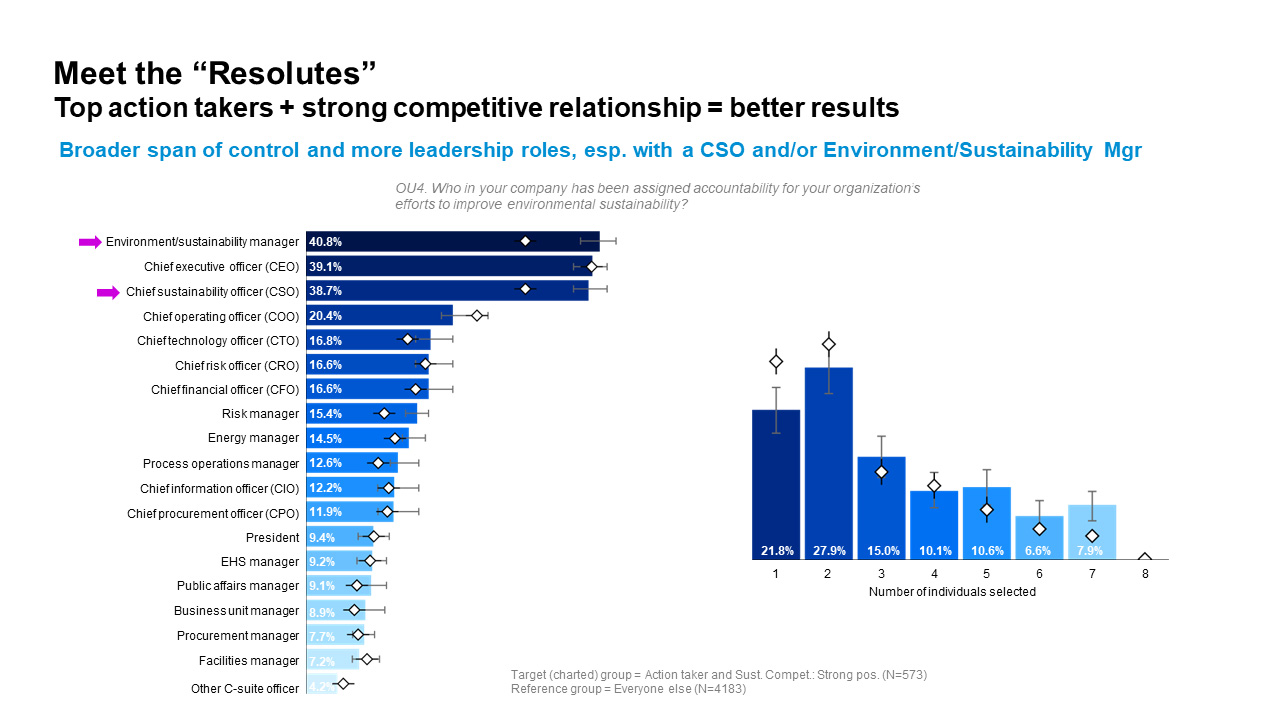
Bar graph showing who respondents identified as accountable for their organization's efforts to improve environmental sustainability
Click to enlarge.

“Our experience suggests that success is more likely when executives empower [their] organizations to engage proactively and strategically hold them responsible for creating measurable impact. Only then will companies be able to maximize the value at stake from their sustainability initiatives.”McKinsey

Improving Data Quality

Becoming an intelligent, sustainable enterprise requires regular, reliable, and accessible data. With the majority of emissions sitting within a company’s supply chain, shareability across business networks is also essential for meaningful decision-making. Unfortunately, many companies still rely on estimates and assumptions, many of which they gather manually.

Highly sustainable organizations have a solid focus on the quality of their sustainability data. Quality data comes from primary sources that track actual emissions, waste, and other elements. Unsurprisingly, this leads to more satisfaction with the data. The companies with the most substantial connection between sustainability and competitiveness report the highest level of satisfaction with overall data quality – 47% compared to just 10% of other organizations.
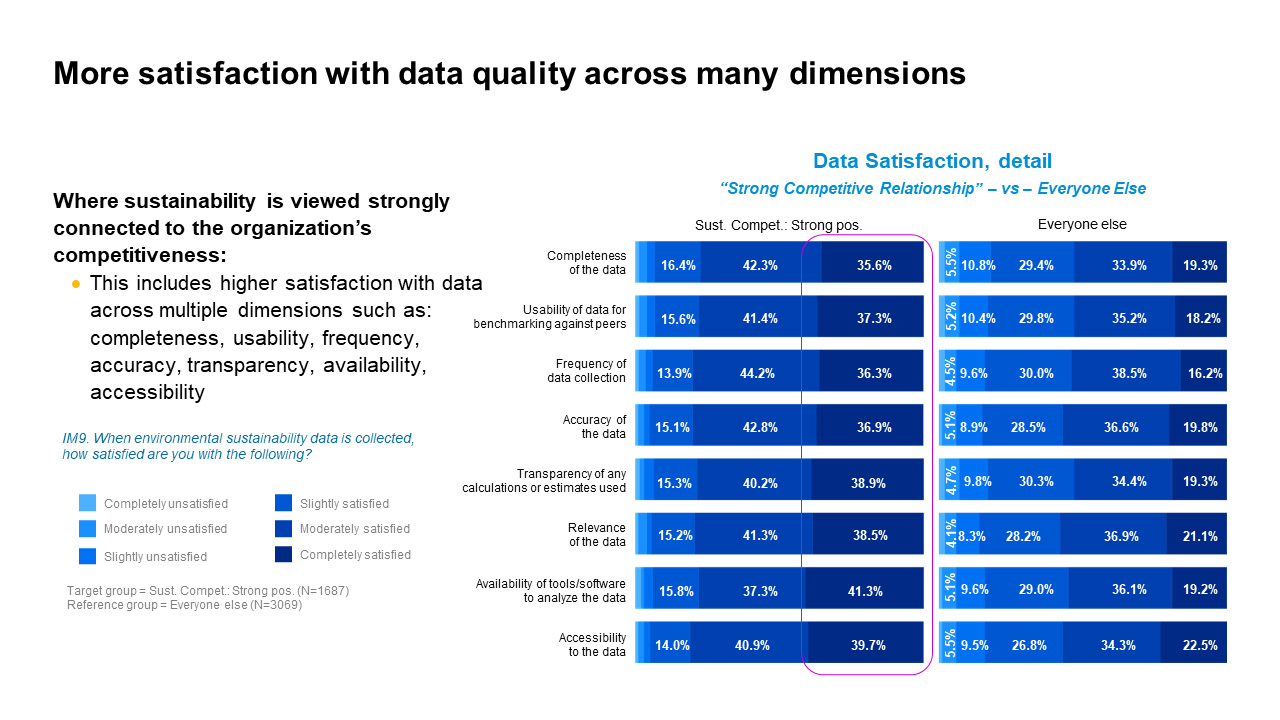
Graphic showing respondents answers to how satisfied they are with different factors (such as completeness of data) when environmental data is collected
Click to enlarge.

Reliable data is more useful in determining strategy. Forty-one percent of respondents indicate strong data usage to inform decision-making. They also integrate data into more business processes and operations such as procurement, product labeling, selecting M&A opportunities, and recruitment.

“The way we report on environmental data needs to quite quickly go through the same journey that accountancy went on many years ago.” Stuart Coleman, Open Data Institute

S.Oleum, a Brazilian agroforestry business that generates a third of its revenue from carbon credits, has implemented several SAP software solutions to help track and manage its environmental, social, and governance (ESG) data. Having a robust core system in place serves as a basis for all other processes and decision-making, as well as provides the accountability, transparency, and confidence it needs.

Quality data is the cornerstone of Catena-X, a program that allows the standardized exchange of carbon emissions data in the automotive industry using interoperability standards established by the WBSCD Partnership for Carbon Transparency (PACT). This lets businesses share product carbon information, promoting transparency throughout the supply chain, accelerating their journey to net zero, and making them more competitive in the process.

Sustainability as a Business Strategy

The top 25% of businesses reporting the strongest impact from sustainability reported that they treat sustainability as any other strategic pillar, on a par with IT for example. This has resulted in a much higher use of metrics for decision-making, increased investment, higher data satisfaction, and higher confidence of a return on investment in a one-to-three year period.

It has also led to positive business impacts including growth and improved profitability, increased efficiency, better quality products and services, and reduced costs, suggesting a truly sustainable business is more robust and resilient.
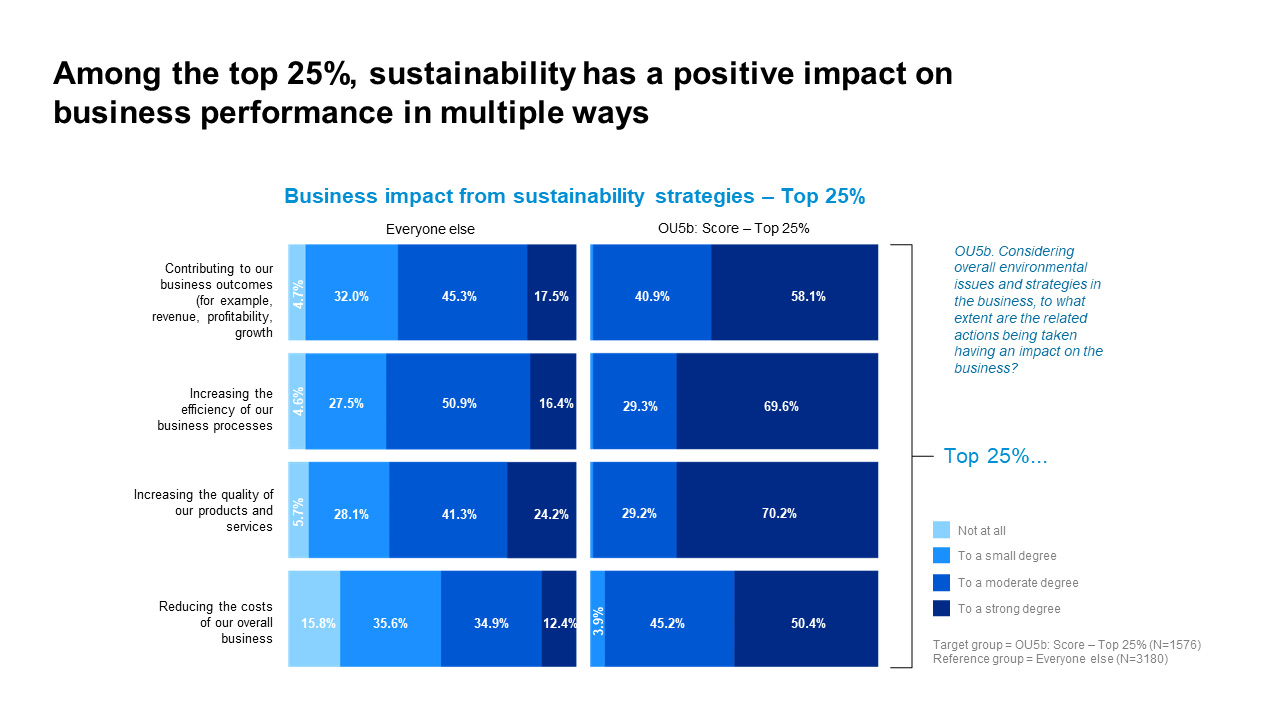
Graphic showing how respondents think actions that are being taken are having an impact on their business
Click to enlarge.

With clearer business imperatives, companies make investment decisions to drive business value. They invest in sustainability initiatives and can set realistic expectations of a positive financial return on investment in a shorter time frame, putting sustainability on a comparable timeline with other investments.

Linking Sustainability to Competitiveness

Companies are motivated to take action on sustainability when they see it as a genuine opportunity for differentiation and revenue growth. This leads them to make more people responsible for delivering on sustainability strategies and renders the barriers typically encountered earlier in a company’s sustainability journey, such as funding and concerns over ROI, less material.
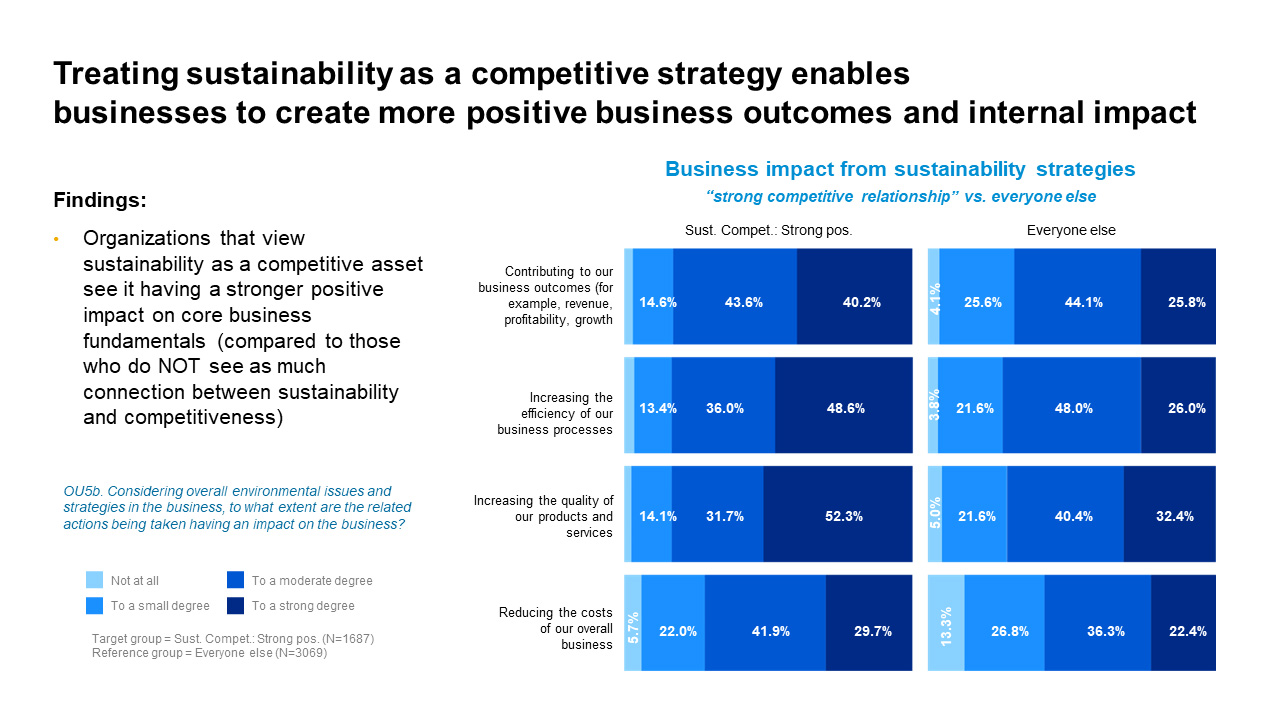
Graphic showing findings around business impact from sustainability strategies
Click to enlarge.

It is interesting to note that in the UAE, where sustainability has been promoted at a country level as being as crucial for differentiation, a high proportion of companies (nearly 74%) are planning to increase their investment in environmental issues over the next three years.

The commitment to investment and lack of skepticism around sustainability in the UAE leads businesses there to report a significantly higher than average level of satisfaction with data – 36% are completely satisfied compared to 23% in the rest of the global results. More of these businesses, therefore, use reporting for decision-making, which is viewed more materially and results in decisions being taken more quickly. A positive relationship between sustainability and competitiveness is the culmination of these favorable indicators, allowing them to outshine their competitors in their sector.

Conclusion

The Wave 3 study results are clear: reacting to sustainability initiatives and demands isn’t adequate to gain a competitive advantage. Companies must invest in and treat sustainability as a key business strategy to unlock opportunities. In doing so, they will set a virtuous circle in motion where investment in accountability and better quality data drives more strategic decision-making and further investment. This benefits the company as a whole, making it more efficient, profitable, and robust in the face of the changing climate.

Read the full SAP Insights research study to learn more. To see the original post, follow this link: https://news.sap.com/2023/11/sap-sustainability-research-study-wave-3/




Be loud and proud with sustainable practices

14 10 2023

Image: ERP

By Richard Howells, VP, ERP and Digital Supply Chain at SAP via ERP Today • Reposted: October 14, 2023

With a world caught up in climate difficulties, sustainability needs to take the priority, along with ensuring ethical practices.

Consumers want to buy sustainable products from ethical companies, and they’re willing to put their money where their mouth is. In fact, recent studies show that eight out of ten consumers said they would pay up to 5 percent more for sustainably produced goods.

Yet it can be challenging for consumers to identify which products are truly sustainable. While regulators establish minimum standards for everything from drinking water to vehicle emissions, individual retailers are beginning to adopt expanded measures that go considerably further as a way to address consumer concerns and advance their own sustainability goals. In June, for example, Walmart and Sam’s Club announced an initiative to raise supplier standards around tuna fishing. Their new policy aims to address issues such as accidental catching of species other than tuna, illegal fishing and abandonment of fishing gear. All of these factors pose a threat to ocean ecosystems.

To ensure suppliers are complying with these standards, Walmart and Sam’s Club will need increased visibility across the tuna supply chain, and they’re not alone in this need. Whether companies are seeking to comply with regulatory standards or track progress against their internal policies, they need transparency in every tier of their complex supply chains.

Efficient, effective technology can help businesses acquire and manage the data and information they need to measure compliance, minimize risk and boost sustainability. IoT devices, embedded in fishing vessels and storage facilities, can collect data on fishing practices, temperatures and handling conditions, contributing to effective oversight and management of sustainability practices. This kind of data will also be of great interest to retailers.

Gain access to relevant data

Accessing accurate data is the first step for businesses to gather the sustainability information they need. Walmart and Sam’s Club are focused on their oversight of transshipment – the practice of transferring fish products from one fishing vessel to another at sea or in port – which offers opportunities for bad actors to hide illegal or unregulated fishing activities. By 2027, Walmart and Sam’s Club will only source from fisheries that offer 100% monitoring of transshipment activity – a process that will produce massive amounts of data.

One solution is to implement a technology layer that can gather data, measure KPIs and benchmark against other companies in the same industry. The ability to track and trace the movement of products from one location or company to another lets businesses create an unbroken chain of ownership from raw materials to finished goods. Or in this instance, from sea to plate.

Rely on collaboration tools to share data

With accurate data in hand, companies need collaboration tools that ensure the data’s integrity and authenticity from end to end. As a decentralized and unchangeable ledger, blockchain technology can ensure data is uncompromized as it moves from one company to another, or otherwise changes ownership.

This data must be housed in a system that allows companies to determine exactly which end products their raw materials went into, as well as every step they underwent along the way. This type of system enhances the ability of companies like Walmart and Sam’s Club to monitor reports from transshipment observers and other inputs. It can also be helpful in the event of a product recall or other product safety concerns.

Showcase sustainability to customers

Companies can now focus on the customer experience, implementing tech-enabled features that allow end consumers to access the information they’ve gathered about their supply chain. This type of transparency builds trust and strengthens brand reputation. That’s especially true for Gen Z consumers, who are particularly conscious of sustainability.

Stay on top of regulatory and compliance issues

Regulatory oversight of supply chain issues is increasing around the world. Several European countries and the United States have recently passed legislation mandating due diligence in supply chains, while the European Union and Canada have proposals under consideration. Technology solutions can help businesses track their compliance with constantly changing regulations to back up their sustainability claims.

What companies need to learn about supply chain visibility

The tuna fishing policy serves as a powerful case study for other companies looking to embrace sustainability as a core business principle. Like SAP, companies in our industry are committing to zero emissions, zero waste and zero inequality. Stakeholders aren’t settling for less, even amid growing anti-ESG backlash.

In this environment, a holistic approach to sustainability is key. Businesses must examine their value chains comprehensively, from sourcing raw materials to understanding the end product’s lifecycle.

By adopting technology-driven solutions like blockchain and IoT, companies can ensure that their sustainability efforts extend beyond the surface level to every aspect of their operations. Regulations and rules will only continue to grow in number, but with the right technology, companies can achieve greater supply chain visibility and meet their sustainability targets.

To see the original post, follow this link: https://erp.today/be-loud-and-proud-with-your-sustainability-practices/


Diversity and Inclusion Policies Are at Threat – Here’s How To Keep Them on Track

20 09 2023
Image: SAP
By Supriya Jha, Chief Diversity and Inclusion Officer, SAP via World Economic Forum • Reposted: September 20, 2023
  • A debate in the United States around affirmative action has placed doubt on the future of broader diversity and inclusion (D&I) policies in the workplace.
  • The adversity around proactive D&I can provide an opportunity to revisit internal policies and practices to strengthen them.
  • Here are four things organizations can do to ensure D&I goals stay on track.

Diversity and inclusion (D&I) is under fire. In the United States (US), the courts recently ruled that race could no longer be a factor in university admissions, defeating affirmative action policies. There is now a passionate and polarizing debate on whether D&I strategies in the corporate environment lead to equity or bring down meritocracies. 

To make matters worse, the narrative of defunding D&I initiatives in the corporate arena can unnerve companies’ small D&I teams. As we stand in the throws of this debate, it should be clear that D&I has not been a fleeting trend and remains an imperative that shapes the fabric of organizations and society. 

The US trajectory on D&I might seem uncertain but the need for it is clear, including at a global level. Today’s challenges are opportunities to refine and strengthen our strategies so workplaces and communities are genuinely inclusive.

Maintaining the path to an inclusive future

As organizations stand at a crossroads, here are four things that can keep one grounded in the D&I journey:

1. Cultivating a sense of belonging 

D&I is not a checkbox exercise; a common misconception is that it targets only people of colour. The purpose of D&I is to nurture a sense of belonging regardless of individual differences. When individuals feel welcomed, valued and respected, they contribute their best. 

Gone are the days when people can simply be viewed as organizational assets: employees want to be valued as individuals and creators of change. Nothing cultivates belonging more than love and care – that’s evident as we feel genuinely connected to familial units, societies and organizations that care for us.

Nurturing that belonging in the workplace requires genuine and consistent leadership, commitment and vision. When I reflect on the many actions companies took during the pandemic, the most compelling ones contributing to higher retention involved leaders being accessible and present to listen to employees. 

Creating opportunities for leaders to listen to and act on the needs of their diverse employee base is a strategy that works well in many directions. From the CEO to the front-line manager, empathetic listening skills assure employees they are heard and seen.

2. Doing the groundwork for our future

Efforts in the D&I arena are not momentary but also exist for future generations. 

As a mother of two girls, I have a vested interest in driving forward D&I in organizations. I want my daughters to experience a workplace where they can be themselves and their differences and uniqueness are celebrated. They should be provided with opportunities based on their skills and talent. 

More importantly, the workplace should help staff optimize their potential instead of wasting time fitting into cultures made by a homogenous majority. My hope is the pandemic-induced flexible and remote work policies don’t become exceptional but are normalized across industries where feasible. Additionally, providing employees with tools to recognize and address unconscious biases via continuous education and training can help raise collective awareness and foster a more inclusive environment.

Having served in the [diversity and inclusion] space for over 16 years, I’ve learned that [it] is not a one-time action; it requires resilience and constant adaption.”— Supriya Jha, Chief Diversity and Inclusion Officer, SAP SE

3. Unleashing the power of employee resource groups

Employee resource groups are beacons of progress in a company’s journey. hese networks are voluntary, employee-led groups that unite individuals with shared backgrounds, experiences, identities or interests. More importantly, they need to be open to all – so that the “upstanders” – not bystanders – and allies can find a space to learn and grow.

Spaces for shared experiences spark conversations that lead to meaningful change for the community and business. Making employee resource groups part of the business strategy with executive involvement has been tried and tested in most organizations. Enabling these groups to contribute to partner, supplier and community interactions can further help unleash the collective’s power. What makes for great strategy within the workplace can translate to a growing movement in society and the marketplace. 

4. Consistency is key

Having served in the D&I space for over 16 years, I’ve learned that it is not a one-time action; it requires resilience and constant adaption. To bring about lasting change, we must show evidence of incremental progress. But any win is worthwhile, even minor achievements.

It is essential to remember that accumulating these steady, incremental steps leads to success overall. As we navigate the complexities of implementing D&I strategies, let us recognize that it is not about a destination but the journey. 

Inculcating inclusive hiring practices at all levels, fostering environments that champion the engagement of neurodivergent talent and opening doors for underrepresented businesses will all set us on a path to a more equitable future. Setting clear and measurable goals, recalibrating at every step, celebrating the diversity and uniqueness of the workforce and amplifying the achievements loudly are the factors contributing to success.

Ultimately, our quest for belonging is a tapestry woven with threads of diverse experiences, united by a shared purpose. Let us continue weaving this tapestry, creating a world where our differences are not divisions but vibrant threads that enrich the canvas of human existence.

To see the original post, followo this link: https://www.weforum.org/agenda/2023/09/diversity-and-inclusion-policies-are-at-threat-here-s-how-to-keep-them-on-track/