How sustainable, liveable and resilient housing can help us adapt to a changing future

3 11 2023

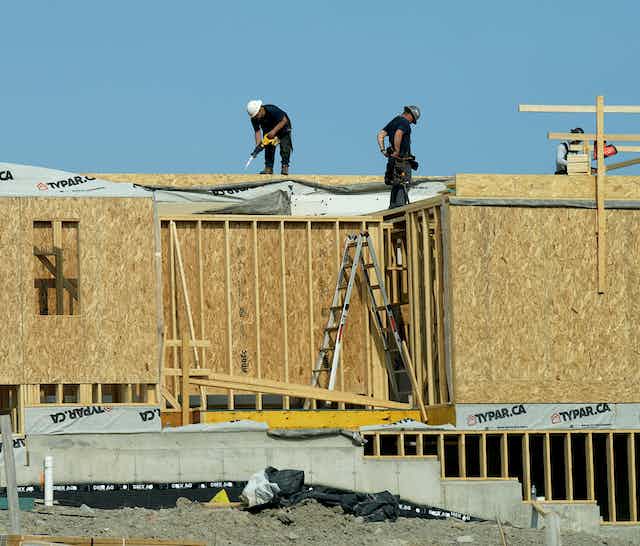
A new house under construction outside the Duffins Rouge Agricultural Preserve, Ont. Image: THE CANADIAN PRESS/Chris Young

By Andréanne Doyon, Assistant professor, School of Resource and Environmental Management, Simon Fraser University and Trivess Moore, Senior Lecturer, School of Property, Construction and Project Management, RMIT University via The Conversation • Reposted: November 3, 2023

This summer, Canada experienced wildfires, extreme heatdrought and flooding. Other regions of the world faced similar events

It’s hard not to wonder if we’re prepared for what comes nextwith climate change. This includes our housing, which has a critical role to play in a sustainable, liveable, and resilient future. 

Sustainable housing provides significantly improved environmental performance compared to (most) current housing achieving zero, or near zero, carbon outcomes. However, it is more than just improving energy and water performance. 

Sustainable housing considers impact across the whole of its design, construction, use and end-of-life phases. In doing so, it reduces material wasteoperating costs, improved thermal comfort and occupant health and well-being, and it is climate resilient.

The good news is we can deliver this type of housing right now. There are many examples of innovative new sustainable housing, and retrofits of existing housing. We explore these in our new book and outline some examples below.

Fossil-free housing

Several jurisdictions have banned fossil fuel-based heating in homes. Bans are taking place at the national level across the European Union, at the provincial level in Québec, and at the local level in DublinNew York City and Vancouver

These bans are in response to the Paris Agreement’s 2050 targets and the United Nation’s Sustainable Development Goals, which include moving away from polluting fuels for health reasons and the need to decarbonize our energy networks. 

Natural gas being burned from a gas burner.
Natural gas fuel is polluting and increasingly banned in many jurisdictions around the world. Image: AP Photo/Steven Senne

Other jurisdictions are banning the use of gas completely and requiring a shift to all-electric housing. Electrification is about reducing environmental impact and delivering a more affordable healthier home. 

In Australia, bottom-up support for the all-electric home has grown significantly (as exemplified by the My Electric Home Facebook group which has over 100,000 members) and is putting pressure on governments. 

For example, the Victorian State Government recently banned the use of gas for all new housing and renovations that require a planning permit from 2024 onwards. However, this approach needs to also be accompanied by a rapid expansion in grid capacities and decarbonization of the wider energy network.

Location, density, and size

Sustainable housing is also about the location and scale of dwellings. Some jurisdictions are increasing the density of lots to accommodate more housing in existing neighbourhoods and where existing infrastructure and amenities already exists. An example of upzoning is the Oregon’s House Bill 2001, which essentially eliminated single-family zoning in most cities. 

Oregon is also famous for its urban growth boundaries, which is a statewide effort to accommodate population and employment growth within urban boundaries to protect agriculture, forests and open space. 

A row of single-family homes seen from the air.
Single-family homes, such as this one in Vancouver, are wasteful in terms of space and materials, and are increasingly being zoned out of major urban areas. Image: THE CANADIAN PRESS/Darryl Dyck

House size is also important. Larger houses consume more land, materials and resources, and require more energy for heating and cooling. Cities like Vancouver and Toronto have changed zoning legislation to support accessory dwelling units, such as laneway houses, and legalize secondary suites

There are also social movements devoted to living small. From tiny houses to apartments and self-contained units, these dwellings range in size from approximately 300 to 1,000 square feet. Popular social media accounts include Living Big in a Tiny House600sqft and a baby and Never Too Small which offer instruction and resources — and a community — for those wanting to live with a lighter footprint. 

Co-living

There has been an increase in people living in shared or communal accommodations in response to decreasing housing affordability and climate change, as well as loneliness

Such housing can reduce environmental impacts through smaller dwellings and buildings, shared spaces and facilities, and opportunities for grey water filtration systems or community-scale energy projects. Co-housing is a model of intentional community living, which includes self-contained units with shared facilities and amenities that deliver a range of wider social benefits. Channels like ‘Living Big in a Tiny House’ champion the small homes movements while providing community for those looking to downsize their footprint.

In Germany, Baugruppen (German for building group) refers to a practice of self-initiated, community-oriented living where residents share the responsibility of the building. Baugruppen is an approach, not a rule book, where financing, individuals and their needs inform the development. 

In Australia, Nightingale Housing is a non-profit organization working to provide sustainable and higher density housing. While the developments go significantly beyond minimum construction code performance requirements, it is the provision of shared and community spaces that is challenging business-as-usual designs. These include communal laundries, productive gardens and outdoor cooking areas designed to encourage interaction with neighbours. 

There is no doubt that our housing will play a critical role in delivering a sustainable, affordable and resilient future for households and communities. There are examples all around the world showing us the type of housing we should (and can) be delivering right now. We don’t need to reinvent the wheel. 

Given the climate emergency and other critical issues with our housing, we need policymakers, the construction industry and households to demand more of our housing.

To see the original post, follow this link: https://theconversation.com/how-sustainable-liveable-and-resilient-housing-can-help-us-adapt-to-a-changing-future-212412



The thinking error that makes people susceptible to climate change denial

5 05 2023


Expecting black-and-white answers can make it hard to see the truth. 
bubaone via Getty Images

By Jeremy P. Shapiro, Adjunct Assistant Professor of Psychological Sciences, Case Western Reserve University via The Conversation • Reposted May 5, 2023

Cold spells often bring climate change deniers out in force on social media, with hashtags like #ClimateHoax and #ClimateScam. Former President Donald Trump often chimes in, repeatedly claiming that each cold snap disproves the existence of global warming.

From a scientific standpoint, these claims of disproof are absurd. Fluctuations in the weather don’t refute clear long-term trends in the climate

Yet many people believe these claims, and the political result has been reduced willingness to take action to mitigate climate change. Why are so many people susceptible to this type of disinformation? My field, psychology, can help explain – and help people avoid being misled.

The allure of black-and-white thinking

Close examination of the arguments made by climate change deniers reveals the same mistake made over and over again. That mistake is the cognitive error known as black-and-white thinking, also called dichotomous and all-or-none thinking. As I explain in my book “Finding Goldilocks,” black-and-white thinking is a source of dysfunction in mental health, relationships – and politics.

People are often susceptible to it because in many areas of life, dichotomous thinking does something helpful: It simplifies the world.

Binaries are easy to handle because there are only two possibilities to consider. When people face a spectrum of possibilities and nuance, they have to exert more mental effort. But when that spectrum is polarized into pairs of opposites, choices are clear and dramatic.

Image of a person showing arrows pointing in opposite directions the person might take.
Most things don’t fall neatly into only two choices. eyetoeyePIX via Getty Images

This mental labor-saving device is practical in many everyday situations, but it is a poor tool for understanding complicated realities – and the climate is complicated.

Sometimes, people divide the spectrum in asymmetric ways, with one side much larger than the other. For example, perfectionists often categorize their work as either perfect or unsatisfactory, so even good and very good outcomes are lumped together with poor ones in the unsatisfactory category. In dichotomous thinking like this, a single exception can tip a person’s view to one side. It’s like a pass/fail grading system in which 100% earns a pass and everything else gets an F.

With a grading system like this, it’s not surprising that opponents of climate action have found ways to reject global warming research, despite the overwhelming evidence.

Here’s how they do it:

The all-or-nothing problem

Climate change deniers simplify the spectrum of possible scientific consensus into two categories: 100% agreement or no consensus at all. If it’s not one, it’s the other.

A 2021 review of thousands of climate science papers and conference proceedings concluded that over 99% of studies have found that burning fossil fuels warms the planet. That’s not good enough for some skeptics. If they find one contrarian scientist somewhere, they categorize the idea of human-caused global warming as controversial and conclude that there is no basis for action.

Powerful economic interests are at work here: The fossil fuel industry has funded disinformation campaigns for years to create this kind of doubt about climate change, despite knowing that their products cause it and the consequences. Members of Congress have used that disinformation to block or weaken federal policies that could slow climate change.

Expecting a straight line in a variable world

In another example of black-and-white thinking, deniers argue that if global temperatures are not increasing at a perfectly consistent rate, there is no such thing as global warming. 

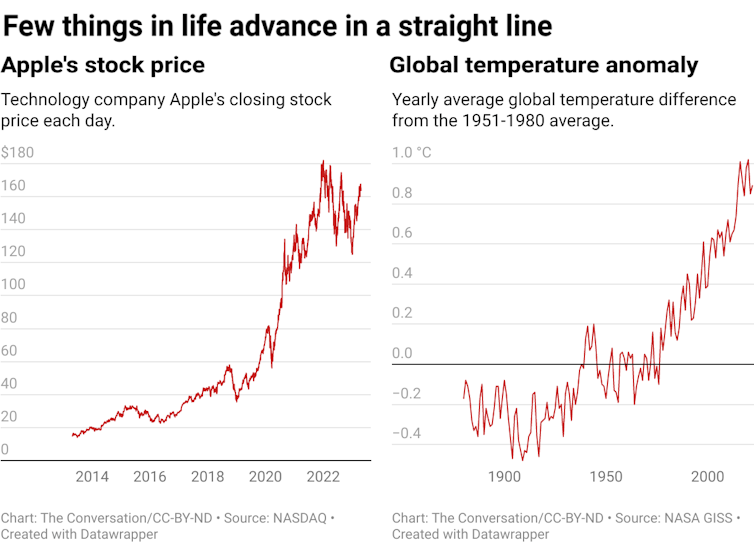
However, complex variables never change in a uniform way; they wiggle up and down in the short term even when exhibiting long-term trends. Most business data, such as revenues, profits and stock prices, do this too, with short-term fluctuations contained in long-term trends.

Charts showing Apple's changing stock price and global temperatures over time. Both have a saw-tooth pattern.
These two graphs have the same form: a long-term trend of major increase within which there are short-term fluctuations. CC BY-ND

Mistaking a cold snap for disproof of climate change is like mistaking a bad month for Apple stock for proof that Apple isn’t a good long-term investment. This error results from homing in on a tiny slice of the graph and ignoring the rest.

Failing to examine the gray area

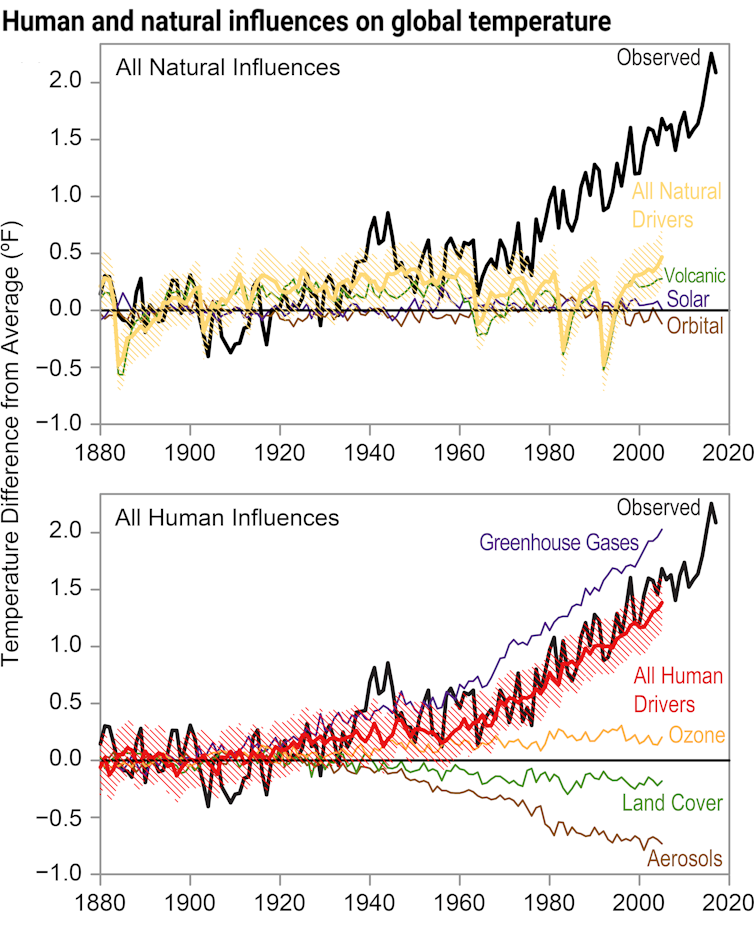
Climate change deniers also mistakenly cite correlations below 100% as evidence against human-caused global warming. They triumphantly point out that sunspots and volcanic eruptions also affect the climate, even though evidence shows both have very little influence on long-term temperature rise in comparison to greenhouse gas emissions.

In essence, deniers argue that if fossil fuel burning is not all-important, it’s unimportant. They miss the gray area in between: Greenhouse gases are indeed just one factor warming the planet, but they’re the most important one and the factor humans can influence.

Charts showing impact of different forces on temperature. Natural sources have little variation, but the upward swing of temperatures corresponds closely with rising greenhouse gas emissions.
Influences on global temperature over time. 4th National Climate Assessment

‘The climate has always been changing’ – but not like this

As increases in global temperatures have become obvious, some climate change skeptics have switched from denying them to reframing them.

Their oft-repeated line, “The climate has always been changing,” typically delivered with an air of patient wisdom, is based on a striking lack of knowledge about the evidence from climate research.

Their reasoning is based on an invalid binary: Either the climate is changing or it’s not, and since it’s always been changing, there is nothing new here and no cause for concern.

However, the current warming is on par with nothing humans have ever seen, and intense warming events in the distant past were planetwide disasters that caused massive extinctions – something we do not want to repeat.

As humanity faces the challenge of global warming, we need to use all our cognitive resources. Recognizing the thinking error at the root of climate change denial could disarm objections to climate research and make science the basis of our efforts to preserve a hospitable environment for our future.

To see the original post, follow this link: https://theconversation.com/the-thinking-error-that-makes-people-susceptible-to-climate-change-denial-204607