Sustainable Brands Are Worth $44 Billion to U.S. Consumers, New Study Finds

29 02 2024

(Image credit: .shock/Adobe Stock)

By Mary Mazzoni from Triple Pundit • Reposted: February 29, 2024

We often hear that consumers are looking for sustainable products and brands, and that many are even willing to pay more for them. But it’s often difficult for brand leaders to pin down just how much of an impact sustainability really has on consumer purchasing, making it harder to tie investments in sustainability to the bottom line. A new piece of research out this week puts a dollar figure on consumer affinity for sustainable brands for the first time — and it’s big enough to make leaders take notice. 

A $44 billion prize is up for grabs as consumers switch from brands they perceive as less sustainable to brands they perceive as more sustainable, according to the analysis from the research technology firm Glow, in partnership with TriplePundit, our parent company 3BL and panel partner Cint. 

“We wanted to really understand: If it’s important, can we see it in the data? Can we show a link between business performance and the investment in sustainability from a consumer perspective?” Glow CEO Tim Clover said during an on-demand webcast we hosted about the research. “The key point here is that the opportunity is quantifiable.”

Consumers are voting with their wallets, and now we know how much that’s worth for sustainable brands 

The notion that businesses acting responsibly is somehow controversial has crept into the fringes of the U.S. cultural zeitgeist over the past few years. But there’s little evidence the public is on board, and our research is the latest to prove this out. 

More than 85 percent of U.S. consumers consider it important for businesses to act responsibly with regards to society and the environment, compared to only 3 percent who don’t, according to our survey of more than 3,000 U.S. adults conducted in November 2023. 

“In this study we show, as has been shown previously, that this issue is almost universally important to consumers,” Mike Johnston, data product leader at Glow, said during our webcast interview. “We also show there’s an expectation for businesses to act on these issues.” 
consumers think it is important for businesses to act responsibly - study on consumer perception of sustainable brands

That expectation increasingly translates into how people spend their money. As part of the report, we asked consumers about the level of influence sustainability has on their choice of products and brands across 12 industries. About a quarter of respondents said they stopped doing business with a brand in 2023 because of its social or environmental behavior.

The rate of sustainability-driven brand switching is even higher in some sectors. In the food and grocery sector, 33 percent of consumers said they switched from one brand to another because of sustainability last year, while 31 percent said the same about pension fund providers and airlines. 

“In a sector like food and grocery, this might be expected,” observed TriplePundit contributor Andrew Kaminsky, lead author of the report. “Think about how often consumers make food and grocery purchases, and how easy it is to try a different product. Pension funds, on the other hand, are much less transitory, and consumers need to go through considerable efforts to make sustainable changes.” 

Still, 22 percent of consumers say social and environmental issues are “the single most important factor” in choosing a pension fund provider, according to the report. A finding like this is significant “not just for pension fund managers, but for all companies nationwide,” Kaminsky noted. “As pension funds invest in a wide range of companies across sectors, the high priority placed on sustainability means that companies that want to attract investors will have to improve their sustainability credentials.”

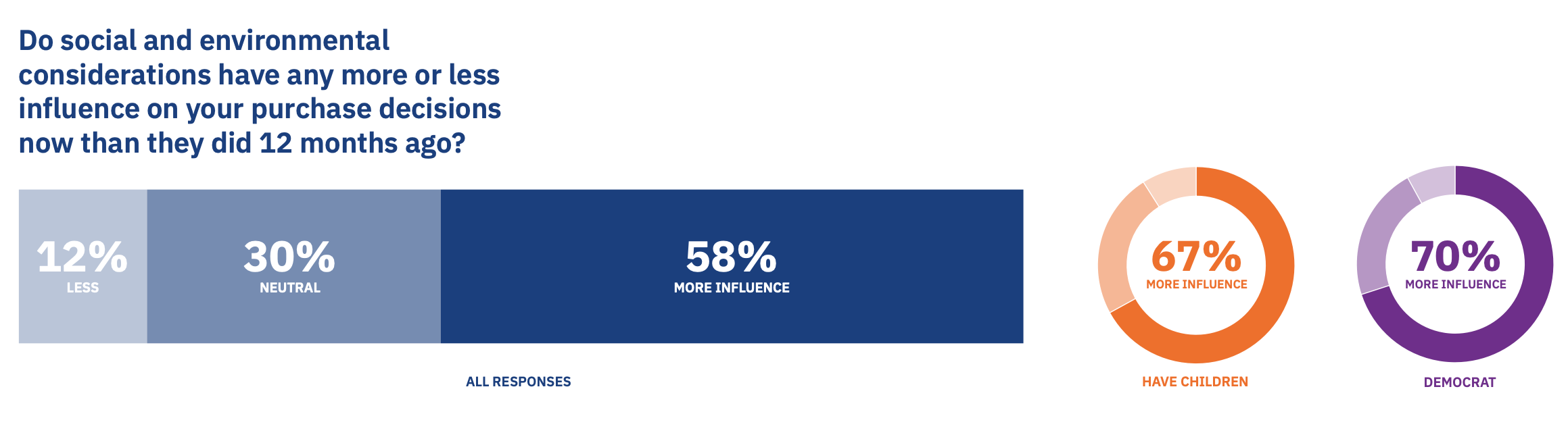
Interest in sustainability as a purchase driver is increasing - study about consumer perception of sustainable brands
Brand switching and preference for sustainable brands is only increasing

Even as the rising cost of living reaches crisis proportions across the U.S., people are still interested in sustainable brands and products. Of course price is an important factor for consumers, but it’s far from the only thing they’re looking for in a company they patronize — and most told us that sustainability will only play a bigger role in their buying patterns over time. 

More than half (58 percent) of consumers say social and environmental considerations are more influential today than they were a year ago, and half expect this influence to continue growing in 2024.

“We hear a lot of talk about, ‘People say sustainability is important, but they won’t act.’ Well, that’s not what the data says,” Clover told us. “What it says is that there are cohorts of people in the population who are very well-educated around key issues for particular categories and industries, and that they will often act. And that cohort of people is growing.”

The fact that sustainability plays such an important role alongside other purchase drivers like price and product quality — enough to put it in a top-three rank or higher for many industries we analyzed — may be surprising to some. But Johnston cautions brand leaders to pay close attention to findings like these and not fall into the trap of prioritizing price above all else. 

“This kind of report does two things. One, it really gives the rationale and the economic viability to act now because there is payoff, but it also shows that there’s a future imperative,” Johnston said. “As cost of living starts to reduce for certain cohorts of the population — and it will — those that have ignored sustainability while it’s been growing in importance in the background will be playing catch-up. And you don’t want to be in that position with something that is going to continue to be of increasing importance to how customers make their decisions.”
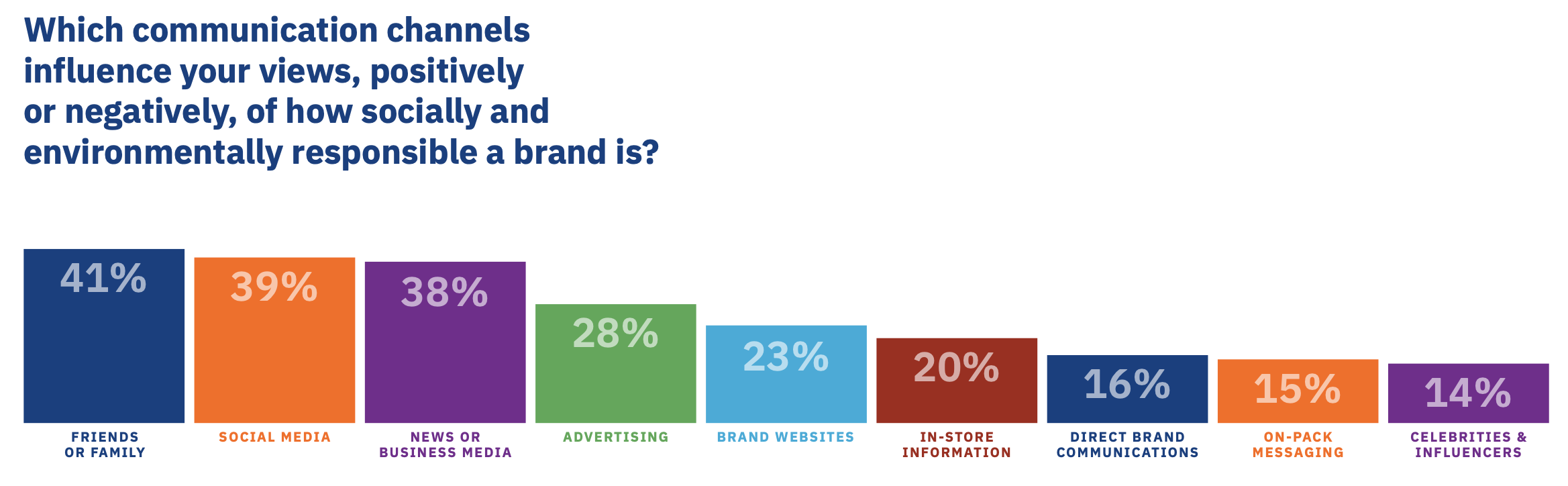
which channels most influence consumer perception of sustainable brands
The communication opportunity for sustainable brands

Consumers have to know what sustainable brands are doing in order to reward them for it. Our research shows many are actively seeking more information about what brands do when it comes to society and the environment, presenting a golden opportunity for sustainable brands to reach consumers with effective messaging and score new sales. 

“If we don’t communicate, we can’t educate people about where we are and why we’re investing and taking the pathway we’re taking,” Clover said. 

Around a quarter of consumers said the reason sustainability didn’t factor more into their purchase decisions is because they “don’t know enough” about brands’ sustainability credentials to make an informed purchase. 

“Price and lack of information are the leading reasons why consumers don’t consider sustainability more in their purchases,” Kaminsky noted in the report. “While the need to pay more for products that are responsibly managed might be unavoidable, lack of information is certainly within a brand’s control.” 

The report explores in detail how to best reach various audiences with effective messaging on the platforms where they gather to learn more about sustainability, but the top-line message is: A growing segment of people want to learn more, and if brands don’t tell their own sustainability stories in a way that reaches and resonates with these consumers, others will tell that story for them.

“There are ways to discuss sustainability in an accurate and informative way, without falling prey to ‘greenhushing’ or retreating to the sidelines,” Kaminsky wrote in the report. “It’s fairly straightforward, but it’s something that brands and their marketing teams struggle to do effectively.”

The type of messaging that stands out is keenly focused on the issues consumers care about, backed up by evidence and, ideally, confirmed by third parties like media partners, researchers and influencers who consumers look to and trust.

Mary Mazzoni has reported on sustainability and social impact for over a decade and now serves as executive editor of TriplePundit. To see the original post, follow this link: https://www.triplepundit.com/story/2024/sustainable-brands-consumer-purchasing/795941


Why Are Corporate Climate Disclosures Important, and How Can Investors Put the Pressure On?

21 06 2023

An orange hue tints New York City on June 7 as smoke from more than 100 wildfires across Quebec, Canada, filters south. Wildfire seasons are starting earlier, lasting longer and causing more damage due to climate change, scientists say. (Image: Metropolitan Transportation Authority/Flickr)

By Mary Riddle from Triple Pundit • Reposted: June 21, 2023

The annual Non-Disclosure Campaign engages investors to directly request climate disclosures from top companies responsible for high levels of greenhouse gas emissions.

Organized by the nonprofit CDP (formerly the Carbon Disclosure Project), this year’s campaign includes nearly 300 global financial institutions with almost $29 trillion in assets under management. They’re calling for disclosure from over 1,600 high-impact companies — including Saudi Aramco, ExxonMobil, Tesla, Chevron, Caterpillar and Volvo. Together, these companies emit nearly the same amount of greenhouse gases as the United Kingdom, European Union and Canada combined, according to CDP. And they’ve all failed to respond to the nonprofit’s climate disclosure requests.

So, why are climate disclosures important, and how can investors and other stakeholders put the pressure on more companies to disclose? We sat down with Sebastian O’Connor, an associate director at CDP whose team has conducted the Non-Disclosure Campaign since 2017, to learn more. 

Why are environmental and climate disclosures important? 

“The theory of change behind CDP is quite simply what gets measured gets managed,” O’Connor said. “The end goal of all of our work on climate change is to get emissions down to zero. To get to that point, you need a target that is feasible but ambitious. And to get a target, you need to know where you start.” 

While climate disclosures are the most common kind of disclosure reported to CDP, many companies also disclose their water and forest impacts, O’Connor said. “It is more than climate. The whole aspect of nature should be disclosed against — climate and nature are interlinked.”

Corporate climate disclosures encompass business activities that produce emissions, including in the company value chain. Because the world still lacks a global standardized reporting framework, CDP is one of the recognized industry leaders in evaluating climate and nature impacts. 

“CDP is the best avenue for standardized, comparable disclosures that can be assessed and graded to see how well a company is doing,” O’Connor said. “We need to know how corporations are impacting the environment in order to create a sustainable economy.”

Why do companies fail to disclose? 

Corporations give various reasons for refusing to disclose their climate, water or other nature-related impacts. Some companies cite the time and resources it takes to complete a CDP questionnaire, while others choose to publish their own sustainability reports instead of going through third parties. But self-published reports can be bias, O’Connor said. 

“The devil is truly in the details, as companies can decide what to omit and what to publish,” he told us. “Will companies put out anything that goes against the narrative of them always making progress?” 

CDP also allows the public to compare companies against others in their peer group in a standardized way that is assessed by an independent third party.

Putting on the pressure

O’Connor thinks chronic non-disclosing companies might not be getting enough pressure from regulators and their investors, but this is changing. “There is clear pressure from regulatory regimes in every part of the world,” he said. “Regulators are paying attention because climate and nature impact the financial security of the world economy. This year, our Non-Disclosure Campaign got 288 signatories to sign on, a quadruple increase from 2017.”

Supporters of this year’s campaign included investors, asset managers, asset owners, insurance companies and other financial institutions. The nonprofit typically sees success because of the direct, simple nature of the requests, O’Connor said. 

“CDP acts as an effective bridge between financial institutions and the corporate world,” he said. “We facilitate meetings that often revolve around companies giving their reasons for not disclosing. Then, investors are able to show the benefits to disclosing. When this happens, we have a high rate of previously non-disclosing companies disclosing the following year.”

As governments around the world move toward standardized reporting frameworks, CDP is working to ensure that the regulations are rigorous and ambitious, O’Connor said.

“CDP came into play 20 years ago because regulation did not exist,” he explained. “We formed the foundation of the ESG [environmental, social and governance] universe that we see today.” While regulated disclosures are a welcome change, “we can also influence these regulations to make sure they do not just go to the lowest common denominator,” he said. 

“It is about more than just disclosure. We want to help guide companies through every step that leads them to being truly sustainable.” 

To see the original post, follow this link: https://www.triplepundit.com/story/2023/corporate-climate-disclosures/777106


Americans Are Ready to Change Their Behavior for the Sake of Sustainability: Are Brands Willing to Help?

2 06 2023

Image credit: Bluewater Sweden/Unsplash

By Mary Mazzoni from Triple Pundit • Reposted: June 2, 2023

We hear it time and time again: People aren’t ready, willing or interested in changing their lifestyles for the sake of sustainability. They’re too busy, too broke or too ambivalent to think about how their choices impact the world around them. And until they change their tune, there’s nothing brands can do about it — except sell them more stuff. 

This prevailing narrative has been around for decades, but data continues to show that it isn’t representative of how people really feel. The public is increasingly aware of the environmental and social challenges we face — from climate change to wealth inequality — and they want to be part of the solution. 

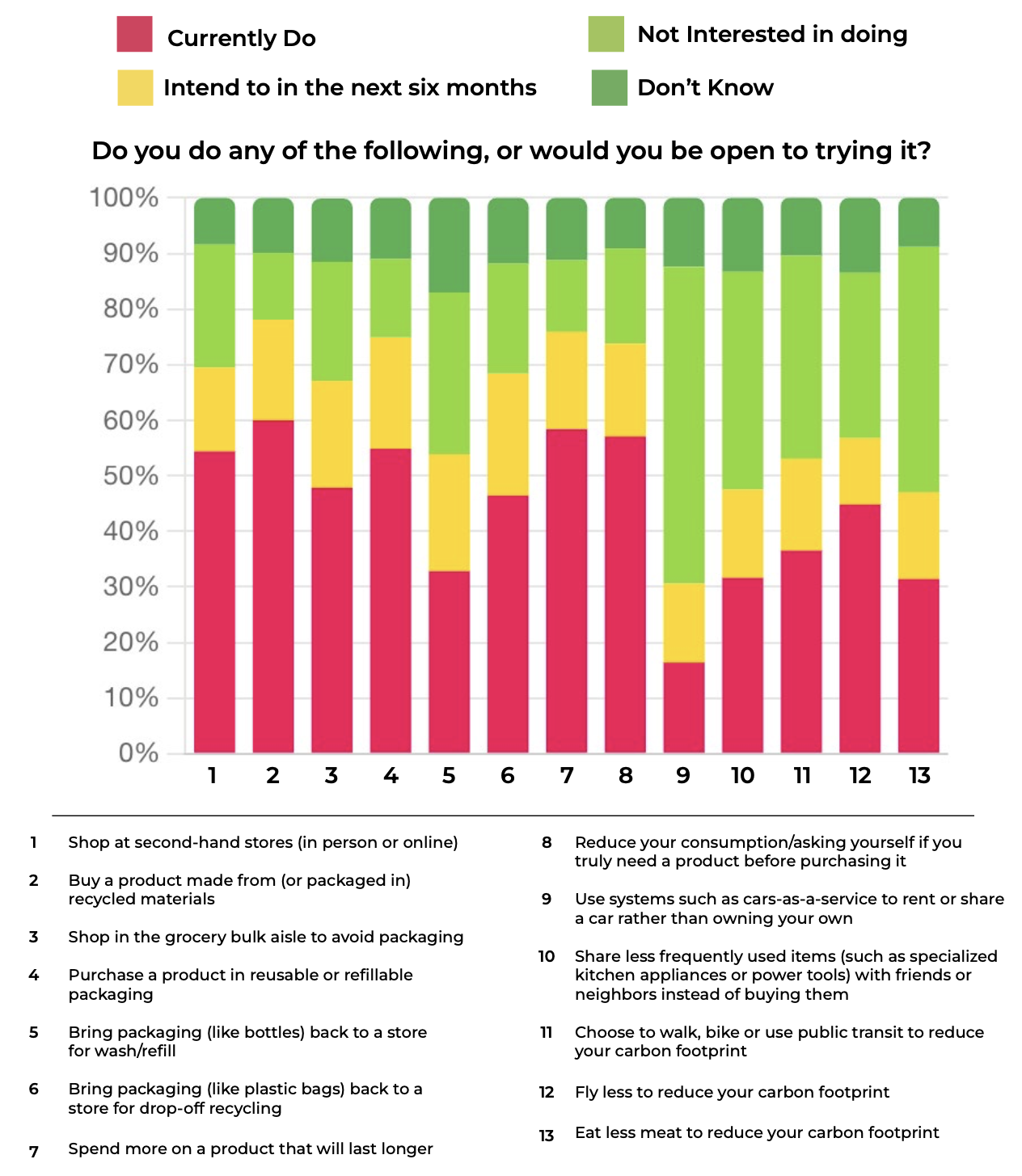
Over half of Americans say they’ve already made lifestyle changes like shopping secondhand, purchasing products in reusable or refillable packaging, and buying less overall in order to reduce their impact on people and the planet, according to a December survey conducted by TriplePundit and our parent company, 3BL Media, in partnership with the research technology firm Glow. 

Let’s break down what U.S. consumers are really saying about sustainability, how it factors into their own lives, and how brands can respond differently than they have in the past. 

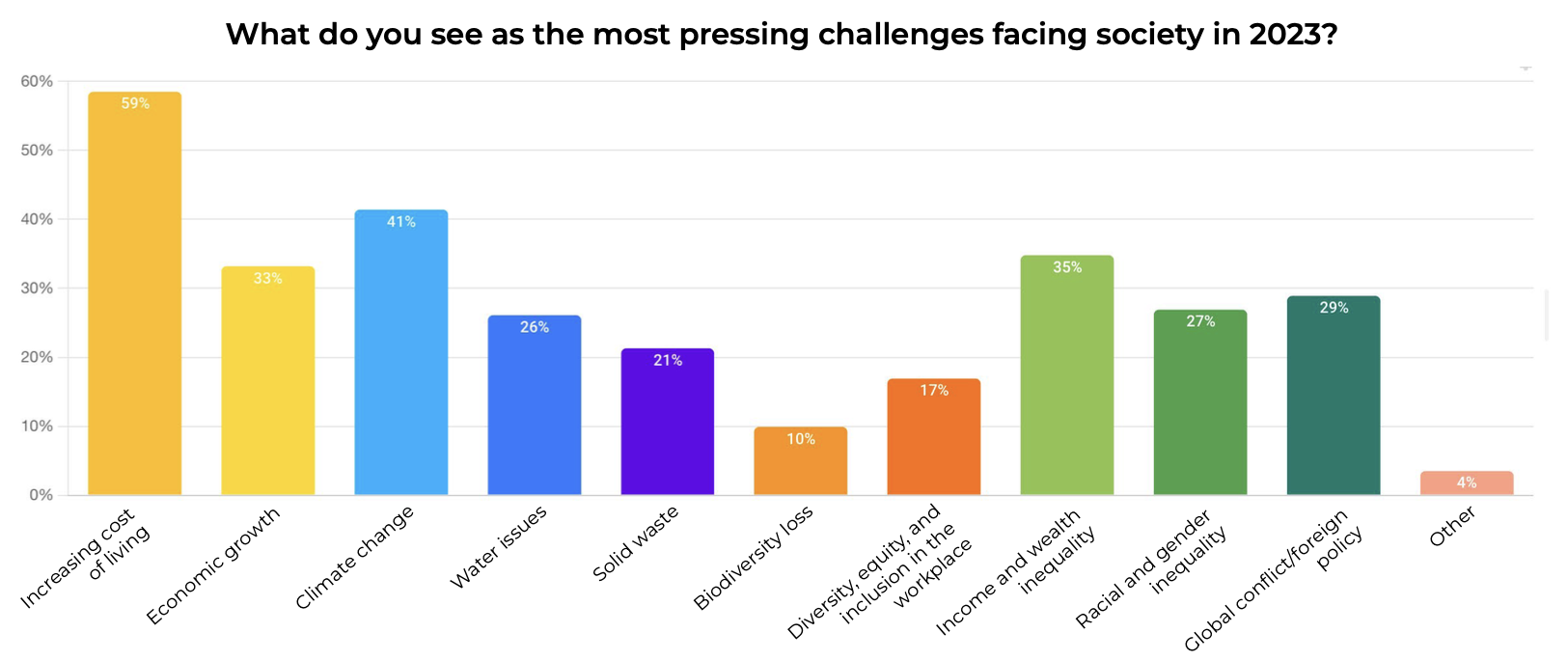
what people view as the most pressing challenges facing society - survey findings
Americans rank climate change and economic inequality among the top three challenges facing society today, only behind their anxiety about keeping food on the table. Download the report to learn more.

People are willing to change their behavior for the sake of sustainability 

Shopping secondhand. Purchasing products made from, or packaged in, recycled materials. Choosing items in reusable or refillable containers. Shopping in the grocery bulk aisle to avoid packaging altogether. Some would have us believe these lifestyle shifts are too expensive or too cumbersome for Americans. But more than 60 percent of respondents to our survey said they’re already making these changes or intend to do so within the next six months. 

Of course the say/do gap — which refers to the difference between what people say in surveys and what they actually do in their daly lives — is always a factor. Even so, the interest in these lifestyle changes is significant and runs counter to preconceived notions that consumers don’t really want — or aren’t really ready — to change their lifestyles for sustainability reasons. 

People even expressed interest in behaviors that are commonplace in other countries but often dismissed as something that could “never work” in the U.S. For example, over half of respondents said they would be willing to take packaging like bottles back to a store for wash and refill.

people are willing to change their behaviors for sustainability - survey findings
More than 60 percent of U.S. consumers are willing to adopt lifestyle changes like shopping secondhand, opting for the bulk aisle, or choosing items in reusable or refillable packaging. Download the report to learn more

Our findings support existing research on general readiness for behavior change: In another 2022 survey, for example, half of responding U.S. adults said they’re willing to accept 95 percent of the changes needed to avert the climate crisis and restore ecosystems. The survey also revealed the extent of climate anxiety among the public, with 1 out of 4 respondents worried they may have to give up long-term goals like starting a family. 

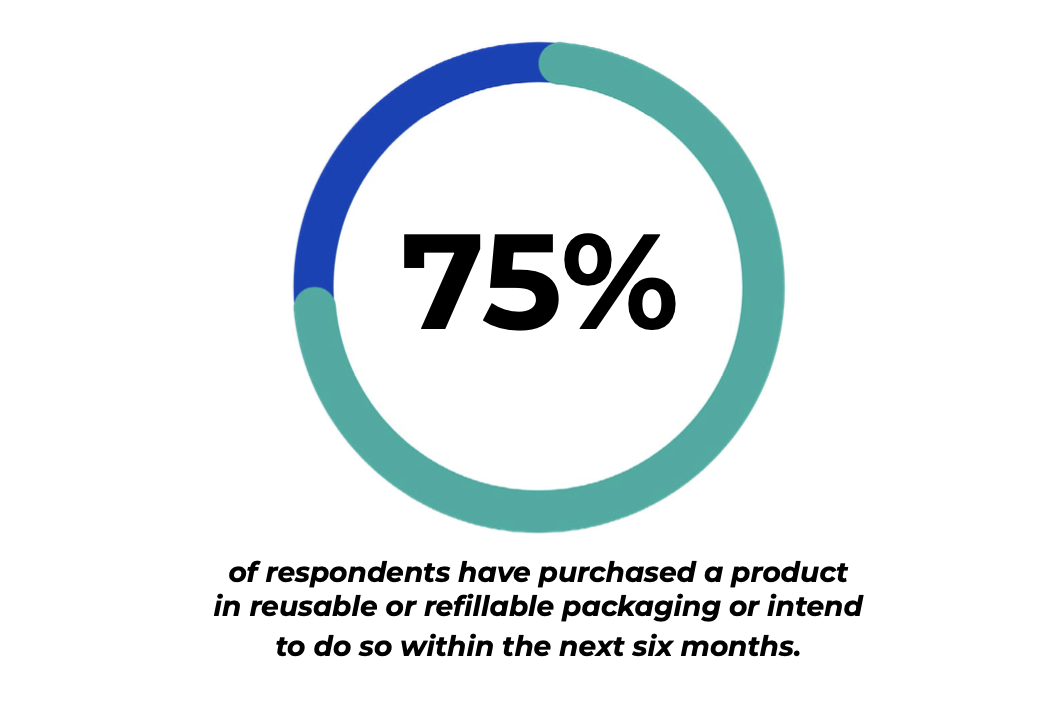
When it comes to packaging in particular, our findings indicate that 75 percent of U.S. consumers are willing to choose reusable alternatives — echoing 2022 polling from Trivium Packaging which found the same. The trade publication Packaging World recently declared reusable and refillable packaging to be a “global opportunity,” with sales forecast to grow by 4.9 percent annually to $53.4 billion by 2027.

75 percent of people have purchased a product in refillable packaging or would be willing to do so - sustainability survey findings
Download the report to learn more

How brands can respond to shifting consumer preferences

Many advocates point to the calls for consumer behavior change as merely a delay tactic from large companies: If the narrative keeps people focused on their own behaviors — analyzing everything from cup preferences to clothing choice — they won’t have energy left to push for a shift in corporate practices or government regulations.

In the past, this may have been true, with consumers and brands pitted against each other in a cyclical blame-game while the poor get poorer and global temperatures rise. But findings like these indicate we’ve reached a critical moment when ideologies can align, and brands can show up as partners for consumers looking to play a role in the future they want to see. 

Leveraging our nearly two decades of experience in communicating about sustainability, TriplePundit and 3BL Media’s Consumer Insights and Sustainability Benchmark report includes key action items for businesses looking to respond to consumer sentiment in a positive way. 

“Understanding people’s uncertainties and anxieties about the future, and what they want to see from business, gives companies the opportunity to communicate and present themselves as part of the solution that consumers are looking for,” the report reads. “The next piece of the puzzle is to figure out how businesses can tailor their communications to appeal to consumer interests and bring them on board their journey to a more sustainable world.” 

In particular, we highlight how brands can adopt a more meaningful role of partner and educator — rather than simply another purveyor of goods and services. “Since consumers want to be part of the solution, help them do that by sharing actionable information,” the report reads. “It may be as simple as telling them how to make your product last longer or how to lower their personal carbon footprint with a checklist on your website. You can celebrate your company’s successes by applauding theirs.”

For more insight on how brands can — and should — respond to shifting consumer attitudes about sustainability, check out prior reporting on TriplePundit or download the report here

To see the original post, follow this link: https://www.triplepundit.com/story/2023/consumer-behaviors-sustainability/775591


This, Not That: More Consumers Are Switching Brands Based on Sustainability

18 03 2023

Image credit: Gustavo Fring/Pexels

By MARY RIDDLE FROM TRIPLEPUNDIT.COM • Reposted: March 18, 2023

We know shoppers are increasingly interested in more sustainable products, and new research indicates many are ready to leave their standby brands behind. Half of all U.S. consumers, including 70 percent of millennials, have changed food and grocery brands based on environmental, social and governance (ESG) considerations, according to new polling. 

For its latest sustainability benchmark report, the research technology company Glow surveyed 33,000 U.S. adults to get their take on the ESG performance of more than 150 food and grocery brands. Across the board, consumers report changing their spending habits to better align with their personal values — and forward-looking brands are reaping the benefits. Almost 90 percent of respondents believe it’s important for businesses to be environmentally and socially responsible, and two-thirds said they’re willing to pay more for products that support vulnerable groups and communities.

“It is vitally important for companies to contribute to supporting society and the planet. And there is a growing body of evidence that doing so is more than the right thing to do, it is good for business,” said Julia Collins, CEO of Planet FWD, a carbon management platform for consumer brands, in a statement. “This report provides further evidence … that those who are leading in consumers’ minds are already reaping the commercial benefits and are best placed for future success.” Indeed, 8 in 10 respondents said they feel more loyalty to purpose-driven brands.

ESG performance is correlated with revenue growth

Glow also found a positive correlation between ESG performance and revenue growth. Even in a troubled economy with a cost-of-living crisis, environmentally- and socially-responsible companies are seeing the economic benefits of standing for their values: 20 percent of consumers rank sustainability in their top three considerations when shopping at the grocery store, and 10 percent of millennials said sustainability is the single most important factor when making a purchase.

Additionally, while 70 percent of consumers are actively switching food and grocery brands to save money, many consider sustainability a key reason not to do so, particularly among younger shoppers. 

“Now more than ever, if brands want to retain and win consumers, they must stand for something,” Mike Johnston, managing director of data products at Glow, said in a statement. “All consumers are looking for ways to save money. They will need a compelling reason why they shouldn’t walk away from your brand for a cheaper alternative. Along with quality, sustainability is a key barrier to change, especially for millennials.” 

It’s worth noting that what consumers view as “sustainable” will vary based on the product. Consumers report that plastic and waste issues are of greater importance in the household goods department, for example, while health and wellbeing is a top concern for consumers when choosing beverages and beauty products. 

Still, across all categories, products with ESG-related claims on their packaging grew an average 1.7 percent faster than those without. Labels and messaging associated with regenerative agriculture, plastic-free products, cruelty-free operations, water footprint, and renewable energy caught consumers’ attention the most.

Consumer expectations are high

U.S. consumers widely perceived the food and grocery industry as a leader in corporate sustainability, Glow’s data revealed, but the industry still faces significant barriers to meeting consumer expectations in a few key areas. For example, almost a third of responding consumers are dissatisfied with the industry’s efforts to reduce emissions, mitigate climate change, protect wildlife and ensure the welfare of suppliers.

While being misaligned with consumer expectations is never ideal for a company or sector, this gap presents an opportunity for brands to re-engage with this growing segment of consumers and stakeholders. By aligning ESG priorities with consumer expectations, companies can take advantage of a growth opportunity, while reducing risk and improving impacts on the environment.

“There’s a role of education here that’s critical for businesses,” Tim Clover, founder and CEO of Glow, told TriplePundit. “Consumers really want to understand the issues in more detail, to understand some of the science and the lengths to which companies are going to solve these problems. Companies that are brave enough to go and take the time to explain the depth of these issues and educate the market, they’re leading. They’re winning.”

To see the original post, follow this link: https://www.triplepundit.com/story/2023/consumers-switching-brands-esg/768956


Brands, Don’t Make These Mistakes During Black History Month (and What To Do Instead)

3 02 2023

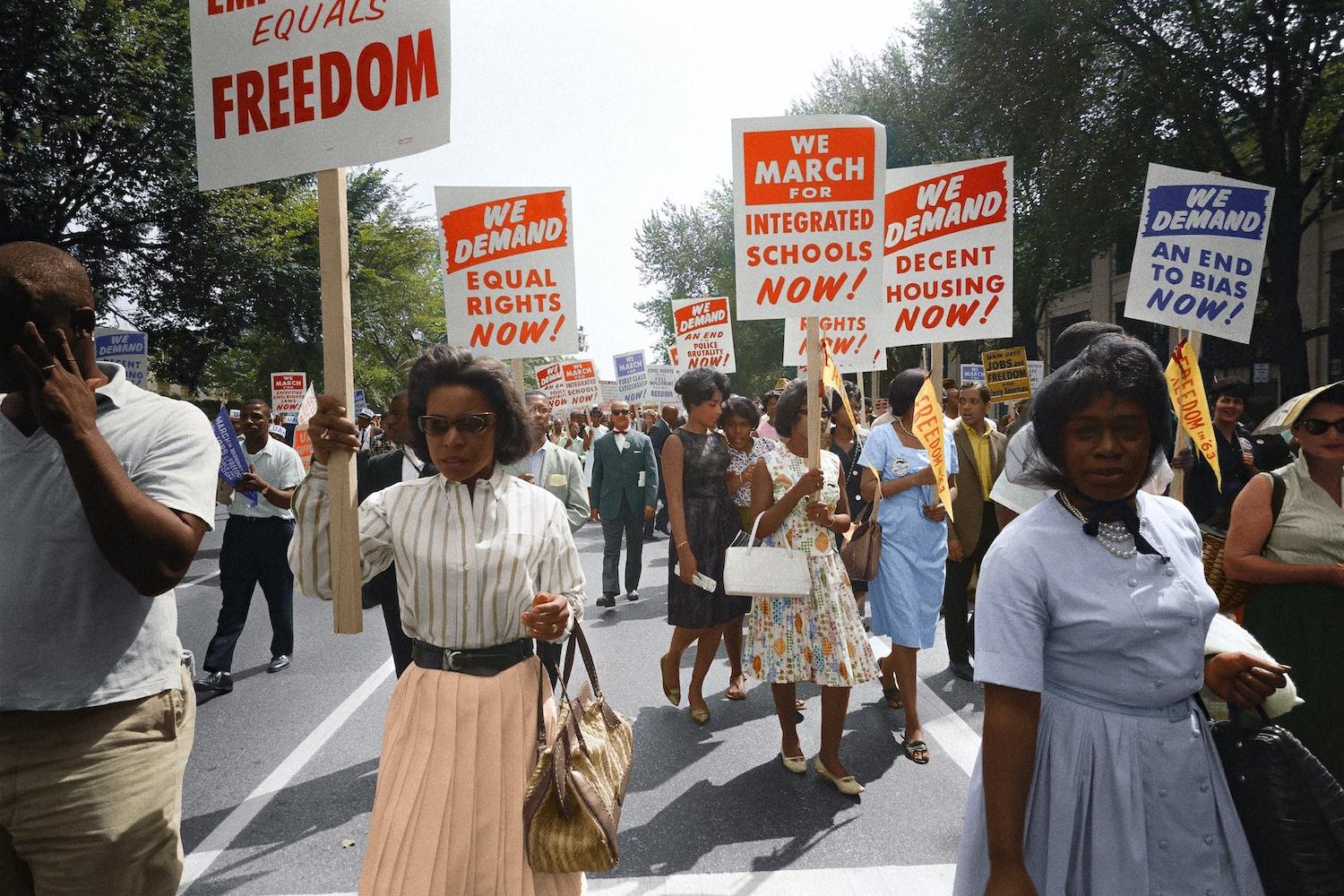
A colorized image of the 1963 civil rights March on Washington, where an estimated 250,000 people gathered to demand equal access to jobs, housing and education — and hear Martin Luther King Jr.’s now famous “I Have a Dream” speech. 

By Mary Mazzoni from triple pundit.com • Reposted: February 3, 2023

Corporate efforts to observe Black History Month are often cringe-worthy at best and offensive at worst. If you’re planning to add a kente avatar on social media or pen a generic letter to employees, please do us all a favor and stop now. Business leaders can — and should — do better. Here’s some advice to get you started, from the Black thought leaders who have been telling us for years. 

Don’t: Pander to your employees and customers this Black History Month

In the Year of Our Lord 2023, we should really all be past the platitudinous “Happy Black History Month” email to employees — or worse, the dreaded product drop. Think back to when TriplePundit asked workplace inclusion expert Kim Crowder about corporate cash-grabs around Juneteenth: “This is a repeat of why Juneteenth was needed,” she reminded business leaders. “It is basically commodifying the Black American experience by those who do not share those experiences and who have benefitted from the enslavement of people.”

The same holds true for brands that seek to capitalize on Black History Month while doing little to honor Black history or benefit Black communities. Just ask Ernest Owens, editor at large for Philadelphia magazine, who has never been shy with his opinions about how brands observe the holiday. 

“Just like Pride Month, Black History Month has become a routine time of year when corporations say the absolute most while doing the least for marginalized communities,” he wrote in a 2021 op/ed for the Washington Post

Do: Look inwardly — and act accordingly 

Rather than looking to commodify the holiday or pat your company on the back for its great work on racial equity, turn your mind to the work ahead of you — and communicate frankly and thoughtfully with your employees and stakeholders about what comes up.

“Organizations should be looking beyond one day and focusing on areas such as pay equity, promotion rates, the ability for Black team members’ work to be seen and acknowledged, and partnering with Black businesses regularly — including paying them well for their work,” Crowder told us. “The goal is to work toward Black liberation every day.”  

Don’t: Expect praise for pennies 

In December polling commissioned by TriplePundit, less than 20 percent of over 3,000 U.S. consumers said they’d be impressed by a billion-dollar company donating $5 million to a social cause like racial equity, with the majority agreeing that “business should do more.” 

Findings like these indicate that people are growing more wary of brands appearing to “check the box” by donating to a nonprofit. They want to see what changes you’re making, and they want to hear about the outcomes of that change. 

“The key here is authentic leadership —  in other words, walking the walk, not just talking the talk,” Gary Cunningham, president and CEO of Prosperity Nowtold TriplePundit back in 2021. “It’s easy to say that you’re anti-racist without changing anything about how your organization operates.” 

Do: Champion your partners

Of course, there’s absolutely nothing wrong with donating to nonprofits or establishing new programs that look to address racial equity, nor is it intrinsically wrong to communicate these programs during Black History Month. But if you do, do so thoughtfully.

Find clear alignment between your company, your teams and the nonprofits you support. Communicate with your stakeholders about the great work your partners do and why you trust them. For example, did someone from your team recommend this organization? Does it work in your community? Is it particularly positioned to address the issues your teams and stakeholders care about most? Remember, this is an opportunity to educate your stakeholders about the issues — and highlight the perspective of your community partners that know these issues best. 

“So often I’ve witnessed corporations and business leaders act as if because they are very smart and can solve problems that they can understand and know how to solve the complex problems of racial and ethnic inequality,” Cunningham told us. “Trust the guidance of people who can help you learn, help you bring your work into the community, and help you understand the depth of the issues that you’re trying to contain.” 

Don’t: Task your Black employees with more unpaid work

As companies pushed to demonstrate their commitment to racial equity in 2020, it wasn’t long before they looked toward their Black employees to do the hard work for them.

Asking Black employees to speak on panels, lead new employee resource groups, or consult on strategies for diversity, equity and inclusion (DEI) — all for no added compensation — is not only unfair, but it also plainly illustrates the very inequities these companies claim to oppose. Over half of Black women in particular told the consultancy Every Level Leadership they feel singled out as the sole resource to educate their colleagues about DEI. 

Think of your team’s well-being, and don’t repeat the ugly cycle this Black History Month. As Najoh Tita-Reid, chief marketing officer for Logitech, observed in Fortune back in June 2020: “Black people did not create these problems, so please do not expect us to resolve them alone.”

Do: Take responsibility for educating yourself

It’s past time for non-Black people to take personal responsibility for educating themselves about racial justice issues, rather than leaning on their friends and colleagues. If you’re an executive, read more, watch more and generally consume more media about the topic. Encourage everyone in your organization to do the same, and give them opportunities to discuss it, if and when they choose.  

“Take responsibility for your own education on racial issues,” Tita-Reid suggested in Fortune. “Create companywide forums and Q&A sessions to educate large groups. Bring in experts, if needed, to provide actionable plans that systematically implement racial equity. Identify those of us who are open to speak, and respect those of us who do not want to talk about the situation.” 

When it comes to your formal DEI strategy work: Resource it, and pay your teams accordingly. “Do not shortchange race equity work,” Andrea J. Rogers and Tiloma Jayasinghe of Community Resource Exchange recommend in Nonprofit Quarterly. “And if you feel like doing that, ask yourself why, and take this opportunity to unpack biases around what is valued, who is valued, and what impact means for your organization.”

To see the original post, follow this link: https://www.triplepundit.com/story/2023/brand-mistakes-black-history-month/765126