
Unleashing the potential of social sustainability

22 11 2023
Busy enterprise life – board of management board brainstorming. Photo: iStock

In today’s rapidly evolving business landscape, the pursuit of profit is no longer the sole factor in determining success, writes Sheryl Moore, Global Director of Sustainability, Converge Technology Solutions Corp. via Circular UK • Reposted: November 22, 2023

Today, customers are more conscious of social, economic, and environmental issues. Leaders are now tasked with ensuring their business delivers value – not only to customers and the economy – but to society as a whole.

According to research by Sprout Social, 66% of consumers who want brands to take a stand on social issues believe brands and businesses can make real and lasting change. And we’re seeing this trend increasingly infiltrate the B2B space too. According to Amazon Business’ State Of Business Procurement report, 89% of B2B buyers would be more likely to make purchases from sellers that can be easily identified as sustainably certified.

When it comes to sustainability, we sometimes only ever hear about environmental sustainability – our ongoing responsibility to reduce our carbon emissions or ambition as a country to achieve net zero. With the UK government now hoping to achieve net zero by 2050, many organisations have shifted their focus solely towards the likes of sustainable procurement, carbon offsetting, and waste reduction.

However, in reality, sustainability is about so much more than just environmental initiatives. Today, sustainable development and practises fall under the three pillars commonly referred to as ESG (Environmental, Social and Governance).

In reality, sustainability is about so much more than just environmental initiatives.

The social side of sustainability is by no means a new concept. The idea of social sustainability began to build momentum in 2012 through the UK government’s introduction of the Public Service (Social Value) Act. Since then, it has become a critical component of any successful ESG strategy, and something organisations are investing more time and resources into.

Essentially, social sustainability is about looking and planning for business changes to help cement its future. Alongside a commitment to being environmentally conscious, social sustainability involves the development of ethical supply chains, supporting the local community, and the retention and development of colleagues – as well as providing learning opportunities and equality for all.

There is a human cost to doing business, and if a business is socially sustainable, it can unlock the door to new markets, better employee engagement, new business partners and much more. Of course, the drive to achieve net zero is still an important objective for organisations across the globe. However, there needs to be an equal amount of focus on creating resilient communities, too.

According to the UN Global Compact, social sustainability should form part of an organisation’s overarching strategy, due to its direct impact on the quality of relationships with stakeholders such as shareholders, customers, and suppliers. 

The first steps towards establishing social sustainability
net zero

The first step any business can take to embrace social sustainability and embed it into its ethos is to focus on its workforce. Recent years have seen buzzwords such as “quiet quitting” and “the great resignation” circulate like wildfire, so if a business wants to be seen as a force for good, it must first cultivate a culture where employee wellbeing is a core pillar of its philosophy.

This can be achieved through a variety of initiatives, such as partnering with educational institutions to deliver training and development or provide work experience and enterprise schemes to help nurture future generations.

Additionally, improving the sustainability of the supply chain can make a significant social impact by upholding high standards when it comes to issues such as fair-trade suppliers and social equity. Now more than ever, businesses must ensure their procurement is ethically sound. Investing in measures to achieve this, can bring improved supplier relations and quality for customers.

Socially responsible companies can benefit from a positive reputation in the market as a result, leading to increased business and higher demand.

Tracking and maximising impact
Green jobs

It’s important that businesses can monitor and track the impact of their social sustainability efforts to establish what is working and what areas need further investment.

Unlike profits or reducing CO2 emissions, tracking the impact of social sustainability initiatives can be difficult as they often consider a range of issues and metrics. Social value calculators, which capture and measure social value, can be massively beneficial here.

For example, the metrics could focus on the number of hours employees spent on environmental training or how many work experience and apprenticeship programmes were deployed to education institutions.

Through these social value calculator tools, business leaders can effectively see the monetary value of every social sustainability activity – ensuring that they are aligned with the objectives and budgets they set out for the year. 

We all have a role to play in making the future more sustainable and businesses have a collective responsibility to lead by example. To be truly sustainable, organisations cannot solely focus on environmentally conscious decisions and they must also ensure they are focused on social sustainability.

By doing so, they not only help create a more sustainable world, but also future-proof their organisation for the challenges ahead, creating a workplace that the talent pool of the future can be proud to work in.

To see the original post, follow this link: https://www.circularonline.co.uk/opinions/unleashing-the-potential-of-social-sustainability/ 


Evidence-Based Pathways for Business to Support the SDGs

14 10 2023

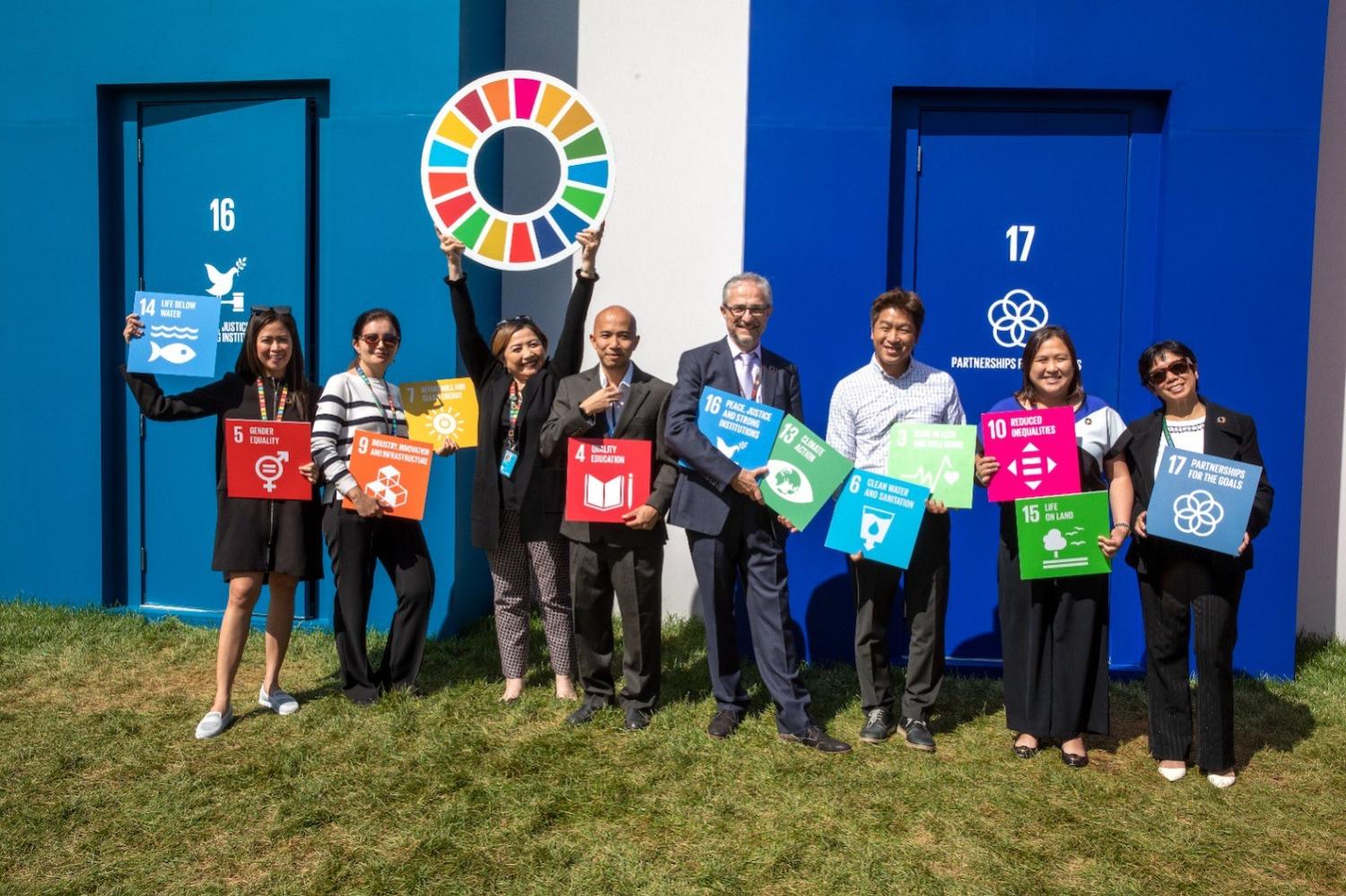
Climate Week attendees strike a pose at the SDG Pavilion in front of the United Nations Headquarters in New York City on September 21, 2023. Image credit: U.N. Partnerships/Pier Paolo Cito via Flickr

By Mary Riddle from Triple Pundit • Reposted: October 14, 2023

As the Sustainable Development Goals (SDGs) reach their midpoint, the world is “woefully off-track” in meeting the targets by the 2030 deadline, the United Nations warned this summer. Only 15 percent of the SGDs are on track, according to the U.N. Global Compact. Progress on 37 percent of the targets has either stagnated or reversed, while efforts on the remaining half are considered weak or insufficient. With seven years left to meet the Global Goals, the U.N. is calling on the private sector to help accelerate implementation.

While business leaders remain confident about the vision for the future underscored in the SDGs, their confidence in meeting the targets by 2030 dwindled from 92 percent in 2022 to 51 percent this year, according to a new report. 

Last month, Accenture partnered with the U.N. Global Compact to publish the Global Private-Sector Stocktake, a first-of-its-kind look at private-sector impact on the SDGs, with tangible action items and resources that companies can consider to drive progress on the road to 2030. The report outlined 10 key pathways for corporations — which include putting existing markets to work for social equity by way of a living wage and addressing gender pay gaps, as well as more transformative moves to integrate the SDGs into corporate finance and promote sustainability leadership in the private sector. 

Sustainable corporate finance 

“There is a lot of momentum around impact accounting, which ensures companies are taking into full account both tangible outcomes like revenues and returns for shareholders, but also the intangible outcomes like indirect carbon emissions,” said Vik Viniak, senior managing director and North America sustainability lead at Accenture.

“For example, Mastercard links incentives for executives and employees to their ESG [environmental, social and governance] objectives, which include gender equity and emissions reductions,” he said. “With Google and Amazon, if you look at their tech businesses like Google Cloud and [Amazon Web Services], they are using green principles to create more energy-efficient computing systems, and that ties into their executive remuneration. In most public companies, your compensation is tied to shareholder value, but it is important to remember that ESG is also directly tied to shareholder value.”

Sustainable corporate finance just makes good business sense. Impact accounting helps corporations establish better decision-making frameworks and can give companies leverage in discussions with their supply chain partners.

“If you are looking at two suppliers in your supply chain and everything else is equal, but one supplier has a better record on emissions, suddenly the decision becomes much easier,” Viniak said. Impact accounting should also be part of a company’s public reports, he said. 

However, he emphasized that sustainable finance is an evolving space. The U.N. Global Compact launched the CFO Coalition last month to put clear definitions and guidelines in place to help companies integrate the SDGs into their corporate financing. Viniak is optimistic about the coalition’s work. “The current state of confusion is causing companies to not take action,” he said. “There is a paralysis. This clarity can help get blood flowing so it can function.” 

Strengthening sustainability leadership for the SDGs

“True sustainability leadership is about holding senior leaders accountable,” Viniak said. “Empower everyone in the organization to take action, but make sure leaders are talking the talk and walking the walk. We need humility and self-realization in organizations. Management can lead by being humble and knowing that they can do more.”

There are clear benefits to corporate support for the SDGs, but it is important for companies to be able to substantiate their claims, show their metrics, and transparently report on their goals, reasoning and progress. “The market has gotten smarter,” Viniak said. “Investors and consumers can identify SDG-washing in companies that can’t support their claims.”

When leaders embrace the SDGs, it can serve to engage the entire workforce, Viniak said. “For leaders, one of the most important incentives for working toward the SDGs is that people are going to get excited,” he told us. “At Accenture, we have a huge, young workforce, and this workforce is asking Accenture what we are doing for the SDGs. Our CEO always says that we need to be our best credential. We have rallied our workforce around the mission of sustainability, and in our global workforce, in every community we are in, our people are making an impact. You can rally your whole organization around the SDGs and give them the tools to measure their impacts, and we can all hold each other accountable.”

The SDG Stocktake is a clarion call for all corporations 

For companies that have yet to examine their impact on the SDGs, Viniak emphasized that it is not too late. “I encourage every company to start the process of understanding specific ESG impacts based on their industry and sector,” he said. “The biggest positive and negative impacts need to inform strategy.” 

Once a corporation clearly understands their ESG impacts, they can evaluate how those impacts could help meet the targets of the SDGs and embed that into their decision-making frameworks.

“You can’t improve what you can’t measure,” Viniak said. “Companies must reflect on their impact on the SDGs. Then, they must set goals, identify how they can continue to accelerate the areas in which they lead, and how they can double down to improve those areas where they might be behind.”

Scaling up new incentive systems is also key to move progress forward. In the Global Private-Sector Stocktake report, business leaders clearly identified the support they need. “There is a huge lack of clarity in terms of goals and measurements,” Viniak explained. “Eighty percent of business leaders claim there are insufficient policy incentives to incorporate ESG considerations, and 84 percent are uncertain about measurements and calculations.” 

Fortunately, the private sector is rapidly innovating to address leadership concerns, with new data management companies and softwares regularly coming to market that address these challenges. “There are now data providers that are helping companies define specific impacts on the SDGs,” Viniak said. “This kind of data could help companies understand their own impact in a measurable way for the first time.”

But for these services to make a difference, companies have to use them. “Companies need to see the value of this and pay for it,” Viniak said. “This data could revolutionize incentives if tied to accounting and taxation in the future. We may be able to crack the data measurement problem soon. While companies are currently not being held accountable in consistent ways, with emerging data tools, they can be and should be.”

Viniak recognizes that the private sector is off track, but he remains optimistic. “Games are won in the second half, not the first,” he said. “Yes, we are trailing. We are behind, but we can win. The private sector is a key player to achieve the SDGs. It is time to step up in the second half to win this game.”

Mary Riddle is a writer and sustainability consultant based in Florence, Italy. As a former farmer and farm educator, she is passionate about regenerative agriculture and sustainable food systems.  to See the original post, follow this link: https://www.triplepundit.com/story/2023/ways-business-support-sdgs/785016


New CEO Study on Corporate Sustainability From Accenture and the UN Global Compact

23 01 2023

An overwhelming 98% of executives now agree that sustainability is core to their role. But faced with geopolitical instability, they are also navigating an unprecedented number of global business challenges. From CSRwire: Posted: January 23, 2023

As we’re approaching the halfway point to accomplish the 2030 Agenda, how are business leaders contributing to achieve the UN Sustainable Development Goals? 

According to the 12th UN Global Compact-Accenture CEO Study — the world’s largest research initiative on sustainable leadership — an overwhelming 98% of executives now agree that sustainability is core to their role. But faced with geopolitical instability, they are also navigating an unprecedented number of global business challenges.

Download the CEO Study today to find out how business leaders are:

  • Building resilience by incorporating sustainability into their core business operations and strategies 
  • Leveraging innovation and partnerships to advance the UN Sustainable Development Goals
  • Shaping the future of sustainable development by delivering shared stakeholder value and competitive advantage

Download now

To see the original post, follow this link. https://www.csrwire.com/press_releases/764606-new-ceo-study-corporate-sustainability-accenture-and-un-global-compact