Well behind at halftime: here’s how to get the UN Sustainable Development Goals back on track

21 09 2023

Photo: United Nations

By Cameron Allen, Research Fellow, Monash University and Shirin Malekpour, Associate Professor in Sustainable Development Governance, Monash University via The Conversation • Reposted: September 21, 2023

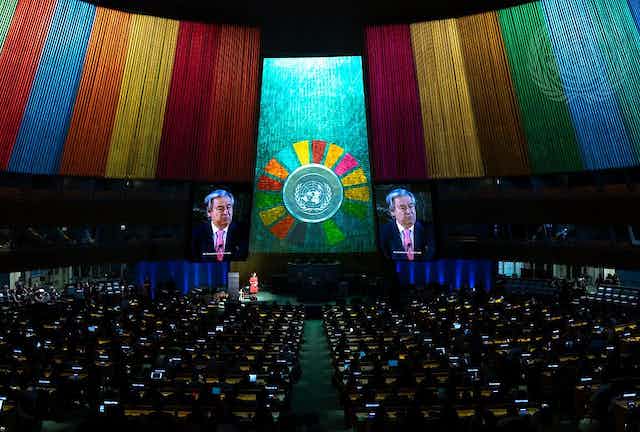
This week world leaders are gathering at the United Nations (UN) headquarters in New York to review progress against the Sustainable Development Goals. We’re halfway between when the goals were set in 2015 and when they need to be met in 2030.

As authors of a global UN report on the goals, we have a message to share. Currently, the world is not on track to achieve any of the 17 goals. 

There is much at stake. Failing to achieve the goals would mean by the end of the decade, 600 million people will be living in extreme poverty. More than 80 million children and young people will not be in school. Humanity will overshoot the Paris climate agreement’s 1.5℃ “safe” guardrail on average global temperature rise. And, at the current rate, it will take 300 yearsto attain gender equality.

But there is hope. With decisive action, we can shift the dial towards a fairer, more sustainable and prosperous world by 2030.

What does the research say?

The set of 17 universal goals agreed in 2015 to aim to end poverty, improve health and education, and reduce inequality – while tackling climate change and preserving our oceans and forests. Each of the goals are broken down into targets. 

Every four years, the UN Secretary-General appoints an independent group of 15 international scientists to assess progress against these goals and recommend how to move forwards. We were among the authors of the latest Global Sustainable Development Report published late last week.

To provide a snapshot of progress, we reviewed 36 targets. We found only two were on track (on access to mobile networks and internet usage) and 14 showed fair progress. Twelve showed limited or no progress – including around poverty, safe drinking water and ecosystem conservation. 

Worryingly, eight targets were assessed as still going backwards. These included reducing greenhouse-gas emissions and fossil fuel subsidies, preventing species extinction and ensuring sustainable fish stocks.

What is holding us back?

Recent studies have identified feasible and cost-effective globaland national pathways to accelerate progress on the goals. 

Unfortunately, in many developing countries, insufficient financial resources and weak governance hinder progress. In other cases, existing investments in fossil fuels have generated strong resistance from powerful vested interests. Achieving some goals, such as responsible consumption and production, will also require big, unpopular changes in habits and lifestyles, which are very ingrained.

To accelerate progress on the goals, targets must be fully integrated by government and business at all levels into core decision making, budgeting and planning processes. We need to identify and prioritise those areas that lag furthest behind. To be effective, we also need to uncover and address the root causes of inadequate outcomes, which lie in our institutions and governance systems.

Accountability also remains weak. The goals are not legally binding and even though countries have expressed their support, this has often failed to translate into policy and investments. In practice, the targets are often “painted on” to existing strategies without redesigning norms and structures to deliver improved outcomes.

If the world is to accelerate progress on the goals, governments need to play a more active part, by setting targets, stimulating innovation, shaping markets, and regulating business. 

We call on policymakers to develop tailored action plans to accelerate progress on the goals in the remaining years to 2030, including measures to improve accountability. 

Scientists have a major role to play too. As we argued in Nature, scientists can help us redesign institutions, systems and practices. By studying ways to strengthen governance and build momentum for tough but transformative reforms, research can overcome resistance to change, and manage negative side-effects.

What does it mean for Australia?

Australia tends to perform poorly on the goals when compared to our peers in the OECD (Organisation for Economic Co-operation and Development), ranking 40th in the world in 2023. Our best-performing goals include health and education, while progress lags on environmental goals, economic inequality and cost-of-living pressures. 

While some environment agenciesbusinesses and local groupshave embraced the goals, Australia’s poor performance is symptomatic of limited traction and commitment at the centre of government. 

Here, the goals are often seen as an international development issue rather than central to domestic policy efforts. We lack a high-level statement or any strategy or action plan for the goals. There is no lead unit or coordination mechanism in place and no reference to the goals in the federal budget. One promising development, a national Sustainable Development Goal monitoring portal, hasn’t been updated in five years. 

The best performing countries have taken concrete steps to mainstream the targets and ensure accountability:

  • Denmark requires new government bills to be screened and assessed for their impacts on the goals 
  • Finland has taken steps to place sustainable development and people’s wellbeing at the heart of policy and decision making. A sustainable development commission, annual citizens’ panel on sustainable development and national audits provide increased accountability
  • Wales requires public bodies to use sustainable development as a guiding principle reflecting the values and aspirations of the Welsh people.

Australia’s first wellbeing framework is an important step forward. The framework of 50 indicators has considerable overlap with the goals, despite notable exceptions such as the lack of a poverty indicator or any specific targets or benchmarks. 

To see the original post, follow this link: https://theconversation.com/well-behind-at-halftime-heres-how-to-get-the-un-sustainable-development-goals-back-on-track-206677


We Asked Americans What They Think About the Term “ESG.” Their Answers Were Eye-Opening

13 09 2023

Image credit: blacksalmon/Adobe Stock

By Carol Cone from Triple Pundit • Reposted: September 13, 2023

The term ESG is fine, according to a recent poll of 1,000 Americans. Despite continued polarization related to the acronym, which stands for environmental, social and governance, the majority of Americans believe it’s the best way to describe a company’s approach to improve business, society and the environment. Before we get to the data, though, it’s important to understand why we asked this question in the first place.

How did we get here?

Over the past year, a rising chorus of conservative U.S. voices have claimed that ESG is “woke capitalism,” or corporate virtue signaling about social and environmental concerns which they see as beyond the bounds of business.

The issue drew President Joe Biden’s first presidential veto in March of this year, defending legislation related to ESG investing and bringing the issue into the national spotlight. ESG is facing such a significant backlash that BlackRock CEO Larry Fink, long one of the financial industry’s staunchest proponents for purpose and ESG, doesn’t even want to use the term — though BlackRock’s policies around society, the environment, and business governance remain unchanged.

It’s also important to establish that whatever you call them, sound ESG practices are not new, and are indeed vital to operating a responsible, ethical, and profitable business. As Fortune sustainability reporter Eamon Barrett observed, “major corporations documenting their environmental, social, and governance policies for investor scrutiny is actually a decades-old process.” At its core, ESG is a means to broaden the lens on what constitutes key drivers of business value, accompanied by efforts to measure and report on what matters for individual company operations via standardized reporting frameworks. 

Americans say ESG is a-okay

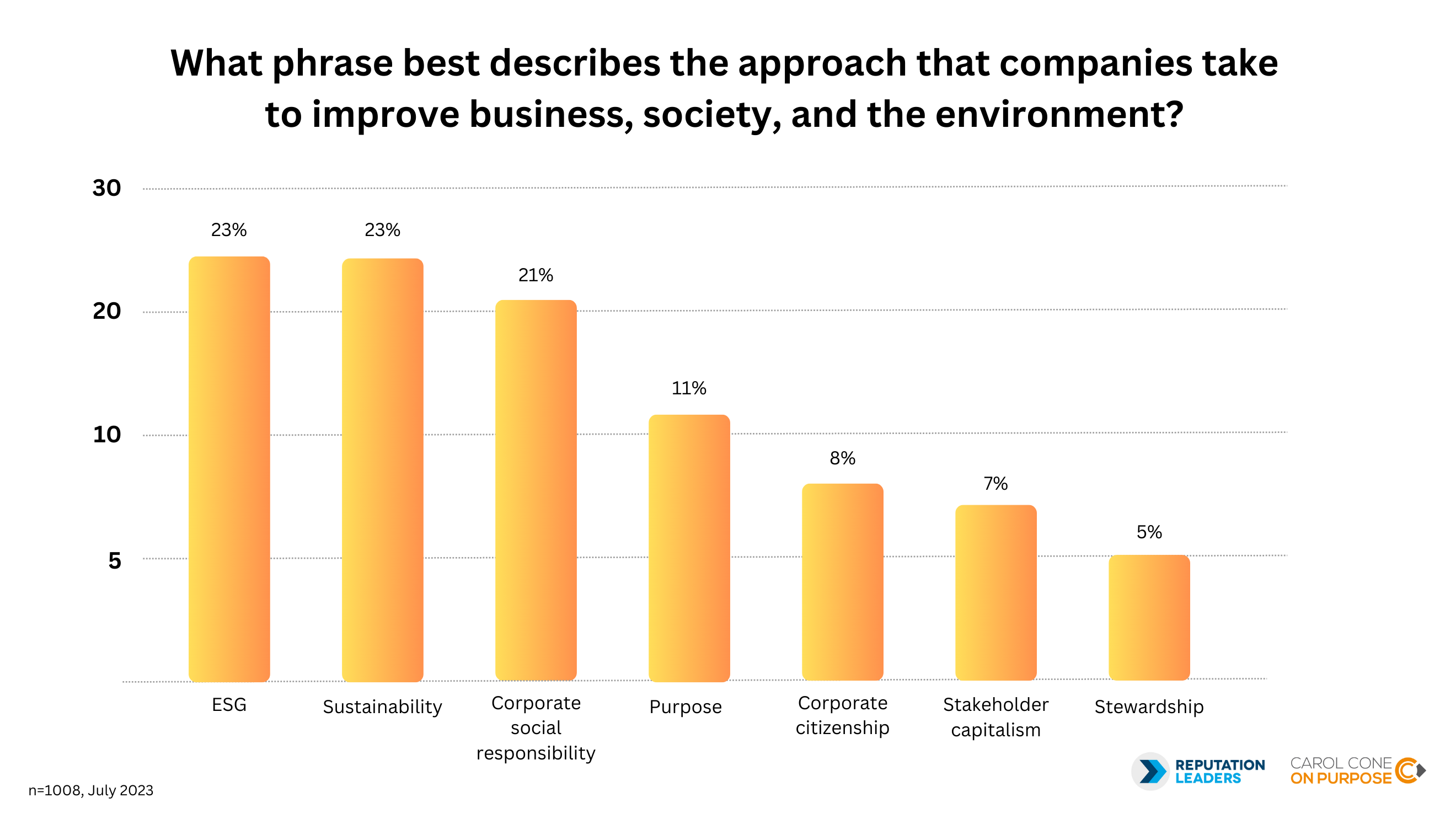
We partnered with Purpose Collaborative member Reputation Leaders, a global research and thought leadership consultancy, to ask Americans what term they feel best describes “the approach companies take to improve business, society and the environment.”
ESG and sustainability are tied for the top, at 23 percent each. Corporate social responsibility is second, at 21 percent, followed by purpose (11 percent), corporate citizenship (8 percent), stakeholder capitalism (7 percent) and stewardship (5 percent).

ESG research statistics — public opinion

Across demographic groups, ESG and sustainability are the favored terms among men, while women prefer “corporate social responsibility,” a phrase that connotes a sense of obligation. ESG is also the top choice for younger audiences, particularly those aged 25 to 34, while consumers aged 55 to 64, prefer the term “sustainability.” There are regional differences, as well. People living in the Northeast prefer sustainability, while their Southern and Midwestern counterparts prefer ESG.

Reputation Leaders also analyzed the tone of media coverage related to Americans’ top three terms: ESG, CSR and sustainability. CSR garnered the largest share of positive sentiment at 37 percent, with sustainability in second place at 32 percent and ESG trailing at 20 percent. ESG was the only term to have a significant amount (10 percent) of negative sentiment.

What now?

This study can help support companies in exploring the terms they will use to discuss the impact their business has on society. It is important to develop a clear, shared perspective and take a long-term view.

From the United Nations to the World Economic Forum, global leaders are advocating for businesses to embed a net-positive approach into their operating models to accelerate innovation and impact. Increasingly, employees, customers, supply chain partners, and others are asking about the ESG commitments of the companies they work for or with. Business leaders need to have answers and a strong point of view on which issues are most important to their business, and why. Our best advice? Don’t worry about what you call it — stick to your organization’s long-term, strategic commitments to stakeholders, society and the environment.

When it comes to communications, here are three ways to help depolarize the conversation:

  • Be clear about the goals of ESG. ESG is not about imposing a set of values on business. It provides a framework for companies to assess and optimize their value and impact. 
  • Increase transparency around ESG data and metrics. This will help to ensure that investors and other stakeholders are making informed decisions.
  • Embrace standardized reporting frameworks. This will make it easier to comparecompanies’ ESG performance — think: the Task Force on Climate-Related Financial Disclosures (TCFD), the Global Reporting Initiative (GRI) or the Sustainability Accounting Standards Board (SASB).

Yes, the polarization will continue, especially as the 2024 presidential election nears. As the world continues to endure climate impacts from extreme heat and flooding to record-breaking wildfires, there also will be greater demand for businesses to address environmental challenges.

Scores of studies suggest that ESG — done right — drives sustainable competitive advantage and can accelerate organizational growth over the long-term. An impressive 80 percent of investors believe that companies with strong ESG practices can generate higher returns and make for better long-term investments, according to research from Morgan Stanley.
 
By continuing to show a link between ESG issues and the business, we can help to make the debate around ESG more constructive and less polarizing. This will ultimately benefit businesses, investors and society as a whole.

To see the original post, follow this link: https://www.triplepundit.com/story/2023/americans-think-esg/783186


We Can’t Let Vogue Words Hinder Climate Action

17 07 2023

Image: United Nations

‘Regenerative’ has become the latest trend — a label that’s stuck on anything as a way of making it sound positive and reassuring. To guarantee genuine progress, we need a universal set of principles underpinning regenerative economics and a standardised way of quantifying success. By Amanda Powell-Smith from Sustainable Brands • Reposted: July 17, 2023

“Regenerative” is the new “sustainable.”

Globally, mentions of the word have gone up by 43 percent in online news stories and 282 percent on social media in the last year. Increasingly favoured by brands and companies to describe their positive approach to environmental challenges, regenerative is being stuck on everything from architecture to fashionteatravelskincare and even leather.

But what does it really mean? Originally, it was mostly used to describe an approach to agriculture. Regenerative farming is about producing food while restoring degraded soils and depleted wildlife populations and plant species. In this context, the use of the word ‘regenerative’ makes sense — it’s about keeping living ecosystems in balance. Metrics exist to measure tangible outcomes, like an increased percentage of organic matter in the soil or an upswing in insect numbers. We can track change.

Things become trickier when we apply the term ‘regenerative’ to human systems. What does a regenerative economy look like and how do we judge its success? As things stand, the term remains too broad-brush to be able to answer these questions in a consistent and meaningful way.

When applied to economics, it bears many similarities to the idea of a wellbeing economy — which is about healing, recovery and recuperation. However, the use of the word ’wellbeing’ offers much greater clarity because an existing suite of metrics exists to enable measurement of both healthy people and a healthy planet.

For example, the World Health Organization provides global figures on life expectancy and mother-and-child mortality rates. Likewise, for the animal world, the International Union for Conservation of Nature updates a red list of wildlife at threat of extinction. Plant and tree species numbers can similarly be tracked; no equivalent exists for the descriptor ‘regenerative.’

To guarantee genuine progress, we need a universal set of principles underpinning regenerative economics and a standardised way of quantifying success. Otherwise, the ‘regenerative’ epithet will lose its meaning and become just another empty badge exploited by greenwashers and climate deniers alike.

For those of us working in communications, this means — as ever — being careful with our use of language. We mustn’t decide that the word ‘sustainable’ is no longer important or relevant. Its meaning is critical but remains widely misunderstood with many aligning it to the environment only — when it’s about building an inclusive and resilient future for both people and the planet.

The United Nations defines sustainable as ‘meeting the needs of the present without compromising the ability of future generations to meet their own needs;’ and we won’t achieve that without the repair, renewal and regeneration of our natural world.

We can’t let ‘regenerative’ become the latest trend — a label that’s stuck on anything as a way of making it sound positive and reassuring. Those who want to use words such as ‘sustainable’ and ‘regenerative’ must always ally them with real substance, thought and impact. Words are important and what they stand for matters to us all.

To see the original post, follow this link: https://sustainablebrands.com/read/marketing-and-comms/vogue-words-hinder-climate-action


Disaster survivors need help remaining connected with friends and families – and access to mental health care

19 03 2023

Hatay, Turkey, was hit hard by the February 2023 earthquakes. Ugur Yildirim/dia images via Getty Images

By Daniel P. Aldrich, Professor of Political Science, Public Policy and Urban Affairs and Director, Security and Resilience Program, Northeastern University and Yunus Emre Tapan, Ph.D. Student in Political Science, Northeastern University via The Conversation * Reposted: March 19, 2023

The earthquakes that struck southeastern Turkey and northern Syria in early February 2023 have killed at least 47,000 people and disrupted everyday life for some 26 million more. 

Survivors of big disasters like these earthquakes – among the worst in the region’s history – certainly need food, water, medications, blankets and other goods. But they also need psychological first aid – that is, immediate mental health counseling along with support that strengthens their connections with their friends, relatives and decision-makers. 

As scholars who study how disaster survivors benefit from preserving connections to people in their networks, we know that these social ties help with the recovery from traumatic events that cause significant upheaval.

But often in the rush to keep survivors fed, warm and housed, we’ve observed that the flow of support that focuses on meeting their psychological needs falls short of what’s needed.

Emergency response underway

The Turkish government agency responsible for disaster management – the AFAD – focuses strongly on the delivery of tents, medical care and physical aid. And the few nongovernmental organizations providing mental health care, such as the Maya Foundation and Turkish Psychological Association, have received less than 10% of the donations channeled through the Turkey Earthquake Relief Fund

Many international aid groups, private companies and NGOs have launched campaigns to support search and rescue operations and response and recovery through disaster diplomacyThe United Nations invited its member states to raise US$1 billion to support aid operations. The U.S. is providing more than $100 million in aid.

All this assistance is funding emergency response efforts and humanitarian aid that largely consists of food, medicine and shelter in the area.

The Turkish government has announced it will begin building 30,000 homes in quake-hit areas in March and will give cash aid to those affected.

Psychological aspects of disasters

Research conducted after a wide variety of catastrophes has shown that mental health problems become more common after these events. Many survivors experience anxiety, depression and post-traumatic stress disorder because of everything they have been through. 

One reason for this is that disasters can cut people off from their routines and sever access to the sources of emotional support they previously relied on. Often moved to emergency shelters, and away from their doctors, neighbors and friends, survivors – especially those without strong networks – regularly experience poor mental health.

Further, when there are many casualties after major disasters of any kind, families may have lost loved ones and still not have a gravesite at which they can mourn. Within seven weeks of Hurricane Katrina in 2005, for example, nearly half of the residents of New Orleans surveyed by the Centers for Disease Control and Prevention had PTSD symptoms

An important lesson we’ve drawn from researching what occurs after disasters is that robust social networks can soften some of the blows from these shocks. Even after someone loses a home and a sense of normalcy, staying in close touch with family and friends can minimize some of the sense of loss. 

People who are pushed out of their routines but manage to remain connected to their neighbors – who are often going through the same ordeal – tend to have lower levels of PTSD and anxiety. Their friends and relatives can provide emotional support, help them stay informed, and encourage the use of mental health treatment and outside help when it’s needed.

One of us participated in a research team that surveyed nearly 600 residents of a town located near the Fukushima Daiichi power plant after the nuclear meltdowns in March 2011. More than one-fourth of these survivors of the catastrophe had PTSD symptoms. Those with strong social networks, however, generally had fewer mental health problems than other survivors with weaker connections to their friends and loved ones.

Another study of Japan’s Great Eastern Earthquake and tsunami in 2011 that one of us took part in showed that survivors of that disaster with stronger social ties recovered more rapidly and completely following a disaster.

People dressed for winter gather in a semi-outdoor space.
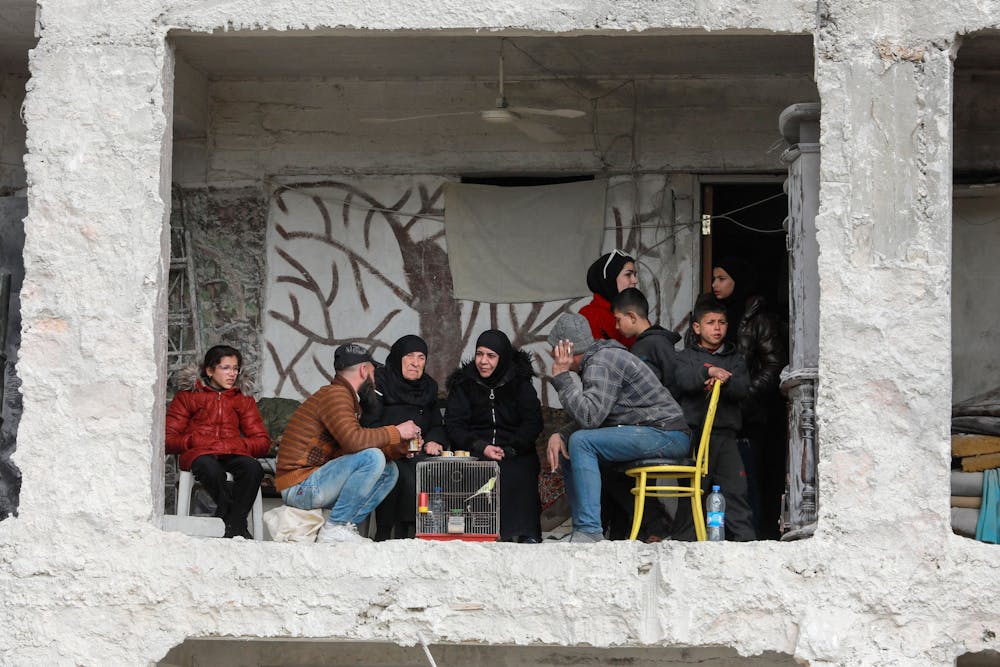
Syrians gather in Aleppo, in a building damaged by the February 2023 earthquake. Louai Beshara/AFP via Getty Images

4 strategies that can help

In our view, relief organizations that operate in Turkey and Syria and government aid agencies need to focus and spend more on mental health priorities. Here are four good ways to accomplish this:

  1. Include psychologists, therapists, social workers and other mental health professionals in the mix of aid workers who arrive immediately after disasters to begin group and individual therapy. 
  2. Ensure that local faith-based organizations and spiritual leaders play key roles in the recovery process
  3. Get as many public spaces, such as cafes, libraries and other gathering spots as possible, up and running again. Even virtual get-togethers using Zoom or similar software can help maintain connections with displaced friends and loved ones – as long as survivors have working cellphone service, at a minimum.
  4. Disaster recovery efforts should make communications technology a high priority. In addition to spending on food, tents, blankets, cots and medical supplies, we recommend that basic disaster aid should include access to free phone calls and Wi-Fi so that people whose lives have been upended can stay in contact with far-flung friends and loved ones. 

Given the likelihood of more large-scale disasters in the future, we believe that it’s essential that relief efforts emphasize work that will strengthen the mental health and social networks of survivors.

To see the original post, follow this link: https://theconversation.com/disaster-survivors-need-help-remaining-connected-with-friends-and-families-and-access-to-mental-health-care-200247


U.N.: “Resilient People, Resilient Planet: A Future Worth Choosing.”

1 02 2012

The UN High-Level Panel Global Sustainability released its report in Addis Ababa yesterday entitled “Resilient People, Resilient Planet: A Future Worth Choosing.” The panel’s 99-page report, which will serve as an input to the UN Conference on Sustainable Development in June, (otherwise known as the Rio+20 Summit) is a call to action, “to address the sustainable development challenge in a fresh and operational way.”

The executive secretary of the panel, Janos Pasztor said:

We cannot go into sustainable development without making a radical transformation of the economy.”

The long-term vision of the Panel is to eradicate poverty, reduce inequality and make growth inclusive, and production and consumption more sustainable, while combating climate change and respecting a range of other planetary boundaries. In light of this, the report makes a range of recommendations to take forward the Panel’s vision for a sustainable planet, a just society and a growing economy.

 In their summary report, the panel reminded us of the sober reality of the world today.
  • 27 per cent of the world’s population lives in absolute poverty (down from 46 per cent in 1990)
  • Global economic growth is up 75 per cent since 1992 but inequality is still high
  • An increase of 20 million undernourished people since 2000
  • 5.2 million hectares net forest loss per year
  • Ozone layer will recover to pre-1980 levels in 50 years plus
  • Two thirds of the services provided by nature to humankind are in decline
  • 85 per cent of all fish stocks are over-exploited, depleted, recovering or fully exploited
  • 38 per cent increase in annual global carbon dioxide emissions between 1990 and 2009
  • 20 per cent of the world’s population lack access to electricity
  • 884 million people lack access to clean water
  • 2.6 billion people are without access to basic sanitation
  • 67 million children of primary school age are out of school
  • 3.5-year increase in life expectancy between 1990 and 2010

The report says:

“The signposts are clear: We need to change dramatically, beginning with how we think about our relationship to each other, to future generations, and to the eco-systems that support us. Our mission as a Panel was to reflect on and formulate a new vision for sustainable growth and prosperity, along with mechanisms for achieving it.

With seven billion of us now inhabiting our planet, it is time to reflect on our current path. Today we stand at a crossroads. Continuing on the same path will put people and our planet at greatly heightened risk.”

Article originally posted on Triplepundit.com