The anthem for 2012.
This cut was put together by Vivek Chauhan, a young film maker, together with naturalists working with the Sanctuary Asia network (www.sanctuaryasia.com).
The anthem for 2012.
This cut was put together by Vivek Chauhan, a young film maker, together with naturalists working with the Sanctuary Asia network (www.sanctuaryasia.com).
Congratulations to Portfolio 21 Investments in Portland for a remarkably blunt, clear and inspiring strategic approach to managing investments in “the age of volatility.”
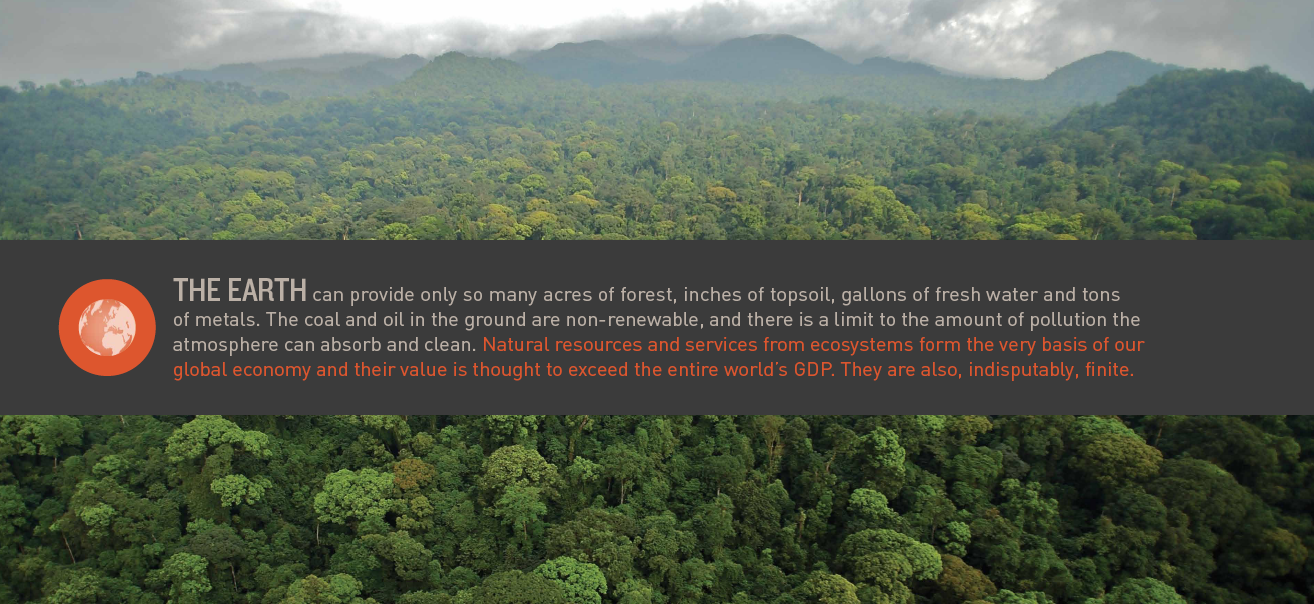
In one of the most compelling presentations regarding the need to re-think investment criteria in a world of ecological crises, Portfolio 21 Investments calls for re-thinking traditional criteria for investment and puts forward a unique pov to navigate a new landscape. They are making a commitment to factor in new levels ecological risks and to seek the rewards from those that are bringing forward innovation and new ways to confront new realities.
By evaluating companies’ energy and resource efficiencies as well developing new strategies for operating in an ecologically limited world, Portfolio 21 is bringing timely and refreshingly enlightened thinking to the investment sector.

Portfolio 21’s report cautions: “Investors must be aware of a stark and fairly recent truth: Our economic system has become so large that is is overpowering and threatening the natural systems that support it. Our failure to anchor the economy within the earth and its systems facilitates a fallacy: the belief that the economy can grow infinitely, regardless of the planet’s physical limits.”

Kudos to Portfolio’s 21 fresh and importantly provocative pov. Let’s hope investors listen and companies heed the wisdom.
 Major global companies including Motorola Mobility, Deutsche Bank, Bloomberg, Method and BD (Becton, Dickinson and Co.) have produced or have pledged to procure at least 25 percent of their operations’ power consumption from wind energy. They announced their commitment to become certified under the new WindMade consumer label at a Global Launch event in New York.
The companies pioneering the use of the world’s first wind power consumer label were unveiled today at an event hosted by WindMade and the UN Global Compact in New York.
The label allows participating companies to communicate the share of wind power and other renewable sources as part of the overall power demand of their operations. The objective behind WindMade is to drive demand in wind power, thereby boosting investment and growing the renewable energy market.
Here is a video that tells the story of the WindMade label.
“These companies are at the forefront of the global sustainability movement,” said Henrik Kuffner, WindMade’s CEO. “We are delighted to have them on board the unique WindMadeTM initiative, and are confident that many others will follow suit in the coming weeks and months.”
“Consumers are ready to act. 67 percent of 31,000 consumers globally have told us they would favor WindMade products, even at a premium,” said Morten Albæk, SVP Global Marketing and Customer Insight at Vestas Wind Systems, the company spearheading the WindMade initiative. “WindMade empowers people to choose brands that choose wind.”
“We believe clean growth is good economics,” said Sabine Miltner, Group Sustainability Officer for Deutsche Bank. “We are committed to leveraging our core business expertise towards a cleaner and more energy efficient global economy. We believe in leading by example and have increased our use of clean electricity from seven percent to 65 percent over the last four years. WindMade is an important step toward more market transparency and we are pleased to join this new partnership.”
“It is Motorola Mobility’s intent through our participation in the WindMade initiative to encourage greater use of renewable energy sources like wind and solar around the globe,” said Bill Olson, director office of sustainability and stewardship, Motorola Mobility.
“The supply side of the clean energy sector can clearly deliver, but now it is time to galvanize demand. Government has done their part, and it is now up to the corporate community to demonstrate leadership by committing to clean energy development. WindMade provides us with a roadmap for achieving this,” said Curtis Ravenel, head of sustainability, Bloomberg.”Corporations investing in wind energy technology need a global set of standards if they are to provide the transparency that’s critical to their stakeholders as well as gain the competitive advantage that such investments can mean for their businesses,” said Kathy Nieland, U.S. sustainable business solutions leader, PwC.
”Using wind power helps BD become a more sustainable organization, and the WindMade label sends a message to our customers and the industry that supporting clean sources of electricity is a sound business decision and an important choice in reducing a corporation’s environmental footprint,” said Glenn Barbi, vice president, Global Sustainability, BD.
For more information on the founders and pioneers, see http://www.windmade.org.
According to the WindMade requirements, companies using the label must source a minimum of 25 percent of the electricity consumed from wind power. The wind energy share can be procured through a company-owned wind power generation facility, a long-term power purchase agreement for wind power, or the purchase of high quality Renewable Energy Certificates approved by WindMadeTM. The exact percentage of the wind energy share will be stated on the label. Companies can choose to certify global, regional or facility level operations, a distinction that will be clearly communicated on the label itself.
WindMade, which was introduced to the world at this past year’s World Economic Forum in Davos, is backed by the UN Global Compact, Vestas Wind Systems, World Wildlife Fund, Global Wind Energy Council, Bloomberg (as the official data provider), and the LEGO Group. PwC is the official verification partner.
A separate label for products is in development and will be released during 2012.

In releasing its latest guide to Greener Electronics, Greenpeace has ranked 15 leading technology companies and how they are performing on key measures around sustainability. The guide is intended to help consumers make better informed decisions when purchasing technology products and help businesses evaluate the performance of their technology vendors in helping them achieve their own sustainability objectives.
Download the Greenpeace Guide here
The comprehensive analysis will help consumers understand the impact of specific products, as well as the sustainability performance of the overall corporation. New criteria added to this edition of the Guide are based on the creation of truly sustainable electronics industry, Greenpeace said, and include a holistic examination of key supply chain issues.
“Right now, HP takes the top spot because it is scoring strongly by measuring and reducing carbon emissions from its supply chain, reducing its own emissions and advocating for strong climate legislation. However all companies we included in the Guide have an opportunity to show more leadership in reducing their climate impact”, Tom Dowdall of Greenpeace said in a statement.
Blackberry manufacturer Research in Motion (RIM) is ranked for the first time and scored well on conflict minerals and sustainable paper policy. But the company ranked bottom of the table because it needs to improve reporting and disclosure of its environmental performance, Greenpeace said. It is interesting to note that failure to communicate progress – the opposite of the idea of sustainable branding – was a key factor in RIM receiving such a low ranking.

Fair Trade USA, the leading third-party certifier of Fair Trade products in the United States, reports new findings which confirm that the prominent appearance of the Fair Trade Certified™ label increases sales among coffee-buying consumers.
To investigate the topic of consumer demand for Fair Trade products, researchers Jens Hainmueller of the Massachusetts Institute of Technology, Michael J. Hiscox of Harvard University, and Sandra Sequeira of the London School of Economics, conducted a six-month research study in partnership with a prominent national grocery retailer. As reported this weekend in the Wall Street Journal, the team examined purchasing behavior among actual consumers at 26 stores and key findings show that:
The findings are consistent with a Globescan study conducted in 2010, which revealed that 75 percent of consumers said Fair Trade certification makes them feel “very positive or positive” about products; 30 percent said Fair Trade is “likely to increase their purchase interest;” and over half said “independent third-party certification is the best way to verify” a product’s social and environmental claims.
“Overall the findings suggest that there is substantial consumer support for Fair Trade,” said Michael J. Hiscox of Harvard University. “The Fair Trade label by itself had a large positive effect on sales, indicating that a substantial number of coffee buyers place a positive value on Fair Trade certification. In addition, a sizeable segment of coffee buyers were willing to pay a premium for coffee if the premium was directly associated with support for Fair Trade. The tests suggest that there are plenty of consumers ready to vote with their shopping dollars to support Fair Trade when it is offered as an option by retailers.”
The study can be referenced online at http://papers.ssrn.com/sol3/papers.cfm?abstract_id=1801942.

A survey of more than 18,500 people across 24 countries has revealed that concern over climate change is eclipsed by other environmental concerns such as energy security and waste disposal.
Global warming was voted a top priority in just four of the nations polled – South Korea, India, Japan and Mexico.
Energy security is the leading environmental issue for Britons, over and above climate change, according to the new international Ipsos poll of working age adults.
Half of Britons (50%) feel that future energy supplies and sources is one of the most important environmental issues facing the nation. Other leading issues are waste management (48%); overpopulation (41%).
Only a quarter of Britons (25%) believe climate change is their leading environmental concern.
Of the 24 nations polled across the globe, Britain is in the bottom third in terms of prioritising climate change. Lower placed nations include South Africa (23%), China (21%), Poland (19%) and Russia (9%).
In contrast the UK is in the top three nations most concerned about energy security, behind Sweden (58%) and Germany (56%).
Ipsos MORI’s Head of Environment Research, Edward Langley, said: “The public are cautious about climate change. They feel there is a lack of consensus on whether it is man-made and the degree to which it will impact their lives.
“In contrast, our dependency on fossil fuels is a more immediate and tangible risk that they can get their heads around, and one where they see an obvious need to take action to maintain living standards.”
The survey was conducted last month in 24 countries around the world via the Ipsos Online Panel system. The countries included Argentina, Australia, Belgium, Brazil, Canada, China, France, Great Britain, Germany, Hungary, India, Indonesia, Italy, Japan, Mexico, Poland, Russia, Saudi Arabia, South Africa, South Korea, Spain, Sweden, Turkey and the United States of America. The international sample included 18,675 adults. Those interviewed were aged 18-64 in the US and Canada, and 16-64 in all other countries.
According to Ipsos MORI, the survey results reveal a number of potential implications for environmental campaigners. Firstly, it is important for the public to realise that the science community is in broad agreement that man-made climate change is happening, and to link the impacts with risks the public care about, that is, economic prosperity and that of future generations.
Secondly, campaigners need to consider the degree to which energy security can be used as a hook to encourage participation in sustainable behaviours.
Looking further afield, campaigners may also consider why other nationalities are more likely to feel Climate Change is a key environmental issue. For example, Japan (48%), Canada (40%), Spain (40%) and Germany (38%) are much more likely to say climate change is a key issue for them. Are there lessons which can be learnt in terms of how the public have been engaged there?
Reposted from Clickgreen.org.uk
Here’s a report on the recent Ernst & Young survey about companies intentions to invest in climate change initiatives. We love the idea that 89% report the efforts are driven by changing customer demands.

Seventy percent of major companies plan to boost spending on climate change efforts in the next two years, according to a new report from Ernst & Young.
Of the 300 corporate executives surveyed this spring, 89% said their green activities were driven by changing customer demands while 92% also pointed to energy costs as a driver. The fact that 43% of those surveyed said that equity analysts will soon consider climate change actions while valuing companies was also a factor.
Thirty percent said their company had a staffer in charge of climate change initiatives, a trend The Times explored in December.
The respondents hail from 16 countries, representing firms in 18 industry sectors that pull in at least a billion dollars a year in revenue. Nearly half said they intend to shell out between half a percent to more than 5% of that revenue – or about $5 million to $50 million each year – for climate change initiatives.
Two-thirds said they are talking with their suppliers about programs to limit carbon emissions; 36% said they are already in the process of cutting greenhouse gases from their supply chains.
Nearly 95% said national policies played a critical role in their company’s climate change strategy and 81% said the same of global laws. But in countries such as the U.S., Japan and Germany, regulatory and compliance issue was ranked as the largest challenge to accomplishing environmental goals.
The study was conducted by the research group Verdantix.
— Tiffany Hsu, The Los Angeles Times
The last team standing (sort of) at the end of the Copenhagen Climate Summit was The Age of Stupid TV Show production team.

The Stupid Show Recaps Copenhagen
You can watch a post -conference Age of Stupid Show with hosts Franny Alexander and Mark Laynas featuring interviews with attendees, dignitaries and others who left with strong opinions about the “agreement”. A re-freshingly non-American-centric perspective.

Measures to combat climate change could have appreciable direct as well as indirect benefits for public health, say authors of a series of six papers and four comments in The Lancet Online First.
In the first comment, authors from the London School of Hygiene and Tropical Medicine say that many policies to reduce greenhouse gas emissions can also have a range of ancillary effects, including effects on health. The authors of the first paper in the series looked at the effects of two hypothetical interventions: to improve the energy efficiency of UK housing stock (combined fabric, ventilation, fuel switching and behavioural changes); and to introduce 150 million low-emission household cookstoves in India. The UK housing changes were estimated to cut disability-adjusted life years (DALYs) by 850 and to save 0.6 megatonnes of carbon dioxide per million population in one year. Introducing cookstoves was calculated to result in substantial reductions in acute lower respiratory tract infection in children, chronic obstructive pulmonary disease and ischaemic heart disease resulting in 12,500 fewer DALYs and a saving of 0.1-0.2 megatonnes of carbon dioxide per million population per year.
A further paper modelled the health and environmental effects of changes to urban land transport in Delhi and London, which included lower-carbon-emission motor vehicles and a higher level of active travel. Increasing active travel – in either city – gave rise to more health as well as environmental benefits than increasing use of lower-emission motor vehicles. Much of the benefit arose from a reduction in the number of years of life lost from ischaemic heart disease, by 10-19% in London and 11-25% in Delhi. Other papers looked at the health effects of strategies linked to low-carbon electricity generation, short-lived greenhouse pollutants, and food and agriculture. In his own comment, Richard Horton, editor of The Lancet, points out how this research could help combat the public’s negative perception of initiatives to combat climate change: “The overwhelming impression among the public is that any response to global warming will be negative … We will have to drive less, fly less, eat differently, change the way we generate energy, and alter our lifestyles in ways that will limit our freedom to do as we please … Not surprisingly, this political message is hard to sell to a public already struggling during a time of global financial insecurity.” “Health is likely to become an increasingly important concern, not only for a public anxious about the impact of climate-change mitigation policies on their lives, but also for politicians eager to sweeten the climate-change policy pill. This latest report aims to accelerate political and public assent for large cuts in greenhouse-gas emissions.”
Professor Vivienne Nathanson, head of science and ethics at the British Medical Association, said of The Lancet’s papers: “Climate change not only contributes to disease and premature death but exacerbates existing health inequalities in the UK and globally. Today’s research shows that a reduction in emissions will have a positive effect on health in both high and low-income settings, and that lifestyle changes made by all us will have direct health benefits.”

The filmmakers behind the groundbreaking documentary on climate change–The Age of Stupid—hope to webcast The Stupid Show live from the United Nationals Climate Summit in Copenhagen in December. To make this happen, they need your support.
I can’t believe I just wrote that headline – but the truth is stranger than fiction. The Guardian reported today:
 Boris Johnson came to the rescue of a high profile climate change activist and filmmaker who was being attacked by a group of young girls brandishing an iron bar, it was revealed today.
Franny Armstrong, the director of The Age of Stupid, described the mayor of London as her “knight in a shining bicycle” after he came to her defence as she was walking home in Camden, north London, last night.
She called out for help to a passing cyclist after being surrounded by a group of hoodie-wearing young girls who pushed her against a car, one holding an iron bar.
She called out for help to a passing cyclist after being surrounded by a group of hoodie-wearing young girls who pushed her against a car, one holding an iron bar.
The cyclist turned out to be none other than Johnson, who has made tackling youth crime a key mayoral priority.
He stopped and chased the girls down the street, calling them “oiks”, according to Armstrong, who praised the mayor’s intervention.
Johnson returned and insisted on walking her home.
Armstrong is the founder of the 10:10 campaign, which aims to cut 10% of carbon emissions in 2010 and has attracted support from leading firms – including the Guardian – and personalities.
“I was texting on my phone so didn’t notice the girls until they pushed me against the car, quite hard,” she said.
“I noticed that one had an iron bar in her hand. It was very frightening. At that moment a man cycled past and I called out for help.
“He said to the girls: ‘What do you think you are doing?’ He picked up the iron bar, called after the girls and cycled after them. He returned a few minutes later and walked me home.
“He was my knight on a shining bicycle.”
Watch an interview with Franny Armstrong.

Like the first important primary of a presidential election, New Hampshire represents a key milestone for another candidate. Ana’s Playground— the short film about children as victims of armed conflict—won Best Short Drama in this past weekend’s festival in Portsmouth, New Hampshire. More than 80 independent films were screened over the weekend.
With award winning honors in three of its first few screenings, Ana’s Playground continues its world tour. Check out the Ana’s Playground filmmaker blog for other news and updates.
One of the largest film fests in New England, the four-day event draws celebrities, academy-award winners, film industry veterans and local film lovers. Most importantly, NHFF offers workshops and discussions for young and new filmmakers to interact with industry pros and learn the art and business of film.
“The first successful dramatisation of climate change to hit the big screen.”
– The Guardian
Last month saw the world premiere of The Age of Stupid on the eve of the United Nations conference on climate change. The Age of Stupid’ is the new cinema documentary from the Director of ‘McLibel’ and the Producer of the Oscar-winning ‘One Day in September’. Filmed in seven countries over four years, this enormously ambitious drama-documentary-animation hybrid stars Oscar-nominated Pete Postlethwaite as an old man living in the devastated world of 2055, watching ‘archive’ footage from 2008 and asking: why didn’t we stop climate change while we had the chance?
Visit the world of The Age of Stupid
Watch a United Kingdom televised report on The Age of Stupid and other eco-documentaries soon to be released.
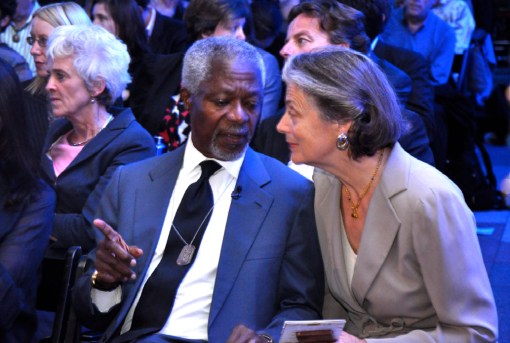
U.N. Secretary General Kofi Annan at the world premiere event in New York on the eve of the United Nationals General Session on Climate Change.
The exterior of The Archive in which Pete Postlethwaite’s character, the archivist, lives. This animation was produced by animator Greg McKnealley.


The momentum of disengagement from the U.S. Chamber of Commerce based on their draconian position denying climate change continues. The chamber in recent weeks has challenged a federal Environmental Protection Act finding that greenhouse gases can be regulated by the Clean Air Act.
Nike announced Wednesday that it has resigned from the Board of Directors of the Chamber. In a statement, Nike said “we fundamentally disagree with the U.S. Chamber of Commerce on the issue of climate change and their recent action challenging the EPA is inconsistent with our view that climate change is an issue in need of urgent action.”
Nike joins PG&E Corporation, PNM Resources and Exelon Corporation— all of whom have left the Chamber in the past week based on the Chamber’s position denying climate change. Speculation continues that Chamber President Thomas Donohue will be forced to resign based on the defection of member companies and allegations of conflict of interest based on his board position at Union Pacific Railway, a company fighting climate change legislation in part based on the large amount of revenues they receive from the shipment of coal.
 “Now is the time for decision-making. We must seal a deal in Copenhagen for a global, equitable and comprehensive deal for the future of humanity and the future of Planet Earth.”
– U.N. Secretary General Ban Ki-Moon
In December in Copehagen, the United Nations will host a global conference from governments around the world to achieve a comprehensive agreement on climate.
Reaching a deal by the time the meeting ends on December 18 will depend not only on complex political negotiations, but also on public pressure from around the globe.
The United Nations has launched “Seal the Deal” campaign that encourages users to sign an online, global petition which will be presented by civil society to governments of the world.
Visit the Seal the Deal website
Watch U.N. Secretary General Ban Ki-Moon talk about the “Seal the Deal” campaign.
CoolPlanet2009 is also on board to support the Seal the Deal campaign.
The week of September 21st has been desiganated as Global Climate Week. Rallies in more than 100 cities across the global are being organized by young people as a major push to keep global warming high on the international agenda. More than 800 young people pledged a comprehensive campaign at the conclusion of the Tunza International Youth Conference in Daejeon, Korea at the end of August.


Now is the time to spread the world about the United Nations’ Seal the Deal campaign. You can follow them on Twitter or join a Seal the Deal group on Facebook. Let’s get Copenhagen and climate change on minds in the U.S. as it is across the world.

“This research shows that consumer values do not change, even in a middle of a recession. They want companies to act and cut their carbon footprints, and provide transparent and accessible evidence of action. We believe companies that take real action will seize the dual benefits of immediate cost savings and a stronger reputation, which is good for business.”
– Harry Morrison, Carbon Trust Standard
New research from the Carbon Trust Standard in the United Kingdom shows that consumers still want to buy green despite the current economic climate, with 62% of consumers saying environmental concerns influence their purchasing decisions—‘the same as a year ago’ and just over a quarter saying they influence them ‘even more’ than in 2008.
Other fun factoids from the research that marketers should be aware of:
So sustainable branding requires new forms of communications and embracing transparency and honesty in all facets of a brand presentation. The research further demonstrated this quest for information that engaged consumers are using to understand whether or not a company is environmentally responsible. The research indicated the most important criteria they rely on are what they read in the media (38%) and third party endorsement or accreditation (34%).
The least popular factor consumers use to judge whether a company is behaving in an environmentally responsible manner is what advertising tells them (6%).
A fun user generated video contestant for the MTV Europe Play to Stop competition.
 Coca-Cola has unveiled its new “PlantBottle” to be rolled out later this year with the Dasani brand and in its Vitaminwater portfolio of products in 2010. In a smart move toward sustainable branding, the new bottles and their environmentally responsible composition will feature on-bottle messaging, in-store displays and on-line marketing communications so customers can begin to appreciate they are purchasing a new sustainable technology.
Said Muhtar Kent, Coca-Cola’s CEO, “The “PlantBottle” is a significant development in sustainable packaging innovation. It builds on our legacy of environmental ingenuity and sets the course for us to realize our vision to eventually introduce bottles made with materials that are 100 percent recyclable and renewable.”
We agree – through its sweeping worldwide sustainability plan under the theme “Living Positively” – Coca-Cola is one of the innovators and pioneers of business practices that support overall good corporate citizenship.
A life-cycle analysis conducted by the Imperial College London indicates the “PlantBottle” consisting of 30 percent plant-based materials will reduce carbon emissions by up to 25 percent, in comparison with traditional PET plastic bottles. The PlantBottle is currently made through an innovative process that turns sugar cane and molasses, a by-product of sugar production, into a key component for PET plastic.
 Cub Foods recently opened a LEED (Leadership in Energy and Environment Design) Gold Certified grocery store in the Phalen neighborhood of St. Paul, Minnesota.
Having visited the store we send big kudos to Cub. Not only is the store a inventive and creative way of reducing the energy consumption, carbon footprint and reduced impact in construction and daily operation, but it is an excellent example of conveying the vision and possibilities to its customers.
The statitsics related to the store itself are impressive.
But we love how Cub has used the physical environment of the store itself to provide information about every aspect of how the store is operating in a sustainable way. The subtle signage is designed to educate Cub customers about the important facets of the store’s operations.
Messages conveyed include how the store uses reduced refrigerant.

Use of natural light to reduce energy consumption.

How Cub uses packaging made from only 100% renewable resources.

How the overall store operates in a more energy efficient fashion.
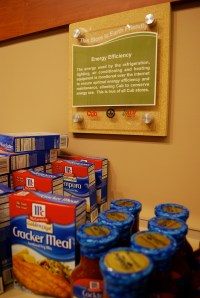 LED refrigerator case lighting to conserve energy.

Special parking places reserved for customers driving fuel efficient vehicles.

An overall store experience which is designed to be more respectful to nature and healthy for all.

In additional to many of the customer facing aspects of the store, the new Cub also features creative, energy saving ideas in all aspects of its operation. For employees, the Cub facility features men and women’s shower rooms for employees to encourage them to ride the bike to work and worked with the city of St. Paul to create an additional city bus route so their employees can take the bus to and from work versus driving. The facility also features a white roof to reflect heat to reduce energy consumption and special landscaping to absorb rainfall.
All in all, we encourage everyone to visit this very special new store if you have the chance. And we send our congratulations to the leadership of SuperValu (the parent of Cub Foods) for their courage and leadership in creating and building what we hope will become the role model for retailers everywhere.
Our thanks to the support of Cub Foods—and in particular Lee Ann Jorgenson, Manager of Community Relations and Communications—for allowing us to fully understand and share all of what the new Cub store is doing to be respectful to its new home in the Phalen neighborhood.
(Photos by P.J. Milan. All rights reserved.)
We love the work MTV Europe is doing in partnership with the European Union announced today, kicking off a six month campaign to raise awareness and action among young people in Europe regarding climate change leading up to the Climate Conference in Copenhagen in December. Stunningly, research from Europe indicates only a little more than half of people aged 15-24 have taken action to fight climate change, the lowest proportion of any age group. The campaign is designed to give a voice to the age group to be most affected by climate change.
“Events like this are vital, because young people are a tremendously important pressure group. They will be most affected by climate change — so their voices are the most important,” Environment Commissioner Stavros Dimas said in a statement.
Moby will perform in Stockholm on August 20, with other artists taking to the stage in Budapest and Copenhagen in the coming months. Each concert will take place alongside a major climate change event in the respective cities.
The six-month campaign, to be held in the run-up to international climate talks in Copenhagen in December, will run in 11 EU countries and include TV spots, webcasts and games. MTV will provide editorial content on tackling climate change.
Watch the hilarious MTV Play to Stop Promo
 Eric Block On Responsible Branding
You must be logged in to post a comment.