How the Healthcare Industry Can Confront the Climate Crisis Through its Supply Chain

1 08 2023

Photo: Boston Scientific

By Kathryn Unger from Triple Pundit • Reposted: August 1, 2023

As Earth’s temperatures continue to rise, it has become evident that protecting the planet will require global cooperation and direct action across every single industry. The healthcare industry is no exception. Indeed, the connection between environmental health and human health underscores the importance of the medical community’s role in reaching net zero carbon emissions. 

The healthcare sector contributes an estimated 4.5 percent of global emissions. Some of these greenhouse gases are produced from healthcare facilities; others are the result of the industry’s supply chain of goods and services. Yet when it comes to climate change, the healthcare industry must go beyond focusing on treating the health conditions resulting from environmental degradation — and increasingly, we’re seeing industry starting to shift toward helping to prevent those health conditions by addressing climate change itself. 

Boston Scientific is among those medical technology companies working to reduce emissions. Our ambitious effort will involve reevaluating every aspect of business and making changes to support achieving net-zero emissions along the company’s entire value chain. This work represents a considerable challenge, and one whose time has come. 

“Climate change will affect almost every human disease in some way,” says Dr. Kenneth Stein, chief medical officer. “For those of us in the healthcare industry, who are dedicated to improving health and patient outcomes, that’s a worrisome thought. But we can apply our considerable innovative skills toward becoming part of the solution.”

Fortunately, we have a couple of important factors working in our favor. They are ingredients which, I would suggest, every company needs to succeed in meeting its ESG goals: A thoughtful, realistic, and science-based sustainability plan in development, along with full-throated support for our initiative at every level of our organization.

Making the business case for sustainability in healthcare

Within the medtech sector, some sustainability changes involve tracing products back through the supply chain to reimagine the way those products are sourced, manufactured, packaged and shipped. Doing so is a significant undertaking – so much so, that if an organization doesn’t have a clear understanding that its sustainability goals are in line with a clear mission to improve health outcomes, it might shy away from the challenge.

Paudie O’Connor, senior vice president in charge of Boston Scientific global supply chain, points out that for that reason, it’s important to dispel myths that there is tension between the two goals. “There is no reason why we can’t further healthcare to help decrease the plight of human suffering, and work to improve the environment at the same time,” he told me. 

In fact, Boston Scientific was the first medical device company to commit to carbon neutrality within its manufacturing network, as well as to receive approval for its net zero target by the Science Based Targets initiative (SBTi), an international organization that provides clear guidance for reducing greenhouse gas emissions in line with the latest climate science. 

 Already, we’ve made progress toward carbon neutrality goals by shifting our electricity sources in the U.S. and Europe to 100% renewable electricity – contributing to 76% renewable electricity across our global manufacturing and key distribution sites – putting us on track for 100% renewable electricity worldwide by 2024 in our manufacturing and key distribution sites. All are important milestones on the path to achieving the company’s net zero emissions target across the entire value chain by 2050. 

However, some sustainability goals are more complicated. For instance, physicians and patients need medical products that are sterile, safe and reliable – and those standards are highly regulated. Now, teams must consider the environmental footprint of products at every life cycle stage, from design, sourcing, production and distribution to waste disposal and recycling. 

“We spend a great deal of time thinking about how we can structure our supply chain to support growth and environmental sustainability,” O’Connor says. “For example, thinking of ways to reduce packaging, digitize instructions for use, target sterilization practices and use strategic modes of distribution.”

Shipping is a good example. Medical device manufacturers have long shipped products to their destinations by air as a matter of convenience and, importantly, speed, so that devices are always available for patients who require immediate intervention. “Our supply chain has a purpose statement: ‘delivering for patients,’” says O’Connor. “Getting high-quality products to patients when they need them.”

Rail and maritime transport are far more carbon-efficient than air transport, but take longer; for example, a product that takes four days to get from Costa Rica to Boston by air may take 14 days by boat and rail. Thus, in switching to moving products by land or sea to key distribution hubs, a company must carefully reexamine the timetables by which products are sent and adjust them accordingly. Mapping out such thoughtful, deliberate changes can result in meaningful carbon reduction, making the effort well worthwhile. 

Tackling environmental challenges for better health

This is one of the biggest challenges that the global population has faced, let alone the healthcare industry. But by viewing environmental sustainability as a step toward improving human health, the goals of both the medical community and those of global supply chain teams can come together as one. I believe that such a holistic view is precisely the way to frame the important sustainability work ahead of the healthcare industry. Dr. Stein agrees: “To reduce healthcare disparities, we can’t ignore how environmental and climate changes will affect health, especially for society’s most vulnerable.” 

There is so much more work to do to continue to advance our collective efforts to contribute to a healthier planet. Regulations are increasing and evolving. Customer expectations are evolving. Science is constantly evolving and changing the things that we can accomplish for our customers and patients. But the industry is making meaningful changes — and by holding ourselves and each other accountable, we can accelerate progress and achieve more together.

This article series is sponsored by Boston Scientific and produced by the TriplePundit editorial team. To see the original post, follow this link: https://www.triplepundit.com/story/2023/healthcare-industry-climate-change/780166




Sustainability report shows importance of affordability and convenience

1 08 2023

A new study finds three-quarters of consumers wish to live more sustainably, with convenience and affordability the main impediments. By Tom Joyce from fruitnet.com • Reposted: August 1, 2023

Nearly three-quarters of consumers want to live more sustainably, according to a new report commissioned by Alibaba Group, but inconvenience and high costs were seen by shoppers as the biggest barriers.

NL CREDIT Albert Heijn TAGS plastic bags sustainability net reusable recycling

The Sustainability Trends Report 2023, which polled more than 14,000 consumers from 14 countries across Asia, Europe and the Middle East, found that convenience (53 per cent) and affordability (33 per cent) were “critical for driving behavioural changes on consumer sustainability”.

Businesses, the report concluded, could make it easier for consumers to make sustainably conscious choices.

“Making sustainable products more affordable (61 per cent), making fewer products using single-use plastics and packaging (55 per cent) and a wider selection of sustainable products and services (47 per cent) are the top three ways consumers say businesses can promote consumer sustainability,” it stated.

However, it showed that businesses faced a challenge in earning consumers’ trust concerning sustainability claims, especially in Europe, where 23 per cent of respondents said they did “not trust very much” the sustainability claims made by businesses.

A lack of information on how products are sustainable (48 per cent) and the high price of sustainable products (45 per cent) were cited as the main barriers for consumers to make more sustainable purchases.

The research found 76 per cent would welcome more advice on how to be more sustainable, with the proportion highest in the Philippines (93 per cent), Indonesia (91 per cent) and the UAE (90 per cent).

However, over half of those surveyed said that they would only make sustainable choices if they were convenient, with a third saying that living sustainably was unaffordable.

To see the original post, follow this link: https://www.fruitnet.com/eurofruit/sustainability-report-shows-importance-of-affordability-and-convenience/255269.article


3 straightforward ways to combat the anti-ESG push

31 07 2023

Image: Shutterstock

By Dylan Siegler, SVP, Sustainability via Green Buzz Weekly • Reposted: July 31, 2023

State and federal policymakers on the right were not targeting corporate sustainability programs when they began lobbing anti-ESG rhetoric and proposed laws into state and national legislatures. 

But what began as a campaign against making environmental, social and governance risks and opportunities part of investment decisions predictably spread, just as high-profile battles over drag shows and critical race theory took over the news cycle. Bans against banks and financial services companies that “boycott” fossil fuels, as in Texas Government Code Chapter 809, became a pressure on companies to back away from social impact as well as environmental measures. 

This spring, there were increased reports of ESG backlash from shareholders (and their partisan advisers) when they voted on investor proposals at public company annual meetings. About a third of anti-ESG shareholder proposalsfocused on pressuring companies to stand down on DEI initiatives. Climate also took a hit (although it’s important to note that the data is more complex in that area, where pro-ESG shareholder engagement is advanced). Many of these proposals failed; passing didn’t seem to be the point.

Meanwhile, anecdotal evidence indicates that more companies are “greenhushing,” or taking a quieter approach to sustainability communication. A sustainability head for a Fortune 500 red-state-based company, who spoke to me only if I didn’t identify him or his company in this newsletter, confirmed that anti-ESG rhetoric has caused his employer to communicate to the public less often and less comprehensively about sustainability efforts, and we hear similar accounts from members of our GreenBiz Executive Network, a peer learning forum for sustainability executives from large companies. 

Another continuing issue potentially abetting the anti-ESG movement is that despite bold public climate goals and other commitments, many of the same companies hold back from advocating for progressive policy, and sometimes actively lobby against those interests. Specifically, some fund PACs that support political candidates who may espouse rhetoric in conflict with a company’s own ESG strategy. Even unintentional firewalls between government affairs and sustainability can cause companies to talk out of both sides of their mouths.  

What to do about anti-ESG rhetoric

I asked Deborah McNamara, co-executive director of ClimateVoice, a nonprofit focused on helping climate-positive companies influence policy, what actions a sustainability professional should take to counteract the ESG backlash. In an email, she said anti-ESG rhetoric is “a new form of climate denialism” and exhorted companies with sustainability commitments to, effectively, stay the course and focus on impact. “Employees and sustainability professionals should talk about how ESG investments help them build a better and more profitable business,” she said. Companies should “remain focused on aligning all levels of business operations and advocacy with achieving meaningful climate goals, and continue to advocate forcefully and consistently for climate policy progress on all fronts.” 

The Fortune 500 sustainability head who told me he sees more greenhushing gave an important and reassuring caveat: While his company may not be shouting from the rooftops about ESG, the company’s real-world actions in sustainability have not markedly changed in response to the shift in political tone. 

It would be satisfying to raise a fist and advise sustainability professionals to speak out brashly against the backlash and encourage their companies to do the same in the face of political pressure. But not every company has a sustainability head with high company-wide social capital, a mature sustainability program with a proven business case or the executive support to withstand ever stronger political headwinds. Almost 70 percent of the top five earning executives in U.S. S&P 1500 firms are affiliated with the Republican party, which has made opposing ESG one of its calling cards in the current election cycle. Some professionals — and their companies — will simply need to choose between being brave and being safe.

Here are three straightforward ways you can push back against the anti-ESG campaign:

Low lift
If your company is in a greenhushing phase, use it to your advantage. When you say less, my Fortune 500 source points out, it’s more straightforward to prioritize accuracy and assess any risk that might be associated with your disclosures. Less can be more — especially if you’ve historically not seen eye to eye with your comms colleagues.

Medium lift
Get to know your government affairs department. Do they understand your motivations, and vice versa? What risks are they focused on? If you don’t have a dialogue, start one.

Heavy lift
Sign your company on to the Ceres / We Mean Business Coalition-led initiative Freedom to Invest. The campaign mobilizes business and investor interests “around a unified message to policymakers: Protect the Freedom to Invest Responsibly.”

Big ambitions? Do all three. But whatever you do, do something. 

“It can either be that all of us decide, ‘I have a lot of other work to do to sell my product or service. I don’t want to stick my head up. I don’t want to [have] what Disney has [experienced] happen to me. I’ll let somebody else fight this.’ That’s one example,” said Steven Rothstein, managing director of the Sustainable Markets Accelerator at Ceres on the main stage at last month’s GreenFin 23 event. 

“The other one is that we all decide to get involved. The future of this industry is up to literally the people in this room … so I hope all of us reach out to people — Democrats, Republicans — all kinds of folks. If everyone here writes a letter to the editor, or does social media or an op-ed, or signs a petition or whatever you want to do — what GreenFin in ’25 will be like will be determined by what each of us do in the coming months.” 

To see the original post, follow this link: https://www.greenbiz.com/article/3-straightforward-ways-combat-anti-esg-push?utm_campaign=greenbuzz&utm_medium=email&utm_source=newsletter&mkt_tok=MjExLU5KWS0xNjUAAAGNSpV9U3bcByekasdOTttihdUL21qapnbQuTmRFrpSxlyTElE6yycHJPDJeeODHf8gt-kO5y4x5f-7la93epGDjuOfbg7uklCa2LAb4hFytVPNjQ


How to Start and Grow Your Purpose-Driven Business

31 07 2023
Photo: Getty

Tips to launch a purpose-driven business that can thrive in any economy.  BY BRYAN JANECZKO, CEO, NUNBELIEVABLE via INC. • Reposted: July 31, 2023

Once the must-have shoe made of sustainable materials, Allbirds is now flapping its wings against the winds of change – its stock is down 96% since its initial IPO. And though fashion is historically fleeting, tech giant Salesforce, which pioneered giving 1% of their time, product, and equity to charitable causes, has seen thousands of layoffs in just a few months. It’s now pledging to be “lean and mean” in efforts to hit 30% profit margins. Though their giving model currently remains, employees have been warned to not let “culture” get in the way of their leaner marching orders.

These stories may tempt you to jump to the conclusion that today’s world is more jaded and less concerned about for-purpose missions, especially with talks of recession in the air. However, I would argue the opposite is true. 

Launching a business when so much economic uncertainty looms may feel particularly risky. Launching a purpose-driven business probably feels even riskier – some might say downright inadvisable. Their skepticism is not entirely unwarranted. It’s hard to feel like the for-purpose model is thriving when its former giants are falling. 

Once the must-have shoe made of sustainable materials, Allbirds is now flapping its wings against the winds of change – its stock is down 96% since its initial IPO. And though fashion is historically fleeting, tech giant Salesforce, which pioneered giving 1% of their time, product, and equity to charitable causes, has seen thousands of layoffs in just a few months. It’s now pledging to be “lean and mean” in efforts to hit 30% profit margins. Though their giving model currently remains, employees have been warned to not let “culture” get in the way of their leaner marching orders.

These stories may tempt you to jump to the conclusion that today’s world is more jaded and less concerned about for-purpose missions, especially with talks of recession in the air. However, I would argue the opposite is true. 

Consumers today are seeking more meaningful, genuine approaches to mission-driven business than ever before. 72% of US consumers want to buy from companies that reflect their values and 71% of millennials will pay more for brands they believe in. Even with inflation at 40-year highs, 57% of Americans reported they purchased goods from socially responsible brands in 2022. Moreover, talent today wants to work for brands that align with their values. Over half of employees in the US won’t consider jobs that aren’t in line with their values.

So now is actually the perfect time to launch a purpose-driven brand. In my experience, mission-driven businesses attract talent, open doors to unexpected opportunities and connections, and provide a north star for both employees and consumers to get behind. 

Here’s how to launch a for-purpose brand that doesn’t just survive, but thrives. 

Don’t create a product, create a community 

For-purpose brands take a stand for something. Whether it be sustainably sourced materials, fair wages, donated proceeds, donated time, or any number of mission-driven initiatives, there are added costs associated with working towards social good that tend to increase product prices. That can be intimidating, but the first thing to know about a for-purpose brand is that it thrives within a community, and that community is its greatest asset. 

I think Bombas is an incredible example of the power of community for for-purpose brands. At its inception, Bombas sold expensive socks. Nice socks, but expensive. From a strictly business perspective, it’s easy to dismiss. But of course, the power of Bombas was in their mission: for every pair bought, a pair would be donated to someone experiencing homelessness. This type of model obviously adds costs to the business, but after just three years they were profitable. 

That was because of the power of their community. The right talent got on board because they believed in a larger vision. They then physically took that mission to the streets: hand delivering goods to shelters and transitional housing across New York City. Building those kinds of relationships brings more people in because they see the authenticity behind the brand. The DNA of the brand itself increases the sales pipeline of customers who want to put their money behind the purpose. In fact, 82% of today’s consumers agree that how a brand treats customers, employees and the community is important to their purchasing decision. 

As an emerging for-purpose brand, engage with your community in a way that aligns with your mission. Volunteer with a local organization, organize a food drive, highlight your customers on social media, and get creative with it!  

The mission is also going to open doors to opportunities that might not be there otherwise. For example, in my experience, a large retailer like Walmart or Kroger is more willing to take a meeting with a for-purpose brand, than just another CPG company with something to sell. 

Find your path to enduring success through simplicity 

Whether for-purpose or not, every business has to hit profitability, ideally sooner than later. This is particularly relevant today with funding dollars significantly less availablethan they were two years ago. Gaining traction and growing support within your immediate community is a proof point that investors will consider, but you’ve got to keep that momentum going.

In pursuit of that movement, a lot of new entrepreneurs make the mistake of rapidly expanding into new product lines or tackling new initiatives to further their for-purpose mission. In reality, when working towards that path to profitability, simplicity can be your secret weapon. There are three areas to simplify in order to maximize margins and growth: your mission, your packaging, and your business model. 

Simplifying your mission doesn’t mean shrinking, it just means getting really clear on what your north star looks like. A great example is Beyond Good chocolate products. There are many brands putting out chocolate bars with environmental missions, and rightly so. Beyond Good focused its role within that niche by working directly with local farmers and producing their chocolate in Madagascar- and paying a living wage. In a crowded space like the chocolate aisle in Whole Foods, having a unique, clear mission can be the difference between a sale and being left on the shelf. 

The same can be said for your packaging. In the case of CPG products, you’ve got to catch the consumer’s eye and communicate your mission clearly. RX Bar is doing this well. Without prior knowledge of the brand, you can take one look at its packaging and know exactly what you’re getting, which is a mission statement in itself. Their mission to make wellness an easier choice is represented in those easy-to-see and read ingredients.

Lastly, simplify your business by right-sizing your model to increase margins. Justin’s is a great case study on doing this well. Before the pandemic, they sold 40 different nut-based products, but the supply chain crisis meant changes were necessary, so they reduced their product SKUs to focus on what was really selling. Evaluating your SKU mix to optimize profitable SKUs and eliminate those that are not or don’t contribute to the bottom line is crucial to making sure you can keep your business successful while continuing to work towards your mission for good. 

Harness the power of PR to amplify your voice

We’ve already talked about how the power of for-purpose brands lies in their ability to build and actively engage with their communities. The flip side of that is the way today’s consumers can mobilize to turn against brands they see as behaving irresponsibly. Nearly a third of Americans reported boycotting brands last year for this reason. 

The current economic climate has consumers making tough choices regarding how they spend their money, but even with 46% saying the cost of for-purpose brands prevented them from buying their products, 70% said a company’s purpose or mission was an important determinant for support.

Public relations is a great tool to share the stories that make your product and larger mission unique. Even though budgets are often tight for emerging businesses, it’s a worthwhile investment to consider working with a PR professional or agency that can help you propagate your stories to a larger audience through the media. 

This is a much longer-term strategy than something like optimizing SKUs, but the payoff can be tremendous. Just look at a company like Airbnb. They’ve recently reported their most profitable fourth quarter ever and a profitable first quarter for the first time ever. Their CEO credits PR as their “most important channel” for success. 

Though starting a for-purpose venture right now may seem risky, I think it’s the ideal time to launch a business. When things get tough, which they always do, you have a larger mission to remind you – and your community – why you started this journey to begin with. The movement has gained so much momentum over the years and it’s only going to continue to grow.

To see the original post, follow this link: https://www.inc.com/magazine/202304/ben-sherry/how-a-federal-fraud-investigation-inspired-this-cpa-to-launch-his-own-company.html


What Are You Waiting For? Help Your Company Hold The Line For ESG

31 07 2023

Writing an ESG report, concept, goals, trends and company achievements Photo: GETTY

By Kathy Miller Perkins via Forbes • Reposted: July 31, 2023

In today’s world, sustainability has become a pressing global issue, and organizations increasingly recognize the importance of incorporating sustainable practices into their operations. Corporate leaders are playing tug-of-warwith anti-ESG (environmental, social, and governance) warriors.

In the face of the ESG backlash, companies’ reactions vary. Some are going quiet about their initiatives and accomplishments. The Washington Post refers to this behavior as “greenhushing”.

However, others are doubling down on their commitments to sustainability. For example, hundreds of companies released a letter last spring claiming their commitments to ESG positively impacted governance and asking policymakers to respect their freedom to make responsible investments.

Most of the press covering how companies are pushing back on the anti-ESG forces focus on senior leaders. However, all employees, no matter where they sit in the organization, can play a significant role in this fight.

If you care about sustainability, you can act within your company regardless of your title or position. You can take steps to support ESG and develop a strategy for influencing and supporting the senior leaders in taking a stand.

Here are some ways to fight against the anti- ESG pressures.

Educate yourself about the organization’s ESG goals and initiatives. Stay on top of the anti-ESG messaging and look for ways to refute it with evidence and data.

Staying informed about sustainability efforts allows you to communicate effectively and address concerns raised by anti-ESG individuals.

Participate in ESG training sessions and educational programs organized by the company. Understanding the value of sustainability and its long-term benefits can help you become a more effective ESG advocate.

To influence higher-level managers to keep their commitments, gather compelling evidence on the benefits of sustainability initiatives.

Include data on cost savings, risk mitigation, enhanced brand reputation, and customer loyalty. Include how organizational sustainability contributes to a culture of engaged employees. and point out the benefits of this culture to the success of the company.

Using information strategically, you can demonstrate the tangible advantages of embracing sustainability and counteract the attacks on ESG.

Organize Advocacy for ESG

Encourage and lead open discussions about ESG initiatives and their importance within the organization. Engage with colleagues and management to promote more active support for sustainability and dispel misconceptions associated with ESG.

Leadership development specialist and coach Dr. Andre Taylor says a key to effectively advancing sustainability is to form advocacy coalitions. He suggests CEOs are more receptive to ideas and initiatives supported by a cross-section of leaders throughout the organization.

Form coalitions for collective advocacy dedicated to sustainability. A cross-functional approach allows diverse perspectives and strengthens your clout.

Identify influential allies who can provide guidance and support and act as champions for sustainability efforts. Collaborating with them can amplify the message and create a shared sense of purpose across the company.

As these partnerships and coalitions grow, sustainability will become more deeply embedded into the culture. And robust and supportive cultures make stepping away from sustainability commitments more difficult.

Communicate Positively

Use constructive communication to appeal to both heads and hearts. Tell stories of how the company’s ESG efforts support the wellbeing of stakeholders.

Through examples, you can shift the perception of sustainability from a standalone effort to a strategic imperative.

Highlight how sustainable practices align with the business’s core values and contribute to long-term profitability.

Include appeals to emotions. Sure, data can be important for swaying the opinions and actions of others. However, when you also appeal to their feelings, you are more likely to persuade them.

Crafting compelling stories that educate, showcase, and highlight how sustainable and unsustainable practices impact people can evoke emotions and inspire action.

Remember You Are a Key Stakeholder

As an employee of the company, you are among the most critical stakeholder groups. You must speak up!

Share with your colleagues and managers how you feel about the importance of the company’s sustainability pledges.

Speak passionately about how these commitments impact your engagement with the company and your loyalty to it. Talk about how you would feel if the company gave in to the anti-ESG forces.

In the battle against anti-ESG sentiment, every individual’s contribution holds significance, regardless of seniority level.

You must not remain passive and leave the responsibility for the fight solely to others. Embrace your role in the struggle for sustainability and ESG, as your efforts can substantially impact your organization, its leadership, and the world.

Recognize that the stakes are significant, and you can contribute to positive change. You can and must contribute to a more sustainable and responsible future for all by actively engaging and collaborating.

To see the original post, follow this link: https://www.forbes.com/sites/kathymillerperkins/2023/07/30/what-are-you-waiting-for-help-your-company-hold-the-line-for-esg/?sh=4ff7fa73788a


To reclaim downtowns from traffic, require developers to offer strategies for cutting car use

29 07 2023

Parking consumes 20% or more of prime locations in many U.S. downtowns. Photo: George Rose/Getty Images
By Chris McCahill, Managing Director, State Smart Transportation Initiative, University of Wisconsin-Madison via The Conversation • Reposted: July 29, 2023

The U.S. has a car-centric culture that is inseparable from the way its communities are built. One striking example is the presence of parking lots and garages. Across the country, parking takes up an estimated 30% of space in cities. Nationwide, there are eight parking spots for every car. 

The dominance of parking has devastated once-vibrant downtowns by turning large areas into uninviting paved spaces that contribute to urban heating and stormwater runoff. It has driven up housing costs, since developers pass on the cost of providing parking to tenants and homebuyers. And it has perpetuated people’s reliance on driving by making walking, biking and public transit far less attractive, even for the shortest trips. 

Why, then, does the U.S. have so much of it? 

For decades, cities have required developers to provide a set number of parking spaces for their tenants or customers. And while many people still rely on parking, the amount required is typically far more than most buildings need.

Columbus, Ohio, pioneered this strategy 100 years ago, and by the middle of the 20th century minimum parking requirements were the norm nationwide. The thinking was straightforward: As driving became more common, buildings without enough parking would clog up the streets and wreak havoc on surrounding communities. 

Today, however, more urban planners and policymakers acknowledge that this policy is narrowly focused and shortsighted. As a data scientist who studies urban transportation, I focused my earliest research on this topic, and it shaped how I think about cities and towns today. 

It’s encouraging to see cities rethinking minimum parking requirements – but while this is an important reform, urban leaders can do even more to loosen parking’s grip on our downtowns.

Eliminating parking requirements

Despite research and guidance from the Institute of Transportation Engineers, it is extremely difficult to predict parking demand, especially in downtown areas. As a result, for years many cities set the highest possible targets. This led to excess parking that is vastly underused, even in areas with perceived shortages

In 2017, Buffalo, New York, became the first large U.S. city to eliminate its minimum parking requirement as part of its first major overhaul of zoning laws in more than 60 years. This shift has breathed new life into downtown Buffalo by spurring redevelopment of vacant lots and storefronts. Researchers estimate that more than two-thirds of newly built homes there would have been illegal before the policy change because they would not have met the earlier standards.

In the same year, Hartford, Connecticut, followed Buffalo’s lead and eliminated mandatory parking minimums citywide. Communities including Minneapolis; Raleigh, North Carolina; and San Jose, California, have since taken similar steps.

Tony Jordan, president of the nonprofit Parking Reform Network, has argued that once cities stop mandating specific levels of private parking, leaders need to be more thoughtful about how they manage public curbside parking and spend the revenues that it generates. Some communities have implemented maximum parking allowances to ensure that developers and their investors don’t add to the glut.

Map with areas used for parking colored
In Tampa, Fla., 30% of the city’s central business district is devoted to parking (shown in red). As of July 2023, the city had not implemented parking reforms. Graphic: Parking Reform NetworkCC BY-ND
Reducing reliance on cars

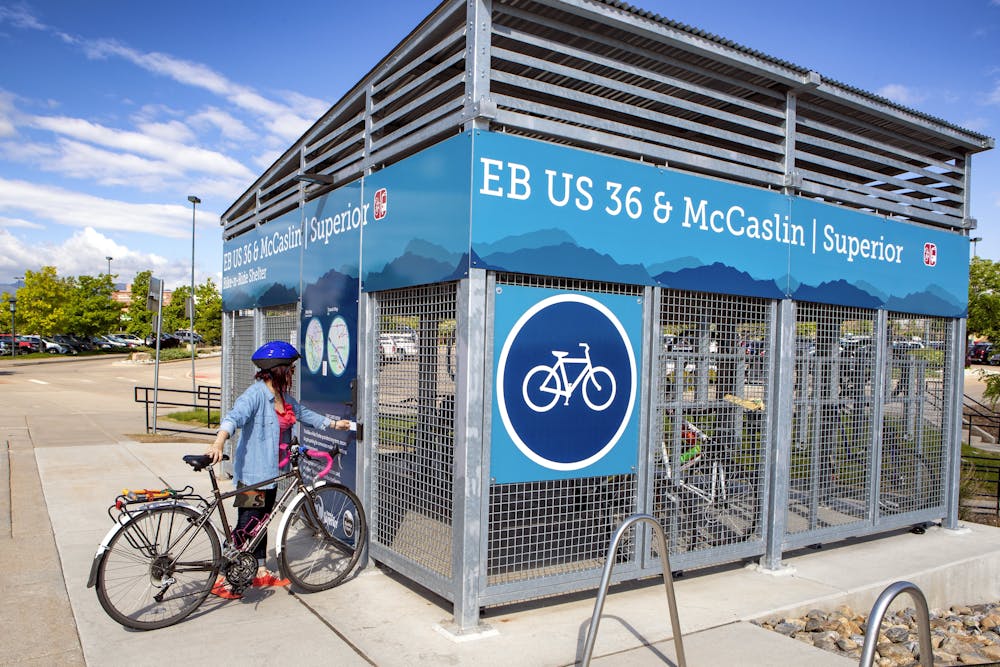
Parking mandates aren’t the only lever that city officials can use to make their downtowns less car-centric. Some local governments are now asking developers to help reduce overall traffic levels by investing in improvements like sidewalks, bike storage and transit passes. 

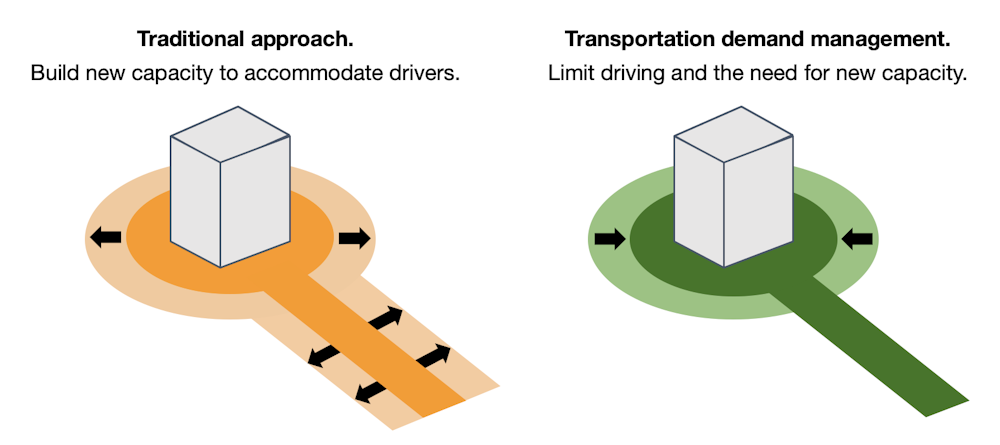
This approach is typically called transportation demand management, or modern mitigation. It still leverages private investment to serve the public good but without a singular focus on parking.

And unlike parking requirements, this strategy helps connect buildings to their surrounding communities. As urban planning scholar Kristina Currans explained to me in an interview, traditional parking requirements ask developers to fend for themselves. In contrast, transportation demand management policies require them to consider the surrounding context, integrate their projects into it and help cities function more efficiently. 

Graphic showing that traditional development consumes more land to accommodate drivers, while transportation demand management reduces the need for parking and space for cars.
Traditional development leads to more parking and more traffic, which consumes more space, while transportation demand management encourages less traffic and has a smaller footprint. Graphic: City of Madison, adapted by Chris McCahillCC BY-ND

This approach dates back at least to 1998, when Cambridge, Massachusetts, introduced a policy requiring developers to produce a transportation demand management plan whenever they add new parking. That policy has now outlived the city’s minimum parking requirements, which Cambridge eliminated for all residential uses in 2022.

Newer policies tend to incorporate point systems or calculators that link different strategies directly to their potential impact on car use. These tools are common in cities across California, where state law now requires city planners to evaluate how much new car use each new development will generate and take steps to limit the impact. Policies such as charging users directly for parking spots or offering employees cash in exchange for giving up their spot are among the most effective.

A woman enters metal enclosure to lock her bicycle.
Denver offers 10 Bike-n-Ride shelters where commuters can store bikes and connect to the city’s mass transit system. Users access the shelters with key cards. Photo: Denver Regional Transportation District
Lessons from Madison

The University of Wisconsin-Madison’s State Smart Transportation Initiative, which I direct, along with UW’s Mayors Innovation Project, has outlined policies like these in a guidebased on our earlier work with the city of Los Angeles. We recently collaborated on a new transportation demand management program in Madison.

This program initially faced some pushback from developers, but their input ultimately made it better. It passed the city’s Common Council unanimously in December 2022.

For their projects to be approved, developers now must earn a certain number of traffic mitigation points based on how large their project is and how many parking stalls they propose to include with it. For example, providing information to visitors and tenants about different travel options earns one point; providing secure bike storage earns two points; offering on-site child care earns four points; and charging market-rate parking fees is worth 10 points. Scaling back planned parking can reduce the number of points they need to earn in the first place.

While parking is no longer required in many parts of Madison, this new policy adds a layer of accountability to ensure that developers provide access to multiple transportation options in environmentally responsible ways. As urban leaders look for meaningful opportunities to reduce their cities’ contributions to climate change, we may soon see other cities following suit.

To see the original post, follow this link: https://theconversation.com/to-reclaim-downtowns-from-traffic-require-developers-to-offer-strategies-for-cutting-car-use-206921


Why Corporate Social Responsibility is critical for Companies

29 07 2023

Companies have to legally comply to investments in CSR initiatives, based on annual profits. The management is accountable for this compliance and it includes all the stakeholders in the process. By Bineesh Mathew via Enterprisetalk.com • Reposted: July 29, 2023

Corporate social responsibility is an ongoing process. Companies need to be ethical about ensuring they comply to this regulation.

CSR is very important for enterprise today. It includes initiatives such as supporting diversity, inclusivity, underprivileged empowerment and rights, protection of the environment, energy initiatives and poverty eradication.

Through the corporate social responsibility, companies can contribute to:

  • Economic growth of the country
  • Enhancing the well-being of employees and their families
  • Development of local communities and society as a whole

Through the practices of ethical values, CSR aims to share prosperity with the society that enables their profits. CSR activities can support individuals, societies, and the environment. This may include different policies, educational efforts, and charitable activities. With these, companies can help develop or sustain communities in which they operate.

CSR is about the dedication of businesses to maintain ethical commitment to the society they work in. As CSR activities need collaboration with various stakeholders, it brings economic growth to society. It also enhances the well-being of all the stakeholders. Clearly both businesses and the communities benefit from it.

Companies are giving attention to local, national, and global CSR opportunities, today. With commitments to socially beneficial activities, they can showcase a good brand image. This will help to attract clients and shareholders. Thus, it impacts the financial performance of the companies as well.

Need for Corporate Social Responsibility

Firms need to have a more extensive customer base to recruit the best resources, and also boost profits.  For this, they need an excellent public image. The best way to show commitment to social causes is by investing into a CSR commitment. This can transform the public perception of the company.

  • Long-Term Business Interest

CSR serve the interests of both the society and the company. A developed society will create a better atmosphere for businesses. So strong CSR enables businesses to achieve long-term business growth and profits as well.

On the other hand, an open-minded and socially responsible company will show concern for the society’s needs. So, investment into developing a better community, indirectly also helps businesses grow.  Investing in social welfare programs can be a strategy to accomplish this goal.

  • Avoiding Government Intervention

Regulations and controls from the government bring financial and other risks for businesses. To avoid some of these interventions, companies can invest in CSR activities. This will keep them safe to an extent and also allow the leaders to take decisions favorable for the business.

If the government finds negligence in social investment, it will impose penalties and regulatory clauses on a company. To avoid these, companies need to identify projects that show the change they want to make to the society. They can select a CSR initiative that is suitable for their area.  With this small investment, they can also save themselves from government intervention.

Benefits of CSR
  • Productivity and Quality

Since CSR is about giving back to the society, it usually encourages employee participation. employees can feel the commitment to the project and be a part of the decision-making process. Thus, it increases productivity and reduces the challenges that leaders face in running a company

  • Improved Financial Performance

Socially responsible businesses can improve their financial outcomes. This improvement can happen due to many factors. They can include:

  • Stable socio-political legal environment
  • An enhanced competitive advantage resulting
  • Superior corporate reputation and brand image
  • Better recruitment
  • Retention and motivation of employees, and
  • A more secure operational environment
  • Brand Image and Reputation

A socially responsible company can strengthen its brand reputation in the industry. It will also enhance its position in the business community. So the company can boost its capacity to attract potential customers.

  • Increases Employee Motivation

Companies showing interest in social responsibility improve their employee engagement. It enables companies to attract resources with a motivation to create an impact. this kind of employees boost the company’s efficiency and market growth.

A collective employee’s effort is critical to accomplish CSR initiatives. Employees working together for a cause will improve workplace morale and will lead to better productivity. Thus, CSR activities in a company increase employee engagement and motivation levels. In this manner, it will contribute to the profits of the company.

  • Community Support and Customer Loyalty

Social responsibility is a common ground for both companies and consumers. CSR can support the betterment of both local and global societies. thus it can be a bridge that benefits both.

Social responsibility programs should align with the core values of a firm. It opens doors to enhance customer retention and foster a sense of loyalty.

  • Bolstered Public Trust

After establishing a reputation for CSR, it is imperative not to become complacent. With a visible initiative, the industry watches for developments. A successful CSR initiative also helps to fight the common skepticism towards capitalist brands. Enterprise often believed to be profit-seekers, can show a different focus with a successful CSR project.

Continuous support to the project is necessary to maintain the trust gained as a responsible brand. Companies can maintain it through sustainable financial backing. They also can provide transparent evidence of equal organizational principles to achieve this.

  • Greater Sustainability

Environmentally friendly initiatives derive a lot of value for the enterprise.

  • Adopting environmental CSR practices aligns with preserving the environment. Moreover, it holds economic value for businesses.
  • Damaging the environment can have negative effects on business. Incorporating sustainable initiatives makes logical business sense.
  • Transitioning to sustainable alternatives may involve significant initial investments. These systems are more cost-effective in the long term.
  • The prices of fuel and other inputs are rising. So, companies that adopt less expensive technologies will gain financial benefits.
  • Encourage professional and personal growth

A CSR culture within companies encourages the culture of volunteering. It also encourages employees to be charitable in many other ways.

Encouraging such behavior aligns individuals with philanthropic values. Further, it fosters a commitment to improving local and global communities. So, it makes employees more productive and creative. Thus, corporate social responsibility in companies enables employees to grow personally and professionally.

Summing Up

Even a small initiative can make a significant impact on society. Smaller companies will have limitations in contributing funds or resources for CSR.  But since the CSR compliance varies according to the size of the company, they can start with whatever suits their pockets.

These could include:

  • Organizing modest fundraising events
  • Fostering a culture of volunteering
  • Implementing a social mission and well-defined objectives
  • Providing educational programs for employees
  • Aligning with like-minded businesses to pool efforts.

Adopting corporate social responsibility (CSR) activities improves customer loyalty and retention. Moreover, it:

  • Boosts employee commitment
  • Enhances brand perception
  • Attracts investment prospects
  • Fosters recruitment of exceptional talent
  • Impacts financial performance

Socially responsible businesses make a good brand reputation and attract more clients. Moreover, it will help in attracting exceptional employees to the company. These are crucial factors in getting the desired results, profit, and better financial outcomes.

To see the original post, follow this link: https://enterprisetalk.com/featured/why-corporate-social-responsibility-is-critical-for-companies/


How Corporate Partnerships Scale Health and Wellness Around the World

28 07 2023

Images courtesy of Feed the Children and Herbalife Nutrition

By Ellen R. Delisio from Triple Pundit • Reposted: July 28, 2023

The U.S. has had a child hunger problem for decades. The COVID-19 pandemic turned that problem into a crisis.

Before the pandemic, 1 in 7 American children experienced food insecurity. The pandemic narrowed that ratio to 1 in 4 by the end of 2020, and nearly 1 in 6 families with children have struggled with food insecurity in the past year. 

Hunger, clearly, is not just a U.S. problem. The U.N. Sustainable Development Goals (SDGs) call for an accelerated response to end hunger in all its forms by 2030. But the pandemic’s impact on economies and supply chains led to global hunger increasing for the first time in nearly a decade. 

While many people are back to work and the economy is slowly growing again, agencies that support at-risk families are still trying to make up ground.

“Though we’ve seen improvement since the pandemic, too many are still struggling to keep food on the table as inflation wreaks havoc on families who are most vulnerable,” said Travis Arnold, president and CEO of Feed the Children, a 40-year-old anti-hunger organization that provides aid to children in the U.S. and abroad. In 2022, the agency distributed about 92.6 million pounds of food and essential items worldwide, benefiting more than 11.5 million people globally.

Corporate partnerships can help nonprofits and communities fight hunger

Nearly 10 percent of the global population, up to 811 million people, faced hunger, food insecurity and malnourishment in 2020, according to the Food and Agriculture Association of the United Nations.

More corporations have had to step up with supplies, service and partnerships. One successful pairing is the ongoing collaboration between Feed the Children, Herbalife and the Herbalife Nutrition Foundation. These organizations have partnered since 2019 through Herbalife’s global health and wellness initiative. According to Feed the Children, this collaboration focuses on expanding access to healthy food, identifying sustainable food resources and improving nutrition education, as well as raising awareness about the global hunger crisis.

Worldwide, Herbalife provides nutritional supplements to support thousands of children and families in the countries where Feed the Children works, Arnold said. “In the U.S., we have partnered for multiple community events, most recently in the Los Angeles area,” he told us. “Through our partnership, we have been able to provide both food and resources to thousands of families without life’s essentials across the country. These products help to supplement meals to thousands of families who are struggling to make ends meet.” 

As important as the money and supplies Herbalife contributes is the educational material it produces and presents. “Herbalife not only provides a generous means for Feed the Children to scale our impact, but also meaningful ways to talk about the power of our work with new audiences,” Arnold said. The company’s registered dietitians and nutrition experts regularly provide educational materials, including meal and snack recipes, to pack into food donation boxes. The company has printed and delivered 48,000 recipe cards for Feed the Children food boxes.

In preparing recipes, Herbalife experts focus on creating meals that are accessible, affordable, nutritious and can be fun to prepare, according to the company. Recipes adhere to guidelines including the U.S. Department of Agriculture’s low-cost ingredients index and utilize foods often found in boxes that Feed the Children distributes. Bilingual recipe cards, in English and Spanish, also are available.

feed the children - child with nutrition boxes that fight hunger
Scaling nutrition education worldwide

Herbalife and Feed the Children are looking to create additional joint education programs, including resources for teachers, teacher stores and nutrition education seminars for community partners. 

In terms of Feed the Children’s own direct education efforts, it sponsors a support program for new mothers and pregnant women. Called Care Group, the program utilizes a peer-to-peer behavior change methodology: Facilitators work with pregnant women and new mothers directly to educate them about prenatal and postnatal nutrition, the benefits of breastfeeding exclusively for the baby’s first six months, and the types of supplemental foods to use until the child is 2 years old. “We help mothers learn how to select and prepare meals that provide the diversity of vitamins and nutrients growing bodies need,” Arnold explained. 

Feed the Children also manages child-focused community development programs that focus on reducing hunger and malnutrition, teaching health, and promoting self-reliance in eight countries in Asia, Africa and Latin America.

And thanks to increased monetary and product contributions from corporate partners, Feed the Children expects to reach even more families in the U.S. and around the world this year, Arnold said. 

The extra aid from Herbalife alone will supplement 300,000 meals and beverages for families in the U.S. The company has also increased its financial commitment to Feed the Children’s international program by $500,000 over two years. Globally, Feed the Children expects to expand programs designed to improve the health and nutritional profile of women and children. These resources include supplementary feeding supplies, deworming medicine and vitamin A supplements for children. 

Partnerships are key to success

Corporate collaborations and other pairings are critical to the ongoing mission and success of Feed the Children and its fellow aid organizations, Arnold said. 

“Partnerships are vital to success in every aspect of our work. Whether here in the U.S. or in communities around the globe, we cannot do this work alone,” he told us. “We are providing access to food and reducing the stigma around food insecurity through community events and resource rooms across the country. We are engaging communities in developing countries with education and empowerment. Our work with Herbalife is one example of how companies can make a significant contribution to a global issue through collaboration and true partnership.”

This work is needed now more than ever. With the price of basic necessities including food, energy and housing continuing to rise, the number of families straining to meet expenses are expected to increase in the coming months, Arnold observed. 

“During the pandemic, we learned to be innovative in order to get food and essentials to families in their own communities,” he continued. “Many of these efforts continue today through our network of community partners, as well as through the generosity of our donors and corporate supporters. It takes all of us working together in order for these efforts to be successful.” 

This article series is sponsored by Herbalife Nutrition and produced by the TriplePundit editorial team. To see the original post, follow this link: https://www.triplepundit.com/story/2023/corporate-partnerships-hunger-health/779896


10 tips for a successful sustainability journey

28 07 2023

By Mary K. Pratt from Techtarget.com • Reposted: July 28, 2023

Just as with any journey, a sustainability journey requires understanding some keys to success.

Many organizations are struggling to build sustainability programs and implement more environmentally friendly practices. Furthermore, some companies have exaggerated their sustainability records, a practice known as greenwashing.

“Sustainability maturity ranges quite a bit,” said Michelle Benavides, executive director of the International Society of Sustainability Professionals, a professional association of sustainability practitioners. “There are leaders who have been working on this for a long time. But many others are in the early stages of setting commitments and trying to figure out how to hit those commitments.”

More companies are starting on their journey toward environmental sustainability as top leadership prioritizes the issue.

Environmental sustainability ranked as the number eighth strategic issues for CEOs heading into 2023, according to the “2022 Gartner CEO and Senior Business Executive Survey.”

In addition, consumers have become more interested in the environmental records of those they buy from and engage with. Employees are seeking more action from their employers on this front. Many governments around the world have added environmental regulations and reporting requirements.

Organizations looking to meet those demands can consider 10 actions to help enable sustainability success.

1. Understand the environmental impact

Cutting greenhouse gas emissions to limit further global warming is at the core of ensuring a livable world, and business leaders can have major impact.

Working to understand the direct and indirect carbon footprint is key, both in terms of direct and indirect emissions.

The Greenhouse Gas Protocol, a widely used classification system for emissions reporting, has laid out three scopes of direct and indirect emissions:

  • Scope 1 includes direct greenhouse emissions.
  • Scope 2 includes indirect greenhouse gas emissions from energy a company purchases.
  • Scope 3 includes a wide range of indirect greenhouse emissions across the value chain, from sourcing through disposal.

Carbon emissions are not the only environmental impact a company has. Leaders should also understand their effect in other areas, from the physical waste they produce to their organization’s use of natural resources, and how their company’s actions affect water, air and land quality.

Moreover, sustainability includes environmental impacts besides climate change as well as broader social and business issues.

“The sustainability journey is so much more than taking emissions out of the business,” said Vinay Shandal, managing director and senior partner at Boston Consulting Group.

2. Create a sustainability roadmap

Once company leaders understand how and where the organization affects the environment, they can start to analyze and measure those impacts as well as benchmark themselves against other organizations — determining if they’re laggards or leaders in sustainability work.

That information helps each organization create a strategy for improving their sustainability, Benavides said. “It’s always critical to understand your baseline so you understand where you can go and can break down how to get there.”

Executives can start with areas that they can directly control — such as creating more energy efficient buildings and operations — and then focus on how to improve sustainability in other areas such as their supply chains, Benavides said.

Looking to the biggest potential wins can also be fruitful.

Executives should identify areas where changes could yield the biggest improvements in sustainability and prioritize those, Shandal said.

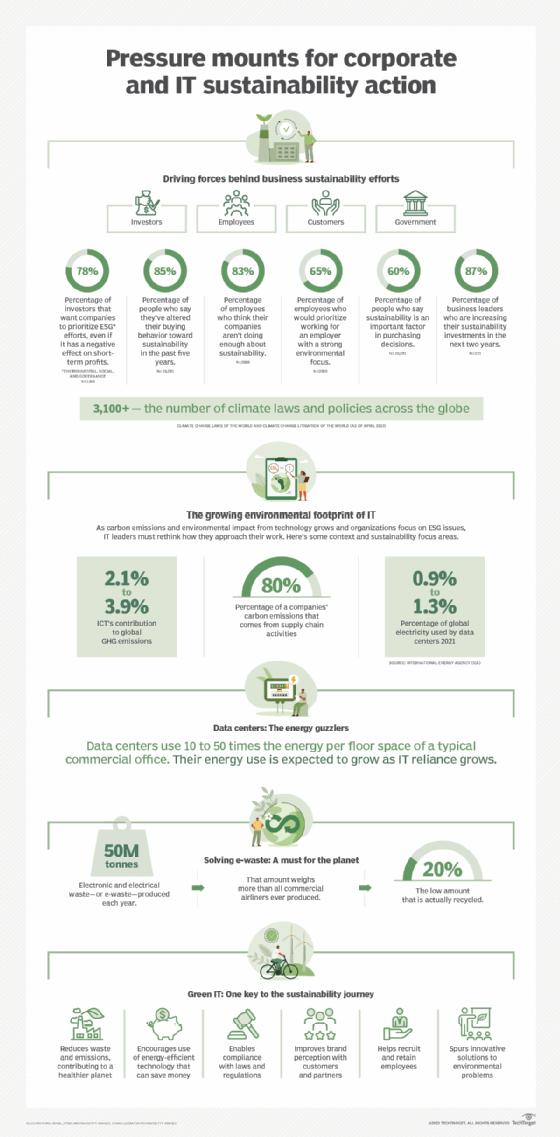
Statistics about why sustainability is becoming more important to companies
3. Go after easy sustainability wins

Some organizations have yet to implement the fundamentals of an environmental sustainability journey. In these cases, leaders can look to what can be achieved with little effort, Benavides said.

Those basic greening strategies include the following:

  • Lower energy consumption by powering down lights, devices and other electronics when not in use.
  • Install smart fixtures that automatically shut off and energy-efficient equipment, such as LED lighting.
  • Create sustainability awareness programs that encourage a reduce-reuse-recycle mentality in the workplace and support it through corporate actions by, for example, replacing bottled water vending machines with water dispensers designed to fill reusable water bottles.
  • Digitalizing business processes to reduce environmental impacts such as paper waste, excess business travel and commutes to the office.
  • Switching to renewable energy sources, where possible.
4. Empower workers

Lowering the organization’s environmental impact requires increasing employee engagement on sustainability.

Executives should aim to encourage, empower and train their teams to do their part, Benavides said.

“This truly is a mission and commitment that everyone has to get involved in, so build foundational knowledge across the entirety of your staff,” she said. “You want to make sure staff across the board can deeply understand the commitments being made by the sustainability managers, why it’s so critical, how they fit into the puzzle and how they can act to meet those goals.” Communication about sustainability is key. “Make sure everyone is equipped and then go forward from there with a solid action plan.”

5. Get top-level buy-in

As with any important initiative, support from the top is key.

Creating a more sustainable organization requires support from senior leaders and the board, Benavides said. To build sustainability into the fabric of the company, top-level buy-in is necessary. When that buy-in is absent, the results are unlikely to be successful.

“[Sustainability] becomes a more siloed effort and it becomes harder to reach any sustainability commitments the company might have set,” she said.

6. Bring sustainability to the supply chain

Most organizations are part of complex networks. This means business and IT leaders need to consider the sustainability of their supply chain, their suppliers and their business partners. The criteria for evaluating these varies by industry as well as by each organization’s own objectives.

Many organizations consider the carbon footprints of those with whom they do business, said Abhijit Sunil, an analyst at Forrester Research whose research focuses on environmental reporting and sustainability strategies.

As part of that carbon footprint evaluation and as part of other sustainability considerations, organizations also may consider what materials their suppliers use, how they source those materials, how they produce their materials or products, and how they ship their products, he said.

Some organizations also consider their suppliers’ product designs and packaging and whether materials and products can be repaired, recycled or reused. These are key principles for reducing environmental impacts and cutting back on waste and encouraging a more environmentally friendly circular economy.

7. Measure and track

A slew of companies, nonprofit entities and government agencies have been announcing their plans to become carbon-neutral and less environmentally impactful. But many may lack the ability to measure their existing environmental impact, track progress toward their stated goals and accurately report their sustainability metrics.

Think about where value is shifting and, ‘How do I position my business to play and win in this new economy?’Vinay ShandalManaging director and senior partner, Boston Consulting Group

To address that, sustainability chiefs should work with their executive colleagues to create processes for quantifying their environmental impacts and tracking their improvements in those areas, Sunil said. Organizations also should create KPIs based on the objectives they have for their sustainability programs.

CIOs can play a leading role by helping select software for capturing, quantifying, analyzing and reporting sustainability-related metrics. For example, governance, risk and compliance software as well as environmental health and safety management software often have modules for carbon accounting, Sunil said.

CIOs could bring other technologies to bear here too, Sunil said. IoT, for example, can help companies track and analyze information and provide more visibility into their environmental impact.

8. Understand how technology impacts the environment

CIOs are key players in sustainability success, even beyond helping to select tracking and reporting software.

They should be evaluating their own department’s environmental impact as well as how and where they can bring improvements, Sunil said.

IT equipment consumes significant amounts of energy, with some technologies — such as generative AI — requiring more power than other types of digital solutions.

Data centers — whether on premise or with cloud providers — use not only large amounts of power but also use significant amounts of water for cooling and often require large tracks of land.

However, CIOs can opt to consider their technology suppliers’ sustainability records along with performance criteria when selecting vendors, Sunil said. They can also work with hardware providers to ensure they have solid take-back programs so end-of-life devices can be reused or recycled. They can promote the use of software designed for sustainability.

In the near future, CIOs may have no choice but to become more sustainability minded.

Seventy percent of leaders in the area of technology sourcing, procuring and vendor management will have performance objectives for their functions that focus on environmental sustainability, according to Gartner’s “Predicts 2023: Environmental Sustainability Is Now an IT Sourcing Imperative.”

9. Take a holistic approach

Enterprise executives should remember that environmental sustainability is one part of environmental, social and governance ESG efforts. They should consider their sustainability initiatives through the environmental lens as well as the social and governance lenses.

Leaders should think end to end, Shandal said. For example, electric vehicle makers should be considering how and where the materials to create the batteries are sourced; how they’re handled at end-of-life; the environmental and social impact of that work; and how all those pieces will be monitored and governed according to the policies, standards and objectives established by the vehicle maker.

10. Look for opportunities in a sustainability-focused economy

Going on a sustainability journey can unlock new sources of revenue.

Companies should identify what opportunities they may have as they and others increasingly embrace sustainable practices, Shandal said.

For example, as companies turn away from using chemicals that harm the environment, they’ll be looking for environmentally friendly alternatives — a shift that opens up a market opportunity for those ready to meet the changing market demands, Shandal said.

“Think about where value is shifting and, ‘How do I position my business to play and win in this new economy?'” he said.

To see the original post, follow this link: https://www.techtarget.com/sustainability/feature/Tips-for-a-successful-sustainability-journey


Sustainable Summers: Small Steps Towards Big Impacts

27 07 2023

Panther Media GmbH / Alamy Stock Photo

What costs $1.2 TRILLION and continues to get more and more expensive? The answer: Americans’ summer travel. In line with the increasingly prominent green trends sweeping the nation, it’s important that we approach our summer adventures with a mindful consideration of their environmental impact. By EREF Staff • Reposted: July 27, 2023

What costs $1.2 TRILLION and continues to get more and more expensive? The answer: Americans’ summer travel[1]!

Now that it’s officially summer, many Americans are headed out of town. Whether weekends at the beach or months abroad, this summer is set to witness the strongest air travel since the pre-pandemic era, possibly making it the most robust ever. Over a quarter of Americans (26%), an increase from 19% in the first quarter, are preparing to embark on leisure travel in the coming three months[2]. This increase in travelers will translate into an approximate 12% growth in passengers for the three biggest U.S. airlines, expected to ferry 8.6 million people during the summer season[3]. While this mass mobilization symbolizes an exciting era of discovery and relaxation, it’s crucial to remember that our travel plans, while invigorating for us, can impose a heavy toll on the environment. In line with the increasingly prominent green trends sweeping the nation, it’s important that we approach our summer adventures with a mindful consideration of their environmental impact.

This summer’s surge in travel activity can unfortunately translate into increased waste production, with potential negative implications for our environment and lifestyle. Moreover, maintaining the allure and accessibility of our favorite scenic spots and lakes depends significantly on how well we protect them from pollution and trash accumulation. In a world where single-use plastic is commonplace, the path to sustainability can seem daunting. But a little planning can go a long way in fostering eco-friendly travel.

Unfortunately, it’s rare to see recycling bins at rest stops and gas stations, which makes it difficult for travelers to responsibly dispose of recyclables like plastic bottles or cans. As a result, these items often end up in general trash bins, destined for landfills. By including more visible and accessible recycling facilities at these high-traffic areas, we could make a substantial contribution to reducing travel-related waste.

As you plan your travel, consider these tips. When driving, pack snacks from home, carrying reusable beverage containers, and maintaining separate trash bags for recyclables and other waste in your car. Make a game out of minimizing waste – it not only teaches sustainability but can add a fun twist to the journey. When traveling by plane, one could manage waste by having a meal before a short flight to avoid single-use packaged snacks. For longer flights, taking advantage of in-flight meals helps reduce waste as these meals would otherwise be discarded. Train travel, in addition to being an efficient mode of transportation, also offers a refreshing respite from the bustling city traffic. If your travel requires documentation or tickets, digital documents on your phone or tablet help save paper and are less likely to be lost.

Choosing larger, shareable items, using snack cups for family members, and reducing hotel service to only when needed are effective ways to cut down waste. Don’t fall for the convenience of disposable utensils. Carrying reusable utensils, dishes, straws, and cloth napkins might seem like a chore, but such small steps can significantly lessen the landfill load.

Whether you’re headed to the beach, mountains, cities, or abroad, there are specific steps you can take to reduce waste. For beach or lake visits, the use of items that could be swept away by the wind or tide should be minimized. In the mountains, a pack it in, pack it out mindset goes a long way in preserving the natural beauty. City travelers can cut down waste by enjoying meals in local restaurants instead of opting for takeaway. When traveling abroad, especially to European countries known for their waste minimization efforts, be sure to pay attention when you have items to discard as most offer a more diverse suite of options for disposal than the average American city and in many cases have separate recycling bins for plastic, glass, metal, paper and food.

These small steps may seem minor, but collectively, they can significantly impact our environment, potentially steering the future of the tourism industry towards a more sustainable path. As you make summer travel plans, and add to that $1.2 trillion price tag, consider a pledge to travel responsibly and sustainably.

To see the original post, follow this link: https://www.waste360.com/sustainability/sustainable-summers-small-steps-towards-big-impacts


Busting The Sustainability Value-Action Gap

27 07 2023

Do consumers say one thing but do another? Image: GETTY

By Solitaire Townsend via Forbes • Reposted: July 27, 2023

We’ve all been there, right? The mountain of reusable bags we forget to take to the store. The burger that should have been plant-based. The over-packaged product you just splurged on. These gaps between intention and action manifest when we start to diet, to start a hobby, go to the gym and especially when we try to live sustainably. We are all a hot mess of un-met intentions.

Now, here’s where things get interesting. A Global Sustainability Study revealed that a whopping 50% of consumers rank sustainability within their top five drivers for value, especially millennials who consider sustainability a crucial criterion for making purchases. In fact, Google’s search trends team tells us that searches related to living a sustainable lifestyle have skyrocketed by a staggering 4500% since 2019.

But there seems to be a misalignment between consumers and retail executives when it comes to perspective of willingness to pay for sustainable products. Surprisingly, while 66% of consumers claim they are willing to pay more for sustainability, a striking 66% of retail executives believe otherwise. Now that’s the real gap.

Because rather than gap, consumers face giant barriers. Reframing from gaps (which imply something missing in consumer morality), to barriers (which aren’t consumers fault) is empowering for business. The barriers range from price, availability, and structural factors that require infrastructure change, to myths, awareness, and availability, that can marketers can tackle.

To bust these barriers, we need to ask ourselves a crucial question when promoting a product, service, or action: Are we effectively selling the benefits? Because only benefits can bust through barriers. Let’s break it down into three key categories of benefits – functional, emotional, and social:

  1. Functional benefits play a crucial role in selling sustainable products. Consider how sustainability can add value for money, enhance performance and efficacy, improve quality, save time, or contribute to safety. Understanding and emphasising these functional benefits can make sustainable choices more appealing to consumers.
  2. Emotional benefits are equally important. As retailers, it’s essential to acknowledge that the consumer is the hero, not us. The feel-good factor associated with buying sustainable products can be a significant motivator. Does sustainability strengthen sensory enjoyment, provide physical comfort, offer an exciting experience, boost self-worth, or offer a sense of personalisation? These emotional benefits can truly make a difference in consumers’ decision-making.
  3. Finally, let’s not forget about social benefits. How does sustainability impact family dynamics, desirability in the eyes of others, the perception of being cool, smart, or part of a community? Highlighting these social benefits can create a sense of belonging and encourage individuals to embrace sustainable choices.

To see the original post, follow this link: https://www.forbes.com/sites/solitairetownsend/2023/07/26/busting-the-sustainability-value-action-gap/?sh=68ca03c065ec


What to Expect From the SEC’s Climate Disclosure Rule

26 07 2023

Image credit: Ale Alvarez/Unsplash

By Mary Riddle from Triple Pundit • Reposted: July 26, 2023

The U.S. Securities and Exchange Commission (SEC) is expected to release its long-awaited climate disclosure rule this fall, and businesses are preparing for change. The intent is to create a framework for companies to make climate-related disclosures in a way that is standardized and allows for comparison

“I think it is helpful to frame the SEC proposal not as a climate proposal, but rather as a proposal to enhance and standardize climate-related financial disclosures,” said Emily Pierce, chief global policy officer at the carbon accounting firm Persefoni and a former SEC lawyer involved in developing the proposed rule. 

What’s different about the SEC climate disclosure rule?

The SEC’s forthcoming climate disclosure rule has been over a decade in the making. In 2010, SEC staff issued guidance stating that climate change could impact business operations as it carries material risks that affect financial performance, Pierce said. And anything that could impact financial performance should be communicated to investors.

Five years later, the investor demand for information was growing steadily. “By 2015, there was a collective concern about investor demand for sustainability information,” she said. “Investors were not getting the information they were asking for, and the marketplace was inefficient.” 

The Task Force on Climate-Related Financial Disclosures (TCFD) rose up to meet that demand shortly after the Paris climate agreement was adopted in 2015. “TCFD developed helpful disclosure frameworks for governance, strategy and risk management processes,” as well as metrics and targets to measure a company’s greenhouse gas footprint, Pierce said.

“TCFD is a market norm, but it wasn’t always complete and comprehensive, and it didn’t allow for comparison,” she explained. “The SEC was inspired by the TCFD framework that investors and companies have found useful.”

What do we know about the new rule?  

The SEC’s proposed rule covers how companies communicate their climate-related risks. Companies will be required to disclose material risks, including physical risks and transition risks, related to climate change. These may include sea-level rise, more frequent extreme weather events and wildfires, or changes in government regulation and consumer demand. 

Importantly, the rule will not initially apply to all companies, but will be phased in over time. “Phasing is an important part of the proposal, because it’s our way of managing implementation,” Pierce said. “We have to strike the balance between investor protection and creating a rule that is feasible for companies to implement. I think the most likely scenario is that, if it is finalized this year, companies will need to gather data next year for fiscal year 2025.”

The rule will also hold companies’ feet to the fire for claims made about net-zero and emissions reductions. If a company has a public target related to cutting emissions, the SEC will require additional disclosures and obligations related to that target. 

“A lot of companies calculate their greenhouse gas emissions today,” Pierce said. “But they do it in a way that does not have as much control over their data, calculations, and outputs compared to what they would have in their financial calculation reporting. When you’re making information investor-grade and compliance-ready, you should bring lessons you have learned from the financial space into the carbon accounting space.” 

Emissions created by a company’s direct operations — Scope 1 emissions — and emissions associated with the company’s purchase of energy — Scope 2 emissions — will need to be externally assured, Pierce said. But smaller companies will not need to disclose value chain emissions from assets the company does not own — Scope 3 emissions — unless they set an emissions target for Scope 3, she predicted. 

What’s next?

The climate disclosure rule should not contain any surprises compared to the SEC’s current proposal, Pierce said. But the timing of release will be later than anticipated, due to the unprecedented number of public comments and feedback. Many analysts agree it will be released this fall.

“To be ready for climate disclosure, companies need to bring discipline and processes to their broader corporate thinking about governance, strategy and risk management,” Pierce said. “Additional discipline and processes will help them communicate about what they’re doing.” 

A lot of companies are already thinking about these issues, calculating their emissions and gathering the necessary information, Pierce said. “There are market rewards to decarbonizing, and they see the value in that. We will see an increase in the market rewarding sustainable behavior, whether it is in access to capital, customer preference, more business-to-business relationships or consumer demand.”

To see the original post, follow this link: https://www.triplepundit.com/story/2023/sec-climate-disclosure-rule-explained/779646


Seafood Retailer Engagement at Fisheries Meetings Essential to Fulfilling Sustainability Commitments

26 07 2023

Spain, Barcelona, Mercat de Sant Antoni Market, canned seafood display. (Photo by: Rosie Irene Betancourt/Jeffrey Greenberg/Universal Images Group via Getty Images)

Companies should make their voices heard by participating in critical stakeholder events. By Jamie Gibbon & Katy Hladki from Pew Trusts • Reposted: July 26, 2023

With catch worth more than US $40 billion dollars per year, tuna is one of the most important species for supermarkets and other companies in the global seafood industry. So it is critical that its catch is closely monitored to help protect the sustainability of the species.

But that isn’t the case. Of the over 20,000 registered vessels catching and transporting tuna throughout the world’s ocean, only a small portion are independently monitored.

However, that may soon change. Retailers are hearing from their customers that the sustainability of the fish they buy is more important than ever. To ensure greater transparency, which can lead to more sustainable management of tuna species, retailers can—and should—become more active in calls for increased oversight and data collection on the vessels bringing tuna to the market.

In June, Walmart, one of the world’s largest global retailers, committed to improving transparency in the data collection of its tuna supply chain and will soon source exclusively from vessels with 100% observer coverage, through either human observers or electronic monitoring (EM), which uses cameras and sensors to collect information on fishing activity. This level of commitment to transparent, well-managed tuna fisheries is commendable, and while some retailers have made similar calls for transparency, more should do the same.

Making a commitment to 100% observer coverage in tuna supply chains is an important first step. But to ensure that there is sufficient product to meet consumers’ needs while also fulfilling this transparency pledge, retailers should get more involved in the policy process, letting government officials and fishing companies know that sustainability is a priority for the buyers.

Direct engagement with regional fisheries management organizations (RFMOs) is one way for retailers to do that. RFMOs govern most of the world’s shared commercial fisheries and regulate both the amount of fish caught and how they are caught. By advocating for region-wide EM programs, market members can help ensure that all vessels fishing for tuna will have the tools and rules available to easily collect data on their catch and operations and share that information with government regulators and the companies that buy their fish. That can help retailers meet their commitments to consumers.

Public pressure is already starting to pay off. In the Indian Ocean, where retailers have warned that continued overfishing of yellowfin tuna could affect their buying decisions, governments recently agreed to the world’s first EM standards, which will allow fishing vessels to use cameras and sensors to collect data required by regulators. Similar discussions are underway among Atlantic and Pacific ocean fishery managers, and retailers should advocate for RFMOs in those regions to adopt and implement EM programs that include standards and pathways for improving and increasing observer coverage.

Companies buying and selling seafood directly benefit from healthy tuna stocks. As such, they bear responsibility for ensuring that fisheries are well managed and that vessels are capturing and reporting accurate and transparent data. Through their purchasing practices, sourcing commitments and advocacy actions at RFMOs, businesses can help protect the long-term health and stability of global tuna stocks and ocean ecosystems.

Major retailers committing to increased transparency and data collection can help profoundly improve practices throughout the seafood supply chain, which in turn will promote the health of the ocean and fisheries globally. This will pay dividends to those companies—and seafood consumers worldwide—for a long time to come.

Jamie Gibbon is a manager and Katy Hladki is a senior officer working on Pew’s international fisheries project.

To see the original post, follow this link: https://www.pewtrusts.org/en/research-and-analysis/articles/2023/07/25/seafood-retailer-engagement-at-fisheries-meetings-essential-to-fulfilling-sustainability-commitments


How can we reimagine sustainability in the supply chain?

26 07 2023

Sustainable supply chains are vital and attainable. Image: Photo by Lenny Kuhne on Unsplash

Sustainability is not an elusive concept that competes with traditional metrics of profitability and efficiency, but one that can be measured and achieved by using what you have more intelligently. By Saar Yoskovitz, Co-Founder and Chief Executive Officer, Augury via the World Economic Forum • Reposted: July 26, 2023

Supply chain disruptions and inventory concerns continue to trouble governments, businesses and consumers worldwide. Even as supply chain bottlenecks begin to clear up, severe sustainability and supply problems remain due to the amount of waste traditionally produced by retail and manufacturing sectors and the increasingly stringent metrics by which they are judged by investors and consumers.

Moreover, with ongoing geopolitical contention in Europe and Asia, inflationary challenges and increased consumer spending, the manufacturing and supply chain industries are under pressure to navigate constant obstacles.

The interconnectedness of the supply chain

To find solutions, we need to look at the interconnectedness of the supply chain. Factories, for example, play a prominent role in mitigating a host of supply-chain problems and can help lower the impact of inflationary pricing by working more efficiently in several ways. Worn down and inefficient machinery, for instance, slows production, causing bottlenecks and wasting energy and materials.

Furthermore, labour costs increase as more people are brought in to address broken machinery and even more money is lost when the factory line pauses production. 

Where does sustainability come in?

Often, efficiency and sustainability are seen as competing interests, but what if there was a way that companies can establish both in their manufacturing processes and support supply-chain efficiencies?

A focus on sustainability on the factory floor can reduce waste (most obviously by lowering costs and increasing yields) while alleviating pressures across the supply chain. How so? When fewer materials are needed to create a product, less mining, harvesting and sourcing of these materials is required, thus involving less processing, trucking and warehousing and minimizing potential pain points in other areas of the supply chain.

And, when machines operate efficiently while producing quality goods, there is also a chance of fewer recalls around issues in the manufacturing process. This, in turn, diminishes the inventory volume of goods travelling back through the supply chain, alleviating another host of problems. These benefits compound; improvements in quality issues boost sustainability and customer service scores.

Running manufacturing assets better and more efficiently can help organizations realize their sustainability goals and serve customers better, while easing supply-chain pressures ahead of the holiday bloat.

To do so, we must consider machine and process health through a predictive lens.

Machine health

There are three key components to machine health: mechanical problems, design problems and operational problems. Every industrial leader must understand how the factory level is performing across these three measurements to ensure production runs smoothly.

Monitoring for mechanical problems includes monitoring temperature, vibration and magnetic data to identify changes ahead of complete machine failure.

Design problems come to the forefront when individual machines undergo extra amounts of stress due to an inefficiently designed production facility. By getting ahead of these issues, facilities can avoid unplanned downtime, delays, bottlenecks and inconsistent product quality, tying back to the efficiencies detailed above. 

Operational problems come into play with the human element. Even with a perfectly designed machine, people make modifications and unknowingly create additional issues.

Continuously monitoring machine health can curtail unplanned downtime and boost productivity to new heights that will be felt throughout the supply chain. According to the National Institute of Standards and Technology, running assets more efficiently can also save US manufacturers $3.3 billion in waste caused by downtime, reduce energy consumption by 12% to 15% and avoid up to 6,500 workplace accidents annually. 

But machine health is only half of the equation for solving industry concerns. Process health offers a look into the interconnected inputs and elements of a full production system and other contributing factors, which, when misaligned, become part of the industry’s sustainability problems.

Process health

Manufacturing and supply chain leaders are aware of profits left on the table, but that does not have to be an accepted standard. There is a critical measurement that can combat inefficiencies and losses. Enter process health.

According to a report by ARC Strategies, there is an estimated $1 trillion lost due to unplanned downtime in the process industries. To bridge the trillion-dollar gap, organizations can unlock productivity by honing their machine health and optimizing production by 40% and improving energy use by up to 30%. Those are significant markers.

Process health helps leadership prevent losses from occurring in the future by analysing data at every step and level of production. It can also identify optimal process settings and establish connections between dynamic and complex variables. It is a no-brainer for industry leaders who want to see significant improvements in quality, throughput, energy and reductions in CO2 emissions and waste.

Big picture vision

The supply chain is a complex structure that is the backbone of our economy. While there may not be a one-size-fits-all solution to address the dilemmas of late, repositioning our understanding of the interconnectedness – starting at the factory floor – can illuminate opportunities that may not have been as apparent. 

Continuously monitoring machine and process health can reveal untapped potential. In fact, it is estimated that 10% to 20% of manufacturing capacity is shadow capacity or production capabilities that exist within current manufacturing lines, but are going unused. Embracing shadow capacity has positive implications for onshoring, productivity and efficiency. 

As supply chain obstacles continue amid ongoing geopolitical turmoil, fluctuations in consumer spending and a possible recession, it is high time we rethink the relationship between sustainability, manufacturing and the supply chain. Sustainability is no longer an elusive concept that competes with traditional metrics of profitability and efficiency, but one that can be measured and achieved by using what you have far more intelligently.

To see the original post, follow this link: https://www.weforum.org/agenda/2023/07/how-and-why-we-must-create-sustainable-supply-chains/


Decades of public messages about recycling in the US have crowded out more sustainable ways to manage waste

25 07 2023

A worker sorts cardboard at a recycling center in Newark, N.J. Photo: Jeff Greenberg/Universal Images Group via Getty Images

By Michaela Barnett, Founder, KnoxFill, University of Virginia, Leidy Klotz, Associate Professor of Engineering and Co-Director, Convergent Behavioral Science Initiative, University of Virginia, Patrick I. Hancock, Postdoctoral fellow, University of Virgini and Shahzeen Attari, Associate Professor of Public and Environmental Affairs, Indiana University via The Conversation • Reposted: July 25, 2023

You’ve just finished a cup of coffee at your favorite cafe. Now you’re facing a trash bin, a recycling bin and a compost bin. What’s the most planet-friendly thing to do with your cup?

Many of us would opt for the recycling bin – but that’s often the wrong choice. In order to hold liquids, most paper coffee cups are made with a thin plastic lining, which makes separating these materials and recycling them difficult. 

In fact, the most sustainable option isn’t available at the trash bin. It happens earlier, before you’re handed a disposable cup in the first place. 

In our research on waste behaviorsustainabilityengineering design and decision making, we examine what U.S. residents understand about the efficacy of different waste management strategies and which of those strategies they prefer. In two nationwide surveys in the U.S. that we conducted in October 2019 and March 2022, we found that people overlook waste reduction and reuse in favor of recycling. We call this tendency recycling bias and reduction neglect.

Our results show that a decadeslong effort to educate the U.S. public about recycling has succeeded in some ways but failed in others. These efforts have made recycling an option that consumers see as important – but to the detriment of more sustainable options. And it has not made people more effective recyclers.

A global waste crisis

Experts and advocates widely agree that humans are generating waste worldwide at levels that are unmanageable and unsustainable. Microplastics are polluting the Earth’s most remote regions and amassing in the bodies of humans and animals

Producing and disposing of goods is a major source of greenhouse gas emissions and a public health threat, especially for vulnerable communities that receive large quantities of waste. New research suggests that even when plastic does get recycled, it produces staggering amounts of microplastic pollution

Given the scope and urgency of this problem, in June 2023 the United Nations convened talks with government representatives from around the globe to begin drafting a legally binding pactaimed at stemming harmful plastic waste. Meanwhile, many U.S. cities and states are banning single-use plastic products or restricting their use.

Upstream and downstream solutions

Experts have long recommended tackling the waste problem by prioritizing source reduction strategies that prevent the creation of waste in the first place, rather than seeking to manage and mitigate its impact later. The U.S. Environmental Protection Agency and other prominent environmental organizations like the U.N. Environment Programme use a framework called the waste management hierarchy that ranks strategies from most to least environmentally preferred. 

Graphics showing options for managing waste, moving from upstream (production) to downstream (disposal).
The U.S. EPA’s current waste management hierarchy (left, with parenthetical explanations by Michaela Barnett, et al.), and a visual depiction of the three R’s framework (right). Michaela Barnett, et al., CC BY-ND

The familiar waste management hierarchy urges people to “Reduce, Reuse, Recycle,” in that order. Creating items that can be recycled is better from a sustainability perspective than burning them in an incinerator or burying them in a landfill, but it still consumes energy and resources. In contrast, reducing waste generation conserves natural resources and avoids other negative environmental impacts throughout a product’s life. 

R’s out of place

In our surveys, participants completed a series of questions and tasks that elicited their views of different waste strategies. In response to open-ended questions about the most effective way to reduce landfill waste or solve environmental issues associated with waste, participants overwhelmingly cited recycling and other downstream strategies. 

We also asked people to rank the four strategies of the Environmental Protection Agency’s waste management hierarchy from most to least environmentally preferred. In that order, they include source reduction and reuse; recycling and composting; energy recovery, such as burning trash to generate energy; and treatment and disposal, typically in a landfill. More than three out of four participants (78%) ordered the strategies incorrectly. 

When they were asked to rank the reduce/reuse/recycle options in the same way, participants fared somewhat better, but nearly half (46%) still misordered the popular phrase. 

Finally, we asked participants to choose between just two options – waste prevention and recycling. This time, over 80% of participants understood that preventing waste was much better than recycling.

Recycling badly

While our participants defaulted to recycling as a waste management strategy, they did not execute it very well. 

This isn’t surprising, since the current U.S. recycling system puts the onus on consumers to separate recyclable materials and keep contaminants out of the bin. There is a lot of variation in what can be recycled from community to community, and this standard can change frequently as new products are introduced and markets for recycled materials shift. 

Our second study asked participants to sort common consumer goods into virtual recycling, compost and trash bins and then say how confident they were in their choices. Many people placed common recycling contaminants, including plastic bags (58%), disposable coffee cups (46%) and light bulbs (26%), erroneously – and often confidently – in the virtual recycling bins. 

This is known as wishcycling – placing nonrecyclable items in the recycling stream in the hope or belief that they will be recycled. Wishcycling creates additional costs and problems for recyclers, who have to sort the materials, and sometimes results in otherwise recyclable materials being landfilled or incinerated instead. 

Although our participants were strongly biased toward recycling, they weren’t confident that it would work. Participants in our first survey were asked to estimate what fraction of plastic has been recycled since plastic production began. According to a widely cited estimate, the answer is just 9%. Our respondents thought that 25% of plastic had been recycled – more than expert estimates but still a low amount. And they correctly reasoned that a majority of it has ended up in landfills and the environment. 

Empowering consumers to cut waste

Post-consumer waste is the result of a long supply chain with environmental impacts at every stage. However, U.S. policy and corporate discourse focuses on consumers as the main source of waste, as implied by the term “post-consumer waste.” 

Other approaches put more responsibility on producers by requiring them to take back their products for disposalcover recycling costs and design and produce goods that are easy to recycle effectively. These approaches are used in some sectors in the U.S., including lead-acid car batteries and consumer electronics, but they are largely voluntary or mandated at the state and local level.

When we asked participants in our second study where change could have the most impact and where they felt they could have the most impact as individuals, they correctly focused on upstream interventions. But they felt they could only affect the system through what they chose to purchase and how they subsequently disposed of it – in other words, acting as consumers, not as citizens.

As waste-related pollution accumulates worldwide, corporations continue to shame and blame consumers rather than reducing the amount of disposable products they create. In our view, recycling is not a get-out-of-jail-free card for overproducing and consuming goods, and it is time that the U.S. stopped treating it as such.

To see the original post, follow this link: https://theconversation.com/decades-of-public-messages-about-recycling-in-the-us-have-crowded-out-more-sustainable-ways-to-manage-waste-208924


We Need ‘Solutionist’ Entrepreneurship: Problem-Solvers Focused on Purpose and Long-Term Impact

25 07 2023

Featured image: Pixabay/Pexels

By Rasha Rehman via Triple Pundit • Reposted: July 25, 2023

To solve society’s most pressing problems, we need a new type of entrepreneur. 

Solitaire Townsend, co-founder of the consultancy Futerra, describes these changemakers in her new book, “The Solutionists: How Business Can Fix the Future.” Townsend defines a “Solutionist” as part-entrepreneur and part-activist who is exclusively focused on solving problems. This type of mindset is needed to tackle a wide range of societal problems such as biodiversity loss, social division, racism and exclusion, she argues. 

Townsend said she coined the term to help like-minded people find and identify each other. 

What distinguishes a Solutionist from a traditional entrepreneur is that their purpose lies in solving problems. “They don’t approach social or eco-entrepreneurism and sustainable business as the latest fad for an additional value-add for business,” Townsend wrote. “Their companies, inventions, strategies and solutions are designed explicitly to confront problems — that’s the Solutionist way.”

And these problem-solvers are focused on action. “A traditional entrepreneur is driven probably by excitement, by their product and vision, [and] financially where they can be front page of Fortune, front page of Forbes,” Townsend told TriplePundit. “But a Solutionist is driven by [the fact that] their product, their service, their business is going to solve the world’s problems.”

In her book, Townsend outlines energy, infrastructure, transport, food, materials, finance, biodiversity, digitization, culture and the creative industry as key areas in which Solutionists can solve problems. 

For example, Solutionists in the food industry might work on the research and development of foods that can help people reach optimal nutritional levels — and that they actually want to eat. Or they might work on developing marketing campaigns that encourage consumers to participate in the industry’s transition to net-zero emissions.

It’s time to communicate about solutions 

The urgency of many of the world’s problems, like climate change, is already clearly communicated, Townsend said. Now, it’s crucial to engage with the entertainment and culture sector to tell stories about solutions. 

“We’ve got so many of the technological solutions that we need. We know what policies we need, they’re just really difficult to get signed off,” Townsend said. “We have got so much of that infrastructure [of] solutions already worked out, it just needs to be implemented. The thing which we don’t have yet is the story.” 

That means engaging with creative industry professionals like scriptwriters, musicians, artists and social media creators to tell creative and impactful stories.

“We’re in a dystopia,” she said. ”We don’t need any more dystopia stories. And we don’t need utopias either because that would be comforting but not very helpful. What we need is adventure stories of how we’re going to get from where we are to the solutions.” 

Compelling narratives not only kickstart conversations about challenges like climate change, but they also educate consumers about the solutions required to tackle them — especially in niche, complicated areas. Right now, funding and resources should be put toward telling stories about these solutions, Townsend said. 

Solitaire Townsend — proponent of Solutionist entrepreneurship
Solitaire Townsend, author and co-founder of the consultancy Futerra. 
How aspiring Solutionists can overcome challenges 

Being a Solutionist comes with its own set of challenges, like traditional entrepreneurship. However, there are some key differences. Entrepreneurs require funding to kickstart their projects. But Solutionists should ensure their investors are as interested in their business impact as they are in income, Townsend told 3p.

This path is a long-term pursuit that does not come with immediate rewards. “You tend not to save the world in the first two years of trying to do it,” Townsend said. Having grit, tenacity and flexibility in adapting your plans is important. She encourages balancing a determined mindset to accomplish your goals, while being relaxed and flexible in how you achieve them. 

Solutionists, especially young people, can benefit from managing expectations of themselves and their impact realistically, Townsend said. This means taking breaks, making mistakes, and alleviating themselves from the pressures of perfection and failure. And instead, focusing on the big picture — that they are working on solutions that they know are impactful, notwithstanding external validation. 

To see the original post, follow this link: https://www.triplepundit.com/story/2023/solitaire-townsend-solutionist-solutionists/779471


Majority of Global Companies Increasing Investment in Sustainability

25 07 2023

Photo Credit: Getty Images

Seven in 10 surveyed companies said the political and regulatory environment has had a positive impact on their sustainability initiatives in the past 12 months. By Marina Mayer from Honeywell International from Supply Chain Executive • Reposted; July 25, 2023

A sizable majority of global companies surveyed are planning increased investments in support of their sustainability targets, despite economic uncertainty, according to data released by Honeywell in partnership with The Futurum Group.

“The latest Environmental Sustainability Index confirms that large global companies are continuing to stay on pace and invest in technology and staff to achieve their environmental sustainability goals,” says Evan van Hook, chief sustainability officer at Honeywell. “Sustainability is top of mind for leadership, and they are activating top-level staff to increase involvement and traction toward goals. At Honeywell, we are well on our way to delivering on our commitment to reaching our 2035 goals, and we are helping our customers to do the same with our ready-now solutions.”

From PR Newswire:

  • 86% of the 751 global companies surveyed indicated that they plan to increase their sustainability budgets.
  • Seven in 10 surveyed companies said the political and regulatory environment has had a positive impact on their sustainability initiatives in the past 12 months.
  • 74% of respondents said they were optimistic about attaining sustainability goals, particularly with respect to 2030 energy goals – a strong number but 3 percentage points lower than the last index.
  • Budget increases are slated across four sustainability categories: energy evolution and efficiency, emissions reduction, pollution prevention and circularity/recycling. 
  • Improving energy evolution and efficiency is the top sustainability commitment across all geographies, with 87% of respondents citing it as a priority.
  • Some 25% and 20% of organizations in Latin America and Europe, the Middle East and Africa (EMEA), respectively, plan to boost their investment in energy evolution and efficiency by at least 50% in the coming 12 months – outpacing the budgetary commitments being made in North America and the Asia-Pacific. 
  • For manufacturing and energy companies, sustainability has become their top priority, with roughly eight in 10 organizations in both sectors citing sustainability goals as their most important initiative for the coming six months. These companies indicate that sustainability is far outpacing their other corporate priorities, including financial performance, market growth and workforce development. 
  • 82% of these organizations are optimistic that their reporting methods will meet disclosure requirements that may emerge in the next year. Managing the reporting process is a bit trickier, however, as only 38% say they have a centralized person on staff to track sustainability efforts. 

“The fourth release of Honeywell’s Environmental Sustainability Index provides new insight into how organizations are reporting and tracking their previously set commitments toward sustainability,” says Daniel Newman, principal analyst and founding partner of The Futurum Group. “This quarter, we are seeing increases in investment and transparency of efforts along with a balanced approach to technology versus process when it comes to reaching goals. As we move into 2024, we look forward to sharing data about our year-over-year comparison.”

To see the original post, follow this link: https://www.sdcexec.com/sustainability/carbon-footprint/news/22868115/honeywell-international-majority-of-global-companies-increasing-investment-in-sustainability


Should You Outsource Your Chief Sustainability Officer?

23 07 2023

Image: Getty

By Shashi Menon, Member, Forbes Business Council via Forbes • Reposted:July 23, 2023

In today’s business world, many functions are outsourced. For example, at my company, we outsource payroll, IT, legal services and taxes because of the highly specialized knowledge required to do the tasks and the economies of scale achieved by the vendors. It doesn’t make sense for us to hire a full-time, in-house attorney with expertise in contracts, employment law, litigation, etc., when there is a buffet of highly specialized lawyers I can access through one relationship with a law firm—and I can rely on them as needed.

A similar theme is emerging in sustainability services. As an expert in providing outsourced CSO services, my company and others in the space help firms achieve their sustainability goals.

One of the biggest challenges faced by businesses today is finding people to assimilate all the knowledge needed to maneuver the energy transition, which places increasing pressure on businesses to reduce emissions, promote circularity and track sustainability. According to LinkedIn’s Global Green Skills Report 2022, demand for “green skills” is outpacing supply, and the specialization of “green skills” is proliferating—from climate and renewable energy to environmental awareness and corporate social responsibility.

Companies are responding to this need by appointing a chief sustainability officer, or CSO, who is expected to lead the response to the energy transition. The skills required to do this are complex, technical and often beyond the abilities of one person. It requires engineers, legal experts, market analysts, investment bankers and project managers.

Outsourcing CSO services, like outsourcing legal and accounting, allows businesses to access specialized sustainability experts. Outsourced CSOs can provide sustainability, business strategy and operational guidance related to the energy transition.

Making The Decision To Outsource

Whether you are leading a small startup or a large publicly traded firm, here are several instances where outsourcing CSO services can be an effective way to address some of today’s carbon challenges:

• New climate startups: You have launched a successful business model and are fortunate enough to be juggling multiple balls—hiring and training, sales and business development, investor relations and more. Your leadership team may not have time to keep up with global climate policies, emerging incentive programs, new competing technologies, evolving carbon markets, data standards and carbon accounting rules.

• Small or midsized privately held businesses: You have loyal customers who like your products or services, and you are growing steadily in a stable environment. Recently, these customers have been asking casual questions about the company’s sustainability efforts. The leadership team doesn’t have the time or the baseline knowledge to analyze the company’s sustainability.

• CEOs or CFOs: It’s time to update investors and shareholders about profit margins, strategic plans and key performance indicators, and they also want to see an analysis of energy transition risks and climate risks. As a believer in risk-averse governance, you know you should include this in your quarterly report, but you are not clear where to start.

• One-person sustainability departments: Pressure from the board and upper management has forced one person to research and respond to a variety of questions over the years, and their role has evolved to include “sustainability expert.” But the questions are becoming more complex and overwhelming. A climate scientist, a policy analyst and a process engineer are needed on the team to fully respond to the situation, but the budget doesn’t allow this.

Of course, outsourcing a task core to a business’ strategic direction is not always a good idea. A CSO is a part of the leadership team and has access to confidential information that is key to a company’s success and competitive advantage, which are not things that can be shared with an outside firm before establishing a high level of trust. In these cases, it is better to plan to have an in-house CSO who can incorporate these business secrets into a long-term sustainability strategy.

Getting Started With An Outsourced CSO

The CSO is usually key to building the company’s “green team” that has the passion for facilitating the energy transition and the specialized skills needed to perform the critical analysis needed. If you are outsourcing a CSO, make sure you have established an internal team with diverse skill sets; these include climate scientists, market analysts, process engineers, policy advisors, etc.

The energy transition requires a business to rethink how it’s doing business, and a CSO must frequently interact with purchasing, marketing, legal, accounting and operations, and talk their language.

A key CSO function is communicating complex technical concepts in simple language. Ask your CSO to conduct an analysis of the risks and opportunities your business faces, so when a customer or an investor casually asks what you are doing on the sustainability front, you can give a clear and confident response.

CSOs lead a company’s response to the energy transition: Look for someone who is unbiased, data-driven, aspirational in their approach, has a strong grasp of internal and external stakeholder needs, and a peer network that includes policy analysts, engineers, auditors, carbon life cycle experts, etc.

The biggest challenge in deciding whether to outsource the CSO function is how to integrate someone external into the day-to-day details of your team’s workflow. Should you give them a company email? How much confidential information should you share? Who should be the main point of contact internally for the outsourced service? Each company has to develop its own processes to govern the level of outsourcing it wishes to put in place.

Some companies starting fresh on the energy transition journey need a temporary leader with a full team of external technical resources that they can use as needed. Others, further down the path, may have an internal CSO on the team, but they need to outsource technical expertise and receive policy briefings and technical analyses, as needed.

Outsourcing the CSO function can make it easier for businesses to make sustainability and strategic decisions. An outsourced CSO can analyze the risks and opportunities a business faces due to climate policy, carbon pricing, consumer preferences or even severe weather events, so when a customer or an investor asks what you are doing on the sustainability front, you can give a clear and confident response.

To see the original post, follow this link. https://www.forbes.com/sites/forbesbusinesscouncil/2023/07/21/should-you-outsource-your-chief-sustainability-officer/?sh=786f96cc777e


Responsible Marketing Agency Emerges to Help Industry Make ‘Media and Creative Fit for Progress’

23 07 2023

IMAGE: KINDEL MEDIA

The RMA aims to fill a crucial gap by offering brands, agencies and publishers a range of services to accelerate their competitive advantage through a sustainability lens. From Sustainable Brands • Reposted: July 23, 2023

As the media world grapples with its role in the climate crisis, the Responsible Marketing Agency (RMA) launched this week as a new breed of specialist with a mission to help media, digital and marketing clients to realize sustainable growth through responsible and progressive practices.

The RMA’s team of ethically minded media and marketing professionals will help brands, agencies and publishers to accelerate competitive advantage, shaping capabilities and enabling delivery of credible environmental, social and governance (ESG) roadmaps and KPIs in line with the UN’s Sustainable Development Goals.

As outlined in the World Federation of Advertisers’ (WFA) and Kantar’s Sustainable Marketing 2030 report, 39 percent of client-side marketers say their companies are only now taking their first steps towards sustainable practices, citing a lack of resources, knowledge and skills — while 15 percent haven’t yet started.

To address this, the Responsible Marketing Agency aims to fill a crucial gap by offering flexible service models to cover advisory, enablement, strategy and partnerships through a sustainability lens.

A BRAND GUIDE TO DRIVING SUSTAINABLE CONSUMER BEHAVIOR CHANGE

Download SB’s new, free guide to learn how your company can create an advantage in the marketplace through sustainable and innovative solutions that influence consumer behavior. The guide features case studies, a list of other helpful resources, and five actionable steps that brands and marketing teams can take to drive sustainable behavior change at scale.

Take me there!

The RMA’s experts are passionate about helping clients plan for what’s next, whilst striving to ensure positive societal impact synchronized with business growth. Its inaugural clients include spirits giantDiageo and the WFA, with which it collaborated recently to create a groundbreaking report covering ten ways advertisers can reduce greenhouse gas emissions in the media supply chain.

As of press time, it’s unclear whether the RMA will focus more on the tactical or the creative side of marketing (or both); but regardless, its launch comes at an inflection point for marketers and advertisers — who are now working to balance market and consumer pressure to deliver impactful, engaging creative that authentically conveys brands’ values; and increasing scrutiny from regulators on the validity of brand claims; as well as increased attention to advertising as an overlooked but addressable carbon hotspot — thanks to significant supply chain emissions during both production and the massive amounts of energy used in their distribution and viewing.

The company says it will offer consultative services to create and shape programs that will drive responsible, sustainable and progressive marketing solutions. The team also helps clients to source and manage third-party relationships to advance progressive marketing programs.

“The Responsible Marketing Agency’s Manifesto states that when brands act responsibly in the media and marketing environment, their success deepens. From brand safety to sustainability, inclusion and ethical marketing practices, the modern marketer’s success hinges on making media and creative fit for progress,” says Hannah Mirza, founder of the RMA and VP of the Bloom Network, who has over 20 years’ experience — including agency, publisher and client-side roles. “However, all too frequently, ESG market solutions are immature and not fit for purpose. So, our team of plug-and-play expert advisors is determined to help in this mission, guiding clients through the ESG maze, navigating new solutions and integrated strategies.

“I love to help clients thrive in uncharted, complex situations — driving opportunities for business growth. As authentic, performance-orientated and trusted independent advisors; we are now offering a full-service capacity — including expertise on supply path optimization in programmatic, through independent analysis, to media decarbonization strategies and DEI programs.”

To see the original post, follow this link: https://sustainablebrands.com/read/marketing-and-comms/responsible-marketing-agency-help-industry-make-media-creative-progress


The Simplest and Least Expensive Way Consumers Can Help the Environment

21 07 2023

IMAGE COURTESY OF THE LOS ANGELES TIMES

From Brandpoint • Reposted: July 21, 2023

Originally published by the Los Angeles Times on LATimes.com

(BPT) – Recycling is one of the easiest and least expensive ways to help the environment. Although many people understand the significance of recycling, there is still room to improve participation and recycling rates. The Carton Council, which works to increase the recycling of food and beverage cartons, has several tips to help consumers become more diligent recyclers.

1. Make a game plan: Develop a strategy for hassle-free recycling by keeping containers within easy reach in areas where recyclable packages are consumed. Know your community’s collection schedule and have enough space to store your recyclables until the designated collection day.

2. Know what to recycle and what to throw: Keep in mind that acceptable materials vary based on the recycling program and community. Turn to your community’s website to determine what can and can’t be recycled where you live.

3. Stick it to your memory: To help stick to your recycling plan, create reminders throughout your home. Try placing notes in visible locations, such as on your refrigerator or where you place your keys, to keep recycling top of mind. Make sure to note your collection day.

4. Make a difference by being a recycling influencer: Be the change you wish to see by inspiring others to recycle. Share your recycling efforts on social media and tag your local recycling program, homeowner’s association, and even the Carton Council to inspire others to join the recycling movement.

5. Don’t judge a book by its cover: Dirty, misshapen or dented packages can still be recycled. Unless the item is covered in food, such as peanut butter or melted cheese, place it in your recycling container.

6. Own your role in the power of recycling: Take pride in your efforts and recognize the positive impact your recycling makes. Without recycling, there would be no recycled materials available to create new products. For example, 30 food and beverage cartons can be recycled to produce a sustainable ceiling tile. A ton of paper made from recycled fiber conserves 7,000 gallons of water and 17-31 trees.

Recycling is an easy way everyone can play a role in helping the environment.

Not sure if food and beverage cartons can be recycled where you live? Check our address locator at RecycleCartons.com.

A person dumping contents of a small bin into a larger recycling bin.
IMAGE COURTESY OF THE LOS ANGELES TIMES

To see the original post, follow this link: https://www.csrwire.com/press_releases/779271-simplest-and-least-expensive-way-consumers-can-help-environment


Sustainability, and Other Tall Tales

21 07 2023

Graphic: © Monikabaumbach | Dreamstime.com

Investors, customers and regulators have clued in to greenwashing and are stepping up enforcement. By Stephan Liozu from Industry Week • Reposted: July 21, 2023

The era of making fake and false sustainability claims is over. Consumers, NGOs, investors, and regulators are watching closely and are holding businesses accountable. Think twice before making sustainability claims. Do what you say and say what you do. The number of greenwashing lawsuits have exploded for the past five years. A 2020 report by Foley and Lardner reported a doubling of greenwashing lawsuits in the oil and gas industry in just 5 years.

Lawsuits are public and at times very costly. They touch all sectors across all geographies. Let us look at some examples.

  • Delta Airlines is facing a class action lawsuit over claims that it misrepresented its environmental impact by presenting itself in advertising and promotional activities as being “carbon neutral.” 
  • Nike is being sued by a consumerbecause they “deceive consumers into believing that they are receiving products that are ‘sustainable,’ ‘made with recycled fibers,” and can reduce one’s carbon footprint in a move to “zero carbon and zero waste.
  • Hyundai Motor UK was fined for claiming that if 10,000 of their hydrogen-powered Nexo cars were on the road, the carbon emission reduction would be the equivalent of planting 60,000 trees 
  • Deutsche Bank is under investigation by regulators in U.S. and Europe because the bank’s asset management arm allegedly sold investment products worth $1 trillion as more environmentally friendly and “sustainable” than they actually were.
  • Walmart was fined $3 million for making deceptive green claims” about some textile products.
  • Shell’s 11 board directors were sued for breach of their legal duties under the Companies Act when for adopting and implementing a so-called  “Energy Transition Strategy” that fails to align with the Paris Agreement. 

Let us start by defining what greenwashing means. It is a practice used by businesses to represent themselves as more sustainable than they truly are. It includes providing misleading information regarding a product’s sustainability or labeling an offer as “green” when it is not. 

Greenwashing is not a static concept. It occurs on a spectrum, ranging from wishful thinking to outright deceit. Greenwashing can also be unintentional, as rules and regulations change over time. Finally, it now extends to broader sustainability concepts such as social good and human rights. Government enforcement actions and civil suits alleging greenwashing are on the rise through a myriad of different laws, including securities regulations, consumer protection laws, fraud and misrepresentation statutes and advertising standards. Bottom line, it is serious business!

I propose five steps to avoid greenwashing-related litigation.

1. Review the claims you are making across your business: Conduct an internal inventory of what claims are made and communicated to the market through all the formal and informal channels. That includes written and verbal claims. You might be surprised by the lack of governance and the variability of claims made at the divisional and regional level.

2. Review the exposure related to claims and the quality of the back-up data: Based on this inventory, evaluate the level of risks associated with the most definitive sustainability claims: The above-mentioned lawsuit examples provide a good illustration of how companies might potentially be exposed to greenwashing claims. One of the lessons to be taken from recent legal filings is that companies should avoid sweeping statements about their sustainability efforts. If a company can support concrete statements with concrete data, they are better able to neutralize and defend the greenwashing claims that are now flooding the litigation landscape.

3. Provide training on ESG, green marketing and the associated risks: Part of the sustainability and ESG capability building program should include training on greenwashing and about making sustainability claims in sales and marketing. Teams should be aware of the risks of making unfounded or exaggerated claims. In addition, the same teams should understand the need for solid and concrete data to support claims (including customer data, research data and technical data).

4. Establish a dynamic review of changes in the regulatory landscape and update the governance model: If you pay attention to sustainability reporting requirements, you realize the level of dynamism. Rules and regulations are changing by industry and by country. If you work across many industrial verticals, regulatory changes might happen without your realizing it. Dynamism therefore relates to the speed and complex nature of changes in your regulatory landscape. A review combines the use of the right regulatory benchmark software as well as the involvement of internal experts who scan the landscape. It is really hard to keep up. You might be compliant today but miss an important update in reporting requirements that could impact your sustainability, marketing and communication strategies.

5. If in doubt, bring in the experts. experts include suppliers, consultants, and your internal risk management teams. Do not improvise. It could be costly. Establish regular reviews of your marketing and sales materials by these experts as part of the governance process. Quickly take action if your claims are overstated or non-complaint.

If you are an industrial organization,  you do not want to be on the naughty list of greenwashers. That is a given. You must have an internal discussion about the claims you are making to avoid potential risks of litigation. Remember that your customers, investors and regulators might be more sophisticated that you are, and they might reverse-engineer your claims. So, do what you say and say what you do.

Stephan Liozu ­­­is founder of Value Innoruption Advisors, a consulting boutique specializing in industrial pricing, XaaS pricing and value-based pricing. He is also the co-founder of Pricing for the Planet, which specializes in pricing for sustainabilityStephan has 30 years of experience in the industrial sector with companies like Owens Corning, Saint-Gobain, Freudenberg and Thales.

To see the original post, follow this link: https://www.industryweek.com/leadership/corporate-responsibility/article/21269938/greenwashers-beware-enforcement-of-climate-claims-is-on-the-rise


How Worst-Case Scenario Exercises Help Companies Prepare For A Crisis

20 07 2023

Conducting worst-case crisis scenario exercises can help ensure companies are as prepared as possible when, not if, disaster strikes. Indeed, too many business leaders have found out the hard way that today’s ‘it would never happen here” crisis can become a real-life corporate emergency tomorrow. Image: GETTY

By Edward Segal, Senior Contributor at Forbes • Reposted: July 20, 2023

Conducting worst-case crisis scenario exercises can help ensure companies are as prepared as possible when, not if, disaster strikes.

Indeed, too many business leaders have found out the hard way that today’s ‘it would never happen here” crisis can become a real-life corporate emergency tomorrow.

Given the nature of all the crises that could befall organizations, there is an element of urgency for practicing responses to “what-if” situations and ensuring there are plans place to deal with different disasters, scandals, or other emergencies.

Reality Checks

The crisis simulations can provide company executives with reality checks about their readiness, resources, and responses to situations that could impact their organization’s image, reputation, operations, and bottom line.

“Scenarios can be used to raise awareness, to train and reinforce skills and procedures, to assess preparedness and identify gaps, as an aid in developing crisis/emergency response plans, and even to test and improvise such plans,” Eric Stern, a professor at the College of Emergency Preparedness, Homeland Security & Cybersecurity at the University of Albany, said via email.

There are many ways in which the simulations can be conducted, such as tabletop and thought exercises, computer simulations, and role playing off-site. But no matter how it’s done, the issue is whether they are tested at all.

‘Different Definitions’

“Each company will have a different definition of a worst-case scenario—if you’re an airline, it’s a crash or a massive passenger-related issue; if you’re a tech company, it could be a cybersecurity breach; if you’re a nonprofit, it could be insider fraud,” Heather Wilson, managing director and head of crisis and litigation at TrailRunner International, said via email.

The more varied the subject of the exercise, the better. The possibilities could include accidents, strikes, the death of corporate executives, and economic downturns.

The simulations “can be inspired by recent or historical experience of peer organizations at home or abroad, expert risk analysis of contingencies that have not happened yet but are thought likely in the future, as well as by data-driven so-called modeling and simulation techniques,” the University of Albany’s Stern observed.

‘Often Overlooked’

“Worst-case scenario planning is often overlooked but incredibly invaluable in crisis communications, Zoe Mumba, senior manager for public relations and communications at Bitmovin, a video streaming technology company, said via email.

“While it is unrealistic to have an individual and tailored plan for every worst-case scenario, there should be a plan in place for how your company should respond to a crisis in the first few hours,” she said. That should include “the process for communicating with internal and external stakeholders, the approval process for communications ,and even having a template for holding statements.

‘Building Muscle Memory’

“Exercising builds muscle memory. By practicing ways of working in a crisis, a team becomes comfortable working under pressure. They understand what needs to be done, when and how,” Jonathan Hemus, managing director and crisis management consultant at crisis management agency Insignia, said via email.

“This creates confidence and assurance, which is lacking in teams who fail to rehearse. It means the team can focus on the really important parts of managing the crisis—making big decisions—rather than worrying about the process itself,” he observed.

Not Just For Brick And Mortar Organizations

Crisis response exercises are important for every business and organization, including those who operate outside of traditional offices.

Each year the Houston Livestock Show and Rodeo holds a public parade, “and we do a run-through from a crisis communications standpoint,” Danielle Grossman, the organization’s director of strategic communications, said via email.

“We work through our plan from start to finish if there was some type of crisis. We mimic who is contacted first, then the chain of command thereafter and how we ultimately disseminate information to the public, if any,” she noted.

If you don’t think it’s important to anticipate and practice for worst-case scenarios, think again.

Consider Travis Scott’s November 2021 concert at the Astroworld Festival in Houston, where eight people where died.

Concert organizers did had a crisis management plan. But it made no provisions for crowd surges—which created the deadly crisis.

To see the original post, follow this link: https://www.forbes.com/sites/edwardsegal/2023/07/19/how-worst-case-scenario-exercises-help-companies-prepare-for-a-crisis/?sh=286caf35696f


Just in time for back-to-school shopping: How retailers can alter customer behavior to encourage more sustainable returns

20 07 2023

Retail returns have become big business for UPS. AP Photo/Toby Talbot

By Christopher Faires,Postdoctoral Researcher in Supply Chain Management, Iowa State University and Robert Overstreet, Assistant Professor of Supply Chain Management, Iowa State University via The Conversation • Reposted: July 20, 2023

Back-to-school sales are underway, and people across the country will be shopping online to fill up backpacks, lockers and closets – and they’ll be taking advantage of free returns.

Making it easy for customers to return items at no cost started as a retail strategy to entice more people to shop online. But it’s getting expensive, for both retailers and the planet.

In 2022, retail returns added up to more than US$800 billion in lost sales. The transportation, labor, and logistics involved raised retailers’ costs even higher. Product returns also increase pollution, greenhouse gas emissions and waste in landfills, where many returned products now end up.

So how can retailers fix this problem and still provide quality customer service?

We conduct research in reverse logistics, focusing primarily on the intersection of retail returns and customer behavior. Here are some insights that can help reduce the abuse of free returns and lower costs without losing quality.

Nudging: In-store vs. shipped returns

Where a product is returned makes a difference. Items returned to the store can be restocked an average of 12 to 16 days faster than those that are mailed. Mailed returns also cost companies more: The difference between the most expensive shipped returns and least expensive in-store returns is $5 to $6 per item. That adds up quickly.

Studies show that customers may be willing to change their return behavior – with a little help.

Behavioral nudges are a technique used in decision-making to steer a person toward a specific behavior. Putting candy at eye-level at the grocery store checkout counter to encourage impulse purchases is an example, or making employee participation in a 401(k) savings program the default option. Another type of nudge involves providing more information.

If you’ve ever shopped online and seen statements like “10 out of 10 customers recommend this product” or “Only 2 items left in stock,” you have experienced the use of information to influence your decision. Nudges emphasizing sustainability may also appeal to customers and have a positive impact on return behavior.

A man hands a slip of paper to a woman a returns desk at Saks Fifth Avenue.
Returning items to a store can avoid extra transportation, shipping and packaging, saving money and avoiding waste and emissions. AP Photo/Mark Lennihan

In a recent survey, 94% of merchants said customers were concerned about sustainability, according to a report from Happy Returns, a logistics firm that works with retailers.

However, a much lower percentage of customers actually make sustainable return decisions. That suggests that customers do not fully understand the environmental impact of their return choices – and it offers a way for retailers to help.

Our research found that when customers were given information about the environmental impact of the different return options, they were nearly 17 times more likely to choose an in-store return rather than returning an item by mail. Nudges like this offer a simple and inexpensive way for retailers to alter customer behavior in favor of sustainability.

Picking up returns to speed up the process

Some customers request to return an item but then wait weeks before mailing it. It’s known as customer procrastination, and it also has a cost. The longer these products remain unprocessed, the more value they can lose.

High-priced electronics, such as laptops and tablets, have short product life cycles and lose value quickly, sometimes at a rate of 1% per week. Seasonal items, such as back-to-school supplies or winter coats, become more difficult to resell if retailers get them back on shelves after demand has bottomed out. A returned item’s resale value determines its destination: It can end up back on store shelves, sold to liquidators for pennies on the dollar or sent to a landfill.

A worker carries an Amazon box as another checks over a box and address.
Transportation is a large expense for retail returns, for both companies and the planet. AP Photo/Mark Lennihan

A home pickup service for time-sensitive returns could reduce delays in a way that is also useful to the customer. A small number of pickup vehicles collecting returns from customers could avoid multiple shipments, reducing total miles traveled and cutting vehicle emissions, while also avoiding the need for each return to be individually packaged.

Our research found that a pickup service could help retailers collect returns faster and reduce product value loss, particularly for high-priced products and products that lose value quickly, such as consumer electronics.

How to change policies without losing customers

While several retailers have stopped offering free returns or changed their return policies over the past year, our research suggests that changes affecting all customers might not be the best choice.

Broad policy changes that affect everyone might involve limiting the number of returns per customer, charging a fee for returns or shortening the window for returns. An alternative is a targeted return policy that applies only to people who abuse the system. For example, retailers can restrict free returns for people who repeatedly buy more items than they intend to keep, knowing they can return the rest.

A woman standing a computer terminal checks boxes on an assembly line.
Offering free returns carries a cost for retailers, but ending return policies can also turn off customers. Photo: Johannes Eisele / AFP via Getty Images

We conducted two studies to explore how customers would view changes to a retailer’s return policies.

In the first study, 460 participants were significantly more likely to speak negatively about the retailer – a fictitious company, in this case – when the retailer’s returns policy change applied to everyone and affected everyone equally.

Our follow-up study asked 100 online customers about their thoughts regarding generalized versus targeted policy changes. When the return policy change targeted customers who abused returns, 44% of the participants expressed positive emotions, and only 13% expressed negative emotions.

Those positive emotions included comments like, “I would feel proud of the company for taking action against people who try to cheat the system.” Such responses indicated that participants understood that cheaters were increasing the price paid by everyone. 

But when the return policy change applied to everyone, 64% of the participants expressed negative emotions. Nearly half indicated they would speak negatively about the policy change to family and friends, and 42% said they would shop at another store.

Other ways to help customers make better decisions

Retailers can also change the online shopping experience before the customer makes a purchase to avoid the need for returns.

One way is to obtain detailed customer feedback on returns and use that to provide better product descriptions to customers. Another is to avoid incentivizing the wrong behavior. Well-intentioned free shipping on orders over a set dollar amount could encourage customers to overpurchase and later return products.

Posting videos of items for sale can help buyers spot problems that photos might hide. Virtual fitting rooms that use an avatar of the customer to try on clothes virtually can help customers choose the right size the first time.

There is no doubt that managing retail returns is a difficult task. To make the process more sustainable, retailers need to help customers make choices that limit the need for a return or that minimize the impact of a return on the environment and, of course, the retailer’s bottom line.

To see the original post, follow this link: https://theconversation.com/just-in-time-for-back-to-school-shopping-how-retailers-can-alter-customer-behavior-to-encourage-more-sustainable-returns-206164


Right-to-charge laws bring the promise of EVs to apartments, condos and rentals

20 07 2023

Charging at home is more convenient for apartment dwellers, too. Photo: Westend61 via Getty Images

By Eleftheria Kontou, Assistant Professor of Civil and Environmental Engineering, University of Illinois at Urbana-Champaign via The Conversation • Reposted: July 20, 2023

More than 3.6 million electric cars are driving around the U.S., but if you live in an apartment, finding an available charger isn’t always easy. Grocery stores and shopping centers might have a few, but charging takes time and the spaces may be taken or inconvenient.

Several states and cities, aiming to expand EV use, are now trying to lift that barrier to ownership with “right to charge” laws.

Illinois’ governor signed the latest right-to-charge law in June 2023, requiring that all parking spots at new homes and multiunit dwellings be wired so they’re ready for EV chargers to be installed. Colorado, Florida, New York and other states have passed similar laws in recent years.

But having wiring in place for charging is only the first step to expanding EV use. Apartment building managers, condo associations and residents are now trying to figure out how to make charging efficient, affordable and available to everyone who needs it when they need it.

Electric cars can benefit urban dwellers

As a civil engineer who focuses on transportation, I study ways to make the shift to electric vehicles equitable, and I believe that planning for multiunit dwelling charging and accessibility is smart policy for cities.

Transitioning away from fossil-fueled vehicles to electric vehicles has benefits for the environment and the health of urban residents. It reduces tailpipe emissions, which can cause respiratory problems and warm the climate; it mitigates noise; and it improves urban air quality and quality of life.

Surveys show most EV drivers charge at home, where electricity rates are lower than at public chargers and there is less competition for charging spots. In California, the leading state for EVs, 88% of early adopters of battery electric cars said they were able to charge at home, and workplace and public charging represented just 24% and 17% of their charging sessions, respectively. Nationwide, about 50% to 80% of all battery electric car charging sessions take place at home.

Yet almost a quarter of all U.S. housing structures have more than one dwelling unit, according to the 2019 American Housing Survey. In California, 32.5% of urban dwellings have multiple units, and only a third of those units include access to a personal garage where a charger could be installed.

Even if installing a personal charger is an option, it can be expensive in a multiunit dwelling if wiring isn’t already in place. And it often comes with other obstacles, including the potential need for electrical upgrades or challenges from homeowner association rules and restrictions. Installing chargers can involve numerous stakeholders who can impede the process – lot owners, tenants, homeowners associations, property managers, electric utilities and local governments.

However, if a 240-volt outlet is already available, basic charger installation drops to a few hundred dollars.

Right-to-charge laws aims for ubiquitous home charging

Right-to-charge laws aim to streamline home charging access as new buildings go up.

Illinois’ new Electric Vehicle Charging Act requires that 100% of parking spaces at new homes and multiunit dwellings be ready for electric car charging, with a conduit and reserved capacity to easily install charging infrastructure. The new law also gives renters and condominium owners in new buildings a right to install chargers without unreasonable restriction from landlords and homeowner associations.

A woman unloads a shopping cart in a parking lot and puts items into her EV, which is charging from a public charger.
Public chargers typically aren’t as convenient as charging at home, and chargers aren’t always available. Photo: martin-dm/E+ via Getty Images

California, Colorado, Florida, Hawaii, Maryland, New Jersey, New York, Oregon and Virginia also have right-to-charge lawsdesigned to make residential community charging deployment easier, as do several U.S. cities including Seattle and Washington, D.C. Most apply only to owner-occupied buildings, but a few, including California’s and Colorado’s, also apply to rental buildings.

Chicago officials have considered an ordinance that wouldinclude existing buildings, too.

Sharing chargers can reduce the cost

There are several steps communities can take to increase access to chargers and reduce the cost to residents.

In a new study, colleagues and I looked at how to design shared charging for an apartment building with scheduling that works for everyone. By sharing chargers, residential communities can reduce the costs associated with charger installation and use. 

The biggest challenge to shared charging is often scheduling. We found that a centralized charging management system that suggests charging times for each electric car owner that aligns with the owner’s travel schedule and the amount of charge needed can work – with enough chargers.

The view from high in an apartment building shows balconies below and the solar-panel covered roof over the parking area.
Apartments in a tower in China look down on an EV charging station covered in solar panels. Photo: Zhihao/Moment via Getty Images

In a typical multiunit dwelling in Chicago – with an average of 14 cars in the parking lot – a small community charging hub with two level 2 chargers, the type common in homes and office buildings, can cover daily residential recharging demand at a cost of about 15 cents per kilowatt-hour. But having only two chargers means residents are waiting on average 2.2 hours to charge.

A larger charging hub with eight level 2 chargers in the same city avoids the delay but increases the cost of charging to 21 cents per kWh because of upfront cost of purchasing and installing the chargers. To put that into context, the average electricity cost for Chicago residents is 16 cents per kWh

The future of charging management at multiunit dwellings will be automated for efficiency, with a computer or artificial intelligence determining the most efficient schedule for charging. Optimized scheduling can be responsive to the times renewable electricity generation sources are producing the most power – midday for solar energy, for example – and to dynamic electricity pricing. Automation can also eliminate delays for drivers while saving money and reducing the burden on the electric grid.

The current limited access to home charging in many cities constrains electric vehicle adoption, slows down the decarbonization of U.S. transportation and exacerbates inequitiesin electric vehicle ownership. I believe efforts to expand charging in multidwelling buildings can help lift some of the biggest barriers and help reduce noise and pollution in urban cores at the same time.

To see the original post, follow this link: https://theconversation.com/right-to-charge-laws-bring-the-promise-of-evs-to-apartments-condos-and-rentals-206721


Electrifying Agriculture and Construction, One Machine at a Time

19 07 2023

CNH Industrial worked with Monarch Tractor to create the New Holland T4 Electric Power, an all-electric utility tractor with zero tailpipe emissions. Photo: CNH Industrial

By Tina Casey from Triple Pundit • Reposted: July 19, 2023

With their reliance on massive combines and other large pieces of diesel-powered equipment, the agriculture and construction industries present a major challenge for electrification. Nevertheless, suppliers are beginning to offer electric options, and the global firm CNH Industrial illustrates how careful strategizing can yield rapid results.

A head start on electrification

The Electrification Portfolio Management team is a relatively new addition to CNH Industrial as the electrification industry picked up steam over recent years. The sector’s rapid rise has enabled CNH Industrial to recruit talent from a deep pool of accomplished electrification experts.

“Now that the technology is known, there is a well-defined supply chain and expertise in the market, we decided to look at the market and bring in that expertise,” said Mario de Amicis, head of the CNH Industrial electrification team.

Knowing both the customer and the technology is another foundation of the company’s strategy. While some firms have gained publicity by electrifying massive pieces of machinery, CNH Industrial assessed the demand for relatively small, lightweight utility tractors, taking particular note of the specific benefits that electrification would bring to customers.

Collaborating to accelerate electrification

Another leg of the strategy involves forming partnerships with experienced electrification companies, helping to accelerate the timeline from concept to market. For its inaugural electric tractor project, CNH Industrial enlisted the U.S. firm Monarch Tractor as a strategic partner.

The result was a prototype version of the T4 Electric Power, an all-electric utility tractor for CNH Industrial’s New Holland Agriculture brand. The prototype was produced in record time and unveiled at the company’s tech day event in Phoenix, Arizona, in December 2022. 

A production model will extend to CNH Industrial’s Case IH brand as well, where the company has also introduced an all-electric mini-excavator.

Electric vs. diesel vehicles: Compare and contrast

Around 70 percent of the CNH Industrial’s electrification team comes from the automotive industry, de Amicis said. That experience shows up in T4 features that have become standard fare in electric vehicles, including battery range that can last up to a day depending on the type of work. Another key element is fast-charging capability: a bi-directional charging system enables the tractor to provide power to electric tools (such as welding machines and drills) and function as a generator for emergency or daily use.

The commercial version of the T4 will launch with remote and autonomous features. Similar to those in other electric vehicles, these elements are expected to result in significant productivity improvements.

“Farmers can remotely activate the tractor via a smartphone app,” the company detailed in a recent announcement. “Shadow Follow Me mode lets operators sync machines to work together. A 360-degree perception system detects and avoids obstacles. Telematics and auto guidance keep all functions in check for operators.”

CNH Industrial also took care to incorporate a power take-off feature and other standard elements for attaching implements to a tractor, with a high-tech twist. The T4 comes with a fleet management controller that recognizes and links the attachments, enabling farmers to run the tractor remotely through all stages of use.

All the benefits of electrification

As with all electric vehicles, the T4 eliminates tailpipe emissions and offers a significant savings on operating costs. CNH Industrial estimates a savings up to 90 percent over the cost of fueling and maintaining a diesel engine. The electric drive also delivers improvements in responsiveness, traction control and all-around handling, according to the company. 

In terms of agricultural use, the electric tractor eliminates the risk of soil contamination from spills or accidents, de Amicis said. That’s an especially important consideration for regenerative agriculture, which prioritizes soil health.

On a more holistic basis, regenerative practices also prioritize worker health, making a zero-emission tractor all the more attractive. 

The T4 reduces noise by up to 90 percent, according to company estimates, and tamps down on vibrations, too. That’s a significant improvement in the well-being of both workers and farm animals, while lessening disturbance for nearby neighbors.

Similar benefits are at work in CNH Industrial’s electric mini-excavator. It is sized to enable it to pass through doorways and conduct work indoors, free of the diesel fumes and noise of conventional equipment.

Next steps for decarbonization

CNH Industrial also offers farmers a methane biofuel option for New Holland’s T7 and T6 tractors. These models are a particularly good fit for livestock farms with digester equipment, which extract biogas from manure.

“Farmers grow crops and use waste products to generate biomethane, which powers the tractor, which, in turn, helps to grow those very crops,” New Holland’s website reads

Electrifying combines and larger pieces of equipment involves another set of challenges. Here, CNH Industrial is focusing on a hybrid strategy to satisfy customer demand for both performance and efficiency, while also achieving a sharp reduction in carbon emissions, de Amicis said. 

“Battery-electric, with no combustion, is a really good application for small machines,” he explained. “But when we move up, we know that — due to the limit of the power density and cost of the battery — we need to talk about hybridization for medium to large machines.

Much of the equipment attached to farm and construction vehicles is driven by hydraulic systems, which lend themselves to electrification.

“Electrification is an opportunity for efficiency,” de Amicis said. “A tractor is pointless alone. It is intended to pull and provide energy for something else — for implements. There is a lot of opportunity because of the hydraulics in implements, and if we move to electrification, we can improve controllability.”

Beyond EV batteries

As much as CNH Industrial and other firms have been helped along their electrification journey by the size and maturity of the on-road electric vehicle market, further progress in the off-road area will require a tailored approach.

The next step involves forming new supply chain partnerships to develop a battery designed specifically for high-voltage systems, de Amicis said. “We can’t simply copy and paste what the automotive industry is doing. Due to the specific requirements linked with our environment, a customized solution is required.”

The decarbonization of the agriculture and construction industries is only just beginning. But equipment suppliers such as CNH Industrial are poised to overcome the technology challenges and accelerate the transition away from fossil energy. 

To see the original post, follow this link: https://www.triplepundit.com/story/2023/electrification-agriculture-construction-equipment/778526


How Supporting Gender Equality in the Workplace Supports Us All

19 07 2023

Hot Bread Kitchen is a New York City-based nonprofit organization that creates economic opportunity for immigrant women and people of color with training and job placement in the food industry. (Image courtesy of Hot Bread Kitchen)

By Leslie Abbey and Miriam Warren from Triple Pundit • Reposted: July 19, 2023

When we look at what it takes to be successful in the workplace — and what makes a workplace successful — it becomes immediately apparent that workers need agency over their choices, goals and actions. It’s also clear that women and people who identify beyond the gender binary are systematically denied agency in the workplace — as in, the opportunity to make decisions, take purposeful action and pursue goals.

The COVID-19 pandemic highlighted myriad barriers to women’s agency in the workplace, attributable to outdated societal gender norms. In the first months of the pandemic in the United States, women’s employment fell precipitously in comparison to men. The reason? Women still tend to be more likely than men to leave their jobs or downsize their positions to take care of children and/or elderly family members when the need arises. 

For those that remain in the workforce, factors limiting the agency of women and gender-expansive people abound. Women’s agency is hindered because they are more likely to fill service-industry jobs that tend to offer limited flexibility or benefits, and women with lower educational attainment are hit the hardest.

Transgender and gender-expansive people face workplace barriers due to being generally underrepresented in the U.S. workforce, and consistently enduring threats of violence, discrimination and stigma. Lack of guaranteed healthcare or paid leave, limited access to childcare, inflexible schedules, fewer opportunities to build knowledge and skills, and much more intersect to limit women and trans people’s freedom to pursue their professional goals.

This shift toward lower workforce participation among women and trans people — and the increased gender inequality that follows — has lasting implications for the future options and decision-making of workers, not to mention for younger generations. Further, lack of workforce diversity is both a result of, and leads to, lack of leadership diversity, further entrenching these conditions. 

Mindful of lessons learned from the pandemic, and with the knowledge that women and gender-expansive people are critical to business’ success, we are more aware than ever that organizations and workers excel when they are led with wisdom and compassion. When ranked by their employees, 55 percent of women leaders were perceived to have these two critical traits, versus 27 percent of men. The point is not that women are necessarily better leaders, but rather that they tend to embrace leadership practices that foster more inclusive work environments for everyone, which in turn creates a bulwark against the trends listed above.

The existing gender gap in workplace leadership has real ramifications for the bottom line and for our culture. When various industries’ current leaders (who, generally speaking, tend to be men) continue to take a “traditional” approach to leadership and company policies — one that favors business-as-usual over humanity and equity — it further entrenches norms that exclude women and gender-nonconforming people from leadership positions, diminishes overall productivity, and has larger implications for generational wealth. And, as we saw in the early days of the pandemic, these approaches can push women out of the workforce entirely and limit agency for the longer term.

By embracing an approach focused on wisdom and compassion, employers — from major corporations to local nonprofit organizations — can play an important role in advocating for women’s and gender-expansive people’s agency and success in the workforce and beyond, ensuring all workers have the resources they need to excel at work and at home. 

hot bread kitchen empowers women with restaurant skills
Hot Bread Kitchen provides immigrant women and people of color with culinary skills training and professional readiness programs, job placement, food business entrepreneurship assistance, social services support, bridge training, an extensive employer network, and more. (Image: Wini Lao for Hot Bread Kitchen)
How Hot Bread Kitchen supports empowered workers

This is where Hot Bread Kitchen comes in. Hot Bread Kitchen is a New York City-based nonprofit organization that creates economic opportunity for immigrant women and people of color using the vibrant food industry as a catalyst for personal and professional growth.

We support our program members — who are disproportionately affected by social and economic barriers to wealth generation and long-term stability — as they pursue their career ambitions. We support women and gender-expansive people by providing culinary skills training and professional readiness programs, job placement, food business entrepreneurship assistance, social services support, bridge training, an extensive employer network, and more.

In the years since our founding, it has become clear that these strategies are critical tools for advancing women’s ability to find and sustain employment, grow in their careers, make choices for their families, and achieve their goals. 

This holistic approach has been an evolving aspect of Hot Bread Kitchen’s model. When our organization started in 2008, we were a bakery with a simple, but important, mission: teach women bakery skills and connect them with food industry employers to secure jobs. Many other workforce development programs still drive toward a similar goal today: get people who are looking for work in the door, give them relevant skills training, and connect them with a job. 

While there’s no arguing that this is an important objective, working side-by-side with our participants over the years has evolved our understanding of what it means to ensure women’s agency, a thriving career, or a meaningful public life. At Hot Bread Kitchen, we learned that for our members to be successful in the long run, we needed to do more — to take an approach that supports the whole person, not just the worker. 

Empowering women to succeed in the workplace demands a comprehensive approach to overcoming obstacles, both at work and beyond. But what exactly does this look like, and what can you do to help?

To see the original post, follow this link: https://www.triplepundit.com/story/2023/women-gender-equality-workplace/778986


Simplifying the Path to Net-Zero With Technology

18 07 2023

Image credit: Anders J/Unsplash

By Amy Brown from Triple Pundit • Reposted: July 18, 2023

The world needs to cut greenhouse gas (GHG) emissions by almost half this decade to limit warming to 1.5 degrees Celsius as recommended by climate scientists, the United Nation warns. As companies wrestle with how best to meet their net-zero targets, technology presents an important and powerful tool to determine which approaches will make the greatest impact.

“Technology plays a key role in untangling some of those challenges and helping organizations achieve net-zero,” says Salma Bakr, product lead at the sustainability software company FigBytes.

Several mitigation options costing less than $100 per ton of carbon dioxide equivalent could reduce global emissions by at least half by 2030 compared to 2019, according to the sixth assessment report from the Intergovernmental Panel on Climate Change (IPCC). Examples include using more renewable power generated from sources like solar and wind, transitioning to more fuel-efficient vehicles, and using more energy-efficient technologies.

That’s good news for the more than 90 percent of business leaders who say they prioritize long-term decarbonization. “Companies play a crucial role in tackling climate change and benefit from decarbonization by reducing risks like extreme weather events and policy changes,” Bakr says. “In the long run, and as more low-carbon solutions are adopted and become more affordable, decarbonizing a business saves operational costs and enhances efficiency, for example, where you pay lower bills for your energy and waste.”

Why technology is key to unlocking solutions for climate action

In the context of decarbonizing businesses, technology comes under two categories, Bakr explains: digital technologies that enable a net-zero future, and physical technologies for climate mitigation or adaptation.

These technologies complement each other in support of net-zero targets. For example, digital technologies enable efficient and scalable processing of climate data, allowing for more informed problem detection and decision-making. They also allow companies to evaluate multiple decarbonization solutions virtually and chart the best path forward, Bakr says. Together, digital technologies have the potential to reduce emissions by up to 20 percent by 2050 if scaled and adopted in high-emitting sectors like energy, materials and mobility, according to the World Economic Forum.

Physical technologies, on the other hand, enable climate mitigation and adaptation. The IPCC’s sixth assessment report shows that several of these technologies have high potential for GHG reduction at scale. For climate mitigation, this includes solar and wind power, energy-efficient appliances and lighting, and fuel-efficient vehicles. For climate adaptation, a key example is building resilient power systems which provide a diverse and stable energy supply.

How digital technologies can accelerate progress to net-zero

Digital technologies enhance decarbonization efforts in multiple ways, Bakr says. Even more good news: Organizations of all sizes across every industry already use many of these digital tools to ease their progress toward strategic goals — making it fairly seamless to digitize their approach to climate action as well. 

For example, most businesses use foundational technologies to support daily tasks of measurement, reporting, and basic analytics for data-driven insights. Examples include enterprise resource planning (ERP) systems, customer relationship management (CRM) systems, and supply chain tracking systems.

“This means organizations don’t have to start from scratch,” Bakr says. “For example, they can add sustainability solutions ‘on top’ of their existing systems.”

Organizations can also use decision-making technologies as part of the daily course of doing business, where machine learning can be leveraged, for example, to imitate how humans learn and ingest new data, which can improve decision-making accuracy, Bakr says. Such technologies also allow organizations to use historical data to forecast future events, or provide actionable recommendations to inform actions around decarbonization.  

Another group of digital technologies increasingly embraced on the decarbonization journey are sensing and control technologies. These range from automation, robotics and drones to enhanced connectivity through the Internet of Things. By deploying these technologies, companies can more easily collect data from physical systems and more accurately control things like office temperature, humidity and lighting based on occupancy. 

Yet another category are enabling technologies that support organizations to operate more efficiently. Examples include cloud computing and mobile communication, which allow organizations to scale their resources on-demand.

Technology advances ease climate accounting

“Tracking progress is crucial,” in pursuit of climate goals, “as net-zero is all about beating the clock and making progress,” Bakr says. “That’s why climate action needs climate accounting first, including a comprehensive emissions inventory. And the main challenge in establishing an emissions inventory is a data problem: data collection, consolidation, validation, verification and so on.”

This is where technology is an asset, she explains. A climate accounting solution collects, validates and verifies activity data, and conducts basic emissions modeling, reporting and analytics. Making that solution cloud-hosted “helps scale data collection, cross-collaboration across teams and geographies, and stakeholder engagement, where you can collect data from anywhere in the world and scale your computations as needed,” Bakr says. 

Climate accounting systems can be integrated with decision-making technologies such as machine learning to augment the intelligence of an organization’s analytics, for example, to ensure the right emission factors are applied to calculate emissions data, she adds.

Companies and organizations that have set science-based targets should also keep watch on the “Progress Framework” under development by the Science Based Targets initiative, Bakr advises. It aims to advance the measurement, reporting and verification of science-based targets, providing clear and standardized expectations and guidance on how to measure, report and verify climate action progress against those targets.

This framework will support transparency and integrity by holding companies and financial institutions accountable for their climate targets. Development is expected to be completed at the 2023 U.N. Climate Change Conference (UNFCCC COP28) in Dubai in December.

Overcoming the challenge of future scenario planning

After the initial steps of streamlining a baseline emissions inventory and setting net-zero targets, an important but often challenging part of the decarbonization journey is the ability to forecast future emissions scenarios and understand associated risks and opportunities. “Many organizations find challenges in defining and analyzing net-zero scenarios,” Bakr says. “It’s a tricky and complicated process.”

But organizations can overcome that challenge by better understanding what is involved in a future climate scenario, she advises. “Scenarios should challenge business-as-usual assumptions about the future, but also illustrate a credible story comprising possible and consistent future events. Scenarios should also be relevant, meaning they explore future insights relating to the various implications of climate-related risks and opportunities. They should also be distinctive by exploring different permutations and combinations of key factors impacting future developments to generate multiple decarbonization alternatives for the organization to select from.”

Again, an organization can turn to technology to do this. “A solid climate accounting solution, coupled with decision-making capabilities, can help an organization forecast and visualize the future emissions associated with various scenarios based on the various data inputs considered,” Bakr says.

At the same time, technology isn’t a panacea, and it also has its own footprint to consider. “As we consider various technologies in the transition to net-zero, we need to also understand that those digital and physical technologies do produce emissions in one way or another,” she adds. “We need to take a systemic approach to tackling emissions reduction and stay on top of the latest research and development efforts.” 

Inaction is not a possibility

Taking action is the only option, Bakr points out. “The journey to net-zero is bumpy but inevitable,” she says. Organizations can set themselves up for success with a solid climate action strategy that aligns net-zero targets with the latest climate science, and leverages technology to speed up the transition.

“This will make the net-zero journey as efficient, effective and consistent as possible,” she says. Crucially, the goal should be to invest in net-zero innovation that extends beyond any single organization’s value chain: “Focus on bold reductions, first and foremost. And if your progress strays, make sure you realign by identifying more reduction potentials.”

This article series is sponsored by FigBytes and produced by the TriplePundit editorial team.


How to Work in Sustainability at a Fashion Brand

18 07 2023

In 2018, Everlane made an environmental commitment to eliminate all virgin plastic from its supply chain. For Earth Month in 2023, the brand celebrated its progress with a limited-edition collection of “ReTrack” styles. Photo: Courtesy of Everlane

By Maura Brannigan from Fashionista via Yahoo Life • Reposted: July 18, 2023

As the fashion industry becomes more and more implicated in the climate crisis, brands and retailers are beginning to take more and more responsibility for their roles in it.

“Responsibility” takes many forms, of course: There’s true accountability and transparency, and then there’s greenwashing, in which companies of all makes and models invest more in marketing themselves as being sustainable than in tangibly tackling their environmental impact. It’s no surprise that the former is easier — and, often, more appealing — than the latter. That’s because in fashion, the climate crisis is an issue of systemic proportions. But a growing number of businesses are making key C-suite hires to rebuild those systems from the inside.

Enter the chief sustainability officer, a role tasked with addressing an organization’s approach to climate responsibility and, theoretically, minimizing the company’s environmental impact. And the job description is being written in real time.

“One of the toughest challenges in my career was creating a job for myself that hadn’t existed before,” says Reformation‘s Chief Sustainability Officer and VP of Operations Kathleen Talbot, who first joined the brand in 2014. “Sustainability was a brand-new field. When I reached out to Reformation, I had no background in fashion or business, but I was committed to learning and passionate about helping define what sustainability would look like at Reformation in the long term.”

Now a decade in, Talbot has worked to define Reformation’s environmental practices, from investing in green building infrastructure to publishing the brand’s quarterly Sustainability Report. But every retailer is venturing into this work from its own unique starting block, which makes this position a particularly challenging one.

Ahead, we spoke with folks at companies like Everlane and Depop about what a chief sustainability officer (or an equivalent title) actually does, why their job matters and how to break into the field for yourself.

How to get your big break in sustainability

Full-time roles in the intersection of fashion and sustainability are few and far between, which means that the people who currently hold them are at the top of their proverbial game — and have the experience to show for it.

While this often takes the form of a stacked resume, those in the field have an innate fascination with and appreciation of this planet, as well as knowledge of how to do better by it.

“I joke that I fulfill every stereotype you may have of a Seattleite,” says Reformation’s Talbot. “I’ve been interested in sustainability my whole life and have been aware from an early age that our future is dependent on changing our relationship with the environment.”

Talbot began her career in academia, having gotten a master’s degree in sustainability before looking to find ways to bridge the concepts she was teaching with action. Consumer products presented a new challenge: “There’s such an enormous opportunity to make things differently.”

Like Talbot, Kirsten Blackburn entered the apparel space from the outside, having previously worked in the policymaking and nonprofit sectors. While building out the advocacy program at The Conservation Alliance, which funds and partners with grassroots organizations working to protect wild places across North America, she began to explore the ways in which consumer structures, like fashion brands, can most efficiently move policy.

“When businesses pool resources and advocate for causes they care about, it makes a difference, more so than other actors in the policymaking space,” says Blackburn, director of Keen‘s environmental and social justice program, Keen Effect. “Brands — particularly privately-held, family-run brands like Keen — have a really huge opportunity to affect change.”

Justine PorterieDepop‘s director of sustainability and DEI, entered sustainability from the corporate side, supporting large investors and fast-moving consumer-goods companies, like Unilever and PwC, with their responsible investment and sustainability strategies. After nearly a decade, Porterie joined a social incubator that investigated business opportunities to turn waste into resources.

“I stumbled upon fashion and was shocked by how wasteful the industry is,” she says. “One truckload of clothes ending up in the landfill every second — that’s mad, and what triggered the idea for my own company.”

Called Outstand, Porterie’s business specialized in curating secondhand fashion as an answer to curbing apparel’s waste crisis. She connected with Maria Raga, Depop’s former CEO, not long after, and began consulting with the peer-to-peer social e-commerce platform to help create its first sustainability strategy. Porterie officially joined the team in February 2020, and the rest, as they say, is history.

What your day-to-day might look like

At the highest level, a director of sustainability is responsible for identifying new ways to incorporate a climate focus across a brand’s operations. It’s a broad and seemingly ambitious set of obligations, but experts explain that typically, their job descriptions can be broken down into various subsets, including (but not limited to) supply chain management, political advocacy and PR and marketing.

To execute this position effectively, these folks need to touch every part of the business. At Reformation, for example, Talbot leads a team of six sustainability professionals to rally the brand’s 1,000-person employee base around a high-level vision.

“I consider us to be catalysts,” she says. “How do you actually adopt material innovations and key transitions? Identify and build relationships with strategic suppliers for decarbonization programs? Reduce transportation emissions? This work happens through daily decisions and doing ‘business per usual’ in a different way, so we’re constantly facilitating and pushing the team forward.”

The role extends beyond internal communications, of course: To functionally move the needle, those actually consuming the product need to “buy in” to the mission, too. This is where annual “sustainability reports” come in: They have different names from brand to brand, but serve a similar purpose of outlining goals and, more crucially, holding themselves — and their progress — accountable as they work toward those goals.

Everlane’s Impact Report, for example, outlines a short- and long-term strategy around its sustainability objectives by establishing three pillars: 1) Keep Earth clean, 2) Keep Earth cool and 3) Do right by people. Katina Boutis, the brand’s director of sustainability, isn’t only responsible for defining these intentions —she’s also tasked with bringing them to life.

“Our success hinges on our customers being brought along this journey with us,” says Boutis. “A really big part of what we’re doing is translating the work we do behind the scenes, not just to our own internal teams, but also to our broader community that we’re trying to foster.”

The skills you’ll want to hone 

There are a number of opportunities in sustainable fashion, and Depop’s Porterie finds they all require a slightly different skillset. Working in the sustainability team at a fashion company is different than in, say, business development at a circular fashion company, or in the field at a regenerative cotton farm. But all three positions contribute to advancing the sustainability agenda in the industry. For the wider team at Depop, stakeholder management is particularly essential — after all, Porterie says, their aim is to make their agenda everyone’s agenda, so influence is critical.

“I always recommend that people keen to break into sustainable fashion start by interrogating what they’re good at and what excites them first,” she says. “Is it data, reporting, policy, technology, agriculture, marketing, design?”

Beyond individual interests, these positions also require a profound and technical understanding of sustainability and the wider fashion industry. For Kenneth Loo, co-founder and CEO of communications agency Chapter 2, this includes knowledge of the reengineering of production processes, recycling, certifications and various sustainable materials and chemicals.

“The narrative has shifted,” says Loo, whose Sustainability division at Chapter 2 supports clients in the clean-fashion spaces. “We no longer discuss mere factories, but technology platforms striving for innovation and ‘future-proofing’ that seek recognition from industry leaders.”

Finally, experts recommend a quality slightly less quantifiable, and that’s work ethic, fueled by an unrelenting growth mindset. At Keen, Blackburn describes this as a “fail-fast and fail-forward mentality,” to take the challenging, largely systemic problems you’ve been handed and come up with creative solutions to fix them.

“How can you take learnings from something that didn’t go well and celebrate it? Every day we’re uncovering something we don’t know, and that’s not unique to KEEN — that’s sustainability and climate writ large,” says Blackburn. “We’re hoping that we’re collectively doing more of the right things so that we’ll collectively make an impact in the future.”

What you’re working toward

“Sustainability is now non-negotiable in fashion, thankfully,” says Reformation’s Talbot. “Given our industry’s outsized environmental impact, there’s more customer demand to integrate sustainability into brand and product than ever. It follows that we’re seeing more career opportunities in the field open up, even compared to just five years ago.”

In short: We’re at a tipping point because people — and regulators — are no longer having it. Depop research shows that 60% of the platform’s users would rather buy from a company with environmental and social standards, and they’re not afraid to walk away or even publicly boycott those who do not meet their standards.

“Navigating increasing stakeholder expectations and changing legislative landscapes alongside business priorities is not an easy task,” says Porterie. “Until sustainability is entirely embedded in the DNA and ways of working of fashion companies, there will be space for sustainability professionals to keep on driving the agenda from within.”

These professionals have their work cut out for them, to be sure, but progress is afoot: Just last month, EU parliament voted to support a set of anti-fast-fashion recommendationsthat force the fashion industry to operate more sustainably. Then there’s New York’s Fashion Act, which aims to hold major clothing labels (i.e., those with over $100 million in global revenue) accountable for their environmental and social impacts.

“These policies are not something that I think anyone would’ve necessarily thought would be possible,” says Everlane’s Boutis. “Sustainability professionals are critical at any level in any organization, but I think there’s a special place in certain industries, like fashion, that have this ability to cut through cultural movements and spaces in that way.”

To see the original post, follow this link: https://www.yahoo.com/lifestyle/sustainability-fashion-brand-120000397.html


The future of sustainability: 4 fast-emerging trends

18 07 2023

Underwater view of the ocean surface. Image via Shutterstock/Dudarev Mikhail

What’s coming next for sustainability: Mining, oceans, artificial intelligence and justice. By Dylan Siegler from Greenbiz.com • July 18, 2023

Every July, a portal into the future opens. The near future. Say, one to three years out. 

During this time of year, we look into that near-future-portal — the database of more than 500 proposed speakers to our February GreenBiz conference — and patterns, distinct from prior years, emerge. We see what the corporate sustainability ecosystem will be talking more and more about next

I don’t mean decarbonization, data or climate tech, and I don’t mean supply chain issues, nature, Scope 3 emissions or DEI. Those make up the current canon of corporate sustainability priorities, whether your company has a sophisticated sustainability strategy or is just getting started. Combined, they were mentioned more than 1,500 times throughout proposed session descriptions — I ran the write-ups through an online word-frequency counter.

Those topics will certainly be covered at GreenBiz in February, but they were likely once first glimpsed through this proposal season wrinkle-in-time trick in prior years. 

Here is a look at what’s just now hitting the Top 40 charts for the first time. It’s a non-exhaustive selection of topics that represent a view to the future of rising risks and opportunities that senior sustainability executives and rising stars are starting to grapple with and want to present or talk about with peers.

What you should have on your radar

Mining and critical minerals 
Our applicants have tuned in to the challenges around achieving global decarbonization, particularly the energy transition, given it requires critical minerals such as cobalt, lithium, copper and other materials often mined in geopolitically iffy regions. 

A sustainability head at Oracle proposes to tease out how the auto industry is achieving traceability of some critical minerals (as well as human rights, carbon and other metrics) at scale using a blockchain platform. Consultancy ERM proposes to bring together reps from mining companies with stakes in critical minerals to talk successes and failures so far in sourcing these materials in response to “customer demand and government incentives like the Inflation Reduction Act (IRA).” Others propose more potentially contentious dialogue: Positive takes on the controversial prospect of deep sea mining, and a celebration of a Nevada lithium mine project in an Endangered Species Act conflict.

Oceans
The proposals we received this season were not only about protecting oceans, but using them. Multiple proposals promote seaweed as a solution. Seaweed-based yarn startup Keel Labs proposes to spotlight the “potential of the ocean to accelerate our planet’s development towards a more sustainable future,” while World Wildlife Fund proposes to “explore whether accelerating a market for seaweed could be a climate change solution.” Another swath of ideas from entrepreneurs position oceans as central to carbon removal. 

A wave of ocean plastic-related proposals and other upstream-pollution-related content include a pitch from Dell and HP on “advancing commercially viable and socially-responsible ocean-bound plastics.” 

Artificial intelligence
The applications of AI proposed have gone from grand and theoretical to remarkably tactical. UL Solutions proposes a session on “how to write for AI and machine learning readers of ESG reports and communications, as these are the most ‘influential’ readers of ESG reports, parsing and mining company data for raters and rankers.” An SAP proposal promises to show how generative AI can help companies “achieve immediate transparency into their suppliers’ ESG profiles,” and Autocase offered to introduce an AI-assisted online decarbonization planning tool for real estate portfolios.

Justice
This year social justice showed up in more intersectional, and specific, contexts than before, and from more innovators building justice into their business models. Supplements company Ritual pitched a session on identifying and tracking PFAS through the supply chain that would make “explicit intersections between sustainability, human rights, justice and traceability.” 

Biomaterials startup erthos proposed to discuss how “the intersections of race, gender, social and economic status, and age influence how we view, engage, and protect our planet.” Startup GreenWealth Energy connected environmental justice and workforce development to public EV charging infrastructure funding by highlighting state and local government programs supporting under-resourced “community involvement in the electrification space.”

Is this everything you should be watching? No chance. Is there a good chance these topics will gain traction in the coming year? I’d bet on it. And if it’s something you should start to pay more attention to to help you do your job, we’ll include it in the GreenBiz 24 program. Speakers and sessions will start to be announced next month.

To see the original post, follow this link: https://www.greenbiz.com/article/future-sustainability-4-fast-emerging-trends


Make Your Office More Eco-Friendly — and Save Money —With These Steps Toward Sustainability

17 07 2023
Entrepreneurs and business leaders can play a pivotal role in advancing the green building movement by transforming their offices into sustainable workspaces. Through these actionable steps, businesses can contribute to environmental sustainability while reaping benefits such as cost savings and improved workplace health. 

By Ari Chazanas from Entrepreneur.com • Reposted: July 16, 2023

As concerns over climate change and environmental sustainability grow, green buildings represent a significant shift in the real estate development landscape. Defined as structures designed and managed to reduce their environmental impact, green buildings have become a focal point for businesses committed to environmental sustainability.

For entrepreneurs and business leaders, there’s an increasing responsibility — and indeed an opportunity — to transition their existing buildings or offices into greener spaces. Rooted in ecological stewardship, these architectural marvels are designed to minimize environmental impact through resource conservation and sustainability.

Energy efficiency: The first step toward green buildings

While green buildings represent a significant evolution in real estate, their implications go beyond the initial construction phase. Entrepreneurs and business leaders have a significant role to play in this green revolution. By transforming their offices into eco-friendly spaces, they can contribute to environmental preservation while fostering a healthier work environment and reducing operating costs.

Transforming an office into a green building involves several interconnected steps. The first is energy efficiency, a cornerstone of the green building philosophy. Efficient energy use not only reduces carbon emissions but also lessens reliance on non-renewable power sources. Energy efficiency is the backbone of any green building. By optimizing energy use, businesses can significantly reduce their carbon footprint. Replacing conventional lighting with energy-efficient LED or compact fluorescent lights (CFLs) can reduce energy consumption by up to 75%. Furthermore, intelligent lighting systems, such as those with occupancy sensors or natural light adjustments, can further minimize energy wastage.

High-performance appliances, rated by programs like ENERGY STAR, can offer significant energy savings over their conventional counterparts. Building automation systems, managing HVAC, lighting and other power systems, ensure energy is used only when needed, leading to substantial energy conservation. Green buildings, through energy-efficient design and sustainable practices, can lead to significant cost savings in the long run.

Harnessing renewable energy

To take the leap from energy efficiency to green energy, businesses can transition to renewable energy sources. Green buildings ideally source their power from renewable resources, thus reducing reliance on fossil fuels and minimizing carbon emissions. Installing solar panels, for instance, can help offset a significant portion of a building’s energy consumption.

If on-site generation is unfeasible, business leaders can explore renewable energy contracts. Numerous energy providers offer “green power” plans where the electricity is sourced from renewable energy projects. If installing renewable energy systems is not feasible, consider green energy contracts. Many energy providers offer plans where the electricity is sourced from renewable sources.

Water conservation and management

Water is another critical resource that can be managed more effectively. Small changes, like installing low-flow taps, toilets and urinals, can significantly reduce water consumption in the office. Going a step further, consider implementing a rainwater harvesting system. Rainwater can be collected, stored and used for non-drinking purposes, such as watering plants or flushing toilets. Low-flow fixtures, such as taps, toilets and urinals, can reduce water consumption by up to 20%.

Aside from installing low-flow fixtures and rainwater harvesting systems, businesses can explore other methods of conserving water. Greywater recycling systems, for instance, can treat and reuse water from sinks, showers and washing machines for non-potable uses like flushing toilets and irrigation. Businesses can also implement water-efficient landscaping, using native or drought-resistant plants, which require less water and maintenance. Ensuring regular maintenance to prevent leaks, which can lead to significant water wastage over time, is another practical step toward water conservation.

Waste management

Waste management is an essential component of a green office. Establishing recycling programs can ensure that waste materials such as paper, plastic, metal and electronics are properly disposed of and repurposed. If the office has a kitchen, consider composting food waste. Not only does this reduce the amount of waste going to landfills, but the resulting compost can be used to nourish office plants or donated to local community gardens. By establishing recycling programs, businesses can ensure that waste materials like paper, plastic and metal are properly disposed of and repurposed. Composting organic waste reduces the amount of waste going to landfills while producing nutrient-rich soil for use in landscaping.

Beyond recycling and composting, businesses can implement waste reduction strategies. This could involve going paperless, using digital alternatives for meetings and note-taking, and reducing unnecessary packaging in the office. Moreover, businesses can explore the concept of a circular economy, where resources are used for as long as possible, and at the end of their life, components are recovered and regenerated. This could involve initiatives like leasing office equipment or using modular furniture that can be easily repaired, upgraded or disassembled for recycling.

Enhancing indoor environmental quality

Good ventilation not only ensures an adequate supply of fresh air but also helps control indoor humidity levels, reducing the risk of mold growth. Businesses can also consider “thermal comfort,” which refers to maintaining a temperature range in which people feel comfortable. Thermal comfort depends on factors like air temperature, humidity, air movement and the type of clothing worn by people. The indoor environmental qualitysignificantly affects occupant health and productivity. Using low-VOC (volatile organic compounds) or VOC-free paints, adhesives and cleaning products reduces exposure to harmful chemicals. Additionally, incorporating indoor plants can improve air quality while creating a more calming and attractive environment.

Embarking on the journey to transform an office into a green building requires commitment and often investment. Still, the benefits — from cost savings and improved employee health to promoting a more sustainable future — make it a worthwhile endeavor. By taking these steps, entrepreneurs and business leaders are not just creating healthier, more sustainable workplaces. They are joining the green building revolution, contributing significantly to the future of sustainable real estate development and shaping the way we think about the spaces in which we work.

The evolution of the green building movement offers an array of opportunities for entrepreneurs and business leaders. By staying abreast of the latest green practices and technologies and fostering a culture of sustainability within their organizations, they can make a meaningful contribution to the environment while reaping tangible business benefits. It’s a win-win scenario, where businesses can bolster their bottom line while making strides towards a more sustainable and ecologically responsible world.

To see the original post, follow this link: https://www.entrepreneur.com/green-entrepreneur/make-your-office-more-eco-friendly-and-save-money/453889


We Can’t Let Vogue Words Hinder Climate Action

17 07 2023

Image: United Nations

‘Regenerative’ has become the latest trend — a label that’s stuck on anything as a way of making it sound positive and reassuring. To guarantee genuine progress, we need a universal set of principles underpinning regenerative economics and a standardised way of quantifying success. By Amanda Powell-Smith from Sustainable Brands • Reposted: July 17, 2023

“Regenerative” is the new “sustainable.”

Globally, mentions of the word have gone up by 43 percent in online news stories and 282 percent on social media in the last year. Increasingly favoured by brands and companies to describe their positive approach to environmental challenges, regenerative is being stuck on everything from architecture to fashionteatravelskincare and even leather.

But what does it really mean? Originally, it was mostly used to describe an approach to agriculture. Regenerative farming is about producing food while restoring degraded soils and depleted wildlife populations and plant species. In this context, the use of the word ‘regenerative’ makes sense — it’s about keeping living ecosystems in balance. Metrics exist to measure tangible outcomes, like an increased percentage of organic matter in the soil or an upswing in insect numbers. We can track change.

Things become trickier when we apply the term ‘regenerative’ to human systems. What does a regenerative economy look like and how do we judge its success? As things stand, the term remains too broad-brush to be able to answer these questions in a consistent and meaningful way.

When applied to economics, it bears many similarities to the idea of a wellbeing economy — which is about healing, recovery and recuperation. However, the use of the word ’wellbeing’ offers much greater clarity because an existing suite of metrics exists to enable measurement of both healthy people and a healthy planet.

For example, the World Health Organization provides global figures on life expectancy and mother-and-child mortality rates. Likewise, for the animal world, the International Union for Conservation of Nature updates a red list of wildlife at threat of extinction. Plant and tree species numbers can similarly be tracked; no equivalent exists for the descriptor ‘regenerative.’

To guarantee genuine progress, we need a universal set of principles underpinning regenerative economics and a standardised way of quantifying success. Otherwise, the ‘regenerative’ epithet will lose its meaning and become just another empty badge exploited by greenwashers and climate deniers alike.

For those of us working in communications, this means — as ever — being careful with our use of language. We mustn’t decide that the word ‘sustainable’ is no longer important or relevant. Its meaning is critical but remains widely misunderstood with many aligning it to the environment only — when it’s about building an inclusive and resilient future for both people and the planet.

The United Nations defines sustainable as ‘meeting the needs of the present without compromising the ability of future generations to meet their own needs;’ and we won’t achieve that without the repair, renewal and regeneration of our natural world.

We can’t let ‘regenerative’ become the latest trend — a label that’s stuck on anything as a way of making it sound positive and reassuring. Those who want to use words such as ‘sustainable’ and ‘regenerative’ must always ally them with real substance, thought and impact. Words are important and what they stand for matters to us all.

To see the original post, follow this link: https://sustainablebrands.com/read/marketing-and-comms/vogue-words-hinder-climate-action


VIANT’S NEW CONSUMER STUDY DIVES INTO SUSTAINABILITY’S IMPACT

17 07 2023

Over two-thirds of consumers between the ages of 18 and 34 are likely to purchase from companies committed to Sustainability. From Viant • Reposted: July 17, 2023

IRVINE, Calif.–(BUSINESS WIRE)–Jun. 6, 2023– Viant Technology Inc.(NASDAQ: DSP), a leading people-based advertising technology company, today released the findings from its new Consumer Sustainability Study, revealing that over two-thirds of consumers between the ages of 18 and 34 are likely to purchase from companies committed to sustainability. Furthermore, of the more than 1,000 consumers surveyed, 69 percent agreed that businesses have a responsibility to reduce their environmental impact. As sustainability priorities continue to grow among brands, Viant’s new report underscores the importance of sustainability for consumers and how sustainability is a key driver of consumer purchasing decisions.

Key takeaways from Viant’s Consumer Sustainability Study:

  • When it comes to sustainability, consumers prefer action over words: When asked how important it was for brands to take action towards reducing their carbon footprint, versus just talking about their commitment to sustainability, 65 percent of consumers cited that action was important.
  • Gen Z and Millennials hold businesses accountable for sustainability: Consumers 18-34 years old feel most strongly that businesses have a responsibility to reduce their environmental impact, more so than those 35 and older.
  • Renewable energy can positively impact brand perception, especially among younger consumers: Almost three-quarters (74%) of consumers between the ages of 18 and 34 expressed that they would view a brand positively if they are utilizing renewable energy sources. When analyzing all age groups (18+) surveyed, 67 percent of consumers cited that they would view a brand positively if they are utilizing renewable energy sources.

“Our latest research demonstrates that consumers are increasingly looking for brands to not only talk about sustainability and about reducing their carbon footprint, but to take real action,” said Jon Schulz, Chief Marketing Officer, Viant. “As sustainability remains top of mind for both brands and their customers, we are pleased to offer our clients a number of leading-edge solutions, including our Adtricity program, which help brands take real action to achieve their sustainability goals.”

To further support brands and agencies in understanding their carbon footprint from advertising, this week Viant launched its new Carbon Emissions Calculator to help advertisers assess the carbon impact of their digital campaigns.

To learn more about the findings from Viant’s Consumer Sustainability Study, please click here.

About Viant’s Consumer Sustainability Study

This survey was fielded online and reached a total of n=1,197 respondents. Respondents were consumers in the US (18+) who were representative of the national population. The survey was fielded between May, 1st, 2023 – May, 2nd, 2023.

To see the original post, follow this link: https://www.businesswire.com/news/home/20230606005445/en/Viant’s-New-Consumer-Study-Dives-Into-Sustainability’s-Impact#:~:text=Over%20two%2Dthirds%20of%20consumers,from%20companies%20committed%20to%20Sustainability.&text=IRVINE%2C%20Calif.,WIRE)%2D%2DViant%20Technology%20Inc.


AccountAbility CEO Sees ESG Metrics as Key Predictors of Corporate Financial Health

15 07 2023

From AccountAbility • Reposted: July 15, 2023

AccountAbility, the trusted global ESG Consulting and Standards firm with a three-decade history in guiding leaders to build better companies, is pleased to announce that CEO Sunil (Sunny) A. Misser recently engaged in an exclusive interview with Nareit, the worldwide representative voice for REITs and listed real estate companies with an interest in U.S. Real Estate and Global Capital Markets.

AccountAbility, the trusted global ESG Consulting and Standards firm with a three-decade history in guiding leaders to build better companies, is pleased to announce that CEO Sunil (Sunny) A. Misser recently engaged in an exclusive interview with Nareit, the worldwide representative voice for REITs and listed real estate companies with an interest in U.S. Real Estate and Global Capital Markets.

In the interview, Mr. Misser shared insights on the latest trends in ESG practices, and the evolving landscape of sustainability within the corporate sector. This was framed against the ESG predictions and patterns observed by Mr. Misser over the past decade. Notably, the Consolidation and Standardization of ESG Frameworks and Standards at the highest level, and the significant shift as ESG metrics sit alongside financial metrics in predicting the future health of a company.

Standardization and Consolidation of ESG Standards, Frameworks, Reporting, and Disclosure has occurred. ESG Metrics are now entering the mainstream of business. With this, ESG metrics will not be used to just report and disclose a company’s financial health, but more importantly predict it,” comments AccountAbility CEO Sunil (Sunny) A. Misser.

Mr. Misser spoke in detail on emerging ESG Trends that are shaping the corporate agenda, including the impact of geopolitical disruption across all facets of the global economy: Disruption of Supply Chains, Cost of Capital, Managing Inflation, Access and Cost of Energy, and Clear Direction of Monetary Policy. Business will need to respond to this New “G” (Geopolitics) in ESG while maximizing resilience to macro shocks and prioritizing uninterrupted service delivery.

Corporate Boards have long played a key role in setting an organizations culture, values, and business practices. Now, the structure of Boards is changing. Mr. Misser spoke to this trend and the emergence of Boards that will be purpose built with diversity of thinking (beyond just diversity of pigmentation) sitting alongside gender, socio-economic, professional, and cultural backgrounds as central to effective, future-focused Boards.

These emerging trends, as detailed within the AccountAbility 7 Sustainability Trends 2023 Report, together with the economic factors impacting specific geographies and industries, make clear the need for companies to integrate sustainability into their core business strategies to remain competitive and resilient in today’s rapidly evolving global market.

The AccountAbility 7 Sustainability Trends 2023 – Highlights

  1. The Net Zero Landscape: Against an unprecedented volume of net zero commitments, what are the risks for those that fail to act, and the opportunities for businesses to lead? 
  2. Stakeholder Activism Is Getting Louder: As businesses face increasing pressure to take a stance and demonstrate actionable progress on a range of ESG issues, how best can leaders balance this with the imperative to maximize shareholder value? 
  3. Geopolitics: The New “G” In ESG: In an era of increasingly globalized business operations, how can organizations address the outsized role that the new G (Geopolitics) is playing in the business landscape? 
  4. Building an Effective, Future-Focused Board: As demands and expectations shift, how best to equip future-focused Boards to meet the requirements of the evolving business environment? 
  5. Next Generation ESG Disclosure and Reporting: A shift from voluntary to mandatory ESG Disclosure is set to heighten attention on corporate sustainability disclosure practices. How will these changes impact ESG Reporting? 
  6. The Road to a Sustainable Value Chain: How can the integration of sustainability criteria into supply chains drive organizational shifts towards a more context-aware and competitive value chain? 
  7. Nature Based Assets Will Drive Valuations: As nature-based assets are increasingly recognized for their significant impact on valuations, what steps can companies take to achieve nature-based performance goals?

AccountAbility is committed to fostering knowledge sharing and collaboration and to helping advance the Global ESG agenda. By engaging in discussions with industry leaders such as Nareit, and with their 7 Sustainability Trends 2023 Report, the firm continues to advance the collective understanding of ESG trends, challenges, and opportunities that are shaping the business landscape.

The full Nareit interview with Mr. Misser can be viewed here.

Download the AccountAbility 7 Sustainability Trends 2023 Report.

To see the original post, follow this link: https://www.csrwire.com/press_releases/778726-accountability-ceo-sees-esg-metrics-key-predictors-corporate-financial-health


Change the Product, Not Just the Packaging:A Crucial Step Towards a Sustainable Food Future

15 07 2023

Image: Foodberry

A growing industry solution to plastic packaging pollution is to create food products that are more stable and compatible with more minimal and sustainable packaging materials. By Marty Kolewe from Sustainable Brands • Reposted: July 15, 2023

In recent years, the world has witnessed growing environmental impacts due to the proliferation of unsustainable packaging. Over 80 million tons of plastic packaging is produced each year, with a recycling rate of only 5-6 percent — leaving millions of tons of plastic heading into landfills and waterways to contribute to pollution and endanger ecosystems. It is projected that by 2050, there will be more plastic than fish in our oceans.

Addressing this issue requires a shift in how we develop and package our products — and compostable packaging plays a significant role in enabling a sustainable future. By increasing awareness and educating consumers on the benefits of viable, compostable alternatives, individuals can make more informed purchasing decisions and drive positive change.

But the bottom line is that the only path to sustainability is for industry to break its dependence on plastic. One widespread belief fueling our habit is that the functionality of sustainable packaging materials needs to match that of traditional plastic. This isn’t necessarily true; there are many applications where the functionality of plastic is just not needed. Take, for instance, all the baggies of screws and parts that come with an item that needs to be assembled — several more sustainable packaging options could get that job done.

Food packaging, on the other hand, does require certain functionalities. It protects the food from the environment, aids in preservation, and helps maintain the integrity and safety of the product. However, foods have varying packaging needs; so, there’s no quick fix. It’s important that we work together and think creatively to develop and support food packaging solutions that are both functional and sustainable.

Admittedly, adopting sustainable packaging is not without its challenges. Governments and regulatory bodies play a crucial role. While it appears highly unlikely that any domestic regulatory body will tax — or really, in any way discourage — the manufacturing of something as prevalent and lucrative as plastic packaging, they can incentivize the use of sustainable materials through credits or offsets for the incremental costs. Creating a favorable regulatory environment encourages companies to prioritize sustainable packaging, which would lead to more widespread adoption and a corresponding reduction in negative environmental impacts.

Valid concerns over product integrity and compatibility also pose technical hurdles. Finding materials that meet a product’s unique requirements can be particularly difficult, especially for foods with a high moisture content — such as yogurt or hummus — that do not have an inherent barrier like that of fresh fruit. While environmentally unsustainable, the water barrier functionality that plastic packaging provides is critical.

Overcoming these challenges requires innovation and long-term investment. Brands and manufacturers have the opportunity to lead the change by integrating compostable packaging options and supporting the development of new materials. Inertia within established supply chains can be overcome through the adoption of long-term impact innovation and support from well-established companies or ESG-focused investors.

But what does this innovation look like? What should these brands and manufacturers be investing in? It’s time to reevaluate how we’re approaching the solution to our packaging problem: Change the product, not just the packaging.

It is possible to create food products that are more stable and compatible with more minimal and sustainable packaging solutions. Modifying a food itself, so that it requires less functionality (e.g. barrier protection) from its packaging, allows for compatibility with a broader set of materials that include more sustainable and bio-based solutions. Integrating barrier materials in the form of coatings or outer layers is an underutilized but growing solution in sustainable packaging. Companies such as Mori and Apeel make edible barriers that are designed to be applied to fresh foods’ existing peels and to extend shelf life. Foodberry uses biomimicry to replicate the properties of fruit skins and peels — creating coatings made of fibers, phytonutrients and minerals that manufacturers can use to create self-contained, bite-size versions of their signature products. The coatings create a functional, edible barrier — just like fruit skins found in nature — meaning that even hydrated foods can be distributed in bulk, or sold in compostable or biodegradable packaging.

The benefits of sustainable packaging extend to businesses, consumers, the environment and the entire economy. It stimulates innovation and product differentiation, appealing to consumer preferences for sustainability. By bringing new solutions to the market, businesses can leverage sustainability as an innovation catalyst — reducing environmental harm, improving human health, and fostering a healthier and more sustainable future.

To see the original post, follow this link: https://sustainablebrands.com/read/chemistry-materials-packaging/change-product-not-just-packaging-sustainable-food-future


How To Implement Philanthropy Into Your Work Culture

14 07 2023

Photo: Getty Images


By TH Herbert, Forbes Councils Member, Forbes Business Council via Forbes • Reposted: July 14, 2023

TH Herbert is the CEO of Semarchy, a data software company that enables organizations to leverage their data to create business value.

Giving back to those in need via your time, money or resources can be an incredibly rewarding experience. For businesses, giving back is a chance to use your status as a force for positive change and build a stronger teamwork culture in the process.

More people than ever are paying attention to brands that are taking a stance on something they care about, and employees are increasingly looking for more than just a paycheck. Aligning yourself with charitable work not only sets a great example but allows you and your team to play an active role in community improvement. With more conscious consumers and added corporate pressure to maximize short-term profits, however, many businesses need help understanding how to prioritize philanthropy.

While you don’t have to be a philanthropy-focused business to help your community, I believe that you do need to install some philanthropic spirit into your workplace. While philanthropy is essential in building a reputation for your company as a form of corporate social responsibility (CSR), it shouldn’t be exclusively a tactic to promote your brand image and profit through advertising or cause-related marketing. It’s much more than bolstering your reputation in the media—consider how your business can significantly impact the lives of others, including those within your own company.

Showing that your business is committed to positively impacting society beyond recognition and core business activities, which naturally helps build trust and goodwill among consumers, employees and other stakeholders, is what will ultimately lead to increased brand loyalty and support as a by-product.

According to America’s Charities, employee participation increases when a business decides to make a charitable choice. The company culture notably shapes how employees see their profession, so philanthropic acts, no matter how often, allow employees to use their knowledge and experience while doing good within a community. According to America’s Charities, workplace giving (donating directly from a paycheck) is the most common type of employee engagement. Approximately $5 billion is raised through workplace giving annually, according to America’s Charities.

But there are many more ways to act. Through a philanthropic culture, businesses can differentiate themselves and create a unique selling proposition that appeals to clients looking for socially responsible companies and dedicated to making a change in the world.

Philanthropy In Practice

As an example of how to put this in practice, my company celebrates an annual “Day of Giving.” Even as a highly virtual company, our team finds creative ways to make a positive impact, banding together to raise awareness and money for things like medical research, planting trees or volunteering at local charities.

It’s up to the organization to set an example. For example, during our annual day of giving, my company supplies software and services at huge discounts to nonprofits like Cancer Research U.K. I’ve found that these types of efforts can significantly raise your employer net promoter score(eNPS).

How To Incorporate Philanthropy Into Your Workplace

There are many ways to establish a culture of giving within your workplace. First off, your company itself must make giving a priority. Whether by donations, matching programs or allowing employees time away for charitable endeavors, taking steps to create a culture of generosity adds value to your business, meaning to your employees and instills why giving back is necessary.

Once people start getting involved, I’ve found that it becomes a domino effect. More employees will continue participating, and healthy, friendly competition will often develop between offices. Eventually, volunteer opportunities can expand into much larger endeavors, allowing your company to adopt a philanthropic culture on its own. Employees will feel encouraged to think outside the box, looking for ways to make a difference.

Value Your People

Before encouraging your employees to donate or volunteer for any cause with the company, you must show them that you value them. A business that treats its workers poorly won’t be able to promote a culture of giving back. If employees are unhappy, why would they want to spend more time volunteering with co-workers or contributing to company-wide charity events?

You must listen, support and properly acknowledge your employees for their work if you want to inspire them to share that value with those in need. An organizational health assessment is a good starting point. Ensure that time is taken to understand the feedback and make it actionable is key.

Volunteer As A Team

Establishing camaraderie creates a community within your work environment, allowing people to know one another more deeply. Seeing one member do something wholesome tends to encourage others to participate. Good deeds and kindness can be highly contagious.

I also recommend that you utilize suggestions from employees on charities they may have a connection with—making them a part of the decision making. You can rotate through ideas and make it a time your company looks forward to multiple times a year. It shouldn’t just be a one-time thing.

Donate More Than Money

Donating money is not the only option for charitable giving. Organizations need supplies, volunteers and resources right away, not the money to buy them later. Collecting items or organizing a volunteer day are often much better alternatives. This can also help everyone play a personal role in helping others, knowing that their items will improve other lives.

Giving back can be a great challenge for an organization; it takes time, planning and commitment. But I think you’ll be surprised about the benefits that come along with it. Creating a work environment with opportunities for community initiatives and charitable giving incites motivation for your team to succeed. Incorporating philanthropy into your business model can make your employees more responsible, inspired and satisfied with their jobs.

To see the original post, follow this link: https://www.forbes.com/sites/forbesbusinesscouncil/2023/07/13/how-to-implement-philanthropy-into-your-work-culture/?sh=56343b41447d


Sustainability Still Extrinsic to Many Companies’ Cultures

13 07 2023

Graphic: CFO

But progress is being made in laying the strategic groundwork for embedding sustainability into organizations’ DNA. By Vincent Ryan from CFO • Reposted: July 13, 2023

“Sustainability is probably one of the biggest culture change jobs or change management jobs within a company,” said Levi Strauss’s chief sustainability officer at a National Retail Federation trade show earlier this year. “And if you’re working for a company with a very strong culture, I often find that you can use it to pull your strategy forward,” reported Sourcing Journal.

Building a culture that embraces sustainability can serve as an accelerant, agreed the Conference Board and accounting firm Baker Tilly in a report released on July 10. For example, a prime benefit of embedding sustainability into the culture is ensuring “that sustainability is integrated into the company’s business planning processes and the microdecisions employees make daily,” according to the Conference Board report.

Environmental, social, and governance efforts and sustainability — which the Conference Board defines as “the full range of initiatives designed to promote the long-term welfare of a company, its multiple stakeholders, society at large, and the environment” — are increasingly on the minds of business stakeholders. 

In addition to upcoming regulatory mandates, it’s why 494 companies in the S&P 500 disclosed some level of ESG-related information for reporting periods ending in 2021, 30 more than in 2020, according to a recent release from the Center for Audit Quality. And 320 S&P 500 companies disclosed having some ESG metrics audited, up from 282 the year before.

Slow Progress

But reporting is one thing, shifting company culture another.

So far, not many companies that participated in the Conference Board research have reached the goal of deeply embedding sustainability into their companies’ cultures. (The data is from a working group of more than 250 executives from 160 companies that the Conference Board interviewed in multiple sessions over eight months in 2022.)

According to the Conference Board, many companies are laying the essential groundwork before focusing on the cultural aspects. 

It may take two to three years before a company begins to make tangible progress on the cultural front.

According to the Conference Board, the “prerequisites” for building a company culture infused with an ethos of sustainability are: 

Conducting a strategic analysis to determine the sustainability areas the company should focus on; 

  1. determining whether those areas intersect with the company’s business and processes; 
  2. setting goals in those key areas and deciding how to provide incentives to achieve them; 
  3. establishing appropriate governance structures at the board and management level to achieve those goals; and 
  4. developing a core narrative that tells the company’s sustainability story. 

“Once a company has those strategic elements in place, it can turn to culture — recognizing that changing culture will take time and resources,” according to the Conference Board report. “Indeed, it may take two to three years before [a] company begins to make tangible progress on the cultural front.”

The CFO’s Role

The CFO would be crucial in at least four of those strategic tasks. But a CFO also has a big responsibility to help the CEO (who the Conference Board says should take the leadership role) build the business case for sustainability and, as part of that, bring in the perspective of investors, business partners, and regulators.

However, CFOs should note that making the case for building a sustainability culture involves “both the positive ROI (return on investment) and the negative ROI (risk of inaction),” according to the Conference Board.

“Explaining the negative consequences of failing to change can be a powerful initial motivator that supports the positive case for how increasing the organization’s focus on sustainability will improve the company’s performance in the marketplace, including the markets for products and services, talent, and capital,” the report said.

Positive ROI shouldn’t be neglected, however. As columnist Steve McNally suggested on CFO.com more than a year ago, “Sustainability initiatives can impact long-term planning and value creation. Seek sustainability initiatives with a positive ROI to benefit the organization’s bottom line.”

Target Middle Management

For a cultural change to take root, it must have widespread employee buy-in. A culture of sustainability requires training employees, instilling in them a sense of personal responsibility and accountability, encouraging cross-functional collaboration, and providing incentives like senior management recognition, compensation, or both to change behaviors.

To do that, the Conference Board recommends focusing on middle management — the people making business unit-level decisions and running day-to-day operations.

“Savvy and well-resourced middle managers build buy-in and participation by translating company vision [into] day-to-day execution.”

To see the original post, follow this link: https://www.cfo.com/strategy/sustainability/2023/07/sustainability-culture-esg-roi-business-case-employee-training-incentives/


How To Be An Impactful Sustainability Leader

13 07 2023

Image: Getty

By Claire Simier, Forbes Councils Member & Forbes Coaches Council • Reposted: July 13, 2023

Claire Simier is the founder and managing principal of Simier Partners.

Within enterprises today, there is an increasing focus on sustainability, with both internal and external stakeholders demanding sustainable initiatives and culture. Within the context of organizational leadership, sustainability refers to both environmental and social outcomes.

This includes everything from minimizing an organization’s negative impact on the environment to being ecologically responsible and reducing or reversing the effects of pollution and climate change. It also involves supporting the well-being of a company’s employees and stakeholders and implementing programs to reduce economic and social inequality in the various communities in which the business operates.

Given the impact of business on people and on the planet, organizations need leaders with a clear sustainability leadership commitment. These leaders must be able to effectively integrate sustainability into organizational strategy and operations, leveraging a sustainable mindset with the skills and initiative to drive the transformation needed to achieve sustainability and commercial profitability.

Adopting A Sustainable Mindset

To implement meaningful sustainable transformation, leaders must develop a sustainable mindset. Plainly stated, a sustainable leader puts sustainability at the core of the business model and is committed to the belief that the commercial success and performance of a business is directly linked with the social and environmental framework in which it operates. A leader with this mindset recognizes sustainability as a source of competitive advantage and is driven by implementing and incorporating changes with the greatest ecological and social impact—for both the short and long term. (This sometimes means taking actions at some short-term cost to profit margins, or operating in a more logistically complex way to keep sustainability at the forefront, understanding the long-term effects will result in environmental, social and economic profitability.)

Sustainable leaders consistently reflect on sustainable values and are able to respond in the most effective way to social and environmental complexities, sometimes challenging traditional approaches to business if necessary. This means promoting sustainable practices in their organizations and surrounding communities, as well as encouraging others to do the same. They both have the intention and the commitment to truly be purpose-driven, with sustainability and long-term profitability as their guiding principles.

Communicating And Relationship-Building

Conveying the mindset of sustainability relies on effective communication to create a shared vision among individuals and organizations, cultivating an environment for collective progress with similar goals. As with any good communicator, sustainable leaders are clear and direct about their sustainable goals and values, which allows them to inspire others to join in the work ahead. These leaders have a knack for breaking down complex information and data about sustainable strategy into understandable message points that are accessible for a range of different audiences. They are skilled at active listening and storytelling and are able to pivot and adapt to the shifting and growing challenges that the environment is facing.

Moreover, these individuals use their skills to build bridges between sometimes disparate groups. They understand the need to build relationships in order to broaden knowledge on numerous topics with one or two strong pillars of expertise and to convey knowledge across sectors to achieve long-term sustainability goals. They know when it’s time to engage ecosystems with specialties beyond those of their organization and can effectively collaborate with leaders in different roles to integrate action plans and key strategies.

Inspiring Others To Look Ahead

Sustainable leaders understand that they must lead by example—by living an authentic and sustainable lifestyle themselves. To get alignment on sustainability goals, they must establish their own credibility, by their passion and personal values, to inspire others. These leaders generate trust which, in turn, increases others’ willingness to work collaboratively towards shared sustainability goals.

Aligning their words with actions, they demonstrate what leading with authenticity looks like, which allows them to inspire others and shift the culture around them. They aren’t intimidated by doing the hard work of reexamining a company’s core values to ensure that the way it operates reflects their commitment to sustainability.

Moreover, these leaders have the courage to look toward an uncertain future, organizationally, ecologically and globally. The complexity of sustainability initiatives can sometimes be financially daunting to reexamine in the short-term; taking a long-term perspective requires patience and perspicacity, but can help leaders make decisions while carefully considering their far-reaching impact on the organization and its stakeholders. Sustainability leaders must recognize the long-term impacts of both climate change and social changes, and provide resources that have the potential to deliver long-lasting results. Those who can embrace and lead with purpose-driven objectives, as well as accountability and progress check-points to keep them from resorting to outdated ways of operating, will be more successful in the long term.

Bringing Everyone Together

A key component of relationship-building is involving a range of stakeholders in decision-making and taking action about sustainable approaches. Sustainable leaders who implement long-term strategies that cast a wider net of goals can better engage stakeholders. They are keenly aware and able to illustrate how integration of sustainability in businesses is both environmentally and socially responsible. Doing so will, in turn, create a competitive distinction, allowing businesses to retain investor support and attract top talent.

When employees, clients and other stakeholders encounter truly sustainable leadership—evidenced by a stated intention, practice and implementation of initiatives that meaningfully support social and environmental goals—it fosters an unusual and enduring relationship of trust and transparency. As organizations all over the world continue to shift their priorities, seek to reduce their environmental impact, save costs, engage employees, enhance their reputation and comply with regulations, leaders who embody a sustainable mindset will be at a strategic and competitive advantage.

To see the original post, follow this link: https://www.forbes.com/sites/forbescoachescouncil/2023/07/12/how-to-be-an-impactful-sustainability-leader/?sh=66f6fddb6a66



New Certification Raises Bar for Restaurant Sustainability Practices

12 07 2023

IMAGE: ELENA REYGADAS’ ROSETTA RESTAURANT IN MEXICO CITY

The Food Made Good Sustainability Standard is the only certification designed to measure restaurants’ social and environmental impacts, wherever they are in the world. It also highlights areas for improvement and provides credibility in communicating sustainability practices to customers. From Sustainable Brands * Reposted: July 12, 2023

After 15 years of operating in the UK, the Sustainable Restaurant Association (SRA) has launched a globally accessible platform to allow hospitality businesses everywhere to take 360-degree accountability for sustainability to a standard that is recognized by industry and consumers alike.

In response to the universal scale of food-system issues within hospitality, juxtaposed by a genuine desire from chefs and industry workers to contribute to a solution, the SRA has developed the holistic, functional and global Food Made Good Sustainability Standard— which aims to level the playing field by providing businesses with trustworthy, expert-led and up-to-date accreditation, as well as guidance on continued improvement in their commitment to sustainability and credibility in communicating sustainable business practices to customers.

Developed with input from leading food businesses and international experts — including the Ellen McArthur FoundationWRAP and the Ethical Trade Initiative — the newly global Standard is the only certification specifically designed to measure a restaurant’s social and environmental impact, wherever they are in the world.

The Food Made Good Sustainability Standard builds on The SRA’s signature Food Made Good assessment — which has been the sustainability accreditation of choice for UK foodservice businesses – covering more than 12,000 sites – since its launch in 2010, and has been used as the basis for judging the sustainability award for The World’s 50 Best Restaurants and Bars and all of its regional offshoots since 2013. Used by world-renowned chefs — including France’s Raymond Blanc OBEMexico’s Elena ReygadasThe Netherlands’ Richard Ekkebus and Spain’s Ángel León, all of whom embrace sustainability as a cornerstone of their cuisine — the new Standard is designed to measure a business’s social and environmental impact and is built on a 10-point framework, organised across three pillars: Sourcing, Society and Environment. In order to be both effective and globally applicable, the Food Made Good Standard is closely aligned with international norms — including the UN Sustainable Development Goals.

“In an environment in which chefs and restaurant operators understand the need to act urgently and decisively, we recognized the need for a holistic framework defining what ‘good’ looks like across both environmental and social issues,” explains Juliane Caillouette Noble, Managing Director of The SRA. “Issues like food waste, treating staff fairly and animal welfare are universal. Now’s the moment for a global conversation about what it means to be a good restaurant in every sense — with a certification that is digestible for every business, supplier, owner and guest. We are setting the Standard by which a restaurant in Buenos AiresBeijing or Birminghamcan accurately compare its sustainability achievements and join the Food Made Good movement to build a better industry for our planet.”

Since 2010, The SRA has worked to advance sustainability in hospitality across the UK. Now, with the global Food Made Good Standard, it aims to connect businesses around the world to accelerate change towards a hospitality sector that is socially progressive and environmentally restorative. Areas of focus within each of the three pillars include:

Sourcing
1. Celebrate provenance
2. Support farmers and fishers
3. Serve more plants, better meat
4. Source seafood sustainably

Society
5. Treat staff fairly
6. Feed people well
7. Support the community

Environment
8. Reduce your footprint
9. Waste no food
10. Reduce, reuse and recycle

To achieve the Food Made Good Standard, restaurants must submit answers and evidence on the Food Made Good digital platform and must score at least 50% in the evaluation across the three pillars. Each submission is evaluated, evidence-checked and subjected to a final enquiry from SRA experts, before a final report is completed with a score and an action plan for improvement. Those that score 50-59% will be awarded a 1-Star rating; those scoring 60-69%, 2 Stars; and 70%+, 3 Stars.

“The work The SRA is doing through globally standardizing sustainability in our industry is not only inspired but essential,” Chef Blanc says. “We, as restaurateurs and business operators, need to understand where we are today to work out where we’re going tomorrow. By creating the tools needed to turn the individual’s commitment to sustainability into measurable, reportable action, the Standard is offering accountability and transparency, which are fundamental to the future of our livelihoods and indeed our lives.”

The SRA invites any restaurant, anywhere in the world to start its journey at standard.foodmadegood.org. Its ambition is to help 100,000 restaurants to transform what we eat, how we eat and the impact this has on the world by 2030.

To see the original post, follow this link: https://sustainablebrands.com/read/walking-the-talk/certification-raises-bar-restaurant-sustainability-practices


Target Gets a Second Chance on LGBTQ Rights

12 07 2023

Image credit: Daniel ODonnell/Unsplash

By Tina Casey from Triple Pundit • Reposted: July 12, 2023

Leading U.S. retailer Target disappointed human rights organizations earlier this year when it failed to push back against a wave of aggressive anti-LGBTQ behavior related to its Pride Month merchandise. Now Target has another chance to get it right, and the stakes are high.

Target backs down when anti-LGBTQ activists come calling

Anti-LGBTQ activists confronted staff at several Target stores in May, during the runup to Pride Month. Instead of pushing back, Target removed the offending displays. “Target is pulling some LGBTQ merchandise from stores that it rolled out for Pride Month after confrontations with customers,” Jessica Guynn of USA Today reported on May 23.

Guynn cited a statement from Target, in which the company referred to “threats impacting our team members’ sense of safety,” as well as “volatile circumstances” and “confrontational behavior” that influenced its decision to remove merchandise.

That decision was roundly criticized by hundreds of human rights groups in a letter organized by the Human Rights Campaign on June 5. However, some saw it as a case of better safe than sorry. The confrontations at Target go beyond the actions of a few scattered individuals. They reflect a dangerous environment of anti-LGBTQ entitlement leading to physical attacks on LGBTQ events and individuals. That includes confrontations sparked by the white supremacist organization Proud Boys, a group the Justice Department has connected to the failed insurrection of January 6, 2021.

This environment of entitlement has built up over years of sustained, state-sanctioned attacks on LGBTQ rights. Critics say former President Donald Trump imprinted anti-LGBTQ activists with approval from the highest office of the land throughout his tenure ending in 2020. That was followed by a fresh torrent of state-based anti-LGBTQ legislation in 2021, on the heels of the January 6 insurrection.

New anti-LGBTQ legislation has been cropping up ever since, including a rising tide of book bans directed against LGBTQ authors. That also includes anti-ESG (environmental, social and governance) legislation, which leans heavily on the “woke capitalism” canard to stop businesses from pursuing diversity, equity and inclusion goals.

State attorneys general double down on hate

Social media has also played a key role in raising the profile of anti-LGBTQ activists. The social media effect burst into full flower in April when activists aimed their fire at a promotional relationship between the trans actor and influencer Dylan Mulaney and the Bud Light brand  of AB-InBev.

Rightwing commentators including Matt Walsh said the social media campaign against Bud Light aimed to “make ‘pride’ toxic for brands,” Fortune’s Ellen McGirt reported. Guynn of USA Today quoted another such activist, who wrote on Twitter: “Target deserves the Bud Light treatment. We will work to put the pressure on them.”

Seven state attorneys general — representing Arkansas, Idaho, Indiana, Kentucky, Mississippi, Missouri and South Carolina — appeared to get the message.

On July 5, they issued a joint public letter to Target CEO Brian C. Cornell that all but threatens legal action unless Target stops selling any “potentially harmful” products to minors. “As the chief legal officers of our States, we are charged with enforcing state laws protecting children and safeguarding parental rights. … In light of these responsibilities, we wish to communicate our concern for Target’s recent ‘Pride’ campaign,” they wrote.

This goes way beyond Pride

The letter sparked a wave of media attention, much of it focused on several products that the attorneys general singled out for removal. However, the letter is far more interesting for its recommendations on what to put in, not what to take out.

“It is likely more profitable to sell the type of Pride that enshrines the love of the United States,” they recommended. “Target’s Pride Campaign alienates whereas Pride in our country unites.” 

“We live in a different day and age from our nation’s founding. But certain immutable precepts and principles must always endure so long as America is to remain free and prosperous,” they admonished. 

As for what type of products and images reflect “love of the United States” and “immutable precepts and principles,” the letter leaves that up in the air. It does, however, strongly suggest that removing all LGBTQ symbolism from products is just the first volley in an attack on any kind of image that appears to be “anti-Christian.”

“Target also sold products with anti-Christian designs, such as pentagrams, horned skulls and other Satanic products,” the attorneys general note.

More fact-free legal action from the usual suspects

The anti-Christian accusation is sensational, but it appears to be woven out of thin air. The letter apparently refers to images in a weeks-old social media post that were identified as fabricatedback on June 2, yet here they are popping up again in an official letter from seven state attorneys general.

Spotting “anti-Christian designs” where there are none is just one more example of the fact-free thinking that has come to characterize policy-making by many Republican office holders from the Supreme Court on down. It’s no surprise to find the same mindset at work elsewhere in the letter, where the attorneys general attempt to show that Target’s Pride campaign was an abrogation of its fiduciary duty to stock holders.

“The evidence suggests that Target’s directors and officers may be negligent in undertaking the ‘Pride’ campaign, which negatively affected Target’s stock price,” they charge.

That’s news to Wall Street analysts. Target’s stock was on the downswing long before the Pride controversy, falling 32 percent in 2022, according to an April analysis posted on Forbes. The analysis, conducted by Trefis, linked the company’s wavering stock price to “a slowing economy, supply chain worries and shifting consumer sentiment,“ along with inventory issues and higher logistics costs.

By May, MarketWatch discerned a spark of good news. “After a difficult 2022, when Target was one of the more highly visible examples of the inventory glut that plagued retailers last year, the benefits of being cleaner were notable in the [company’s first quarter 2023] report,” D.A. Davidson analyst Michael Baker wrote on the platform

Bringing the news up to date on July 6, the investor organization Motley Fool was even more optimistic. “Target is dealing with major sales and earnings challenges stemming from a sharp demand shift away from merchandise categories that were booming during the pandemic,” observed Motley Fool reporter Demitri Kalogeropoulos, who completely ignored the steamy rhetoric from anti-LGBTQ activists. “Yet inventory levels are down, potentially setting the business up for a solid rebound over the next few quarters.”

If Target learned anything from Pride Month, it’s that nothing will satisfy anti-LGBTQ activists, whether it’s an unhinged individual loudly confronting a store clerk or a phalanx of state attorneys general quietly issuing letters. The best defense is a good offense, as the saying goes. And the retailer has a real opportunity to change its tune. 

To see the original post, follow this link: https://www.triplepundit.com/story/2023/target-second-chance-lgbtq-rights/778611


The one question every CPG brand should ask ESG innovators right now

12 07 2023

Photo: Charday Penn via Getty Images

By Benson Hill via Food Dive • Reposted: July 12, 2023

The question was simple, yet profound. 

We were at a recent conference where startups were pitching creative products to meet the needs of our changing world. The audience was full of executives and investors with the cumulative financial power to fund those changes.

During a conversation about upcycling, a leader from a global CPG beverage powerhouse raised his hand and asked the speaker, “How do you know what you’re doing is the best possible use?”

At first, a few of us were puzzled. Then he explained it was his job to find the best use of their time and money when it came to environmental, social and governance-related initiatives (ESG).

With more options available today for CPG food and beverage manufacturers to create workstreams and dedicate resources to certain initiatives, how do they choose which ones to green light? How do they know where to start or who to trust? And how do they influence authentic action while operating in times of unparalleled scrutiny?

The business world is becoming increasingly more conscious of the impact of ESG, and the food and beverage industry stands at the forefront of industries that can make a positive impact. Many of these companies want to do the right things, but they’re grappling with a unique set of challenges. They strive to avoid greenwashing. They try to reduce their carbon footprint. They focus on minimizing food waste, ensuring ethical sourcing and fostering diversity all the way back to the farm level.

Their willingness to grow and learn means the stage is set for great ESG growth. However, there are still complex hurdles to clear as they sprint from the desire to change to the finish line of ESG-related ROI.

ESG moves the needle, but is it enough?

The good news is positive consumer sentiment toward sustainability and ESG-related purchases have been growing. But there are still gray areas between how customers say they want to live and shop vs. what they actually purchase. Consider this research:

The ESG-related retail growth stats, while significant, suggest customers don’t always buy sustainable products at a rate that backs up how they say they feel.

So why don’t they? Forty-one percent of NielsenIQ respondents said sustainable products are too expensive, while 35% said it’s hard to find ESG-related products at the store. And perhaps the most telling stat may be who they see as responsible for driving sustainability product changes: 46% said brands were responsible, 40% said local government was responsible and only 37% pointed at consumers themselves.

That misalignment of expectations may further confound CPG executives trying to make the best possible use of their budget when funding ESG products and initiatives. But it does bring one thing into relief: Short of government regulation forcing product changes, evolution in the ESG space rests on CPG’s shoulders.

A framework for vetting potential ESG partners

There are no instant ESG solutions in the CPG space. The sustainability evolution inside your company – and in the market as a whole – requires a staged approach and a fundamental adoption of new ways of working. 

That’s why it’s imperative you start your ESG product innovation journey now. Your CPG brand must fully vet, substantiate and compare multiple initiatives to ensure it’s making the right choices.

Savitha Chelladurai, Benson Hill’s Director, ESG & Sustainability, said CPG leaders should think about these five things when evaluating with ESG innovators: 

  • Look for partners – not just suppliers: Find innovators who are willing to develop programs or products together to meet your specific needs.
  • Validate affluency in ESG: Look for innovators who show they understand your current state and goals, and can help you lead in the space.
  • Connectors: Find innovators who can bring other partners to the table to jointly develop holistic solutions.
  • A complete view of sustainability: Find innovators who understand how sustainability goals affect your full organization.
  • Identify quick wins: Partner with innovators who can implement solutions that work within the context of your current business model, allowing you to see immediate impact while working through longer-term investment and infrastructure changes. 

Food and beverage companies know they must redefine their product offerings for all of us to have a sustainable future. But before they can do that, they need ESG innovators to clearly answer the original, crucial question: Is this the best possible use?

To see the original post, follow this link: https://www.fooddive.com/spons/the-one-question-every-cpg-brand-should-ask-esg-innovators-right-now/654485/