Fair Trade Certified Labeled Products Increases Sales.

28 04 2011
Researchers from Harvard, the London School of Economics and Massachusetts Institute of Technology Release Study on the Value of Ethical Labeling

Fair Trade USA, the leading third-party certifier of Fair Trade products in the United States, reports new findings which confirm that the prominent appearance of the Fair Trade Certified™ label increases sales  among coffee-buying consumers.

To investigate the topic of consumer demand for Fair Trade products, researchers Jens Hainmueller of the Massachusetts Institute of Technology, Michael J. Hiscox of Harvard University, and Sandra Sequeira of the London School of Economics, conducted a six-month research study in partnership with a prominent national grocery retailer. As reported this weekend in the Wall Street Journal, the team examined purchasing behavior among actual consumers at 26 stores and key findings show that:

  • The Fair Trade Certified label alone has a large positive impact on sales.
  • Sales of the two most popular bulk coffees sold in each of the 26 test stores increased by up to 13 percent when labeled as Fair Trade Certified.
  • The study also revealed that a substantial segment of consumers are willing to pay up to eight percent more for a product bearing the Fair Trade Certified label.

The findings are consistent with a Globescan study conducted in 2010, which revealed that 75 percent of consumers said Fair Trade certification makes them feel “very positive or positive” about products; 30 percent said Fair Trade is “likely to increase their purchase interest;” and over half said “independent third-party certification is the best way to verify” a product’s social and environmental claims.

Overall the findings suggest that there is substantial consumer support for Fair Trade,” said Michael J. Hiscox of Harvard University. “The Fair Trade label by itself had a large positive effect on sales, indicating that a substantial number of coffee buyers place a positive value on Fair Trade certification. In addition, a sizeable segment of coffee buyers were willing to pay a premium for coffee if the premium was directly associated with support for Fair Trade. The tests suggest that there are plenty of consumers ready to vote with their shopping dollars to support Fair Trade when it is offered as an option by retailers.”

The study can be referenced online at http://papers.ssrn.com/sol3/papers.cfm?abstract_id=1801942.


Green is Universal Reports Green Consumersim and Brand Loyalty Are On the Rise.

27 04 2011

A new report from Green Is Universal reports that 78% of consumers believing more than ever that buying green is a way to shop with their values and ethics (up 9 points vs. two years ago).  The poll also reveals that an overwhelming majority of consumers feel they have a personal responsibility to take care of the earth (93%), and believe that if we don’t do so, there will be negative consequences for future generations (91%).  Nine out of 10 consumers say companies have a social responsibility to protect the environment.

Sixty-eight percent (68%) of consumers say it’s worth paying more for a green product or service if it is a brand they trust (an increase of 8 points vs. 2 years ago).”These findings underscore that consumers are increasingly shopping with their values, particularly when it comes to the environment,” said Beth Colleton, Vice President, Green is Universal. “This is an enormous opportunity for marketers to communicate their brand’s commitment to green, as a way to build both loyalty and returns for their business.”

Not only do consumers hold themselves accountable when it comes to protecting the earth, but they believe companies should be held to the same standard. and three-quarters (77%) say they have a more favorable impression of companies that promote environmental causes. Putting their money where their mouth is, findings show substantially more consumers who say they have boycotted a company/product in the past year, because it had policies and practices that were not environmentally responsible (27%) (up 8 points from 2009).

Additional highlights from a related but separate Green is Universal poll on re-use, “From Trash To Treasure,” include the following:

  • 62% say they are making a conscious effort to purchase products made by environmentally responsible companies
  • 68% say they are paying more attention to whether products are made from recycled materials
  • 84% appreciate companies who make it easier for them to recycle
  • 78% appreciate companies who make using recycled materials a priority because it provides them with an easy way to help the environment
  • 57% say they are likely to encourage others to buy products that are made from recycled materials
Reposted from Sustainable Life Media.


Mainstream Green: Moving Sustainability from Niche to Normal

21 04 2011

Ogilvy Earth issues an important report on moving sustainability for niche to normal.

The report has some interesting insights into how marketers are creating more confusion and causing more harm than good in terms of getting people to adopt sustainable products into their everyday lifestyles.  To quote Oglivy Earth:

Topline: We’ve been getting the message all wrong

Our research shows that when it comes to motivating the American Mainstream, marketers, governments, and NGOs have been approaching messaging and marketing around sustainability all wrong. Indeed much of what we’ve been doing has actually been cementing the Green Gap by making green behavior too difficult and costly from a practical, financial, and social standpoint.

The study found that 82% of Americans have good green intentions but only 16% are dedicated to fulfilling these intentions, putting 66% firmly in what we’re calling the Middle Green.

Other highlights from the report.

  •  82% of our respondents said going green is “more feminine than masculine.” No wonder then that men clustered to the left, less- green side of our continuum while the greener, right side was dominated by women.
  • 80% of Americans would rather cure cancer than fix the environment.
  • 73% percent of Americans opted for the known, mainstream brand. A legacy of inferior performance prevents consumers from taking the leap to an unknown, eco brand.
Kudos to Ogilvy Earth for helping us better understand the barriers we need to overcome to move green to the mainstream.

Read the executive summary here.


Sensible advice from VW Canada.

19 04 2011


Props To Starbucks: Free Coffee In Your Travel Mug On Earth Day.

18 04 2011

To celebrate Earth Day, Starbucks is offering free coffee to everyone who chooses to get their coffee in a travel mug vs. the paper cup.  A great example of smart sustainable branding.


Brilliant Work: The Sustainability & Branding Survey

7 04 2011

“If you are striving to be more sustainable, your actions need to demonstrate that in everything you do,

which means new ways of thinking about branding.”

Kudos to the Sustainable Branding Collaborative for their new research report surveying innovators and early adopters in the sustainable business environment.  Some of the key interesting findings that stand out of the work include:

  • 63% say brand and 59% say sustainability is of primary importance to their organizations success.
  • 73% say sustainability investments yield positive returns.
  • 47% advise firms that are branding more sustainable products to “walk their talk”.

You can download a summary of their survey here.

The Sustainability & Branding Survey


Edelman Report: 90% of UK Consumers believe brands should support society as well as business.

27 03 2011

Recent research from Edelman Worldwide shows that two thirds of UK consumers think brands spend too much on advertising and should invest more in social causes and promoting them through their advertising.

Nine out of 10 consumers believe that brands need to place at least the same weight on society’s interests as those of business and do more than just give money to good causes.

The report claims that more than 50% of consumers say “purpose” is more important than design, innovation or brand loyalty as a purchase trigger, when quality and price are the same.

Nearly two-thirds of UK consumers say that they will buy and recommend products and services from companies that support a good cause.

Carol Cone, managing director of brand & corporate citizenship at Edelman, says: “Cause related-marketing, as we know it, is dead. It is no longer enough to slap a ribbon on a product. Consumers seek deeper involvement in social issues and expect brands and companies to provide various means of engagement. We call this the rise of the ’citizen consumer’.”

Key findings from the report

  • 60% believe brands should promote good causes through their advertising to help raise public awareness.
  • 58% believe brands spend too much advertising or marketing and they should put more money into some good cause or social purpose.
  • 54% believe brands should share a portion of their advertising space with organisations that support good causes.
  • 57% feel that it is no longer enough for companies to simply give money away to good causes; they need to integrate them into their day-to-day business.
  • 56% have more trust in a brand that is ethically and socially responsible.


Cone Research: The Green Gap Persists.

25 03 2011

In its third Green Gap Study, Cone research continues to document the confusion that reigns over environmental messages in the marketplace.

Consumers Seeking Clarity

A majority of consumers are distrustful of companies’ environmental claims (57%) and are overwhelmed by the amount of environmental messages in the marketplace (51%). Given this confusion, it’s understandable that consumers are somewhat wary of general claims alone:

  • 59% say it is only acceptable for marketers to use general environmental claims when they are backed up with additional detail and explanation.
  • 23% say vague environmental claims should never be used.
  • 79% want detailed information readily accessible on product packaging.
  • 75% wish companies would do a better job helping them understand the environmental terms they use.

Consumers are clearly seeking information, but fortunately, they do not expect companies to be saints. A full three-quarters (75%) say it is okay if a company is not environmentally perfect – as long as it is honest and transparent about its efforts.

At the same time, most Americans are willing to punish a company for using misleading claims. Of the 71 percent who will stop buying the product if they feel misled by an environmental claim, more than a third (37%) will go so far as to boycott the company’s products entirely, according to the 2011 Cone Green Gap Trend Tracker.

“It’s telling that three years after Cone first conducted the Green Gap survey, not much has changed,” saysJonathan YohannanCone’s senior vice president of corporate responsibility. “Consumers continue to be confused about environmental claims, often without realizing it. This creates a huge risk for consumer backlash. To overcome this gap between environmental messaging and consumer perception, companies need to provide detailed information in-line with the Federal Trade Commission’s guidelines in a place where consumers are making purchase decisions.”

Consumer Perception and Environmental Reality Not Always Aligned
As corporate marketers and regulators alike evaluate how to communicate environmental commitments and avoid greenwashing, the 2011 Cone Green Gap Trend Tracker tested which of three common marketing approaches was most influential in consumer purchase decisions. Consumers were asked to “purchase” the most environmentally responsible of three generic cleaning products based on an isolated marketing approach – a certification, a vague environmental claim or an environmental image.

  • Certification: By far the most influential purchase driver – 51 percent selected the product bearing a mock certification. What’s more telling is that more than half of respondents (51%) believed the certification meant this product was reviewed and verified by a credible third party.
  • Claim: Thirty percent of respondents chose the product with a vague “made with natural ingredients” claim.
  • Imagery: Environmental imagery was the least influential purchase driver, yet one-in-five (19%) still chose this product without any other indication it was better for the environment. Some even believed the environmental imagery indicated this product is safe for the environment (14%).

Deception Breeds Consumer Backlash
Testing the certification, claim or image on-pack indicated each drove consumer perceptions that the products themselves did not necessarily live up to. This disconnect is a significant threat for companies because consumers who feel misled by an environmental claim may punish the brand. They will:

  • Stop Buying: 71 percent will stop buying the product; 37 of these will boycott the company’s products altogether.
  • Do Nothing: Only 11 percent will continue buying the product.

“As Americans continue to consider environmental claims when shopping, companies must be transparent to build trust – or face the consequences,” says Yohannan. “Puffery and generic claims alone aren’t going to cut it. Companies will be held accountable to ensure the claims are not only accurate, but also aligned with consumer perceptions.”


What Would You Add or Delete? The social forum for the future of marketing, advertising and global good.

20 01 2011

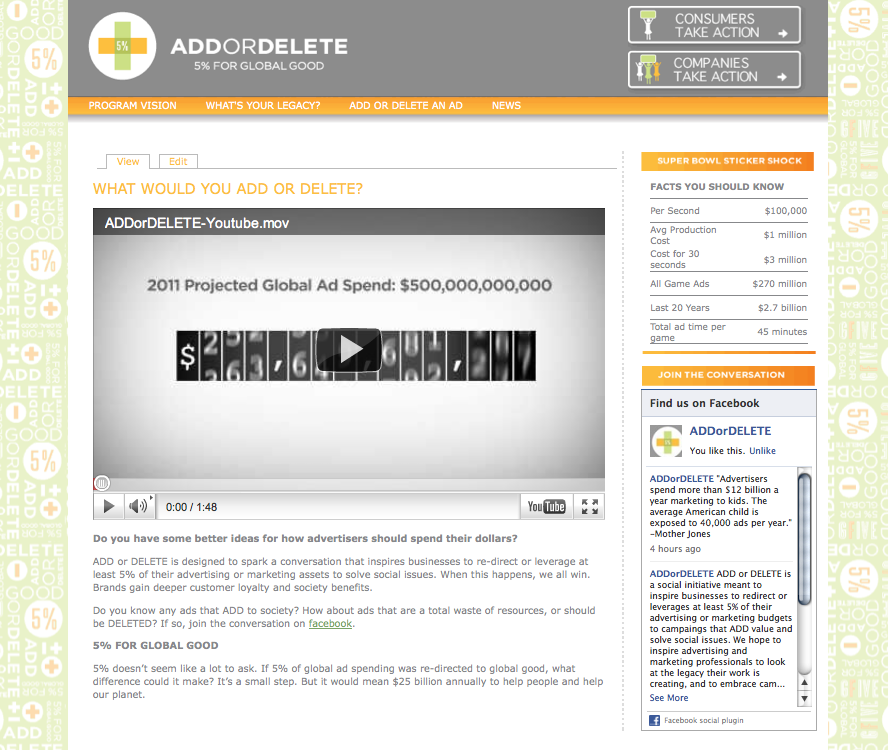
Kudos to ADDorDELETE, the brainchild of the tribe at Haberman.  It’s a fresh yet startling conversation centered around the power of marketing and advertising to ADD to society and address social problems and challenges.

By challenging the global marketing industry to re-direct 5% of the $500 billion global ad spend to causes, social problems and people that need help, we can unleash $25 billion for global good.

Learn more at the Add or Delete website

Join the conversation on facebook

Let’s call out all those ads that we’d prefer to delete.  Those messages that attempt to entertain at the expense of others.  The ads that just create noise and empty moments.  ADDorDELETE challenges everyone to take stock – what legacy do you want to leave?  Are you ADDING?  Here’s to less self-promotion and more social improvement.


Sustainability Making Business Smarter, More Competitive and More Profitable.

16 12 2010

A new report commissioned by KPMG and The Economist Intelligence Group shows that global corporate business executives are seeing positive—and potentially surprising – business benefits from their sustainability initiatives.  More than half of those surveyed represented C-Suite executives.  This week’s report is a preview of a major research paper coming from KPMG early next year.

  • 62% of company’s now claim to have a strategy for sustainability, up from just over half in early 2008.
  • 44% of business executives believe that sustainability is and will continue to be a source of innovation.
  • 39% of executives see sustainability as a source of revenue growth.
  • 41% see sustainability as a driver for brand enhancement.

Some of the other benefits cited by executives from sustainability initiatives include happier employees, better relationships with clients and suppliers, cost reduction, access to new markets, new product and service offerings and improved investor awareness.

But once again there is a gap between reality and perception, with many companies still not effectively communicating sustainability progress to investors and other stakeholders.

And the vast majority of survey respondants claim they viewed sustainability reporting as “just PR.”

It is time for business to back up their actions with transparent and authentic communication to translate their efforts into positive external perceptions and brand reputation enhancement.  The communication challenge is to be  real, believable, trusted and for the messages to be served up in digestible, understandable and emotionally inspiring ways.  And that friends, is the essence of great branding and the huge opportunity: creating responsible brands that prosper in the new age of sustainability.

Download the KMPG Research Report Preview Here


“Activate CSR through Brands”: Coca-Cola Enterprises

13 12 2010

Congratulations to the wise mind of Joe Franses of Coca-Cola Enterprises who calls on markets to harness the power of brands to engage consumers in the sustainable brands movement.

We’ve long called on a new take for CSR – corporate social responsibility.  The problem with CSR as it is currently defined and often practiced is that it lives at the “corporate” level.  The issue with this approach is that most consumers don’t want to have relationships with corporations.  What they do have is relationships with BRANDS.  Activating social responsibility at the brand level is key to get consumers to take notice of efforts and get engaged in the movement.  By selecting socially responsible efforts that are authentic to a brand’s values, consumers are much more likely to get engaged.

Note this report from Sustainable Life Media:

While speaking at the conference, Mr. Franses also stressed that innovation will be a major driver of business sustainability moving forward – and success will depend on how well brands can engage consumers in the process. The first step in this process, he said, will be for companies like Nestle, Coca-Cola Enterprises and Unilever to work at aligning their top-down management initiatives with brand agendas around sustainability more effectively.