The thinking error that makes people susceptible to climate change denial

5 05 2023


Expecting black-and-white answers can make it hard to see the truth. 
bubaone via Getty Images

By Jeremy P. Shapiro, Adjunct Assistant Professor of Psychological Sciences, Case Western Reserve University via The Conversation • Reposted May 5, 2023

Cold spells often bring climate change deniers out in force on social media, with hashtags like #ClimateHoax and #ClimateScam. Former President Donald Trump often chimes in, repeatedly claiming that each cold snap disproves the existence of global warming.

From a scientific standpoint, these claims of disproof are absurd. Fluctuations in the weather don’t refute clear long-term trends in the climate

Yet many people believe these claims, and the political result has been reduced willingness to take action to mitigate climate change. Why are so many people susceptible to this type of disinformation? My field, psychology, can help explain – and help people avoid being misled.

The allure of black-and-white thinking

Close examination of the arguments made by climate change deniers reveals the same mistake made over and over again. That mistake is the cognitive error known as black-and-white thinking, also called dichotomous and all-or-none thinking. As I explain in my book “Finding Goldilocks,” black-and-white thinking is a source of dysfunction in mental health, relationships – and politics.

People are often susceptible to it because in many areas of life, dichotomous thinking does something helpful: It simplifies the world.

Binaries are easy to handle because there are only two possibilities to consider. When people face a spectrum of possibilities and nuance, they have to exert more mental effort. But when that spectrum is polarized into pairs of opposites, choices are clear and dramatic.

Image of a person showing arrows pointing in opposite directions the person might take.
Most things don’t fall neatly into only two choices. eyetoeyePIX via Getty Images

This mental labor-saving device is practical in many everyday situations, but it is a poor tool for understanding complicated realities – and the climate is complicated.

Sometimes, people divide the spectrum in asymmetric ways, with one side much larger than the other. For example, perfectionists often categorize their work as either perfect or unsatisfactory, so even good and very good outcomes are lumped together with poor ones in the unsatisfactory category. In dichotomous thinking like this, a single exception can tip a person’s view to one side. It’s like a pass/fail grading system in which 100% earns a pass and everything else gets an F.

With a grading system like this, it’s not surprising that opponents of climate action have found ways to reject global warming research, despite the overwhelming evidence.

Here’s how they do it:

The all-or-nothing problem

Climate change deniers simplify the spectrum of possible scientific consensus into two categories: 100% agreement or no consensus at all. If it’s not one, it’s the other.

A 2021 review of thousands of climate science papers and conference proceedings concluded that over 99% of studies have found that burning fossil fuels warms the planet. That’s not good enough for some skeptics. If they find one contrarian scientist somewhere, they categorize the idea of human-caused global warming as controversial and conclude that there is no basis for action.

Powerful economic interests are at work here: The fossil fuel industry has funded disinformation campaigns for years to create this kind of doubt about climate change, despite knowing that their products cause it and the consequences. Members of Congress have used that disinformation to block or weaken federal policies that could slow climate change.

Expecting a straight line in a variable world

In another example of black-and-white thinking, deniers argue that if global temperatures are not increasing at a perfectly consistent rate, there is no such thing as global warming. 

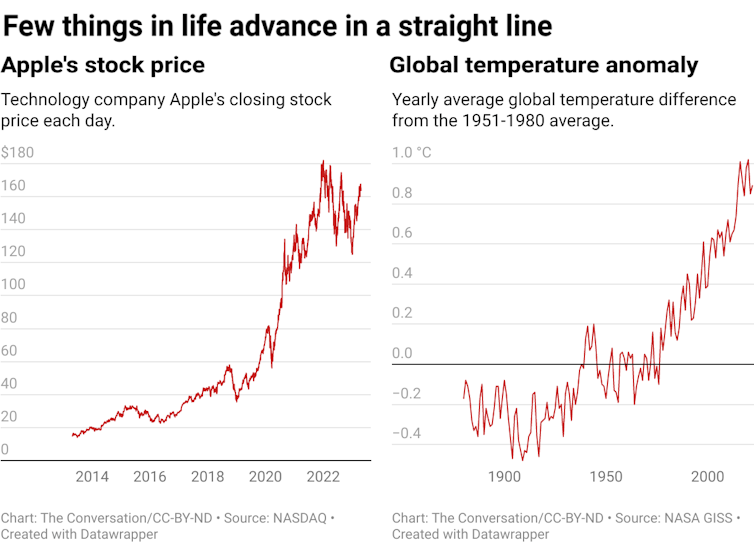
However, complex variables never change in a uniform way; they wiggle up and down in the short term even when exhibiting long-term trends. Most business data, such as revenues, profits and stock prices, do this too, with short-term fluctuations contained in long-term trends.
Charts showing Apple's changing stock price and global temperatures over time. Both have a saw-tooth pattern.
These two graphs have the same form: a long-term trend of major increase within which there are short-term fluctuations. CC BY-ND

Mistaking a cold snap for disproof of climate change is like mistaking a bad month for Apple stock for proof that Apple isn’t a good long-term investment. This error results from homing in on a tiny slice of the graph and ignoring the rest.

Failing to examine the gray area

Climate change deniers also mistakenly cite correlations below 100% as evidence against human-caused global warming. They triumphantly point out that sunspots and volcanic eruptions also affect the climate, even though evidence shows both have very little influence on long-term temperature rise in comparison to greenhouse gas emissions.

In essence, deniers argue that if fossil fuel burning is not all-important, it’s unimportant. They miss the gray area in between: Greenhouse gases are indeed just one factor warming the planet, but they’re the most important one and the factor humans can influence.
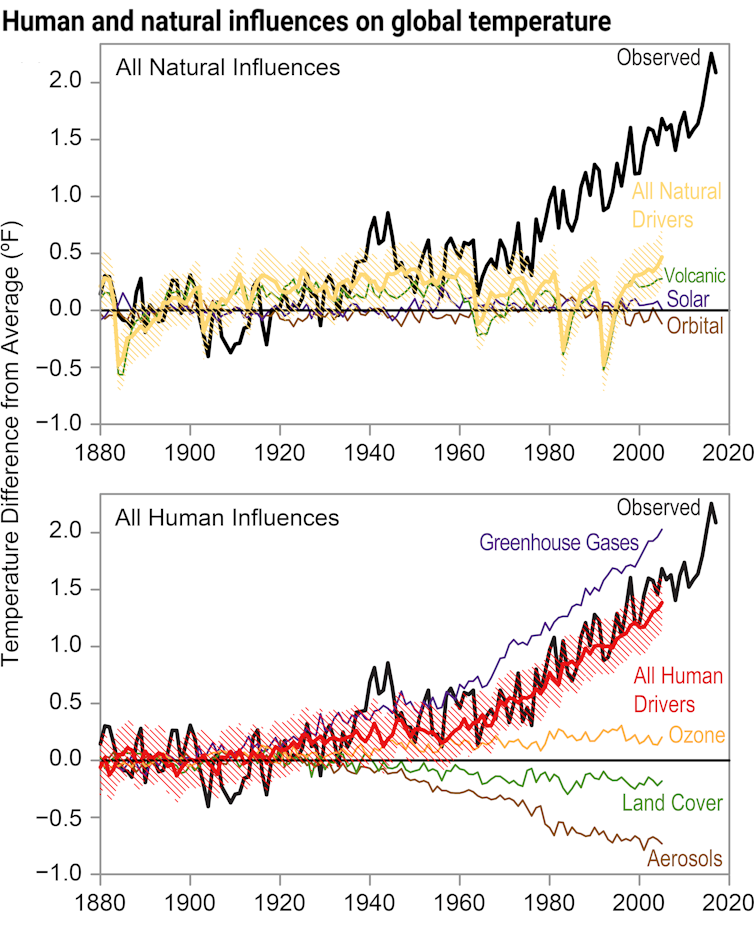
Charts showing impact of different forces on temperature. Natural sources have little variation, but the upward swing of temperatures corresponds closely with rising greenhouse gas emissions.
Influences on global temperature over time. 4th National Climate Assessment

‘The climate has always been changing’ – but not like this

As increases in global temperatures have become obvious, some climate change skeptics have switched from denying them to reframing them.

Their oft-repeated line, “The climate has always been changing,” typically delivered with an air of patient wisdom, is based on a striking lack of knowledge about the evidence from climate research.

Their reasoning is based on an invalid binary: Either the climate is changing or it’s not, and since it’s always been changing, there is nothing new here and no cause for concern.

However, the current warming is on par with nothing humans have ever seen, and intense warming events in the distant past were planetwide disasters that caused massive extinctions – something we do not want to repeat.

As humanity faces the challenge of global warming, we need to use all our cognitive resources. Recognizing the thinking error at the root of climate change denial could disarm objections to climate research and make science the basis of our efforts to preserve a hospitable environment for our future.

To see the original post, follow this link: https://theconversation.com/the-thinking-error-that-makes-people-susceptible-to-climate-change-denial-204607




Bridging the Sustainability Trust Gap in a Climate-Challenged World

3 05 2023

Image: Getty

Despite growing corporate efforts to drive sustainable change and climate action, there’s an underlying issue: a lack of consumer trust towards companies’ claims on this front. By Dr. Rebecca Swift, Global Head of Creative Insights at Getty Images from Sustainable Brands • Reposted: May 3, 2023

Around the world, major environmental events and extreme weather conditions have pushed climate change to top of mind for people worldwide. According to iStock and Getty ImagesVisualGPS research, “climate change” ranks top of the list of concerns for individuals across the globe — higher than inflation, the energy crises, or issues surrounding world peace.

However, there is still a general sense of ambiguity on who is accountable for driving forward actions to combat climate risks — is it the government? Big businesses? Or are individuals most responsible? Our insights tell us people globally believe it is a shared responsibility; yet each actor’s expectations seem to be first on others, rather than on themselves.

Historically, across different industries, ad campaigns have promoted the idea of individual responsibility. We are used to seeing visuals highlighting individual sustainable practices — from recycling to biking to using reusable shopping bags. All of these concepts, mostly driven by brands and policies, reinforce the idea that sustainability is an individual responsibility.

On the other hand, as VisualGPS found, individuals believe that government is the primary agent responsible for dealing with sustainability efforts and environmental concerns related to global climate change; and that businesses are as responsible as individuals for protecting the planet and enacting sustainable practices.

Since the first UN Climate Change Conference held in 1995, people have been able to follow some countries’ governments’ progress in dealing with climate change issues, while also seeing how corporate philanthropy evolved into impactful CSR programs. Today, 7 out of 10 individuals around the globe believe they have made a lot of progress toward living a more environmentally sustainable life, VisualGPS found.

Nonetheless, despite all involved agents taking part in making a change — denoting a high level of climate awareness — there’s an underlying issue yet to be solved: VisualGPS also revealed a lack of consumer trust towards companies’ claims on this front. More than 80 percent of consumers believe products are made to seem environmentally friendlier than they are, followed by distrust of products that are labeled ”environmentally friendly” as a marketing ploy; and they believe companies claim they abide by ESG (Environmental, social, and governance) standards but do not show enough evidence for it.

The 2023 Edelman Trust Barometer reported an average five-to-one margin of respondents who want businesses to play a bigger, not smaller, role in addressing climate change. The same research found respondents have low trust in the government; in contrast, businesses continue to gain trust around the world and are the sole institution seen as competent and ethical — showing companies are uniquely positioned to bridge the sustainability trust gap, fill the void left by governments, and showcase the invaluable role they play in addressing climate change.

When it comes to deciding which company to use or buy from, 84 percent of people believe it is important that a company uses sustainable business practices and extends these to their products; yet more than half claim it’s too much work to research what brands are actively doing to mitigate climate risks. Knowing most consumers make purchase decisions based on visual content — and also expect brands to take a public stand and drive real action on social and environmental issues — companies and brands can lean on better visuals to tell their sustainability story and make their efforts known to engage with consumers.

Regularly, visuals related to environmentalism and sustainability rely on familiar visual clichés— think, the lone polar bear or hands cupping a sapling — unimaginatively used to convey environmental issues. Many brands also focus on conceptual images and videos that are too abstract to stand out or resonate in a crowded visual landscape. Instead, businesses could focus on large-scale (often policy-backed) visuals — such as actions in the realm of infrastructure, renewable energy, agriculture, water conservation, or management of green spaces — imagery representing topics and initiatives that could transcend the barrier of practices often seen as greenwashing.

As the climate crisis accelerates, consumers are becoming more knowledgeable about what is sustainable; how our decisions, products and policies impact the environment; who is responsible — and whether or not they trust corporate and government sustainability claims. In turn, businesses should look to visual images and messaging that rise to the occasion.

To see the original post, follow this link: https://sustainablebrands.com/read/marketing-and-comms/bridging-sustainability-trust-gap-climate-challenged-world


2 leaders on the need for organizational transformation towards sustainability

3 05 2023

Photo: WEF

By Nadine Sterley, Chief Sustainability Officer, GEA and Judith Wiese, Chief People and Sustainability Officer and Member of the Managing Board, Siemens from the World Economic Forum • Reposted: May 3, 2023

  • Corporate sustainability has become a crucial strategic imperative.
  • Sustainability leaders are pivotal in shaping organizational change.
  • Two leaders share their thoughts on how this can be achieved.

The need for critical action to achieve climate and nature goals has elevated the role of the Chief Sustainability Officer (CSO). The private sector will play a key role in multistakeholder partnerships to actualize the impact on climate and nature. 

However, this cannot be achieved without a human-centred approach, making the Chief Human Resources Officer (CHRO) role also essential for sustainability transformation.

Within the private sector, CSOs and CHROs will shape fundamental strategies for organizational change to catalyze sustainable habits in organizations and individuals. 

“Sustainability, HR and organizational change can influence companies and their value chains” 

Nadine Sterley, Chief Sustainability Officer, GEA Group

As the world is confronted with the consequences of the climate crisis and other environmental challenges, acting sustainably is becoming increasingly essential in companies. This is true both from a strategic point of view as well as with regard to innovations and successful recruiting. At the same time, the breadth of sustainability topics is increasing year-on-year. 

The growing importance for companies to act sustainably and report on their sustainability performance has elevated the role of the Chief Sustainability Officer (CSO). Sustainability has evolved from being a niche function to a strategic one. CSOs are expected to take a key role in leading their organizations towards sustainable business practices. At GEA, the CSO role belongs to the inner circle of the company’s decision-making. It plays a crucial role in helping its executives and the entire workforce to easier understand, reasonably measure and adequately report on sustainability impacts, risks and opportunities.

As sustainability has fundamental strategic importance, GEA has put the topic at the heart of its strategic approach. In fact, sustainability is the core theme in GEA’s corporate purpose, “Engineering for a better world”, from which the company’s vision is derived: “We safeguard future generations by providing sustainable solutions for the nutrition and pharmaceutical industries.”

Moreover, sustainability has its own pillar within GEA’s Mission 26 corporate strategy and underpins the other six key levers. Taken together, they form the roadmap to ensure GEA achieves its targets. Within this framework, the CSO works strategically to ensure sustainability is integrated into all business activities and the entire company. This requires adept networking and advocacy skills and the ability to connect the dots within and outside the organization to drive sustainability transformation.

However, as important as they are, neither strategy, nor the organization or the products on their own are enough to make the key difference. What matters most to achieving real transformational change and becoming a truly sustainable company is the mindset, behaviour and commitment of a company’s employees. To help their organization succeed, employees need to be engaged, empowered, and assume a key role in the transformation. And this is where the human resources function must become part of the game. It can create a supportive environment that fosters a sustainable mindset and behaviour. It also plays a critical role in hiring and helping ensure new employees understand and embrace company values.

GEA is taking this aspect very seriously. Of GEA’s five values, the first one is: “Responsibility: We care for people and planet.” Internally and externally, our CEO, Stefan Klebert, has made it his personal mission to promote this value, thus setting the tone for all employees.

The clarity and importance placed on caring for people and planet, reinforced by GEA’s corporate purpose: “Engineering for a better world”, serve as a promise to current and future employees. This has already had a positive impact on our goal to become “Employer of Choice” in our industry. Likewise, our values and purpose set a clear expectation toward all employees and, consequently, any people-related decisions.

In addition to requesting a driving mindset towards sustainability from all employees, GEA is significantly investing in the competency development of its business leaders. Just recently, the top 160 leaders of the company, went through a comprehensive programme with a renowned business school that was strongly focused on identifying new ways of leveraging sustainability as a source for competitive advantage.

Building on that, the company’s leadership teams are now expected to develop their own strategies to create additional value for their customers by offering products and solutions that allow a reduction of energy, water, or waste. To encourage even more innovation in these areas, we set up cross-function and cross-divisional sustainability-focused hackathons to spark creativity.

As of 2023, a significant proportion of GEA’s senior leaders will participate in a variable compensation plan which is linked to GEA achieving its sustainability-related targets. For example, the reduction of CO2 emissions in GEA’s own plants and along entire supply chains will lead to higher compensation, as will the development of more efficient products that support customers in achieving their sustainability targets.

With the support of our employees, GEA is not only driving its own sustainability transformation but also the transformation of the many industries it supports through engineering excellence.

“Being Chief People and Sustainability Officer is a game changing superpower”

Judith Wiese, Chief People and Sustainability Officer and Member of the Managing Board, Siemens

The challenges to human (co-)existence on the planet from resource depletion, climate change, and unsustainable practices of the industrial age are undeniable. In the corporate world, the broader attention needed to handle sustainability issues is generally allocated to the role of the Chief Sustainability Officer (CSO). There are, however, no universal standards for what this function does or how much authority it has to be effective. At Siemens, the CSO role has been a board-level position since 2008, underscoring the importance of sustainability as a building block of our DNA and setting a strong foundation to build on. And that’s what we do, every day.

As Chief People and Sustainability Officer (CPSO) at Siemens, I have the unique opportunity to wear two hats: one for ensuring the well-being of our people and nurturing our company culture, and one for advancing sustainable practices in our own operations and all aspects of our business – multiplying the impact for our customers and communities. For me, this is a superpower. It joins two powerful elements that run horizontally across all our businesses: people and sustainability – both necessary if solutions are to be found for solving the most critical issues of our time. Add in the power of technology that Siemens brings as a technology company, and you have an unstoppable combination that actively supports the mindset shift needed for achieving a more sustainable world.

At Siemens, our push for sustainable business practices is encompassed in our 360-degree framework, containing six fields of action: Decarbonization, Ethics, Governance, Resource Efficiency, Equity, and Employability or DEGREE. Our DEGREE framework is, among other things, a commitment to ethical standards based on trust and respect for human rights in the supply chain. 

DEGREE allows a holistic view of sustainability that puts people topics like employability and equity, as well as environmental and societal impact topics, in focus. We encourage continuous learning and are committed to re- and upskilling, especially green skills. In the last fiscal year, we invested €280 million in professional training and continued education to transform our workforce into sustainability ambassadors. Our highly popular Base Camp for Sustainability offers an introduction to DEGREE and 66,000 participants have completed the course already in FY23.

We value the E for Equity that helps us integrate and promote diversity, equity, and inclusion into the fabric of our company. It helps us create a workforce that reflects our customer landscape and brings a fresh perspective to the way we think about creating solutions. The intersection of people’s interests with our company values creates a sense of belonging and engagement that we both admire and appreciate.

Combining the responsibilities for sustainability and people operations allows social aspects to be complemented by proficiency in the environmental and corporate governance spheres. At Siemens, with sustainability at the core of our processes, we need relevant skillsets across our business units and corporate functions. This allows sustainable approaches to be developed in an ecosystem manner, observing the cross-functional and business governance standards required to comply with new EU Taxonomy regulations and develop non-financial reporting and accounting guidelines.

To effect change, a cultural and organizational transformation and mindset shift are necessary. The convergence of people and sustainability can be a useful tool to speed up the momentum of much-needed change in all aspects of our existence. Indeed, for a company like Siemens – undergoing the transformation from industry to global technology leader – sustainability is a tremendous opportunity. Crucially, this applies both to our own operations and to our portfolio. We have increased our CO2 reduction target from 50% to 90% by 2030, compared to 2019, and will invest €650 million in decarbonizing our activities by 2030. But our products and solutions can also help our customers with their sustainability challenges – ~150 Mio tons of emissions were avoided by customers in FY22 alone.

Those companies that recognize the power of this combination will be well positioned to be drivers of innovation and growth, increase employee engagement, and mitigate the challenges associated with rapid transformation.

As a company at the intersection of the real and digital worlds, we at Siemens believe that technology is a key driver of sustainability. Embracing a holistic view that goes beyond environmental topics, we anchor sustainability firmly in all our business and operations. We are confident that leveraging the superpower combination of technology, people and sustainability can make a difference and transform the lives of billions.

To see the original post, follow this link: https://www.weforum.org/agenda/2023/05/leaders-need-for-organizational-transformation-sustainability/


Ethical Marketing: 4 Values All Brands Should Strive For

3 05 2023

Photo: Getty Images

By Jeff Bradfor, PR pro, president of Dalton Agency’s Nashville office, author of “The Joy of Propaganda: The How and Why of Public Relations and Marketing.” via Forbes • Reposted: May 3, 2023

Today, consumers demand that companies not only offer quality products and services but also behave ethically in their marketing practices. Ethical behavior is a critical aspect of building long-term relationships with consumers.

In this article, I will list what I believe are the fundamental, perennial philosophical values that guide ethical marketing—values that have guided the work of our PR agency for the past 23 years—and describe how brands have implemented them in their strategies.

Honesty

Honesty means telling the truth, being transparent and avoiding deception. In the past, many companies have used deceptive tactics in their marketing practices to gain a competitive advantage. However, with the rise of social media and other digital channels, such tactics are easily exposed and can damage a brand’s reputation.

An example of deception is Volkswagen’s diesel emissions scandal. The company admitted to using software that could detect when its cars were being tested for emissions and then adjust the performance to pass the test. However, in real-world driving conditions, the cars emitted up to 40 times the legal limit of nitrogen oxide. The company faced massive backlash, with many consumers feeling betrayed and questioning the brand’s ethics.

On the positive side, Tylenol dramatically demonstrated how to honestly and openly respond to a crisis during the infamous Tylenol tampering incident in 1982, in which several people died after taking Tylenol laced with potassium cyanide. The company quickly and completely shared information about the incident and took a huge financial hit by removing and destroying all products on the market at the time. Not only did Tylenol’s honesty save lives, but it also saved the company’s reputation. Within a year of the incident, sales of Tylenol had rebounded to pre-incident levels—and the company was widely praised for its ethical response to a tragedy that cost it over $100 million.

Respect For Individual Rights

This includes respecting privacy, data protection and avoiding discrimination. Consumers have the right to control their personal data and decide how it is used by companies. Brands must ensure they are transparent about their data collection and usage practices and obtain explicit consent from consumers.

A recent example of this is the General Data Protection Regulation (GDPR) in the European Union. Brands that prioritize individual rights and respect consumer privacy are more likely to build trust and loyalty with consumers.

Respect For Human Dignity

Brands must recognize the inherent worth and value of each person and treat them accordingly. In marketing, respect for human dignity means avoiding tactics that exploit or manipulate consumers, such as intentional deception.

For instance, while influencer marketing can be an effective way for businesses to reach new audiences, some influencers have been criticized for promoting products that they do not actually use or endorse, or for promoting products that may be harmful or unethical. This lack of authenticity and transparency can be seen as a violation of respect for human dignity.

Responsibility

Marketers have a responsibility to ensure that their marketing efforts do not harm people or society. They should also be responsible for ensuring that their products or services are safe and reliable.

For example, in 2019, a well-known vaping brand was criticized for its marketing practices, which contributed to the rise of teenage vaping. The company had used colorful packaging and social media influencers to target young people, despite knowing that its products were highly addictive and harmful. The company’s marketing practices had undermined the common good and contributed to a public health crisis.

Another example of irresponsibility is the issue of greenwashing, the practice of making false or misleading claims about the environmental benefits of a product or service. It has become a significant problem, as consumers are becoming more aware of environmental issues and are looking for sustainable products. Companies are being urged to be more transparent about their environmental practices and ensure that their marketing efforts are responsible.

Conclusion

Ethical marketing is critical for building trust and long-term relationships with consumers. Brands that prioritize honesty, responsibility and respect for individual rights and human dignity will not only meet consumer expectations but also set themselves apart from their competitors. By implementing these values in their marketing strategies, brands can create a positive impact on society while also driving business success.

To see the original post, follow this link: https://www.forbes.com/sites/forbesagencycouncil/2023/05/02/ethical-marketing-4-values-all-brands-should-strive-for/?sh=199547681f79


The Climate Science Behind Managing Disaster Risk

2 05 2023

Tourists try to stay dry in a flooded St Mark’s Square in Venice, Italy, in 2018. Flooding in the region has only intensified in recent years. Image credit: Jonathan Ford/Unsplash

By Joyce Coffee from Triplepundit.com • Reposted: May 2, 2023

It has become de rigueur for companies eager to reduce their climate-related disaster risks to sign up with groups that focus on assisting corporate clients with their climate change challenges. 

The Science Based Targets initiative (SBTi), for one, helps the private sector set science-based emissions reduction targets. It’s a partnership between CDP, the United Nations Global Compact, the World Resources Institute and the World Wide Fund for Nature (WWF). Another, the Task Force on Climate-Related Financial Disclosures, offers guidelines for how companies can report their exposure to physical climate-related risks, among other things.

The assistance these groups provide is timely. The U.S. Securities and Exchange Commission (SEC), which protects investors and regulates publicly-held companies’ disclosures, is considering rules to require public companies to provide climate risk-related financial data. And most (if not all) U.N. agencies and other international climate change-related programs recognize the need to address disaster risks and other forms of climate risk worldwide. 

But do these groups follow climate science? That question arose last month when a distinguished engineer openly questioned climate science in a presentation to the U.N. Disaster Risk Reduction Private Sector Alliance for Disaster Resilient Societies (ARISE) and its growing membership of U.S. corporate leaders. “We don’t know if climate change is happening now, and we don’t know if it will happen in the future,” he contended.

Peruse any legitimate climate source, and it’s nigh impossible to question climate science, whether our planet is warming and the effects of greenhouse gas emissions. The U.N. has a growing set of resources, among them:

As the U.N. plainly asserts: “It is unequivocal that human influence has warmed the atmosphere, ocean and land. Widespread and rapid changes in the atmosphere, ocean, cryosphere and biosphere have occurred.” 

ARISE, whose U.S. arm I co-chair, follows the Sendai Framework for Disaster Risk Reduction. The latest documents of the Framework — the 2015 U.N.-adopted document that calls for assessing and reporting progress on disaster-reduction plans — emphasize that disaster risks “are growing at an unprecedented rate globally, inflicting damage across sectors and vital systems for human societies and economies.”

It also maintains: “We are living outside the boundaries of what our planet can sustain, to the detriment of future generations. Radical shifts are needed to change course toward a more sustainable and risk-informed pathway, as the world is facing a projected 40 percent increase in disasters during the lifetime of the Sendai Framework to 2030.” 

The Framework cites climate change on over half of its 140 pages, and the No. 1 commitment of the U.N. Plan of Action on Disaster Risk Reduction for Resilience is to take a risk-informed approach. 

We must also heed another distinguished engineer, U.N. Secretary General António Guterres, who earned a degree in the field from the Instituto Superior Técnico in Portugal back in 1949. “Greenhouse gas emissions keep growing, global temperatures keep rising, and our planet is fast approaching tipping points that will make climate chaos irreversible,” he told CNBC last year. “We are on a highway to climate hell with our foot still on the accelerator.” 

And we must promote companies looking to the SBTi and others for assistance in mitigating disaster risks.  Onward with this important work!

Joyce Coffee headshot

Joyce Coffee, LEED AP, is founder and President of Climate Resilience Consulting. She is an accomplished organizational strategist and visionary leader with over 25 years of domestic and international experience in the corporate, government and non-profit sectors implementing resilience and sustainability strategies, management systems, performance measurement, partnerships, benchmarking and reporting.

To see the original post, follow this link: https://www.triplepundit.com/story/2023/disaster-risks-climate-science/773221


Smart tech can boost business sustainability in 6 key areas

2 05 2023

Photo: Getty Images

Graham Rihn, Founder & CEO of RoadRunner Recycling, discusses how smart technology can boost a business’s sustainability credentials in six key areas. By Graham Rihn from Sustainability Magazine • Reposted: May 2, 2023

More and more, business leaders are identifying that sustainability initiatives are not only beneficial for climate change, but can also have positive impacts on a company’s bottom line, when executed effectively. 

Resultantly, companies are investing in smart technology like AI, machine learning, and blockchain to help accelerate and streamline sustainability efforts, operate more efficiently and drive shareholder value.

While businesses, especially those with large national or global footprints, often face the challenge of scalability when it comes to implementing sustainability action plans across a variety of locations, a recent PriceWaterhouseCooper study found that more than 70% of sustainable goals could be accelerated through technology adoption.

New technologies can step into this arena to help businesses overcome these challenges among others. Here are six areas of sustainability businesses can improve with the help of tools such as AI, machine learning, and blockchain development. 

Energy Efficiency

Businesses can optimise energy efficiency through data analysis, and, in turn, identify opportunities for reduced energy consumption and potentially lower bills. For example, connected sensor technology can adjust lighting and air conditioning to occupancy levels. Fewer people in the office can equate to less energy usage. Industrial manufacturing company, Siemens, uses machine learning to optimise data center energy consumption. In the process, the company cut energy costs by 10% and carbon emissions by 16%. 

Renewable Energy

A major challenge for businesses involving climate change is sourcing energy that does not come from burning fossil fuels. In 2019, burning fossil fuels accounted for 74% of U.S. greenhouse gas emissions. 

Businesses that choose renewable energy sources can use AI to increase efficiency and reduce their carbon footprint. Google installed a 1.6 MW solar array at its company headquarters as part of its plan to wholly utilise carbon-free energy by 2030. They use AI to maximise the use of that clean energy across data centers, shifting energy-intensive processes to the times of day when the most electricity is available. 

Investing in renewables, committing to optimising green energy production, and employing technology to optimise usage can yield dividends in terms of climate change.

Sustainable Supply Chain

Supply chain transparency is essential for building a sustainable business and negating climate change, but tracing a product’s journey is no easy task. Blockchain technology can step in to help a business ensure sustainable sourcing methods are utilised for raw materials. Walmart recently partnered with IBM to implement a blockchain based supply chain tracking system to follow products and materials.

Before applying technology to the supply chain, it took a team more than six days to find the source of a package of mangoes being sold at a store location. Working with IBM, that team could eventually trace each package in less than three seconds. Sustainable sourcing can help businesses reduce emissions, better manage climate risks, and even streamline operations.

Sustainable Product Design

Analysing product performance data can be accomplished through AI algorithms that optimise product design for energy efficiency and recyclability. 

As of 2010, Nike employed AI and machine learning to design a sustainable running shoe made with recyclable materials that maintained their standards of durability and athletic performance. The carbon footprint of the product was reduced by 30%

Applying technology to product design can mean reductions in energy usage and carbon emissions for businesses.

Waste and Recycling Management

Sustainability measures are not only important at a product’s creation, but also when it reaches the end of its usable life. Waste accounts for an estimated 20% of methane emissions across the world. 

Today, new technologies can analyse waste generation to identify areas in which organisations can reduce waste output. Waste metering technology is able to monitor the types and volumes of waste being generated to optimise service. It can also identify areas for increased recycling or waste elimination. 

One example, the city of Amsterdam implemented an AI-based application in 2021 that can detect garbage and recycling on the street. It automatically maps the area and once the material is identified by the AI in real time, the information is shared with the city’s waste management department to clean up. The application is able to quickly solve waste disposal issues in Amsterdam at scale.

ESG Reporting

Embracing technologies that aid in implementing sustainable changes to businesses can also enable better, more accurate ESG reporting. Disclosing this type of information could soon become a requirement with potential new SEC Scope 3 emissions reporting rules coming in 2023 and technology adoption can help businesses be well-prepared.

Many businesses find that with the use of AI and sensor technology that data quality is improved, reporting processes can be automated, the technology can identify risks and opportunities, and they are better able to forecast future trends. 

Microsoft uses AI-based carbon management software and Internet of Things for its AI for Earth programme. It can measure, manage, and find ways to reduce an organisation’s carbon footprint. That can be an attractive metric to investors measuring a company by its ESG score. Cutting emissions usually means a reduction in energy use which often translates to lower costs. Using AI for data collection and predictive analytics can provide a powerful avenue to find new methods of driving sustainability solutions. 

Why apply technology to sustainability

Implementing these tools as part of a holistic sustainability program allows companies to find solutions that fit their needs and sets your business up for success in both the short- and long-term. 

Smart technologies can help us accelerate the road to a more sustainable future, and the time to start is now. Implementing this technology now prepares your business for a future in which sustainability will have a bigger impact on the bottom line. 

In fact, more than 74% of institutional investors said they would divest from companies with a poor environmental track record. 

AI, machine learning, and blockchain technology can push businesses to achieve goals such as Zero Waste and carbon neutrality, while preparing you for the expectations of tomorrow, today. 

To see the original post, follow this link: https://sustainabilitymag.com/articles/smart-tech-boosts-business-sustainability-in-6-key-areas


Your iPhone Contains More Recycled Materials Than You Thought

1 05 2023

Image credits: Bagus Hernawan/Unsplash and Apple 

By Gary E. Frank from triplepundit.com • Reposted: May 1, 2023

Mobile devices like Apple’s iPhone contain at least 30 chemical elements — from common metals like aluminum, copper, lithium, silver and gold, to rare earth elements like yttrium, terbium, lanthanum, neodymium and dysprosium, all of which are extracted from the earth through mining.

Apple is looking to reduce demand for these elements and others by quietly expanding its use of recycled content. The company reached a new high for recycled materials in 2021, with nearly 20 percent recycled content across all products, according to its 2022 Environmental Progress Report released last week. It also introduced certified recycled gold for the first time in 2021, and more than doubled the use of recycled tungsten, rare earth elements and cobalt, the company reported. 

Recovering more materials for use in future products helps reduce mining. For example, a single metric ton of iPhone components contains the same amount of gold and copper that’s typically extracted from 2,000 metric tons of mined rock. 

“We are making real progress in our work to address the climate crisis and to one day make our products without taking anything from the earth,” Lisa Jackson, Apple’s vice president of environment, policy and social initiatives, said in a public statement. “Our rapid pace of innovation is already helping our teams use today’s products to build tomorrow’s.”

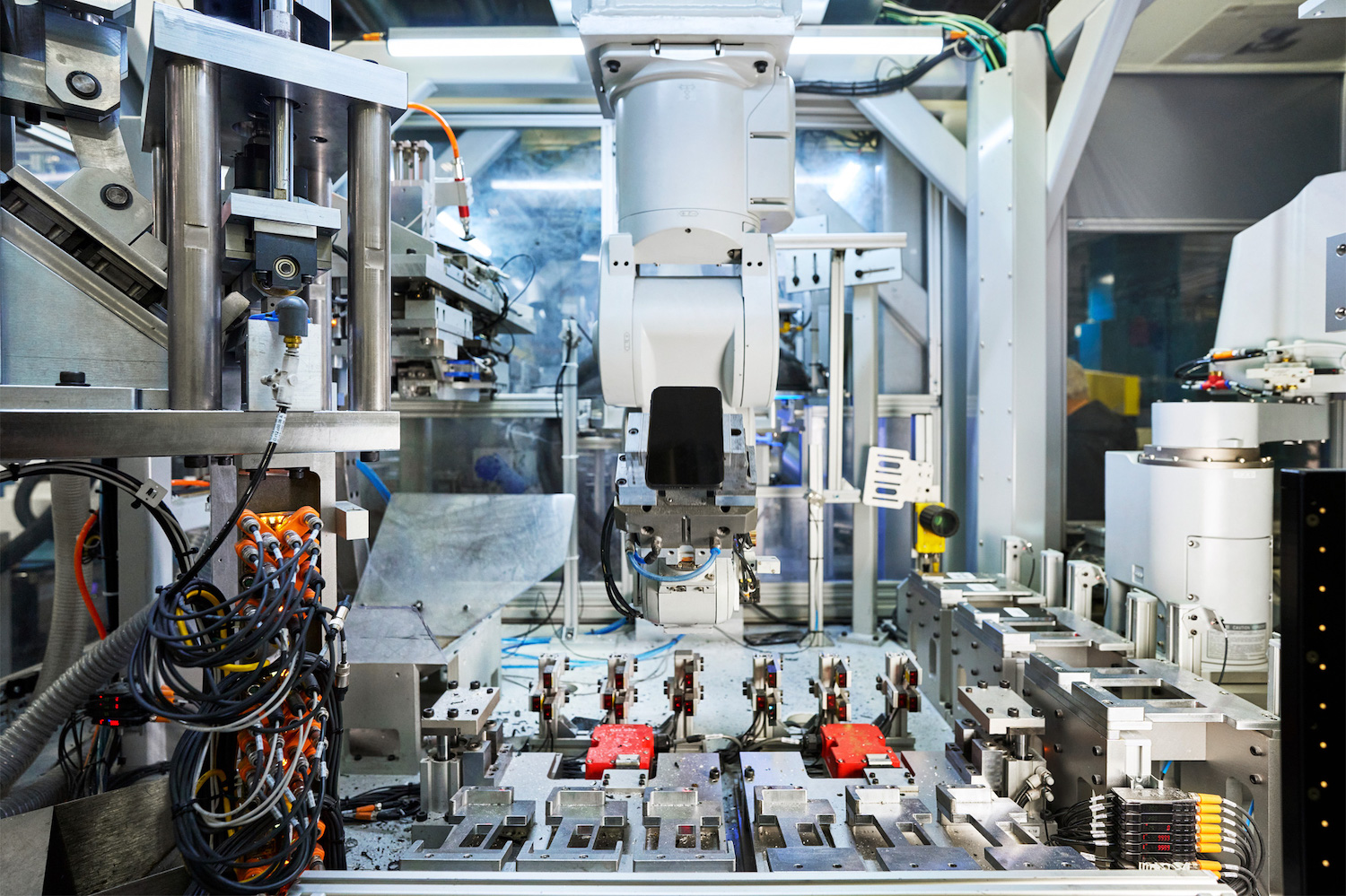
Increasingly, that means the use of recycling robots like Daisy, which the company says can disassemble up to 1.2 million phones a year and recover key materials like rare earths. With recently enhanced capability, Daisy can now take apart 23 models of iPhone, and Apple has offered to license the robot’s patents to other companies and researchers free of charge.

apple daisy iphone recycling robot
Apple’s first recycling robot, Daisy, can disassemble up to 1.2 million phones each year, helping Apple recover more valuable materials for recycling, according to the company. 

Apple rolled out Taz, a cousin to Daisy, last year — which uses “shredder-like technology” to recover more rare earth elements from devices. An additional robot, Dave, disassembles taptic engines, the technology that provides users with tactile feedback to simulate actions, such as clicks on a stationary touch screen. These steps help in the recovery of valuable rare earth magnets, tungsten and steel, the company said. 

All totaled, Apple products that came off the assembly lines in 2021 included 45 percent certified recycled rare earth elements, the company’s highest mark ever. 

The company has also committed to extend product lifetimes through refurbishment. It reported sending more than 12 million devices and accessories to new owners for reuse in 2021, extending their lifetime and reducing the need for future mining. In the long term, Apple aims to use only renewable or recyclable materials in its products, a goal announced in 2017.

The company’s 2022 report also highlighted its progress toward achieving carbon neutrality by 2030. In a year when many other companies saw large increases in their footprints and the company’s revenue grew by 33 percent, Apple’s net emissions remained flat. The company has been carbon neutral for its global operations since 2020, including 100 percent renewable energy used to power all offices, stores and data centers since 2018.

And Apple says it’s spreading the gospel of renewables, with Apple suppliers more than doubling their use of clean power from 2020 to 2021, according to the report. As of April 2023, 213 of the company’s manufacturing partners have pledged to power all Apple production with renewables across 25 countries.

The company has also reduced plastic in its packaging by 75 percent since 2015, on the way eliminating plastic packaging entirely by 2025.

To see the original post, follow this link: https://www.triplepundit.com/story/2023/apple-iphone-recycled-materials/772961


United Nations: Global sustainability goals are in ‘deep trouble’

1 05 2023

Image: sustainability-times.com

By Laureen Fagan from sustainability-times/.com • Reposted: May 1, 2023

Global progress on achieving the United Nations Sustainable Development Goals (SDGs) has been stalled, with the COVID-19 pandemic and conflict in Ukraine causing setbacks that threaten achievement of the 2030 goals.

“It’s time to sound the alarm. At the midway point on our way to 2030, the SDGs are in deep trouble,” said the new interim report, previewed this week. “A preliminary assessment of the roughly 140 targets with data show only about 12% are on track.”

For example, 575 million people (about 7% of the world’s population) will still be living in extreme poverty in 2030 if current trends hold. That compares to 800 million in 2015 (10.8%). “The COVID-19 pandemic reversed three decades of steady progress with the number of people living in extreme poverty increasing for the first time in a generation,” the report said. Some 70 million were pushed back into extreme poverty since 2019.

There have been successes: child mortality rates continue to fall, progress on HIV prevention and treatment continues, and there are gains on electricity access in poor countries. Renewable energy and an increased number of marine protected areas are bright spots. But on far too many measures, including climate-related goals, more is needed.

At this rate, some 660 million people will still lack power and renewable energy will still be a fraction of the mix in 2030. Climate finance is falling short and debt relief is increasingly critical in the developing world. Food security (SDG2) and safe water access (SDG6) are threatened as more people are affected by climate impacts.

“The world is on the brink of a climate catastrophe and current actions and plans to address the crisis are insufficient. Without transformative action starting now and within this decade to reduce greenhouse gas emissions deeply and rapidly in all sectors, the 1.5°C target will be at risk and with it the lives of more than three billion people,” the report said.

“Failure to act leads to intensifying heatwaves, droughts, flooding, wildfires, sea-level rise, and famines. Emissions should already be decreasing now and will need to be cut almost by half by 2030 – a mere seven years from now.”

Guterres is appealing for “deep reforms of the international financial architecture” through international lenders and development banks, including SDG stimulus funds of at least US$500 billion per year to assist low-income nations with their plans for the SDG targets.

“Many developing countries cannot invest in the SDGs because they face a financing black hole. Before the pandemic, the annual SDG funding gap was $2.5 trillion. According to the OECD, that figure is now at least $4.2 trillion,” said Guterres. “And many developing countries are buried under a mountain of debt.”

The interim report was released ahead of the UN General Assembly’s high-level Economic and Social Council meeting in July and, ultimately, the SDG summit in September.

To see the original post, follow this link: https://www.sustainability-times.com/low-carbon-energy/un-sdgs-global-sustainability-goals-are-in-deep-trouble/


Three Things Companies Should Consider When Targeting Gen Z

29 04 2023

Photo: Getty Images

By David Herpers, Forbes Councils Member via forbes.com • Reposted: April 29, 2023

As Generation Z begins to harness its buying power and make significant financial decisions, competition for its attention grows. For companies hoping to capture this generation’s business, it’s important to understand the way they view their finances and how they engage with a brand. While Gen Z’s relationship with money and brands is similar to that of its older siblings, millennials, it’s certainly not the same. Let’s look at how Gen Z approaches finances and consumer brands.

Money Habits

As with the members of any younger generation, we tend to expect Gen Z to have irresponsible spending habits and not to be the biggest savers. Studies show this isn’t the case.

Gen Z tends to spend less and save more than the other generations, contributing an average of $867 in savings per month, almost doubling what the average American saves each month ($462). One may find themselves asking, is Gen Z more fiscally responsible than the rest of us?

The answer is yes and no. One main factor leading to the high monthly average of savings is many Gen Zers still live at home. According to a 2022 study by Credit Karma, Gen Z is setting records for the number of people living with their parents following high school education. With costs of living at an all-time high, most Gen Zers are making the decision to stay home in the best interest of their short- and long-term financial security.

That said, there’s still a large portion of Gen Z that chooses to spend over saving. However, those that fall into the spending category are still taking a cautious approach. Over 68% of Gen Zers use a budgeting tool of some sort to manage their finances. Of those surveyed, 43% say they prefer the old-fashioned pen-and-paper method, while 38%, respectively, say they use online budgeting tools.

Brand Enthusiasm

Gen Zers’ cautious nature isn’t exclusive to their housing and higher costs. It extends to their relationships with brands as well. When looking at the relationship between Gen Z and brands, a recent IBM study measured brand loyalty (repeated purchases) and brand enthusiasm (active engagement between brands and customers).

According to the IBM study, Gen Z is more likely to display brand enthusiasm over brand loyalty. Known as the “generation of researchers,” this is likely due to Gen Z’s habit of turning to online platforms for reviews before making even small purchases.

Rather than committing to a brand they are familiar with, Gen Zers will evaluate all options, taking into consideration customer and influencer reviews, social media presence and value alignment. When they find a brand that checks all their boxes, they are eager to share and engage with it. But keep in mind, should the brand harm the relationship in some way, Gen Zers quickly move to purchase from a competitor.

An advantage of appealing to brand enthusiasm, as noted by IBM, is that it creates opportunities to gain insight into customers’ attitudes and purchasing habits in relation to a brand. Companies get to have conversations with customers about what they want rather than guessing. And we already have insight into what Gen Z customers crave.

Authenticity

While millennials may stray away from content that’s been highly edited and airbrushed and that poses perfect “promises,” Gen Z has taken it to the next level—by adeptly recognizing the differences between real and fake online content. As the first generation born into social media and becoming more tech-savvy than generations so far, Gen Z is quick to identify fantasy versus reality. According to IBM’s study of Gen Z’s relationships with brands, it’s clear this generation places a high value on a brand’s authenticity and prefers real content over staged content.

The concept of authenticity extends beyond advertising and product images for Gen Z; it includes the company’s impact. According to a 2019 Kearney study, 57% of Gen Z reports a brand’s social and environmental impacts are key factors in its purchasing decision. But a statement about a brand’s commitment isn’t enough to sway the generation of researchers. In fact, Gen Z will go out of its way to find—and even pay slightly more for—a product or service if it means the purchase aligns with its values.

As Gen Z’s influence on the market and society continues to grow, companies and brands can best position themselves for success by aligning with the values and habits of this generation. With a large number of consumers that can take the success of a brand into their own hands, keep in mind their financial concerns, engagement expectations and craving for authentic content, as these are likely essential to keep a brand afloat in the rise of this new generation.

David Herpers is the SVP of Digital Bank at Credit One Bank. His expertise includes wealth management, banking and product management.

To see the original post, follow this link: https://www.forbes.com/sites/forbesfinancecouncil/2023/04/28/three-things-companies-should-consider-when-targeting-gen-z/?sh=1c1847f71a5d


4 Strategies for Bridging the Sustainability Skills Gap

29 04 2023

IMAGE: TIMA MIROSHNICHENKO

While it may be tempting to take a ‘wait and see’ approach, more and more companies are developing their own solutions to mitigate this gap internally. Here are four such strategies. By JOANNA BUCZKOWSKA-MCCUMBER via Sustainablebrands.com • Reposted: April 29, 2023

Businesses across industries are under mounting pressure to adopt sustainable practices, reduce their environmental impact, and provide ESG reporting and transparency in their efforts while staying accountable to their commitments. As demand for sustainability grows, so does the need for skilled professionals and workers who can drive and implement strategy and practices effectively across organizations and supply chains. However, most companies do not have the talent with the knowledge, experience and skills to achieve their sustainability goals.

Companies are recognizing that the demand for sustainability talent is outpacing the supply; and the gap is only growing — as sustainability roles expand and new ones get created, a Corporate Sustainability Officer is just not enough. The International Labour Organization suggests that 18 million net new jobs could be created worldwide by net-zero commitments by 2030. Recent research found that 82 percent of sustainability executives believed there were significant skills gaps within their own organization to tackle sustainability requirements. The World Economic Forum has directly linked the lack of qualified talent as being one of the significant barriers to implementing sustainability strategies; while the UN Global Compact has called for direct action to address this skills gap — prompting companies to prioritize and invest in skilling, upskilling and reskilling their teams.

While it may be tempting for companies to take a ‘wait and see’ approach, it won’t bridge this gap fast enough and will have negative effects. More and more companies — includingMicrosoftSalesforce and Interface — are turning to mitigate this gap internally by developing and implementing their own solutions.

Bridging the sustainability skills gap internally will be fundamental for businesses in reaching their sustainability objectives. Here are four such strategies.

Make sustainability a strategic priority

First and foremost, a strong sustainability strategy sends a clear signal to potential and current employees that a business is committed to sustainability. This can be a major selling point for job seekers who are looking to work for a company that shares their values. By publicly committing to sustainability and investing in the resources needed to achieve sustainability goals, businesses can attract top talent and build a workforce that is passionate about sustainability. But it’s not just about attracting the right talent — a sustainability strategy can help to engage, motivate and develop the skills of existing employees.

Investing in a sustainability strategy can also help businesses to stay ahead of the curve when it comes to trends and regulations. As governments around the world enact more stringent sustainability regulations, businesses that are already taking a proactive approach to sustainability will be better positioned to adapt to these changes. By investing in a sustainability strategy now, businesses can ensure that they have the knowledge, skills, and resources needed to comply with future regulations and stay ahead of their competitors.

Provide training across your organization

They’re perhaps the most obvious on the list, but education and training programs are essential for building the skills and knowledge needed to implement sustainable practices effectively. These programs can take various forms — including workshops, online courses, mentoring programs, internships, etc — and can be customized to specific job functions and levels. They can be developed internally, sourced online or even co-developed with educational institutions.

The trick is ensuring that you are levelling up your current workforce while priming the incoming talent pipeline. That focus then has to consider both an internal and external training lens. Microsoft is an excellent example of how a company can tackle the sustainability skills gap on both sides — focusing on internal training for employees while also building out external learning opportunities through its Sustainability Learning Center.

Integrate sustainability into company culture

Planning and training are key tools in providing knowledge and setting the playing field but incorporating sustainability into corporate culture is what makes sustainability efforts meaningful. In 2021, the World Economic Forum released a study that found companies with a strong sustainability culture are more likely to attract and retain employees with the appropriate skills and knowledge — helping to mitigate brain drain.

Building a culture rooted in sustainability entails fostering a culture that prioritizes and values sustainability and encourages employees to develop their sustainability skills regardless of their job responsibilities. Companies can start by creating plans that set sustainability goals and targets, and ensuring those are communicated clearly and in a format that not only engages but enables every employee to feel that they have a role to play in the execution of the plan.

Providing channels where employees can execute sustainability goals while having the agency to develop and recommend new sustainability initiatives, rounded out by volunteering opportunities or employee resource groups, provides a rich internal ecosystem for sustainability to thrive. Acknowledging employees who exhibit leadership and innovation and celebrating teams that achieve sustainability goals is an added strategy to inspire and motivate employees to become champions of sustainability within the organization and sustain an engaged workforce.

Embed sustainability into the employee lifecycle

Companies must prioritize sustainability throughout the employee lifecycle, integrating it into major HR functions. A Harvard Business Review study found that embedding sustainability in the employee lifecycle by incorporating sustainability targets and social impact considerations into the attraction and recruitment processes can improve employee engagement and retention rates. For example, job descriptions, interview questions and selection criteria can emphasize the importance of sustainability skills and experience or even a desire to learn new sustainability skills.

Investing in sustainability initiatives can offer ample opportunities for employees to develop their skills and enhance their knowledge in this critical area. Ensuring that sustainability elements are baked into regular HR functions such as professional development, checks-ins and performance reviews will enable leaders to be aware of specialized skill development and matching employees with new opportunities within the company as they arise.

To remain competitive in the marketplace, companies must adopt proactive measures to address the sustainability skills gap — by investing in making sustainability a priority, training, and embedding it across culture and people functions. Being proactive in bridging this business challenge will only have a net-positive effect on performance across environmental and social factors; but without it, companies will be left behind.

To see the original post, follow this link: https://sustainablebrands.com/read/organizational-change/4-strategies-bridging-sustainability-skills-gap


FTC takes a microscope to sustainability claims

26 04 2023

Does this count as recycling? | Seth Wenig/AP Photo

By Debra Kahn and Jordan Wolman from Politico.com • Reposted: April 26, 2023

Companies are talking the talk on sustainability. The Federal Trade Commission is gearing up to make sure they’re walking the walk, Jordan reports.

As demand for sustainable products has skyrocketed, so have concerns about greenwashing. Public comments were due yesterday on the FTC’s first update in 11 years of its “Green Guides,” which are essentially advice for how companies can make environmental marketing claims.

The nearly 60,000 comments shed light on what companies, industry trade groups and environmentalists are fighting over:

— Recycling claims. Current FTC guidelines say companies should qualify claims of “recyclability” when products aren’t recyclable in at least 60 percent of their market. The EPA wrote that the bar “should be much higher,” while environmental groups want to clarify that at least 60 percent of products need to actually be recycled — not just collected. That coalition also wants to set a higher bar of 75 percent for store drop-off programs.

The Plastics Industry Association wants the standards to stay as-is: The FTC “should not further complicate the issue by adding hurdles,” the group wrote. It also wants take-back or drop-off programs to be equally eligible to make unqualified recycling claims.

— Corporate net-zero claims. Ceres, a nonprofit focused on corporate sustainability, wants the FTC to give guidance on how companies can use carbon offsets to make claims about their climate commitments and achievements. Sierra Club and a half-dozen other groups want disclosure of specific offsets’ climate benefits.

— Chemical recycling. The American Chemistry Council and the Plastics Industry Association want to make it easier to claim that chemical recycling — a set of technologies that involve melting hard-to-recycle plastic down into its components — counts toward companies’ recycled content and recyclability standards. The ACC submitted a new poll showing that nearly 90 percent of consumers believe chemical recycling qualifies as “recycling.” Green groups are pushing back.

— Enforcement. Environmental groups want the FTC to initiate a formal rulemaking process to codify the Green Guides (currently, the agency can bring enforcement action via violations of the FTC Act), with an eye toward California’s “truth in labeling” law. EPA seems to be on board, too, but the Plastics Industry Association opposes rulemaking.

How much does this all matter? The FTC doesn’t do a ton of enforcement of green marketing claims: It’s taken enforcement action under the Green Guides 36 times since 2013. It hasn’t taken enforcement action based on recycling claims since 2014 — although it does send warning letters, which can nudge companies into compliance.

The agency tends to pick big cases that send a signal — like its $5.5 million penalty last year against Walmart and Kohl’s over claims that they marketed rayon textiles as made from eco-friendly bamboo, when in fact converting bamboo into rayon involves toxic chemicals.

But officials are signaling willingness to wade into the details on new technologies such as chemical recycling.

“Our job is to not say what’s good or bad for society, it is to make sure that people aren’t lying,” James Kohm, associate director of enforcement in the FTC’s Bureau of Consumer Protection, said in an interview. “We wouldn’t necessarily hesitate to get involved in a situation. What we don’t want to do is contradict the EPA, and we’ve been careful in a number of areas to not do that. There are a bunch of trade offs — that you have less trash, but you might have more air pollution, for example. If we had enough information, and we weren’t contradicting the EPA, we would probably give advice.”

We could be in this for the long haul: The last time the Green Guides were updated, the process started in 2007 and didn’t end until 2012. There’s an initial public workshop on recycling scheduled next month.

To see the original post, follow this link: https://www.politico.com/newsletters/the-long-game/2023/04/25/ftc-takes-a-microscope-to-sustainability-claims-00093682


How the Collective Power of Small and Medium Sized Businesses Can Combat Climate Change

20 04 2023

Photo: Meta

By Mary Riddle from triple pundit.com • Reposted: April 20, 2023

The collective power of small- and medium-sized enterprises (SMEs) — defined as those employing less than 500 employees — is far greater than many may expect. Together SMEs make up 90 percent of businesses worldwide and affect the livelihoods of more than 2 billion people.

In Europe, SMEs reign supreme — accounting for 99 percent of all companies and 63 percent of business-related emissions across the EU. Business owners in Europe have faced incredible challenges in recent years — from the pandemic, to supply chain disruptions, to inflation and labor shortages. Creating and implementing a sustainability program is difficult work during normal times, but recent crises have compounded the challenges.

Together, SMEs could wield significant influence over their industries, including suppliers, vendors, customers and other stakeholders, as well as their neighborhoods. With the help of SME Climate Hub, a nonprofit global initiative empowering small- to medium-sized businesses to take climate action, Meta is working to help SMEs overcome barriers to creating more sustainable business operations, one company at a time.

Harnessing Meta’s power of convening to help SMEs

“Meta has over 200 million businesses that use Meta platforms, so as a company we are uniquely positioned to help,” said Eoghan Griffin, Meta’s head of sustainability for Europe, the Middle East and Africa. “We have a brilliant convening power.”

Traditionally, Meta has focused on enabling business, particularly SMEs, to navigate the digital transition — from e-commerce to social media to communications, Griffin said. “Recently we have been looking at how to support SMEs in the green transition, as well,” he continued. “We knew informally that small businesses are struggling with supply chain requirements of larger companies, the complexity in navigating terminology, and customer expectations. Their customers are asking for this.”

To address these challenges, Meta collaborated with the SME Climate Hub to create the Meta Boost Guide to Green, a sustainability training program for SMEs in Europe. “Guide to Green was a huge success,” Griffin said, “and we heard from businesses loud and clear that they want more support and guidance.”

The Guide to Green offers information to help businesses incorporate sustainability into their company operations, as well as ways to communicate their stories.

Many small businesses are already playing their part on climate action and are using Meta’s platforms to support their businesses. For example, family-run Hippersons Boatyard in Norfolk, U.K., is taking a leadership role in promoting climate action within the local community. The Sparrow family, who run Hippersons, is working with their neighbors to increase recycling and rewilding. On top of that, they are embedding climate action into their own business operations through efforts such using lower-carbon fuel alternatives and providing discounts for those who use the train to get to the site rather than driving.

Belfast-based local produce delivery service, Farm Next Door, is encouraging customers to switch to ethically-grown produce from local farmers through educational programming. They also host events that help customers understand the various steps involved in growing produce and the benefits of buying local. The company has found this to be a great tool for engaging with its customer base and encouraging them to buy from Farm Next Door.

Breaking down SME barriers to sustainability

In 2022, Meta partnered with Accenture to learn more about the barriers that SMEs face to implementing sustainability programs — and they came away with three high-level findings.

Making the business case. “First, there is a need to provide and boost the value case for this kind of work,” Griffin said. “We need to showcase success stories, provide funding and provide value. Demonstrating and enabling that value is a critical barrier.”

Understanding how to take action. SMEs also need help in knowing what matters most. “The climate change landscape is rapidly evolving. There is an overload of information from external sources, and it mostly targets different kinds of businesses,” Griffin explained. “We need to cut through the noise to address what kinds of actions SMEs can take.”

A big part of this is understanding what climate action looks like for smaller businesses with fewer resources, because it will look different than it does at a major multinational. “SMEs can’t do everything, nor should they have to do the same things as a big company that has a bigger footprint,” Griffin said. “However, SMEs can be massive drivers of change. They have a galvanizing and accelerating role and opportunity in their communities.”

Keep it simple. “The third big challenge is that we need to make it massively easier to deliver these changes,” Griffin said. “COVID taught us that: With supply chain disruptions and the cost of living crisis, somehow we need to make [sustainability] a lot smoother and easier for them. It is not realistic for SMEs to spend four or six months to put together sustainability plans, but Meta can get valuable, third-party content to as many businesses as possible.”

As part of its work in the EU, Meta is also looking to ensure that sustainability information is available in as many countries and cultural contexts as possible. Meta Boost Guide to Green is translated and available in the local language for some of the company’s EU markets. The training was also piloted with SMEs throughout Europe to ensure the programs were relevant for business owners across the region.

“Our flagship partner, SME Climate Hub, has been a critical partner in guiding us,” Griffin said. “They have a pledging tool, which allows businesses access to even more external validation. We don’t want to duplicate what other organizations are doing. We want to highlight the external resources, like SME Climate Hub, that are already available. Much of our guidance is highlighting the great work they are doing already.”

The collective impact of SMEs

Historically, SMEs have been underrepresented in many of the agencies and programs dedicated to reducing business emissions. “The U.N. and other agencies are focused on the emissions of large businesses, but collectively, SMEs have a huge impact, and they have been neglected in terms of support,” Griffin said.

“That led us to creating this program,” he continued. “We aren’t a consulting firm, but we do think we have a brilliant convening factor and can get access to a lot of businesses at the same time. We are excited to support businesses in their journeys where we can.”

While small businesses individually have small levels of greenhouse gas emissions, their collective action can help eliminate business sector emissions and galvanize communities.

“No one is putting the blame on SMEs,” Griffin hastened to say. “As a large company, we have a huge focus on ourselves. However, collectively, SME emissions account for 63 percent of all business emissions in Europe. Sixty-six percent of customers want businesses to take a stand on climate, and SMEs have enormous reach in their communities. There is a huge opportunity there.”

And Griffin noted that when SMEs succeed, Meta also succeeds. “We are always keen to develop and deepen the relationships we have with SMEs, and there is a lot of shared social value within that,” he said. “Our training reached over 1 million SMEs, and in a climate crisis, we get to contribute to the drumbeat of stories that highlight how important this is and where the resources are.”

Meta continues to partner with businesses of all sizes to help them establish communications plans and campaigns around their sustainability progress. “When a business is ready to communicate their stories, Meta is ready to help them do that,” Griffin concluded. “Those stories can lead to more brand loyalty. We can help translate the sustainability work that they’re doing into tangible business opportunities.”

This article series is sponsored by Meta and produced by the TriplePundit editorial team.

To see the original post, follow this link: https://www.csrwire.com/press_releases/771996-how-collective-power-smes-can-combat-climate-change


Should sustainability professionals (still) be working to make themselves redundant?

18 04 2023

Photo: edie.net

An ever-growing cohort of businesses claim they have ‘fully embedded’ sustainability. So, as business strategies and sustainability strategies become one and the same, should sustainability teams be working to end the need for their function? By Sarah George from edie.net • Reposted: April 18, 2023

It’s a question which leaders in the profession have been mulling for several years. When edie was founded 25 years ago, corporate sustainability was in its infancy. Many firms had no dedicated staff and those that did either tasked them with a compliance-based to-do list or with carrying out philanthropic initiatives on the periphery of core business.

Fast-forward to the 2020s and the perfect storm of top-down (regulatory changes, new scientific research) and bottom-up (growing public awareness and activism) pressures – as well as physical risks crystalising in this era of polycrisis – are prompting smart businesses to see their core strategy and sustainability strategy as the same thing.

Beyond mergers of strategy documents, this prioritisation can be seen in the trends towards integrated financial and ESG reporting and towards giving board members environmental KPIs. A PWC-led study published in February concluded that more than three-quarters of large businesses have now linked executive pay outcomes to climate targets, up from less than 50% in 2020.

And, promisingly, in edie’s recent survey of hundreds of energy and sustainability managers, 91% said their chief executive was ‘somewhat’ or ‘very’ engaged with ESG. The proportion stood at 81% for the wider board.

But, of, course, a company’s culture does not hinge solely on executives. Mary Kay Cosmetics’ founder Mary Kay Ash is often quoted as saying that “a company is only as good as the people it keeps”. Sustainability professionals will need to embed culture beyond the C-suite if they are to ever make themselves redundant.

There is a growing body of research to prove that the workforce of the 2020s are increasingly seeking employers with strong ethics. But there is also a wealth of proof that, for most people in their day-to-day job, there is confusion on how to be part of the solution to big, global challenges like the climate crisis.

Are you an agitator or an ambassador? 

To help turn intention into impact, a growing number of businesses are now assigning ESG-related KPIs to all staff. One such business is innocent Drinks, which exceeded a pledge for at least 90% of employees to have such a target in 2020.

“As we know, working for a business you are proud of is becoming more and more important to staff …  But it’s one thing to know that a company cares about these issues, and knowing what you can do at your level is a bigger question,” explains innocent’s head of force for good in the UK, Emilie Stephenson.

To ensure that all new staff know what is expected of them in terms of ESG, every role description now assigns a related responsibility. Social media and communications staff, for example, are tasked with increasing discussions on topics like climate. Operations and procurement team members are told their work is key to reducing waste and emissions – not just to keeping smoothies and juices on shelves.

For existing staff, Stephenson explains, KPIs have been effectively retrofitted through regular updates to personal development plans.

Beyond giving staff targets, innocent makes a point of considering how their personality and skillset could best aid delivery. Since the mid-2010s, staff have been encouraged to work with their line managers to determine whether they are an  ‘agitator’, ‘activator’, ‘ambassador’ or ‘protector’.

Stephenson says: “I think it works because it’s so tangible – people understand what it is and they can talk to people about it. This, and the language itself, is motivational.”

Many board members are natural ‘protectors’, as they have the seniority to hold teams accountable for taking the actions needed to reach sustainability ambitions. ‘Activators’, meanwhile, specialise in taking the action, delivering specific projects on the ground.

‘Ambassadors’, meanwhile, share innocent’s work with others and advocate externally for a greater focus on sustainability in the private sector and beyond. And being an ‘agitator’ is the most common choice; these people scrutinise current strategies and practices to suggest potential improvements.

Blended roles and B Keepers 

Linked to the ‘protector’ role is the role of ‘B Keeper’ – a new title which came into being through innocent’s certification as a B Corp in 2018, and is linked to the protection of B Corp status. In Stephenson’s opinion, the B Corp certification process helped to provide a more “solid framework” of focus areas for staff. She also recounts hearing some team members who were typically not the most vocal speaking up and taking responsibility for certain sets of points during the process.

A similar experience is recounted to edie by Heather Lynch, head of impact and sustainability at fellow B Corp Oddbox. The business, which sells boxes of fruit and vegetables that would otherwise have gone to waste, became a B Corp in 2020 and is currently in the process of re-certifying.

Oddbox is a mission and vision-driven brand, Lynch explains. The mission is fighting food waste. The vision is of a world where all food grown is eaten.

“I see mission and vision as the ‘what’, and the B Corp as a framework for the ‘how’,” Lynch says, adding that the first B Impact assessment prompted a “thorough stock-take of opportunities” and the second as providing a “framework for tracking progress”.

One key opportunity identified through certification was to upskill staff. 70% of Oddbox’s staff have now completed an eight-hour carbon literacy training course, and the business is targeting at least 90% by the end of the year. As Lynch explains, this training ensures that staff have a base understanding of carbon jargon and climate science – and that they are clear on their role in the business’s delivery of net-zero emissions by 2030.

So, most Oddbox staff are officially carbon-literate and several of them are B Keepers. Beyond that, some managers have blended roles, due to their role in creating and delivering the sustainability strategy.

The operations team co-created the firm’s net-zero strategy, with support from Lynch and her junior, plus external consultants. As such, senior operations team members are effective net-zero managers, responsible for delivery and reporting. They are also helping senior logistics and packaging staff to do the same.

“Ownership is just as important as, if not more important than, awareness,” Lynch says. “That, I feel, has been really powerful.”

Ownership is a sure-fire way to ensure that people do not feel strategies or targets are being put on them from the top-down, landing them with an extra burden. Co-creating strategies with staff and emphasising the particular benefits to each group is a tactic gaining popularity far beyond Oddbox; the practice is often called green jiu jitsu and there are specific training courses.

The final say  

So, say your business has taken similar steps to Oddbox and innocent. It has a long-term sustainability strategy backed up with interim goals, and governance mechanisms in place to report against these and keep them on board members’ desks. Your staff all know exactly what role they have to play in contributing to goals, and relish taking that action.

Do they still need you?

“I don’t necessarily think there needs to be a separate sustainability function, but there needs to be space and time to think about – and plan for – sustainability over the long-term if not,” Lynch says.

She also emphasises how, even if sustainability is embedded, reporting and employee engagement are ever-evolving pieces of work. On the former, her junior is a sustainability data analyst, and she recounts how the addition of this role has left her with more time for “strategy, influencing, holding people accountable and also researching for the future”.

innocent’s Stephenson, however, believes that most businesses are not quite ready to hold that space for sustainability without having in-house experts.

She says: “Douglas [Lamont, former innocent chief executive] has previously advocated for sustainability being embedded in all teams and, therefore, not needing a separate team. My hunch is that this work is not done yet.

“Yes, everyone should be incentivised to play their part. But you still need a leader, there’s still that need for someone to co-ordinate centrally.

“In due course, yes, I’d love to be made redundant. But, at the moment, when you’ve got strategy to develop and deliver, when staff have conflicting priorities, I’d say you still absolutely need someone to hold the torch.”

It bears noting that while innocent and Oddbox are both B Corps, their staff cultures are doubtless very different. Oddbox, for example, that it has a far smaller – yet far more rapidly-expanding – staff base. It has around 75 staff, up from less than 20 in 2019. innocent has more than 760 staff.

Moreover, Oddbox was founded on that aforementioned mission of fighting food waste. While innocent’s founders have built a company often regarded as an exemplary specimen for purpose-led business, they were initially looking for a reason to leave corporate jobs to be their own boss – and the popularity of their smoothies at a music festival proved to be that reason.

So, one could only imagine the situation at even bigger, older, less agile companies, who still either publicly state their purpose as creating value for shareholders or are so frequently accused of purpose-washing. Such firms may say that they have ‘embedded sustainability’ or that it is ‘in their DNA’, but they may have only just hired their first senior specialist – let alone be ready to make them redundant.

To see the original post, follow this link: https://www.edie.net/should-sustainability-professionals-still-be-working-to-make-themselves-redundant/


A HoT Job: Why corporations need a Head of Traceability

17 04 2023
Graphic: Planet Tracker

There is a new acronym in town and it’s HoT. From Planet Tracker • Reposted: April 17, 2023

If you are looking for a job where compensation can be linked to your impact, consider becoming Head of Traceability(HoT), especially at a nature-dependent company.

Here is why:

  • Under pressure from regulators1, investors2 and consumers, nature-dependent companies in particular need to substantiate their sustainable claims. This cannot be achieved without traceability.
  • Traceability is cross-functional, covering sustainability, IT, product development, sourcing, legal, logistics and marketing: it needs a dedicated person to oversee all of these. Instead, traceability is often the remit of sustainability departments, who have limited leverage over sourcing and logistics staff, raising the risk of traceability-washing (when companies’ claims on traceability cannot adequately be traced to real initiatives). Or it is siloed in sourcing, logistics, or IT departments, potentially without considering sustainability issues.
  • Traceability allows companies to save costs and reduce risks (through increased efficiencies, reduced waste and recalls mostly): in textiles, we calculated that it would increase net profits by 3-7%. In seafood, we estimated that the whole industry’s meagre profits could rise by 60% if it became fully traceable. 
  • This makes HoT an attractive job where performance means a simultaneously positive impact on the company’s bottom line and a reduced negative impact on nature is feasible. Crucially, that performance can be measured and traced. It should therefore form part of the remuneration package of any HoT. Indexing remuneration on sustainability performance is badly needed, but proposals to do so typically fall short.
  • Being in charge of traceability is likely to be a challenging job: senior managers typically expect traceability to generate a variety of different outcomes – see Figure 1.


Figure 1: Companies’ top goals for traceability initiatives (Source: Bain, 2021)

Planet Tracker did not find enough HoT jobs

We have searched for all companies which have appointed a Head of Traceability (or equivalent title) on LinkedIn and performed a simple search on Google too. Our results are incomplete since “only” 25-30% of the global workforce is on LinkedIn,3, 4 the search was made in English only, and we might have omitted synonyms/equivalent titles. Still, we believe the results are noteworthy.

We found only 18 companies with a Head of Traceability – excluding companies whose business is to sell traceability solutions and government agencies. By comparison, there are at least 10,000 Heads of Sustainability on LinkedIn.5

One of the possible reasons why HoTs are a rare species could be that it exposes management to more searching questions from financial institutions. Access to a HoT, who has extensive reach and understanding of a company’s operations, could provide investors and lenders with significant insights. They should be very much in demand by the financial markets. Presently, the information asymmetry between management teams and their stakeholders is skewed in favour of the former.6 Please see ‘Implementing Traceability; Seeing Through Excuses’.

Companies with a HoT are engaged in a variety of sectors exposed to recognisable sustainability challenges – e.g. palm oil, textiles, tuna, leather, fertiliser, waste management. They are headquartered in 16 different countries on all continents, except South America. Three quarters of them operate in the food or textile industries – see Table 1. The absence of companies engaged in plastic production or meat production is noteworthy.

Table 1: List of companies with a Head of Traceability

Whilst large textiles companies such as H&M Group and Inditex have a Head of Traceability, many large food companies typically do not. This is concerning since a lack of oversight on traceability within a company is likely to elevate their risk profile and impede their success.

Achieving traceability in food systems is a key requirement that could increase overall food system profits by USD 356 billion or more and is key to transforming this global system. Please see the Financial Markets Roadmap for Transforming the Global Food System. Planet Tracker’s work on the seafood system alone suggested that companies that implemented fully traceable supply chains could see profits increase by 60%. Please see ‘How to Trace USD 600 billion’.

In many cases, the companies in our sample have a Head of Traceability with an IT background: traceability is viewed as a digitalisation issue. In others, they have a supply chain/logistic background. In a minority of cases, the responsibility for traceability is assumed by the Head of Sustainability.

Why HoTs will be hot

Presently, there are not many Heads of Traceability in place – if we have missed one at your company, please get in touch – but we believe this will change, for a number of reasons listed here, the most important being regulation.

Already the key expected outcome for traceability is compliance with regulation and likely to become more important given the number of new laws that will require traceability to be implemented. For instance, the EU deforestation regulation, the FDA’s increased traceability requirements in the US, EU Green Claims Directive proposal and the EU’s Corporate Sustainability Reporting Directive (CSRD), which passed in January 2023.

For this reason, the urgent implementation of traceability systems overseen by a Head of Traceability or an equivalent cross functional person, is key in our view. Financial institutions should be engaging with company executives and enquiring where the traceability function sits within their management structure.

Note: this blog was inspired by this article in Vogue Business. Credit goes to Bella Webb for raising awareness on the need for Heads of Traceability.

To see the original post, follow this link: https://planet-tracker.org/a-hot-job-why-corporates-need-a-head-of-traceability/


How Robust Procurement Practices Support Sustainability Objectives

17 04 2023

Graphic: Accelerationeconomy.com

By Joanna Martinez from accelerationeconomy.com • Reposted: April 17, 2023

In a previous analysis, I laid out reasons why sustainability should be a priority for every chief procurement officer (CPO). Now, I’d like to focus a bit on how procurement can make a positive impact on sustainability. Taking just a few measures can set the right foundation for a meaningful program that helps your organization meet its goals in this area.

Drafting Governing Principles

Adopt a sustainability mindset. If your company has an ESG (environmental, social, and corporate governance) already, you draw your sustainability objectives from the policies to be found there. Procurement professionals, in particular, must remember that sustainability initiatives, to be effective, require actions in at least two areas: Purchasing the greenest materials from suppliers while also implementing sustainable practices within the company. A good place to start is with the overarching principle that whatever goes to the customer, whether it is a good or a service, is produced in the greenest way possible.

Most of your suppliers have sustainability initiatives of their own and you may already be buying green without realizing it. Tap into their knowledge base by asking what their other customers are doing or what initiatives they have in place internally or with their suppliers. There will likely be some good ideas for your company to adopt.

I’ve looked at the websites of competitors to see what sustainability initiatives they are emphasizing — everything from products made of post-recycled plastic to delivery via EV trucks — to get ideas on what my employer may have been missing.

Purchasing the Greenest Materials From Suppliers

In a manufacturing company, changes to any materials that go into the finished product must undergo rigorous testing to make sure there are no compatibility or shelf-life issues. As such, direct materials and chemicals will not be a source of quick wins. Even so, it still makes sense to pursue green initiatives, even if it takes time to see sustainability results; the sheer volume of what gets purchased to support manufacturing will inevitably yield bigger sustainability gains than other parts of the business.

Here are just a few practices for procurement to consider regarding the sourcing and purchase of materials:

  • Convert to recycled materials and packaging where it makes sense
  • Prioritize sourcing wood products, such as corrugated packaging, that are certified by the Forest Stewardship Council
  • Include sustainability questions in RFPs and evaluate potential new suppliers on their sustainability programs
  • Rethink the global supplier mindset and make room for some materials coming from local suppliers, which would reduce the carbon emissions produced by transportation and help support local economies
  • Choose energy-efficient equipment

Purchasing Indirect Materials

Not every company manufactures, but all companies buy indirect goods and services that are obtained to help their employees and facilities function. Typically, there is a wide range of items here, from carpeting to technology. Actions that procurement sponsors will be visible to the organization and reinforce that the company is “walking the walk.” Here are just a few examples:

  • Source products that are designed for longevity and can easily be recycled. For example, reusable water bottles and coffee mugs are small items from a cost standpoint, but are visible indicators of a company’s commitment to sustainability.
  • Require that office paper be made from recycled materials
  • Ensure that the cleaning crews use biodegradable cleaning products
  • As with direct materials, make room for local businesses in the supplier mix
  • Include energy efficiency as a factor in equipment decisions
  • Prioritize sustainable transport, such as using EVs or hybrid delivery trucks

Measure and Report

There are many ways to measure sustainability progress — carbon footprint, energy consumption, ESG performance, and waste generation, to name a few. Many businesses track their CSR (corporate social responsibility) score, which evaluates a company’s actions in the areas of the environment, labor and human rights, ethics, and sustainable procurement. It’s important to choose a few measurements — whatever is relevant to a given business — that can be tracked and understood. Too many metrics — especially at the start — can result in information overload and resources being focused in the wrong place.

Proof Point

I worked for a global facilities management company, and our clients typically expected both cost reductions and sustainability initiatives. One way to get both was to focus on energy. The first thing that happened when a new client came on board was to conduct a thorough assessment of their energy usage. We looked at carpets, windows, HVAC, lighting, and even the water usage on the landscaping, to make sure that improving energy efficiency was a priority. If your company is just beginning a sustainability program, this might be a great place to start, and there are third-party experts who can help you.

To see the original post, follow this link: https://accelerationeconomy.com/cxo/how-robust-procurement-practices-support-sustainability-objectives/


How brands can show a sustainability commitment in 2023

14 04 2023

Implementing sustainable practices is no easy feat and often takes years. But brands must understand consumer priorities and show a commitment, no matter how formidable the challenge. From Ipsos • Reposted: April 14, 2023

KEY FINDINGS:

  • Consumers, more than ever, are pushing brands to become more sustainable, Ipsos research finds
  • 38% of Americans say manufacturers and retailers should be responsible for reducing unnecessary packaging
  • More brands than ever feel pressure to show their sustainability agenda—but being a sustainable brand has different meanings to different consumers

This passage has been adapted from Emmanuel Probst’s new book “Assemblage: The Art and Science of Brand Transformation” (Ideapress Publishing, 2023).

Numerous brands in 2023 aim to show they are implementing sustainable practices in response to consumer concerns about the environment and climate change—but are often unsure where to start. Ipsos research on sustainability provides a guide for companies on key questions to ask themselves as they look to implement sustainable goals.

  1. How does my audience perceive my brand in terms of its sustainable and environmentally responsible practices?
  2. How prevalent is sustainability in the context of my specific markets, product categories, and competitor brands?
  3. What can I implement almost immediately that will improve the perception of my brand as it pertains to sustainability?

Consumers are awash in products

Consumer spending in the United States hit an all-time high of $13.3 trillion in the third quarter of 2019, up from $10.5 trillion in 2010 and $8.2 trillion in 2000. They are spending more than ever on personal care items, consumer electronics, and clothes. The average American buys 66 garments a year.

Consuming has become easier, as shoppers no longer have to comply with restrictive store hours. Goods have become cheaper, even when they must be shipped halfway around the globe. Consumers also dispose of the products they buy faster than ever when they reach programmed obsolescence or simply because they get bored with them.

Most of these products end up in landfills; the average American disposes of 4.4 pounds of trash every day, which translates into 728,000 tons of daily garbage, or 63,000 garbage trucks full. Every year, Americans throw away 9 million tons of furniture, 9.4 million tons of consumer electronics, and 14 million tons of clothing (double the 7 million tons tossed 20 years ago).

For many Americans, sustainability is becoming a priority in the face of relentless consumption, with surveys showing a desire to pivot toward more meaningful and responsible consumption choices.

Who should be responsible for combating the climate crisis?

Ipsos Global Trends 2023 shows that 80% of people in 50 markets around the world believe the planet is heading for an environmental disaster unless consumers change our habits quickly, yet only 39% believe their country has a clear plan in place for how people, government, and businesses are going to unify to tackle climate change, according to an Ipsos poll of 30 countries from 2022.

People feel the burden of responsibility. In a global survey from Ipsos, 72% agreed that if ordinary people do not act now to combat climate change, they will be failing future generations and 68 percent said that if companies do not act to combat climate change, they are failing their employees and customers. Globally, 65% believe that if their government does not combat climate change it is failing citizens.

These concerns are prompting brands to become more sustainable. When asked, “Who should be responsible for finding a way to reduce unnecessary packaging?” 40% of people surveyed said everyone, 38% said manufacturers and retailers, and only 3% said consumers alone. Product packaging is something that brands (not consumers) own and control, yet consumers influence business decisions by which brand they buy, based on its environmental impact.

And when it comes to implementing sustainable practices, organizations must also be conscious of public perception and overpromising—especially when there may be aspects outside their control. A major international airport, for example, recently committed to becoming carbon neutral by 2030. However, the pledge only reflects the airport’s infrastructure. There is a danger that, in the public’s view, the commitment should also include the emissions from the 1,300 flights that take off or land there every day. Doing the right thing on sustainability, while also managing public perceptions, is not an easy balance to get right.

What consumers believe contrasts with how they shop

Brands also face a tricky factor in consumer behavior itself. While many people claim to be concerned with the environment, their efforts to live in a more environmentally friendly way often fall short and they default on easier actions.

An Ipsos study revealed that almost 90% worldwide are confident in recycling and using low-energy lightbulbs. Conversely, only 55% would consider switching to a mostly plant-based diet, and 59% would avoid driving a car and long-distance air travel.

When it comes to shopping, Ipsos Essentials data shows that globally, just over half of citizens consider themselves to be ethical or sustainable shoppers. In the U.S., only 24% of shoppers see sustainability as a crucial factor when making a purchase, compared to 53% who say the same for affordability and 71% for quality.

Shoppers also differ on their sustainability priorities depending on the product. In baby and toddler products, for example, an Ipsos study showed that sustainability was not a top priority. Parents favored diaper brands that make a safe product for their baby (70%) and fit their baby well (60%). In contrast, only 22% care that the brand is environmentally responsible, declining by three percentage points over the last year.

How some brands are responding

As sustainability is becoming a topic of growing interest, brands feel obliged to talk to their sustainability agenda and show their actions through initiatives and commitments to various time frames. Many brands aim to eventually become carbon neutral (offsetting one’s emissions by planting trees), including:

  • Netflix by 2022
  • Apple, Microsoft, and Facebook by 2030
  • Amazon by 2040
  • Coca-Cola and Nestlé by 2050
  • Starbucks aims to become “resource positive” by 2030, which it defines as reducing carbon emissions, water withdrawal, and waste by 50% while expanding plant-based menu options, shifting to reusable packaging and investing in regenerative agricultural practices.

Brands rely on a range of terms to describe their sustainability initiatives, including but not limited to “carbon zero” (Hytch, a commuting app), “zero-carbon” (Zero Carbon Coffee), “climate positive” (Max Burgers), and even “air-made” (the carbonneutral alcohol brand Air Vodka).

Being a “sustainable brand” has different meanings to different consumers

Some brands are purposefully built around sustainability. “Oatly was born sustainable. Its very existence is the manifestation of their mission. Specifically, to help support ‘a systemic shift toward a sustainable, resilient food system’… to ensure the future of the planet for generations to come.”

Some brands have a purpose that aligns with sustainability

Although denim is notorious for requiring large quantities of water to create jeans, Levi’s new collection, Water<Less uses 96 percent less water. Levi’s implements sustainable practices through its entire design and manufacturing process and is working to source cotton that is 100 percent sustainable.

Some brands must shift to sustainability

Volkswagen’s mission is to power a grand switchover to electric vehicles and has enshrined the mission in VW’s new tagline, “Way to Zero.” They aim for total carbon neutrality by 2050, with the hope of creating a sustainable production process from design concept to showroom.

Implementing sustainable practices is no easy feat and often takes years. But brands, especially in 2023, must understand consumer priorities and show a commitment, no matter how formidable the challenge.

To see the original post, follow this link: https://www.ipsos.com/en-us/how-brands-can-show-sustainability-commitment-2023


Employee Values: Why an Authentic Sustainability Strategy Will Win the Talent War

9 04 2023

Every organisation should be able to identify what a sustainable version of itself looks like, who is needed to run and support that, and where there are needs for new skills and roles within it.By Kathleen Enright from sustainable brands.com • Reposted: April 9, 2023

The war for talent may be ongoing, but the battlefield is being redrawn. The seismic changes to people’s lives wrought by COVID, the climate emergency and the cost-of-living crisis have all reshaped the demands employees are making on the companies they work for. The Great Resignation was, at its core, a movement to find greater purpose in work and is an indication of the power dynamics swinging in favour of the workforce. To win the hearts and minds of the best and brightest, corporates need to acknowledge these shifts and alter their tactics accordingly.

Tony Danker, Director General of the Confederation of British Industry (CBI), openedits recent Future of Work Conference by recognising that “new realities demand a new approach.” Alongside the expectation for more flexible working models, he highlighted that people are increasingly making career choices based on employers’ social and environmental ethics and that businesses need to adopt new values to win them over. “It’s no longer just that they work for us,” he warned. “We have to work for them.”

Danker’s argument was that British businesses must embrace bold climate goals and demonstrate their social awareness through “active diversity and inclusion strategies” if they want to attract Generation Z workers. Young talent, he believes, will only work for businesses that share their own values.

It doesn’t start — or end — with Gen Z

All of which is true. But by focusing on the need for purpose among workers at the start of their careers, Danker overlooks the rising demand among employees of all ages for corporations to demonstrate social and environmental accountability. Generations X and Y are just as keenly focused on sustainability when it comes to picking their employer.

2020 report by intranet company Unily found that 72 percent of multigenerational UK office workers were concerned about environmental ethics — and 65 percent would be more likely to work for a company with strong environmental policies. Climate change, human rights and social equitychimed particularly loudly with workers in their 30s and 40s.

Employers who focus solely on the demands of Gen Z when it comes to incorporating sustainability into their business, marketing and brand strategies will be ignoring the needs of a significant — and expanding — proportion of their staff. Employee demographics are changing, with the proportion of over-50s in the workforce steadily increasing. According to Cebr research, by 2030 47 percent of over-50s will be in employment. To put this into context, in 2032 the first of the millennials — aka Generation Y — will enter their 50s. Meanwhile, the employment rate of over-60s has almost doubled in the last two decades and is set to continue increasing.

Attraction is futile without retention

While it is clearly crucial to consider the requirements of their future workforces, businesses need to be aware that social and environmental issues also play strongly with senior talent. The generation of employees currently raising young children have heightened fears over the planet’s fragility, while those established in their careers have greater leverage to make employers respond to their priorities. Disregard them, and they will take their skills and experience elsewhere. Fundamentally, corporate responsibility isn’t just a factor in talent attraction but, crucially, in talent retention.

Among every demographic, the talent pool is worried about the future and well-informed about the realities of the climate crisis. Workforces want businesses to do more but they will not be duped by punchy slogans or unsupported promises. The Unily research found that 83 percent of office workers believed their employers were doing too little to address climate change, suggesting a worrying gap between intention and action on the part of employers.

This is partly due to a failure by companies to align their sustainability strategy with business strategies across every aspect of their organisations — a failure to demonstrate how sustainability is rooted in the business, how it is driving change, reshaping it for tomorrow; and how employees will play a critical role of in that journey. In our ProgressPoint survey of 20 global companies, Salterbaxter analysed the employee communications of progressive employers to understand how their sustainability strategy was being framed to staff and if it enabled them to make active decisions. Were employees, for example, provided with opportunities to take on real-world sustainability challenges? It was an area when almost every business fell down.

Empowering workers to contribute to sustainability solutions is far more motivating than simply raising awareness of corporate sustainability strategies and is a significant factor in talent retention. But we found that the companies we analysed scored only averagely or poorly in how they positioned sustainability in their employee value proposition or in their employee development programmes — they may have progressive sustainability strategies, but they are not taking their talent along with them.

Authenticity is everything

The retention issue makes it essential that companies embed their sustainability strategy into their human capital strategy — as well as their wider business strategy — rather than having it sat alongside existing HR operations. Doing so means demonstrating how the sustainability strategy helps deliver the business strategy and effectively communicating that combined strategy to existing and potential talent so that they are engaged and inspired.

Marketing an organisation as a sustainability-led employer is largely insufficient. Attracting and retaining top talent means hitting multiple proof points that show the sustainability strategy is long term and operational. This includes making genuine progress against environmental and social goals, including the UN SDGs, and striving to meet credible corporate sustainability standards.

Alongside those goals and targets, the sustainability strategy should outline who will deliver them. There must be a framework in place to bring talent into the company, and then a platform from which they are empowered to take the strategy forward. Each business should be able to identify what a sustainable version of itself looks like, who is needed to run and support that, and where there are needs for new skills and roles within it.

Conclusion

Demonstrating that sustainability strategies lie at the heart of the business will enable companies to secure the best talent — which will then allow those businesses to deliver on the sustainability challenges they face now and in the future, thus attracting (and retaining) future talent. It’s a powerful virtuous circle for those that get it right.

We are already seeing that the future of work will be very different from the past. Business as usual is over. This is the beginning of a long-term shift in power dynamics in the workplace that will see employers fighting to attract and retain talent in new ways. Those that recognise and authentically respond to the ethical priorities of their current workforce and future talent will be best placed to succeed in tomorrow’s business landscape.

To see the original post, follow this link: https://sustainablebrands.com/read/organizational-change/employee-values-authentic-sustainability-strategy-win-talent-war


The Role of the CFO in Sustainability Reporting

6 04 2023

Image: Controllers Council

With increased expectations to assume the role of climate controller in business, how should CFOs go about measuring the success of their organization’s environmental policies? By KIRSTY GODFREY-BILLY from sustainable brands.com • RepostedL April 6, 2023

The changing role of the Chief Financial Officer has been widely discussed in recent years. CFOs today must be prepared to respond to growing interest from stakeholders in their company’s sustainability practices and are increasingly becoming some of the most important drivers of sustainability initiatives across every industry. So, let’s look at why.

In the face of climate change, transparency is becoming non-negotiable in modern business. CFOs have always handled financial and business reporting; so, we are a natural fit for to take on sustainability reporting. It’s not a question of whether CFOs will assume this new responsibility — but rather, when. Robust, data-driven reporting is key to building and maintaining trust with customers, partners, investors and employees; and this is something we need to deliver on now.

This shift in public sentiment and expectation shouldn’t come as a surprise. As we witness the climate changing around us, the average consumer expects the brands they support to be proactive and communicative about their environmental impact and how they will reduce it. In fact, a recent PwC study found that 83 percent of consumers think companies should be actively shaping ESG practices. The benefits flow internally, too — in a recent study from the European Investment Bank, three-quarters of young employees surveyed say the climate impact of prospective employers is an important consideration when job hunting.

With increased expectations to assume the role of climate controller in business, how exactly should a CFO go about measuring the success of their organization’s environmental policies?

3 KEY INSIGHTS TO SUPPORT CARBON-LABELING AMBITIONS

The SB Socio-Cultural Trends Research, conducted in partnership with Ipsos, tracks the changing drivers and behaviors of consumers around the intersection of brands and sustainable living. Our latest report explores how brands can maximize the impact of their sustainability efforts by approaching carbon-label strategies through the lens of consumer perceptions — learn more in SB’s Q4 Pulse highlights report.

As you can imagine, this is not a one-size-fits-all process. Every company and every leadership team has a unique purpose and set of values; and no two industries are necessarily impacting the environment in the same way. As a starting point, your climate strategy must be closely linked to your company strategy and purpose. Whether an agriculture company has pledged to eliminate pesticide usage or a financial institution is decarbonizing its lending portfolio, their respective CFOs should ensure clear performance targets are established and a company-wide plan is in place so meaningful progress can be delivered and reported on.

Externally, it might be assumed that because tech businesses aren’t typically considered among the biggest greenhouse gas emitters, we don’t face as much pressure to reduce and report our emissions. However, every business has a role to play in supporting the transition to a net-zero economy. The tech industry is still accountable — researchers from Lancaster University estimate that tech companies could contribute 2.1-3.9 percent of global greenhouse gas emissions.

This is why — in conjunction with a company’s sustainability experts and leaders across the business — tech CFOs should work to integrate their company’s environmental practices with their everyday compliance and tracking systems. From there, the idea of publishing their progress is much less daunting come reporting season. Whether they decide to mesh their financial and sustainability reporting into a single document such as an Annual Report or publish them separately, their sustainability practices and performance should be clear for all to see.

In an effort to introduce more transparency around our environmental impact at Xero, we’ve shared our plans to work towards net-zero emissions and set clear emissions-reduction targets — which we will share in our Annual Reports, in line with climate science. We are looking to reduce our carbon emissions right across the business — from reducing various contributors such as energy used in office spaces to indirect emissions in our value chain from cloud hosting, business travel, corporate catering and IT equipment.

Thankfully, many organizations and standards bodies exist to provide direction for companies looking to improve their sustainability performance and reporting. For example, the Task Force on Climate-related Financial Disclosures and the UN Global Compact CFO Taskforce are encouraging and supporting companies to integrate sustainable practices into all aspects of their business and report on performance. The International Financial Reporting Standards (IFRS) is also developing standards for climate accounting that are due to be released in 2023.

The most important thing to remember in all of this is to approach climate action genuinely and with commitment. Publicly reporting your sustainability performance has become as critical as reporting financial performance. Not only is it the right thing to do; it also gives leaders a broader picture of organizational performance and will support the long-term success and sustainability of every business.

To see the original post, follow this link: https://sustainablebrands.com/read/finance-investment/role-cfo-sustainability-reporting


How Sustainability Impacts Consumer Preferences in the Grocery Industry 

5 04 2023

Contributed by The Ashkin Group via Cleanlink.com • Reposted: April 5, 2023

A March 2023 study released by Glow, a research technology company, and NielsenIQ, a global information services company, finds that sustainability in the food and grocery (F&G) industry is becoming more and more imperative.

According to the researchers, “Consumers are increasingly willing to align their purchases with their values” about sustainability. The study, conducted from April 2022 to December 2022, included more than 33,000 respondents. Researchers said the respondents were a representative sample of US consumers based on age, gender, and geography.

Among the key takeaways from the report are the following:

 Sustainability is good for business. Companies focused on sustainability are outpacing their competitors regarding sales and market share.

• Consumers are switching brands based on sustainability. Switching brands based on how sustainability-focused a company is viewed is happening across all market categories, especially among younger consumers.

• Sustainability outweighs cost. With inflation, some consumers are looking for less costly product alternatives. But many consumers won’t trade down to a less expensive brand if that organization is not practicing sustainability.

• Sustainability communications matter. The study found that many brands are not getting the recognition they deserve – along with the related market share and profits – because they are not promoting their sustainability practices to consumers.

“We must remember this study focused on the food and grocery industry,” says Steve Ashkin, president of The Ashkin Group and the professional cleaning industry’s leading advocate for sustainability. “Consumers and end-customers may differ on the importance of sustainability by industry. However, F&G is closely connected to the professional cleaning industry. What happens in food and grocery will likely follow very quickly in professional cleaning — if it has not already.”

The study supports this view. In F&G, the three sustainability drivers most important in the overall sustainability of a brand are the following:

1.    Reducing emissions to slow climate change.

2.    Protecting natural resources

3.    Protecting wildlife and ecosystems.

“These are among the same key drivers in the professional cleaning industry driving the industry to operate more sustainably as well,” says Ashkin.

The full study is available here.

To see the original post, follow this link: https://www.cleanlink.com/news/article/How-Sustainability-Impacts-Consumer-Preferences-in-the-Grocery-Industry—29591


Companies Face Another Packed Year of Sustainability Shareholder Votes

27 03 2023

Anti-ESG proposals have also jumped, and the first vote this year was for one at Apple that called for reporting on the “risks” of the company’s diversity and inclusion programs. PHOTO: JOHN G MABANGLO/SHUTTERSTOCK

Proposals on social issues have waned slightly but continue to be the most popular while climate action ones are on the rise. By Dieter Holger from The Wall Street Journal • Reposted: March 27, 2023

U.S. companies are facing fewer shareholder proposals on social issues this year but more calls for climate action. Anti-ESG ones are increasing, too.

For annual general meetings taking place in the first six months of the year, shareholders across all U.S. publicly traded companies filed a total of 538 proposals related to environmental, social and sustainability governance issues, according to the Sustainable Investments Institute, a Washington-based nonprofit that tracks such votes. Last year, there were 577 filings over the same period.  

Proposals focused on social issues were again the most popular this year, mentioned in 338 of the filings, down more than 9% from 373 last year. Environmental issues were at the heart of 162 proposals, up slightly from 2022’s comparable tally of 155. Included in the grand total were 48 so-called anti-ESG proposals focused on the risk of ESG-promoting policies, up from 27 in the same period last year. 

Historically proposals sought more transparency, better disclosure or asked for companies to set goals, said Peter Reali, managing director and member of the sustainable investments team at fund manager Nuveen LLC. Now, many are calling for a change in behavior or impact, he said.

While the votes on proposals aren’t binding, they can create pressure for companies to change, to take a position on hot-button issues and can also express a lack of investor confidence in board members. However, Heidi Welsh, director of the Sustainable Investments Institute, cautioned that “it’s far too soon to draw any conclusions about support levels since we only have seen about half a dozen votes.” Sustainability ProposalsFilings are trending down this year compared with 2022, but more are expected to surfaceSource: Sustainable Investments InstituteNote: Proposals filed by March 20 for U.S. public companies with annual general meetings in the first six months of the​year.EnvironmentalSocialSustainability Governance2014’15’200100200300400500600

There are 298 proposals for companies to take more action on social issues, slightly down from 332 in 2022. Again this year, around a third of those concerned politics, including requests to set up board oversight or to report on a company’s lobbying, election spending or trade associations. Last year, politically-focused proposals won an average of 32% support, with only five—including at Twitter Inc., Netflix Inc. and insurer Travelers Companies Inc. —achieving majority support. 

There are also 20 pay equity proposals this year, down from 33 in 2022. These typically ask companies to audit or report on gender-and-racial pay differences. Abortion has also emerged as a flashpoint with 22 reproductive health proposals this year, up from four last year.

Environmental action was the second most popular area of shareholder focus. So far, there are 160 pro-environment proposals this year, up from 154 in 2022. Most environmental proposals ask companies to adopt or report on Paris-aligned climate targets, while a smaller number ask investors, insurers and banks to report on, limit or cease their financing of fossil fuels. 

Shareholders voted on a record number of pro-climate proposals last year, but their support was lukewarm for more ambitious goals such as ending fossil-fuel financing. 

Support has waned slightly since 2021 when proposals calling for emission-reduction targets garnered record backing. Investors have also been more hesitant to support proposals that specifically lay out how a company should meet a climate target, said Mr. Reali: “It’s one thing to ask companies to set goals and targets, it’s another thing to tell companies how to achieve those goals and targets.” 

Evidence of the rise of the anti-ESG movement in the U.S. can also be seen. The 48 anti-ESG filings to date mostly ask companies to report on the “risks” of corporate plans for improving diversity and inclusion in and outside the company. Only five concerned the environment.

Ms. Welsh expects more anti-ESG proposals this season. However, last year, most of these types of proposals received less than 5% support, the threshold necessary to refile it again in the coming year. This year’s first anti-ESG vote—asking Apple Inc. to report on the “risks” of its diversity and inclusion programs—received 1.4% support.

The proposal tally will change over the AGM season, running from January to September but with most meetings happening between April and June. Some proxy statements will include new proposals. Companies will avoid votes when shareholders withdraw some current proposals, usually after they reach an agreement with the company on an issue. Last year, 273 proposals were withdrawn before they could be voted on during the AGMs in the first half of 2022. The comparable figure this year is 120, so far. 

To see the original post, follow this link: https://www.wsj.com/articles/companies-face-another-packed-year-of-sustainability-shareholder-votes-94c2c8bb


The Social Media Secret Behind Sustainable Consumer Behavior Change

22 03 2023

Image credit: Anna Nekrashevich/Pexels

By Mary Riddle from triple pundit.com • Reposted: March 22, 2023

A majority of consumers say they’re ready to change their lifestyles to help combat climate change, and more people than ever are seeking out information about sustainability on social media. A new study commissioned by Unilever shows that influencers have the biggest impact on consumers’ sustainability-related choices, ahead of documentaries, news articles and governmental campaigns. In fact, 83 percent of all consumers believe that TikTok and Instagram are helpful places to seek out information about sustainability, and 75 percent are more likely to add sustainable behaviors to their lifestyles after viewing social media content about sustainability.

Unilever also specifically examined the efficacy of different content styles in inspiring consumer behavior change around plastic use and food waste, comparing pragmatic and explanatory content with more optimistic and humorous posts.

While the study found that both styles were effective in spurring consumer behavior change, 69 percent of people who viewed the more pragmatic content went on to make lifestyle changes, versus 61 percent of those who watched the more optimistic, humorous content. Branded content was seen as equally engaging and authentic as unbranded content.

“People are finding it hard to make sustainable choices due to a lack of simple, immediate and trustworthy information. Our ambition is to continue to collaborate with our partners to improve the sustainability content produced by our brands and support the creators we work with” said Conny Braams, Unilever’s chief digital and commercial officer, in a statement. 

Leveraging social media to drive consumer behavior change

Unilever partnered with Behavioral Insights Team and 10 sustainability influencers to develop content that aimed to persuade consumers to use less plastic and waste less food. Unilever then showed the content to 6,000 social media users in the U.K., U.S., and Canada.

Three out of four respondents said the content made them more likely to engage in the suggested sustainable behaviors, specifically reusing plastic, buying refillable products, and freezing and reusing leftover food. Also, 72 percent of participants supported companies selling them more sustainable products and services.

“This study is a world-first of its kind and the largest online, controlled trial to test the effect of different styles of social media content,” David Halpern, chief executive of the Behavioral Insights Team, said in a statement. “The behavior change potential of social media is clear, and the results show that there’s huge opportunity — providing fertile ground for further exploration in this space.” Over 75 percent of respondents said they support content creators encouraging their audiences to behave in more sustainable ways. 

More social change is needed to avert climate catastrophe

Unilever’s study found that social media is an effective tool for sustainable consumer behavior change. However, today’s world of social media is more commonly used to increase spending habits and consumption levels, which are key barriers to fighting climate change.

To effectively use their platforms to drive sustainable behaviors, brands and influencers must encourage individual actions and social change. Unilever is leveraging the results from the new study to bolster its sustainability messaging.

“What we hear from consumers is that living sustainably is a constant, overwhelming effort and many feel ‘my act alone won’t count, anyway,’” Braams noted. However, armed with the results of the new study, Unilever is aiming to support content creators and improve their sustainability content to help drive better individual actions across their consumer base.

“Together, we are learning what is all likes and no action versus content that makes sustainable choices simple and preferred,” she said. Instead of contracting with influencers to encourage their viewers to buy and consume, companies can accelerate rates of individual change by communicating with their audiences simple ways to make better choices for the environment.

To see the original post, follow this link: https://www.triplepundit.com/story/2023/influencers-sustainable-consumer-behavior-change/769166


IPCC report: Climate solutions exist, but humanity has to break from the status quo and embrace innovation

21 03 2023

Image: Fotograf Sune Tølløse –

By Robert Lempert, Professor of Policy Analysis, Pardee RAND Graduate School and Elisabeth Gilmore, Associate Professor of Climate Change, Technology and Policy, Carleton University via The Conversation * Reposted: March 21, 2023

It’s easy to feel pessimistic when scientists around the world are warning that climate change has advanced so far, it’s now inevitable that societies will either transform themselves or be transformed. But as two of the authors of a recent international climate report, we also see reason for optimism.

The latest reports from the Intergovernmental Panel on Climate Change, including the synthesis report released March 20, 2023, discuss changes ahead, but they also describe how existing solutions can reduce greenhouse gas emissions and help people adjust to impacts of climate change that can’t be avoided.

The problem is that these solutions aren’t being deployed fast enough. In addition to pushback from industries, people’s fear of change has helped maintain the status quo. 

To slow climate change and adapt to the damage already underway, the world will have to shift how it generates and uses energy, transports people and goods, designs buildings and grows food. That starts with embracing innovation and change.

Fear of change can lead to worsening change

From the industrial revolution to the rise of social media, societies have undergone fundamental changes in how people live and understand their place in the world.

Some transformations are widely regarded as bad, including many of those connected to climate change. For example, about half the world’s coral reef ecosystems have died because of increasing heat and acidity in the oceans. Island nations like Kiribati and coastal communities, including in Louisiana and Alaska, are losing land into rising seas.Residents of the Pacific island nation of Kiribati describe the changes they’re experiencing as sea level rises.

Other transformations have had both good and bad effects. The industrial revolution vastly raised standards of living for many people, but it spawned inequality, social disruption and environmental destruction.

People often resist transformation because their fear of losing what they have is more powerful than knowing they might gain something better. Wanting to retain things as they are – known as status quo bias – explains all sorts of individual decisions, from sticking with incumbent politicians to not enrolling in retirement or health plans even when the alternatives may be rationally better. 

This effect may be even more pronounced for larger changes. In the past, delaying inevitable change has led to transformations that are unnecessarily harsh, such as the collapse of some 13th-century civilizations in what is now the U.S. Southwest. As more people experience the harms of climate change firsthand, they may begin to realize that transformation is inevitable and embrace new solutions.

A mix of good and bad

The IPCC reports make clear that the future inevitably involves more and larger climate-related transformations. The question is what the mix of good and bad will be in those transformations.

If countries allow greenhouse gas emissions to continue at a high rate and communities adapt only incrementally to the resulting climate change, the transformations will be mostly forced and mostly bad

For example, a riverside town might raise its levees as spring flooding worsens. At some point, as the scale of flooding increases, such adaptation hits its limits. The levees necessary to hold back the water may become too expensive or so intrusive that they undermine any benefit of living near the river. The community may wither away.

A person in a boat checks the river side of sandbag levee protecting a community during a flood.
Riverside communities often scramble to raise levees during floods, like this one in Louisiana.  Photo: Scott Olson/Getty Images

The riverside community could also take a more deliberate and anticipatory approach to transformation. It might shift to higher ground, turn its riverfront into parkland while developing affordable housing for people who are displaced by the project, and collaborate with upstream communities to expand landscapes that capture floodwaters. Simultaneously, the community can shift to renewable energy and electrified transportation to help slow global warming.

Optimism resides in deliberate action

The IPCC reports include numerous examples that can help steer such positive transformation.

For example, renewable energy is now generally less expensive than fossil fuels, so a shift to clean energy can often save money. Communities can also be redesigned to better survive natural hazards through steps such as maintaining natural wildfire breaks and building homes to be less susceptible to burning.

Charts showing falling costs and rising adoption of clean energy.
Costs are falling for key forms of renewable energy and electric vehicle batteries. IPCC sixth assessment report

Land use and the design of infrastructure, such as roads and bridges, can be based on forward-looking climate information. Insurance pricing and corporate climate risk disclosures can help the public recognize hazards in the products they buy and companies they support as investors.

No one group can enact these changes alone. Everyone must be involved, including governments that can mandate and incentivize changes, businesses that often control decisions about greenhouse gas emissions, and citizens who can turn up the pressure on both.

Transformation is inevitable

Efforts to both adapt to and mitigate climate change have advanced substantially in the last five years, but not fast enough to prevent the transformations already underway.

Doing more to disrupt the status quo with proven solutions can help smooth these transformations and create a better future in the process.

To see the original post, follow this link: https://theconversation.com/ipcc-report-climate-solutions-exist-but-humanity-has-to-break-from-the-status-quo-and-embrace-innovation-202134


Disaster survivors need help remaining connected with friends and families – and access to mental health care

19 03 2023

Hatay, Turkey, was hit hard by the February 2023 earthquakes. Ugur Yildirim/dia images via Getty Images

By Daniel P. Aldrich, Professor of Political Science, Public Policy and Urban Affairs and Director, Security and Resilience Program, Northeastern University and Yunus Emre Tapan, Ph.D. Student in Political Science, Northeastern University via The Conversation * Reposted: March 19, 2023

The earthquakes that struck southeastern Turkey and northern Syria in early February 2023 have killed at least 47,000 people and disrupted everyday life for some 26 million more. 

Survivors of big disasters like these earthquakes – among the worst in the region’s history – certainly need food, water, medications, blankets and other goods. But they also need psychological first aid – that is, immediate mental health counseling along with support that strengthens their connections with their friends, relatives and decision-makers. 

As scholars who study how disaster survivors benefit from preserving connections to people in their networks, we know that these social ties help with the recovery from traumatic events that cause significant upheaval.

But often in the rush to keep survivors fed, warm and housed, we’ve observed that the flow of support that focuses on meeting their psychological needs falls short of what’s needed.

Emergency response underway

The Turkish government agency responsible for disaster management – the AFAD – focuses strongly on the delivery of tents, medical care and physical aid. And the few nongovernmental organizations providing mental health care, such as the Maya Foundation and Turkish Psychological Association, have received less than 10% of the donations channeled through the Turkey Earthquake Relief Fund

Many international aid groups, private companies and NGOs have launched campaigns to support search and rescue operations and response and recovery through disaster diplomacyThe United Nations invited its member states to raise US$1 billion to support aid operations. The U.S. is providing more than $100 million in aid.

All this assistance is funding emergency response efforts and humanitarian aid that largely consists of food, medicine and shelter in the area.

The Turkish government has announced it will begin building 30,000 homes in quake-hit areas in March and will give cash aid to those affected.

Psychological aspects of disasters

Research conducted after a wide variety of catastrophes has shown that mental health problems become more common after these events. Many survivors experience anxiety, depression and post-traumatic stress disorder because of everything they have been through. 

One reason for this is that disasters can cut people off from their routines and sever access to the sources of emotional support they previously relied on. Often moved to emergency shelters, and away from their doctors, neighbors and friends, survivors – especially those without strong networks – regularly experience poor mental health.

Further, when there are many casualties after major disasters of any kind, families may have lost loved ones and still not have a gravesite at which they can mourn. Within seven weeks of Hurricane Katrina in 2005, for example, nearly half of the residents of New Orleans surveyed by the Centers for Disease Control and Prevention had PTSD symptoms

An important lesson we’ve drawn from researching what occurs after disasters is that robust social networks can soften some of the blows from these shocks. Even after someone loses a home and a sense of normalcy, staying in close touch with family and friends can minimize some of the sense of loss. 

People who are pushed out of their routines but manage to remain connected to their neighbors – who are often going through the same ordeal – tend to have lower levels of PTSD and anxiety. Their friends and relatives can provide emotional support, help them stay informed, and encourage the use of mental health treatment and outside help when it’s needed.

One of us participated in a research team that surveyed nearly 600 residents of a town located near the Fukushima Daiichi power plant after the nuclear meltdowns in March 2011. More than one-fourth of these survivors of the catastrophe had PTSD symptoms. Those with strong social networks, however, generally had fewer mental health problems than other survivors with weaker connections to their friends and loved ones.

Another study of Japan’s Great Eastern Earthquake and tsunami in 2011 that one of us took part in showed that survivors of that disaster with stronger social ties recovered more rapidly and completely following a disaster.

People dressed for winter gather in a semi-outdoor space.
Syrians gather in Aleppo, in a building damaged by the February 2023 earthquake. Louai Beshara/AFP via Getty Images

4 strategies that can help

In our view, relief organizations that operate in Turkey and Syria and government aid agencies need to focus and spend more on mental health priorities. Here are four good ways to accomplish this:

  1. Include psychologists, therapists, social workers and other mental health professionals in the mix of aid workers who arrive immediately after disasters to begin group and individual therapy. 
  2. Ensure that local faith-based organizations and spiritual leaders play key roles in the recovery process
  3. Get as many public spaces, such as cafes, libraries and other gathering spots as possible, up and running again. Even virtual get-togethers using Zoom or similar software can help maintain connections with displaced friends and loved ones – as long as survivors have working cellphone service, at a minimum.
  4. Disaster recovery efforts should make communications technology a high priority. In addition to spending on food, tents, blankets, cots and medical supplies, we recommend that basic disaster aid should include access to free phone calls and Wi-Fi so that people whose lives have been upended can stay in contact with far-flung friends and loved ones. 

Given the likelihood of more large-scale disasters in the future, we believe that it’s essential that relief efforts emphasize work that will strengthen the mental health and social networks of survivors.

To see the original post, follow this link: https://theconversation.com/disaster-survivors-need-help-remaining-connected-with-friends-and-families-and-access-to-mental-health-care-200247


Forbes: Purpose is the next digital

16 03 2023

The Stakeholder Model of Purpose. Graphic: CONSPIRACY OF LOVE

The Stakeholder Model Of Purpose: How Cause Marketing, CSR, Sustainability, DEI And ESG Can Operate Harmoniously In This New Age Of Purpose. By Afdhel Aziz, Contributor, Co-Founder, Conspiracy Of Love, And Good Is The New Cool via Forbes. Reposted: March 16, 2023

One of the biggest questions in the global movement of business as a force for good is how the different disciplines of CSR, ESG, sustainability, cause marketing, and diversity and inclusion all fit with the idea of Purpose.

I propose this simple model to show how they can all work in harmony.

Purpose is the Next Digital

A good analogy to start with comes from the quote ‘Purpose is the next Digital’ by Max Lenderman. In the same way that businesses had to transform themselves in every aspect (from the supply chains to their marketing) with the arrival of digital technology, the same evolution is happening with the advent of Purpose.

We see the emergence of the term ‘Purpose’ – the overarching umbrella term now increasingly being used to describe the idea of business as a force for good – in much the same way as we see the term ‘Digital.’ Just as ‘Digital’ now covers a myriad of different channels and technologies (from CRM, to supply chain management, to social media), so too does Purpose now encompass a wide range of different disciplines that preceded it (like CSR, ESG, DEI, etc).

Moving from Shareholder to Stakeholder Capitalism

The evolution of business we are seeing has also often been described as a move away from purely Shareholder-driven capitalism (where only the needs of investors were taken into account) towards a more Stakeholder-driven model (where the needs of multiple stakeholders including employees, consumers, investors, communities and the planet are also considered).

As such, mapping different manifestations of Purpose against these stakeholder groups provides a simple way to understand how they can all work in harmony, towards the higher order purpose.

Purpose at the core: The higher order reason for a company’s existence that inspires action to profitably solve the problems of the world. This exists as the core organizing principle of a truly Purpose-driven company, acting as a North Star around which to align all of the following.

Diversity, Equity and Inclusivity (DEI) is an Employee-focused manifestation of Purpose, ensuring that there are systems and processes in place in order to ensure a culture of belonging and opportunity, regardless of gender, ethnicity, sexuality, disability or neurodiversity. Inclusion should be baked into every aspect of the employee experience from recruitment to retention to Governance. If done right, it can not only lead to employee motivation and engagement but also innovation that leads to inclusive growth, through identifying new opportunities that less diverse cultures cannot envision.

Of course, DEI is only one manifestation of Purpose as it pertains to employees: there are so many more avenues (from inspiring personal purpose, to volunteering, giving, innovation and more generally, building it into the talent value proposition (TVP) and activating it at every stage from recruitment to onboarding to retention and career planning.

Cause marketing (or Purpose-driven marketing) is the legacy term for the manifestation of Purpose towards Consumers. This has now blossomed into many forms beyond its original basic models of the past.

This could take the form of initiatives that engage consumers via simply buying the product (eg TOM’s famous 1 for 1 model or Product (Red) which helped raise money for HIV/AIDS prevention.

At retail, this could manifest in a portion of revenue from products going to good causes (for instance, see Chips Ahoy raising money for the Boys and Girls Clubs of America).

Or indeed in digital or physical activations (for instance, Airbnb’s Open Homes initiative which invited hosts to donate their homes to refugees and victims of natural disasters).

Corporate Social Responsibility (or CSR) is the manifestation of Purpose towards the Communities a company serves – whether they be geographically contextual (like helping communities in the cities the company is based in) or issue focused (like The North Face funding non-profits that help make the outdoors more diverse via their Explore Fund grant).

This has always been a form of corporate philanthropy that a company has practiced in a more ‘defensive’ mode to deflect criticism of them not being a good corporate citizen. But in recent years, progressive companies have seen the benefit of treating CSR in a more enlightened way. By representing the voice of community to the company, and building deep relationships with non-profits and other partners, it can become a vital force helping drive authenticity, innovation and growth.

Sustainability is the manifestation of Purpose towards the Planet, pertaining to everything from how a company utilizes resources efficiently (like reducing their carbon footprint, stripping plastic out of their supply chain or managing waste) to how it obtains the resources (eg agricultural or mineral) with an ethical supply chain that is respectful not only to the Earth but the people who help them obtain it (eg farmers)

ESG (Environmental, Social, Governance) is the manifestation of all of the above in a codified way towards Investors and Shareholders, in a transparent and measurable way, in a way that allows for comparison between companies. Despite attempts to politicize and demonize it, when done correctly it can become a useful tool to help articulate Commitments the company is making in service of environmental and social goals (people and planet) in an accountable and tangible way.

The key to success in this new world of Purpose is orchestration. When all these disparate disciplines are re-aligned around a powerful and inspiring Purpose, the effect is so much stronger than if they were focused on a myriad of different objectives and issues. They become parts of an orchestra playing a harmonious single theme rather than instruments operating on a discordant solo basis.

To see the original post, follow this link: https://www.forbes.com/sites/afdhelaziz/2023/03/14/the-stakeholder-model-of-purpose-how-cause-marketing-csr-sustainability-dei-and-esg-can-operate-harmoniously-in-this-new-age-of-purpose/?sh=27616a3af777


ISSB to launch first two sustainability standards by June

22 02 2023

Photo: ISSB.

The International Sustainability Standards Board (ISSB) has confirmed that it will issue its first two finalised frameworks by the end of June, with an expectation that the first corporate reports aligned with these frameworks will be issued in 2025. From edie.net • Reposted: February 22, 2023

Members of the ISSB gathered in Montreal, Canada, last week, to agree on the technical content of its initial standards following consultations in 2022. The Board is focusing on climate-related reporting in the first instance but its first two standards – IFRS S1 and S2 – will also cover other sustainability-related risks and opportunities.

IFRS S1 is designed to apply globally, to corporates in all sectors. It has been described as the “core baseline” of sustainability reporting, attempting to better unify disclosures on factors such as waste and emissions. It also sets out how companies can integrate reporting, linking sustainability-related and financial information.

IFRS S1 also sets out plans for companies to disclose all material sustainability-related risks and opportunities.

IFRS S2, meanwhile, is more detaied in regard to specific topics – particularly climate mitigation and climate adaptation. It is designed to build on existing disclosure frameworks in this field, chiefly the Taskforce on Climate-Related Financial Disclosures (TCFD).  

While the EU is proposing mandatory “double materiality” impact reporting for big businesses – imploring them to report on their impacts on people and the environment, plus the risks and opportunities that external changes could bring – the ISSB is taking a different approach. Its chief focus at present is enterprise value, which entails getting a deeper understanding of the link between sustainability and company valuation.

“We responded to capital market and G20 demand for a common language of investor-focussed, sustainability-related disclosure, working diligently to deliver standards that fulfil the global baseline,” said ISSB chair Emmanuel Faber.

The ISSB is expected to issue IFRS S1 and S1 by the end of the second quarter, making June the likely issuance date. It is intending to make the standards effective from January 2024, meaning that we will likely see the first corporate reports aligned with the standards in 2025.

Voluntary adoption will be likely in the first case, and some nations and regions may opt for mandatory disclosures in time.

“Given [that] sustainability disclosure is new for many companies globally, the ISSB will introduce programmes that support those applying its Standards as market infrastructure and capacity is built,” the Board said in a statement. But it acknowledged that, in some markets like the EU, disclosure is less new – so there is a need to align with and streamline existing standards.

Commenting on the news, KPMG’s global head of audit Larry Bradley said: “The proposed effective date of 1 January 2024 is ambitious, but – importantly – it’s aligned with the EU timetable, so some companies may adopt on this date regardless of local requirements. It still remains for jurisdictions to decide whether to enforce this date. But the transition provisions, such as not requiring Scope 3 GHG emissions reporting in the first year of adoption, should smooth the path for companies.

“The good news is that companies are going to be explicitly allowed (but not required) to use metrics from GRI and ESRSs where they are useful to investors and there is no equivalent IFRS sustainability standard. This demonstrates a level of pragmatism and a keen awareness of the need to balance cost and benefit for as many companies as possible. However, companies already reporting under GRI won’t be able to simply cut and paste swathes of disclosures, because they will need to apply the ISSB’s investor-focused materiality lens. For companies reporting under multiple frameworks, this will make reporting less challenging.”

The ISSB was first proposed by the not-for-profit International Financial Reporting Standards Foundation (IFRS Foundation) in early 2021, and launched later that year. Its aim is to unify disclosures from corporates, helping investors and other stakeholders to properly compare their sustainability performance and related risks. One year on from its formal launch, in November 2022, CDP confirmed that it will incorporate IFRS S2 into its platform.

To see the original post, follow this link: https://www.edie.net/issb-to-launch-first-two-sustainability-standards-by-june/


Campaigns With Heart Honored As 2023 Halo Award Finalists

16 02 2023

Corporate Social Impact Winners Will Be Revealed At The May 2023 Engage For Good Conference in Atlanta, GA. From Engage for Good • February 16, 2023

In the spirit of Valentine’s Day, Engage for Good celebrates companies and causes that truly ‘get it’ – companies with heart – with the announcement of this year’s Halo Award finalists.

Now in its 21st year, the Halo Awards are North America’s highest honor for corporate social impact initiatives that showcase outstanding consumer and/or employee engagement efforts.

“At a time of such societal and political division and countless natural and manmade calamities, it is refreshing to see so many companies and causes partnering to build a better world,” said Engage for Good President David Hessekiel. “The Halo Awards is once again a celebration of outstanding efforts to sustainably create positive corporate social impact.”

Thirty-six campaigns were announced today as finalists in nine Halo Award categories. Gold and Silver Halo Award winners will be announced in each category at the Engage for Good Conference in Atlanta on May 17. Please join us in congratulating these finalists:

Consumer-Activated Corporate Donation  
Bounty #PicksItUp – Bounty & Best Friends Animal Society  
Bringing Communities Together In Nature – Sun Outdoors & National Park Foundation  
Chance & Friends Holiday Philanthropic Collection – PetSmart & PetSmart Charities  
Iced Coffee Day – Dunkin & Dunkin’ Joy In Childhood Foundation

Consumer Donation  
2022 Macy’s Holiday Campaign – Macy’s & Big Brothers Big Sisters Of America  
Integrated Partnership To Drive Point-Of-Sale Donations – JOANN & Susan G. Komen  
Pin Pad Donation – PetSmart & PetSmart Charities  
Wendy’s Frosty Treats Warm Hearts – The Wendy’s Company & The Dave Thomas Foundation For Adoption

Education  
John Hancock MLK Scholars Program – John Hancock  
STEM Careers All YEAR – General Motors & First Book  
Subaru Loves Learning – Subaru Of America & AdoptAClassroom.org  
Teacher Academy: Transforming STEM Professional Development To Spark Teachers’ Knowledge, Self-Efficacy, And Practice – Samsung Electronics America & MindSpark Learning

Emergency/Crisis Initiative  
UPS Global Vaccine Equity Initiative – UPS  
Moves That Matter – Total Quality Logistics  
PayPal’s Response To The Humanitarian Crisis In Ukraine – PayPal & Multiple Nonprofits  
Stand With Ukraine All-for-Charity Initiative – Humble Bundle, Razom For Ukraine, International Rescue Committee, International Medical Corps & Direct Relief

Employee Engagement  
Clayton Impact: Team Member Volunteer Program – Clayton  
Coast 2 Coast 4 Cancer – Bristol-Myers Squibb & V Foundation For Cancer Research  
Employee Empowerment Thru Volunteering – FedEx & Operation Warm  
Using Tech For Good: How Northwestern Mutual Leverages The Passions Of Its Employees To Make A Positive Impact In Their Communities Through STEM-based Projects – Northwestern Mutual

Health (Physical or Mental Health)  
Advancing Equity In Maternal Health – Elevance Health, Creating Healthier Communities, March Of Dimes & 23 Local Nonprofit Organizations  
Bloom: Growing Kids Mental Well-Being – Nationwide, Nationwide Children’s Hospital & On Our Sleeves  
iHeart National Recovery Month – iHeart & The Voices Project  
Mosquitoes Don’t Deserve a Drop – Orkin & American Red Cross

JEDI (Justice, Equity, Diversity And/Or Inclusion)  
Fast Break For Small Business – LegalZoom & Accion Opportunity Fund  
Leveling The Playing Field: Engaging Fans And Players For Financial Equity And Inclusion – U.S. Women’s National Team Players Association & Kiva Microfunds  
Nespresso x Ali Forney Center – Nespresso USA x Accompany Creative & The Ali Forney Center  
Justice For Change – Relativity

Social Impact Video  
Peace Builders – Microsoft & Nobel Peace Center  
Styles Of Pride Initiative – Macy’s & The Trevor Project  
Teen Tech Center “Mentor Moments” – Best Buy & Best Buy Foundation  
The Big Wait PSA – Arby’s & Big Brothers Big Sisters of America

Social Service  
#MomsUnite4Milk To Support Families Impacted By The Formula & Human Milk Shortages – Medela  
Lowe’s Hometowns – Lowe’s & Points of Light  
HelloFresh Meals With Meaning Program – HelloFresh & Partners  
Project DASH – DoorDash

About Engage for Good  
Engage for Good is a professional development organization that helps social impact leaders at businesses and nonprofits access the resources and community they need in order to build a better world and the bottom line. While best known for its annual conference and the Halo Awards, Engage for Good provides year-round resources, trainings and events to help corporate social impact professionals advance their careers, campaigns and organizations. Learn more at http://www.engageforgood.com/.


Investors Want More Information From Firms On ESG – Nuveen

9 02 2023

Image: Nuveen

From familywealthreport.com • Reposted: February 9, 2023

Nuveen, the investment manager of TIAA, has recently released its 7th Responsible Investing Survey, tracking US investors’ attitudes and behaviors regarding responsible investing. 

A new survey by Nuveen shows that three-quarters of US investors believe that ESG factors should always be part of the investing process.

According to the survey, more than 80 per cent of US investors also think that companies need to be more open in communicating the risks and opportunities that shape their standing as “responsible investments.”

Seventy-three per cent said they are more likely to invest in a company that shares its plans with investors for effectively managing those factors.

Investors’ demand for more ESG-related information from companies is paired with strong agreement that ESG investing now represents a core portfolio approach, the firm continued.

Nearly eight out of 10 respondents see responsible investing as a framework that incorporates material factors not typically accounted for in traditional financial analysis. Four in five agree that investors should view responsible investing as a long-term strategy – and 76 per cent say that factoring in RI risks and opportunities should always be part of the investment process.

Younger investors are particularly in tune with the fundamental value of responsible investing:  92 per cent of Gen Z and Millennial investors agree that related risks and opportunities always belong in the investment process, compared with just 68 per cent of Gen X’ers and Baby Boomers, the firm said.

The survey, which was conducted by The Harris Poll on behalf of Nuveen, covered 1,003 adults aged 21 and over with at least $100,000 in investible assets between July and August 2022. It includes 573 investors who said they currently own funds managed according to principles of responsible investing – also known as ESG investing.

“Although many investors are interested in RI’s positive impact on society, in their minds the process of managing key ESG factors should also focus squarely on mitigating critical impediments to company performance,” said Amy O’Brien, global head of responsible investing.

According to the firm, about seven in 10 investors agree that having RI options in their retirement plan makes them feel good about working for their employer.  The sentiment is even stronger among Gen Z and Millennial investors: 95 per cent would feel good, compared with just 56 per cent of Gen X’ers and Baby Boomers.

“Responsible investing options are becoming a ‘must-have’ for corporate retirement plans, driven by strong participant interest in aligning investments with their values while tracking toward long-term financial goals,” said O’Brien. 

“Retirement plan sponsors who introduce RI options and offer education about the portfolio advantages clearly have an opportunity to build even greater appreciation and loyalty especially among employees who are early on in their careers,” she continued.

To see the original post, follow this link: https://www.familywealthreport.com/article.php?id=196917#.Y-UeIS2cZMa


A New Year and New Approach to DEI at Agencies

7 02 2023

By Ashish Prashar from Triplepundit.com • Reposted: February 7, 2023

We in the advertising industry talk a lot about equity and inclusion. We design a lovely showroom that celebrates our apparent commitment to diversity in all its forms. Sadly, this is all superficial. Peel back the curtain and we see … nothing. We continue to ignore blatant racism and injustice and fail to take even the most basic steps that can drive real change.

For all the pledges we saw from agencies in 2020 to finally address systemic racism, over two years later we’ve seen little real action. Even while they complain of a “war for talent,” agencies aren’t doing enough to change how they recruit and promote talent and are struggling to make a meaningful cultural impact.

Racism and exclusion persist in the workplace, with higher turnover rates and lower promotion rates among people of color. For years, we’ve known there’s a clear business case for prioritizing diversity, equity and inclusion at work beyond lip service. A McKinsey study found that the most diverse companies were 36 percent more profitable in 2019 than their least diverse counterparts.

While companies may sometimes have good intentions in coming forward with commitments after a big cultural moment, the impact falls short every time. After George Floyd’s death in 2020, company after company promised to recruit and retain more diverse talent and pledged to put cash toward DEI. But there was little accountability. Companies often don’t report their demographics, and it’s even more rare that they disclose information about spending.

A number of agencies are recruiting more diverse talent, and some are willing to share their data, with varying degrees of detail and frequency, but there is a lot more work to be done — particularly when it comes to instigating change at the top. This is where agencies can move beyond anti-bias and anti-racism training to provide things like committed executive sponsorship and mentorship of young diverse talent.

It can be difficult to hold organizations accountable when it comes to all aspects of DEI, particularly when looking beyond financial commitments and assessing what data is important when considering DEI progress.

We need to think bigger If we’re going to make meaningful change. The best DEI strategies target all parts of companies, and that starts by going beyond recruiting. Recruiting a diverse workforce is one part of DEI, but it should be viewed as a first step, not a comprehensive solution. It takes holding leaders accountable for change, something agencies haven’t seemed willing to take on. This may include difficult decisions around current leadership and has to encompass taking the impact on talent and agency culture into account when filling new leadership roles. Managers who create or enable a workplace environment that makes people of color uncomfortable should never be shoo-ins for new leadership roles.

It also means asking questions about who we work with, the kind of work we want to create, and the stories we want to share with the world. Companies often make the biggest difference when they change something within their spheres of influence. In this industry, our sphere of influence is narrative.

The creative industry has served as an arbiter of ideas and a reflection of a society’s failing or burgeoning health. Creatives have had a powerful hand in building either massive propaganda machines or culture-changing art and movements. The question about which side we’ll fall in this dichotomy can be answered by choosing to be conscious of our resources and of our responsibilities.

It is our responsibility in the creative industry to question what ideas and values we are disseminating, what stereotypes or biases we are introducing, and to whom we are giving platforms through our work. But it’s not enough just to avoid making the mistakes of the past. This industry has a responsibility to create new narratives that help tear down the biases and stereotypes it has previously helped perpetuate.

If agencies really want to make a difference in connecting with people of color, they can start by working on the issues and causes that impact and shape our lives. There is no shortage of partners in need of help addressing issues like justice reform, education and healthcare equity. Find out who you can work with to make an impact, and get to work. Talent (and prospective talent) will notice.

Make 2023 the year that your agency was truly an ally in the fight for diversity.

To see the original post, follow this link: https://www.triplepundit.com/story/2023/dei-agencies/765591


Newsweek publishes its list of America’s Most Responsible Companies for 2023

15 01 2023

America’s Most Responsible Companies 2023

In recent years, and especially with the rise in popularity of “ESG” (environment, social and corporate governance) focused investing, “corporate responsibility” has become a phrase many companies are happy to use in their advertising. There is no set definition but generally it is used as shorthand for “Our company is not a soulless machine designed to do absolutely anything–no matter how destructive, reckless or dishonest–in pursuit of a buck.” In any given case, it can be hard to tell whether such a statement means a corporation really tries to treat its customers, employees and planet decently or is just public relations blather. Talking the talk is easy, but walking the walk is hard.

To highlight those corporations that are actually serious about trying to be good guys, Newsweek has partnered with global research and data firm Statista for our fourth annual list of America’s Most Responsible Companies. This year our list includes 500 of the U.S’s largest public corporations. They vary dramatically by size and by industry. We found the largest number of responsible companies (55) in the materials and chemicals business; the fewest (12) in hotels, dining and leisure. Our overall number one this year is the computer hardware giant HP.

We are proud to present this year’s ranking and to honor companies that actually mean it when they say they are serious about being good corporate citizens.

RankCompanyHQ StateIndustry RankIndustryOverall ScoreEnvironmental ScoreSocial ScoreCorporate Governance Score
1HPCalifornia1Technology Hardware93.0994.9499.5184.93
2General MillsMinnesota1Consumer Goods91.7992.0686.8496.56
3Whirlpool CorporationMichigan2Consumer Goods91.5393.8385.2195.64
4Merck & CoNew Jersey1Health Care & Life Sciences89.9591.07100.0078.86
5CloroxCalifornia3Consumer Goods89.5694.6888.0886.03
6HNIIowa4Consumer Goods89.4096.2187.9284.15
7Applied MaterialsCalifornia2Technology Hardware89.1291.0289.6486.80
8IntelCalifornia3Technology Hardware88.9888.3092.5186.21
9S&P GlobalNew York1Financial88.8095.2371.27100.00
10TapestryNew York5Consumer Goods88.6991.6087.4287.14
11XylemDistrict of Columbia1Capital Goods88.6895.0277.2193.90
12Abbott LaboratoriesIllinois2Health Care & Life Sciences88.0389.8480.9293.40
13QualcommCalifornia4Technology Hardware87.7283.3583.7996.10
14Keysight TechnologiesCalifornia1Software & Telecommunications87.6889.8679.2194.08
15AptargroupIllinois1Materials & Chemicals87.6896.7888.2478.13
16Texas InstrumentsTexas5Technology Hardware87.3984.5795.1582.53
17MicrosoftWashington2Software & Telecommunications86.9798.7669.1193.14
18Estee Lauder CompaniesNew York6Consumer Goods86.6192.8581.3885.69
19Cisco SystemsCalifornia6Technology Hardware86.5599.5174.5585.70
20Advanced Micro DevicesCalifornia7Technology Hardware86.5293.9775.3790.30
21BroadcomCalifornia8Technology Hardware86.2981.9282.4294.61
22AvientOhio2Materials & Chemicals86.2791.0978.5389.28
23Sensata TechnologiesMassachusetts9Technology Hardware86.0386.7878.1793.23
24Owens CorningOhio3Materials & Chemicals85.8082.4179.8995.19
25CortevaIndiana4Materials & Chemicals85.7981.4080.3895.69
26NVIDIACalifornia10Technology Hardware85.6986.9484.0886.13
27IlluminaCalifornia3Health Care & Life Sciences85.5490.5893.3772.75
28Campbell SoupNew Jersey7Consumer Goods85.2591.9078.6085.34
29Boston PropertiesMassachusetts1Real Estate & Housing85.2399.3878.1378.29
30Analog DevicesMassachusetts11Technology Hardware85.0995.5972.4587.34
31LumentumCalifornia3Software & Telecommunications85.0393.0876.4785.63
32JacobsTexas1Professional Services84.9895.2179.3280.50
33Maxim Integrated ProductsCalifornia12Technology Hardware84.9591.5780.1883.20
34Hewlett Packard EnterpriseTexas13Technology Hardware84.8095.3083.1576.04
35CumminsIndiana1Automotive & Components84.6392.1478.1683.68
36Lear CorporationMichigan2Automotive & Components84.6291.8170.8091.34
37Edgewell Personal CareConnecticut8Consumer Goods84.5789.8977.3486.57
38PayPal HoldingsCalifornia2Financial84.3593.7569.9789.42
39Walt DisneyCalifornia1Hotels, Dining & Leisure84.2793.5776.4082.94
40MastercardNew York3Financial84.2096.2765.9090.52
41ComericaTexas4Financial84.0990.7583.0178.59
42TrinseoPennsylvania5Materials & Chemicals84.0491.9977.8782.34
43United RentalsConnecticut2Professional Services83.7492.0981.6477.60
44Iron MountainMassachusetts4Software & Telecommunications83.7293.3572.5285.39
45Regeneron PharmaceuticalsNew York4Health Care & Life Sciences83.5685.0887.6977.98
46EcolabMinnesota6Materials & Chemicals83.5596.3884.5069.88
47Berry GlobalIndiana7Materials & Chemicals83.5190.2974.1286.20
48Sun CommunitiesMichigan2Real Estate & Housing83.4890.3674.0886.09
49Newmont GoldColorado8Materials & Chemicals83.4066.2194.6789.39
50Eversource EnergyMassachusetts1Energy & Utilities83.3094.1582.1973.66
51Vertex PharmaceuticalsMassachusetts5Health Care & Life Sciences83.2674.6191.8483.40
52SeagenWashington6Health Care & Life Sciences83.1884.0783.0682.48
53American TowerMassachusetts5Software & Telecommunications83.1287.1581.7480.56
54Lam ResearchCalifornia14Technology Hardware82.9992.9887.8868.22
55Granite ConstructionCalifornia2Capital Goods82.9883.9777.9187.15
56General MotorsMichigan3Automotive & Components82.9491.3468.2889.29
57CraneConnecticut9Materials & Chemicals82.7984.8177.9285.72
58IngevitySouth Carolina10Materials & Chemicals82.6372.5188.2187.23
59ZoetisNew Jersey7Health Care & Life Sciences82.6085.4177.7584.72
60Baxter InternationalIllinois8Health Care & Life Sciences82.5992.1780.8074.90
61Moody’sNew York5Financial82.5484.4471.1692.10
62Edwards LifesciencesCalifornia9Health Care & Life Sciences82.4986.8771.6389.05
63Lowe’s CompaniesNorth Carolina1Retail82.4091.2775.8880.12
64Public Service Enterprise GroupNew Jersey2Energy & Utilities82.3380.8381.8984.35
65Kimberly-ClarkTexas9Consumer Goods82.3079.5176.1491.33
66JabilFlorida15Technology Hardware82.1183.5273.9188.96
67Regency CentersFlorida3Real Estate & Housing82.0288.7677.3280.09
68Motorola SolutionsIllinois16Technology Hardware81.9990.4471.8883.74
69Keurig Dr PepperMassachusetts10Consumer Goods81.9888.0874.8683.09
70Dell TechnologiesTexas17Technology Hardware81.9392.2876.1377.47
71AGCOGeorgia3Capital Goods81.9275.6281.9988.23
72Las Vegas SandsNevada2Hotels, Dining & Leisure81.7687.3780.5277.47
73Waste ManagementTexas3Energy & Utilities81.6382.3684.3078.31
74Jones Lang LaSalleIllinois4Real Estate & Housing81.6384.2672.3188.39
75Western DigitalCalifornia18Technology Hardware81.5883.5683.1878.08
76Armstrong World IndustriesPennsylvania4Capital Goods81.4884.0278.0782.42
77RibbonTexas6Software & Telecommunications81.3982.5077.3184.44
78KrogerOhio2Retail81.3488.1571.7684.19
79Principal Financial GroupIowa6Financial81.2183.4873.9486.29
80CaleresMissouri11Consumer Goods81.1481.3281.9880.19
81McCormick & CompanyMaryland12Consumer Goods81.0693.5983.2666.42
82Summit MaterialsColorado11Materials & Chemicals80.9883.8972.8786.26
83Kimball InternationalIndiana13Consumer Goods80.8989.7279.0574.01
84AdobeCalifornia7Software & Telecommunications80.8788.8171.9981.89
85AmphenolConnecticut19Technology Hardware80.8489.6773.7079.25
86Huntington BancsharesOhio7Financial80.8284.5079.2678.80
87Cadence Design SystemsCalifornia8Software & Telecommunications80.7963.7989.2289.41
88PPLPennsylvania4Energy & Utilities80.7868.5799.2874.55
89Ball CorpColorado12Materials & Chemicals80.6986.8479.9575.38
90EXL ServicesNew York3Professional Services80.6777.7272.0392.33
91Healthpeak PropertiesColorado5Real Estate & Housing80.5490.2874.8476.59
92Sherwin-WilliamsOhio13Materials & Chemicals80.4987.9970.0683.50
93Univar SolutionsIllinois14Materials & Chemicals80.4792.8262.6586.02
94American WaterNew Jersey5Energy & Utilities80.4374.2291.9475.22
95HasbroRhode Island14Consumer Goods80.4189.3785.2266.72
96AppleCalifornia20Technology Hardware80.2491.3763.0086.45
97TargetMinnesota3Retail80.1890.2170.3080.10
98Newell BrandsGeorgia15Consumer Goods80.0081.8872.4485.75
99DeereIllinois5Capital Goods80.0087.9387.4364.71
100ManpowerGroupWisconsin4Professional Services79.9393.0972.2774.53
101Agilent TechnologiesCalifornia10Health Care & Life Sciences79.9394.5264.9280.45
102Baker HughesTexas6Energy & Utilities79.8991.9077.3470.53
103American ExpressNew York8Financial79.8793.4664.7181.55
104PNC Financial ServicesPennsylvania9Financial79.8183.3278.9877.22
105Hudson Pacific PropertiesCalifornia6Real Estate & Housing79.7084.2175.6579.33
106First SolarArizona7Energy & Utilities79.6789.7873.5875.74
107Eastman ChemicalTennessee15Materials & Chemicals79.6668.3486.2484.48
108Mettler-Toledo InternationalOhio21Technology Hardware79.6188.1964.8185.91
109NielsenNew York5Professional Services79.5983.7174.1680.98
110HessNew York8Energy & Utilities79.5977.8881.7379.24
111Colgate-PalmoliveNew York16Consumer Goods79.5580.5474.8783.31
112CenterPoint EnergyTexas9Energy & Utilities79.5471.0192.3775.31
113CBRE GroupTexas7Real Estate & Housing79.5272.9977.7187.94
114PPG IndustriesPennsylvania16Materials & Chemicals79.4782.4077.5878.53
115Becton Dickinson andNew Jersey11Health Care & Life Sciences79.4688.5168.8681.09
116Carter’sGeorgia17Consumer Goods79.4188.6974.6774.98
117Verizon CommunicationsNew York9Software & Telecommunications79.3988.2073.2776.79
118UbiquitiNew York10Software & Telecommunications79.1683.5564.8389.18
119BorgWarnerMichigan4Automotive & Components79.0779.1178.4979.67
120PotlatchDelticWashington6Capital Goods79.0578.8472.5185.88
121M&T BankNew York10Financial79.0183.6570.1883.28
122W W GraingerIllinois7Capital Goods78.9576.6775.7484.51
123AutodeskCalifornia11Software & Telecommunications78.9484.1384.9667.82
124IBMNew York12Software & Telecommunications78.8780.9676.7878.93
125Howmet AerospacePennsylvania8Capital Goods78.8580.6369.0286.99
126Deckers OutdoorCalifornia18Consumer Goods78.8369.7382.8284.02
127California Water Service GroupCalifornia10Energy & Utilities78.7770.1489.8476.40
128Regal RexnordWisconsin9Capital Goods78.6793.1167.7375.26
129NasdaqNew York11Financial78.6776.0163.9996.08
130Micron TechnologyIdaho22Technology Hardware78.6480.3678.3077.34
131Zurn Elkay Water SolutionsWisconsin10Capital Goods78.5680.9676.5878.22
132Thermo Fisher ScientificMassachusetts12Health Care & Life Sciences78.5477.0372.5586.11
133CommScope Holding CompanyNorth Carolina23Technology Hardware78.4794.4267.5473.55
134Kraft HeinzIllinois19Consumer Goods78.4581.0870.6483.71
135FMCPennsylvania17Materials & Chemicals78.3885.0167.1283.09
136Tennant CompanyMinnesota11Capital Goods78.3767.7487.1180.34
137CSXFlorida1Transport & Logistics78.2684.6469.5880.65
138CelaneseTexas18Materials & Chemicals78.2669.3497.3568.16
139AZZTexas12Capital Goods78.2083.2765.9785.43
140IDEXX LaboratoriesMaine13Health Care & Life Sciences78.1975.7882.6276.26
141GapCalifornia4Retail78.1977.4367.9989.22
142Williams CompaniesOklahoma11Energy & Utilities78.1766.1492.0376.41
143Emerson ElectricMissouri13Capital Goods78.1385.1172.7676.61
144Church & DwightNew Jersey20Consumer Goods78.0793.4472.0368.82
145Marriott InternationalMaryland3Hotels, Dining & Leisure78.0679.5581.8272.88
146SempraCalifornia12Energy & Utilities78.0565.6388.5680.02
147InvescoGeorgia12Financial78.0391.1365.3277.73
148ValvolineKentucky5Automotive & Components77.9278.8972.4182.54
149Ingersoll RandNorth Carolina14Capital Goods77.8881.9666.9384.83
150UnitedHealth GroupMinnesota14Health Care & Life Sciences77.8891.8671.4470.43
151ViasatCalifornia13Software & Telecommunications77.8487.0373.7772.83
152The Home DepotGeorgia5Retail77.8078.6276.6378.25
153Host Hotels & ResortsMaryland4Hotels, Dining & Leisure77.7890.0668.7874.60
154Norfolk SouthernGeorgia2Transport & Logistics77.7782.8270.7979.77
155RepligenMassachusetts15Health Care & Life Sciences77.7676.5566.7190.08
156VisteonMichigan6Automotive & Components77.7492.0473.4267.87
157Yum! BrandsKentucky5Hotels, Dining & Leisure77.7191.5862.7778.88
158Lennox InternationalTexas15Capital Goods77.7189.8474.6668.70
159ServiceNowCalifornia14Software & Telecommunications77.6878.0168.5286.58
160Commercial Metals CompanyTexas19Materials & Chemicals77.6882.8070.4579.86
161Conagra BrandsIllinois21Consumer Goods77.6390.1369.8173.03
162WatersMassachusetts16Health Care & Life Sciences77.6392.6567.2673.06
163JPMorgan Chase & CoNew York13Financial77.6084.0163.4985.37
164AbbVieIllinois17Health Care & Life Sciences77.5584.3970.8377.52
165MetLifeNew York14Financial77.4881.3467.3283.87
166West Pharmaceutical ServicesPennsylvania18Health Care & Life Sciences77.4479.2469.2283.95
167California ResourcesCalifornia13Energy & Utilities77.2873.0283.6975.20
168DanaherDistrict of Columbia19Health Care & Life Sciences77.2269.8677.6584.23
169FedExTennessee3Transport & Logistics77.2173.6875.9582.08
170NordsonOhio16Capital Goods77.1570.8083.4177.30
171Bank of AmericaNorth Carolina15Financial77.1490.2969.7371.50
172USANA Health SciencesUtah22Consumer Goods77.0274.0575.4481.65
173LabcorpNorth Carolina20Health Care & Life Sciences76.9684.1170.4876.40
174TeradataCalifornia15Software & Telecommunications76.9578.6861.3190.94
175Best BuyMinnesota6Retail76.8892.5272.7665.45
176KennametalPennsylvania17Capital Goods76.8886.1673.5371.02
177Stanley Black & DeckerConnecticut18Capital Goods76.8792.6664.9073.14
178AlcoaPennsylvania20Materials & Chemicals76.8061.4381.7187.33
179KoppersPennsylvania20Materials & Chemicals76.8079.1880.9070.41
180United TherapeuticsMaryland21Health Care & Life Sciences76.7961.4583.9485.03
181PfizerNew York22Health Care & Life Sciences76.7673.3569.7887.21
182MascoMichigan19Capital Goods76.6975.3669.0985.71
183Kimco RealtyNew York8Real Estate & Housing76.6786.4085.3258.37
184Qurate Retail GroupPennsylvania7Retail76.5688.5571.5369.68
185OtisConnecticut20Capital Goods76.5075.2872.0382.26
186Organon & Co.New Jersey23Health Care & Life Sciences76.4376.6284.3168.44
187Reliance Worldwide CorporationGeorgia21Capital Goods76.3867.2675.2486.71
188Air Products and ChemicalsPennsylvania22Materials & Chemicals76.3778.0176.9974.18
189Fluor CorporationTexas22Capital Goods76.3380.7070.0378.34
190SPXNorth Carolina23Capital Goods76.3178.1471.9378.94
191Darling IngredientsTexas23Consumer Goods76.2971.3668.3489.25
192Insulet CorporationMassachusetts24Health Care & Life Sciences76.2479.8077.5771.45
193Essex Property TrustCalifornia9Real Estate & Housing76.1688.5471.3868.65
194Truist FinancialNorth Carolina16Financial76.1168.7882.0477.59
195AtkoreIllinois24Capital Goods76.1175.2667.0686.09
196Pioneer Natural ResourcesTexas14Energy & Utilities76.0982.8079.1966.36
197VMwareCalifornia16Software & Telecommunications75.99100.0045.9282.14
198Regions FinancialAlabama17Financial75.9773.1977.6677.14
199WorkdayCalifornia17Software & Telecommunications75.9778.8867.5281.59
200SnapCalifornia18Software & Telecommunications75.9271.2884.7771.77
201PVHNew York8Retail75.9088.6066.9772.21
202Fifth Third BankOhio18Financial75.8993.1970.2564.33
203InfineraCalifornia24Technology Hardware75.8981.9468.9976.82
204Kilroy RealtyCalifornia10Real Estate & Housing75.8788.9263.4275.36
205Watts Water TechnologiesMassachusetts25Capital Goods75.8380.2466.1581.17
206XeroxConnecticut25Technology Hardware75.8096.3862.4868.63
207PrudentialNew Jersey19Financial75.7881.0965.5580.79
208Digital Realty TrustTexas11Real Estate & Housing75.7780.9278.3968.09
209OnsemiArizona26Technology Hardware75.6885.9956.0785.06
210BizLinkCalifornia26Technology Hardware75.6880.8273.6572.64
211Brixmor Property GroupNew York12Real Estate & Housing75.6573.2787.6166.15
212APA CorpTexas15Energy & Utilities75.5964.6174.6387.61
213Tractor Supply Co.Tennessee9Retail75.5080.3677.1769.07
214Dover CorporationIllinois26Capital Goods75.4773.5368.8184.14
215Universal DisplayNew Jersey28Technology Hardware75.4474.9980.4770.93
216United Parcel ServiceGeorgia4Transport & Logistics75.4375.2074.2676.91
217DanaOhio7Automotive & Components75.4283.1170.3872.86
218MicrochipArizona29Technology Hardware75.4281.4764.4380.44
219Teledyne TechnologiesCalifornia30Technology Hardware75.4180.2369.8976.18
220Element SolutionsFlorida23Materials & Chemicals75.4086.7466.4673.09
221GXOConnecticut5Transport & Logistics75.3276.8379.6269.60
222Fortune BrandsIllinois24Consumer Goods75.2980.4671.9573.53
223Weatherford InternationalTexas16Energy & Utilities75.2570.3578.9876.48
224Federal Realty Investment TrustMaryland13Real Estate & Housing75.2186.3264.4174.97
225J M SmuckerOhio25Consumer Goods75.2086.3563.5275.81
226GlobalFoundriesNew York31Technology Hardware75.1688.6966.3570.52
227AT&TTexas19Software & Telecommunications75.1480.1672.3672.97
228General ElectricMassachusetts27Capital Goods75.1077.6370.3777.37
229HubbellConnecticut28Capital Goods75.0577.6369.0978.51
230VF CorporationColorado26Consumer Goods75.0584.5869.7670.88
231AvalonBay CommunitiesVirginia14Real Estate & Housing74.8392.1467.1165.32
232Vornado Realty TrustNew York15Real Estate & Housing74.7990.4362.6971.34
233Crown HoldingsPennsylvania24Materials & Chemicals74.7774.3063.9286.16
234VirtusaMassachusetts20Software & Telecommunications74.6789.4864.0370.59
235CintasOhio27Consumer Goods74.6075.7168.6479.53
236State StreetMassachusetts20Financial74.5988.5853.6481.63
237Public StorageCalifornia16Real Estate & Housing74.5186.4770.0167.14
238GreifOhio25Materials & Chemicals74.4487.0258.1678.23
239Pacific Premier BancorpCalifornia21Financial74.3783.9369.6469.63
240Helmerich & PayneOklahoma17Energy & Utilities74.3667.6873.1382.34
241Salesforce.ComCalifornia21Software & Telecommunications74.2778.9671.6672.28
242LPL FinancialCalifornia22Financial74.2681.8669.4571.54
243Comfort Systems USATexas29Capital Goods74.2277.0668.9976.69
244Realty IncomeCalifornia17Real Estate & Housing74.2070.2089.5862.89
245National Energy Services ReunitedTexas18Energy & Utilities74.1979.0066.0877.58
246AlbemarleNorth Carolina26Materials & Chemicals74.1970.5883.9368.13
247Crown CastleTexas22Software & Telecommunications74.1571.8972.7077.93
248Arista NetworksCalifornia23Software & Telecommunications74.0576.5065.1080.64
249Quaker HoughtonPennsylvania27Materials & Chemicals74.0375.3460.0586.78
250ADMIllinois28Consumer Goods73.9780.6072.9668.45
251BungeMissouri29Consumer Goods73.9188.1567.9065.76
252UnumTennessee23Financial73.9071.2371.5079.04
253SBAFlorida24Software & Telecommunications73.8767.9566.8286.92
254Hormel FoodsMinnesota30Consumer Goods73.8779.3283.4558.93
255VentasIllinois18Real Estate & Housing73.8171.8170.4579.24
256SpireMissouri19Energy & Utilities73.7964.7785.2471.43
257TimkenOhio30Capital Goods73.7780.5271.7069.18
258Bank of New York MellonNew York24Financial73.7687.9265.3868.07
259Omnicom GroupNew York6Professional Services73.7471.8971.3378.07
260ItronWashington7Professional Services73.7380.4068.4372.44
261Phibro Animal HealthNew Jersey25Health Care & Life Sciences73.7271.0669.6280.55
262Constellation Energy CorporationMaryland20Energy & Utilities73.7064.2985.6671.20
263Juniper NetworksCalifornia32Technology Hardware73.6767.2974.1679.62
264Cirrus LogicTexas33Technology Hardware73.6463.0473.1784.78
265Adtalem Global EducationIllinois8Professional Services73.6377.2271.7771.99
266TeradyneMassachusetts34Technology Hardware73.6079.6349.8891.39
267ABM IndustriesNew York9Professional Services73.6056.9877.1186.77
268CoupaCalifornia25Software & Telecommunications73.5673.9065.7181.15
269Allison TransmissionIndiana31Capital Goods73.5180.6664.3275.63
270MacerichCalifornia19Real Estate & Housing73.5090.0356.9173.64
271Illinois Tool WorksIllinois32Capital Goods73.4482.9468.8368.64
272Kosmos EnergyTexas21Energy & Utilities73.4270.5580.3569.43
273TPI CompositesArizona33Capital Goods73.4273.5382.3564.43
274Knowles CorporationIllinois35Technology Hardware73.4087.2468.2964.75
275TJX CompaniesMassachusetts10Retail73.3773.7766.6679.75
276Avanos MedicalGeorgia26Health Care & Life Sciences73.3676.4873.2370.45
277AMETEKPennsylvania36Technology Hardware73.2686.1570.6663.07
278Tanger Factory Outlet CentersNorth Carolina20Real Estate & Housing73.2583.3574.9861.52
279Cooper-Standard HoldingsMichigan8Automotive & Components73.1190.4672.4156.55
280NiSourceIndiana22Energy & Utilities73.0871.7076.5471.06
281American Axle & Manufacturing HoldingsMichigan9Automotive & Components73.0478.0465.5275.64
282HalliburtonTexas23Energy & Utilities73.0374.0671.4973.63
283Helen of TroyTexas31Consumer Goods73.0079.4579.5360.11
284NetAppCalifornia26Software & Telecommunications72.9667.8260.0091.13
285ResMedCalifornia27Health Care & Life Sciences72.9374.9067.8876.08
286Alliant EnergyWisconsin24Energy & Utilities72.9369.0886.6563.12
287Hilton Worldwide HoldingsVirginia6Hotels, Dining & Leisure72.9275.4267.5775.85
288CatalentNew Jersey28Health Care & Life Sciences72.9281.3068.6368.90
289WestrockGeorgia28Materials & Chemicals72.9064.8270.8183.14
290CarrierFlorida34Capital Goods72.8780.9272.6465.13
291Expeditors International of WashingtonWashington6Transport & Logistics72.8480.8076.3261.48
292GenArizona27Software & Telecommunications72.8061.3167.4189.73
293Mueller Water ProductsGeorgia35Capital Goods72.7974.3470.8073.31
294CaterpillarIllinois36Capital Goods72.7276.5862.0679.62
295Green PlainsNebraska29Materials & Chemicals72.7161.1875.0781.94
296XPO LogisticsConnecticut7Transport & Logistics72.7067.6672.5877.94
297Equity ResidentialIllinois21Real Estate & Housing72.6684.7065.6467.73
298AramarkPennsylvania7Hotels, Dining & Leisure72.6274.9968.8774.06
299Alphabet (Google)California28Software & Telecommunications72.5388.9359.5069.25
300PetcoCalifornia11Retail72.5084.1659.5773.83
301Ormat TechnologiesNevada25Energy & Utilities72.4970.3171.2875.96
302MattelCalifornia32Consumer Goods72.4480.9270.7965.71
303Hecla MiningIdaho30Materials & Chemicals72.3977.5158.8980.84
304FactSetConnecticut25Financial72.3751.5373.5892.06
305Simpson Manufacturing CompanyCalifornia37Capital Goods72.3668.7477.9370.49
306Compass Minerals InternationalKansas31Materials & Chemicals72.3263.9873.7279.33
307Charles River LaboratoriesMassachusetts29Health Care & Life Sciences72.3177.8374.3264.86
308Graphic PackagingGeorgia32Materials & Chemicals72.3069.0072.9974.98
309GrafTech InternationalOhio38Capital Goods72.2670.2871.3475.22
310KeyCorpOhio26Financial72.2579.8559.8777.10
311OshkoshWisconsin10Automotive & Components72.2083.5370.9362.21
312Kansas City SouthernMissouri8Transport & Logistics72.1158.9979.0978.29
313IPGNew York10Professional Services72.1074.3160.2081.88
314HubSpotMassachusetts29Software & Telecommunications72.0979.3851.3685.62
315Goodyear Tire & Rubber CoOhio11Automotive & Components72.0679.6970.6565.93
316Kelly ServicesMichigan11Professional Services72.0270.5775.1170.46
317SimsNew York33Materials & Chemicals71.9781.0564.9969.95
318BalchemNew York34Materials & Chemicals71.9358.1568.0289.68
319CotyNew York33Consumer Goods71.9083.4272.7559.62
320KratonTexas35Materials & Chemicals71.9071.6470.9873.15
321DXC TechnologyVirginia12Professional Services71.8677.4565.6872.54
322Worthington IndustriesOhio36Materials & Chemicals71.8387.7054.7373.14
323SanminaCalifornia37Technology Hardware71.7779.0754.6081.73
324Scotts Miracle-GroOhio37Materials & Chemicals71.7677.4169.0068.94
325NOVTexas26Energy & Utilities71.7569.2375.8570.23
326Columbus McKinnonNew York39Capital Goods71.6990.9464.4559.76
327U.S. SilicaTexas38Materials & Chemicals71.5673.6580.8960.23
328SynopsysCalifornia30Software & Telecommunications71.5169.4463.5281.63
329AECOMTexas13Professional Services71.4655.0880.0879.28
330UnifiNorth Carolina39Materials & Chemicals71.4573.5064.8876.06
331FortiveWashington40Capital Goods71.4256.8962.7694.67
332Schlumberger NVTexas27Energy & Utilities71.4284.8871.9357.52
333Masonite InternationalFlorida41Capital Goods71.4077.2967.4469.54
334HologicMassachusetts30Health Care & Life Sciences71.3870.3058.1185.80
335Pactiv EvergreenIllinois40Materials & Chemicals71.3672.1170.5271.53
336ICFVirginia14Professional Services71.2284.3973.1056.25
337HanesbrandsNorth Carolina34Consumer Goods71.1585.8364.2263.47
338Empire State Reality TrustNew York22Real Estate & Housing71.1280.4452.8180.20
339Union PacificNebraska9Transport & Logistics71.1083.6955.9673.75
340Williams-SonomaCalifornia35Consumer Goods71.0663.2870.1679.80
341National InstrumentsTexas31Software & Telecommunications71.0477.7867.1768.26
342KLA CorporationCalifornia38Technology Hardware71.0440.0677.7295.39
343GartnerConnecticut15Professional Services71.0258.9667.9186.23
344Mid-America Apartment CommunitiesTennessee23Real Estate & Housing71.0085.7553.1574.19
345SteelcaseMichigan36Consumer Goods70.9987.8962.9462.22
346Molson Coors BrewingIllinois37Consumer Goods70.9683.2866.6763.00
347C.H. RobinsonMinnesota10Transport & Logistics70.8964.1975.6572.90
348AkamaiMassachusetts32Software & Telecommunications70.8877.9350.3984.42
349IntuitiveCalifornia31Health Care & Life Sciences70.8862.6377.8572.21
350Packaging Corporation of AmericaIllinois41Materials & Chemicals70.8563.8565.4783.28
351Ralph LaurenNew York38Consumer Goods70.8592.1149.9770.55
352ZendeskCalifornia33Software & Telecommunications70.7365.3467.8779.04
353Silicon LabsTexas39Technology Hardware70.6688.8970.4152.78
354SL Green RealtyNew York24Real Estate & Housing70.6578.4054.9478.70
355Dick’s Sporting GoodsPennsylvania12Retail70.6471.5162.0178.47
356MSA SafetyPennsylvania16Professional Services70.5083.2967.3360.97
357Global PaymentsGeorgia27Financial70.4884.1558.5168.87
358Murphy USAArkansas13Retail70.4463.6471.9975.76
359EntergyLouisiana28Energy & Utilities70.3844.9998.1568.05
360Essential UtilitiesPennsylvania29Energy & Utilities70.3780.1873.4057.61
361Howard HughesTexas25Real Estate & Housing70.2874.9562.1073.86
362Palo Alto NetworksCalifornia34Software & Telecommunications70.2377.1267.2466.41
363ONEOKOklahoma30Energy & Utilities70.2363.8073.1373.83
364Dominion EnergyVirginia31Energy & Utilities70.2150.7387.5672.38
365BrunswickIllinois42Capital Goods70.1865.2564.7780.60
366CF Industries HoldingsIllinois42Materials & Chemicals70.1745.3973.1292.05
367Marsh McLennanNew York17Professional Services70.1157.7364.8387.81
368Bread FinancialOhio28Financial70.0769.0667.2174.01
369Merit Medical SystemsUtah32Health Care & Life Sciences70.0762.3472.2875.64
370PerkinElmerMassachusetts33Health Care & Life Sciences70.0562.7565.4082.08
371Sonoco ProductsSouth Carolina43Materials & Chemicals70.0585.3860.1264.73
372GoDaddyArizona35Software & Telecommunications70.0471.3853.7785.03
373Ziff DavisNew York36Software & Telecommunications70.0254.4768.7386.90
374GenthermMichigan12Automotive & Components70.0177.0562.8670.19
375FormFactorCalifornia40Technology Hardware69.9579.3250.3680.26
376The Cheesecake FactoryCalifornia8Hotels, Dining & Leisure69.9383.3349.5676.98
377Skywork SolutionsCalifornia41Technology Hardware69.9271.8969.8868.06
378AmedisysLouisiana34Health Care & Life Sciences69.8967.7575.1566.82
379Booz Allen HamiltonVirginia18Professional Services69.8756.4771.2981.91
380Polaris Inc.Minnesota13Automotive & Components69.8481.8366.5961.19
381UDRColorado26Real Estate & Housing69.8481.7060.6467.26
382TextronRhode Island43Capital Goods69.8180.6164.9963.92
383Brown-FormanKentucky39Consumer Goods69.8164.3957.9787.12
384KB HomeCalifornia27Real Estate & Housing69.7757.1975.4076.77
385Sensient TechnologiesWisconsin44Materials & Chemicals69.7468.5562.2778.46
386Winnebago IndustriesIowa14Automotive & Components69.6861.4457.2490.41
387BurlingtonNew Jersey14Retail69.6191.2860.2457.40
388Dentsply SironaNorth Carolina35Health Care & Life Sciences69.6081.1476.7151.02
389TimkenSteelOhio45Materials & Chemicals69.5568.2965.2575.20
390SunPowerCalifornia32Energy & Utilities69.5170.8779.4458.30
391DiscoverIllinois29Financial69.4469.6866.2372.47
392Meritage HomesArizona28Real Estate & Housing69.4247.7165.0695.55
393EnerSysPennsylvania42Technology Hardware69.4077.9848.7781.53
394Harley-DavidsonWisconsin15Automotive & Components69.3478.1165.6864.31
395TerexConnecticut44Capital Goods69.3167.0876.0564.87
396Cabot MicroelectronicsIllinois43Technology Hardware69.3084.1169.3554.52
397Clearway EnergyNew Jersey33Energy & Utilities69.2878.6468.7860.48
398DTE EnergyMichigan34Energy & Utilities69.1556.6079.6771.23
399Franklin ElectricIndiana44Technology Hardware69.1374.7869.1963.49
400Corporate Office Properties TrustMaryland29Real Estate & Housing69.0277.0368.9161.19
401ManitowocWisconsin45Capital Goods68.9963.3271.2872.42
402MPLX LPOhio35Energy & Utilities68.9861.1965.1180.69
403H&R BlockMissouri19Professional Services68.9768.0668.1270.80
404Xcel EnergyMinnesota36Energy & Utilities68.9253.4978.7574.58
405Ameriprise FinancialMinnesota30Financial68.9162.6852.9491.19
406AMN Healthcare ServicesTexas36Health Care & Life Sciences68.8966.5768.7671.40
407T. Rowe PriceMaryland31Financial68.8970.4367.5368.78
408T-MobileWashington37Software & Telecommunications68.8392.8549.8763.88
409Lumen TechnologiesLouisiana38Software & Telecommunications68.7774.7466.6165.04
410Renewable Energy GroupIowa37Energy & Utilities68.7682.8078.4145.16
411Iridium CommunicationsVirginia39Software & Telecommunications68.7481.0251.4673.82
412BlackbaudSouth Carolina40Software & Telecommunications68.6279.1352.7474.06
413Sunstone Hotel InvestorsCalifornia30Real Estate & Housing68.5575.4964.4365.81
414Gates Industrial CorporationColorado46Capital Goods68.5269.1775.1461.34
415Thor IndustriesIndiana16Automotive & Components68.4672.1859.2074.07
416International Flavors & FragrancesNew York46Materials & Chemicals68.4474.9265.5264.94
417PrologisCalifornia31Real Estate & Housing68.4069.6468.5867.06
418EquinixCalifornia41Software & Telecommunications68.3963.8266.8674.55
419Vistra EnergyTexas38Energy & Utilities68.3857.1580.4567.60
420CrestwoodTexas39Energy & Utilities68.3259.9883.3261.72
421AlnylamMassachusetts37Health Care & Life Sciences68.3276.4169.0659.56
422CeridianMinnesota42Software & Telecommunications68.2978.1463.8362.97
423LittelfuseIllinois45Technology Hardware68.2578.9469.8956.00
424Brinker InternationalTexas9Hotels, Dining & Leisure68.2479.2956.0769.43
425Hersha Hospitality TrustPennsylvania32Real Estate & Housing68.1385.6756.0062.82
426AARIllinois11Transport & Logistics68.1269.4850.9983.97
427Nextera EnergyFlorida40Energy & Utilities68.1256.4883.8964.05
428Tyler TechnologiesTexas43Software & Telecommunications68.0679.9661.0663.23
429NorthWestern EnergySouth Dakota41Energy & Utilities68.0452.9480.9970.26
430Roper TechnologiesFlorida46Technology Hardware68.0158.0065.8680.22
431Lincoln NationalPennsylvania32Financial68.0087.9367.0949.08
432Automatic Data ProcessingNew Jersey44Software & Telecommunications67.9960.5661.0282.44
433Taylor MorrisonArizona33Real Estate & Housing67.9832.6480.9490.39
434IPG PhotonicsNew York47Technology Hardware67.9859.5366.0678.40
435Western MidstreamTexas42Energy & Utilities67.9653.4465.6984.82
436Hawaiian Electric IndustriesHawaii43Energy & Utilities67.8653.0882.3768.19
437WESCO InternationalPennsylvania12Transport & Logistics67.8572.4870.4060.73
438DolbyCalifornia45Software & Telecommunications67.8452.0070.0781.50
439Southwest AirlinesTexas13Transport & Logistics67.7366.8361.8774.56
440CallawayCalifornia40Consumer Goods67.7260.1968.0674.96
441Alamo GroupTexas14Transport & Logistics67.7078.1860.7564.24
442Cooper TiresOhio17Automotive & Components67.6972.6964.0866.37
443KadantMassachusetts48Technology Hardware67.6869.8752.9180.33
444WolfspeedNorth Carolina48Technology Hardware67.6881.2265.2856.61
445EnphaseCalifornia50Technology Hardware67.6762.9572.2367.90
446CohuCalifornia51Technology Hardware67.6465.3662.1275.52
447Sprouts Farmers MarketArizona15Retail67.6368.2662.3972.32
448Monolithic Power SystemsWashington52Technology Hardware67.6162.2665.6075.04
449FISFlorida46Software & Telecommunications67.5070.3852.6479.55
450Sleep NumberMinnesota16Retail67.5070.3760.6671.53
451Synchrony FinancialConnecticut33Financial67.4459.8277.3965.17
452Paramount GlobalNew York10Hotels, Dining & Leisure67.3964.3068.4469.48
453Henry ScheinNew York38Health Care & Life Sciences67.3565.0661.0676.00
454eHealthCalifornia34Financial67.3469.5570.9461.60
455LiventPennsylvania47Materials & Chemicals67.2773.7766.6761.45
456Carlisle CompaniesArizona48Materials & Chemicals67.1666.9453.4681.15
457Cooper CompaniesCalifornia39Health Care & Life Sciences67.1650.5872.9677.98
458VeecoNew York53Technology Hardware67.1586.5244.8870.13
459O-IOhio49Materials & Chemicals67.1149.8077.2974.29
460Sealed AirNorth Carolina50Materials & Chemicals67.0768.6460.1972.44
461Cornerstone Building BrandsNorth Carolina47Capital Goods67.0675.4965.0060.79
462Pebblebrook Hotel TrustMaryland11Hotels, Dining & Leisure67.0679.5763.7157.99
463GibraltarNew York48Capital Goods67.0566.8474.2260.18
464Varex ImagingUtah40Health Care & Life Sciences66.9969.4466.6464.95
465NRG EnergyTexas44Energy & Utilities66.9549.3072.1679.44
466FiservWisconsin47Software & Telecommunications66.8957.6066.2776.88
467HawkinsMinnesota51Materials & Chemicals66.7464.9661.3074.03
468Rogers CorporationArizona52Materials & Chemicals66.7173.9864.0062.22
469HF SinclaorTexas45Energy & Utilities66.6476.6574.4248.93
470MDU ResourcesNorth Dakota45Energy & Utilities66.6444.7584.9870.23
471National VisionGeorgia17Retail66.5955.1959.0585.60
472TransUnionIllinois20Professional Services66.5883.0254.3762.45
473Paramount GroupNew York34Real Estate & Housing66.5268.0054.8976.73
474Citrix SystemsFlorida48Software & Telecommunications66.4359.4351.1388.79
475ANSYSPennsylvania48Software & Telecommunications66.4369.5962.4567.31
476IntuitCalifornia50Software & Telecommunications66.4071.1659.2468.87
477SwitchNevada54Technology Hardware66.3664.5966.9667.59
478VeritivGeorgia53Materials & Chemicals66.2549.4673.4075.95
479HarscoPennsylvania21Professional Services66.2360.2174.3264.22
480Cabot CorporationMassachusetts54Materials & Chemicals66.2165.1971.1162.39
481The HanoverMassachusetts35Financial66.1968.5657.9972.09
482Americold Realty TrustGeorgia35Real Estate & Housing66.1875.8271.6751.13
483CentennialColorado47Energy & Utilities66.1750.3371.0177.23
484American Homes 4 RentCalifornia36Real Estate & Housing66.1260.8074.1163.49
485Equitrans MidstreamPennsylvania48Energy & Utilities66.1156.5579.7362.11
486Avis Budget GroupNew Jersey22Professional Services66.0962.7165.9069.73
487The Container StoreTexas18Retail66.0677.3550.8570.06
488Advanced Drainage SystemsOhio49Energy & Utilities66.0668.0863.5466.64
489QTSKansas37Real Estate & Housing66.0662.2269.3366.69
490Devon EnergyOklahoma50Energy & Utilities65.9365.3867.5664.92
491Installed Building ProductsOhio23Professional Services65.9251.8769.2176.73
492WabtecPennsylvania15Transport & Logistics65.9260.0368.9468.84
493Caesars EntertainmentNevada12Hotels, Dining & Leisure65.8983.1651.2763.31
494Array TechnologiesNew Mexico51Energy & Utilities65.8869.1360.8567.73
495New Jersey ResourcesNew Jersey52Energy & Utilities65.7756.2966.1674.92
496Range ResourcesTexas53Energy & Utilities65.7657.8876.6862.78
497Hostess BrandsKansas41Consumer Goods65.6858.0368.5770.52
498Kontoor BrandsNorth Carolina42Consumer Goods65.6154.3360.6681.90
499Greenbrier CompaniesOregon16Transport & Logistics65.6064.8867.5764.42

  Visit our rankings portal 

Licensing

If your company was listed in the ranking, click here to learn more about the licensing options.METHODOLOGY

THE RANKING AMERICA’S MOST RESPONSIBLE Companies 2023 focuses on a holistic view of corporate responsibility that considers all three pillars of ESG: environment, social and corporate governance. 
In total, 500 companies were identified as America’s Most Responsible Companies.The initial analysis focused on the top 2000 public companies by revenue and banks and insurance companies with total assets exceeding $50 billion. 

The analysis is based on two metrics:
1. Quantitative data from KPI (key performance indicator) research: More than 30 KPIs from the three areas of CSR (corporate social responsibility) were considered for the ranking.
2. The CSR reputation of each company from an extensive survey of 13,000 U.S. residents: Respondents were asked to select companies familiar to them and then to evaluate the company’s CSR performance in general and in the three sub-dimensions: social, environmental and governance.

  Visit our rankings portal 

he selection of the companies and the definition of the evaluation criteria were carried out according to independent journalistic criteria of Newsweek and Statista. The evaluation was carried out by the statistics and market research company Statista. Newsweek and Statista make no claim to the completeness of the companies examined.
The ranking is composed exclusively of U.S. companies that are eligible regarding the criteria described here. A position in the ranking is a positive recognition based on research of publicly available data sources at the time, the information provided in the validation survey and an extensive survey of U.S. residents. The ranking is the result of an elaborate process which, due to the interval of data-collection and analysis, is a reflection of official ESG data from 2020 or 2021. Furthermore, events following November 3, 2022 were not a subject of this survey. As such, the results of this ranking should not be used as the sole source of information for future deliberations. The information provided in this ranking should be considered in conjunction with other available information. The quality of companies that are not included in the ranking is not disputed. For a complete methodology see newsweek.com/amrc-2023 

ewsweek and Statista make no claim to the completeness of the companies examined.
The ranking is composed exclusively of U.S. companies that are eligible regarding the criteria described here. A position in the ranking is a positive recognition based on research of publicly available data sources at the time, the information provided in the validation survey and an extensive survey of U.S. residents. The ranking is the result of an elaborate process which, due to the interval of data-collection and analysis, is a reflection of official ESG data from 2020 or 2021. Furthermore, events following November 3, 2022 were not a subject of this survey. As such, the results of this ranking should not be used as the sole source of information for future deliberations. The information provided in this ranking should be considered in conjunction with other available information. The quality of companies that are not included in the ranking is not disputed. For a complete methodology see newsweek.com/amrc-2023 


Cone: 76% of Millennials would take a pay cut to for work for a responsible company.

3 11 2016

screen-shot-2016-11-03-at-9-18-28-am

Three-quarters (76%) of Millennials consider a company’s social and environmental commitments when deciding where to work and nearly two-thirds (64%) won’t take a job if a potential employer doesn’t have strong corporate social responsibility (CSR) practices, according to the 2016 Cone Communications Millennial Employee Engagement Study.

The study reveals that meaningful engagement around CSR is a business – and bottom line – imperative, impacting a company’s ability to appeal to, retain and inspire Millennial talent. More than any other generation, Millennials see a company’s commitment to responsible business practices as a key factor to their employment decisions:

  • 75% say they would take a pay cut to work for a responsible company (vs. 55% U.S. average)
  • 83% would be more loyal to a company that helps them contribute to social and environmental issues (vs. 70% U.S. average)
  • 88% say their job is more ful lling when they are provided opportunities to make a positive impact on social and environmental issues (vs. 74% U.S. average)
  • 76% consider a company’s social and environmental commitments when deciding where to work (vs. 58% U.S. average)
  • 64% won’t take a job from a company that doesn’t have strong CSR practices (vs. 51% U.S. average)“Millennials will soon make up 50 percent of the workforce and companies will have to radically evolve their value proposition to attract and retain this socially conscious group,” says Alison DaSilva, executive vice president, CSR Research & Insights, Cone Communications. “Integrating a deeper sense of purpose and responsibility into the work experience will have a clear bottom line return for companies.”

Cone will allow you to download the report here if you register.

http://www.conecomm.com/research-blog/2016-millennial-employee-engagement-study


Cause Marketing Halo Awards: Social Impact To Build A Better World And Bottom Line

17 02 2016

halo_dog_square_with_logo_smaller


The 2016 Cause Marketing Halo Awards announced its 42 finalists of programs designed to yield both social and financial dividends.  The Gold and Service winners in each of ten categories will be announced at the at the 2016 Cause Marketing Forum Annual Conference in Chicago June 1-2, 2016.


CMF_logo_larger


More than 100 entries were received in the Cause Marketing Forum’s competition for North American programs designed to yield social and financial dividends.

Programs named finalists in multiple categories include

  • Bank of America’s “Pass the Flame” campaign with Special Olympics promoting inclusion of people with intellectual disabilities in sports and in life;
  • Think it Up’ Staples/DonorsChoose.org partnership supporting student-powered, teacher-led projects in classrooms across the country;
  • Gateways and Getaways’, a bird- and flight-centric education program for New York families from JetBlue and the Wildlife Conservation Society;
  • Dementia-Friendly Massachusetts’ which Senior Living Residences developed to help people better understand the challenges of living with dementia;
  • #Unlimited’ a tween-targeted back to school program from Old Navy and Boys & Girls Clubs of America to support summer programming for kids.

The Halo Awards will highlight many of the most innovative programs that companies and causes took at the intersection of profit and purpose last year. Some examples include:

  • A video game marathon that raised funds to put veterans back to work.
  • An app that helps autistic children make social and emotional connections.
  • Canvas shoes turned into artwork to support high school arts programs.
  • “Thumb Socks” that help persuade teens from texting and

With the proliferation of cause campaigns reaching consumers each day, the Cause Marketing Halo Awards are designed to bring clarity, innovation and best practices to light.

About the Cause Marketing Forum

Now in their fourteenth year, the Cause Marketing Halo Awards are North America’s highest honor in the field of cause marketing. They are presented to US and Canadian companies by the Cause Marketing Forum, a company dedicated to providing business and nonprofit executives with the practical information and connections they need to succeed.

All Halo finalists can be seen online at: http://www.CauseMarketingForum.com/halo2016

original post  http://www.csrwire.com/press_releases/38699-These-Corporate-Social-Impact-Programs-Build-a-Better-World-and-the-Bottom-Line


New Survey: Only 10% of Americans trust business to behave ethically.

17 09 2015

96 percent of Americans believe it is important for companies to ensure their employees behave ethically but only 10 percent have trust and confidence in major companies to do what is right.

2015_1

Pharmaceuticals and health insurance were viewed to be the least trustworthy industries. The most trustworthy were thought to be manufacturing, technology and large retailing.

Princeton Survey Research Associates International’s 2015 Public Affairs Pulse survey polled 1,600 Americans on their attitudes about corporate behavior, big business and small business, the trustworthiness of companies and industries, levels of regulation, and lobbying and politics. The study found the vast majority of the public expects the business sector to think beyond profits and be valuable components of society.

Other interesting findings include:

  • More than nine in 10 Americans say businesses need to protect the environment, including 76 percent who feel it is very important that businesses limit their environmental damage.
  • 88 percent believe companies should contribute to charities
  • 85 percent believe they should take a leadership role in helping society in ways that go beyond their business operations
  • 39 percent believe it is very important that businesses take more responsibility in helping the government solve problems.

How can companies communicate what they’re doing for these causes? Social media is reportedly the best way that companies can communicate what they are doing for social causes, with 45 percent calling it very effective and 38 percent calling it somewhat effective. Not surprisingly, those under 50 years old were more strongly in favor of social media communication than those over 50.

Only 15 percent say social media has a significant influence on their opinions, while almost 40 percent say it does not influence their opinion at all. Personal experiences as a customer or employee of a major company were the top factors influencing people’s opinions of a business.

Access more of the Princeton Survey here.  http://pac.org/pulse/


TetraPak: Most U.S. Consumers Would Choose Renewable Packaging to Help Mitigate Climate Change

17 08 2015

Tetra_1


A new survey suggests U.S. consumers are largely unaware of the severity of global resource scarcity, but their choice of packaging would be impacted if they had readily available information on how renewable materials mitigate climate change.

Tetra Pak and the Global Footprint Network conducted a survey of 1,000 U.S. consumers about their grocery spending habits. An overwhelming 86 percent agreed that if they knew the use of renewable packaging contributed to reducing carbon emissions, it would impact their choice of packaging. Women were particularly motivated to choose renewable packaging options based on this knowledge: 90 percent of females said they would modify their purchasing habits while 77 percent of men did.

According to TetraPak, consumers indicated that they are ready to be held as accountable as government and industry for climate change, and they are ready to support actions to mitigate its harmful effects. While 81 percent of respondents said that no one group is responsible for addressing natural resource constraints, the majority also believes that no single group is doing enough.

“Our survey confirms our belief that with information and education, consumers will respond favorably to the need to pay closer attention to resource challenges and change their individual actions, including making more environmentally responsible decisions around packaging,” said Elizabeth Comere, Director of Environment & Government Affairs for Tetra Pak US and Canada.

The survey also asked respondents about specific actions they would be willing to take to conserve natural resources. The top three responses were:

  • buying local grown food as much as possible (75 percent)
  • only buying as much food as a household was going to consume (72 percent)
  • seeking out food or beverage products that come in renewable packaging (69 percent).

Daily purchasing choices can make a difference, said Mathis Wackernagel, president and co-founder of Global Footprint Network.

“How we meet our basic needs — including food — is a powerful way to shape sustainability. Eating food from local sources and less emphasis on animal-based diets can lower the Ecological Footprint,” he said. “When we buy packaged foods, opting for packaging made from renewable materials also contributes to a lower Ecological Footprint.”

These findings coincide with Earth Overshoot Day, an indicator of when humanity has used up nature’s ‘budget’ for the entire year. Global Footprint Network announced Wednesdaythat we have overshot faster than ever: Overshoot Day moved from early October in 2000 to August 13th this year.

This survey follows Tetra Pak’s launch of the first carton made entirely from renewable packaging materials last year, and is the latest evidence that consumers desire more sustainable packaging options.


Original article from Sustainable Brands


Tetra Pak introduces milk cartons made entirely from plant based materials.

20 01 2015

Finnish dairy producer, Valio, has become the first company in the world to sell products to consumers in Tetra Pak’s carton packaging made entirely from plant-based materials.

Valio is piloting the Tetra Rex Bio-based packaging until mid-March.

Valio is piloting the Tetra Rex Bio-based packaging for its lactose free semi-skimmed milk drink in retail outlets across Finland until mid-March, and will then use feedback from consumers to decide whether to adopt the cartons more broadly across its chilled product range. Charles Brand, executive vice president of product management & commercial operations for Tetra Pak said: “To finally see fully renewable packages on shop shelves is a fantastic feeling … and bears testimony to the focused efforts of the many customers, suppliers and Tetra Pak employees involved in making this a reality. We have been gradually increasing the use of renewable  materials in our packages over the years and that work will continue, as we look for ways to extend the fully-renewable concept to other parts of our portfolio without compromising safety, quality or functionality.”

TetraPak.

The cartons are manufactured from a combination of plastics derived from plants and paperboard. It is claimed to be a world first and, says Tetra Pak, is a milestone in its commitment to drive ever-stronger environmental performance across all parts of its portfolio and operations. The low density polyethylene used to create the laminate film for the packaging material and the neck of the opening, together with the high density polyethylene used for the cap, are all derived from sugar cane. These plastics, like the Forest Stewardship Council (FSCTM) certified paperboard, are traceable to their origins. The Tetra Rex fully renewable package can be identified by the words “Bio-based” printed on the gable of the package.


Elli Siltala, marketing director at Valio said: “Valio is committed to increasing the share of renewable resources in its packaging material. We share a common vision of innovation and environmental responsibility with Tetra Pak and we are proud to be the first in the world to make our products available in a fully renewable carton package.” The milk drink will be available in one-litre capacity Tetra Rex Bio-based packages, with a cap made of sugarcane and will use Tetra Pak filling machine.

Post originally appeared on 2 degrees network.

https://www.2degreesnetwork.com/groups/2degrees-community/resources/tetra-paks-fully-renewable-carton-package-hits-shelves/utm_campaign=Editors_Highlights_NL&utm_source=hs_email&utm_medium=email&utm_content=15654923&_hsenc=p2ANqtz-8PkxfQxlCfb3ugb0XJDkrTJsHeYALw88d_X7-oyEXihYmtLCrrdfcBKGy1bO1fLBeVmwJXbMIVMKqyk6zIWM3vW-62nQ&_hsmi=15654923


Timberland Tires: A Brand With An End Game in Mind

4 11 2014

Timberland’s partnership with Omni United will create co-branded automotive tires specifically designed to be recycled into footwear outsoles when their road journey is complete.


Timberland Tires

According to a joint press announcement, Timberland and Omni United first conceived this partnership three years ago, when sustainability leaders from both brands came together to address a longstanding shared concern. The tire and footwear industries are two of the largest users of virgin rubber. The majority of tires on the market today have a limited life span; ecologically-sound disposal at the end of that life span presents yet another challenge.

In a statement, Stewart Whitney, president of Timberland said,  “Our partnership with Omni United marks a new day for the tire and footwear industries.  An outdoor lifestyle brand and an automotive industry leader may, at first blush, seem unlikely partners – yet our shared values have given birth to tires that express a lifestyle, deliver performance and safety, and prove that sustainability can be so much more than a theory. It’s this kind of cross-industry collaboration that’s fueling real change and innovation in the marketplace.”

G.S. Sareen, president and CEO of Omni United said,  “Omni United and Timberland are taking an entirely different view of sustainability by designing Timberland Tires for a second life from the outset. That is one of the reasons why establishing a take-back and recycling program before the first tire is sold – and choosing an appropriate rubber formulation for recycling the tires into footwear – is so critical.  Our intent is to capture every worn Timberland Tire and recycle it for a second life, so none is used as fuel or ends up in a landfill.”

To bring the tire-to-shoe continuum to life, Timberland and Omni United have established an industry-first tire return/chain of custody process, to ensure the tires go directly to dedicated North American recycling facilities to begin their path toward a second life as part of a Timberland® product. Key steps include:

  • Tire retailers will set aside used Timberland Tires for recycling after consumers purchase new tires to replace their worn out tires.
  • Omni United is partnering with Liberty Tire Recycling and its network of tire collection and recycling firms to sort and segregate the Timberland Tires at the companies’ facilities.
  • The used tires will be shipped to a North American tire recycling facility where they will be recycled into crumb rubber.
  • The crumb rubber will be processed further into sheet rubber for shipment to Timberland outsole manufacturers.
  • The rubber will be mixed into a Timberland-approved compound for outsoles that will ultimately be incorporated into Timberland® boots and shoes. This blended compound will meet the company’s exacting standards for quality and performance, as well as its stringent compliance standards.

Timberland Tires will be sold initially in the United States at leading national and regional tire retailers, as well as online through a state-of-the-art e-commerce platform.

For more information about Timberland Tires, visit www.timberlandtires.com.


The North Face: This Land Is Your Land

27 10 2014


In a new campaign celebrating the benefits of the great outdoors, The North Face introduces a video today encouraging city dwellers to embrace nature and the environment.  Using Woody Guthrie’s venerable This Land Is Your Land reworked by My Morning Jacket, the campaign subtly demonstrates the uplifting benefits of outdoor activity.

The centerpiece of the campaign is the 90 second video.  The spot closes with the store’s long-running slogan, “Never stop exploring,” and urges consumers to download the new recording of the song from iTunes. The download will cost $1.29, with Apple pocketing its customary third and the rest going to the 21st Century Conservation Service Corps within the United States Interior Department, which hires veterans and at-risk young people to restore and preserve public land. Additionally, the retailer is contributing $250,000 to the corps.


Source:  The New York Times


Cause Driven Social Campaigns More Effective Than Brand Stories.

21 10 2014

pink2810

New research released in London this week points to the effectiveness of cause driven social campaigns activated by brands – showing superior business results than traditional brand communication stories, especially in social media.

In the report, Seriously Social by marketing consultant Peter Field, research indicates that not only were cause-driven campaigns better at delivering business effects — they also generated greater numbers of brand effects once the non-profits were removed from the equation.

Field analysed case studies from the Warc Prize for Social Strategy – a global competition for examples of social ideas that drive business results – defined social strategy as any activity designed to generate participation, conversation, sharing or advocacy.

“Cause-driven campaigns are more strongly associated with business effects,” Field stated, a finding that became even clearer when stripping non-profit campaigns out of the calculation.

Field was able to compare the impact of campaigns that associated a brand with a good cause, with the impact of those that built a story around a brand.
He found that media usage for cause-driven campaigns was more strongly focused on online, WOM/earned media and traditional advertising channels (excluding TV). Brand story campaigns, in contrast, made wider use of media channels and, as they were more likely to be short-term campaigns, included much more activation.

These patterns had an impact on subsequent effectiveness.  The business effectiveness of cause driven-campaigns was found to increase markedly over time, whereas that of brand story campaigns did not.

“Again, this is a reflection of the short-term outlook of the latter group,” Field said, who suggested that conclusions about effectiveness drawn over a period of less than six months would underplay the true strength of cause-driven campaigns.

Source:  WARC


Conservation International: Nature Is Speaking. And She’s Not Happy.

8 10 2014

“Nature doesn’t need people, people need nature.” 

In a series of short films debuting this week for Conservation International, Hollywood celebrities and advertising legend Lee Clow of TWBA Media Arts Lab lend a hand to raise awareness of the importance of protecting, preserving and nurturing the environment – for the good of mankind.

Narrated by various leading actors including Julia Roberts, Harrison Ford, Robert Redford, Ed Norton, Robert Redford, Penelope Cruz, Kevin Spacey, and Ian Somerhalder, each film highlights some aspect of the natural world and represents its point of view about the relationship with humanity.

Ford serves on the Conservation International Board of Directors and has been involved with the non-profit for twenty years.  He called on his celebrity friends to lend their voices to this important campaign.

In commenting on the campaign, Clow told Fast Company’s Co-Create:  “Like so many things right now in our culture and politics, everything seems so polarized that the two extreme ends are the loudest and everyone else in the middle is getting tired and sick of nobody being able to solve anything. That was the hope for this is to be a balanced message that everyone could get on board with.”

The films include the #NatureIsSpeaking hashtag the CI team is encouraging social media discussion with Twitter handles for each of the films’ subjects (@MotherNature_CI, @Ocean_CI, @Rainforest_CI, @Soil_CI, @Water_CI, @Redwood_CI, @CoralReef_CI).

HP, sponsor of the #NatureIsSpeaking hashtag will donate $1 to Conservation International, for every social media mention, up to $1 million.


Nielsen: Doing Well By Doing Good

3 07 2014

business-of-doing-well


55% of global respondents in Nielsen’s corporate social responsibility survey were willing to pay extra for products and services from companies committed to positive social and environmental impact—an increase from 45% in 2011.  However, people living in North America lag the global average, with only 42% saying they would be willing to pay extra – a 7% increase from three years ago.

As continued impactful climate change events and social consciousness raises people’s concern about companies’ impact on society, the importance of brand’s corporate responsibility reputations will continue to rise.  Brands which act responsibly and communicate those actions effectively will increasingly be the ones rewarded by consumers.


corp social responsibility report image


Images:  Future Leaders in Philanthropy, Nielsen


Brandkarma: A new Global Reputation System for Brands

7 03 2014

Screen Shot 2014-03-07 at 2.22.30 PM

“Brands often fall short of their potential to do good – reputation without responsibility. Brandkarma will change that.”

Upendra Shardanand, founder Daylife

Welcome Brandkarma.com – the first social community that will rate and review brands ability to do good in the world.

Consumer research has repeatedly demonstrated that people expect businesses to operate responsibly and to contribute to positive change in the world.  Many people say that if brands fail to operate responsibly, they will stop purchasing the products that the brand provides.

Brandkarma.com was launched to empower consumers to better translate those beliefs into action.  Brandkarma.com allows consumers to see brands holistically – not only the quality of their products but the brand behaviors toward their employees, their community and the planet at large.

Screen Shot 2014-03-07 at 2.27.13 PM

visit brand karma.com here