Business Can’t Ignore These Unavoidable Truths at COP28

1 12 2023

Setup for Pre-COP programming began at the end of October in the United Arab Emirates. (Image: COP28 UAE/Flickr)

By Sheila Bonini via Triple Pundit • Reposted: December 1, 2023

Plummeting costs for solar and wind power. Historic government investments in clean energy and climate priorities. A rising tide of corporate leaders eager to help advance solutions and even calling for the phase-out of fossil fuels. These are just a few of the promising signs of progress as representatives begin to arrive in Dubai for COP28, the latest round of global climate negotiations.  
 
And yet, while fresh reasons for optimism abound, we’re still not implementing solutions at the requisite scale or speed to prevent ecological and human catastrophes. The world just endured the hottest summer in 120,000 years, marked by unprecedented wildfires in such far-flung places as Canada and Maui. More recently, the popular tourist destination of Acapulco, Mexico, was devastated by a surprise Category 5 hurricane that spun up in less than 24 hours over unusually warm waters. This is the underlying reality the U.N. reaffirmed when it unveiled the first Global Stocktake report, an essential tool for measuring the world’s collective efforts — or lack thereof — against the goals of the Paris Agreement ahead of COP28.  
 
With the stakes continuing to grow and our window of opportunity to avoid the worst effects continuing to shrink, many business leaders want a better understanding of where we stand now, why we continue to fall short of where we need to be, and what we can do to close the gap. In response, I offer two fundamental truths, from which everything else flows.  
 
First, the climate crisis and the nature crisis are inextricably linked and mutually reinforcing. Our warming planet is unraveling ecosystems that sustain all life and undergird all economic activity. And as we lose more of the natural world, we lose critical allies in the fight against climate change. I’m talking about our forests, grasslands and peatlands, and other natural systems that slow warming by absorbing vast amounts of carbon, while also providing key resources that help us adapt to the challenges that a century of human-induced warming has already baked in for life on Earth. 
 
The good news is that companies are waking up to the reality of these twin ecological crises. More than 6,500 companies — including 2,000 small-to-medium enterprises — are setting near-term (e.g. 2030) emissions reduction targets through the Science Based Targets Initiative. Hundreds of others are now setting even more ambitious net-zero targets for 2040 or 2050. And a growing number are taking steps to remove deforestation and other harmful impacts from their product supply chains and even going beyond that to invest in the large-scale conservation and restoration of critical terrestrial, freshwater and marine ecosystems.  
 
Innovation bolsters their efforts. Advances in technology have made wind and solar — which helped the world avert a whopping 600 million tons of carbon emissions in 2022 alone — both affordable and scalable over the last decade, to the point where these so-called “alternative” energy sources are cheaper than gas and coal. Furthermore, research shows that investment in renewables generates three times more jobs than the same investment in the fossil fuel industry. The Clean Energy Buyers’ Alliance, which WWF helped found, reports that more than 70 gigawatts of renewable energy have been contracted by corporations since 2014.  
 
Despite these successes, challenges loom large ahead of COP28. Our current pace in ramping up renewable capacity still lags. We need a two- to three-fold acceleration to achieve our decarbonization goals in time to avoid the worst impacts of climate change. Likewise, nature continues to retreat in the face of expansion for agriculture and development, taking with it the myriad social, economic and cultural benefits that it provides to humanity free of charge. 
 
This brings me to my second truth: The private sector can’t do it alone. We need government action to help create the enabling conditions for change and provide ample financing to support it. Last year’s passage of the Inflation Reduction Act in the United States represented much-needed progress on both of these points. The legislation will direct nearly $369 billion into clean energy and climate-centric initiatives, with the aim of cutting U.S. GHG emissions by 40 percent by 2030.  
 
Government can also establish frameworks for additional climate transparency, a step that 87 percent of Americans support. California’s new Climate Corporate Data Accountability Act, a potential new climate disclosure rule from the U.S. Securities and Exchange Commission, the EU directive on sustainability, and the U.K. directive on climate transition planning are indicative of this expanding frontier. Meanwhile, initiatives like the Taskforce on Nature-Related Financial Disclosures (TNFD) are helping to set a new benchmark for voluntary disclosure on nature impacts
 
Business leaders should encourage more government action like this, in the U.S. and on the world stage. The recent and relatively rapid progress toward a global plastics treaty is proof that companies can leverage their collective clout to drive concerted action among the governments of the world. At COP28, and in the months and years that follow it, companies will have another opportunity to push for similar coordination around our global goals for climate and nature. 
 
The Global Stocktake at COP28 once again underscores the need for nations to ramp up their ambitions and match their words with concrete action. It also serves as a reminder that the corporate world has both a stake in and a significant role to play in mitigating climate change and nature loss.

Companies possess the tools, insights and means to drive change. It’s about weaving sustainability into the corporate DNA — benefiting the bottom line, uplifting communities, and ensuring a clean, safe and stable future for our planet. The onus now lies with corporate leaders to amplify their efforts, collaborate efficiently and push for a world where sustainable business is simply business as usual. 

TriplePundit will be in Dubai reporting from COP28. Sign up for our daily newsletter to follow along with our coverage. To see the original post, follow this link: https://www.triplepundit.com/story/2023/business-explainer-cop28/789496

Consumers say their environmental concerns are increasing due to extreme weather

14 11 2023
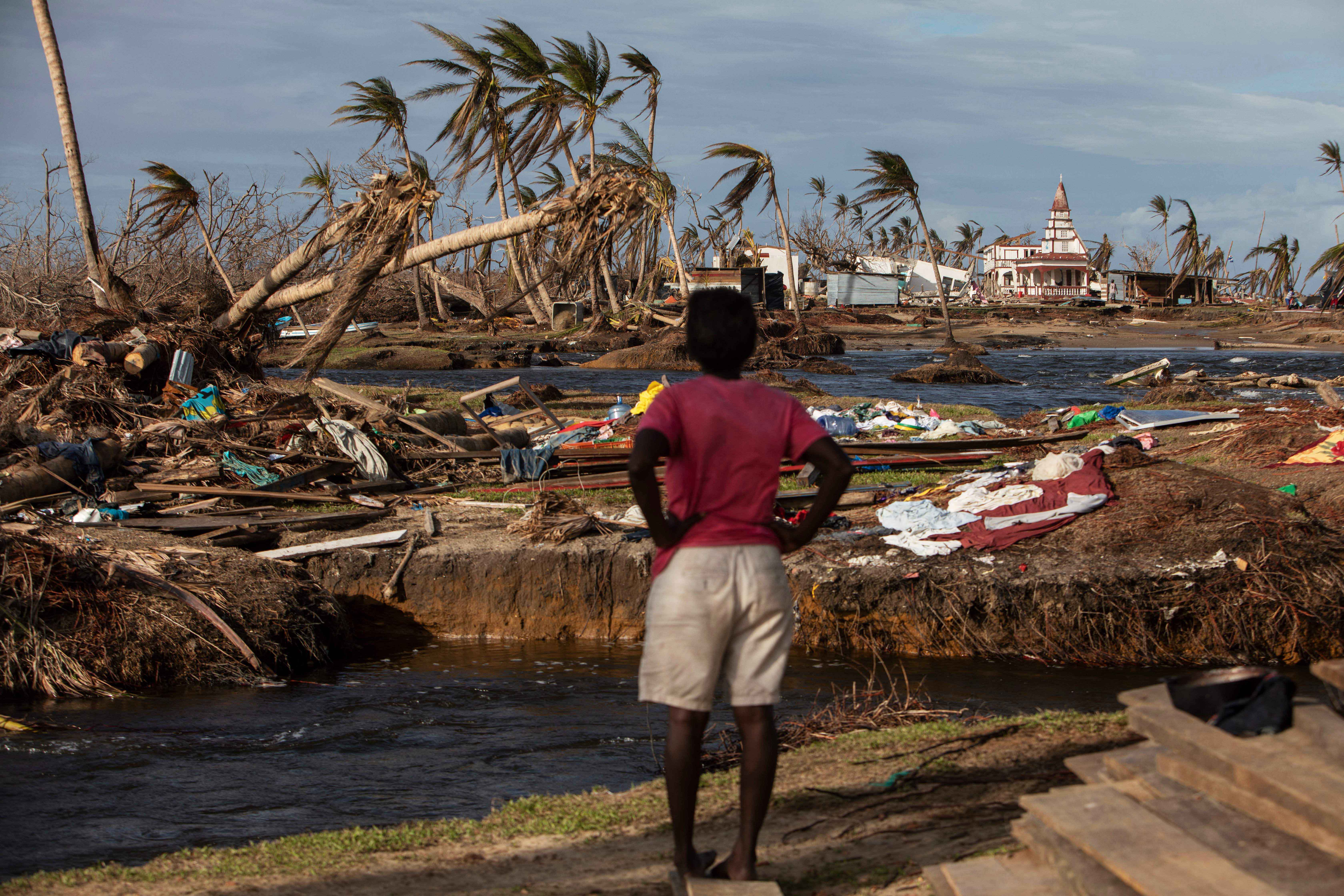
A woman looks at the destruction in Haulover, a community 41 km south of Bilwi, in the Northern Caribbean Autonomous Region, Nicaragua, on November 28, 2020. The World Meteorological Organization tallied nearly 12,000 extreme weather, climate and water-related events over the past half-century that caused economic damage of $4.3 trillion. Photo by Inti OCON / AFP

Bain & Company finds more than 60% of businesses are off track to meet their sustainability goals, an increasingly conscious base of consumers and employees may be able to help. From Bain & Company via PR Newswire • Reposted: November 14, 2023

As extreme weather prompts growing environmental concern across the globe, new research from Bain & Company shows more than 60% of businesses are off track to meet their current sustainability goals. Progress will require a combination of technology, policy, and behavior change. An increasingly conscious base of consumers and employees may prove helpful.

Bain & Company published today a major new study exploring the top sustainability concerns for business leaders, their customers, and their employees.

“We have spoken to thousands of executives about their sustainability ambitions and the associated trade-offs,” said François Faelli, partner and head of the global Sustainability practice at Bain & Company. “They know they have a key role to play in the energy and resources transition. Many view this as their legacy, but they are worried about the growing gap between their progress and public commitments. While it will not be easy, there are three levers CEOs must prioritize: policy, technology, and behavior. Bain’s new research offers some promising news for businesses—their customers and employees are adaptable and eager to contribute along the path to progress.”

To get a broad sense of environmental concerns around the world, Bain surveyed 23,000 consumers. The results underscore the growing urgency of sustainability topics. Some 64% of people reported high levels of concern about sustainability. Most said their worries have intensified over the past two years and that their concern was first prompted by extreme weather.

Surprising truths about consumers

Bain’s research reveals several surprising truths about consumers, dispelling some common misperceptions. Among them, the ideas that consumers won’t pay more for sustainable products and that consumer behavior is fixed.

  • Baby boomers are often just as concerned as Gen Z. Many companies have long viewed younger consumers as more focused on sustainability than their older counterparts, but the reality is not as clear-cut. For example, 72% of Gen Z consumers and 68% of boomers globally are very or extremely concerned about the environment, but in countries as diverse as India, France, and Japan, boomers are more concerned.
  • Both liberals and conservatives are concerned about the environment. In the US, 96% of consumers agree that the climate is changing. Among those concerned about the environment in the US, 85% of self-described liberal voters are very or extremely concerned about climate change, compared with 39% of conservative voters. Yet conservatives say they worry more about specific issues such as water, biodiversity loss, and air pollution.
  • Consumers are willing to pay a premium for sustainable products, 12% on average, but they are still priced too high. As concerns grow, consumers are looking to make environmentally sound choices and are willing to pay more for sustainable products. Yet, they often run into barriers. For example, consumers in the US are willing to pay an average premium of 11% for products with a minimized environmental impact. However, 28% is the average premium for products marketed as sustainable in the US. Consumers in fast growing markets, where Bain found environmental concerns to be highest—such as India, Indonesia, Brazil, and China—are willing to pay an even greater premium, between 15 and 20%. Consumers in the UK, Italy, Germany, and France, on the other hand, are only willing to pay between 8 and 10% extra.
  • Consumer behavior can change more quickly than many companies anticipate, with external factors such as government regulation heavily influencing the market. Chinabegan offering financial incentives on electric vehicles in 2009; now 19% of Chinese consumers report driving an electric car, compared with 8% of consumers globally. In England, the use of single-use supermarket plastic bags has fallen 98% since the government began requiring retailers to charge for them in 2015.
  • There is a disconnect between what consumers want and what most companies sell. Worldwide, 48% of consumers consider how products are used when thinking about sustainability. These consumers are more concerned about how a product can be reused, its durability, and how it will minimize waste. In contrast, most companies sell sustainable goods based on factors such as how they are made, their natural ingredients, and the farming practices deployed. These factors cause many consumers to conflate “sustainable” with “premium.” One result of this disconnect: Nearly half of all developed-market consumers believe that living sustainably is too expensive. By comparison, roughly 35% of consumers in fast-growing markets believe this.
  • Consumers struggle to identify sustainable products and don’t trust corporations to make them. In Bain’s survey, 50% of consumers said sustainability is one of their top four key purchase criteria when shopping. Yet they may be making decisions based on misconceptions. When asked to determine which of two given products generated higher carbon emissions, consumers were wrong or didn’t know about 75% of the time. Consumers say they rely most on labels and certifications to identify sustainable products, yet most were unable to accurately describe the meaning behind common sustainability logos, such as organic production or Fairtrade. A lack of trust in corporations compounds the issue. Bain found only 28% of consumers trust large corporations to create genuinely sustainable products, compared to 45% who trust small, independent businesses.

Four critical areas of focus for companies

The momentum behind sustainability and dynamic shifts in consumer behavior have profound implications for any company. Bain sees four critical areas of focus.

  • Devise a future-proof and flexible strategy. Few companies plan beyond the typical 3-year strategic planning window, and even those that do look out 5 to 10 years tend to focus on expectations for technology adoption. These plans fail to fully consider two other factors that move just as rapidly and with as big an impact: regulations and consumer behavior.
  • Acknowledge a fragmented consumer base. Companies need to deaverage consumers and innovate products and design propositions that appeal to different segments— local markets, consumers with different definitions of sustainability, and consumers with a range of purchasing motivations.
  • Test and learn to determine what works—and repeat. In such a fluid environment, companies can lean aggressively on marketing experimentation, using digital tools to quickly test the sustainability messages that resonate with different segments and adapt accordingly. It’s a way to help consumers gain enough clarity to make decisions that are consistent with their values.
  • Get out in front of regulations. As we’ve seen throughout the world, government policy inevitably becomes a huge contributor to changing consumer behavior. Across all industries, companies need to be at the forefront of helping to shape the regulations affecting their business. A company’s ability to anticipate policy shifts and build future-proof portfolios will help determine whether it can outpace competitors.

Upskilling employees to rise to the challenge

Bain found 75% of business leaders believe they have not embedded sustainability well into their business. The instinct of many CEOs is to prioritize external hiring to address all skill gaps, including in sustainability. Bain advocates for addressing sustainability’s challenges through a combination of smart upskilling and cultivating a learning mindset.

A new Bain survey of 4,700 people found 63% felt different skills and behaviors would be required for their company to execute on its ESG ambition or strategy. Yet only 45% of nonmanagers said their employer offers the reskilling and upskilling opportunities that would enable internal mobility.

Despite almost every CEO saying they have a talent problem, few companies have defined what it means to be a great employer. In Bain’s recent survey, 44% of respondents said it is easier to find a better opportunity outside of their company than within it.

Bain is leading by example on this cause. The firm has committed to cultivating a growth mindset in its team, partnering with 12 world-class universities—including MIT, HEC Paris, and Melbourne Business School—to upskill its employees on ESG. To date, its consultants have completed over 17,000 hours of ESG training through the program.

To see the original post, follow this link: https://finance.yahoo.com/news/consumers-environmental-concerns-increasing-due-050100182.html


Looking for a US ‘climate haven’ away from heat and disaster risks? Good luck finding one

25 08 2023

Burlington, Vt., is often named as a ‘climate haven,’ but surrounding areas flooded during extreme storms in July 2023. Education Images/Universal Images Group via Getty Images

By Julie Arbit. Researcher at the Center for Social Solutions, University of Michigan; Brad Bottoms, Data Scientist at the Center for Social Solutions, University of Michigan and Earl Lewis, Director and Founder, Center for Social Solutions, Professor of History, Afroamerican and African Studies, and public policy, University of Michigan via The Conversation • Reposted: August 25, 2023

Southeast Michigan seemed like the perfect “climate haven.” 

“My family has owned my home since the ‘60s. … Even when my dad was a kid and lived there, no floods, no floods, no floods, no floods. Until [2021],” one southeast Michigan resident told us. That June, a storm dumped more than 6 inches of rain on the region, overloading stormwater systems and flooding homes.

That sense of living through unexpected and unprecedented disasters resonates with more Americans each year, we have found in our research into the past, present and future of risk and resilience.

An analysis of federal disaster declarations for weather-related events puts more data behind the fears – the average number of disaster declarations has skyrocketed since 2000 to nearly twicethat of the preceding 20-year period.

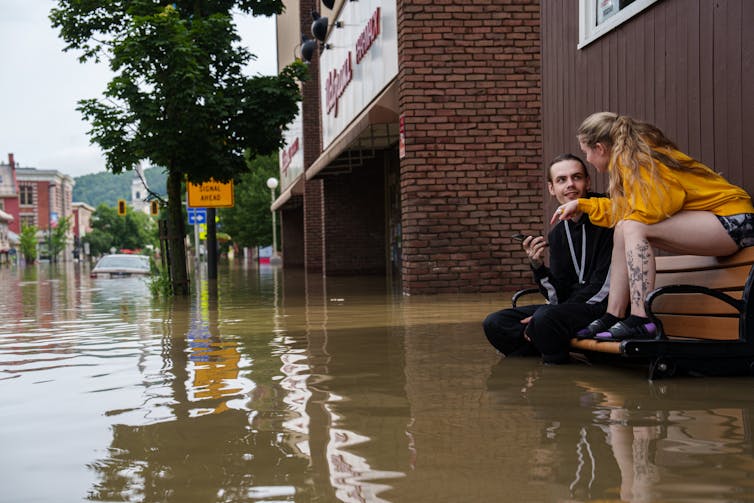
A man and woman sit on a park bench with water up to the  man's knees. The woman is sitting on the chair back. A car in the street is flooded up to the roof.
A powerful storm system in 2023 flooded communities across Vermont and left large parts of the capital, Montpelier, underwater. John Tully for The Washington Post via Getty Images

As people question how livable the world will be in a warming future, a narrative around climate migration and “climate havens” has emerged.

These “climate havens” are areas touted by researcherspublic officials and city planners as natural refuges from extreme climate conditions. Some climate havens are already welcomingpeople escaping the effects of climate change elsewhere. Many have affordable housing and legacy infrastructure from their larger populations before the mid-20th century, when people began to leave as industries disappeared.

But they aren’t disaster-proof – or necessarily ready for the changing climate. 

Six climate havens

Some of the most cited “havens” in research by national organizations and in news media are older cities in the Great Lakes region, upper Midwest and Northeast. They include Ann Arbor, Michigan; Duluth, Minnesota; Minneapolis; Buffalo, New York; Burlington, Vermont; and Madison, Wisconsin.

Yet each of these cities will likely have to contend with some of the greatest temperature increases in the country in the coming years. Warmer air also has a higher capacity to hold water vapor, causing more frequent, intense and longer duration storms.

These cities are already feeling the impacts of climate change. In 2023 alone, “haven” regions in WisconsinVermont and Michigan suffered significant damage from powerful storms and flooding. 

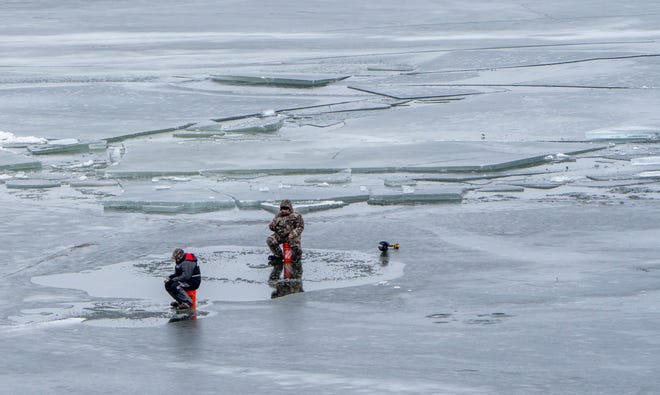
The previous winter was also catastrophic: Lake-effect snow fueled by moisture from the still-open water of Lake Erie dumped over 4 feet of snow on Buffalo, leaving nearly 50 people dead and thousands of households without power or heat. Duluth reached near-record snowfall and faced significant flooding as unseasonably high temperatures caused rapid snowmelt in April.

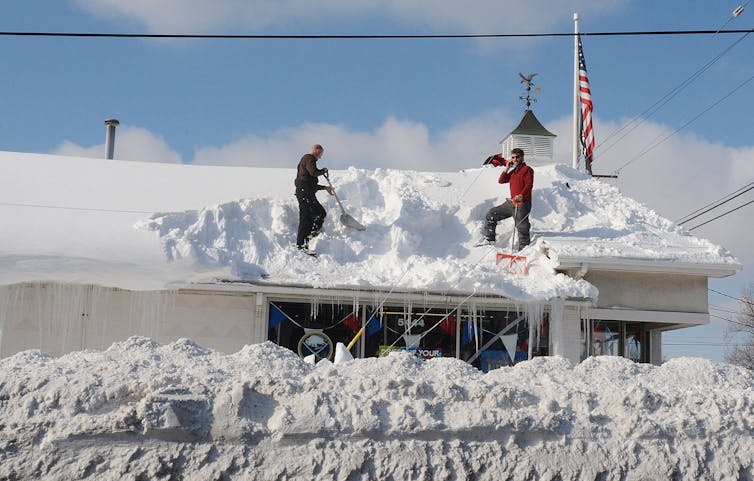
Two people shovel knee-deep snow off a roof.
A lake-effect snowstorm in November 2014 buried Buffalo, N.Y., under more than 5 feet of snow and caused hundreds of roofs to collapse. A similar storm hit in December 2022. Patrick McPartland/Anadolu Agency/Getty Images

Heavy rainfall and extreme winter storms can cause widespread damage to the energy grid and significant flooding, and heighten the risk of waterborne disease outbreaks. These effects are particularly notable in legacy Great Lakes cities with aging energy and water infrastructure.

Older infrastructure wasn’t built for this

Older cities tend to have older infrastructure that likely wasn’t built to withstand more extreme weather events. They are now scrambling to shore up their systems. 

Many cities are investing in infrastructure upgrades, but these upgrades tend to be fragmented, are not permanent fixes and often lack long-term funding. Typically, they also are not broad enough to protect entire cities from the effects of climate change and can exacerbate existing vulnerabilities.

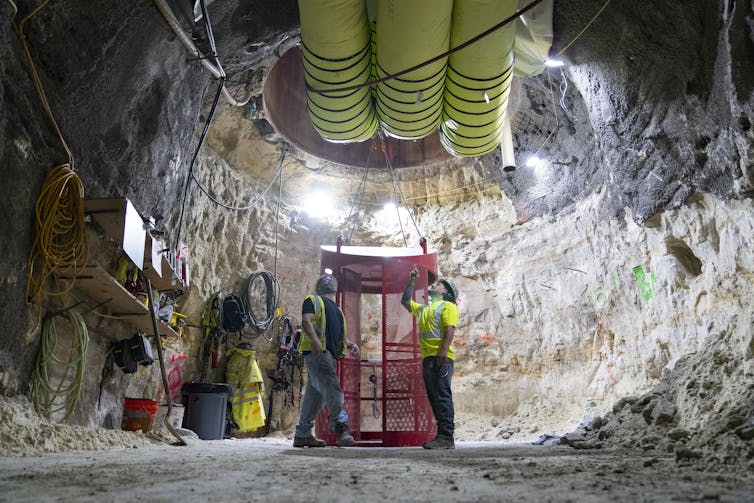
Workers in a rock cavern underground look up at a giant hole in the ceiling and pipe.
Crews in Minneapolis work on a new stormwater tunnel underneath downtown. It’s designed to help protect part of the city, but not all of it. Alex Kormann/Star Tribune via Getty Images

Electricity grids are extremely vulnerable to the mounting effects of severe thunderstorms and winter storms on power lines. Vermont and Michigan are ranked 45th and 46th among the states, respectively, in electricity reliability, which incorporates the frequency of outages and the time it takes utilities to restore power. 

Stormwater systems in the Great Lakes region also regularly fail to keep pace with the heavy rainfall and rapid snowmelt caused by climate change. Stormwater systems are routinely designed in accordance with precipitation analyses from the National Oceanic and Atmospheric Administration called Atlas 14, which don’t account for climate change. A new version won’t be available until 2026 at the earliest.

At the confluence of these infrastructure challenges is more frequent and extensive urban flooding in and around haven cities. An analysis by the First Street Foundation, which incorporates future climate projections into precipitation modeling, reveals that five of these six haven cities face moderate or major flood risk.

Disaster declaration data shows that the counties housing these six cities have experienced an average of six declarations for severe storms and flooding since 2000, about one every 3.9 years, and these are on the rise.

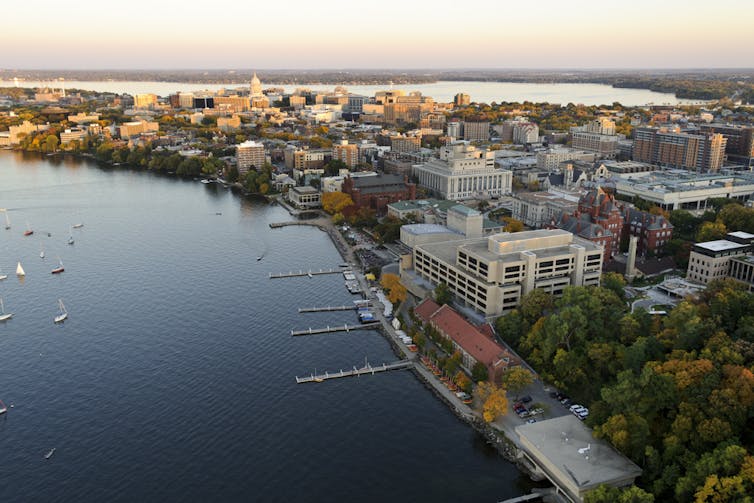
An aerial photo shows the shoreline of Lake Mendota and the University of Wisconsin-Madison campus.
Madison, Wis., has seen warmer summers and more precipitation in the past decade. Jeff Miller/UW-MadisonCC BY

Intensified precipitation can further stress stormwater infrastructure, resulting in basement floodingcontamination of drinking water sources in cities with legacy sewage systems, and hazardous road and highway flooding. Transportation systemsare also contending with hotter temperatures and pavement not designed for extreme heat.

As these trends ramp up, cities everywhere will also have to pay attention to systemic inequalities in vulnerability that often fall along lines of race, wealth and mobility. Urban heat island effectsenergy insecurity and heightened flood risk are just a few of the issues intensified by climate change that tend to hit poor residents harder.

What can cities do to prepare?

So, what is a haven city to do in the face of pressing climate changes and population influx?

Decision-makers can hope for the best, but must plan for the worst. That means working to reduce greenhouse gas emissions that are driving climate change, but also assessing the community’s physical infrastructure and social safety nets for vulnerabilities that become more likely in a warming climate. 

Collaborating across sectors is also essential. For example, a community may rely on the same water resources for energy, drinking water and recreation. Climate change can affect all three. Working across sectors and including community input in planning for climate change can help highlight concerns early.

There are a number of innovative ways that cities can fund infrastructure projects, such as public-private partnerships and green banks that help support sustainability projects. DC Green Bank in Washington, D.C., for example, works with private companies to mobilize funding for natural stormwater management projects and energy efficiency. 

Cities will have to remain vigilant about reducing emissions that contribute to climate change, and at the same time prepare for the climate risks creeping toward even the “climate havens” of the globe.

To see the original post, follow this link: https://theconversation.com/looking-for-a-us-climate-haven-away-from-heat-and-disaster-risks-good-luck-finding-one-211990


Smoke rises from a brush fire near Hollywood Hills in Los Angeles in 2007. 

9 07 2023
Smoke rises from a brush fire near Hollywood Hills in Los Angeles in 2007. Hector Mata/AFP via Getty Images
Over the past two decades, a staggering 21.8 million Americans found themselves living within 3 miles (5 kilometers) of a large wildfire. Most of those residents would have had to evacuate, and many would have been exposed to smoke and emotional trauma from the fire. By Mojtaba Sadegh, Associate Professor of Civil Engineering, Boise State University via The Conversation • Reposted: July 9, 2023

Over the past two decades, a staggering 21.8 million Americans found themselves living within 3 miles (5 kilometers) of a large wildfire. Most of those residents would have had to evacuate, and many would have been exposed to smoke and emotional trauma from the fire.

Nearly 600,000 of them were directly exposed to the fire, with their homes inside the wildfire perimeter. 

Those statistics reflect how the number of people directly exposed to wildfires more than doubled from 2000 to 2019, my team’s new research shows. 

But while commentators often blame the rising risk on homebuilders pushing deeper into the wildland areas, we found that the population growth in these high-risk areas explained only a small part of the increase in the number of people who were exposed to wildfires.

Those statistics reflect how the number of people directly exposed to wildfires more than doubled from 2000 to 2019, my team’s new research shows. 

But while commentators often blame the rising risk on homebuilders pushing deeper into the wildland areas, we found that the population growth in these high-risk areas explained only a small part of the increase in the number of people who were exposed to wildfires.

nstead, three-quarters of this trend was driven by intense fires growing out of control and encroaching on existing communities.

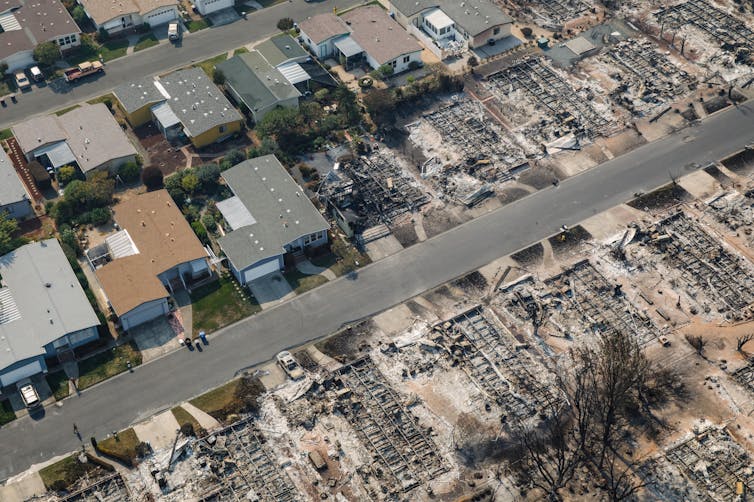
An aerial view of a community of small, closely built houses, with half the homes in the photo burned.
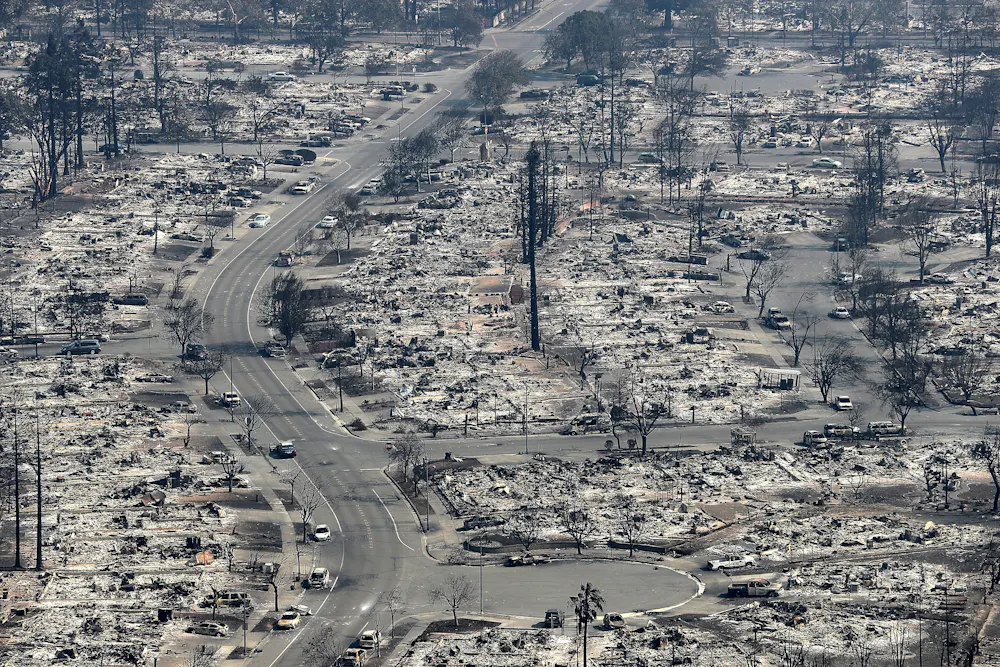
A wildfire in 2017 destroyed more than 3,000 homes in Santa Rosa, Calif., a city of over 180,000 people. Marcus Yam / Los Angeles Times via Getty Images

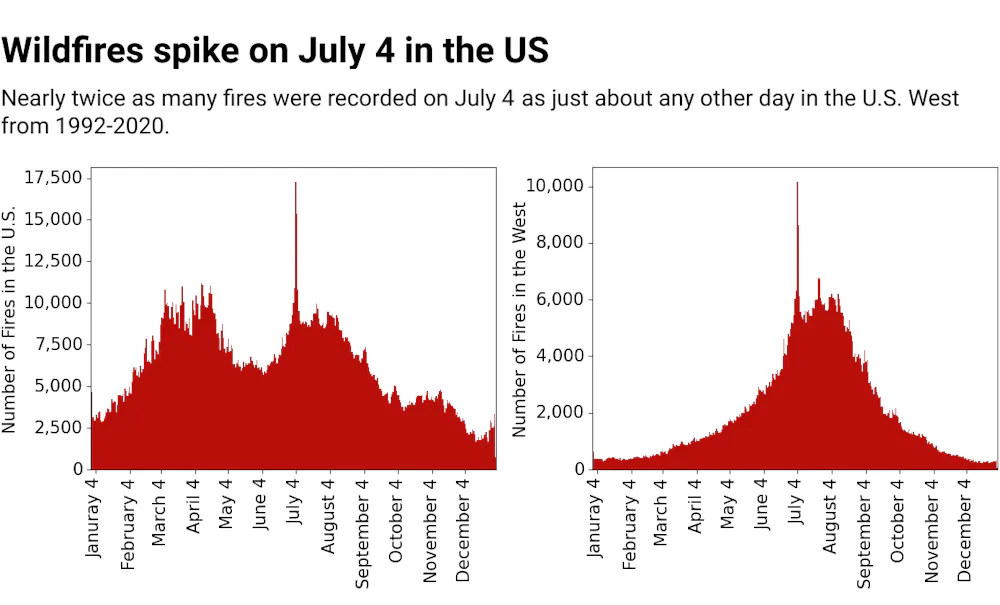
That knowledge has implications for how communities prepare to fight wildfires in the future, how they respond to population growth and whether policy changes such as increasing insurance premiums to reduce losses will be effective. It’s also a reminder of what’s at risk from human activities, such as fireworks on July 4, a day when wildfire ignitions spike

Two charts show wildfire counts by day of the year over 20 years. July 4 stands out as a clear spike, both looking at fires US-wide and just in the US West.
Mojtaba Sadegh, CC BY-ND

Where wildfire exposure was highest

I am a climate scientist who studies the wildfire-climate relationship and its socioenvironmental impacts. For the new study, colleagues and I analyzed the annual boundaries of more than 15,000 large wildfires across the Lower 48 states and annual population distribution data to estimate the number of people exposed to those fires.

Not every home within a wildfire boundary burns. If you picture wildfire photos taken from a plane, fires generally burn in patches rather than as a wall of flame, and pockets of homes survive.

We found that 80% of the human exposure to wildfires – involving people living within a wildfire boundary from 2000 to 2019 – was in Western states. 

California stood out in our analysis. More than 70% of Americans directly exposed to wildfires were in California, but only 15% of the area burned was there. 

https://datawrapper.dwcdn.net/K1mPs/2/

What climate change has to do with wildfires

Hot, dry weather pulls moisture from plants and soil, leaving dry fuel that can easily burn. On a windy day – such as California often sees during its hottest, driest months – a spark, for example from a power line, campfire or lightning, can start a wildfire that quickly spreads.

Recent research published in June 2023 shows that almost all of the increase in California’s burned area in recent decades has been due to anthropogenic climate change – meaning climate change caused by humans.

Our new research looked beyond just the area burned and asked: Where were people exposed to wildfires, and why?

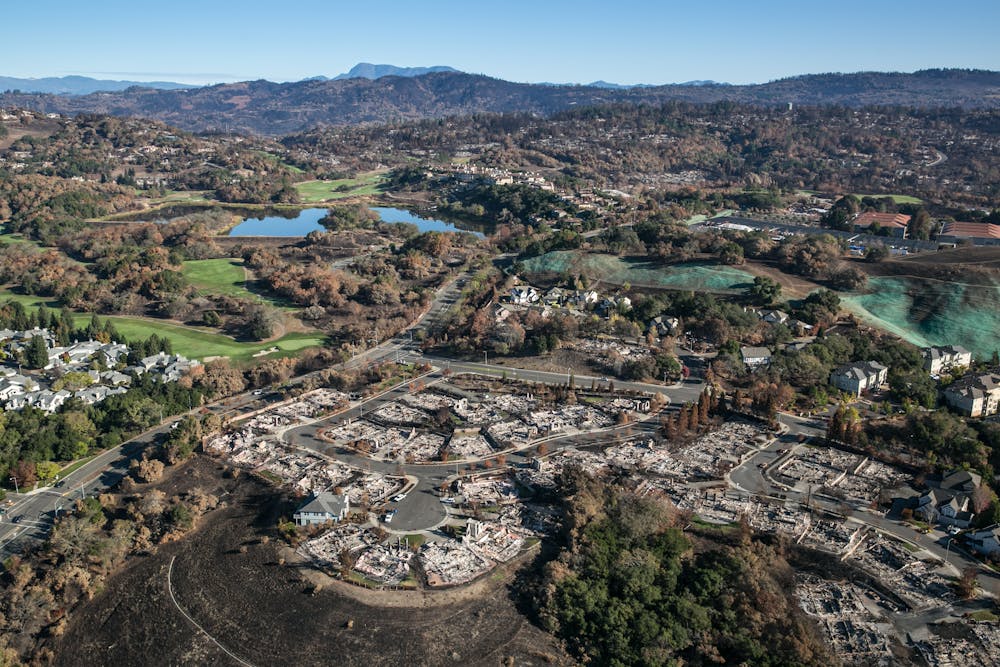
A landscape view across a neighborhood with gold courses, lakes and hills in the background. In the foreground is burned cul de sac that appears to be at the edge of the city.
New homes on the edges of cities have been caught in some fires, like the one in Santa Rosa in 2017. But most of the people exposed were in neighborhoods existing well before 2000. George Rose/Getty Images

We found that while the population has grown in the wildland-urban interface, where houses intermingle with forests, shrublands or grasslands, that accounted for only about one-quarter of the increase in the number of humans directly exposed to wildfires across the Lower 48 states from 2000 to 2019.

Three-quarters of that 125% increase in exposure was due to fires’ increasingly encroaching on existing communities. The total burned area increased only 38%, but the locations of intense fires near towns and cities put lives at risk.

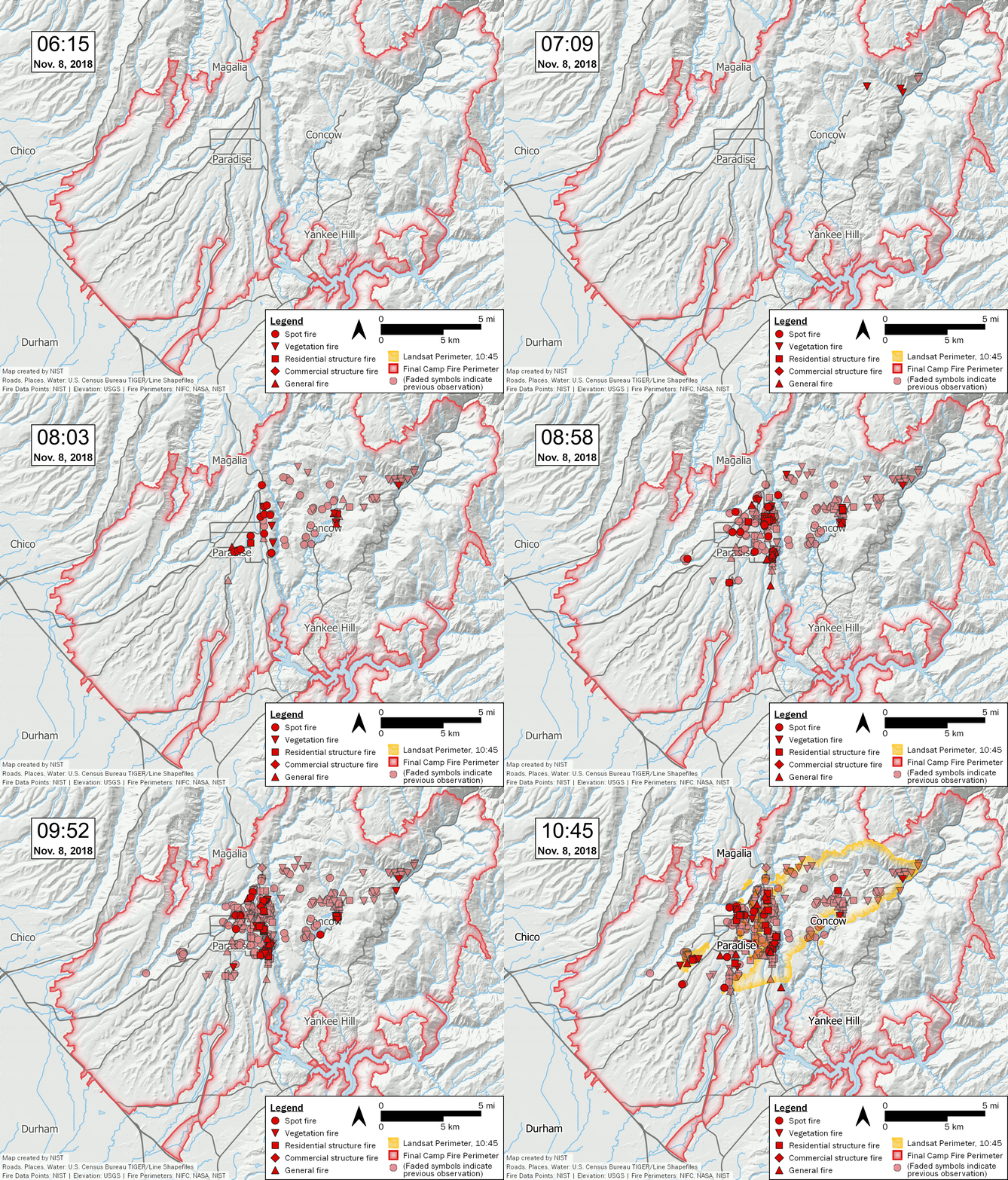
In California, which was in drought during much of that period, several wildfire catastrophes hit communities that had existed long before 2000. Almost all these catastrophes occurred during dry, hot, windy conditions that have become increasingly frequent because of climate change.

The 2018 fire that destroyed Paradise, Calif., began as a small vegetation fire that ignited new fires as the wind blew its embers. NIST

Wildfires in the high mountains in recent decades provide another way to look at the role that rising temperatures play in increasing fire activity.

High mountain forests have few cars, homes and power lines that could spark fires, and humans have historically done little to clear brush there or fight fires that could interfere with natural fire regimes. These regions were long considered too wet and cool to regularly burn. Yet my team’s past research showed fires have been burning there at unprecedented rates in recent years, mainly because of warming and drying trends in the Western U.S.

What can communities do to lower the risk?

Wildfire risk isn’t slowing. Studies have shown that even in conservative scenarios, the amount of area that burns in Western wildfires is projected to grow in the next few decades.

How much these fires grow and how intense they become depends largely on warming trends. Reducing emissions will help slow warming, but the risk is already high. Communities will have to both adapt to more wildfires and take steps to mitigate their impacts.

Developing community-level wildfire response plans, reducing human ignitions of wildfires and improving zoning and building codes can help prevent fires from becoming destructive. Building wildfire shelters in remote communities and ensuring resources are available to the most vulnerable people are also necessary to lessen the adverse societal impacts of wildfires.

To see the original post, follow this link: https://theconversation.com/human-exposure-to-wildfires-has-more-than-doubled-in-two-decades-who-is-at-risk-might-surprise-you-207903


LGBTQ+ Voices in Energy Are Essential for Environmental Justice

20 06 2023

Left to right: Elana Knopp, Zachary Strauss, Avery Hammond, Jenna Patterson and Rashad Williams. Standing at the mic is Stacy Lentz, co-owner of the Stonewall Inn and CEO of the Stonewall Inn Gives Back Initiative (SIGBI). 

By Riya Anne Polcastro from triplepundit.com • June 20, 2023

Representation is an integral factor to bring about real change — especially as it affects marginalized communities. The power industry, which has historically employed an overly homogenous population of white men, could stand to learn a lot from an influx of diverse people and viewpoints. After all, equity of any type can only be achieved when everyone has a seat at the table and their voices are heeded, not just heard.

With this aim in mind, Edison Energy and its LGBTQ+ employee resource group hosted an all-LGBTQ+ panel at the historic Stonewall Inn last week that focused on how to promote queer representation in the energy sector and, by extension, improve outcomes related to climate change and environmental justice.

Continuing the fight

“The Stonewall is hallowed ground for many of us in the queer community,” said moderator Elana Knopp, the senior content writer at Edison Energy, at the beginning of the event. “It’s literally the epicenter of the gay pride movement.” The historic Greenwich Village gay bar was the site of the Stonewall uprising in 1969 that sparked the gay rights movement in New York City and nationwide. 

Renewed efforts by the conservative right to force LGBTQ+, and especially transgender, people back into the closet have heightened the need for this recognition and employee resource groups like Pride in Power. Just as the community’s fight for equal rights faces a massive disinformation campaign from the right wing, so does the fight against climate change, said panelist Brandon Rothrock, an assistant program manager at TRC Companies and board member at OUT for Sustainability, which focuses on mobilizing the LGBTQ+ community for social and environmental action.

The parallel may appear uncanny, as the climate crisis reached emergency proportions in the same timeframe that the Human Rights Campaign declared a state of emergency for LGBTQ+ people in the U.S. It’s the first time in 40 years that the campaign deemed an emergency necessary due to “discriminatory state laws that have created . . . dangerous environments for LGBTQ+ people across the country,” Knopp said. 

Marginalized groups face the brunt of climate change

“One thing that’s been well-documented at this point is that the impacts of climate change have been disproportionately affecting marginalized communities, such as

and people of color (POC),” said panelist Rashad Williams, the director of subscriber services at Groundswell, which focuses on expanding equitable access to clean energy. “And when you combine the two, you start seeing a compounding effect of those impacts.”

Those who are both LGBTQ+ and POC have double the unemployment rate of people who are not in those categories, he said. That rate is triple if they are also transgender. Therefore, they’re more likely to live in low-income neighborhoods, which makes them more likely to experience the negative health effects of pollution and climate change, and less likely to have health insurance.

Perhaps the starkest portrayal of these compounding effects is found among the Guna people, an Indigenous group in Panama who are being forced from their island homes on Gardi Sugdub by rising seas. Guna culture is traditionally gender fluid and matrifocal — customs they could lose as they are absorbed and influenced by the majority Catholic and patriarchal social structure in mainland Panama.

Queer-centered action

It’s important to note that the environmental justice movement owes its inception to the BIPOC community, “the same folks that led the Stonewall uprising,” Knopp said. “The environmental justice movement was basically founded on the principle that everyone deserves to breathe clean air and drink clean water and have access to clean neighborhoods.” 

Still, until recently the movement had not specifically focused on the queer community, she said.

The queer perspective is needed in the energy sector to ensure the switch to clean energy benefits everyone. Changes to infrastructure and access will only be as equitable as they are safe, said panelist Zachary Strauss, a policy analyst at Atlas Public Policy and the founder and president of Out in Energy, a community of LGBTQ+ people in the energy sector. Charging stations have to be in safe locations to be fully accessible, and electric buses won’t do the queer community any good if LGBTQ+ people have to risk their well-being to ride them. 

The energy sector still has a long way to go. Workers in the field report the least confidence in their employer’s recruitment and hiring of members from the LGBTQ+ community compared to other marginalized groups, according to a report commissioned by the National Association of State Energy Officials. Panelists noted a few methods energy companies can utilize to better recruit and retain LGBTQ+ individuals, including mentorships, ERGs like Pride in Power, opportunities to socialize during work hours, inclusive language, and utilizing pronouns that make transgender and non-binary people feel safe as their authentic selves in the workplace. 

Ultimately it starts from the top with a need for leadership to speak out and support the community by investing in the workforce, Strauss said. As well as “retention through affirmation” by ensuring people don’t have to hide who they are in the workplace.

Taking a stand when there are no guarantees 

The clean energy sector does appear to be more conducive to LGBTQ+ employment, but the industry as a whole continues to struggle with anti-queer prejudice. Last year’s Pride in Energy survey found a 40 percent increase in discrimination over 2021.

While allies can, and must, do their part to support LGBTQ+ voices and action, there is no guarantee that power companies will do what’s needed going forward — especially under the current climate in which corporations that have historically presented themselves as allies are backtracking. 

“It’s a little bit trickier making sure that your company takes a stand,” said Avery Hammond, Edison Energy’s senior clean energy analyst. “That’s a decision that’s not left up to most of us — none of us actually.”

This is why it’s more important than ever for allies and LGBTQ+ individuals to speak up, demand better, and reward companies that continue to fight the good fight. True environmental justice depends on it. 

Environmental justice is, after all, a matter of civil rights.

To see the original post, follow this link: https://www.triplepundit.com/story/2023/lgbtq-energy-sector-environmental-justice/776606


1.5 Percent of Corporate Profits Can Transform the Fight Against Climate Change

8 06 2023

Image credit: Mika Baumeister/Unsplash

By Abha Malpani Naismith from Triple Pundit • Reposted: June 8, 2023

The current narrative on climate action puts the world in a bind. On one side, present-day action is considered inadequate to achieve the global warming limit of 1.5 degrees Celsius determined by the U.N. On the other side, there is increasing debate over whether that limit is even attainable.

This narrative is dubbed the “doom loop” in a recent report from the U.K.-based think tanks Chatham House and the Institute for Public Policy Research (IPPR). In the doom loop, the focus on crisis consequences and failure to reach targets takes away from the focus required to implement solutions.

In order to move forward, the narrative needs to quickly change to one that encourages action. TriplePundit spoke with Saskia Feast, managing director of global client solutions at Climate Impact Partners, about how collective private-sector action can help to catalyze that change — starting with Fortune Global 500 companies. 

We don’t need large investments to create change 

Fortune Global 500 companies made more than $2.2 trillion in annual profits over the last three years, according to a recent report by Climate Impact Partners. Investing only 1.5 percent of that — about $33.5 billion — to fund carbon reduction projects like forest conservation, reforestation and micro-renewables would be a massive step toward achieving the transformational change required to hit global climate action targets.

On average, each Global 500 company made $6.7 billion over the last year, according to the report. Committing 1.5 percent of those profits ($100 million) could cut 7.8 million tons of carbon emissions, plant 60,000 trees and protect 120,000 hectares of forest. If every company in the index did the same each year, it would amount to more than 2.6 billion tons in carbon reductions — even more than what scientists say is necessary to cap global temperature rise below 2 degrees Celsius. 

To put this corporate expense into perspective, on average the world’s largest companies spend 12 percent of their annual profits on research and development, 27 percent on sales and administrative expenses, 8.7 percent on marketing and 8.2 percent on information technology, according to the report. 

Offsets or no offsets?

For more than 20 years, Climate Impact Partners has worked with businesses to support over 600 carbon removal and reduction projects in 56 countries. But its work faces criticism around carbon offsets. 

“There is a lot of criticism of the companies who are taking action around offsetting carbon emissions and this idea that it is greenwashing,” Feast said. “By not criticizing the companies that are not taking action, those companies are feeling safer.” 

Saskia Feast, the managing director of global client solutions at Climate Impact Partners.
Saskia Feast, managing director of global client solutions at Climate Impact Partners. Photo courtesy of Climate Impact Partners.

Inaction on climate change could cost the global economy $178 trillion over the next 50 years, or a 7.6 percent cut to global gross domestic product (GDP) in the year 2070 alone, according to a recent report from the Deloitte Center for Sustainable Progress. 

Carbon offsetting is a long-debated method for companies and other large emitters to get involved. Supporters claim it is effective in reducing greenhouse gas emissions while conserving natural resources in sectors like transportation, energy and agriculture.

Some critics dismiss the practice as a flawed system that has negligible impact on reducing emissions. They argue offsets are generated by projects that enable polluting industries to continue their harmful practices. 

When a company first starts its carbon-neutral journey, it might need to offset a higher proportion of emissions, Feast said. But putting a price on it forces emission reductions over time. 

“Once you start putting a price on carbon, you start measuring it and looking for strategic ways to reduce it,” she said. “That helps you drive the internal reduction strategy or the adoption of renewable energy within your organization. The role of the offsetting market is just to help transition us to the low-carbon economy.”

The number of companies using, or planning to use, an internal carbon price increased by 80 percent over just five years, according to a 2021 report by the environmental disclosure management nonprofit CDP. 

The return on sustainability investments

Today, financial success and sustainable practices are increasingly tied to each other. “The business of sustainability reporting has improved dramatically over the last 20 years,” Feast said. “What we’re seeing now is companies including those metrics in their annual reports, like a carbon footprint or water use risk. So, the metrics are merging, which is a great development in the market. We’re seeing sustainability leaders, who are our clients, now working directly with investor relations, their CFO and financial teams.” 

The business case is stronger than before as company sustainability measures impact reputation, market value, and overall ability to attract and retain employees. And now there are many carbon footprint and ESG measurement tools that enable business leaders to truly consider how their operations impact people and the planet. 

Smaller companies can fight climate change, too

Investing in carbon reduction and removal is for every company — small, medium or large. Smaller companies that want to act don’t need a grand plan, Feast said. They can start making decisions in incremental steps like measuring their footprint, supporting renewable energy, making climate-friendly products, and discussing the price of carbon on their business.  

“We want to encourage companies to take action,” she said.”Get out there, start taking your steps and maybe one day run a marathon.”

COP28 Global Stocktake: Tracking progress to 1.5 degrees Celsius

As the baton moves from climate technicians to politicians at the COP28 Global Stocktake, which is also commented on with skepticism, policies driving increased financing of climate action could make a significant impact.

Emerging markets and developing economies must collectively invest at least $1 trillion in energy infrastructure by 2030 and $3 trillion to $6 trillion per year across all sectors by 2050 to mitigate climate change by substantially reducing greenhouse gas emissions, according to the International Monetary Fund.

An additional $140 billion to $300 billion a year is needed by 2030 to adapt to the environmental consequences of climate change, such as rising sea levels and intensifying droughts. This could skyrocket to between $520 billion and $1.75 trillion annually after 2050 depending on how effective climate mitigation measures are.

“One of the most important things is to move away from talking about climate financing — and actually doing the financing,” Feast said. “The more money we can put to finance these projects, the more we will be reducing emissions going forward.”

To see the original post, follow this link: https://www.triplepundit.com/story/2023/corporate-profits-climate-change/775241


The thinking error that makes people susceptible to climate change denial

5 05 2023


Expecting black-and-white answers can make it hard to see the truth. 
bubaone via Getty Images

By Jeremy P. Shapiro, Adjunct Assistant Professor of Psychological Sciences, Case Western Reserve University via The Conversation • Reposted May 5, 2023

Cold spells often bring climate change deniers out in force on social media, with hashtags like #ClimateHoax and #ClimateScam. Former President Donald Trump often chimes in, repeatedly claiming that each cold snap disproves the existence of global warming.

From a scientific standpoint, these claims of disproof are absurd. Fluctuations in the weather don’t refute clear long-term trends in the climate

Yet many people believe these claims, and the political result has been reduced willingness to take action to mitigate climate change. Why are so many people susceptible to this type of disinformation? My field, psychology, can help explain – and help people avoid being misled.

The allure of black-and-white thinking

Close examination of the arguments made by climate change deniers reveals the same mistake made over and over again. That mistake is the cognitive error known as black-and-white thinking, also called dichotomous and all-or-none thinking. As I explain in my book “Finding Goldilocks,” black-and-white thinking is a source of dysfunction in mental health, relationships – and politics.

People are often susceptible to it because in many areas of life, dichotomous thinking does something helpful: It simplifies the world.

Binaries are easy to handle because there are only two possibilities to consider. When people face a spectrum of possibilities and nuance, they have to exert more mental effort. But when that spectrum is polarized into pairs of opposites, choices are clear and dramatic.

Image of a person showing arrows pointing in opposite directions the person might take.
Most things don’t fall neatly into only two choices. eyetoeyePIX via Getty Images

This mental labor-saving device is practical in many everyday situations, but it is a poor tool for understanding complicated realities – and the climate is complicated.

Sometimes, people divide the spectrum in asymmetric ways, with one side much larger than the other. For example, perfectionists often categorize their work as either perfect or unsatisfactory, so even good and very good outcomes are lumped together with poor ones in the unsatisfactory category. In dichotomous thinking like this, a single exception can tip a person’s view to one side. It’s like a pass/fail grading system in which 100% earns a pass and everything else gets an F.

With a grading system like this, it’s not surprising that opponents of climate action have found ways to reject global warming research, despite the overwhelming evidence.

Here’s how they do it:

The all-or-nothing problem

Climate change deniers simplify the spectrum of possible scientific consensus into two categories: 100% agreement or no consensus at all. If it’s not one, it’s the other.

A 2021 review of thousands of climate science papers and conference proceedings concluded that over 99% of studies have found that burning fossil fuels warms the planet. That’s not good enough for some skeptics. If they find one contrarian scientist somewhere, they categorize the idea of human-caused global warming as controversial and conclude that there is no basis for action.

Powerful economic interests are at work here: The fossil fuel industry has funded disinformation campaigns for years to create this kind of doubt about climate change, despite knowing that their products cause it and the consequences. Members of Congress have used that disinformation to block or weaken federal policies that could slow climate change.

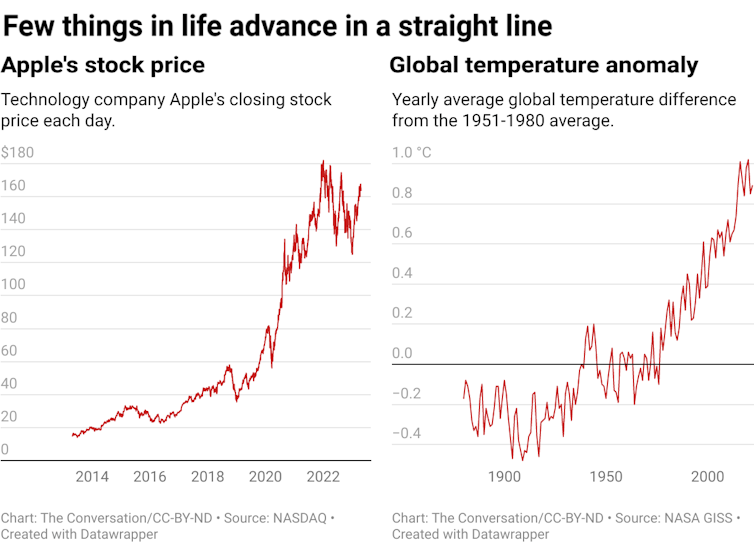
Expecting a straight line in a variable world

In another example of black-and-white thinking, deniers argue that if global temperatures are not increasing at a perfectly consistent rate, there is no such thing as global warming. 

However, complex variables never change in a uniform way; they wiggle up and down in the short term even when exhibiting long-term trends. Most business data, such as revenues, profits and stock prices, do this too, with short-term fluctuations contained in long-term trends.

Charts showing Apple's changing stock price and global temperatures over time. Both have a saw-tooth pattern.
These two graphs have the same form: a long-term trend of major increase within which there are short-term fluctuations. CC BY-ND

Mistaking a cold snap for disproof of climate change is like mistaking a bad month for Apple stock for proof that Apple isn’t a good long-term investment. This error results from homing in on a tiny slice of the graph and ignoring the rest.

Failing to examine the gray area

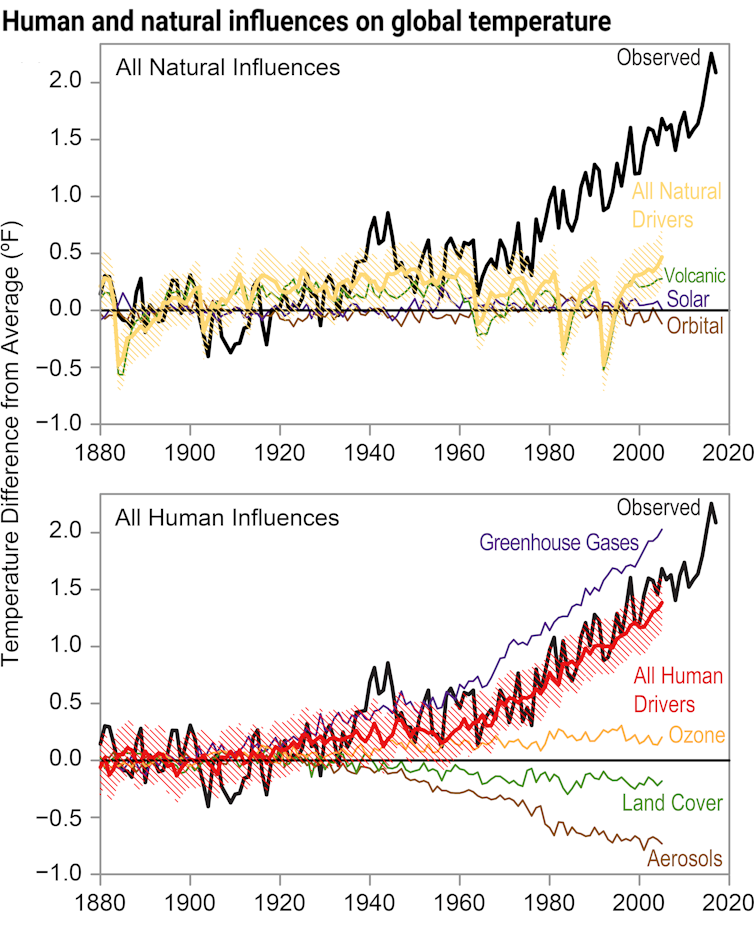
Climate change deniers also mistakenly cite correlations below 100% as evidence against human-caused global warming. They triumphantly point out that sunspots and volcanic eruptions also affect the climate, even though evidence shows both have very little influence on long-term temperature rise in comparison to greenhouse gas emissions.

In essence, deniers argue that if fossil fuel burning is not all-important, it’s unimportant. They miss the gray area in between: Greenhouse gases are indeed just one factor warming the planet, but they’re the most important one and the factor humans can influence.

Charts showing impact of different forces on temperature. Natural sources have little variation, but the upward swing of temperatures corresponds closely with rising greenhouse gas emissions.
Influences on global temperature over time. 4th National Climate Assessment

‘The climate has always been changing’ – but not like this

As increases in global temperatures have become obvious, some climate change skeptics have switched from denying them to reframing them.

Their oft-repeated line, “The climate has always been changing,” typically delivered with an air of patient wisdom, is based on a striking lack of knowledge about the evidence from climate research.

Their reasoning is based on an invalid binary: Either the climate is changing or it’s not, and since it’s always been changing, there is nothing new here and no cause for concern.

However, the current warming is on par with nothing humans have ever seen, and intense warming events in the distant past were planetwide disasters that caused massive extinctions – something we do not want to repeat.

As humanity faces the challenge of global warming, we need to use all our cognitive resources. Recognizing the thinking error at the root of climate change denial could disarm objections to climate research and make science the basis of our efforts to preserve a hospitable environment for our future.

To see the original post, follow this link: https://theconversation.com/the-thinking-error-that-makes-people-susceptible-to-climate-change-denial-204607


After the Bombshell IPCC Report, the Private Sector Can Close the Gap on Decarbonization

11 04 2023

Ice sheets breaking apart in Jökulsárlón, Iceland.  Image credit: Roxanne Desgagnés/Unsplash

By Mary Riddle from triple pundit com Reposted: April 11, 2023

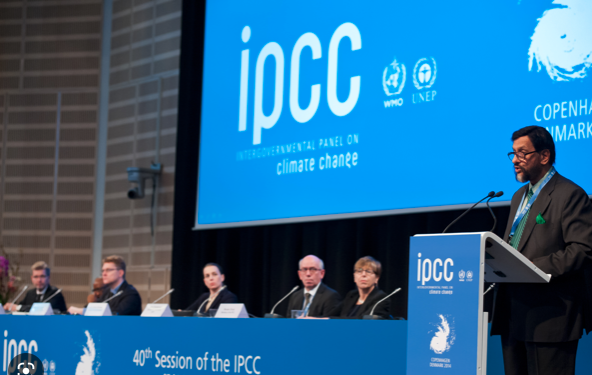
The latest report from the Intergovernmental Panel on Climate Change (IPCC) outlines the widespread impacts and risks of climate change. The findings are grim: Global surface temperature has risen 1.1 degree Celsius above pre-industrial levels, and greenhouse gas emissions have continued their upward trajectory. Global governments are failing to meet their commitments to curb emissions, and current nationally determined contributions (NDCs) have the world on track to shoot past 1.5 degrees within the 21st century, making it far more difficultto limit warming to below 2 degrees.

As civil society fails to curb emissions and avoid the most catastrophic outcomes of the climate crisis, the private sector has an opportunity to drastically decrease emissions and lead the way to a decarbonized world.

TriplePundit spoke with Steve Varley, global vice chair for sustainability at the big-four accounting firm EY, about the ways the private sector can help change the current climate trajectory and create long-term sustainable value.

“The IPCC report is not the first time that we’ve heard a claxon and seen the red flashing lights in a report done by eminent and prestigious scientists on the climate emergency,” Varley said. “We are not acting appropriately in business or government in response to the report. Capitalism can be a powerful agent, and if we can help stakeholders create value by becoming more sustainable, then the world will be more sustainable. The private sector can help close the gap on climate response when national governments are struggling to meet the expectations of a 1.5-degree pathway.” 

The fight against climate change and the road to COP28

The latest IPCC report is framing the global conversation leading up to the U.N. COP28 climate talks in December. Current NDCs — the formal term for country commitments to reduce emissions — put the world on track to see temperature increases between 2.2 and 2.4 degrees Celsius. And some governments are failing to implement their current emissions reductions strategies.

 “We should be tracking how countries improve their NDCs, if at all, on the way to COP28, especially for the G20,” Varley said, referring to the Group of 20 of the world’s largest economies. “I am encouraged by where the U.K. is getting to, but all eyes are on the United States, India, China and Saudi Arabia. We need to move from pledges and promises to progress and performances.” 

At the COP27 climate talks last year, the Joe Biden administration acknowledged that the public sector could not provide adequate financing to fund the transition to a decarbonized economy. A senior advisor to President Biden noted that the world needs the private sector to help unlock trillions of dollars of climate finance needed to avert the worst effects of the climate crisis, but currently, only a small fraction is available.

“As governments shrink away from meeting their commitments on their NDCs, now is the time for the private sector to step forward,” Varley noted. “For those parts of the world where there is a trust gap between civil society and business, this is our opportunity to walk the talk and show how we are decarbonizing at scale. We should come to COP28 with evidence to civil society how we are closing the gap and decarbonizing our businesses.”

Where do businesses go from here? 

The business case for sustainability is increasingly apparent for the private sector, and there are several ways that companies can create value for stakeholders and engage the public. “Sustainability is the defining challenge for businesses and business leaders over the next decade, and we need to address it proportionately,” Varley said. “Capitalism can, on occasion, wreak havoc on the world, but if we bring the power of the private sector as a change agent to the world, we can make the planet more sustainable. To do that, we have to encourage the creation and protection of value.” 

Additionally, the IPCC report needs to be made more available to folks outside of the sustainability sectors. “The private sector needs to translate the IPCC report into everyday descriptions so that civil society can better understand how not dealing with climate change will  impact their lives and the lives of their children,” Varley told us. 

The world is running out of time to act, and the next few years are critical. Governments must continue to support policies that allow for the flow of climate finance. “It’s difficult when politics does not support the climate change agenda, but the private sector is embracing and responding to the climate emergency,” he said.

“There is a quote that I like, that is often attributed to Napoleon: ‘The job of a leader is to establish reality and then give hope,’” he continued. “COP28 can establish realistic optimism and realistic hope. I am optimistic, because I see the great work in many companies around the world to decarbonize. Businesses can start the movement to overtake governments’ efforts to decarbonize at a national scale and close the gap.” The IPCC report notes that at current rates of implementation, adaptation gaps will continue to grow and that an influx of climate finance is necessary to avoid catastrophe. 

To see the original post, follow this link: https://www.triplepundit.com/story/2023/business-leadership-climate-change/770991


CRD Connect: Why Sustainability in real estate matters

9 04 2023

Photo: CRD

By Jennifer Rzeszewski from rismedia.com • Reposted: April 9, 2023

The rise in the severity and frequency of extreme weather events and natural disasters is impacting real estate markets across the country. Higher temperatures, flooding, wildfires, droughts, seasonal storms, etc., are damaging homes and affecting communities at increasing rates. The climate risk profile of certain areas is changing, causing shifts in housing preferences, buyer demand, property values, resale ability, financing options and insurance rates.

As mainstream awareness of these climate-related risks grows, consumers are increasingly factoring sustainability and green features into their real estate purchasing decisions.

According to the 2022 REALTORS® and Sustainability Report – Residential, agents and brokers found that 34% of consumers were very or somewhat concerned about the impact of extreme weather and climate change on the market, and 51% were somewhat or very interested in sustainability.

Widespread consumer interest in these issues makes it crucial for real estate professionals to be knowledgeable on topics such as weather- and environmental-related risks in their local market, sustainability, energy efficiency and green home features.

Here are some tools and resources that will help you better understand these issues and address the questions and concerns of your clients. 

  • “Intro to Sustainability & Resiliency: What REALTORS® Need to Know” is a one-hour course available at no cost to members of the National Association of REALTORS® (NAR) at learning.realtor. This course provides a solid overview of the issues and highlights the importance of sustainability in real estate. 
  • The 2022 REALTORS® and Sustainability Report – Residential provides a statistical snapshot of agent perspectives on sustainability issues in the industry, gathered from a survey of NAR members. 
  • NAR’s Green Designation is designed for agents who want to learn how to effectively market green properties and confidently serve clients interested in energy efficiency, sustainability and green home capabilities. The Green Designation coursework has been revamped and restructured, and can be completed in a classroom setting or in a self-paced online format. You can learn more about the education at https://green.realtor
  • The REALTORS® Property Resource® (RPR®) includes a ClimateCheck® tool that agents can use to help their buyer-clients understand the current and future climate-related risks of a property they are considering purchasing. The ClimateCheck® tool analyzes data from local and national sources to rate a property’s future risk of climate change-related hazards (drought, fire, storm, heat and flood) and assigns a rating from one to 100, with 100 representing the highest risk. Ratings are displayed in a climate-change risk snapshot in the Additional Resources section of any RPR® Property Details page. RPR® is free for all NAR members.

 Research shows that sustainability matters to consumers. Real estate agents who understand climate risks and stay up to date on sustainability and resilience strategies in their markets will be better prepared to help their clients make informed purchase decisions. 

Learn more about CRD at https://crd.realtor/

To see the original post, follow this link: https://www.rismedia.com/2023/04/07/crd-connect-why-sustainability-matters/


What Does It Mean To Be ‘Water Positive’?

24 03 2023

Submitted photo

By Nicole Loher from Meta • Reposted: March 24, 2023

When it comes to water scarcity, the numbers are global, but the impact is hyperlocal.

Community by community, neighbor by neighbor, the issue of water stress impacts humanity’s health and wellness as well as economic development. And yet, more than 1.7 billion people live in water basins that are being depleted by overuse and a 40% shortfall in freshwater resources is predicted by 2030. New water cannot be created, so we must be efficient with the water we use, and return what we take — particularly in highly stressed water basins. Water stewardship means taking care of the communities and ecosystems that share water resources.

In 2021, Meta announced an ambitious goal to be water positive by 2030 and in 2022, joined the Water Resilience Coalition of the UN CEO Water Mandate, a cross-sector initiative to raise the ambition of corporate water stewardship and foster collective impact in priority basins.

“Meta is honored to be a member of the Water Resilience Coalition alongside leading organizations and businesses committed to taking action on water. We’re committed to becoming water positive by 2030 by sourcing water responsibly, driving water efficiency across our facilities and operations, and investing in local water restoration projects where our facilities are located. Through the Water Resilience Coalition, we can work together to collectively protect this shared and precious resource.”

NICK CLEGG 
PRESIDENT, GLOBAL AFFAIRS, META

Striving for Water Positive and Water Stewardship

For Meta, being water positive is about using water efficiently in our operations and returning more water than we consume in water-stressed basins through projects that address local needs and context. We seek to be good water stewards in water basins where we have operations through water efficiency measures and by taking into account the local context and needs of the shared basin.

Water stewardship aims to make sure local access and use of water is culturally equitable, environmentally sustainable and economically beneficial. It requires understanding the ecological and geographical context of local water use — along with issues of governance, balance, quality, sanitation and hygiene — and calls for meaningful individual and collective action.

We are listening to that call. Good water stewardship is intrinsically linked to our other sustainability priorities, which affect how we operate, how we create and how we collaborate. As climate change continues to impact water scarcity on a global scale, good water stewardship will remain a critical collective concern, especially for those living in low-income and disadvantaged communities that face increased climatological risks. 

The road to water positive begins, of course, with saving as much water as possible in the first place. From there, Meta prioritizes the basins where we operate that face water stress and collaborates with partners to preserve and restore the health and resilience of local watersheds, based on local need, even as our need for water grows.

Minimizing Water Use in Our Data Centers

Around the world, our 21 data centers power our family of apps and services 24/7. Maybe it’s no surprise then, that they account for most of Meta’s water use as well.

Since 2012, we’ve tracked and reported water usage effectiveness at our data centers as a first step to good water stewardship, but we’re constantly seeking innovative ways to minimize our water use as well — like using direct evaporative cooling, which relies on outside air rather than chilled water and cooling towers, to keep internal temperatures down.

Additionally, we’re proactively choosing plant species, efficient irrigation, alternative water sources, Forestry Stewardship Council (FSC)-certified new wood products and smart scheduling technologies that together save more than 80,000 kilogallons of water per year at our data centers.

Restoring Local Watersheds

Our restoration efforts not only play a critical role in advancing our water stewardship goals, but promote biodiversity in neighboring communities too. Working with local organizations and utilities, we are investing in restoration projects in water-stressed regions that support the local water supply and help restore local habitats and wildlife.

Since 2017, we have invested in 25 water restoration projects in seven watersheds where we operate data centers. One of the most impactful has been in the Rio Grande basin in New Mexico, which faces water stress and drought. In partnership with the Middle Rio Grande Flow Restoration Project, the 2020 program leased 450 acre-feet of water from the City of Bernalillo, NM, to support wetland and channel areas in the Isleta Reach of the Rio Grande. The water was commingled with volumes acquired through other leases to help keep 35 river miles flowing to support the wetlands and water channels on which the area’s birds, fish and wildlife depend.

Water restoration will remain a high priority for us going forward. As of August 2021, we have invested in water restoration projects that will replenish more than 850 million gallons of water per year in water-stressed basins. You can read more about our ongoing efforts in our Volumetric Water Benefits report.

Increasing Water Efficiency in our Workplaces

With nearly 72,000 employees in our offices across 80 cities, our facilities teams work hard to track our water withdrawal. Many offices, including our headquarters in Menlo Park, CA, utilize on-site recycled water systems to reclaim water from a variety of sources. And across all facilities, we’ve reduced our water needs by installing efficient plumbing fixtures and planting low-water-use plants.

It’s a lot but we still have a long way to go to meet our goal of water positive by 2030. By combining transparency with collaboration and collective action to address local needs, we aim to be good water stewards for our local communities and our planet, ensuring a sustainable future for all.

Curious about what else we’re doing to be water positive? Check out our 2021 Sustainability Report.

To see the original post, follow this link: https://www.csrwire.com/press_releases/769541-what-does-it-mean-be-water-positive


Climate damage is worsening faster than expected, but there’s still reason for optimism – 4 essential reads on the IPCC report

24 03 2023

Wildfires are becoming a greater risk in many countries as the landscape dries. Photo: Michael Nigro/Pacific Press/LightRocket via Getty Images

By Stacy Morford, Environment + Climate Editor, from The Conversation • Reposted: March 24, 2023

Reading the latest international climate report can feel overwhelming. It describes how rising temperatures caused by increasing greenhouse gas emissions from human activities are having rapid, widespread effects on the weather, climate and ecosystems in every region of the planet, and it says the risks are escalating faster than scientists expected.

Global temperatures are now 1.1 degree Celsius (2 degrees Fahrenheit) warmer than at the start of the industrial era. Heat waves, storms, fires and floods are harming humans and ecosystems. Hundreds of species have disappeared from regions as temperatures rise, and climate change is causing irreversible changes to sea ice, oceans and glaciers. In some areas, it’s becoming harder to adapt to the changes, the authors write.

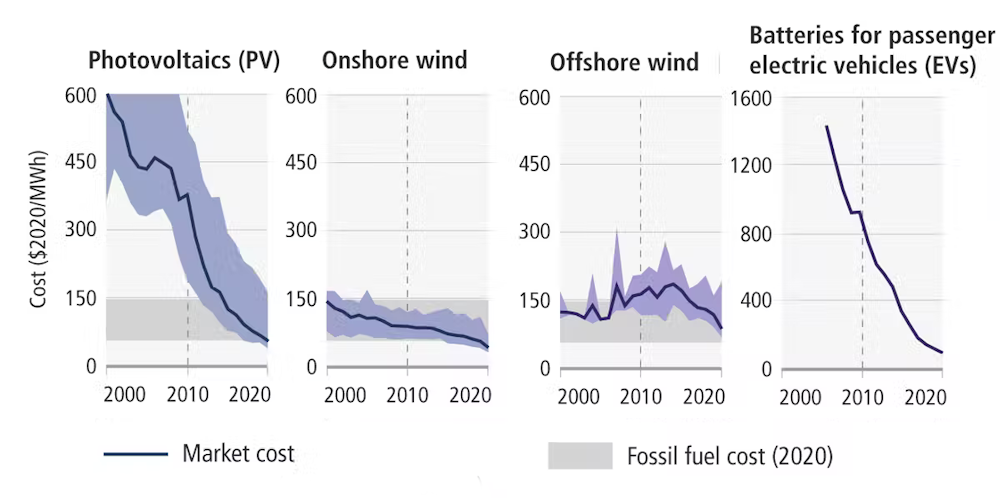
Still, there are reasons for optimism – falling renewable energy costs are starting to transform the power sector, for example, and the use of electric vehicles is expanding. But change aren’t happening fast enough, and the window for a smooth transition is closing fast, the Intergovernmental Panel on Climate Changereport warns. To keep global warming below 1.5 C (2.7 F), it says global greenhouse gas emissions will have to drop 60% by 2035 compared with 2019 levels.

he extent to which current and future generations will experience a hotter world depends on choices made now and in the coming years. The scenarios show expected differences in temperature depending on how high emissions are going forward.IPCC sixth assessment report

In the new report, released March 20, 2023, the IPCC summarizes findings from a series of assessments written over the past eight years and discusses how to stop the damage. In them, hundreds of scientists reviewed the evidence and research.

Here are four essential reads by co-authors of some of those reports, each providing a different snapshot of the changes underway and discussing solutions.

1. More intense storms and flooding

Many of the most shocking natural disasters of the past few years have involved intense rainfall and flooding.

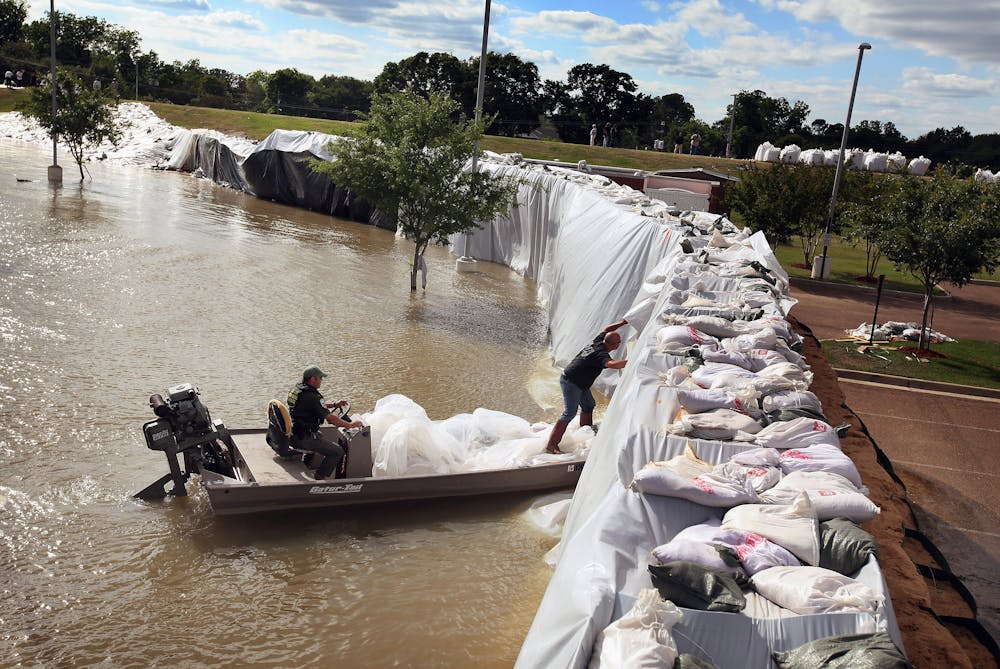
In Europe, a storm in 2021 set off landslides and sent rivers rushing through villages that had stood for centuries. In 2022, about a third of Pakistan was underwater, and several U.S. communities were hit with extreme flash flooding.

The IPCC warns in the sixth assessment report that the water cycle will continue to intensify as the planet warms. That includes extreme monsoon rainfall, but also increasing drought, greater melting of mountain glaciers, decreasing snow cover and earlier snowmelt, wrote UMass-Lowell climate scientist Mathew Barlow, a co-author of the report examining physical changes.

“An intensifying water cycle means that both wet and dry extremes and the general variability of the water cycle will increase, although not uniformly around the globe,” Barlow wrote.

“Understanding this and other changes in the water cycle is important for more than preparing for disasters. Water is an essential resource for all ecosystems and human societies.” 


Read more: The water cycle is intensifying as the climate warms, IPCC report warns – that means more intense storms and flooding


2. The longer the delay, the higher the cost

The IPCC stressed in its reports that human activities are unequivocally warming the planet and causing rapid changes in the world’s atmosphere, oceans and icy regions.

“Countries can either plan their transformations, or they can face the destructive, often chaotic transformations that will be imposed by the changing climate,” wrote Edward Carr, a Clark University scholar and co-author of the IPCC report focused on adaptation.

The longer countries wait to respond, the greater the damage and cost to contain it. One estimate from Columbia University put the cost of adaptation needed just for urban areas at between US$64 billion and $80 billion a year – and the cost of doing nothing at 10 times that level by mid-century.

“The IPCC assessment offers a stark choice,” Carr wrote. “Does humanity accept this disastrous status quo and the uncertain, unpleasant future it is leading toward, or does it grab the reins and choose a better future?”


Read more: Transformational change is coming to how people live on Earth, UN climate adaptation report warns: Which path will humanity choose?


3. Transportation is a good place to start

One crucial sector for reducing greenhouse gas emissions is transportation.

Cutting greenhouse gas emissions to net-zero by mid-century, a target considered necessary to keep global warming below 1.5 C, will require “a major, rapid rethinking of how people get around globally,” wrote Alan Jenn, a transportation scholar at the University of California Davis and co-author on the IPCC report on mitigation.

There are positive signs. Battery costs for electric vehicles have fallen, making them increasingly affordable. In the U.S., the 2022 Inflation Reduction Act offers tax incentives that lower the costs for EV buyers and encourage companies to ramp up production. And several states are considering following California’s requirement that all new cars and light trucks be zero-emissions by 2035.

“Behavioral and other systemic changes will also be needed to cut greenhouse gas emissions dramatically from this sector,” Jenn wrote.

For example, many countries saw their transportation emissions drop during COVID-19 as more people were allowed to work from home. Bike sharing in urban areas, public transit-friendly cities and avoiding urban sprawl can help cut emissions even further. Aviation and shipping are more challenging to decarbonize, but efforts are underway.

He adds, however, that it’s important to remember that the effectiveness of electrifying transportation ultimately depends on cleaning up the electricity grid.


Read more: Revolutionary changes in transportation, from electric vehicles to ride sharing, could slow global warming – if they’re done right, IPCC says


4. Reasons for optimism

The IPCC reports discuss several other important steps to reduce greenhouse gas emissions, including shifting energy from fossil fuels to renewable sources, making buildings more energy efficient and improving food production, as well as ways to adapt to changes that can no longer be avoided.

There are reasons for optimism, wrote Robert Lempert and Elisabeth Gilmore, co-authors on the IPCC’s report focused on mitigation.

“For example, renewable energy is now generally less expensive than fossil fuels, so a shift to clean energy can often save money,” they wrote. Electric vehicle costs are falling. Communities and infrastructure can be redesigned to better manage natural hazards such as wildfires and storms. Corporate climate risk disclosures can help investors better recognize the hazards and push those companies to build resilience and reduce their climate impact.

“The problem is that these solutions aren’t being deployed fast enough,” Lempert and Gilmore wrote. “In addition to pushback from industries, people’s fear of change has helped maintain the status quo.” Meeting the challenge, they said, starts with embracing innovation and change.

To see the original post, follow this link: https://theconversation.com/climate-damage-is-worsening-faster-than-expected-but-theres-still-reason-for-optimism-4-essential-reads-on-the-ipcc-report-202116


‘More precious than gold’

21 03 2023

Photo: Candace Maracle/CBC

Canada’s Haudenosaunee say inconsistent weather is proving to be a sticky situation for maple syrup season. By Candace Maracle from CBC News • Reposted: March 231, 2023

The ideal temperature for maple sap to run is when temperatures fall below 0 C at night and rise above zero during the day.

It’s something Tehahenteh Miller grew up knowing about collecting sap to make maple syrup. Miller, who is Kanien’kehá:ka (Mohawk) and lives in Six Nations, Ont., has been tapping his trees for over a decade.

“If the sun shines, it increases the volume considerably and it’s usually the sunny side that we tap,” said Miller.

Maple trees tapped on Six Nations. Photo: Candace Maracle/CBC

Miller said he has seen changes in the last four or five years. Warmer winter weather followed by cold snaps impedes the maples’ sap flow.

“You look around and you can see a lot of the tops of the trees are dying,” he said.

Miller said that Haudenosaunee teachings predict that once the maple tree starts dying from the top, any conservation effort may be too late to turn things around. He hasn’t tapped his trees for the past three years “to give his trees a rest” from the stress climate change has put on them. 

A full bucket of maple sap. Photo: Candace Maracle/CBC
Sap is used in Haundenosaunee ceremony to honour the maple trees. Photo: Candace Maracle/CBC
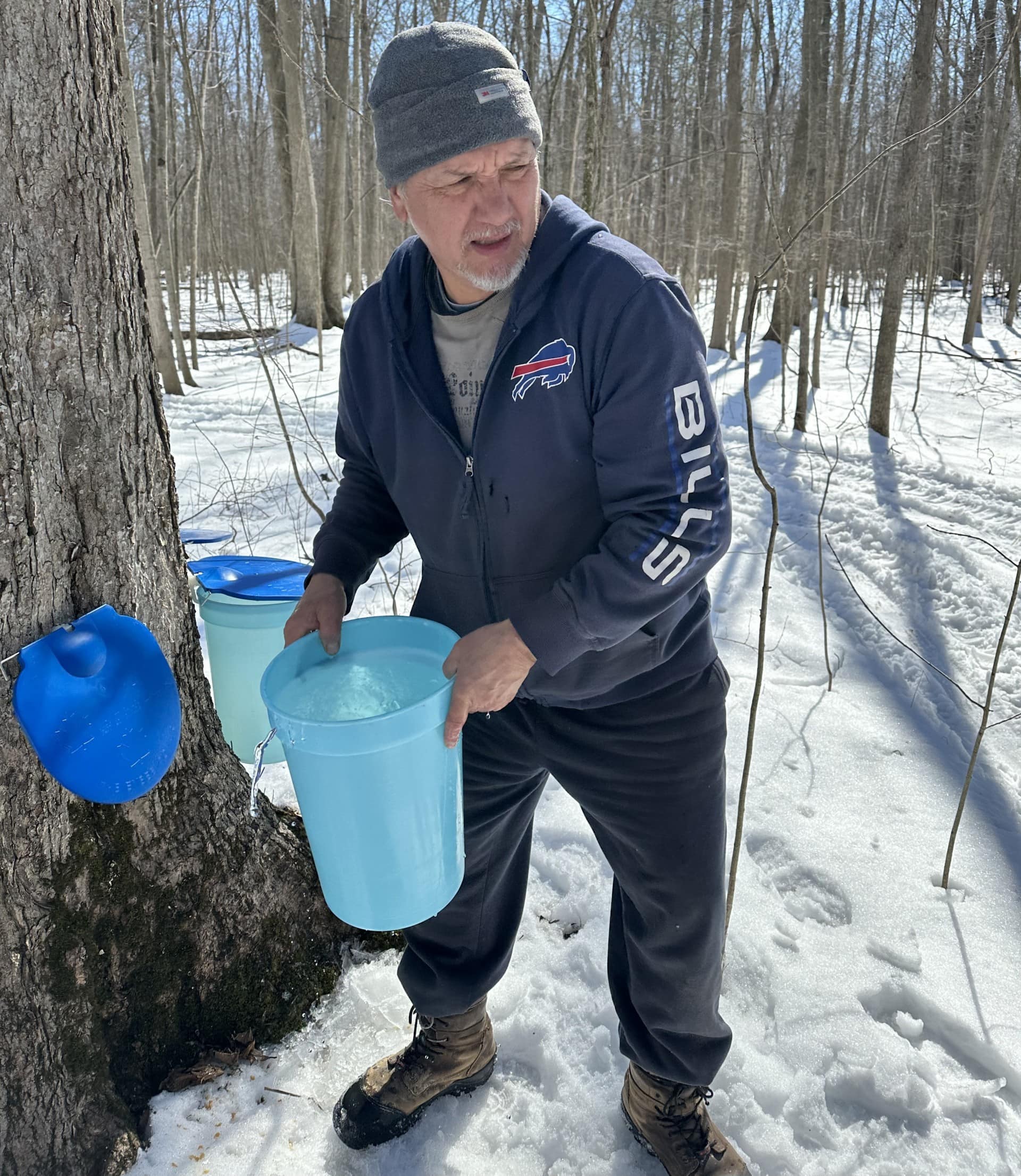
Tim Johnson collects sap from buckets twice a day during the season when sap is running. Photo: Candace Maracle/CBC

Dawn Martin-Hill, an associate professor in the Department of Anthropology at McMaster University, has researched how climate change is affecting Six Nations. She’s one of the co-authors of a 2021 report in Climate Services on observed and projected trends of climate change in Six Nations.

“What the climate change study showed here was that Six Nations was going to experience drought, flood, cycles of instability and that will impact the ability for the trees to run sap for the length that they used to,” she said.

Martin-Hill said Haudenosaunee have always understood the inter-connectedness of life.

“Our people don’t have to change a single story that we have in order to adjust to what modern science is beginning to find out and understand,” she said.

Sap drips from a newly drilled tap. Photo: Candace Maracle/CBC)

The sap that is collected from the maple tree is used in ceremony to honour the opening of the maple trees – the time of year when sap runs and can be collected to make syrup.

Origin of maple syrup

Miller said, according to Haudenosaunee teachings, after a harsh winter a Haudenosaunee village was on the verge of starvation when a young man went into the forest and sat by a tree, thinking of a solution. He noticed a squirrel climb a maple tree and lick the water droplets from a broken branch.He fashioned a small bowl from bark to collect sap where it was leaking from the broken branch. After being left out in the sun, the sap began to evaporate, making it extra sweet.

The young man drank the water and determining it was safe to consume, he told the others in the village. The maple sap nourished them and got them through winter without starving.After that, it was decided the maple tree would be honoured every year for this gift.

The Mohawk Longhouse in Six Nations held a ceremony to open the maple trees last week.

Family tradition

Maple sap must be boiled for hours to make syrup.

Mel Squire and her husband, Angus Goodleaf, collect sap on their property in Six Nations.

This is her second year tapping trees after learning from her family who have been doing it for generations.

“I think just getting older and reflecting back on my childhood and watching my grandfather do it … inspired me to get into doing it myself,” she said.

Angus Goodleaf boils sap for maple syrup. Photo: Mel Squire

They check their 20 taps daily to see how much sap has accumulated in buckets. The sap can only be stored for a few days before it must be boiled for hours.

“Forty gallons of sap gave us one gallon [of syrup],” said Squire.

“We can’t sell it. I don’t even know what I’d price it at. It’s more precious than gold at this point. So, it’s quite priceless.”

Of the Haudenosaunee tradition of tapping maple trees each spring, Miller said, “We owe [the trees] a responsibility to not just acknowledge them, but to be participatory. We’re actually practising our culture, reinforcing our culture by doing that. That’s part of our culture and it needs to be kept alive.”

The finished product. Photo: Mel Squire

To see the original post, follow this link: https://www.cbc.ca/newsinteractives/features/more-precious-than-gold


IPCC report: Climate solutions exist, but humanity has to break from the status quo and embrace innovation

21 03 2023

Image: Fotograf Sune Tølløse –

By Robert Lempert, Professor of Policy Analysis, Pardee RAND Graduate School and Elisabeth Gilmore, Associate Professor of Climate Change, Technology and Policy, Carleton University via The Conversation * Reposted: March 21, 2023

It’s easy to feel pessimistic when scientists around the world are warning that climate change has advanced so far, it’s now inevitable that societies will either transform themselves or be transformed. But as two of the authors of a recent international climate report, we also see reason for optimism.

The latest reports from the Intergovernmental Panel on Climate Change, including the synthesis report released March 20, 2023, discuss changes ahead, but they also describe how existing solutions can reduce greenhouse gas emissions and help people adjust to impacts of climate change that can’t be avoided.

The problem is that these solutions aren’t being deployed fast enough. In addition to pushback from industries, people’s fear of change has helped maintain the status quo. 

To slow climate change and adapt to the damage already underway, the world will have to shift how it generates and uses energy, transports people and goods, designs buildings and grows food. That starts with embracing innovation and change.

Fear of change can lead to worsening change

From the industrial revolution to the rise of social media, societies have undergone fundamental changes in how people live and understand their place in the world.

Some transformations are widely regarded as bad, including many of those connected to climate change. For example, about half the world’s coral reef ecosystems have died because of increasing heat and acidity in the oceans. Island nations like Kiribati and coastal communities, including in Louisiana and Alaska, are losing land into rising seas.Residents of the Pacific island nation of Kiribati describe the changes they’re experiencing as sea level rises.

Other transformations have had both good and bad effects. The industrial revolution vastly raised standards of living for many people, but it spawned inequality, social disruption and environmental destruction.

People often resist transformation because their fear of losing what they have is more powerful than knowing they might gain something better. Wanting to retain things as they are – known as status quo bias – explains all sorts of individual decisions, from sticking with incumbent politicians to not enrolling in retirement or health plans even when the alternatives may be rationally better. 

This effect may be even more pronounced for larger changes. In the past, delaying inevitable change has led to transformations that are unnecessarily harsh, such as the collapse of some 13th-century civilizations in what is now the U.S. Southwest. As more people experience the harms of climate change firsthand, they may begin to realize that transformation is inevitable and embrace new solutions.

A mix of good and bad

The IPCC reports make clear that the future inevitably involves more and larger climate-related transformations. The question is what the mix of good and bad will be in those transformations.

If countries allow greenhouse gas emissions to continue at a high rate and communities adapt only incrementally to the resulting climate change, the transformations will be mostly forced and mostly bad

For example, a riverside town might raise its levees as spring flooding worsens. At some point, as the scale of flooding increases, such adaptation hits its limits. The levees necessary to hold back the water may become too expensive or so intrusive that they undermine any benefit of living near the river. The community may wither away.

A person in a boat checks the river side of sandbag levee protecting a community during a flood.
Riverside communities often scramble to raise levees during floods, like this one in Louisiana.  Photo: Scott Olson/Getty Images

The riverside community could also take a more deliberate and anticipatory approach to transformation. It might shift to higher ground, turn its riverfront into parkland while developing affordable housing for people who are displaced by the project, and collaborate with upstream communities to expand landscapes that capture floodwaters. Simultaneously, the community can shift to renewable energy and electrified transportation to help slow global warming.

Optimism resides in deliberate action

The IPCC reports include numerous examples that can help steer such positive transformation.

For example, renewable energy is now generally less expensive than fossil fuels, so a shift to clean energy can often save money. Communities can also be redesigned to better survive natural hazards through steps such as maintaining natural wildfire breaks and building homes to be less susceptible to burning.

Charts showing falling costs and rising adoption of clean energy.
Costs are falling for key forms of renewable energy and electric vehicle batteries. IPCC sixth assessment report

Land use and the design of infrastructure, such as roads and bridges, can be based on forward-looking climate information. Insurance pricing and corporate climate risk disclosures can help the public recognize hazards in the products they buy and companies they support as investors.

No one group can enact these changes alone. Everyone must be involved, including governments that can mandate and incentivize changes, businesses that often control decisions about greenhouse gas emissions, and citizens who can turn up the pressure on both.

Transformation is inevitable

Efforts to both adapt to and mitigate climate change have advanced substantially in the last five years, but not fast enough to prevent the transformations already underway.

Doing more to disrupt the status quo with proven solutions can help smooth these transformations and create a better future in the process.

To see the original post, follow this link: https://theconversation.com/ipcc-report-climate-solutions-exist-but-humanity-has-to-break-from-the-status-quo-and-embrace-innovation-202134


It’s mid-March and the Great Lakes are virtually ice-free. That’s a problem.

19 03 2023

By Caitlin Looby from the Akron Beacon Journal • Reposted: March 19, 2023

It’s the middle of March and the Great Lakes are virtually ice-free. 

Ice has been far below average this year, with only 7% of the lakes covered as of last Monday — and no ice at all on Lake Erie. Lake Erie’s average ice coverage for this time of year is 40%, based on measurements over the past half-century. The lake typically freezes over the quickest and has the most ice cover because it’s the shallowest of the five Great Lakes. 

But communities along Ohio’s north coast, including Cleveland, Sandusky and Port Clinton, have seen considerably less ice forming on Lake Erie in recent years.

According to the National Oceanic and Atmospheric Administration’s Great Lakes Environmental Research Laboratory, Lake Erie’s ice coverage peaked in early February at 40%, a nearly 20% decrease from the historical average.

Seagulls sit on the thin ice along the shore of Lake Erie in Michigan's Monroe County in March 2022.

No ice isn’t a good thing for the lakes’ ecosystem. It can even stir up dangerous waves and lake-effect snowstorms.  So, what happens when the lakes are ice-free? What does it mean for the lakes’ food web? Is climate change to blame?

Little ice cover can be disastrous

This winter has already proved how dangerous lake-effect snow can be. 

At the end of November, more than 6 feet of snow fell on Buffalo, New York, which sits on the shores of Lake Erie. A few weeks later on Dec. 23, more than 4 feet of snow covered the city and surrounding areas once again. The storm resulted in 44 deaths in Erie and Niagara counties, which sit on Lakes Erie and Ontario, respectively. 

Cleveland and Sandusky reside on the shores of Lake Erie as well. The 2022 storm that swept the region on Dec. 23 dropped relatively little snow, only about 2-4 inches, but created dangerous conditions nonetheless.

In some places in Northeast Ohio, temperatures dropped from nearly 40 degrees to zero and below. Wind chills fueled by hurricane-force winds dragged the temperature even lower to minus 30 or even 35 below zero. This storm was the first time in almost a decade that the Cleveland Weather Forecast Office issued a blizzard warning.
A 46-vehicle pileup on the Ohio Turnpike near Sandusky claimed four lives
.

A 46-vehicle pileup killed four people injured many others on the Ohio Turnpike during a winter storm with whiteout conditions Dec. 23.

During stormy winter months, ice cover tempers waves. When there is low ice cover, waves can be much larger, leading to lakeshore flooding and erosion. That happened in January 2020 along Lake Michigan’s southwestern shoreline. Record high lake levels mixed with winds whipped up 15-foot waves that flooded shorelines, leading Gov. Tony Evers to declare a state of emergency for Milwaukee, Racine and Kenosha counties. 

And while less ice may seem like a good thing for the lakes’ shipping industry, those waves can create dangerous conditions. 

The Great Lakes are losing ice with climate change 

The Great Lakes have been losing ice for the past five decades, a trend that scientists say will likely continue. 

Of the last 25 years, 64% had below-average ice, said Michael Notaro, the director of the Center on Climatic Research at the University of Wisconsin-Madison. The steepest declines have been in the north, including Lake Superior, northern Lake Michigan and Huron, and in nearshore areas. 

But this also comes with a lot of ups and downs, largely because warming is causing the jet stream to “meander,” said Ayumi Fujisaki Manome, a scientist at the Cooperative Institute for Great Lakes Research at the University of Michigan who models ice cover and hazardous weather across the lakes. 

There is a lot of year-to-year variability with ice cover spiking in years like 2014, 2015 and 2019 where the lakes were almost completely iced over.    

Ice fishermen stay close to shore off of Bay Shore Park in New Franken, Wisconsin, in January, which saw relatively little ice cover on the Great Lakes.

No ice makes waves in the lakes’ ecosystems

A downturn in ice coverage due to climate change will likely have cascading effects on the lakes’ ecosystems. 

Lake whitefish, a mainstay in the lakes’ fishing industry and an important food source for other fish like walleye, are one of the many Great Lakes fish that will be affected, said Ed Rutherford, a fishery biologist who also works at the Great Lakes Environmental Research Laboratory. 

Lake whitefish spawn in the fall in nearshore areas, leaving the eggs to incubate over the winter months. When ice isn’t there, strong winds and waves can stir up the sediment, reducing the number of fish that are hatched in the spring, Rutherford said. 

Whitefish haul from the Great Lakes.
A walleye caught during a fishing trip in Lake Erie near Marblehead, Ohio.

Walleye and yellow perch also need extended winters, he said. If they don’t get enough time to overwinter in cold water, their eggs will be a lot smaller, making it harder for them to survive. 

Even so, the Ohio Department of Natural Resources Division of Wildlife released a report stating that Lake Erie’s 2022 walleye and yellow perch populations in the central and western basins are above average. Yellow perch hatches in the central basin are below average, however.

Declining ice cover on the lakes is also delaying the southward migration of dabbling ducks, a group of ducks that include mallards, out of the Great Lakes in the fall and winter, Notaro said. And if the ducks spend more time in the region it will increase the foraging pressure on inland wetlands. 

Warming lakes and a loss of ice cover over time also will be coupled with more extreme rainfall, likely inciting more harmful algae blooms, said Notaro. These blooms largely form from agricultural runoff, creating thick, green mats on the lake surface that can be toxic to humans and pets. 

In this 2017 photo, a catfish appears on the shoreline in the algae-filled waters of Lake Erie in Toledo.

Lakes Erie and Michigan are plagued with these blooms every summer. And now, blooms cropping up in Lake Superior for the first time are raising alarm. 

“Even deep, cold Lake Superior has been experiencing significant algae blooms since 2018, which is quite atypical,” Notaro said. 

More: Blue-green algae blooms, once unheard of in Lake Superior, are a sign that ‘things are changing’ experts say

There is still a big question mark on the extent of the changes that will happen to the lakes’ ecosystem and food web as ice cover continues to decline. That’s because scientists can’t get out and sample the lakes in the harsh winter months.

“Unless we can keep climate change in check … it will have changes that we anticipate and others that we don’t know about yet,” Rutherford said.

Caitlin Looby is a Report for America corps member who writes about the environment and the Great Lakes. Reach her at clooby@gannett.com or follow her on Twitter @caitlooby. Beacon Journal reporter Derek Kreider contributed to this article.

To see the original post, follow this link: https://www.beaconjournal.com/story/news/2023/03/19/lack-of-ice-upends-great-lakes-food-web-incites-algae-blooms/70005026007/


Climate is changing too quickly for the Sierra Nevada’s ‘zombie forests’

14 03 2023
SEQUOIA NATIONAL FOREST, CALIFORNIA – FEBRUARY 19: Smoke rises above young giant sequoia trees during prescribed pile burning on February 19, 2023 in Sequoia National Forest, California. According to the Forest Service, wildfires have destroyed nearly 20 percent of all giant sequoias in the past three years amid hazardous fuel (vegetation) buildup. The Forest Service began emergency action last year to reduce the fuels in 12 giant sequoia groves in the Sequoia National Forest, including prescribed pile burning to reduce wildfire risk. The massive trees can live for over 3,000 years and average between 180 to 250 feet in height. (Photo by Mario Tama/Getty Images)

By Joe Hernandez from NPR • Posted: March 13, 2023

Some of the tall, stately trees that have grown up in California’s Sierra Nevada are no longer compatible with the climate they live in, new research has shown.

Hotter, drier conditions driven by climate change in the mountain range have made certain regions once hospitable to conifers — such as sequoia, ponderosa pine and Douglas fir — an environmental mismatch for the cone-bearing trees.

“They were exactly where we expected them to be, kind of along the lower-elevation, warmer and drier edges of the conifer forests in the Sierras,” Avery Hill, who worked on the study as a graduate student at Stanford University, told NPR.

Although there are conifers in those areas now, Hill and other researchers suggested that as the trees die out, they’ll be replaced with other types of vegetation better suited to the environmental conditions.

The team estimated that about 20% of all Sierra Nevada conifer trees in California are no longer compatible with the climate around them and are in

The team scrutinized vegetation data dating back to the 1930s, when all Sierra Nevada conifers were growing in appropriate climate conditions. Now, four out of five do.

That change is largely due to higher temperatures and less rainfall in these lower-elevation areas, as well as human activities, such as logging, and an uptick in wildfires.

The Sierra Nevada conifers aren’t standing still. The average elevation of the trees has increased over the past 90 years, moving 112 feet upslope. According to Hill, that’s because lower-elevation conifers have died while conifers at higher elevations where the air is cooler have been able to grow.

But the conifers’ uphill trek hasn’t been able to keep pace with the dramatic increase in temperatures.

The researchers said the number of Sierra Nevada conifers incompatible with their environments could double in the next 77 years.

The new maps can inform forest conservation and management plans

But Hill, who is now a postdoctoral researcher at the California Academy of Sciences, hopes that the maps he and his colleagues developed showing the state’s “zombie forests” will help shape people’s understanding of the effects of climate change.

“Conservationists know, scientists know, so many people know that ecosystems are changing and expect them to change more, and people are grappling with this,” he said.

“These maps are unique, in that you can put your finger on a point and say, ‘This area right here is expected to transition due to climate change in the near future,’ and this forces some really difficult questions about what we want this land managed for and do we try to resist these impending changes,” Hill added.

Copyright 2023 NPR. To see more, visit https://www.npr.org.

To see the original post, follow this link: https://www.mprnews.org/story/2023/03/13/npr-climate-change-sierra-nevada-zombie-forests


New “Climate Forward?” Report Advocates for the Use of Climate Projection Data by Architecture and Engineering Professionals

13 03 2023

From The University of Minnesota Climate Adaptation Partnership and national design firm HGA • Reposted: March 13, 2023

The University of Minnesota Climate Adaptation Partnership and national design firm HGA present the current practice, barriers, and opportunities for use of climate projection data and climate change resilience client services. 

Climate change impacts are growing every year, threatening lives, business continuity, and infrastructure—costing an average of $152.9 billion dollars per year in the U.S. alone (NOAA, 2022). Yet the Architecture and Engineering (A&E) industry still relies on historical weather data as a primary resource for performance analysis, system sizing, and other design decisions, as climate projection data are not available in the formats used by A&E codes, process guidelines, and software.  

The new report “Climate Forward? How Climate Projections Are(n’t) Used to Inform Design” from the University of Minnesota Climate Adaptation Partnership (MCAP) and national interdisciplinary design firm HGA, reveals the alarming gap between the current state of A&E practice and climate science.

Currently, energy modelers most often use the Typical Meteorological Year (TMY3) dataset produced by the National Renewable Energy Laboratory (NREL)— based on past median weather conditions for a given location that is sometimes more than three decades old. Our changing climate makes ‘climate normals’ less useful for designers, poorly reflecting the range, frequency, and intensity of potential future weather conditions that a building will need to withstand during its lifespan. Key systems and infrastructure globally will continue to be vulnerable unless design standards change to account for changing climate.  

Risks of Using Historic Weather Data

“We know climate change is here and the past is no longer the best predictor of the future. As we seek to make our buildings more energy efficient and ‘climate-friendly’, we must also use climate projection data to ensure our built environment is resilient to the climate of the future.” say Dr. Heidi Roop, MCAP’s Director and a report author. “This report highlights that there is work to do by the climate science community and A&E professionals to ensure we are designing for climate resilience. Clients and professional societies also play a key role in driving a holistic, forward-looking approach to design of the buildings and infrastructure we all rely on.”

The research makes a decisive case for the development and promotion of industry standards, mandates (including building codes), guidance and training for using climate projections in A&E applications. It also articulates the critical role for boundary organizations and climate data developers to build partnerships and capacities to bridge this gap alongside A&E professionals.

“Climate Forward?” also addresses the missed opportunity to extend the life of our buildings. Today’s sustainable design efforts focus primarily on climate change mitigation—that of reducing carbon emissions. In contrast, MCAP and HGA’s research shows how the industry should also shift to design for climate change adaptation—which are a broader set of design measures that factor in the projected climate over the lifespan of the building and systems. 

Lead author of the report, Ariane Laxo, HGA’s Director of Sustainability said, “There is tremendous potential in climate resilience services—professional services related to climate change resilience and/or adaptation using climate projection data.” She continued, “identifying the right data formats and timescales to factor in the projected climate over the lifespan of the building, landscape, and systems, will dramatically change the way we design to create a more resilient future. Industry associations need to create standards for how to integrate these data into practice, so we are using consistent methodologies.”

The climate is changing rapidly. Action must be taken now, and must involve substantive collaboration with climate data developers, boundary organizations, A&E associations and professionals, policy makers, building code & standards bodies, higher education institutions, and any organization that hires A&E professionals. The report concludes with recommended actions that could close the gap between climate science and the A&E professionals who are designing buildings and infrastructure that must withstand climate change.

Read the full report, “Climate Forward? How architects and engineers are(n’t) using climate projections to inform design.” 

Report authors: Ariane Laxo, HGA, Brenda Hoppe, University of Minnesota Climate Adaptation Partnership, Heidi Roop, University of Minnesota Climate Adaptation Partnership, Patrick Cipriano, HGA and University of Minnesota Climate Adaptation Partnership

About MCAP

The University of Minnesota Climate Adaptation Partnership (MCAP) is a partnership among university, public, non-profit, and private sector groups organized to support Minnesota’s ability to adapt to a changing climate. MCAP conducts cutting-edge climate and adaptation research, champions climate leadership, develops the next generation of adaptation professionals, and advances implementation of effective, equitable adaptation actions across sectors, communities, and levels of government. Learn more about MCAP at climate.umn.edu or follow us on Twitter or LinkedIn.

About HGA 
HGA is a national interdisciplinary design firm committed to making a positive, lasting impact for our clients and communities through research-based, holistic solutions. We believe that great design requires a sense of curiosity—forming deep insight into our clients, their contexts, and the human condition. We are a collective of over 1,000 architects, engineers, interior designers, planners, researchers, and strategists. Our practice spans multiple markets, including healthcare, corporate, cultural, education, local and federal government, and science and technology. Visit HGA.com or follow us on Facebook, Twitter, LinkedIn, and  Instagram

To see the original post, follow this link: https://www.csrwire.com/press_releases/768271-new-climate-forward-report-advocates-use-climate-projection-data-architecture


Investing in communities builds climate resilience

1 03 2023

How local leaders can partner with financial institutions to support frontline communities. By Erin Ceynar & Samantha Ender from Greenzbiz.com • Reposted: March 1, 2023

Image courtesy of Wells Fargo.

This article is sponsored by Wells Fargo and written by Erin Ceynar and Samantha Ender from the Tides Foundation — a Wells Fargo Climate and Social Justice Fund partner.

Climate change isn’t a problem for the future. It’s happening right now. In 2022 alone, the United States endured wildfires, hurricanes, extreme flooding and decreased crop production.

Despite this real and growing threat, the global community is not moving quickly enough to address climate change. The 2015 Paris Agreement aims to limit global temperature rise to 1.5 degrees Celsius. However, a U.N. report released in October notes that without drastic reductions in greenhouse gas emissions, the world is on track to warm by an average of 2.1 to 2.9 degrees Celsius over preindustrial levels by the end of the century.

Climate change affects every person on the planet, but frontline communities — those that inhabit areas that face the worst consequences of climate change — are more vulnerable than most. Small fractions of a degree can affect these communities, leading to infrastructure failures, food and water scarcity, and worsening health outcomes. Rather than addressing these imminent dangers to human lives, however, most climate change relief funding focuses on our relatively slow transition to a low-carbon future.

In 2021, the United States and Canada received $810 million in foundation funding for climate change mitigation. Most of those mitigation dollars were directed towards lowering emissions and improving carbon capture in sectors such as forest protection, overlooking the effects of climate change on American communities experiencing floods, landslides and drought.

In New Orleans, devastated by Hurricane Katrina in 2005, extreme rainfall is an ongoing threat. The challenging natural landscape, combined with disinvestment in infrastructure, leaves the community vulnerable to dangerous flooding. In particular, heavy rain in the city’s 7th Ward significantly affects low-income residents of color who live in low-lying areas where affordable housing is more accessible. The flooding also drives toxic contaminants into the soil, producing respiratory and gastrointestinal health concerns.

The Partnership for Resilient Communities (PRC), a project of the Institute for Sustainable Communities (ISC), supports community leaders of color in strengthening resilient communities. New Orleans community activist Angela Chalk, executive director of PRC partner Healthy Community Services, partnered with ISC to work alongside residents and install rain gardens at their homes to minimize flooding in their neighborhood. The gardens hold water, easing the burden on the city’s old drainage system. This attainable and impactful solution demonstrates how community-driven work can educate residents about climate change while also expanding resources that deliver results.

The rain gardens highlight what we can achieve when frontline communities have a seat at the decision-making table. They intimately understand the challenges they face, the resources they can bring to bear and the solutions that will be successful and durable. In other words, engaging with community leaders provides invaluable context, helping financial partners avoid pitfalls that would otherwise remain hidden.

These grassroots and community-led approaches present homegrown solutions to promote equitable development. Climate interventions that target community-identified problems and give communities decision-making power are more likely to be both successful and sustainable. The goal is to uplift community-driven efforts to create a more resilient, sustainable and vibrant future. However, a lack of access to capital and technical expertise can hamstring these efforts.

Frontline communities need genuine partners who can offer financial support while allowing the community to lead. Financial partners shouldn’t shy away from this approach, falsely assuming that it is slower, less efficient, and less impactful than the usual top-down model.

To achieve climate justice for disinvested communities, financial partners can adopt a cooperative playbook:

  • Partner with communities from the outset.
  • Work with community leaders to identify challenges, opportunities and resources.
  • Work with community leaders to co-develop solutions.
  • Support on-the-ground, community-designed programs.
  • Provide the expertise, training and technical resources needed to strengthen community organizations.
  • Remain committed and engaged for the long term.

Following these steps drastically increases a grant’s impact, strengthens civil society and ensures that the community’s perspective is respected and centered.

As climate change intensifies, the coming years will challenge us all. Resilience demands committed partnerships with funders who have a shared vision of a prosperous and just world. Enduring change is possible when we invest in our communities and find ways to offer support that goes beyond checkbooks. Through these partnerships, we can ensure a robust and lasting impact.

To see the original post, follow this link: https://www.greenbiz.com/article/investing-communities-builds-climate-resilience


Climate Justice Innovators Get $27 Billion Boost From the EPA

27 02 2023

Image credit: KE ATLAS/Unsplash

By Mary Mazzoni from Triple pundit • Reposted: February 17, 2023

The U.S. Environmental Protection Agency is moving the Greenhouse Gas Reduction Fund forward and making good on its recently renewed commitments to environmental and climate justice.

Created by the Inflation Reduction Act of 2022, the Fund aims to mobilize public and private capital to reduce emissions and combat air pollution across the U.S., with a focus on low-income and historically marginalized communities. 

As a first step, the Fund will host two grant competitions worth $27 billion, the EPA announced in its initial guidance last week. A $7 billion competition will award grants to 60 organizations providing clean technologies like community solar and energy storage within U.S. communities. A second will disburse $20 billion to anywhere from two to 15 nonprofit lenders, including community-based lenders and green banks that provide financial assistance for low- and zero-emission technologies in low-income communities. 

“The Greenhouse Gas Reduction Fund will unlock historic investments to combat the climate crisis and deliver results for the American people, especially those who have too often been left behind,” said EPA Administrator Michael S. Regan, the first Black man to head the agency, in a statement. “With $27 billion from President Biden’s investments in America, this program will mobilize billions more in private capital to reduce pollution and improve public health, all while lowering energy costs, increasing energy security, creating good-paying jobs and boosting economic prosperity in communities across the country.”

Those are pretty big words, but a host of environmental and climate justice advocates agree about the Fund’s promise. “This is a huge step,” Adam Kent, Sarah Dougherty and Douglass Sims of the Natural Resources Defense Council’s People and Communities Program, wrote of the Fund in a blog. “It has the potential to not only improve lives, but ultimately transform ‘green’ investments into ‘mainstream’ investments by catalyzing far, far more than $27 billion of investments and building a more equitable clean energy future.”

$27 billion and beyond: Mobilizing funds for climate justice in U.S. communities 

An estimated 1 out of every 25 premature deaths in the U.S. can be linked to air pollution — more than traffic accidents and shootings combined. People of color and low-income people are more likely to be exposed to high levels of air pollution and as such are at greater risk of premature death. These communities also face outsized impacts from climate change. 

Addressing environmental and climate justice issues like these is a key focus in President Joe Biden’s plan to leverage federal funds to advance racial equity. Launched during Biden’s first week in office, the Justice40 Initiative looks to direct 40 percent of the overall benefits of certain federal investments to disadvantaged communities that are underserved and overburdened by pollution.

The Fund will align with Justice40 and take things a step further. “Although the law requires that just over half of Fund investments target low-income and disadvantaged communities, EPA will aim to prioritize investments in these communities throughout the entire $27 billion program,” report Kent, Dougherty and Sims of the NRDC. “This decision could transform how funding flows to underserved communities, and Fund investments can support critical, life-improving projects that otherwise would not have moved forward.”

The $7 billion in grants for clean technologies has the potential to scale transformative solutions like community solar and energy storage that can decarbonize underserved communities while reducing the burden of air pollution. The idea is that a cash infusion from the EPA can help recipient organizations grow and deploy even more community-based projects in pursuit of climate justice, similarly to how a $456 million federal loan helped Tesla become the world’s largest electric vehicle manufacturer. 

“These projects have the potential to create local benefits including savings on energy costs, reliability improvements, and improved air quality, as well as reducing climate pollution,” said Heather McTeer Toney, vice president of community engagement for the Environmental Defense Fund, in a statement. 

Further, the EPA’s decision to diversify its portfolio of nonprofit lenders — rather than investing in a single entity — will allow funds to reach more communities through institutions with proven track records of community-based and green lending. “This is a sound decision, as NRDC and many of our environmental justice and community-based partners have pushed EPA to select multiple recipients as a critical feature of Fund implementation,” Kent, Dougherty and Sims wrote. 

The next step

Both grant competitions are expected to launch in early summer. Organizations will have two to three months to submit their applications, and the EPA plans to make awards by late September of next year. 

The architecture of the Fund is based on input from state, local and Tribal governments, community financing institutions, environmental justice organizations, industry groups, and labor and environmental finance experts, the EPA said — and advocates are calling on the agency to keep the engagement up as it moves to start disbursing grants. 

“This is a positive step toward making the just transition affordable and accessible to those most in need,” Jessica Garcia, climate finance policy analyst at Americans for Financial Reform Education Fund, said in a statement. “The EPA should continue collecting feedback from the directly impacted communities that this fund aims to serve and developing robust criteria for its applicants to achieve its dual directive of protecting communities from climate impacts and providing them financial tools to safeguard their future. ”

To see the original post, follow this link: https://www.triplepundit.com/story/2023/climate-justice-epa/766666


Social Change is Crucial for Climate Action, But Brands Need to Use Their Influence Differently

12 02 2023

Image courtesy of the University of Hamburg

By Riya Anne Polcastro from Triplepundit.com • Reposted: February 12, 2023

Our overheating planet needs social change more than it needs to avoid the physical tipping points we’ve come to associate with climate disaster, according to a new study from the University of Hamburg. The researchers note that while progress has been made in numerous arenas — such as citizen action, fossil fuel divestment, and implementation of U.N. and legislative policies to curb emissions — consumption patterns and corporate behavior remain prime barriers in the fight against climate change.

Ultimately, one is likely the product of the other, with consumers reacting to the constant onslaught of advertising and social media influence designed to keep them buying with little regard for the real consequences for the climate.

Nowhere is this more obvious than with the push to replace internal combustion engines (ICE) with electric vehicles (EVs) instead of building a nationwide infrastructure of public transportation — as Curbed’s Alissa Walker detailed in her extensive report last month, “An EV In Every Driveway Is an Environmental Disaster”.

“A green future, the story goes, looks a lot like today — it’s just that the cars on the road make pit stops at charging stations instead of gas stations,” Walker wrote. “But a one-for-one swap like that — an EV to take the place of your gas guzzler — is a disaster of its own making: a resource-intensive, slow crawl toward a future of sustained high traffic deaths, fractured neighborhoods, and infrastructural choices that prioritize roads over virtually everything else.”

Truly, a low-carbon future requires systemic change, with society organized not around the personal passenger vehicle but around community and getting the most out of transportation resources through integrated public transit. Swapping out ICE vehicles for EVs does nothing to curb the overconsumption problem. If anything, it intensifies it — with many consumers under the mistaken impression that prematurely replacing their gas-powered car or truck somehow helps the environment.

If anything, staying the course on cars represents a refusal to allow social change, with governments and automakers working together to keep the industry going strong in spite of the environmental and social costs.

And while consumers are consistently blamed for their desires, there is no denying that many of those wants and needs are manufactured by corporate interests and used to sell everything from shiny new vehicles to fast fashion. Would Americans really be so eager to shell out an average of almost $6,000 annually per household on loan payments and car insurance alone if not for the incessant advertising campaigns convincing us that we’ll find freedom, or love, or whatever else we desire in our next brand new car?

Would young people really care about being seen in the same outfit twice if the fashion world didn’t shove the message down their throats that it’s a bad thing? Would fast fashion — with garments that notoriously fall apart after just a few washes — have much of a market if clothing companies didn’t pay influencers to a model a one and done lifestyle?

Putting the onus of change on consumers, even as corporate interests invest in convincing them to do more of the same, is precisely why social change is not forthcoming at the rate that is needed. Indeed, while Americans say they are willing to alter their lifestyles to curb climate change, those who rely on their overconsumption aren’t going to give up trying to sell them more than they need any time soon.

The study, titled Hamburg Climate Futures Outlook, concurs with the U.N.’s determination that humanity will not be able to keep global temperatures from rising 1.5 degrees Celsius as set out in the Paris Agreement on climate change. The researchers emphasize the need for social change now versus the current focus on individual physical tipping points like melting ice sheets that won’t have much effect on temperatures until 2050.

“The question of what is not just theoretically possible, but also plausible — that is, can realistically be expected — offers us new points of departure,” researcher Anita Engels of the University of Hamberg said in a statement. “If we fail to meet the climate goals, adapting to the impacts will become all the more important.”

Unfortunately, corporate and billionaire interests appear more than willing to force humanity to adapt as they sacrifice the habitability of much of the planet in order to continue business- and consumption-patterns-as-usual.

For companies aiming to become part of the solution on climate change, the Outlook recommends moving beyond the facility level (Scope 1 emissions) to address emissions across the value chain (Scope 3) — particularly how companies influence and interact with their stakeholders. If governments can come together transnationally, and non-government actors like companies take action against climate change within their entire scope of influence, these crucial social tipping points could come closer into reach. 

To see the original post, follow this link: https://www.triplepundit.com/story/2023/social-tipping-points-climate-change/765886


How beavers are reviving wetlands

6 02 2023

Photo: Getty Images

By Navin Singh Khadka, Environment correspondent • BBC World Service • Reposted: February 6, 2023

We are losing wetlands three times faster than forests, according to the Ramsar Convention on Wetlands. When it comes to restoring them to their natural state there is one hero with remarkable powers – the beaver.

Wetlands store water, act as a carbon sink, and are a source of food. The Ramsar Convention on Wetlands says they do more for humanity than all other terrestrial ecosystems – and yet they are disappearing at an alarming rate.

The main problems are agricultural and urban expansion, as well as droughts and higher temperatures brought about by climate change.

But if you have a river and a beaver it may be possible to halt this process.

These furry sharp-toothed rodents build dams on waterways to create a pond, inside which they build a “lodge” where they can protect themselves from predators. 

Their technique is to chew tree trunks until they fall, and to use the trunk and branches as building materials, along with stones at the base, and mud and plants to seal the dam’s upstream wall.

The dam causes flooding, slows down the flow of water and keeps it on the landscape longer.

“This transforms simple streams into thriving wetland ecosystems,” says Emily Fairfax, an ecohydrologist at California State University.

“The amount of food and water available in their wetlands makes them ideal habitat for many different species. That’s part of why beavers are what’s known as a keystone species.”

A tree chewed by a beaver
Image caption, Beavers chew the base of selected trees until they fall

Over the past 50 years, Canada and several states across the US have reintroduced beavers. Initially this was done to restore beaver numbers, after they were hunted nearly to extinction for their fur and meat in the 19th Century.

But the restoration of wetland ecosystems has also brought huge biodiversity benefits, including the return of many species of frogs, fish and invertebrates. 

A study by Finnish researchers in 2018 found that ponds engineered by beavers contained nearly twice as many mammal species than other ponds. Weasels, otters and even moose were all more prevalent. 

“Beaver wetlands are pretty unique,” says Nigel Willby, professor of freshwater science at University of Stirling.

“Anyone can make a pond, but beavers make amazingly good ponds for biodiversity, partly because they are shallow, littered with dead wood and generally messed about with by beavers feeding on plants, digging canals, repairing dams, building lodges etc. 

“Basically, beavers excel at creating complex wetland habitats that we’d never match.”

Eager beavers

  • Dams built by beavers can be up to 5m high, and the largest one so far recorded – in Alberta, Canada – is 850m long
  • While beavers chop down trees, the tree stumps often sprout new shoots instead of dying – effectively the beavers carry out coppicing
  • The North American beaver and the Eurasian beaver were confirmed to be separate species in the 1970s

A healthy wetland ecosystem also sequesters large amounts of carbon, and by acting as a sponge and soaking up floodwaters it can soften the impacts of climate change, scientists say.

Wetlands store water during wet seasons and release it slowly during drought episodes.

“When you enter a period of drought, all the plants living in a floodplain rely on stored water in the soil to keep green and stay healthy. If they don’t have much water to access they will start to wilt and wither and dry out,” says Dr Fairfax.

A beaver dam at sunset in the Grand Teton national park in Wyoming, USA
Image caption, A beaver dam in Wyoming, USA

She and her team studied 10 different wildfires in five US states between 2000 and 2021 and found in each one beavers and their ecosystem engineering reliably created and preserved wetland habitat, even during megafire events.

“Beaver wetlands have a lot of stored water, so plants in them don’t really feel droughts, they stay green and lush. And when wildfire came through, they were not burnt and we found that they stayed well-watered.”

But experts say beavers are only part of the solution to restore wetlands. Other necessary measures include planting woodland along the banks of lakes and rivers, and restoration of peatland and saltmarsh, says Prof Willby. 

And crucially, beavers are only found naturally in North America and Eurasia.

Introducing them to inappropriate places can be counter-productive. This was demonstrated in Argentina and Chile, where beavers introduced from North America in the 1940s multiplied exponentially in the absence of predators, resulting in severe forest loss.

The Global Wetlands Outlook published in 2021 by the Ramsar Convention on Wetlands found the most widespread wetland deterioration in Africa and Latin America and the Caribbean.

Lake Chad
Image caption, Lake Chad is a shadow of its former self

The drastic shrinking of Lake Chad, closer to the border of Chad, Cameroon and Nigeria in West Africa is one of the most striking examples. 

It has shrunk by 90% since the 1960s mainly due to a steep rise in water demand from a rapidly growing population, unplanned irrigation and now climate-change-induced drought. 

“Conflicts, mainly between farmers and cattle-rearers, over the limited remaining water of the lake was already there and now drought is further drying it up and fighting over the water has gone worse” says Adenike Oladosu, a wetland conservation activist in Nigeria.

Rio Negro
Image caption, The Rio Negro is the largest wetland protected under the 1971 Ramsar Convention on Wetlands

Barron Joseph Orr, lead scientist with the United Nations Convention to Combat Desertification, says wetlands are often resilient ecosystems, but prolonged droughts now pose a growing threat. 

“Climate change projections show increased drought severity in drylands that could compromise wetland resilience and reduce important habitat services,” he says.

In other areas too, drought can damage wetlands, but the beaver can help protect them. There have already been more than 100 successful reintroduction projects in North America and northern Europe.

In Europe the population is believed to have tripled in the last 20 years, according to Prof Willby, with beavers now re-established in most European countries. Sweden, Germany and Austria led the way, according to the Natural History Museum, but the UK followed in the early 2000s.

“The early motivation for bringing beavers back to the UK was mostly about playing a part in restoring a declining species to its native range,” Prof Willby says.

“But the value it could have as a keystone species for other biodiversity and in natural flood management was gaining a lot more traction, and these are the arguments usually put forward now to support the local releases of translocated animals or fenced trials happening in many places.”

To see the original post, follow this link: https://www.bbc.com/news/science-environment-64502365


Western wildfires destroyed 246% more homes and buildings over the past decade – fire scientists explain what’s changing

5 02 2023

A fire burned in a national forest in southern New Mexico.Credit…USDA Forest Service, via Associated Press

By Philip Higuera, Professor of Fire Ecology, University of Montana; Jennifer Balch, Associate Professor of Geography and Director, Earth Lab, University of Colorado Boulder; Maxwell Cook,Ph.D. Student, Dept. of Geography, University of Colorado Boulder and Natasha Stavros, Director of the Earth Lab Analytics Hub, University of Colorado Boulder via The Conversation * Reposted: February 5, 2023

It can be tempting to think that the recent wildfire disasters in communities across the West were unlucky, one-off events, but evidence is accumulating that points to a trend.

In a new study, we found a 246% increase in the number of homes and structures destroyed by wildfires in the contiguous Western U.S. between the past two decades, 1999-2009 and 2010-2020.

This trend is strongly influenced by major fires in 20172018 and 2020, including destructive fires in Paradise and Santa Rosa, California, and in Colorado, Oregon and Washington. In fact, in nearly every Western state, more homes and buildings were destroyed by wildfire over the past decade than the decade before, revealing increasing vulnerability to wildfire disasters.

What explains the increasing home and structure loss?

Surprisingly, it’s not just the trend of burning more area, or simply more homes being built where fires historically burned. While those trends play a role, increasing home and structure loss is outpacing both. 

Streets with burned cars and nothing left of homes but ash.
Entire neighborhoods were reduced to ash when a wildfire spread into Santa Rosa, California, in 2017.  Photo: Justin Sullivan/Getty Images

As fire scientists, we have spent decades studying the causes and impacts of wildfires, in both the recent and more distant past. It’s clear that the current wildfire crisis in the Western U.S. has human fingerprints all over it. In our view, now more than ever, humanity needs to understand its role.

Wildfires are becoming more destructive

From 1999 to 2009, an average of 1.3 structures were destroyed for every 4 square miles burned (1,000 hectares, or 10 square kilometers). This average more than doubled to 3.4 during the following decade, 2010-2020.

Nearly every Western state lost more structures for every square mile burned, with the exception of New Mexico and Arizona. 

Charts showing rising trend of loses from fires.
Adapted from Higuera, et al., PNAS Nexus 2023CC BY

Humans increasingly cause destructive wildfires

Given the damage from the wildfires you hear about on the news, you may be surprised to learn that 88% of wildfires in the West over the past two decades destroyed zero structures. This is, in part, because the majority of area burned (65%) is still due to lightning-ignited wildfires, often in remote areas. 

But among wildfires that do burn homes or other structures, humans play a disproportionate role – 76% over the past two decades were started by unplanned human-related ignitions, including backyard burning, downed power lines and campfires. The area burned from human-related ignitions rose 51% between 1999-2009 and 2010-2020.

This is important because wildfires started by human activities or infrastructure have vastly different impacts and characteristics that can make them more destructive. 

Unplanned human ignitions typically occur near buildings and tend to burn in grasses that dry out easily and burn quickly. And people have built more homes and buildings in areas surrounded by flammable vegetation, with the number of structures up by 40% over the past two decades across the West, with every state contributing to the trend.

Human-caused wildfires also expand the fire season beyond the summer months when lightning is most common, and they are particularly destructive during late summer and fall when they overlap with periods of high winds

As a result, of all the wildfires that destroy structures in the West, human-caused events typically destroy over 10 times more structures for every square mile burned, compared to lighting-caused events.

Map showing where fires burned in 1999-2009 and 2010-2020, comparing lightning-sparked to human-ignition and the amount of structures burned from each. More structures were burned in human-started fires.
Adapted from Higuera, et al., PNAS Nexus 2023CC BY

The December 2021 Marshall Fire that destroyed more than 1,000 homes and buildings in the suburbs near Boulder, Colorado, fit this pattern to a T. Powerful winds sent the fire racing through neighborhoods and vegetation that was unusually dry for late December. 

As human-caused climate change leaves vegetation more flammable later into each year, the consequences of accidental ignitions are magnified.

Putting out all fires isn’t the answer

This might make it easy to think that if we just put out all fires, we would be safer. Yet a focus on stopping wildfires at all costs is, in part, what got the West into its current predicament. Fire risks just accumulate for the future.

The amount of flammable vegetation has increased in many regions because of an absence of burning due to emphasizing fire suppression, preventing Indigenous fire stewardship and a fear of fire in any context, well exemplified by Smokey Bear. Putting out every fire quickly removes the positive, beneficial effects of fires in Western ecosystems, including clearing away hazardous fuels so future fires burn less intensely.

How to reduce risk of destructive wildfires

The good news is that people have the ability to affect change, now. Preventing wildfire disasters necessarily means minimizing unplanned human-related ignitions. And it requires more than Smokey Bear’s message that “only you can prevent forest fires.” Infrastructure, like downed power lines, has caused some of the deadliest wildfires in recent years. 

Reducing wildfire risks across communities, states and regions requires transformative changes beyond individual actions. We need innovative approaches and perspectives for how we build, provide power and manage lands, as well as mechanisms that ensure changes work across socioeconomic levels.

Dot chart showing how each state's area and buildings burned changed. Calfiornia, Oregon and the West overall had above average loss and above average burning. Colorado had above average loss and below average burning.
Adapted from Higuera, et al., PNAS Nexus 2023CC BY

Actions to reduce risk will vary, since how people live and how wildfires burn vary widely across the West. 

States with large tracts of land with little development, like Idaho and Nevada, can accommodate widespread burning, largely from lighting ignition, with little structure loss. 

California and Colorado, for example, require different approaches and priorities. Growing communities can carefully plan if and how they build in flammable landscapes, support wildfire management for risks and benefits, and improve firefighting efforts when wildfires do threaten communities.

Climate change remains the elephant in the room. Left unaddressed, warmer, drier conditions will exacerbate challenges of living with wildfires. And yet we can’t wait. Addressing climate change can be paired with reducing risks immediately to live more safely in an increasingly flammable West.

To see the original post, follow this link: https://theconversation.com/western-wildfires-destroyed-246-more-homes-and-buildings-over-the-past-decade-fire-scientists-explain-whats-changing-197384


Pressures from climate change could challenge agreements safeguarding Great Lakes water

4 02 2023

The Little Sable Lighthouse on Lake Michigan. Many of the legal diversions of water tap Lake Michigan. Photo: MI PR

From Michigan Radio | By Lester Graham • Published February 2, 2023

This week a nationwide Associated Press story looked at the possibility of pumping water from the Mississippi River to the drought-stricken West. That might sound familiar. For years, people in the Great Lakes region have been wary of those dry states looking at diverting water from the Great Lakes.

The cost to pump water that far would be enormous, as Michigan Radio’s Mark Brush reported in 2015. It would require hundreds of miles of large pipes. Since much of the distance would be uphill — across at least one mountain range — many new power plants would be needed to power the pumping stations along the way. In the past, it was believed the cost of that water would astronomical.

With years-long droughts in Western states, some areas are desperate for water. And when you’re desperate you might be tempted to spend astronomical amounts. The thinking is pretty simple: If the Great Lakes have so much water and we have so little, doesn’t it make sense to give us access?

“I think that’s very intuitive to people,” said University of Michigan professor Richard Rood. He studies climate change and its effects.

But the Great Lakes states have an agreement that bans diverting water from the lakes. The Great Lakes Compact was approved partly because they were concerned about diversions closer to home. Towns straddling or just outside the basin wanted access to the water. The Great Lakes Compact bans water diversions in most cases. And even if a diversion is approved, it takes a unanimous vote from all eight Great Lakes states.

Climate change and its effects are challenging all our notions about controlling water. Economic and political pressures are building.

“I believe that once those stresses get high enough, that really all treaties, all things that have been done by humans will be up for negotiation,” Rood said.

Climate change effects are happening sooner and causing challenges that are catching policymakers unprepared.

The water levels of the Great Lakes is a good example. The lakes have always had a cycle of high levels and then low levels. But the much quicker water-level changes, along with higher highs and lower lows, are new.

When water levels get extremely high as they have been in recent years, there aren’t a lot of mechanisms to lower the level. There’s no pressure valve.

“I feel as if one of the most important things to do to anticipate climate change for this region is to start to seriously think about water and water management associated with the Great Lakes,” Rood said.

He did not specifically say that the excess water could or should be pumped elsewhere. But all the tools and all the rules regarding the Great Lakes could be subject to unprecedented economic and political pressure if officials are not prepared.

Rood says they need to start looking at things anew.

“I think all of those compacts, all the agreements, any engineering assets that are currently available were designed for an old climate. And when they were considering the new climate, I don’t think that they actually considered how quickly the climate is changing.”

To see the original post, follow this link: https://www.michiganradio.org/environment-climate-change/2023-02-02/pressures-from-climate-change-could-challenge-agreements-safeguarding-great-lakes-water


Junk food companies say they’re trying to do good. A new book raises doubts

2 02 2023

As soda consumption has dropped in the West, companies are making an effort to woo new customers in other places. This Coke bottle ad is in Mozambique. Photo: Thomas Trutschel/Photothek via Getty Images

By Pien Huang from NPR • Posted: February 1, 2023

So how do you get people to drink more soda?

That’s a question Coca-Cola and other soda makers are wrestling with as soda drinking has waned in U.S. and European markets.

In the 2010s, Coke made a big push into rural parts of lower income countries to sell more soda. So they made smaller, more durable bottles – a 1-cup serving size that could be sold more cheaply and last longer on the shelves.

They built solar-powered coolers that allowed sellers to keep Coke bottles cold in places off the electrical grid – and offer mobile phone-charging to their customers.

And they launched “splash bars” – small businesses run by women that sold shots of Coke, Fanta and other Coca-Cola products for as low as 7 U.S. cents a serving to make the beverage affordable to everyone.

Eduardo J. Gómez is the author of the new book Junk Food Politics: How Beverage and Fast Food Industries Are Reshaping Emerging Economies.
Eduardo J. Gómez is the author of the new book Junk Food Politics: How Beverage and Fast Food Industries Are Reshaping Emerging Economies. Photo: Eduardo J. Gómez

The company presented this strategy as a win-win – they benefited because their product was becoming more available in remote areas and female entrepreneurs had a new way to earn a living.

That’s a story that Eduardo J. Gómez tells in his new book. As he points out, Coke’s characterization of a win-win isn’t universally embraced.

Gómez, director of the Institute of Health Policy and Politics at Lehigh University, says Coca-Cola is one of many junk food companies – fast-food giants like McDonald’s and KFC – who are targeting “emerging economies” – countries where income is on the rise along with trade with wealthier nations.

In these countries, many people see the ability to buy so-called junk food – not just soda but packaged chips and candies and fast food from chains – as a sign they’re made it. And the junk food manufacturers try to put a positive face on their campaigns to expand their audience. They forge partnerships with local governments to fight hunger and poverty – even as the rising consumption of junk food leads to soaring rates of obesity and diabetes.

In his new book, Junk Food Politics: How Beverage and Fast Food Industries Are Reshaping Emerging Economies, Gómez describes a two-way street, where industry and political leaders work together to launch well-meaning social programs – but also skirt regulations that would harm industry’s profits. The result, Gómez says, is that junk food industries thrive in low resource countries at the expense of children and the poor, who develop long-term health problems from consuming sugar-laden, ultra-processed foods.

NPR spoke with Gómez about junk food barges, soda taxes and why healthy eating campaigns aren’t cutting it against ads for candy and fried chicken. The conversation has been edited for length and clarity:

Let’s start with an easy question. What is junk food?

The new book Junk Food Politics.
Johns Hopkins University Press

I define junk food as highly ultra-processed fast foods, from KFC to burgers, candies, confectionery, ice cream. Junk food is also Coca-Cola, Pepsi, Mountain Dew – high-sugar, carbonated soda drinks.

What role does junk food play in lower- and middle-income countries? 

There’s a proliferation of these junk foods now, not only in cities but in rural communities in India, in Mexico, even into the Brazilian Amazon.

In the emerging economies, these foods that were not [previously] accessible suddenly became very accessible in the 1990s or early 2000s.

We’re seeing [a vast and rapid] infiltration of these foods because of what I call “fear and opportunity.” “Fear” that industries have of losing market [share] in Western nations, and “opportunity” because there’s a [growing] middle class in these emerging economies that are eager to purchase them.

What is junk food politics?

Junk food politics is a two-way street. It’s when [junk food] industries influence politics and society so they can avoid regulations that will impact their profitability, such as taxes on junk foods and regulations on marketing and sales.

We often think industry is to blame. But governments are also to blame [because political leaders partner with industry on their own political agendas – which gives industry clout to undermine policies that would cut their profits].

What’s a good example of junk food politics in action?

In Brazil, for example, you have the rise of industry groups, [like the Brazilian Food Industry Association] that were very, very influential in lobbying the congress and infiltrating national agencies that are working on regulations [like advertising restrictions for junk food]. They’re engaging in partnerships [with governments and communities where] they can be perceived as a solution to the problems [of obesity and diabetes] by, for instance, helping to improve the [sharing] of nutritional information. They’re building legitimacy and avoiding costly regulations.

At the same time, [Brazil’s] President Lula [in his prior term] had a famous anti-hunger campaign. And Lula worked with Nestlé to strengthen this program and went as far as creating an office within his presidential palace to partner with industries that wanted to contribute to this anti-hunger program. And so that was a strategic, two-way partnership that benefited industry and benefited the government.

Of course, President Lula’s intentions were admirable in alleviating hunger. But perhaps it wasn’t a good idea to partner with companies that produce a lot of these ultra-processed foods, because it indirectly legitimizes the company. It amplifies the popularity of their products and their harmful consequences to health.

As low-resource countries rise in wealth, rates of obesity and diabetes also tend to rise. What is the scope of the problem? Why does it happen?

The incidence of childhood obesity is growing much faster in developing countries [than in the West]. [Rates of] type 2 diabetes among adolescents are extremely high in India and China and Mexico.

The rural poor are also becoming obese and getting diabetes. This is something we don’t normally assume. In India, for example, in the 1990s and early 2000s, obesity was seen as a “disease of luxury.” It was perceived that only people with status and money that could go to fast food establishments were having this problem. For many years the government didn’t do anything because they perceived [growing rates of diabetes and obesity] as affecting a small minority of the population.

But now, it’s become a general issue because of the increased access to junk foods.

How has access increased? How did junk foods go from being concentrated in cities to being common food items in rural places?

[Junk food distribution] started in cities, and over time they [expand] out to other areas of the country. In Brazil, for a while, Nestlé had these large blue Nestlé boats that traveled throughout the Amazon and distributed candy and cookies throughout the Amazon. [The “junk food barges,” as critics called them, have stopped]. In rural India, there are shops where people pay for one small shot of Coca-Cola while getting their phones charged.

In every country, junk food is something that’s voluntarily bought. It’s voluntarily eaten. So why are programs that encourage healthy eating and daily exercise and nutrition labeling not enough to convince people to avoid it? 

Of course we want people to have nutritional information – we want people to know more, and we want them to know what they’re eating. And there’s growing commitment and success on better food labels. Chile, for example, has introduced more effective food labels – on products high in salt, sugar and fat, they have adopted these black octagon images that are on the food products – that have rippled out through the Americas.

But people are always flooded with marketing and access [to processed foods]. Even when you have this knowledge, there are incentives for you to eat these products that are readily available and less healthy.

What I hear you saying is that healthy eating and exercise campaigns focus on the individual, but poor health and nutrition are rooted in bigger, systemic problems.

Yes, absolutely. Nutritional information is very important, but it’s insufficient. We need to address socioeconomic factors, marketing factors, all these things that play into [making junk foods an easy, accessible choice].

You say governments in low-resource countries have made some progress on taxing junk foods and improving the labeling. What else do you think needs to happen? 

None of these governments have committed to restricting advertising. [Countries have, instead, relied on voluntary pledges from companies to refrain from marketing unhealthy foods to children.] In a lot of these countries, there are no firm laws on what can be sold in schools. And even when they have laws or rules that prohibit the sale of junk foods in schools, they are not effectively being enforced.

There’s a paradox: While countries [such as Mexico, Brazil, India and Indonesia] have done a great job of increasing nutritional awareness, obesity and diabetes is still skyrocketing. And that’s because governments are doing a little bit on the fringes but not really getting to the heart of the problem. They’re not taking on these industries through regulations to sales and advertising.

What does junk food politics cost society?

There’s an extremely high cost to society, mainly from the health consequences. If you develop type 2 diabetes as a consequence of high sugar intake, it has a tremendous impact on your quality of life. Argentina, for example, has seen a crisis in the affordability of insulin. In the context of global universal health care, we don’t pay enough attention to ensuring that the poor do not go broke in getting the medicines that they need to address their high blood pressure, their [blood] sugar.

What’s the solution? What can cut into the influence that junk food politics has on public health?

The solution is having a government that is committed to ensuring the health of all of society. One that provides activists and communities with a voice that is equal to, or exceeds, the voice of industries within government. One that has no fear of taking on the powerful industries and creating regulations that protect vulnerable populations – especially children and the poor – over the interests of major corporations.

And the solution, too, is our work in communities as researchers and as community members, to raise the awareness about the importance of good nutrition and exercise, and to increase awareness about the need for access to healthier foods.

And just wondering if climate change will play any role?

That’s the topic of my next book – climate change and malnutrition.

And your thesis is that with the changing climate …

… the availability of healthy foods becomes increasingly scarce.

To see the original post, follow this link: https://www.mprnews.org/story/2023/02/01/npr-junk-food-companies-say-theyre-trying-to-do-good-a-new-book-raises-doubts


Top Universities Fail to Prepare World Leaders for the Climate Crisis, Report Finds

1 02 2023

A graduation ceremony at Harvard University. Image credit: Christian Lendl/Unsplash

By Patrick McCarthy from triple pundit.com • February 1, 2023

The late comic George Carlin once said, “You don’t need a formal conspiracy when interests converge.” 

A recent assessment of the educational background of world leaders underscores Carlin’s quip, and it provides at least one explanation for global leaders’ consistent inaction regarding climate change: They all went to the same schools.

The new project by youth campaign group Mock COP found that the 30 top universities in the world have not fostered the leadership skills and civic engagement necessary for our world leaders to navigate the impending ecological crisis.

Entitled “1.5 Degrees,” referencing the solemn recommendation from climate scientists that the planet must not warm beyond 1.5 degrees Celsius to prevent catastrophe, the project demonstrates that current world leaders are birds of a feather — an idle feather at that.

Just as Carlin said, the converging interests of world leaders — who share common backgrounds, educations, worldviews, priorities and goals — has resulted in an informal conspiracy of inertia.

Top universities failed leaders, and leaders fail us

“The people with the privilege to study at the so-called ‘top’ universities, and go on to become key decision-makers across society, are being educated at institutions that do not act in the public good and do not ensure their graduates are prepared to lead a more just and sustainable future,” the 1.5 Degrees website reads. 

The project includes a ranking that grades the world’s top universities on how their engineering, law, economics, politics and health courses, which are traditionally chosen by decision-makers, align with the actions needed to tackle the climate crisis.

The ranking of top universities includes Yale, Cambridge, Oxford and Stanford Universities, as well as the Massachusetts Institute of Technology and Imperial College London. No institution received a favorable grade. MIT, as well as Beijing’s Tsinghua and Peking Universities, scored the worst at preparing their graduates for a low-carbon future.

The team of young activists at Mock COP ultimately concluded that the most educated among us are often the worst enablers of climate destruction. They further found that critical courses pertaining to environmental citizenship are “influenced by large corporates working against the advice of the world’s leading climate scientists.”

By and large, leaders around the world are consistent in their approach to climate change — they don’t approach it at all. This can’t come as a surprise, though, once the common education factor is acknowledged. For example, Mock COP found that 20 current heads of state attended Harvard University. These schools shape their students’ worldviews, so if world leaders all went to the same few top universities, it is no wonder that they are acting in lockstep.

“World leaders consistently let us down at conferences like Davos, where they have the opportunity to create real, lasting change,” said Josh Tregale, a mechanical engineering student and Mock COP campaign coordinator, in a statement — referring to the World Economic Forum’s annual meeting earlier this month. “Had our leading decision makers undertaken university courses which effectively taught the facts of the climate crisis and instilled sustainable thinking, then they would understand the urgency and act accordingly. Instead they are uneducated on the facts and unprepared for climate leadership.”

This all adds up to world leaders are well-meaning and inept at best — and ill-intentioned and adept at worst. Neither is very reassuring, but now that the issue has been identified, Mock COP hopes to influence change.

Youth organizers at Mock COP push for curriculum reform to tackle climate change

Mock COP hopes this project will serve to influence curriculum reform and create more of an emphasis on civic duty and environmental engagement at these top universities. If the most exclusive and accomplished institutions begin to prioritize this sort of education, the rest of academia should follow suit. 

The team expects this information to help climate-minded young people decide where to study, as many students may think twice about attending these top institutions after Mock COP’s report.

The planet is not dying from ignorant people making mistakes. It is dying from self-interested, highly educated people making deliberate decisions that prioritize profits over planet. It is time to start teaching the people who have the power to save the planet that saving the planet is not only in their best interest — it’s in their job description.

To see the original post, follow this link. https://www.triplepundit.com/story/2023/top-universities-failing-climate-change/765136


Why don’t we talk about acid rain and the ozone hole anymore? Scientists debunk misinformation

29 01 2023

How a ‘blizzard of false information’ undermines the threat of climate change

Atmospheric chemist Susan Solomon, shown here at a research station in the Antarctic in the mid-1980s, remembers being laughed at by colleagues when she first presented her research on the cause of the thinning ozone layer. Photo: Submitted by Susan Solomon

By Jaela Bernstien · CBC News · Posted: January 28, 2023

If you’re over 30, you likely remember a time when there was a lot of hand-wringing and furrowed brows over the ozone hole and skin cancer, as well as the threat of acid rain destroying ecosystems.

In the 1980s and ’90s, those global environmental crises created buzz and grabbed headlines, but in the decades that followed, the world turned its attention to another threat: climate change.

Yet the success stories of how those threats were tackled — through the co-operation of scientists, policy-makers and the public — are often overlooked, if not outright denied.

A barrage of misinformation on social media, including various tweets and videos, claims those issues were never real in the first place. It’s a conspiracy theory that takes on various shapes, but the underlying common thread is the false claim that climate change is just the latest in a series of hoaxes invented by governments to control the public.

One TikTok video (reminder: this is misinformation) with more than three million views dismisses several global threats as “politics,” listing off a series of examples: “In the ’80s, it was acid rain will destroy all the crops in 10 yrs; in the ’90s it was the ozone layer will be destroyed in 10 years; in the 2000s it was the glaciers will all melt in 10 years …,” the TikTok poster says.

The video claims it was all “fear-mongering nonsense” that never came true.

Watching the video during an interview with CBC News, atmospheric chemist Susan Solomon nods knowingly. It’s not the first time she’s confronted that attitude.

“I’ve heard that kind of — I don’t want to even call it a line of argument — I’ve heard that kind of assertion in the past,” said Solomon, who is a professor in the department of Earth, atmospheric and planetary sciences at the Massachusetts Institute of Technology.

“It’s a little bit like saying, ‘I had a heart attack and my doctor put a stent in. They told me I had to exercise and now I feel great. So I think that was all just nonsense to make money for the medical establishment.”

An image circulating misinformation reads as follows: 1970s - the New Ice Age. 1980s - Acid Rain. 1990s - Ozone Depletion. 2000s - Global Warming. Then they had to switch to climate change since the globe was no longer warming. That's 40 years of shameless and baseless fear-mongering to siphon off billions of dollars from taxpayers, expand government power, and advance the left's agenda. #ClimateHoax
This image, circulated on social media, is an example of a popular conspiracy theory that falsely claims climate change is a hoax, along with acid rain and ozone depletion. (Climate Knight/Facebook)

Scientists set the record straight

It was Solomon’s research in the 1980s that helped establish the cause of the thinning ozone: refrigerants called chlorofluorocarbons, or CFCs.

She recalls a particular meeting where colleagues were discussing ozone depletion. Solomon, 30 at the time, said she presented her paper identifying how refrigerants were breaking apart in the stratosphere.

“People just laughed,” she said.

But Solomon knew she was on to something, and her work contributed to the growing body of evidence that ultimately led to the signing of the Montreal Protocol in 1987, phasing out the harmful refrigerants.

That treaty is working, according to a recent international report, which said the ozone is expected to recover by 2066.

“The fact that we have actually done the right things and fixed certain problems is a cause for celebration. It’s not a cause for pretending that those problems never existed,” Solomon said.


The reason acid rain doesn’t grab headlines anymore is similar — it wasn’t a hoax, it’s another case of governments responding to the scientific community’s alarm bells with regulations, which worked.

“The acid rain story [and] the ozone story show that we are capable of dealing with environmental problems and that we can make significant progress,” said Mike Paterson, a senior research scientist at the International Institute for Sustainable Development’s Experimental Lakes Area in northwestern Ontario.

Paterson wrote his master’s thesis on acid rain in the 1980s, and he recalls the very real impacts at the time, such as declining fish populations in North America and northern Europe.

Scientists established the cause —  sulphur dioxide and nitrogen oxides produced by burning fossil fuels — and North America eventually took action with a series of policy reforms in the 1990s that successfully curbed emissions and reduced the acidity of rain.

A man wearing glasses and a T-shirt sits outside with his arms crossed.
Mike Paterson, a senior research scientist at the International Institute for Sustainable Development’s Experimental Lakes Area in northwestern Ontario, wrote his master’s thesis on acid rain in the 1980s, and he recalls the very real impacts at the time. Photo: Bartley Kives/CBC

How misinformation threatens climate action

The fact that the global threat of climate change is happening in a digital age rampant with misinformation adds a novel layer of complexity to solving the crisis, with its severity constantly being undermined.

A government-funded report published this week by the Council of Canadian Academies — a non-profit organization that gathers experts to examine evidence on scientific topics — states that “targeted misinformation campaigns have played a documented role in creating opposition to policies addressing climate change.”

The report, called Fault Lines, used modelling to estimate that COVID-19 misinformation and its impacts on vaccine hesitancy likely contributed to 2,800 deaths and 13,000 hospitalizations in Canada over a nine-month span in 2021.

The study highlights how misinformation can cause real harm — and warns of the threat that it poses to dealing with future crises by eroding trust in science and making people more susceptible to falling down the rabbit hole of conspiracy theories.

Cognitive scientist Stephan Lewandowsky, who contributed to the report, studies misinformation and public opinion around climate change.

“Exposure to misinformation about climate change leads people to take it less seriously and to be less willing to support policy actions,” Lewandowsky, who is the chair of cognitive psychology at the University of Bristol in England, said in an interview with CBC News.

Women carry belongings salvaged from their homes after flooding caused by unusually heavy monsoon rains displaced millions of people in Pakistan in 2022. Attribution analysis has found that human-caused climate change likely contributed to the disaster. Photo: Fareed Khan/The Associated Press

Society is “drenched” in misinformation, he said, and the solution must go beyond teaching individuals how to debunk conspiracy theories and include shifts on a broader scale.

“We also have to look at the structures that are in place right now and that are assisting people with nefarious intentions to spread misinformation,” Lewandowsky said.

“We’re living in an environment where outrage or anger or fear — anything that evokes attention or captures attention — is being favoured by the algorithms of social media.”

Even if there is a strong scientific consensus on global warming, a steady stream of misinformation makes it difficult for people to sift through it all and sort fact from fiction, he said.

“If people are exposed to this blizzard of false information about climate change, then their right to be informed about risks is being undermined.”

If misinformation isn’t addressed, Lewandowsky said, it will make it all the more difficult for the public to realize and react to how serious climate change truly is, as it increasingly contributes to deadly disasters around the world.

To see the original post, follow this link: https://www.cbc.ca/news/science/misinformation-climate-crisis-ozone-scientists-1.6729005


How California’s ambitious new climate plan could help speed energy transformation around the world

27 01 2023

San Gorgonio Pass wind farm. Photo: Wikipedia

By Daniel Sperling, Distinguished Blue Planet Prize Professor of Civil and Environmental Engineering and Founding Director, Institute of Transportation Studies, University of California, Davis via The Conversation • Published: January 26, 2023

California is embarking on an audacious new climate plan that aims to eliminate the state’s greenhouse gas footprint by 2045, and in the process, slash emissions far beyond its borders. The blueprint calls for massive transformations in industry, energy and transportation, as well as changes in institutions and human behaviors.

These transformations won’t be easy. Two years of developing the plan have exposed myriad challenges and tensions, including environmental justice, affordability and local rule.

For example, the San Francisco Fire Commission had prohibited batteries with more than 20 kilowatt-hours of power storage in homes, severely limiting the ability to store solar electricity from rooftop solar panels for all those times when the sun isn’t shining. More broadly, local opposition to new transmission lines, large-scale solar and wind facilities, substations for truck charging, and oil refinery conversions to produce renewable diesel will slow the transition.

I had a front row seat while the plan was prepared and vetted as a longtime board member of the California Air Resources Board, the state agency that oversees air pollution and climate control. And my chief contributor to this article, Rajinder Sahota, is deputy executive officer of the board, responsible for preparing the plan and navigating political land mines.

We believe California has a chance of succeeding, and in the process, showing the way for the rest of the world. In fact, most of the needed policies are already in place.

What happens in California has global reach

What California does matters far beyond state lines.

California is close to being the world’s fourth-largest economy and has a history of adopting environmental requirements that are imitated across the United States and the world. California has the most ambitious zero-emission requirements in the world for carstrucks and buses; the most ambitious low-carbon fuel requirements; one of the largest carbon cap-and-trade programs; and the most aggressive requirements for renewable electricity.

In the U.S., through peculiarities in national air pollution lawother states have replicated many of California’s regulations and programs so they can race ahead of national policies. States can either follow federal vehicle emissions standards or California’s stricter rules. There is no third option. An increasing number of states now follow California.

So, even though California contributes less than 1% of global greenhouse gas emissions, if it sets a high bar, its many technical, institutional and behavioral innovations will likely spread and be transformative.

What’s in the California blueprint

The new Scoping Plan lays out in considerable detail how California intends to reduce greenhouse gas emissions 48% below 1990 levels by 2030 and then achieve carbon neutrality by 2045.

It calls for a 94% reduction in petroleum use between 2022 and 2045 and an 86% reduction in total fossil fuel use. Overall, it would cut greenhouse gas emissions by 85% by 2045 relative to 1990 levels. The remaining 15% reduction would come from capturing carbon from the air and fossil fuel plants, and sequestering it below ground or in forests, vegetation and soils.

To achieve these goals, the plan calls for a 37-fold increase in on-road zero-emission vehicles, a sixfold increase in electrical appliances in residences, a fourfold increase in installed wind and solar generation capacity, and doubling total electricity generation to run it all. It also calls for ramping up hydrogen power and altering agriculture and forest management to reduce wildfires, sequester carbon dioxide and reduce fertilizer demand.

This is a massive undertaking, and it implies a massive transformation of many industries and activities. 

Transportation: California’s No. 1 emitter

Transportation accounts for about half of the state’s greenhouse gas emissions, including upstream oil refinery emissions. This is where the path forward is perhaps most settled.

The state has already adopted regulations requiring almost all new cars, trucks and buses to have zero emissions – new transit buses by 2029 and most truck sales and light-duty vehicle sales by 2035

In addition, California’s Low Carbon Fuel Standard requires oil companies to steadily reduce the carbon intensity of transportation fuels. This regulation aims to ensure that the liquid fuels needed for legacy cars and trucks still on the road after 2045 will be low-carbon biofuels.

Two electric truck cabs are parked on either side of a charger with a sign reading '2 hour charging limit'.
The Port of Long Beach opened the nation’s first publicly accessible charging station for heavy-duty electric trucks in November 2022. Photo: Brittany Murray/MediaNews Group/Long Beach Press-Telegram via Getty Images

But regulations can be modified and even rescinded if opposition swells. If battery costs do not resume their downward slide, if electric utilities and others lag in providing charging infrastructure, and if local opposition blocks new charging sites and grid upgrades, the state could be forced to slow its zero-emission vehicle requirements.

The plan also relies on changes in human behavior. For example, it calls for a 25% reduction in vehicle miles traveled in 2030 compared with 2019, which has far dimmer prospects. The only strategies likely to significantly reduce vehicle use are steep charges for road use and parking, a move few politicians or voters in the U.S. would support, and a massive increase in shared-ride automated vehicles, which are not likely to scale up for at least another 10 years. Additional charges for driving and parking raise concerns about affordability for low-income commuters.

Electricity and electrifying buildings

The key to cutting emissions in almost every sector is electricity powered by renewable energy.

Electrifying most everything means not just replacing most of the state’s natural gas power plants, but also expanding total electricity production – in this case doubling total generation and quadrupling renewable generation, in just 22 years.

That amount of expansion and investment is mind-boggling – and it is the single most important change for reaching net zero, since electric vehicles and appliances depend on the availability of renewable electricity to count as zero emissions.

Electrification of buildings is in the early stages in California, with requirements in place for new homes to have rooftop solar, and incentives and regulations adopted to replace natural gas use with heat pumps and electric appliances.

A man and woman stand beside a power box on a home.
Two microgrid communities being developed in Menifee, Calif., feature all-electric homes equipped with solar panels, heat pumps and batteries. Photo: Watchara Phomicinda/MediaNews Group/The Press-Enterprise via Getty Images

The biggest and most important challenge is accelerating renewable electricity generation – mostly wind and utility-scale solar. The state has laws in place requiring electricity to be 100% zero emissions by 2045 – up from 52% in 2021.

The plan to get there includes offshore wind power, which will require new technology – floating wind turbines. The federal government in December 2022 leased the first Pacific sites for offshore wind farms, with plans to power over 1.5 million homes. However, years of technical and regulatory work are still ahead.

For solar power, the plan focuses on large solar farms, which can scale up faster and at less cost than rooftop solar. The same week the new scoping plan was announced, California’s Public Utility Commission voted to significantly scale back how much homeowners are reimbursed for solar power they send to the grid, a policy known as net metering. The Public Utility Commission argues that because of how electricity rates are set, generous rooftop solar reimbursementshave primarily benefited wealthier households while imposing higher electricity bills on others. It believes this new policy will be more equitable and create a more sustainable model.

Industry and the carbon capture challenge

Industry plays a smaller role, and the policies and strategies here are less refined.

The state’s carbon cap-and-trade program, designed to ratchet down total emissions while allowing individual companies some flexibility, will tighten its emissions limits. 

But while cap-and-trade has been effective to date, in part by generating billions of dollars for programs and incentives to reduce emissions, its role may change as energy efficiency improves and additional rules and regulations are put in place to replace fossil fuels.

One of the greatest controversies throughout the Scoping Plan process is its reliance on carbon capture and sequestration, or CCS. The controversy is rooted in concern that CCS allows fossil fuel facilities to continue releasing pollution while only capturing the carbon dioxide emissions. These facilities are often in or near disadvantaged communities.

California’s chances of success

Will California make it? The state has a track record of exceeding its goals, but getting to net zero by 2045 requires a sharper downward trajectory than even California has seen before, and there are still many hurdles.

Environmental justice concerns about carbon capture and new industrial facilities, coupled with NIMBYism, could block many needed investments. And the possibility of sluggish economic growth could led to spending cuts and might exacerbate concerns about economic disruption and affordability. 

There are also questions about prices and geopolitics. Will the upturn in battery costs in 2022 – due to geopolitical flare-ups, a lag in expanding the supply of critical materials, and the war in Ukraine – turn out to be a hiccup or a trend? Will electric utilities move fast enough in building the infrastructure and grid capacity needed to accommodate the projected growth in zero-emission cars and trucks?

It is encouraging that the state has already created just about all the needed policy infrastructure. Additional tightening of emissions limits and targets will be needed, but the framework and policy mechanisms are largely in place.

Rajinder Sahota, deputy executive officer of the California Air Resources Board, contributed to this article.

To see the orignal post, follow this link. https://theconversation.com/how-californias-ambitious-new-climate-plan-could-help-speed-energy-transformation-around-the-world-197094


Closing the gap between good intentions and actually adopting farm conservation practices

24 01 2023

Photo: BG Independent News

By Jan Larson McLaughlin from BG Independent News • Posted: January 24, 2023

Most farmers want to be good stewards of the land. And most acknowledge that some crop practices can help protect the region’s water quality.

But somewhere between believing in conservation methods and actually practicing them is a gap. Those good intentions do nothing to keep harmful nutrients from reaching local waterways, stressed Dr. Robyn Wilson, of the Environmental and Social Sustainability Lab at Ohio State University.

The professor of risk analysis and decision science at OSU would like to help close that gap. Wilson, who spoke last week to the Bowling Green Kiwanis Club, comes to conservation from the unusual perspective of growing up on a farm near Findlay and being trained as a behavioral scientist.

This region – the Great Black Swamp – poses significant challenges for farmers. Because the landscape naturally holds onto water, farmers have worked for centuries to drain the swamp. Their efforts to get rid of the water as quickly as possible have resulted in great crop production.

But the wetlands that previously acted as a filter to runoff, no longer function to slow down the drainage into public waterways, Wilson said. And as climate changes create warmer, wetter and wilder conditions, the problems are exacerbated.

Big spring rains drive nutrients – fertilizer – into ditches, rivers and Lake Erie, leading to harmful algal blooms and poor water quality.

Research has shown that two farming practices could greatly slow the runoff of fertilizer, Wilson said. Planting cover crops and injecting the nutrients under the soil could help solve the water quality issues, she said.

“We know what’s causing it and we know how to fix it,” Wilson said. “We could solve Lake Erie’s water quality problems.”

But while farmers believe these practices could help, fewer than a third have actually implemented the methods, she said. A study of farmers in the Great Black Swamp area showed 65% see themselves as good conservationists.

“Good farmers care about soil health and water quality,” Wilson said. “But we have plenty of farmers with strong conservation identities who are doing very little.”

If 70% of farmers adopted these practices, she said, the region would experience a big difference in water quality.

“It’s the failure we have as humans to follow through with good intentions,” Wilson said.

Farmers have been slow to participate in cover crop programs, despite all the benefits. The cover crops can prevent soil and wind erosion, combat nutrient and soil runoff into nearby waterways, improve the soil and add nutrients, suppress weeds, improve the availability of water in the soil, and break pest cycles.

Surveys of Ohio farmers showed they think differently about cover crops depending on the time of year due to fluctuations in financial stability, the amount of work to do, and stress. In January and February, farmers are more likely to be financially stable, think more clearly, and have time to consider conservation practices. 

“Cover crops is one of the trickiest things to ask farmers to do,” Wilson said.

Growing up on a farm and studying as a behavioral scientist, Wilson understands the importance of how conservation topics are presented to farmers. She knows better than using the politically polarizing term “climate change” in a survey.

“They’re all going to throw it away,” if the issue is presented as climate change, she said. The phrase “changing weather patterns” is more acceptable in the farming community.

“All farmers know the climate is changing,” she said. However, there is disagreement over whether the changes are caused by humans.

“I think we have a ways to go on that front,” Wilson said.

To see the original post, follow this link. https://bgindependentmedia.org/closing-the-gap-between-good-intentions-and-actually-adopting-farm-conservation-practices/


Climate change trauma has real impacts on cognition and the brain, wildfire survivors study shows

21 01 2023

The 2018 Camp Fire killed 85 people and destroyed 20,000 buildings in and around Paradise, Calif. Photo: Los Angeles Times

By Jyoti Mishra. Associate Professor of Psychiatry, University of California, San Diego • Reposted: January 21, 2023

The big idea

Psychological trauma from extreme weather and climate events, such as wildfires, can have long-term impacts on survivors’ brains and cognitive functioning, especially how they process distractions, my team’s new research shows.

Climate change is increasingly affecting people around the world, including through extreme heat, storm damage and life-threatening events like wildfires. In previous research, colleagues and I showed that in the aftermath of the 2018 fire that destroyed the town of Paradise, California, chronic symptoms of post-traumatic stress disorder (PTSD), anxiety and depression were highly prevalent in the affected communities more than six months after the disaster.

We also found a graded effect: People whose homes or families were directly affected by fire showed greater mental health harm than those where who were indirectly effected, meaning people who witnessed the event in their community but did not have a personal loss.

In the new study, published Jan. 18, 2023, our team at the Neural Engineering and Translation Labs, or NEATLabs, at the University of California San Diego, wanted to understand whether the symptoms of climate change-related trauma translate to changes in cognitive functioning – the mental processes involved in memory, learning, thinking and reasoning.

We evaluated subjects’ cognitive functioning across a range of abilities, including attention; response inhibition – the ability to not respond impulsively; working memory – the ability to maintain information in mind for short periods of time; and interference processing – the ability to ignore distractions. We also measured their brain function while they performed cognitive tasks, using brain wave recordings obtained from electroencephalography, or EEG.

A man at  a keyboard with a cap that has nodes on it.
A wireless EEG cap records brain activity as a person responds to cognitive tests. The image on the right shows significant differences in electrical brain activity recorded on the scalp between people directly exposed to wildfires and a control group, with greater activity in left frontal cortex (red) for the group directly exposed. Grennan et al., 2022, PLOS ClimateCC BY

The study included three groups of individuals: people who were directly exposed to the fire, people who were indirectly exposed, and a control group with no exposure. The groups were well matched for age and gender.

We found that both groups of people exposed to the fire, either directly or indirectly, dealt with distractions less accurately than the control group.

We also found differences in the brain processes underlying these cognitive differences. People who were exposed to the wildfire had greater frontal lobe activity while dealing with distractions. The frontal lobe is the center for the brain’s higher-level functions. Frontal brain activity can be a marker for cognitive effort, suggesting that people exposed to the fires may be having more difficulty processing distractions and compensating by exerting more effort.

Why it matters

With climate change fueling more disasters, it is incredibly important to understand its impacts on human health, including mental health. Resilient mental health is what allows us to recover from traumatic experiences. How humans experience and mentally deal with climate catastrophes sets the stage for our future lives.

There are strategies people can use to help reduce the stress. Psychosocial research suggests that practicing mindfulness and developing healthy lifestyles, with regular exercise and enough sleep, can protect mental well-being in these scenarios, along with developing strong social bonds

What’s next?

There is much work to be done to understand if the effects we found are replicable in large sample studies. In this work, we focused on a total of 75 study participants. Scientists also need to understand how these effects evolve as climate disasters like wildfires occur more often.

We are also pursuing research with community partners to implement interventions that can help alleviate some the impacts we observed on brain and cognitive functioning. There is no one-size-fits-all solution – each community must find the resiliency solutions that work best in their environmental context. As scientists, we can help them understand the causes and point them to solutions that are most effective in improving human health.

To see the original post, follow this link. https://theconversation.com/climate-change-trauma-has-real-impacts-on-cognition-and-the-brain-wildfire-survivors-study-shows-197870


CEOs Know ‘Business-As-Usual’ Isn’t Working, But Many Are Too Tapped Out to Change

21 01 2023

Image credits: Marvin Meyer and Ryoji Iwata via Unsplash

Executives view climate change as both a short- and long-term threat, but most are failing to address it proactively, PwC CEO Survey shows. By Mary Mazzoni from Triplepundit.com • Reposted: January 21, 2023

We’ve heard it for years — “business-as-usual isn’t working” — and the annual PwC CEO Survey indicates executives are well aware. Nearly 40 percent of more than 4,000 responding global CEOs think their companies will no longer be economically viable in a decade if they continue down their current path. 

That’s a pretty big deal. Yet while one would think such a grim consensus would spur an immediate push for change, many executives told PwC they don’t have nearly enough time to think and talk about the future. Maintaining current operating performance consumed the biggest share of CEOs’ time last year, according to the survey, and executives admitted they’d rather spend more time evolving their companies’ strategies to meet future demands.

Findings like these reflect the “dual imperative” facing CEOs around the world as they look to reinvent their businesses for the future while  navigating a laundry list of daunting challenges in the present day, the PwC CEO Survey found. “If organizations are not only to thrive but survive the next few years, they must carefully balance the dual imperative of mitigating short-term risks and operational demands with long-term outcomes — as businesses that don’t transform, won’t be viable,” Bob Moritz, global chairman of PwC, said in a statement. 

So, will business leaders act to save themselves, or will they be too busy with next quarter’s P&L? Let’s take a closer look inside the survey to see what executives are saying — and what it could mean for the future. 

Executives view climate change as both a short- and long-term threat, but most are failing to address it proactively, PwC CEO Survey shows 

While managing climate risk is a long-term challenge that continues to vex executives, the PwC CEO Survey indicates many are also concerned about the effects of climate change in the here and now. 

Most of the CEOs surveyed expect their businesses to feel some degree of impact from climate change within the next 12 months. About half predict the effects of climate change will have a “moderate,” “large” or “very large” impact on their cost profiles. More than 40 percent anticipate impacts to their supply chains, while around a quarter are worried about climate-related damage to their physical assets.

Their concerns are warranted: The 10 most significant climate-related disasters to strike the world last year caused more than $3 billion worth of damage each, according to the World Economic Forum

Still, the way they respond could use some work. “Deeper statistical analysis of the survey shows that the CEOs who feel most exposed to climate change are more likely to take action to address it,” PwC researchers observed.

“This kind of reactive approach is understandable — when your house is in the path of a forest fire, you reach for the hose — but it creates risks of its own,” they continued. “Combating climate change requires a coordinated, long-term plan. It won’t be solved if the only companies working on it are those that face immediate financial impact.”

Beyond issues with reactivity, the researchers underscore that they “don’t know how much” the actions most often taken by businesses — such as decarbonization initiatives and moves to innovate more climate-friendly products and services — “will move the needle, particularly in the near-term, which, in light of emissions already in the atmosphere, promises continued warming under virtually every scenario.”

While it remains murky if business actions will do anything to curb their climate risk in the short term, the researchers warn that many long-term corporate climate strategies are also incomplete or less effective than they could be — setting the stage for even more serious risk in the years to come. 

More than half of all CEOs surveyed, including 70 percent of those at U.S. companies, say their teams have no plans to apply an internal carbon price to decision-making, “even though doing so could help them account for considerations like taxes and incentives, and clarify strategic trade-offs,” the researchers found. Many are also dropping the ball on reporting, as another recent PwC survey found that 87 percent of global investors think corporate reporting contains unsubstantiated sustainability claims, often referred to as “greenwashing.”

CEOs predict declining global economic growth, but is that really a bad thing? 

Nearly three-quarters (73 percent) of CEOs believe global economic growth will decline over the next 12 months. This is a marked departure from recent years, as more than 75 percent of respondents to the 2020 and 2021 iterations of the PwC CEO Survey said they thought economic growth would improve. It’s also the most pessimistic CEOs have been regarding global economic growth since the PwC CEO Survey began asking this question 12 years ago. 

This comes as no major shock, as other recent polling indicates CEOs around the world are bracing for a recession in 2023. Still, it begs a few questions: Is a slowdown in economic growth inevitable, and is it even a bad thing? 

In the decades since economist Milton Friedman declared that the social responsibility of business is to increase profits for shareholders, conventional reason has dictated that the ultimate marker of business health is to grow bigger and bigger every year, with solid shareholder returns that climb on a quarterly basis. 

Yet study after study indicates that the never-ending pursuit of more consumption, more profit and more money does not equate to better quality of life across the economy — and the spoils of rugged capitalism are not shared equally. In the U.S., for example, CEO pay has grown by a staggering 1,460 percent since 1978, while median worker pay has not even kept pace with inflation, increasing by a mere 18 percent over the same period. U.S. CEOs were paid 399 times as much as a typical worker in 2021. 

So, if the dogged pursuit of “more, more, more” does not increase quality of life for the many, and workers by and large find themselves more wage-poor than their parents were, who really benefits from eternal economic growth as a marker of success? Even businesses stand to lose out as CEOs cash their bloated paychecks while predicting their companies will be belly-up within a decade. 

Against a backdrop like this, it makes sense that conversations around degrowth are having a major moment in mainstream business circles. As the name implies, degrowth calls for intentional reductions in production and consumption to stay within the boundaries of a resource-constrained world — particularly in rich countries, allowing developing countries to have a greater share of the economic pie (and the global carbon budget). 

While respondents to the PwC CEO Survey stop far short of advocating for strategic degrowth, they don’t plan to cope with the impending recession in the way many might expect. While over half of responding CEOs say they are moving to cut operating costs and raise prices, the majority (60 percent) say they do not plan to reduce the size of their workforce in the next 12 months, and 80 percent say they have no plans to reduce compensation. 

Still, it makes sense that predictions about the worst recession in a century would be preoccupying for executives, but as Moritz of PwC observed, those that don’t keep the future in mind are destined for failure. This type of push and pull between long-term longevity and short-term profit is one that has defined conversations around stakeholder capitalism and corporate responsibility for as long as they’ve existed. Parsing through these survey responses, it could be that Mother Nature — and the markets — will finally force executives’ hands, pushing into fruition something that for decades was simply words. 

To see the original post, follow this link. https://www.triplepundit.com/story/2023/pwc-ceo-survey-2023/764296


DiCaprio’s Before The Flood is an epic documentary on Climate Change

2 11 2016

before-the-flood-cover

Leonardo DiCaprio spent two years traveling the globe to talk to those on the front line of Climate Change and focus on the key sources and impacts of the problems.  In the process, he talks to scientists, sustainability and carbon reduction experts, local government officials and world leaders including U.S. President Barack Obama and U.N. Secretary General Ban Ki-moon.

According to The Los Angeles Times:  “The origins of wanting to do this movie is to give the scientific community out there a voice,” DiCaprio said before the screening, to more cheers in the packed house, at Toronto’s giant and august Princess of Wales Theater. “Because we have ignored the predictions of the scientific community for way too long.”

You can watch the entire film on You Tube here.

http://www.youtube.com/watch?v=90CkXVF-Q8M


https://www.beforetheflood.com


TetraPak: Most U.S. Consumers Would Choose Renewable Packaging to Help Mitigate Climate Change

17 08 2015

Tetra_1


A new survey suggests U.S. consumers are largely unaware of the severity of global resource scarcity, but their choice of packaging would be impacted if they had readily available information on how renewable materials mitigate climate change.

Tetra Pak and the Global Footprint Network conducted a survey of 1,000 U.S. consumers about their grocery spending habits. An overwhelming 86 percent agreed that if they knew the use of renewable packaging contributed to reducing carbon emissions, it would impact their choice of packaging. Women were particularly motivated to choose renewable packaging options based on this knowledge: 90 percent of females said they would modify their purchasing habits while 77 percent of men did.

According to TetraPak, consumers indicated that they are ready to be held as accountable as government and industry for climate change, and they are ready to support actions to mitigate its harmful effects. While 81 percent of respondents said that no one group is responsible for addressing natural resource constraints, the majority also believes that no single group is doing enough.

“Our survey confirms our belief that with information and education, consumers will respond favorably to the need to pay closer attention to resource challenges and change their individual actions, including making more environmentally responsible decisions around packaging,” said Elizabeth Comere, Director of Environment & Government Affairs for Tetra Pak US and Canada.

The survey also asked respondents about specific actions they would be willing to take to conserve natural resources. The top three responses were:

  • buying local grown food as much as possible (75 percent)
  • only buying as much food as a household was going to consume (72 percent)
  • seeking out food or beverage products that come in renewable packaging (69 percent).

Daily purchasing choices can make a difference, said Mathis Wackernagel, president and co-founder of Global Footprint Network.

“How we meet our basic needs — including food — is a powerful way to shape sustainability. Eating food from local sources and less emphasis on animal-based diets can lower the Ecological Footprint,” he said. “When we buy packaged foods, opting for packaging made from renewable materials also contributes to a lower Ecological Footprint.”

These findings coincide with Earth Overshoot Day, an indicator of when humanity has used up nature’s ‘budget’ for the entire year. Global Footprint Network announced Wednesdaythat we have overshot faster than ever: Overshoot Day moved from early October in 2000 to August 13th this year.

This survey follows Tetra Pak’s launch of the first carton made entirely from renewable packaging materials last year, and is the latest evidence that consumers desire more sustainable packaging options.


Original article from Sustainable Brands


Most Americans Support Government Action on Climate Change.

30 01 2015

31CLIMATEWEB1-master675

The poll found that 83% of Americans, including 61% of Republicans and 86% of independents, say that if nothing is done to reduce emissions, global warming will be a very or somewhat serious problem in the future.

An overwhelming majority of the American public, including nearly half of Republicans, support government action to curb global warming, according to a poll conducted by The New York Times,Stanford University and the nonpartisan environmental research group Resources for the Future.

Among Republicans, 48 percent said they are more likely to vote for a candidate who supports fighting climate change, a result that Jon A. Krosnick, a professor of political science at Stanford University and an author of the survey, called “the most powerful finding” in the poll. Many Republican candidates either question the science of climate change or do not publicly address the issue.

Although the poll found that climate change was not a top issue in determining a person’s vote, a candidate’s position on climate change influences how a person will vote. For example, 67 percent of respondents, including 48 percent of Republicans and 72 percent of independents, said they were less likely to vote for a candidate who said that human-caused climate change is a hoax.

Over all, the number of Americans who believe that climate change is caused by human activity is growing. In a 2011 Stanford University poll, 72 percent of people thought climate change was caused at least in part by human activities. That grew to 81 percent in the latest poll. By party, 88 percent of Democrats, 83 percent of independents and 71 percent of Republicans said that climate change was caused at least in part by human activities.

Although the poll found that climate change was not a top issue in determining a person’s vote, a candidate’s position on climate change influences how a person will vote. For example, 67 percent of respondents, including 48 percent of Republicans and 72 percent of independents, said they were less likely to vote for a candidate who said that human-caused climate change is a hoax.

Jason Becker, a self-identified independent and stay-at-home father in Ocoee, Fla., said that although climate change was not his top concern, a candidate who questioned global warming would seem out of touch.

“If someone feels it’s a hoax they are denying the evidence out there. Many arguments can be made on both sides of the fence. But to just ignore it completely indicates a close-minded individual, and I don’t want a close-minded individual in a seat of political power.”

Source:  The New York Times.


Conservation International: Nature Is Speaking. And She’s Not Happy.

8 10 2014

“Nature doesn’t need people, people need nature.” 

In a series of short films debuting this week for Conservation International, Hollywood celebrities and advertising legend Lee Clow of TWBA Media Arts Lab lend a hand to raise awareness of the importance of protecting, preserving and nurturing the environment – for the good of mankind.

Narrated by various leading actors including Julia Roberts, Harrison Ford, Robert Redford, Ed Norton, Robert Redford, Penelope Cruz, Kevin Spacey, and Ian Somerhalder, each film highlights some aspect of the natural world and represents its point of view about the relationship with humanity.

Ford serves on the Conservation International Board of Directors and has been involved with the non-profit for twenty years.  He called on his celebrity friends to lend their voices to this important campaign.

In commenting on the campaign, Clow told Fast Company’s Co-Create:  “Like so many things right now in our culture and politics, everything seems so polarized that the two extreme ends are the loudest and everyone else in the middle is getting tired and sick of nobody being able to solve anything. That was the hope for this is to be a balanced message that everyone could get on board with.”

The films include the #NatureIsSpeaking hashtag the CI team is encouraging social media discussion with Twitter handles for each of the films’ subjects (@MotherNature_CI, @Ocean_CI, @Rainforest_CI, @Soil_CI, @Water_CI, @Redwood_CI, @CoralReef_CI).

HP, sponsor of the #NatureIsSpeaking hashtag will donate $1 to Conservation International, for every social media mention, up to $1 million.


CDP: Companies Managing Climate Change Enjoy 18% Higher Return On Equity

4 10 2014

You-Control-Climate-Change-773583_1


In a significant new report, CDP has demonstrated that among S&P 500 Industry Leaders, those corporations who have made significant efforts to reduce their impact on climate change have much improved financial performance and return on equity (ROE) than those companies who are not taking such steps and do not disclose their carbon impact. CDP’s analysis shows that, on climate change management, S&P 500 industry leaders:

  • Generate superior profitability: ROE 18% higher than low scoring peers and 67% higher than non-responders.
  • Have more stability with 50% lower volatility of earnings over the past decade than low scoring peers.
  • Grow dividends to shareholders: 21% stronger than low scoring peers.
  • Exhibit value attributes attractive to equity investors.
The report presents the progress achieved by 70% of S&P 500 companies in integrating climate change risk management into strategic planning, taking action towards emissions reductions and demonstrating a long-term view of how to best manage the assets of shareholders. In the report, Paul Simpson, CEO of CDP says, “There is a palpable sea change in approach by companies driven by a growing recognition that there is a cost associated with the carbon they emit. Measurement, transparency and accountability drives positive change in the world of business and investment.” Here are the CDP leading companies and their corresponding three year return on equity. Screen Shot 2014-10-04 at 1.04.55 PM   In commenting on the report, HP Chairman Meg Whitman said, “By integrating sustainability across the entire value chain, companies can capture return on capital today and build leadership and business value for their future. These investments help companies create a competitive advantage, build stability, and provide assurances to stakeholders that they are well positioned for the challenges of the 21st century.” Read the CDP Climate Action and Profitability Report here


Nielsen: Doing Well By Doing Good

3 07 2014

business-of-doing-well


55% of global respondents in Nielsen’s corporate social responsibility survey were willing to pay extra for products and services from companies committed to positive social and environmental impact—an increase from 45% in 2011.  However, people living in North America lag the global average, with only 42% saying they would be willing to pay extra – a 7% increase from three years ago.

As continued impactful climate change events and social consciousness raises people’s concern about companies’ impact on society, the importance of brand’s corporate responsibility reputations will continue to rise.  Brands which act responsibly and communicate those actions effectively will increasingly be the ones rewarded by consumers.


corp social responsibility report image


Images:  Future Leaders in Philanthropy, Nielsen


WHO: 1 in 8 Global Deaths Linked To Air Pollution

8 04 2014

The World Health Organization reports that in 2012 around 7 million people died – one in eight of total global deaths – as a result of air pollution exposure.  This finding more than doubles previous estimates and confirms that air pollution is now the world’s largest single environmental health risk.

CHINA SANDSTORM

Reducing air pollution could save millions of lives.

The new data reveal a strong link between air pollution exposure and cardiovascular diseases and cancer.  The new estimates are not only based on more knowledge about the diseases caused by air pollution, but also upon better assessment of human exposure to air pollutants through the use of improved measurements and technology. This has enabled scientists to make a more detailed analysis of health risks from a wider demographic spread that now includes rural as well as urban areas.

“Cleaning up the air we breathe prevents non-communicable diseases as well as reduces disease risks among women and vulnerable groups, including children and the elderly,” says Dr Flavia Bustreo, WHO Assistant Director-General Family, Women and Children’s Health. “Poor women and children pay a heavy price from indoor air pollution since they spend more time at home breathing in smoke and soot from leaky coal and wood cook stoves.”

“The risks from air pollution are now far greater than previously thought or understood, particularly for heart disease and strokes,” says Dr Maria Neira, Director of WHO’s Department for Public Health, Environmental and Social Determinants of Health. “Few risks have a greater impact on global health today than air pollution; the evidence signals the need for concerted action to clean up the air we all breathe.”

After analysing the risk factors and taking into account revisions in methodology, WHO estimates indoor air pollution was linked to 4.3 million deaths in 2012 in households cooking over coal, wood and biomass stoves. The new estimate is explained by better information about pollution exposures among the estimated 2.9 billion people living in homes using wood, coal or dung as their primary cooking fuel, as well as evidence about air pollution’s role in the development of cardiovascular and respiratory diseases, and cancers.

In the case of outdoor air pollution, WHO estimates there were 3.7 million deaths in 2012 from urban and rural sources worldwide.

Many people are exposed to both indoor and outdoor air pollution. Due to this overlap, mortality attributed to the two sources cannot simply be added together, hence the total estimate of around 7 million deaths in 2012.

“Excessive air pollution is often a by-product of unsustainable policies in sectors such as transport, energy, waste management and industry. In most cases, healthier strategies will also be more economical in the long term due to health-care cost savings as well as climate gains,” says Dr Carlos Dora, WHO Coordinator for Public Health, Environmental and Social Determinants of Health. “WHO and health sectors have a unique role in translating scientific evidence on air pollution into policies that can deliver impact and improvements that will save lives.”


SOGB: Business Sustainability Progress Has Stalled

27 01 2014
According to the 2014 State of Green Business report published by GreenBiz Group in partnership with Trucost plc., companies around the world are struggling to make progress on climate change, resource efficiency and natural capital dependency.
Screen Shot 2014-01-27 at 12.57.56 PM
“While more and more companies are undertaking a growing number of initiatives to reduce their environmental impacts, there’s very little progress to show for it. Company initiatives are not having an impact at the scale needed to address such challenges as climate change and the availability of water and natural resources,” said Joel Makower, GreenBiz Group executive editor and the report’s principal author.
The seventh annual edition of the report, which measures the global progress of large, publicly traded companies in addressing a myriad of environmental challenges, reveals little meaningful progress across most metrics, including greenhouse gas emissions, water use, waste disposal and other pollutant impacts.
“The environmental impacts of business – air pollution, biodiversity loss, ecosystem degradation and water scarcity – are threatening the ability of our finite stock of natural capital to deliver sustainable growth,” said Richard Mattison, CEO of Trucost. “The challenge for business is to identify growth models that result in reduced environmental impact.
”The report also names the 10 sustainable business trends for 2014. Among them are the growth of collaboration among big corporations to solve mutual sustainability challenges, the growth of chemical transparency for consumer products, the emergence of “shadow pricing” as a means for companies to assess their environmental risks and net-positive buildings.
The 2014 report includes the launch of the Natural Capital Leaders Index, a new methodology for identifying companies that are growing their revenue while reducing their environmental impacts. The 2014 Index found 34 companies from 10 countries that met Trucost’s criteria, which include increasing revenue between 2008 and 2012, disclosure of greenhouse gas emissions and a decrease in environmental impacts during that same period.Among the 34 “decoupling leaders” are Carnival Corp., CSX, Intel, Kimberly-Clark, National Australia Bank, Pearson, Tata Power and Verizon.The Index further identifies US and Global “efficiency leaders” that use the least natural capital to generate revenue compared to sector peers – the more traditional sustainability leaders – which include Adobe Systems, AMEC, BMW, Ford, Manpower, McGraw Hill Financial, Pepco Holdings and Sprint Corp.The metrics from the report were drawn from Trucost’s assessment of 4,600 of the world’s largest companies representing 93% of global markets by market capitalization.The State of Green Business report will be the centrepiece of the upcoming GreenBiz Forum (Feb 18-20), taking place in Phoenix, AZ, where speakers will address many of these trends and metrics.The free report can be downloaded from GreenBiz.com.


National Research Council: Abrupt, near-term impacts to rival dinosaur extinction

10 12 2013

Screen Shot 2013-12-10 at 11.56.39 AM

With little fanfare and a noticeable lack of press coverage, the National Research Council released its report:  Abrupt Impacts of Climate Change: Anticipating Surprises last week.  The 200 page report suggests that a wave of species extinctions rivaling the dinosaurs’ demise might well be coming within the century — and that the time has come to set up early warning systems to detect this and other imminent climate catastrophes.

One of the authors, Anthony Barnosky, made this comment on the report:  “Our report focuses on abrupt change, that is, things that happen within a few years to decades: basically, over short enough time scales that young people living today would see the societal impacts brought on by faster-than-normal planetary changes.”

The study was sponsored by the National Oceanic and Atmospheric Administration, National Science Foundation, U.S. intelligence community and the National Academies, which is made up of The National Academy of Sciences, National Academy of Engineering, Institute of Medicine and National Research Council.

Abrupt Changes Already Underway

Some of the abrupt changes are already taking place, according to the report.

  • The disappearance of late-summer sea ice in the Arctic, with predictions that it may be gone entirely within decades, which “would have potentially large and irreversible effects of various components of the Arctic East Coast system including disruptions in the marine food web, shifts and habitats of summary mammals, and erosion of vulnerable coastlines.”

Because the Arctic region interacts with a large-scale circulation systems of the ocean and atmosphere, changes in the extent of sea ice could cause shifts in climate and weather around the northern hemisphere. The Arctic is also region of increasing economic importance for diverse range of stakeholders, and reductions in Arctic sea ice will bring new legal and political challenges this navigation routes for commercial shipping open and marine access to the region increases for offshore oil and gas development, tourism, fishing and other activities.

  • Rapidly increasing extinction of plant and animal species at a rate already “probably as fast as any warming event in the past 65 million years, and it is projected that its pace over the next 30 to 80 years will continue to be faster and more intense.”   The report cites the following scenarios for species extinction.

If unchecked, habitat destruction, fragmentation, and over-exploitation, even without climate change, could result in a mass extinction within the next few centuries equivalent in magnitude to the one that wiped out the dinosaurs. With the ongoing pressures of climate change, comparable levels of extinction conceivably could occur before the year 2100; indeed, some models show a crash of coral reefs from climate change alone as early as 2060 under certain scenarios.

  • Destabilization of the west Antarctic ice sheet, an “abrupt change of unknown probability,” carries the threat of sea-level rise “at a rate several times faster than those observed today. “

Early Warning System 

In the face of these threats, the report urges development of an Abrupt Change Early Warning System (ACEWS) to closely monitor signals of tipping points drawing near, digest the data and feed it into the best predictive models that can be developed.   “We watch our streets, we watch our banks,” the report’s chief author, climatologist James White of the University of Colorado at Boulder, told the Los Angeles Times. “But we do not watch our environment with the same amount of care and zeal.”  In a press statement releasing the report, Mr. White said “The time has come for us to quit talking and take action.  Right now we don’t know what many of these thresholds are.  But with better information, we will be able to anticipate some major changes before they occur and help reduce the potential consequences.”

The executive summary of the report concludes with this rather dire warning:

“Although there is much to learn about climate change and abrupt impacts, to willingly ignore the threat of abrupt change could lead to more costs, loss of life, suffering and environmental degradation.  The time is here to be serious about the threat of the tipping points so as to better anticipate and prepare ourselves for the inevitable surprises.”


Project Sunlight: Unilever’s Call To Action For Sustainable Living

21 11 2013

Unilever has launched  a worldwide new initiative to motivate millions of people to adopt more sustainable lifestyles.  Launched yesterday on Universal Children’s Day in Brazil, India, Indonesia, the UK and the US, Project Sunlight aims to make sustainable living desirable and achievable by inspiring people, and in particular parents, to join what Unilever sees as a growing community of people who want to make the world a better place for children and future generations.

Project Sunlight was launched with the four-minute film embedded here and created by DAVID Latin America and Ogilvy & Mather London at dawn on November 20th in Indonesia and then follow the sun to India, the UK, Brazil and the US. Additional information can be found at an online hub – www.projectsunlight.com – which brings together the social mission stories of Unilever’s brands across the world, and invites consumers to get involved in doing small things that help their own families, others around the world and the planet.

To mark the launch of Project Sunlight on Universal Children’s Day, Unilever will be helping 2 million children through its ongoing partnerships, providing school meals through the World Food Programme; supporting Save the Children to provide clean, safe drinking water; and improved hygiene through UNICEF.

Ogilvy & Mather Chairman and CEO Miles Young, explains: “Unilever asked us to find a new way to talk about sustainability that would make the benefits real for ordinary people. Project Sunlight is founded on the principle that even small actions can make a big difference and that together, we can create a brighter future.  We are honored to be a part of such a positive and significant movement for the good of our client and our communities.”  Famed film director Erroll Morris directed “Why bring a child into this world?” including moving interviews with expectant parents from around the world.

The project draws on the legacy of Unilever’s founder Lord Leverhulme, who believed that he could change the world with a brand of soap he called Sunlight.

Kudos to Unilever, Ogilvy, DAVID and everyone involved in this important initiative that hits at the heart of the matter: if we can’t work to improve living conditions on our precious planet, how dare you bring a child into this world.


Survey Shows Weak Collaboration Around Sustainability In Companies

11 11 2013

global_sustainability-green-globe-v4019046

BSR/GlobeScan of 700+ corporate sustainability executives in companies worldwide shows decreasing levels of collaboration between sustainability functions and other core corporate functions.

Survey respondents note a lower level, and decreasing, engagement between sustainability functions and corporate functions, such as investor relations (with 37 percent of those surveyed saying they engage with investor relations, down 1 point from 2011), human resources (34 percent, down 3 points), R&D (32 percent, down 9 points), marketing (28 percent, down 14 points).  The weakest area of engagement is between corporate sustainability and finance at 16 percent, down 2 points from 2011.  Unless greater collaboration is made in this area, the business case for sustainability and its potential positive impact on financial performance will be very difficult to make.

“The trend toward weaker engagement between sustainability functions and core functions such as finance, marketing, HR, investor relations, and R&D, is concerning.” Chris Coulter, CEO at GlobeScan, noted, “Not only is engagement limited with these strategic areas, but collaboration between them and sustainability teams has declined—in some cases by a significant margin. While there is a clear need for external collaboration, there is an equally important case to be made for greater internal collaboration.”

Additional topline findings from this survey include:

  • When asked to choose which sustainability issues need collaboration the most, climate change and public policy frameworks promoting sustainability are ranked highest.
  • Only one in five companies has fully integrated sustainability into business.
  • Engagement between sustainability functions and corporate functions such as marketing, R&D, and finance remains very low.
  • Collaboration by BSR member companies focuses more often on engagement with NGOs and other businesses than it does on engagement with government.

Fewer companies collaborate often with governments (46 percent) or media (27 percent), both of which are rated as the most difficult partners for collaboration.

21 percent report that their company is close to full integration. A majority say that their company is either about halfway to integration (51 percent), or is just getting started (22 percent).

“The survey reveals both the sense of urgency to address climate change, and the sense that meaningful progress goes well beyond the steps a single company can take,” observed Aron Cramer, President and CEO of BSR.  “No one sector—not business, government, civil society, or consumers—can ‘save us’ from climate change.


State_of_Sustainable_Business_Poll_2013_Full_Report__BSR_Globescan