American People to Corporate America: We’d Vote You Out.

30 12 2010

In a new survey issued by StrategyOne, 82% of American’s gave a “C grade or lower” on how corporate America did in 2010, with 40% of Americans assigning Corporate America a “D” or an “F”.

The wake up call is that Americans are extremely frustrated and dissatisfied with the behavior of companies in America.  Quite literally, if the leadership of American companies were politicians, there would be a landslide election of the American people voting them out of their corner offices.

“Let’s be clear, Americans are not dreaming up some far out vision of utopia,” said said Bradley Honan, senior vice president of StrategyOne. “Instead they are being realistic that Corporate America should – and indeed must – engage in important issues of the day where they can make a demonstrably positive difference.  That means the economy and jobs for starters, but also ensuring their products are safe and not harmful to use, and that they simply conduct their day to day business activities in an honest, ethical, and transparent manner.”

Other interesting facts undercovered in the StrategyOne survey included:

  • 88% of consumers said it was extremely or very important that companies help get the economy back on track in 2011.
  • 88% said it was extremely or very important to conduct business in an ethical manner in 2011, and 87% said it was a top priority to do business in an honest and moral way.
  • 85% of consumers thought it was extremely or very important for companies in 2011 to deliver high quality products and services;
  • 84% of Americans thought companies needed to demonstrate good governance in 2011.
  • 82% said it was a top priority for companies to make fewer mistakes and errors in 2011.

Let’s hope company leaders make some serious New Year’s resolutions to improve their performance and more effectively communicate with the public to show how they are being more responsbile, sustainable and ethical.  That is the only way to reduce the “trust gap”.  And it is important for corporate leaders to recognize—once and for all—that their futures are dependent on their customers….who happen to be the American people, at the end of the day.

StrategyOne Survey Methodology:

StrategyOne conducted 1,081 online interviews among a representative sampling of Americans between December 6 and 8, 2010.


Sustainability Making Business Smarter, More Competitive and More Profitable.

16 12 2010

A new report commissioned by KPMG and The Economist Intelligence Group shows that global corporate business executives are seeing positive—and potentially surprising – business benefits from their sustainability initiatives.  More than half of those surveyed represented C-Suite executives.  This week’s report is a preview of a major research paper coming from KPMG early next year.

  • 62% of company’s now claim to have a strategy for sustainability, up from just over half in early 2008.
  • 44% of business executives believe that sustainability is and will continue to be a source of innovation.
  • 39% of executives see sustainability as a source of revenue growth.
  • 41% see sustainability as a driver for brand enhancement.

Some of the other benefits cited by executives from sustainability initiatives include happier employees, better relationships with clients and suppliers, cost reduction, access to new markets, new product and service offerings and improved investor awareness.

But once again there is a gap between reality and perception, with many companies still not effectively communicating sustainability progress to investors and other stakeholders.

And the vast majority of survey respondants claim they viewed sustainability reporting as “just PR.”

It is time for business to back up their actions with transparent and authentic communication to translate their efforts into positive external perceptions and brand reputation enhancement.  The communication challenge is to be  real, believable, trusted and for the messages to be served up in digestible, understandable and emotionally inspiring ways.  And that friends, is the essence of great branding and the huge opportunity: creating responsible brands that prosper in the new age of sustainability.

Download the KMPG Research Report Preview Here


“Activate CSR through Brands”: Coca-Cola Enterprises

13 12 2010

Congratulations to the wise mind of Joe Franses of Coca-Cola Enterprises who calls on markets to harness the power of brands to engage consumers in the sustainable brands movement.

We’ve long called on a new take for CSR – corporate social responsibility.  The problem with CSR as it is currently defined and often practiced is that it lives at the “corporate” level.  The issue with this approach is that most consumers don’t want to have relationships with corporations.  What they do have is relationships with BRANDS.  Activating social responsibility at the brand level is key to get consumers to take notice of efforts and get engaged in the movement.  By selecting socially responsible efforts that are authentic to a brand’s values, consumers are much more likely to get engaged.

Note this report from Sustainable Life Media:

While speaking at the conference, Mr. Franses also stressed that innovation will be a major driver of business sustainability moving forward – and success will depend on how well brands can engage consumers in the process. The first step in this process, he said, will be for companies like Nestle, Coca-Cola Enterprises and Unilever to work at aligning their top-down management initiatives with brand agendas around sustainability more effectively.


Cause Marketing: Let the boys play too!

19 11 2010

The first male-specific survey in the six-year history of the PRWeek/Barkley Cause Survey has produced surprising results regarding Men’s relationship with Brands that have cause marketing programs – they are influenced by cause marketing at nearly the same rate as women.

The survey polled 4,252 marketing pros and 2,365 consumers and found that:

  • 88% of men say it’s important for a brand to support a cause
  • 61% have purchased a brand because it supported a cause
  • 67% would try a brand because it supported a cause,
  • 55% would pay more for a brand that supported a cause.

While the data indicates that Men direct their dollars to brands associated with causes in high numbers, 68% of corporate marketing executives surveyed said that they had no plans to specifically target men with their efforts.

Although according to the results, there are brands that could benefit from this kind of communication. When asked what companies are not doing as much as they should to associate with causes, the three top answers were BP, Apple and Goldman Sachs.

For the full survey, visit www.barkleyus.com.


Hartman Group: Only 12% of people can identify a “sustainable” company.

15 11 2010

Proving once again that existing approaches to reporting and marketing sustainability initiatives and corporate social responsibility are failing to connect, new research from The Hartman Group demonstrates too few people are aware of sustainable products and companies.

While the research indicates at 15% increase in awareness of the term “sustainability” up to 69%, just 21% of people responding to the survey could identify a sustainable product.

“We’re seeing a broad gap in the way consumers and companies think about and approach sustainability,” said Laurie Demeritt, Hartman Group President & COO. “That very few consumers today can name a sustainable company underscores the fact that so many Corporate Social Responsibility (CSR) and sustainability activities go relatively unnoticed by consumers.”

Demeritt continues in the Hartman release:  “Above all consumers are looking for companies that are good citizens. From this perspective, we say consumers equate sustainability with the golden rule, or a reciprocal notion of fair treatment of communities, people or animals, and look through this lens when evaluating companies or thinking about which brands to use.”

More than 1,600 U.S. adult consumers participated in the online survey.


Brands: Lost Meaning.

28 10 2010

Disturbing new research shows that the vast majority of consumers WOULD NOT CARE  if two thirds of brands disappeared in the future.

Congratulations to Havas Media for their new Brand Sustainable Futures global research report on consumers’ rising expectations of business and brands.  The report issued this week shows that:

  • Only 33% of brands are considered to be meaningful to consumers worldwide.
  • Only 29% of brands are perceived to be working hard to resolve sustainability issues.
  • 80% of consumers expect businesses to act responsibly.

The data is continued support to the need for businesses to accept the criteria and realities of how they are perceived and their expected role in society.

Havas Director of Global Business Innovation Sara de Dios Lopez commented on the research by saying:

“There’s a real opportunity for companies who shift from relying only on ‘what they do’, through their corporate facts and transparency initiatives, and start building relevant brand roles and engaging initiatives that capture ‘collective will’ and spur people into action.”

Read a summary of the Havas Media Report.


Cheers to Anvil Organics: We Need To Talk

7 10 2010

Here’s a great video that Anvil Organics – a maker of eco-friendly clothing – has produced in association with their sponsorship of Farm Aid 25.  Let the earth talk to you…..


The Clock Is Ticking: 3 Amazing Minutes

1 10 2010

Once again, bless the folks at The Girl Effect for all their efforts on behalf of girls living in poverty.  Their new video is breathtaking.

Pass it along.


Get engaged with Green My Parents

30 09 2010

Green My Parents is a new campaign designed to engage teens in the movement to make their homes, lives and families more sustainable.  The movement is also encouraging kids to ask brands to support the causes they care about.

One kid proclaims “this is the moonshot of our generation, but we need your help”.

Read more about the campaign and watch another video at Sustainable Life Media and how it is focused in engaging brands and kids in a common purpose to help the planet.

Sign up for the movement at greenmyparents.com


83% of people want to see more cause marketing. New report from Cone Research.

20 09 2010

Released last week, the 2010 Cone Cause Evolution Study reports significant new evidence supporting the rise in importance of cause related marketing.  Despite overall low consumer confidence and prolonged unemployment due to the recession, the one thing consumers are confident in is their belief in brands that support worthy causes.

Higlights of the report show that:

  • 88% of people say it is acceptable for comapnies to involve a cause or issue in their marketing.
  • 85% have a more positive image of a product or company that supports a cause they care about.
  • 80% are likely to switch brands, similar in price and quality, to one that supports a cause.

The report also highlighted the powerful role of linking moms and causes in brand purchasing behavior.

Of mom’s surveyed, 95% say cause marketing is acceptable and 92% say they want to buy a product supporting a cause.

You can get a free copy of the Cone Study here.


Congrats to Nissan and TBWA/Chiat Day: Nissan Leaf

10 09 2010

Nice new spot launching the Leaf – the all-electric car from Nissan.


If You’ve Got It = Spend It!

6 09 2010

In an edited excerpt of his new book Aftershock: Reshaping the World Economy After The Crises, Phillpee Legrain writes about the need to embrace new approaches capitalism and consumerism.  His point is that without consumption, there is no production, no income and no jobs.  And in plenty of markets around the world, there are millions and millions of people with unmet needs.  Responsible brands understand that they need to be serving those markets not only with sustainable products but with efforts that aid the public good.  The balance is essential for the retention and recruitment of new audiences of prosperous consumers.

“The aftermath of the crisis opens up huge opportunities to reshape the world economy for the better.  A fairer, richer, greener and more stable global economy is possible.  But to achieve it, we need to rediscover the virtues of open markets, open societies and open minds that go hand in hand with progress:  great opportunities for everyone to chase their dreams and fulfill their potentials.”

Read the article in Ode Magazine.


PR Week: PR firms fail to meet sustainability communication needs.

3 09 2010

In an article written by Chris Daniels, PR Week shares the results of a new survey by Verdantix which highlights the gap between claims and reality about public relations firms which offer sustainability communication consulting expertise.

Read the article in its entirety below.

Most PR firms fail to meet the needs of clients when it comes to sustainable communications.

That is according to a new report from Verdantix, a sustainable business analyst firm, which evaluated 18 firms that claim to offer expertise in sustainable communications.

The report found a majority of the agencies–11 of them–need to seriously improve their offerings. “It seems like some agencies claim a practice, but there’s really not much there,” says Jim Nail, principal analyst for Verdantix.

In fact, the report singled out just two firms (OgilvyEarth and Cone) as leaders in sustainable communications. Four firms were characterized as being on the verge of leadership:  Context America, Ketchum, Edelman and Cohn & Wolfe.

The evaluations are based on interviews with key agency executives, publicly available information, and off-the-record interviews with 15 clients at firms with global revenues of over $2 billion.

PR firms face numerous challenges in relation to sustainable communication—particularly around the fact sustainability is often a complex subject that requires the guidance of third-party expertise, says Nail.

“Almost every agency we talked to has some relationship with NGOs, but they aren’t systematic about bringing them in. They’ll say, ‘Oh, we’ve done some sustainability work with this client so we know what we need to know,’” he says. “I don’t think that’s  sufficient.”

That sentiment was echoed by clients interviewed for the report, who felt big PR firms lack the required knowledge. In fact, six of the 15 firms engaged specialist CSR or sustainability consultants to provide missing expertise.

One of the few firms applauded by the report for its approach on bringing in third-party experts is OgilvyEarth, which has global sustainability advisers who help the agency develop regionally-based experts.

“We rely on our advisers to keep us honest, ensure our work is up-to-date, and to create additional contacts for us, because sustainability is highly networked,” says Seth Farbman, senior partner, worldwide managing director for OgilvyEarth. “If you don’t surround yourself with people who are deeply involved in sustainability, you’ll always be playing catch-up.”

The report found that PR firms also face a lack of client awareness about their sustainable communication offerings. When clients were asked to name a firm known for their sustainability work, no firm was mentioned by more than three companies. In terms of agencies that were top of mind, OgilvyEarth, Edelman, and Cone topped the list.

“That was probably the biggest disappointment for me—that our capabilities weren’t more well-known,” says Dave Chapman, partner at Ketchum West who oversees the agency’s sustainability practice.

He says even before receiving the report, it was an issue Ketchum was addressing. “When this report was being done, we didn’t have a [Web] page that was dedicated to our sustainability point of view and capabilities, but we do now. We didn’t have an Intranet site where we put a lot more information about process for our own internal sources, but we do now,” says Chapman. “We soon hope to be nipping at the heels of Ogilvy and Cone.”

The report also gave the 18 firms poor marks in terms of demonstrating the kind of transparency around sustainability reporting they espouse to clients. “I was shocked to hear they’re not walking the talk,” says Nail.

Edelman was the first PR agency to issue its own CSR report, in 2005, but hasn’t had one since. Chris Deli, global head of CSR and sustainability practice for Edelman, says the agency has made a financial commitment to complete its second full report later  this fiscal year.

The investment into CSR reporting will help put its own policies under a microscope, as well as help inform Edelman’s client work, says Deli. “We’ll be looking not only at our social and environmental impact on a global level, but also what our individual offices are doing.”


Deloitte: The Gap Between Aspiration and Action

30 08 2010

A new survey of corporate business executives by Deloitte identifies the gap that still exists between sustainability vision and execution.   While most business leaders surveyed indicated knowledge of the benefits of developing a relationship between sustainability and the business, much more work needs to be done to make it a fundamental part of the operational, cultural and strategic performance of the company.

Thanks for Deloitte for making this research available to business leaders everywhere.

Read the Deloitte Executive Summary Here.


Brands and Branding For Good.

29 08 2010

“There must be a better way to make the things we want, a way that doesn’t spoil the sky, the rain or the land.”
– Sir Paul McCartney

Coming to South Africa in October is a conference entitled Brands and Branding for Good.

Congratulations to the organizers and the roster of speakers representing a wide range of global brands including IBM, McDonald’s, Nike, and Dell for coming together to understand and demonstrate how brands can work for the public good.

Learn more about the Brands and Branding For Good Conference here


Peter Clarke: 5 Branding Commandments for the Post-Crash Economy

29 08 2010

A very inspiring article by Peter Clark on 5 compelling branding commandents for marketers and agencies moving forward.  His straightforward summary of branding principals for a post-recession era reminds us that consumer’s expectations for brand behavior are forever changed.

Peter’s commandants are:

1.  Simplicity

2. Transparency

3. Responsibility

4.  Sustainability

5.  Affordability

Read the 5 Commandments Article Here.

Grass Image:  Dennis Wong


Visit Fearless Cottage: Our friend Alex’s journey to enlightenment.

29 08 2010

Congrats to Creative Insurgent Alex Bogusky who has walked away from a 20 year career in advertising where he accomplished just about everything. Countless awards, new business wins, huge company growth, industry recognition.  But now he has chucked it all to pursue a new mission of using the creativity that made him famous to promote all aspects of social responsibility.

In his profile of Alex in Fast Company, Robert Safian captures the vision;  “Bogusky has made the FearLess Cottage something of a hub for people he deems, as he has inscribed on the cottage’s keys, “capable of pushing aside fear in pursuit of doing the right thing,” which is to “help define a new era of social responsibility.”

Read the profile of Alex in Fast Company

Visit Alex’s Fearless Cottage Here.

Kudo’s to Alex for the courage to do the right thing.  Recognizing the art of fearless thinking and creativity can make a difference.  He makes us proud and sets the new standard for 21st century challenges:  for successful businesspeople to turn their energies to things that really matter.


Counter-Intuitive Intelligence: Recession = Responsibility

29 08 2010

This article from Brandweek demonstrates that the recession has affected not only consumer wallets, but also brand perception. Kudos to the folks at Landor Associates, Penn Schoen Berland and Burson-Marsteller for their new consumer survey demonstrating that transparency and corporate responsibility have become far more important to consumers in a tough economy.

The survey measured consumer perceptions of corporate social responsibility practices and ranked companies that are the most responsible. It found that despite the recession, 75% of consumers believe social responsibility is important, and 55% of consumers said they would choose a product that supports a particular cause against similar products that don’t.

“[Corporate social responsibility] can be the olive branch between struggling industries and consumers in cases where consumers are experiencing the highest expectations and the biggest let downs,” said Scott Osman, global director of Landor’s citizenship branding practice, adding that the industries with brands that have performed poorly, are the ones in which responsibility is valued most.

While 38% of respondents plan to spend the same or more on products or services from socially responsible companies, more than half of consumers are unsure about the meaning of CSR. And those who do know what the term means, define it as “giving back to the local community” (20%), and as “self-regulation and accountability” (19%).

Additionally, the survey found that 70% of consumers are willing to pay a premium for products from socially responsible companies. In fact, 28% are willing to pay at least $10 more. That means companies have an opportunity to differentiate themselves if they can communicate clearly how they give back to their employees, communities, and the environment, per the survey.

When asked to name the most surprising findings, Osman pointed to the fact that nearly 50% of 18-24 and 25-34 year olds are more likely to take a pay cut to work for a socially responsible company—a much higher percentage than any other age group. However, Osman added, “a year where there seems have been so much responsibility expressed, especially in light of the earthquake in Haiti, only 11% of Americans say they’ve heard corporate CSR communications.”


Cone Study: 75% of consumers grade companies as C, D, or F on engagement around sustainability.

25 05 2010

May 21, 2010 – A recent study conducted by Cone LLC finds that while the overwhelming majority of American consumers believe that their ideas can help business build more sustainable products, a much smaller number believe companies are doing enough to encourage communication about corporate sustainability.

The report, entitled 2010 Cone Shared Responsibility Study, finds that 84% of the 1,045 American consumers polled believed that their ideas could benefit businesses sustainability offerings, while only 53% felt encouraged to engage at any level. The four key areas consumers wanted more engagement in are: including how a company conducts its business (85%), its products and packaging (83%), its support of social and environmental issues (81%) and its marketing and advertising (74%).

In grading companies on their engagement levels, over 75% of those surveyed gave companies either a “C”, “D”, or “F” on customer engagement. Cone calls this a lost opportunity for most companies, as many more consumers would be more likely buy products and services and recommend companies with better engagement policies.

Consumers are also prepared to listen to companies willing to engage them, with a full 92% of respondents wanting more communication from brands. While this number sounds like an overwhelming endorsement for more brand communication, some other statistics bring to light the dichotomy of the situation:

  • Skepticism – 87 percent of consumers believe the communication is one-sided — companies share the positive information about their efforts, but withhold the negative.
  • Confusion – 67 percent of consumers are confused by the messages companies use to talk about their social and environmental commitments.

For a copy of the complete 2010 Cone Shared Responsibility Study fact sheet, please visit http://www.coneinc.com/research/.


Seventy percent of major companies plan to increase climate change spending.

25 05 2010

Here’s a report on the recent Ernst & Young survey about companies intentions to invest in climate change initiatives.  We love the idea that 89% report the efforts are driven by changing customer demands.

Seventy percent of major companies plan to boost spending on climate change efforts in the next two years, according to a new report from Ernst & Young.

Of the 300 corporate executives surveyed this spring, 89% said their green activities were driven by changing customer demands while 92% also pointed to energy costs as a driver. The fact that 43% of those surveyed said that equity analysts will soon consider climate change actions while valuing companies was also a factor.

Thirty percent said their company had a staffer in charge of climate change initiatives, a trend The Times explored in December.

The respondents hail from 16 countries, representing firms in 18 industry sectors that pull in at least a billion dollars a year in revenue. Nearly half said they intend to shell out between half a percent to more than 5% of that revenue – or about $5 million to $50 million each year – for climate change initiatives.

Two-thirds said they are talking with their suppliers about programs to limit carbon emissions; 36% said they are already in the process of cutting greenhouse gases from their supply chains.

Nearly 95% said national policies played a critical role in their company’s climate change strategy and 81% said the same of global laws. But in countries such as the U.S., Japan and Germany, regulatory and compliance issue was ranked as the largest challenge to accomplishing environmental goals.

The study was conducted by the research group Verdantix.

Tiffany Hsu, The Los Angeles Times


Ana’s Playground takes New Hampshire.

19 10 2009

Picture 1

Like the first important primary of a presidential election, New Hampshire represents a key milestone for another candidate.  Ana’s Playground— the short film about children as victims of armed conflict—won Best Short Drama in this past weekend’s festival in Portsmouth, New Hampshire.   More than 80 independent films were screened over the weekend.

With award winning honors in three of its first few screenings, Ana’s Playground continues its world tour.  Check out the Ana’s Playground filmmaker blog for other news and updates.

One of the largest film fests in New England, the four-day event draws celebrities, academy-award winners, film industry veterans and local film lovers. Most importantly, NHFF offers workshops and discussions for young and new filmmakers to interact with industry pros and learn the art and business of film.

Learn more about the New Hampshire Film Festival


Six Powerful Voices

7 10 2009

Sign the petition, upload your photo and send a message about your concern for climate change.  Copenhagen is right around the corner.

Sign the petition.


Seeking an audience for The Age of Stupid

7 10 2009

“The first successful dramatisation of climate change to hit the big screen.”

– The Guardian

Last month saw the world premiere of The Age of Stupid on the eve of the United Nations conference on climate change.  The Age of Stupid’ is the new cinema documentary from the Director of ‘McLibel’ and the Producer of the Oscar-winning ‘One Day in September’. Filmed in seven countries over four years, this enormously ambitious drama-documentary-animation hybrid stars Oscar-nominated Pete Postlethwaite as an old man living in the devastated world of 2055, watching ‘archive’ footage from 2008 and asking: why didn’t we stop climate change while we had the chance?

Visit the world of The Age of Stupid

Watch a United Kingdom televised report on The Age of Stupid and other eco-documentaries soon to be released.

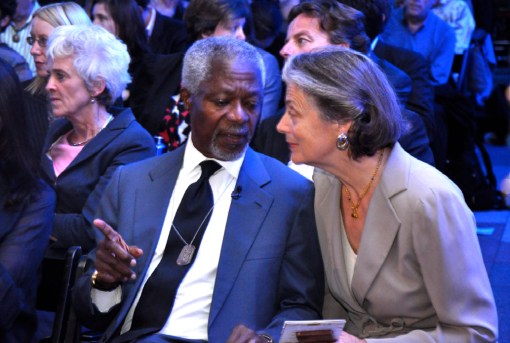
U.N. Secretary General Kofi Annan at the world premiere event in New York on the eve of the United Nationals General Session on Climate Change.

Picture 2

The exterior of The Archive in which Pete Postlethwaite’s character, the archivist, lives.   This animation was produced by animator Greg McKnealley.

Picture 1


Abandon Ship! Follow-up on U.S. Chamber…

1 10 2009

Pendleton_Sinking_Ship

The momentum of disengagement from the U.S. Chamber of Commerce based on their draconian position denying climate change continues. The chamber in recent weeks has challenged a federal Environmental Protection Act finding that greenhouse gases can be regulated by the Clean Air Act.

Nike announced Wednesday that it has resigned from the Board of Directors of the Chamber.  In a statement, Nike said “we fundamentally disagree with the U.S. Chamber of Commerce on the issue of climate change and their recent action challenging the EPA is inconsistent with our view that climate change is an issue in need of urgent action.”

Nike joins PG&E Corporation, PNM Resources and Exelon Corporation— all of whom have left the Chamber in the past week based on the Chamber’s position denying climate change.  Speculation continues that Chamber President Thomas Donohue will be forced to resign based on the defection of member companies and allegations of conflict of interest based on his board position at Union Pacific Railway, a company fighting climate change legislation in part based on the large amount of revenues they receive from the shipment of coal.


Ana’s Playground a winner at Norwich Film Festival

24 09 2009

107_AnasPlay_Kids2

Ana’s Playground received awards for The Best Short Film and Best of The Fest this week at the Norwich Film Festival in the United Kingdom.

In its advance pre-screening at the debut Norwich Film Festival, Ana’s Playground not only won Best Short Film, but Best of The Fest – beating out all the feature films that were screened as well as more than 90 films entered in the competition.

Learn more about the Norwich Film Festival

The world premiere of Ana’s Playground is Friday, September 25 at the Calgary Film Festival.  Information on the Calgary Film Festival is available at their website.

Calgary International Film Festival

Written and directed by Minneapolis film maker Eric Howell, Ana’s Playground is a Oscar worthy story of children subjected to armed conflict.  The mission of the film is to raise awareness of children in conflict and raise funds for Right to Play, an international humanitarian organization that uses sport and play programs to improve health, develop life skills, and foster peace for children and communities in some of the most disadvantaged areas of the world.


A responsibility revolution?

21 09 2009

Picture 1A new survey by Time magazine was highlighted in a recent article written by Richard Stengel: “For American Consumers, A Responsibility Revolution.”  Could this new halo many are happy to be wearing represent some of the most compelling signs of “the new normal”?


The research indicated:

  • 82% of people consciously supported local or neighborhood businesses
  • 40% of people said they purchased a product in 2009 because they liked the political or social values of the company that produced it.
  • 60% of Americans have bought organic products since January
  • 78% of those polled said they would be willing to pay $2,000 more for a car that gets 35 m.p.g. than for a similar one that gets only 25 m.p.g

As the article says, “That’s evidence of a changing mind-set, a new kind of social contract among consumers, business and government. We are seeing the rise of the citizen consumer — and the beginnings of a responsibility revolution.”

Once again, the Time survey adds to the rapidly growing amount of data that indicate we have reached the tipping point where values based marketing and sustainable branding are beginning to rise in importance with customers from all walks of life. Companies who recognize this and infuse sustainable branding into their total customer experience will inevitably be among the winners in the age of accountability.

Read the Time magazine article


Lessons from the U.K.

15 09 2009

british_flag

“This research shows that consumer values do not change, even in a middle of a recession. They want companies to act and cut their carbon footprints, and provide transparent and accessible evidence of action.  We believe companies that take real action will seize the dual benefits of immediate cost savings and a stronger reputation, which is good for business.”

– Harry Morrison, Carbon Trust Standard

New research from the Carbon Trust Standard in the United Kingdom shows that consumers still want to buy green despite the current economic climate, with 62% of consumers saying environmental concerns influence their purchasing decisions—‘the same as a year ago’ and just over a quarter saying they influence them ‘even more’ than in 2008.

Other fun factoids from the research that marketers should be aware of:

  • 66% of U.K. consumers say it’s important to buy from environmentally responsible companies.
  • 14%  said they have voted with their feet by deciding not to buy from a company based on their environmental reputation
  • 25% decided not to buy from a company based on a company’s ethical reputation.
  • 70% of consumers do not feel confident that they can clearly identify which companies are environmentally responsible.
  • 59% are skeptical about the environmental claims companies make.
  • 44% of consumers would like more information on what companies are actually doing to be environmentally responsible.

So sustainable branding requires new forms of communications and embracing transparency and honesty in all facets of a brand presentation.  The research further demonstrated this quest for information that engaged consumers are using to understand whether or not a company is environmentally responsible.  The research indicated the most important criteria they rely on are what they read in the media (38%) and third party endorsement or accreditation (34%).

The least popular factor consumers use to judge whether a company is behaving in an environmentally responsible manner is what advertising tells them (6%).


Congrats WestPac New Zealand: Branding Beyond The Numbers

2 09 2009

We’re interested to follow the development of a new sustainable branding campaign by one of the leading banks in New Zealand – WestPac.  Rather than try to differentiate by low interest rates and car loan messaging in their brand communication, WestPac has launched a multi-media marketing effort that showcases their commitment to sustainability and social responsibility.  

The brand communication plan supports messaging around the 10 goals WestPac has established for sustainability through 2012 and customers can track the bank’s progress on their website.  In addition to tangible sustainability goals such as carbon footprint reduction, the measurement includes community outreach programs such as the volunteer programs to clean up New Zealand’s beaches.

beachclean

We further applaude the smart nature of the communication by portraying one of the bank’s employees as having to learn the new behaviors that add up to sustainability with the line “being sustainable can be tough. we know.”  It’s a great example of a company taking a thought leadership position on sustainability, helping educate their customers on what they can do in their own everyday life, and becoming a catalyst for community action.  Congrats to WestPac for thinking beyond the numbers.

Learn more about WestPac’s sustainability efforts


Study underscores “socially responsible credit gap”.

17 08 2009

DSC_0588“People are willing to pay more for products from socially responsible companies, but almost no companies have any profile as socially responsible.”

PSBA Research

In a study conducted this March, Penn Schoen Berland Associates found that despite significant investments by many major corporations in corporate social responsibility initiatives, Americans have virtually no awareness of who does what, and who does things well.

Some interesting insights from the study first point to the facts that the majority of Americans (despite the recession) want to be associated with socially responsible companies.

  • 75% will pay more for a product from a socially responsible company.
  • 56% say working for a socially responsible company makes a difference.
  • 40% will take a pay cut to work for a socially responsible company.

The study also found that being “honest and trustworthy” was the most important company attribute—ranking higher than “quality” and “value”—regarding who Americans will do business with.

But the most unfortunate (and least surprising) set of findings in this research is how ill equipped Americans are to say what companies are socially responsible.  

  • 70% of those surveyed were unaware of any socially responsible activities of their own employers.
  • There was no correlation between those companies that Americans ranked as being leaders in social responsibility and the actual performance of those companies based on evaluations in the CRO 100. (conducted annually by the Corporate Responsibility Officer Association)

Clearly, this should be a wake up call to the leadership of all companies and those responsible for managing their reputation and brands.  In sum, it suggests there is a huge opportunity to use CSR efforts as a differentiator with an American audience that cares about those issues more than ever before and is placing trust at greater currency than quality and value.  

The call to action is to convert socially responsible practices into branded assets.  But this will require internal corporate silos to be broken down so people responsible for operations, HR and internal communication, PR, marketing branding, advertising, and all other forms of communication are working together around a focused and integrated CSR message.

Read the Corporate Citizenship Study


From Buyer Beware To Seller Beware: IBM’s Study On Corporate Social Responsibility.

12 08 2009

“Three quarters of businesses admit they don’t understand their customer’s corporate social responsibility expectations well.”

 – “Attaining sustainable growth through CSR”,

IBM Institute For Business Value


An interesting study of 250 global business leaders has revealed both the business upside to corporate social responsibility and one of the vulnerabilities – companies who embark on CSR initiatives without a true understanding of the expectations of their customers of those efforts.  The report reveals:

  • 68% of companies are now utilizing CSR as a opportunity and platform for growth.
  • 75% acknowledge the number of advocacy groups collecting and reporting information on their company has increased in the last three years.
  • But only 17% of companies say they really engage and collaborate with their customers regarding CSR activities.

Companies that truly understand the corporate social responsbility expectations of their customers report increased revenues and reduced costs and better differentiated products and services.  They believe they are more effective at improving labor practices, driving sustainability initiatives and aligning philanthropy with business priorities.  They also report having more engaged employees in CSR activities.

Ironically, many companies invest millions of dollars in gaining an understanding customers reactions’ to products and services, but the majority are operating a CSR strategy without insight and collaboration with customers.  The truth is your customer feels entitled to know everything “their brand” is doing.  So we echo IBM’s point of view, today the traditional adage “buyer aware” is now reversed to be “seller beware” — especially if you are unaware of your customers’ expectations regarding your social responsibility practices.

Watch an interview with George Pohle of IBM on the CSR Study


What if my customers say they don’t care?

21 07 2009

  Whatever you can do or dream you can, begin it. Boldness has genius, power and magic in it.”  

                             – Johann Wolfgang von Goethe


“What if my customers say they don’t care?”  

This may be the number one question many companies are wrestling with regarding social responsibility and sustainability strategies.  And is central to the debate of whether it is possible to achive brand differentiation by infusing sustainable practices into messages directed to customers.

It is easy to appreciate how many companies over the past couple of decades have made significant investments to “stay close” to their customers. Brand attribute ratings.  Research departments rebranded as “consumer insights” groups. Tracking studies. Endless focus groups and telephone and on-line surveys.  Trend analysis and more.  Information is good and many sound business strategy decisions have been based on input on the wants and needs of the customer.  But too much information can also lead to an unhealthy paralysis.

So when the research points to data saying that customers don’t care about sustainability—corporate leaders have decisions to make.  This is especially true when we are still buffeted by an uncertain economic climate when many people are struggling financially and not in the position to make the sophie’s choice between being able to afford something they need vs. an alternative that may offer a higher degree of sustainability.  We acknowledge the cold reality that the economy may be holding back customers’ demanding sustainable behaviors, but beware the “sling shot effect” of how quickly this could change when the economic pressures ease.

This is the inflection point that is the very essence of what it means to be socially responsible.  Our way of thinking is that if you can achieve more responsible and sustainable practices (and we acknowledge the practices are not sustainable unless they are profit neutral), you have a moral obligation to do it whether or not your customer says they care.  And we further believe it is a social responsiblity to communicate what you are doing in an effort to educate and inspire your customers to not only appreciate what you are doing, but show them how they should alter their own behaviors for everyone’s benefit.

The next level of consumer insights then is to get deeper into the potential of the responsible and healthy relationship between a company and its customers. True innovation, creativity and positive social change rarely relies on permission.  It insists on the courage to do what is right and transformative and then to communicate the benefits of the innovation to the audience.

I draw the analogy to our society’s history of struggling with the knowledge that smoking tobacco has devasting health consequences.  After the Surgeon General first informed the public of the health hazards of smoking in 1964, it took decades to achieve the broad based awareness, acceptance and change of behaviors (in part because of the addictive nature of the habit).  But “responsible steps” were taken: public service campaigns, packaging warning labels, bans of advertising, bans of sale to minors, bans in public venues, legal action and consequently—millions of smokers quit and millions of non-smokers never started.  Today, some people still make the choice to smoke and to ignore the health consequences, but they are certainly aware of them.  And there is a social stigma that deeply influences healthy behavior for individuals as well as society at large.  None of this would have happened without leaders who were willing to stand up and embrace change as the right thing to do.

Fast forward to today. Even if your customers say they don’t care about sustainability, it is your responsibility to drive to achieve necessary sustainable behaviors into your organization because of your knowledge that it is the right thing to do whether or not your customer will applaud you for it.  The health and social consequences of NOT doing this is no less dramatic than pretending smoking is good for you.  And because it is the right thing to do, it is also imporant to inform your customer of what you are doing and why.  Public education is also a social responsibility.

Imagine if all the tools of today’s instantaneous communication – the internet, digital media, global connectivity, social networks – were available in 1964 when the public first learned about the dangers of smoking tobacco. How much more quickly would have behavior change been accelerated? How many millions of lives might have been improved?  How much suffering might have been avoided?  

We call on all companies to use all the tools and innovation at their disposal to drive sustainable change and communicate the efforts to their customers. Persuade your customers to care, persuade them to take care of themselves and their community.  This is how we will achieve necessary change when the clock is ticking.

There are many examples:  we are inspired by companies like Wal-mart, Tesco and Kingfisher who are driving meaningful sustainable behaviors into their organizations and then boldly yet honestly communicating what they are doing to their customers and how they should get involved.  Don’t wait for permission.


Congratulations to 46664 & Coca-Cola South Africa for Hello!

14 07 2009

Picture 1

Just ran across this moving video that shows an inspiring example of corporate social integration.  In a partnership with the NGO 46664 and using the words and voice of Nelson Mandela, Coca-Cola South Africa is helping raise awareness of the human rights crises that is HIV/Aids in Africa.

Using the iconic power of the Contour bottle, Coca-Cola placed one million empty bottles in random places across the country with a note from Nelson Mandela to further drive for positive living.

46664 International Director Tim Massey said: “The Hello Campaign illustrates the power of partnerships between corporates and charities to realize a common goal — in this case to increase awareness about HIV /Aids. Coca Cola’s generous donation will be used to fund the 46664 outreach activities, while the TV commercial and the outdoor activation will ensure that the 46664 campaign remains highly visible, and that Mr Mandela’s appeal for help is heard by most
South Africans.”

46664 International Director Tim Massey said: “The Hello Campaign illustrates the power of partnerships between corporates and charities to realize a common goal — in this case to increase awareness about HIV /Aids. Coca Cola’s generous donation will be used to fund the 46664 outreach activities, while the TV commercial and the outdoor activation will ensure that the 46664 campaign remains highly visible, and that Mr Mandela’s appeal for help is heard by most South Africans.”

See the Hello video


Trust Gap: A New Landmark Study

25 06 2009

“Actions speak louder than words.  If the public believes that an organization’s first priority is profit maximization, it will be difficult, if not impossible, to build public trust.” – Business Roundtable Institute for Corporate Ethics, Arthur Page Society

A landmark special report was issued today that underscores the deep loss of trust between the public and business.

Read the report 

The topline strategic recommendations provide guidelines to business leaders on the requirements to gain renewed trust with the public.  At is essence, we believe all of these strategies can be summed up as “the golden rule:  treat others as you would like to be treated”.  A timeless axiom that seems to have been forgotten by the leadership of many companies recently.  Hopefully this report will help companies get back to the fundamentals of having a trusting relationship with the public.


Wall Street Journal Report: For companies operating in developing countries, it pays to commit to improving social and environmental conditions.

25 06 2009

IMG_1174

“Here’s a lesson many executives have yet to learn: A commitment to improving social and environmental conditions in the developing countries where a company operates is the key to maximizing the profits and growth of those operations.” – Wall Street Journal

Research reported in the Wall Street Journal indicates those companies that make a commitment to sustainable business practices in developing countries enjoy six key competitive advantages.

  • A sterling reputation.
  • Better employees.
  • More efficient production.
  • A smoother relationship with authorities.
  • Better coordination, internally and with suppliers.
  • Suppliers that are more reliable and flexible.

But importantly, not only is operating in a sustainable and responsible fashion key in developing countries, so is making your customers aware of that commitment.  Increasingly consumers are examining companies social and environmental track records before deciding what products they plan to buy.

Read the WSJ Report


Aberdeen Research: Executives Making Sustainability A Top Priority

25 06 2009

“Research demonstrates that leading companies have made a resoundingly strong business case for the adoption and expansion of genuine, sustainability strategies and initiatives. ” – Aberdeen Group

In a newly released survey of more than 1600 business executives in 700 companies worldwide, sustainability is identified as one of the top 5 corporate priorities in 2009.  The promising report highlights several key insights into current trends, including:

  • The sustainability efforts are being championed by C-suite executives.
  • Budgets are being either maintained or increased.
  • The vast majority of companies already have executive leadership in place to oversee sustainability.
  • Top performing organizations are already achieving strong business benefits —from cost reductions to enhanced brand value.
  • Across all sectors and geographies, responsibility framed strategies have grown in importance, despite the economy.

The research highlights our beliefs that many, many companies have embraced sustainability and social responsibility and are beginning to see positive return on investment for such efforts.  But few organizations have taken advantage of the opportunity to turn these business practices into differentiated marketing assets and brand equities.  Alignment of sustainability actions and brand messaging and experience remains a huge opportunity to enhance corporate reputation and turn customers into engaged brand ambassadors.

Read the Aberdeen Group Press Release


Good News: Marketers Waking Up To The Value Of Sustainable Branding

24 06 2009

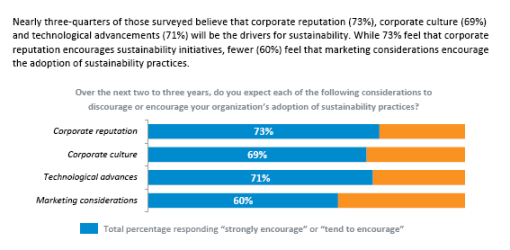
In a very encouraging research survey sponsored by the American Marketing Association and Fleishman Hillard, nearly 60% of marketing and communications professionals believe their organizations will be placing increased emphasis on sustainability issues over the next 2-3 years than in the past.

Read the AMA Fleishman-Hillard Research Study

It is an exciting time to be involved in sustainable branding because more and more companies are recognizing that sustainability can not only be a profitable business practice, but a powerful competitive differentiator.

But in one of the odd contradictions of the survey, while 73% believe corporate reputation will be a driver of adopting sustainability practices, only 60% believe marketing considerations will drive sustainability.  We believe corporate reputation and marketing strategies should be incredibly inter-twined and that communicating and providing ways for people to experience a company’s commitment to sustainability is going to be a brand marketing imperative moving forward.

Picture 1

The truth is that corporate reputation management moving forward requires orchestration of all elements of the organization.  It is critical the internal silos be broken down so corporate social responsibility actions, sustainability initiatives, and brand communication (plus promotion, sponsorship, events, CRM etc) all be choreographed as a part of the overall brand experience.  The customer doesn’t compartmentalize the impressions they take away from a company or a brand so it is important that the organization does not do it either. Now more than ever when it comes to brand reputation management, the right hand and the left hand not only need to know what each are doing—but both hands should be on the wheel!