Men Unmoved By Green Marketing: Radius Research

14 10 2011

New research from global research firm Radius Global Market Research indicates that increased spending on product development and marketing aimed at environmentally conscious consumers may not be getting through to men.

Managing Director of Radius Chip Lister observed “More and more dollars are being dedicated to green marketing initiatives built to associate brands with environmental responsibility but our survey results show that in spite of this increase in spending, the majority of men are not significantly influenced by environmental responsibility when they make a purchase.”

Radius asked U.S. consumers to rate brand attributes across a broad range of products and services in terms of the amount of influence they had on their decision to purchase.

According to the survey, women place importance on a wider range of brand values than do men. Both men and women ranked the same three issues as having the most influence over purchases: (1) Value; (2) Quality; and (3) Trust. After that, however, men appear to be influenced little by any other brand values.

“We found that the value men and women place on environmental responsibility is part of a much broader pattern,” says Lister. “Men are influenced by a much smaller set of brand attributes when they make purchase decisions. Marketers that stray too far from these core attributes run the risk of not being heard. By contrast women seem readily affected in their brand decisions by issues that could almost be considered ‘bigger’, certainly well outside the more direct or tangible deliverables offered by the brand/product.”

Radius’s study was conducted in the third quarter of 2011 and surveyed U.S. households. The firm’s proprietary Know More(TM) panel represents over 3.4 million households, with over 6 million consumers in the U.S. and over 1.5 million consumers in Canada, the U.K. and Europe, Australia and Scandinavia.


Back to the Start: Inspiration from Chipotle

31 08 2011

Willie Nelson sings Coldplay’s riveting “The Scientist” as Chipotle and film-maker Johnny Kelly dramatically depicit how our food and farming system has spun out of control.  


Great effort of sustainable branding from this rare thought leader in the quick service restaurant industry.


Timberland & VF Corporation: New heights or swift decline?

15 06 2011

This week, VF Corporation (the mega holding company for apparel and active lifestyle brands such as Northface, Wrangler, Lee, EastPak) purchased the venerable Timberland brand of sporting footwear for $2 billion.

Of course, Timberland put this positive spin on the news.  Timberland Chief Jeff Swartz said in a statement:   “Timberland is proud of its rich heritage, its track record of success and its reputation as a responsible and environmentally-conscious global citizen, all of which will be preserved and enhanced by becoming part of the VF family of brands.  VF is known for its ability to acquire and grow authentic outdoor brands, while protecting a brand’s unique culture and DNA.”

The jury will be out but many eyes will be watching as the sustainable darling Timberland (ranked number 2 out of 150 companies for sustainability performance by the nonprofit group Climate Counts) will be inspiring to VF. or in the pursuit of stated 10% annual revenue growth – Timberland starts a rocky slide down from sustainability heights of greatness.

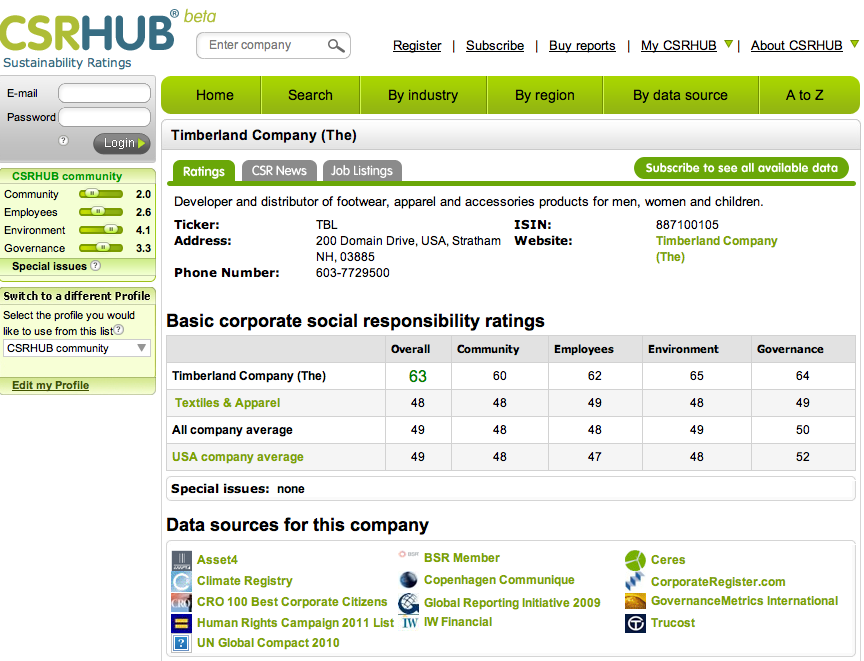
According to CSRHUB.com, VF Corporations current performance on sustainability and overall corporate social responsibility measures is hardly a pace-setter.

VF’s overall CSR ranking is 44 – below the averages for other apparel companies, the average U.S. company and all companies ranked.  Its performance on the environment was 20% below the average for U.S. companies.

Contrary to VF’s rather uninspiring CSR performance, CSRHUB.com gives Timberland an overall ranking of 63 – and a sterling 65 on environment performance measures (vs. 48 for the average U.S. Company).

Timberland’s track record of integrating socially responsible practices and community outreach into their brand marketing efforts make them a poster child for positive sustainable branding.  We worry VF’s leadership won’t cherish the vision and values that has made Timberland special and uniquely sustainable.  Stay tuned.

CSRHUB.com is a great resource for evaluating CSR performance of companies – go here.


ImagePower Survey: 60+% of consumers globally want to buy from environmentally responsible companies.

10 06 2011

Monterey, CA – June 8, 2011– Consumer appetite for green products has increased significantly in the past year, according to findings from the annualImagePower® Global Green Brands Survey, one of the largest global consumer surveys of green brands and corporate environmental responsibility. This year’s survey, which polled more than 9,000 people in eight countries, reveals that consumers worldwide intend to purchase more environmental products in the auto, energy and technology sectors compared to last year. Now more savvy about how green choices in personal care, food and household products directly affect them and their families, global consumers are expanding their green purchase interest to higher-ticket items such as cars and technology.

Industries protecting the environment

Consumers are divided on which industry currently does the best job of protecting the environment. 18 percent of American and 20 percent of Australian consumers say the energy industry does the best job of protecting the environment. By comparison, most of respondents in Germany (19 percent), India (22 percent), China (33 percent) and Brazil (22 percent) cite the technology sector. In the UK, more than 21 percent of consumers say the grocery store industry is the top protector of the environment.

Where consumers are spending

While personal care, grocery and household products are the industries with the greatest representation among the top ten brands list, consumers in the US indicate that they intend to spend more money on green technology, energy and automotive products or services in the next year. When it comes to current usage of green products or services, the 2011 study reveals that the household products and grocery categories have the highest consumer adoption rates in all countries except China, where packaged goods/beverages and personal care are the most used categories, and in Brazil, where household products and personal care dominate. In all countries, consumers indicate that in the coming year they are less likely to buy green packaged goods and beverages, grocery and household products.

“We’re seeing a shift in the ‘In Me, On Me, Around Me’ mentality when it comes to purchasing green products,” said Russ Meyer, Chief Strategy Officer of Landor Associates. “Consumers have a good understanding of how green choices in personal care, food and household products directly affect their families, and they are now seeing benefits like costs savings that attract them to higher cost items like cars and technology.”

Greater perceived value in developing countries

Consistent with last year’s study, more than 60 percent of consumers globally want to buy from environmentally responsible companies. Respondents in all eight countries surveyed indicate that they are willing to spend more on green products. In developed countries such as the US and the UK, roughly 20 percent of those surveyed would spend more than 10 percent extra on a green product.

In developing countries, however, consumers say that green products have a higher inherent value. Ninety-five percent of Chinese consumers say they are willing to spend more on a product because it’s green—with 55 percent of them willing to spend between 11-30 percent more. Similarly 29 percent of Indian consumers and 48 percent of Brazilians say they are willing to spend between 11 – 30 percent more on green products.

“Consumers in developing countries express greater concern over the state of the environment in their countries, which may contribute to their greater willingness to pay more for green products,” said Paul Andrepont, Senior Vice President of Penn Schoen Berland. “Consumers in these markets also differ from their developed-nation counterparts in believing that selection, rather than cost, is the greatest barrier to buying green products. Brands that address these consumers’ very real concern – over air pollution in India or deforestation in Brazil – have the ability to position themselves as premium in the market, a possible competitive advantage.”

Packaging is critical

Packaging continues to be a matter of great concern for US consumers. Seventy-one percent believe companies use too much material in product packaging – though only 34 percent of US consumers say they consciously purchase products that use less packaging. Almost half of American consumers feel that packaging that can be recycled is more important than packaging made from recycled or biodegradable materials.

Packaging also plays a critical role in communicating product benefits to US consumers. More than 50 percent of American consumers say on-pack information helps them understand how green a product is. Additionally, 40 percent say that packaging is their primary source for information on environmental issues regarding products.

“Other than price, the two biggest influences on purchase decisions are on-package messaging and prior experience with the product, both of which satisfy the consumer need to understand a benefit beyond ‘saving the world,’” said Annie Longsworth, global sustainability practice leader for Cohn & Wolfe. “It’s critical for green brands to communicate the real and tangible benefits of their products in addition to being green, which still feels like luxury to many consumers.”

2011 US rankings
For the first time since the inception of the ImagePower® Green Brands Study in 2006, the four brands perceived to be the greenest are “born green” companies. The full list includes:

  1. Seventh Generation
  2. Whole Foods
  3. Tom’s of Maine
  4. Burt’s Bees
  5. Trader Joe’s
  6. The Walt Disney Company
  7. S.C. Johnson
  8. Dove
  9. Apple
  10. Starbucks, Microsoft (tied)

“When we analyzed the approach of the top ten brands companies, using our Esty Environmental Scorecard™, it was clear that the winners achieve a product-value-information trifecta,” said Amy Longsworth, partner at Esty Environmental Partners. “The top brands offer clear price value through co-benefits: a great innovative product that meets my functional needs plus green attributes that meet my values needs. These companies also tend to have robust life-cycle insight and complete sustainability strategies across their value chains, which enable them to draw from rich experience and data for their consumer communications.”

Methodology

The seventh annual Green Brands study polled more than 9,000 people in eight countries —including the United States, the United Kingdom, China, Brazil, India, Germany, France and Australia—and was conducted by WPP agencies (NASDAQ: WPPGY) Cohn & Wolfe, Landor Associates and Penn Schoen Berland Associates (PSB), as well as independent sustainability strategy consulting firm Esty Environmental Partners. The Green Brands Study identifies emerging trends related to consumer perception and purchasing behavior of “green” products. The study was conducted online among the general adult population between April 2, 2011 and May 3, 2011. It has a margin of error of +/- 3.0%. In China, India, and Brazil, respondents were from tier-one cities.

To view 2011 global findings, click here. For US findings, click here.


Kudos to Coke: Appoints Global Chief Sustainability Officer

30 05 2011

Congratulations to Coca-Cola with its appointment of former Chief Marketing Officer Beatriz Perez to Chief Sustainability Officer.

Under the vision of CEO Muhtar Kent, Perez will be responsibile for integrating sustainability initiatives into brand and marketing efforts and further demonstrate its monitoring and improving the commitment to the moderate impact of its products and operations on the environment.

We also find it notable that the new office of sustainability at Coca-Cola will include leaders responsible for corporate social responsibility, environment and water, external affairs and sustainability strategy and communication.

Read the news release below.

May 23, 2011 – The Coca-Cola Company (NYSE: KO) has appointed it first Chief Sustainability Officer (CSO) and created a new global Office of Sustainability in an effort to better integrate ongoing initiatives.

Beatriz Perez, who is currently Chief Marketing Officer for Coca-Cola North America, will serve as CSO beginning July 1. She will work to integrate Coca-Cola’s sustainability initiatives in the areas of water, climate protection, packaging and recycling.

“We have made significant progress with our sustainability initiatives, but our current approach needs focus and better integration to further accelerate our system sustainability agenda and meet our 2020 Vision goals,” said Muhtar Kent, Chairman and CEO, The Coca-Cola Company. “We are realigning this important work to create a unified team, strategy and business plan that connects our sustainability work and actions.”

Under Perez’s leadership, the Office of Sustainability will create and oversee Coca-Cola’s integrated global sustainability strategy; set goals and commitments; assess and drive scaled investments; and steward and track all global partnerships and key sustainability projects.

Reporting to Perez, the new team will include John Reid, Vice President, Corporate Social Responsibility; Charlotte Oades, Global Director, Women’s Economic Empowerment; Abby Rodgers, Vice President, Sustainability Strategy and Communication; Jeff Seabright, Vice President, Environment and Water; and Lisa Manley, Group Director, Corporate External Affairs.

Perez will report to Executive Vice President and Chief Administrative Officer Alex Cummings.

Kent said Perez is uniquely qualified for the role based on her passion for sustainability and deep experience at the Company, including the incorporation of sustainability initiatives into Coca-Cola’s North American marketing programs.


LA TIMES: Skepticism grows over products touted as eco-friendly.

27 05 2011
Great article below by Tiffany Hsu from the Los Angeles Times highlight consumer’s confusion over eco-branded products. According to a recent survey, 65% of consumers want a single seal identifying a green product, similar to the way beef is labeled by the U.S. Department of Agriculture.
But for now, there’s a swarm of companies that issue green certification, endorsements and labels for a fee.
A word of warning for all marketers that sustainable branding is not about false marketing claims and green gimmicks.  It is about an authentic commitment to providing responsible and sustainable brands for the future of the planet and the protection of mankind.
By Tiffany Hsu, Los Angeles Times

May 21, 2011

To Marina Meadows, green may be the new white.When she goes shopping these days, Meadows is often overwhelmed by a bevy of products touted as green, from Earth-friendly dish soaps and bamboo-derived towels to eco-detergents and plant-based soda bottles.But the Santa Monica resident, 26, said that while she is willing to pay extra to help the environment, she’s often not sure how much of the labeling she should believe.”Sometimes, I wonder if any of it’s really green or if it’s all a marketing scheme,” Meadows said.With booming interest in the environment, more companies are trying to cash in by promoting themselves and their products as green.

But environmentalists and some consumers are crying foul, saying that many companies are making the products out to be greener than they really are, a practice they call greenwashing.

The term caught on when hotels began asking guests to reuse towels, saying they were trying to conserve water, though skeptics said it was really to skimp on laundry costs.

These days, greenwashing is reaching “epidemic proportions,” according to advertising firm Ogilvy & Mather, which has been pushing for accurate environmental marketing.

“If we allow companies to get away with exaggeration, consumer skepticism will become cynicism and they’ll stop choosing green products at all,” said Scott McDougall, chief executive of eco-marketing company TerraChoice.

Last year, TerraChoice counted 5,000 items in retail stores that claimed to be green, a 73% increase from the year before. But on every toy and 95% of home and family products, at least one eco-friendly claim turned out to be misleading or false, the company found.

Some efforts just seem a bit odd: Plastic Barbie dolls can now sport handbags and accessories made from recycled materials.

“Most companies are engaged in incremental tinkering — symbolic actions without any real substance,” said Kumi Naidoo, executive director of Greenpeace International.

But no one can agree on what exactly makes a product green and therefore what exactly constitutes greenwashing.

As a result, federal regulators have had difficulty setting standards to regulate green labeling. The Federal Trade Commission has a voluntary guideline for eco-advertising, but it is 20 years old. It is being updated.

According to a recent survey, 65% of consumers want a single seal identifying a green product, similar to the way beef is labeled by the U.S. Department of Agriculture.

But for now, there’s a swarm of companies that issue green certification, endorsements and labels for a fee.

One such program, the EcoAd from EcoMedia, a division of CBS Corp., has earned the ire of some environmental groups. They complained to the FTC that CBS was being potentially deceptive when it sells green leaf badges for advertisers to use in commercials.

“An Eco-label that promises advertisers a green image while telling them they don’t need to do anything to earn that image is the very definition of greenwashing,” said Michael Green, executive director of the Center for Environmental Health, in a statement.

A portion of all EcoAd proceeds go to environmental projects, said EcoMedia President Paul Polizzotto. And although there aren’t disclaimers on the ads themselves, viewers are directed to a website noting that the leaf symbol is not meant as an endorsement of the companies that use it.

“If an advertiser wants 30 seconds of your time, they might as well improve the quality of your life, and that’s the furthest thing from greenwashing,” Polizzotto said. “What I usually see in media is a lot of talk about greening and not a lot of action.”

Labels play a major role in helping consumers decide between products claiming to be green. Nearly 40% said they rely on labels, according to a report from the eco-marketing company Shelton Group.

“Many don’t trust manufacturer motives, but they end up making a decision at the shelf based on the packaging, usually just buying the brands they’ve always bought,” said Suzanne Shelton, chief executive of the group.

It can be a tricky call for consumers, who are regularly met by a vast array of vaguely defined green catchphrases such as “natural,” “clean” and “organic.”

Even manufacturers often don’t know the difference between designations such as “compostable” and “biodegradable,” researchers said. Biodegradable goods break down into carbon dioxide, water and biomass over time, while compostable items do the same while also releasing nutrients into the soil, which can be good for growing plants.

“Companies don’t really understand the science behind it and they don’t question it,” said Steven Mojo, executive director of Biodegradable Products Institute, a testing group. “They think that their packaging or product is somehow going to magically disappear in a landfill.”

Claire Scarisbrick, 26, recently spent half an hour sifting through eco-friendly body wash options atWhole Foods. The dental hygienist and chef, who lives near West Pico Boulevard and South La Brea Avenue, said she researches unfamiliar brands on her iPhone and avoids green products from large companies out of fear of being “duped.”

She likes locally produced products that aren’t heavily processed. She didn’t buy a cosmetic company’s “natural” line of face washes after she compared it to the company’s standard product and found little difference in the ingredients.

“I don’t want to be putting something with 30 chemicals in it onto my skin,” she said. “If I’ve got the money, I’d much rather spend more of it on something that I believe in, not something that’s just easily accessible.”

tiffany.hsu@latimes.com


Green is Universal Reports Green Consumersim and Brand Loyalty Are On the Rise.

27 04 2011

A new report from Green Is Universal reports that 78% of consumers believing more than ever that buying green is a way to shop with their values and ethics (up 9 points vs. two years ago).  The poll also reveals that an overwhelming majority of consumers feel they have a personal responsibility to take care of the earth (93%), and believe that if we don’t do so, there will be negative consequences for future generations (91%).  Nine out of 10 consumers say companies have a social responsibility to protect the environment.

Sixty-eight percent (68%) of consumers say it’s worth paying more for a green product or service if it is a brand they trust (an increase of 8 points vs. 2 years ago).”These findings underscore that consumers are increasingly shopping with their values, particularly when it comes to the environment,” said Beth Colleton, Vice President, Green is Universal. “This is an enormous opportunity for marketers to communicate their brand’s commitment to green, as a way to build both loyalty and returns for their business.”

Not only do consumers hold themselves accountable when it comes to protecting the earth, but they believe companies should be held to the same standard. and three-quarters (77%) say they have a more favorable impression of companies that promote environmental causes. Putting their money where their mouth is, findings show substantially more consumers who say they have boycotted a company/product in the past year, because it had policies and practices that were not environmentally responsible (27%) (up 8 points from 2009).

Additional highlights from a related but separate Green is Universal poll on re-use, “From Trash To Treasure,” include the following:

  • 62% say they are making a conscious effort to purchase products made by environmentally responsible companies
  • 68% say they are paying more attention to whether products are made from recycled materials
  • 84% appreciate companies who make it easier for them to recycle
  • 78% appreciate companies who make using recycled materials a priority because it provides them with an easy way to help the environment
  • 57% say they are likely to encourage others to buy products that are made from recycled materials
Reposted from Sustainable Life Media.


Mainstream Green: Moving Sustainability from Niche to Normal

21 04 2011

Ogilvy Earth issues an important report on moving sustainability for niche to normal.

The report has some interesting insights into how marketers are creating more confusion and causing more harm than good in terms of getting people to adopt sustainable products into their everyday lifestyles.  To quote Oglivy Earth:

Topline: We’ve been getting the message all wrong

Our research shows that when it comes to motivating the American Mainstream, marketers, governments, and NGOs have been approaching messaging and marketing around sustainability all wrong. Indeed much of what we’ve been doing has actually been cementing the Green Gap by making green behavior too difficult and costly from a practical, financial, and social standpoint.

The study found that 82% of Americans have good green intentions but only 16% are dedicated to fulfilling these intentions, putting 66% firmly in what we’re calling the Middle Green.

Other highlights from the report.

  •  82% of our respondents said going green is “more feminine than masculine.” No wonder then that men clustered to the left, less- green side of our continuum while the greener, right side was dominated by women.
  • 80% of Americans would rather cure cancer than fix the environment.
  • 73% percent of Americans opted for the known, mainstream brand. A legacy of inferior performance prevents consumers from taking the leap to an unknown, eco brand.
Kudos to Ogilvy Earth for helping us better understand the barriers we need to overcome to move green to the mainstream.

Read the executive summary here.


Sensible advice from VW Canada.

19 04 2011


Props To Starbucks: Free Coffee In Your Travel Mug On Earth Day.

18 04 2011

To celebrate Earth Day, Starbucks is offering free coffee to everyone who chooses to get their coffee in a travel mug vs. the paper cup.  A great example of smart sustainable branding.


Brilliant Work: The Sustainability & Branding Survey

7 04 2011

“If you are striving to be more sustainable, your actions need to demonstrate that in everything you do,

which means new ways of thinking about branding.”

Kudos to the Sustainable Branding Collaborative for their new research report surveying innovators and early adopters in the sustainable business environment.  Some of the key interesting findings that stand out of the work include:

  • 63% say brand and 59% say sustainability is of primary importance to their organizations success.
  • 73% say sustainability investments yield positive returns.
  • 47% advise firms that are branding more sustainable products to “walk their talk”.

You can download a summary of their survey here.

The Sustainability & Branding Survey


Edelman Report: 90% of UK Consumers believe brands should support society as well as business.

27 03 2011

Recent research from Edelman Worldwide shows that two thirds of UK consumers think brands spend too much on advertising and should invest more in social causes and promoting them through their advertising.

Nine out of 10 consumers believe that brands need to place at least the same weight on society’s interests as those of business and do more than just give money to good causes.

The report claims that more than 50% of consumers say “purpose” is more important than design, innovation or brand loyalty as a purchase trigger, when quality and price are the same.

Nearly two-thirds of UK consumers say that they will buy and recommend products and services from companies that support a good cause.

Carol Cone, managing director of brand & corporate citizenship at Edelman, says: “Cause related-marketing, as we know it, is dead. It is no longer enough to slap a ribbon on a product. Consumers seek deeper involvement in social issues and expect brands and companies to provide various means of engagement. We call this the rise of the ’citizen consumer’.”

Key findings from the report

  • 60% believe brands should promote good causes through their advertising to help raise public awareness.
  • 58% believe brands spend too much advertising or marketing and they should put more money into some good cause or social purpose.
  • 54% believe brands should share a portion of their advertising space with organisations that support good causes.
  • 57% feel that it is no longer enough for companies to simply give money away to good causes; they need to integrate them into their day-to-day business.
  • 56% have more trust in a brand that is ethically and socially responsible.


What Would You Add or Delete? The social forum for the future of marketing, advertising and global good.

20 01 2011

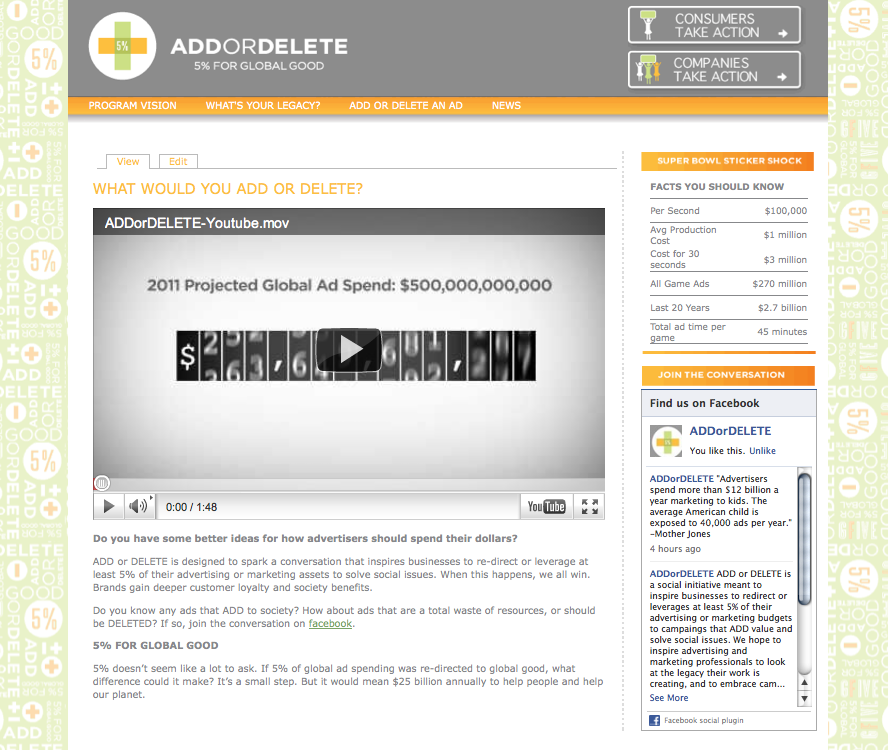
Kudos to ADDorDELETE, the brainchild of the tribe at Haberman.  It’s a fresh yet startling conversation centered around the power of marketing and advertising to ADD to society and address social problems and challenges.

By challenging the global marketing industry to re-direct 5% of the $500 billion global ad spend to causes, social problems and people that need help, we can unleash $25 billion for global good.

Learn more at the Add or Delete website

Join the conversation on facebook

Let’s call out all those ads that we’d prefer to delete.  Those messages that attempt to entertain at the expense of others.  The ads that just create noise and empty moments.  ADDorDELETE challenges everyone to take stock – what legacy do you want to leave?  Are you ADDING?  Here’s to less self-promotion and more social improvement.


“Activate CSR through Brands”: Coca-Cola Enterprises

13 12 2010

Congratulations to the wise mind of Joe Franses of Coca-Cola Enterprises who calls on markets to harness the power of brands to engage consumers in the sustainable brands movement.

We’ve long called on a new take for CSR – corporate social responsibility.  The problem with CSR as it is currently defined and often practiced is that it lives at the “corporate” level.  The issue with this approach is that most consumers don’t want to have relationships with corporations.  What they do have is relationships with BRANDS.  Activating social responsibility at the brand level is key to get consumers to take notice of efforts and get engaged in the movement.  By selecting socially responsible efforts that are authentic to a brand’s values, consumers are much more likely to get engaged.

Note this report from Sustainable Life Media:

While speaking at the conference, Mr. Franses also stressed that innovation will be a major driver of business sustainability moving forward – and success will depend on how well brands can engage consumers in the process. The first step in this process, he said, will be for companies like Nestle, Coca-Cola Enterprises and Unilever to work at aligning their top-down management initiatives with brand agendas around sustainability more effectively.


Get engaged with Green My Parents

30 09 2010

Green My Parents is a new campaign designed to engage teens in the movement to make their homes, lives and families more sustainable.  The movement is also encouraging kids to ask brands to support the causes they care about.

One kid proclaims “this is the moonshot of our generation, but we need your help”.

Read more about the campaign and watch another video at Sustainable Life Media and how it is focused in engaging brands and kids in a common purpose to help the planet.

Sign up for the movement at greenmyparents.com


83% of people want to see more cause marketing. New report from Cone Research.

20 09 2010

Released last week, the 2010 Cone Cause Evolution Study reports significant new evidence supporting the rise in importance of cause related marketing.  Despite overall low consumer confidence and prolonged unemployment due to the recession, the one thing consumers are confident in is their belief in brands that support worthy causes.

Higlights of the report show that:

  • 88% of people say it is acceptable for comapnies to involve a cause or issue in their marketing.
  • 85% have a more positive image of a product or company that supports a cause they care about.
  • 80% are likely to switch brands, similar in price and quality, to one that supports a cause.

The report also highlighted the powerful role of linking moms and causes in brand purchasing behavior.

Of mom’s surveyed, 95% say cause marketing is acceptable and 92% say they want to buy a product supporting a cause.

You can get a free copy of the Cone Study here.


PR Week: PR firms fail to meet sustainability communication needs.

3 09 2010

In an article written by Chris Daniels, PR Week shares the results of a new survey by Verdantix which highlights the gap between claims and reality about public relations firms which offer sustainability communication consulting expertise.

Read the article in its entirety below.

Most PR firms fail to meet the needs of clients when it comes to sustainable communications.

That is according to a new report from Verdantix, a sustainable business analyst firm, which evaluated 18 firms that claim to offer expertise in sustainable communications.

The report found a majority of the agencies–11 of them–need to seriously improve their offerings. “It seems like some agencies claim a practice, but there’s really not much there,” says Jim Nail, principal analyst for Verdantix.

In fact, the report singled out just two firms (OgilvyEarth and Cone) as leaders in sustainable communications. Four firms were characterized as being on the verge of leadership:  Context America, Ketchum, Edelman and Cohn & Wolfe.

The evaluations are based on interviews with key agency executives, publicly available information, and off-the-record interviews with 15 clients at firms with global revenues of over $2 billion.

PR firms face numerous challenges in relation to sustainable communication—particularly around the fact sustainability is often a complex subject that requires the guidance of third-party expertise, says Nail.

“Almost every agency we talked to has some relationship with NGOs, but they aren’t systematic about bringing them in. They’ll say, ‘Oh, we’ve done some sustainability work with this client so we know what we need to know,’” he says. “I don’t think that’s  sufficient.”

That sentiment was echoed by clients interviewed for the report, who felt big PR firms lack the required knowledge. In fact, six of the 15 firms engaged specialist CSR or sustainability consultants to provide missing expertise.

One of the few firms applauded by the report for its approach on bringing in third-party experts is OgilvyEarth, which has global sustainability advisers who help the agency develop regionally-based experts.

“We rely on our advisers to keep us honest, ensure our work is up-to-date, and to create additional contacts for us, because sustainability is highly networked,” says Seth Farbman, senior partner, worldwide managing director for OgilvyEarth. “If you don’t surround yourself with people who are deeply involved in sustainability, you’ll always be playing catch-up.”

The report found that PR firms also face a lack of client awareness about their sustainable communication offerings. When clients were asked to name a firm known for their sustainability work, no firm was mentioned by more than three companies. In terms of agencies that were top of mind, OgilvyEarth, Edelman, and Cone topped the list.

“That was probably the biggest disappointment for me—that our capabilities weren’t more well-known,” says Dave Chapman, partner at Ketchum West who oversees the agency’s sustainability practice.

He says even before receiving the report, it was an issue Ketchum was addressing. “When this report was being done, we didn’t have a [Web] page that was dedicated to our sustainability point of view and capabilities, but we do now. We didn’t have an Intranet site where we put a lot more information about process for our own internal sources, but we do now,” says Chapman. “We soon hope to be nipping at the heels of Ogilvy and Cone.”

The report also gave the 18 firms poor marks in terms of demonstrating the kind of transparency around sustainability reporting they espouse to clients. “I was shocked to hear they’re not walking the talk,” says Nail.

Edelman was the first PR agency to issue its own CSR report, in 2005, but hasn’t had one since. Chris Deli, global head of CSR and sustainability practice for Edelman, says the agency has made a financial commitment to complete its second full report later  this fiscal year.

The investment into CSR reporting will help put its own policies under a microscope, as well as help inform Edelman’s client work, says Deli. “We’ll be looking not only at our social and environmental impact on a global level, but also what our individual offices are doing.”


Brands and Branding For Good.

29 08 2010

“There must be a better way to make the things we want, a way that doesn’t spoil the sky, the rain or the land.”
– Sir Paul McCartney

Coming to South Africa in October is a conference entitled Brands and Branding for Good.

Congratulations to the organizers and the roster of speakers representing a wide range of global brands including IBM, McDonald’s, Nike, and Dell for coming together to understand and demonstrate how brands can work for the public good.

Learn more about the Brands and Branding For Good Conference here


Peter Clarke: 5 Branding Commandments for the Post-Crash Economy

29 08 2010

A very inspiring article by Peter Clark on 5 compelling branding commandents for marketers and agencies moving forward.  His straightforward summary of branding principals for a post-recession era reminds us that consumer’s expectations for brand behavior are forever changed.

Peter’s commandants are:

1.  Simplicity

2. Transparency

3. Responsibility

4.  Sustainability

5.  Affordability

Read the 5 Commandments Article Here.

Grass Image:  Dennis Wong


Counter-Intuitive Intelligence: Recession = Responsibility

29 08 2010

This article from Brandweek demonstrates that the recession has affected not only consumer wallets, but also brand perception. Kudos to the folks at Landor Associates, Penn Schoen Berland and Burson-Marsteller for their new consumer survey demonstrating that transparency and corporate responsibility have become far more important to consumers in a tough economy.

The survey measured consumer perceptions of corporate social responsibility practices and ranked companies that are the most responsible. It found that despite the recession, 75% of consumers believe social responsibility is important, and 55% of consumers said they would choose a product that supports a particular cause against similar products that don’t.

“[Corporate social responsibility] can be the olive branch between struggling industries and consumers in cases where consumers are experiencing the highest expectations and the biggest let downs,” said Scott Osman, global director of Landor’s citizenship branding practice, adding that the industries with brands that have performed poorly, are the ones in which responsibility is valued most.

While 38% of respondents plan to spend the same or more on products or services from socially responsible companies, more than half of consumers are unsure about the meaning of CSR. And those who do know what the term means, define it as “giving back to the local community” (20%), and as “self-regulation and accountability” (19%).

Additionally, the survey found that 70% of consumers are willing to pay a premium for products from socially responsible companies. In fact, 28% are willing to pay at least $10 more. That means companies have an opportunity to differentiate themselves if they can communicate clearly how they give back to their employees, communities, and the environment, per the survey.

When asked to name the most surprising findings, Osman pointed to the fact that nearly 50% of 18-24 and 25-34 year olds are more likely to take a pay cut to work for a socially responsible company—a much higher percentage than any other age group. However, Osman added, “a year where there seems have been so much responsibility expressed, especially in light of the earthquake in Haiti, only 11% of Americans say they’ve heard corporate CSR communications.”


What if my customers say they don’t care?

21 07 2009

  Whatever you can do or dream you can, begin it. Boldness has genius, power and magic in it.”  

                             – Johann Wolfgang von Goethe


“What if my customers say they don’t care?”  

This may be the number one question many companies are wrestling with regarding social responsibility and sustainability strategies.  And is central to the debate of whether it is possible to achive brand differentiation by infusing sustainable practices into messages directed to customers.

It is easy to appreciate how many companies over the past couple of decades have made significant investments to “stay close” to their customers. Brand attribute ratings.  Research departments rebranded as “consumer insights” groups. Tracking studies. Endless focus groups and telephone and on-line surveys.  Trend analysis and more.  Information is good and many sound business strategy decisions have been based on input on the wants and needs of the customer.  But too much information can also lead to an unhealthy paralysis.

So when the research points to data saying that customers don’t care about sustainability—corporate leaders have decisions to make.  This is especially true when we are still buffeted by an uncertain economic climate when many people are struggling financially and not in the position to make the sophie’s choice between being able to afford something they need vs. an alternative that may offer a higher degree of sustainability.  We acknowledge the cold reality that the economy may be holding back customers’ demanding sustainable behaviors, but beware the “sling shot effect” of how quickly this could change when the economic pressures ease.

This is the inflection point that is the very essence of what it means to be socially responsible.  Our way of thinking is that if you can achieve more responsible and sustainable practices (and we acknowledge the practices are not sustainable unless they are profit neutral), you have a moral obligation to do it whether or not your customer says they care.  And we further believe it is a social responsiblity to communicate what you are doing in an effort to educate and inspire your customers to not only appreciate what you are doing, but show them how they should alter their own behaviors for everyone’s benefit.

The next level of consumer insights then is to get deeper into the potential of the responsible and healthy relationship between a company and its customers. True innovation, creativity and positive social change rarely relies on permission.  It insists on the courage to do what is right and transformative and then to communicate the benefits of the innovation to the audience.

I draw the analogy to our society’s history of struggling with the knowledge that smoking tobacco has devasting health consequences.  After the Surgeon General first informed the public of the health hazards of smoking in 1964, it took decades to achieve the broad based awareness, acceptance and change of behaviors (in part because of the addictive nature of the habit).  But “responsible steps” were taken: public service campaigns, packaging warning labels, bans of advertising, bans of sale to minors, bans in public venues, legal action and consequently—millions of smokers quit and millions of non-smokers never started.  Today, some people still make the choice to smoke and to ignore the health consequences, but they are certainly aware of them.  And there is a social stigma that deeply influences healthy behavior for individuals as well as society at large.  None of this would have happened without leaders who were willing to stand up and embrace change as the right thing to do.

Fast forward to today. Even if your customers say they don’t care about sustainability, it is your responsibility to drive to achieve necessary sustainable behaviors into your organization because of your knowledge that it is the right thing to do whether or not your customer will applaud you for it.  The health and social consequences of NOT doing this is no less dramatic than pretending smoking is good for you.  And because it is the right thing to do, it is also imporant to inform your customer of what you are doing and why.  Public education is also a social responsibility.

Imagine if all the tools of today’s instantaneous communication – the internet, digital media, global connectivity, social networks – were available in 1964 when the public first learned about the dangers of smoking tobacco. How much more quickly would have behavior change been accelerated? How many millions of lives might have been improved?  How much suffering might have been avoided?  

We call on all companies to use all the tools and innovation at their disposal to drive sustainable change and communicate the efforts to their customers. Persuade your customers to care, persuade them to take care of themselves and their community.  This is how we will achieve necessary change when the clock is ticking.

There are many examples:  we are inspired by companies like Wal-mart, Tesco and Kingfisher who are driving meaningful sustainable behaviors into their organizations and then boldly yet honestly communicating what they are doing to their customers and how they should get involved.  Don’t wait for permission.


Good News: Marketers Waking Up To The Value Of Sustainable Branding

24 06 2009

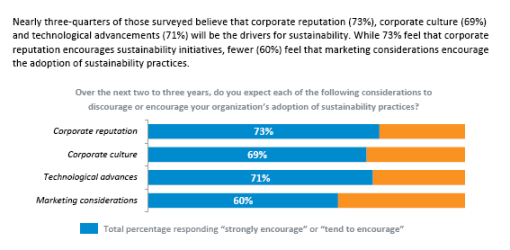
In a very encouraging research survey sponsored by the American Marketing Association and Fleishman Hillard, nearly 60% of marketing and communications professionals believe their organizations will be placing increased emphasis on sustainability issues over the next 2-3 years than in the past.

Read the AMA Fleishman-Hillard Research Study

It is an exciting time to be involved in sustainable branding because more and more companies are recognizing that sustainability can not only be a profitable business practice, but a powerful competitive differentiator.

But in one of the odd contradictions of the survey, while 73% believe corporate reputation will be a driver of adopting sustainability practices, only 60% believe marketing considerations will drive sustainability.  We believe corporate reputation and marketing strategies should be incredibly inter-twined and that communicating and providing ways for people to experience a company’s commitment to sustainability is going to be a brand marketing imperative moving forward.

Picture 1

The truth is that corporate reputation management moving forward requires orchestration of all elements of the organization.  It is critical the internal silos be broken down so corporate social responsibility actions, sustainability initiatives, and brand communication (plus promotion, sponsorship, events, CRM etc) all be choreographed as a part of the overall brand experience.  The customer doesn’t compartmentalize the impressions they take away from a company or a brand so it is important that the organization does not do it either. Now more than ever when it comes to brand reputation management, the right hand and the left hand not only need to know what each are doing—but both hands should be on the wheel!