The anthem for 2012.
This cut was put together by Vivek Chauhan, a young film maker, together with naturalists working with the Sanctuary Asia network (www.sanctuaryasia.com).
The anthem for 2012.
This cut was put together by Vivek Chauhan, a young film maker, together with naturalists working with the Sanctuary Asia network (www.sanctuaryasia.com).

The EPA will also test water at 60 homes to assess whether any residents are being exposed to hazardous substances, the agency said in a statement.
“EPA is working diligently to understand the situation in Dimock and address residents’ concerns,” EPA Regional Administrator Shawn M. Garvin said in a statement. “Conducting our own sampling will help us fill information gaps.”
Residents and activists protested outside a venue where EPA Administrator Lisa Jackson was speaking in Philadelphia last week, urging her to force Houston-based Cabot to clean up wells they say were contaminated after drilling started nearby. The company is using hydraulic fracturing, or fracking, a process that injects water and chemicals to free gas in rock.
Cabot has no data that indicates natural gas operations are the cause of the concerns identified by the EPA, George Stark, a company spokesman, said. He said the agency is conducting an “unwarranted investigation.”
“Cabot looks forward to helping educate the U.S. EPA on the ground water and geological features of Susquehanna County,” where Dimock is located, Stark said in an e-mail.
The agency offered water to the families earlier this month and then reversed the decision the next day. The EPA now has agreed to start water delivery tomorrow, Michael Kulik, an agency spokesman, said in an e-mail.
Dimock residents say their water went bad more than three years ago. In an agreement with state environmental regulators, Cabot pledged to install methane-removal equipment on wells and set aside $4.1 million to pay residents who say they were harmed. The company didn’t admit fault.
Some residents settled. Others went to court and their lawsuit is pending. EPA officials visited residents at the end of last year, and told some not to drink their well water.
In Pennsylvania, the economic losses from possible environmental damage could be high. Drilling in the state’s portion of the gas-rich Marcellus Shale formation could generate $20 billion for the state’s economy by 2020, up from $13 billion last year, according to an industry-funded study published by researchers from Pennsylvania State University.
Separately, the U.S. House Oversight Committee led by California Republican Darrell Issa today asked the Energy Department for transcripts of interviews regarding fracking.
In an e-mailed statement, Issa said the committee also asked Jackson to explain documents obtained by the panel that “appear to indicate” that the EPA “is planning for a future where new supplies of natural gas are limited because of the agency’s concern about the environmental impacts” of the process.
To contact the reporter on this story: Mark Drajem in Washington at +1-
Are you surprised?
24/7 Wall Street’s analysis was based on a rigorous study of two dimensions. One is public research about consumer satisfaction, customer care, pricing of products and services, and brand impressions. Wall St. research takes into account another set of factors, which include present earnings, profit forecasts, product development and quality, and brand valuations.
Here is how they did their research.
“We examined each company based on several criteria. We considered total return to shareholders in comparison to the broader market and other companies in the same sector during the last year. We reviewed financial analyst opinions on those companies that are public. We analyzed data from a broad array of sources, including Consumer Reports, JD Power, the MSN/Zogby Poll, ForeSee and the University of Michigan American Customer Satisfaction Index. We also considered negative press based on 24/7 Wall St.’s analysis of media coverage and the Flame Index, which uses a proprietary algorithm to review more than 12,000 websites and ranks companies based on the frequency of negative words. Finally, we considered the views of taxpayers, Congress and the White House — where applicable.”
Congratulations to Portfolio 21 Investments in Portland for a remarkably blunt, clear and inspiring strategic approach to managing investments in “the age of volatility.”
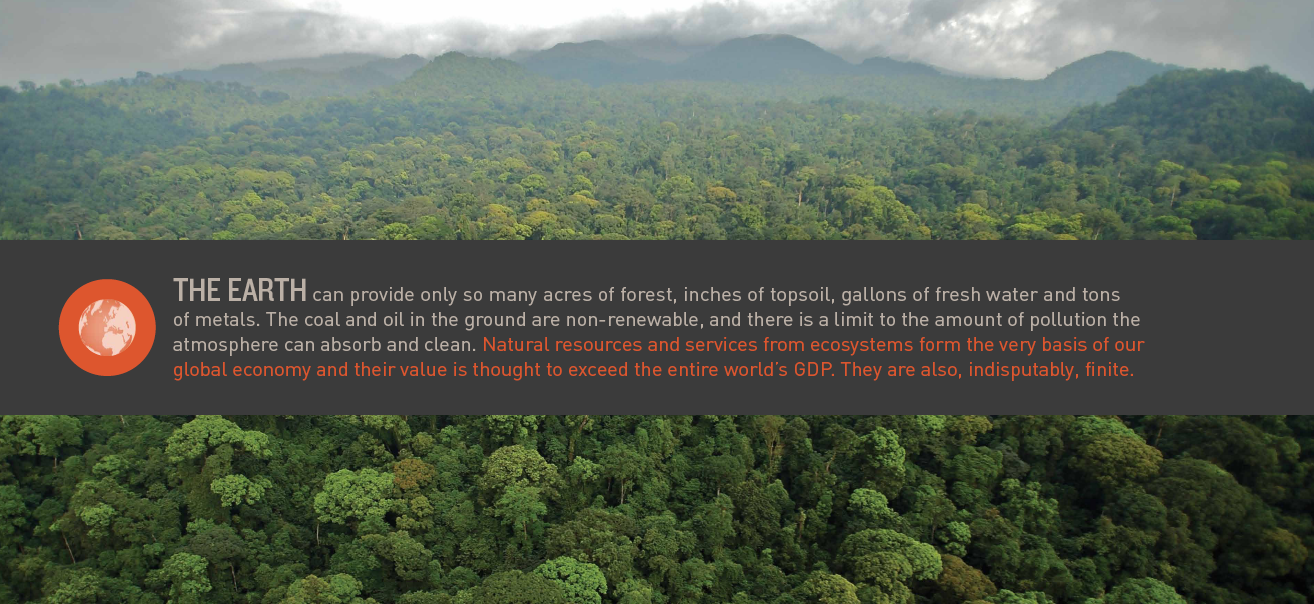
In one of the most compelling presentations regarding the need to re-think investment criteria in a world of ecological crises, Portfolio 21 Investments calls for re-thinking traditional criteria for investment and puts forward a unique pov to navigate a new landscape. They are making a commitment to factor in new levels ecological risks and to seek the rewards from those that are bringing forward innovation and new ways to confront new realities.
By evaluating companies’ energy and resource efficiencies as well developing new strategies for operating in an ecologically limited world, Portfolio 21 is bringing timely and refreshingly enlightened thinking to the investment sector.

Portfolio 21’s report cautions: “Investors must be aware of a stark and fairly recent truth: Our economic system has become so large that is is overpowering and threatening the natural systems that support it. Our failure to anchor the economy within the earth and its systems facilitates a fallacy: the belief that the economy can grow infinitely, regardless of the planet’s physical limits.”

Kudos to Portfolio’s 21 fresh and importantly provocative pov. Let’s hope investors listen and companies heed the wisdom.

The American Sustainable Business Council (ASBC), a coalition of 45 business organizations, urged President Obama to reject the Keystone XL Pipeline.
“Contrary to the claims of the U.S. Chamber of Commerce, American Petroleum Institute and other pipeline advocates who threaten political retaliation if the pipeline is not approved, Keystone XL would not deliver on jobs, energy, safety or economic competitiveness,” said ASBC Executive Director David Levine.
“Keystone is a sneak attack on American’s wallets,” said Frank Knapp, Vice Chairman of ASBC and CEO of the South Carolina Small Business Chamber of Commerce.” Its real aim is to import oil from Canada, refine it, and then export it to foreign buyers. For most businesses and consumers in the mid-west, the pipeline will serve up higher energy prices and higher food prices, since food prices include the price of energy and oil-based fertilizer needed to grow crops. That’s the last thing we need for real economic recovery.”

“The Keystone pipeline endangers the Ogallala aquifer — the only clean and reliable water source for drinking and agriculture for much of the Great Plains,” said Fran Teplitz, ASBC board member. “If this supply were contaminated by an oil spill, the costs to the public and business would be incalculable, and some of America’s most productive farmland would be lost.”

“Keystone makes no economic sense for America,” said ASBC co-founder and Director David Brodwin. “Once we take into account the true cost of oil including subsidies, environmental damage, and military costs, oil is far more expensive than the alternatives. The best thing we can do for the American economy and for American businesses as a whole is to wean ourselves from oil as quickly as possible.”
About The American Sustainable Business Council
The American Sustainable Business Council is a growing coalition of businesses and business networks representing over 100,000 businesses and more than 200,000 entrepreneurs, owners, executives, investors and others committed to advancing policies that support a vibrant and sustainable economy. www.asbcouncil.org.
Kudos once again to our friend John Gerzema and his team at BrandAsset® Valuator for another compelling report on the key trends related to trust, brands, and the rise of the what they deem “The Citizen Marketplace”.
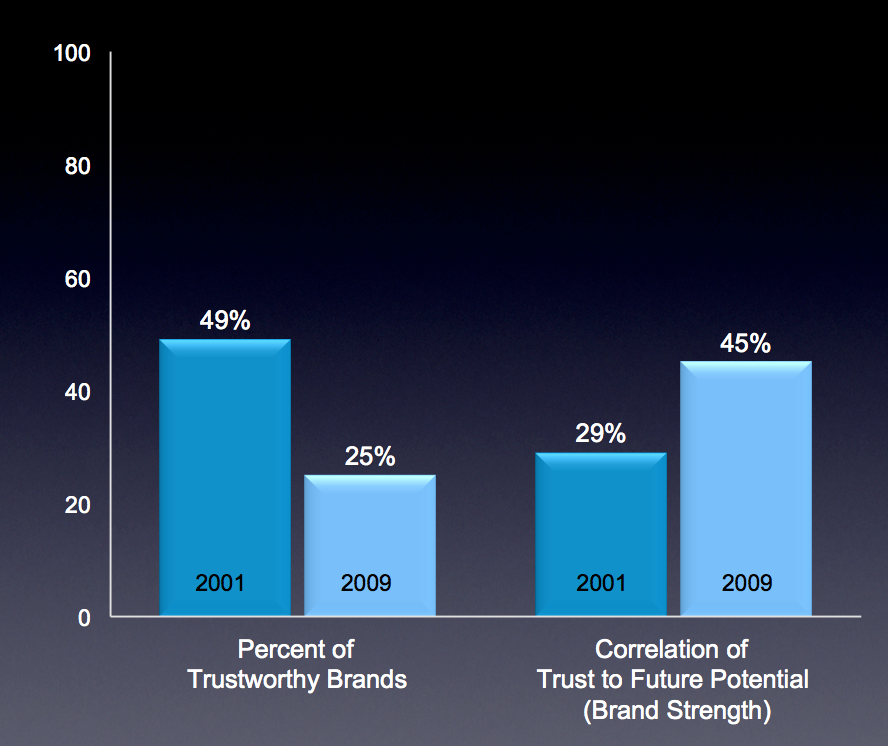
The headlines from their analysis and research demonstrate two inter-related factors as it relates to trust and brands:
That trust is the true, new brand differentiator.
Other key findings in the research is the rise in social media as social contract with trust of social media outlets outpacing that of traditional media (and Twitter leading the trust game among social media outlets).
John and his BAV team conclude the following branding imperatives in the era of the Citizen Marketplace.
Download a BAV presentation on the research here.
Thanks again BAV team for sharing this insightful work.
In their 11th annual global survey on trust, Edelman research reports that people’s trust of institutions and returned to levels comparable to the height of the worldwide financial crises in 2009.
When asked how much they trust various institutions, only NGO’s were trusted by the majority of U.S. respondents. Business, government and the media are not trusted by the majority of people and media’s trustworthiness as reached record lows.
The drivers to corporate reputations are quality, transparency, trustworthiness and employee well-being.

The study concludes that businesses must align profit and purpose for social benefit. It reports that people’s demands for authority and accountability are setting new expectations for corporate leadership and that trust is the essential component to both protect reputations and gain tangible benefits. Lack of trust is a barrier to change.


24% of companies surveyed answered positively to three questions –
indicating they were fully embracing the business benefits of sustainability.
In their new report, MIT’s Sloan Management Review – nearly 49% of executives reported that “improving brand reputation” was the greatest benefit to their organization in addressing sustainability. Brand reputation was the number one drive selected by all companies.
Other key findings in the survey included:
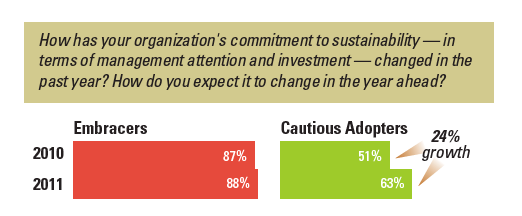
Even Cautious Adopters of sustainability initiatives report significant increases in
attention and investment over the past two years.
According to the report,”Companies that are moving most aggressively on the sustainability agenda are doing more than reducing their environmental impact. And yet by heading down one path – by taking the leap of faith – they are finding many unexpected benefits emerge. Employees are more engaged in meeting environmental goals than had been anticipated. Brand value is enhanced, often in unexpected ways. Partnerships generate unanticipated sources of innovation. In short, sustainability is revealing new paths that will enhance companies’ long-term ability to compete.”
The survey was conducted with more than 3000 business executives from around the world. You can download a copy of the report here.
The retailer Asda has 500 stores across the United Kingdom, serves more than 18 million customers a week, and has a home shopping busienss that serves over 98% of UK homes.
Adsa just released the results of research it did with over 6,000 Asda customers – who they affectionately have labeled Everyday Experts.
Results from the research are encouraging and revealing. One of the most compelling findings is that levels of caring about sustainability issues did not vary among high, middle or low income participants.
Other key findings in the report included:

In its 18th year of tracking the reporting of Corporate Responsibility, KPMG has issued its latest annual CR Reporting survey. KPMG analyzed the reports of 3400 companies in 34 different countries. Among the findings, companies based in the U.S. are lagging behind other regions of the world in terms of the walking the walk vs. talking the talk on corporate responsibility.
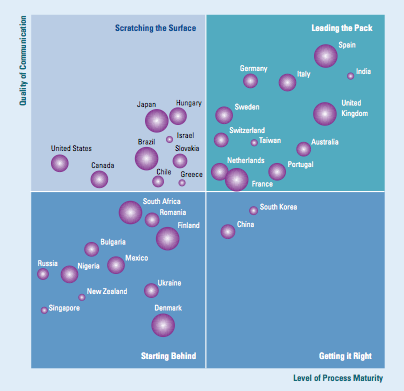
According to KPMG, “Companies that can be seen as ‘Scratching the Surface’ are those that have the highest risk of failing to deliver on the promises they make in their CR report and/or targets they have set. These companies have chosen to focus more heavily on communicating their CR achievements effectively by choosing multiple channels and integrating CR in the regular annual reporting without focusing equally on the CR systems and processes. As a result, they may reach their audiences more effectively than the group that ‘is getting it right.’ However, they could also risk increasing feedback and pressure from their stakeholders, including their investors.”
Among other interesting insights and facts in the report include:
93% of CEOs believe sustainability issues will be key to business success in the future. The concept of creating shared value vs. shareholder value is beginning to penetrate the consciousness of many corporate boardrooms. This new report from FSG – the nonprofit consulting firm – gives best in class examples of social engagement strategies where corporate and social issues are aligned.

According to FSG, “the most advanced companies have begun to look at social engagement through a different lens entirely. Rather than seeing business and society in opposition, they recognize the enormous potential of business to contribute to social progress. At the same time, they understand that firms depend on healthy and well-functioning societies to thrive. Such companies seek to create “shared value” – incorporating social issues into their core business strategies to benefit both society and their own long-term competitiveness.”
Says Harvard Business School professor Michael E. Porter, “What’s happening now is really a redefinition of the boundaries of capitalism. Creating shared value is the next stage of evolution in the sophistication of the capitalist model.”
The report was sponsored by HP and features examples from global business leaders committed to creating shared value, including Alcoa, GE, Cisco, and Nestle among others.
You can download a pdf of the report here.
(Figure from FSG)

In a recent survey revisiting consumer attitudes toward environmental issues vs. 20 years ago, GfK Roper and S.C. Johnson demonstrate how much progress has been made.
The research study reports that 73 percent say they know a lot or a fair amount about environmental issues and problems, up from 50 percent earlier. Compared to 20 years ago, twice as many Americans are taking proactive steps to help the environment. Today, 58 percent of Americans recycle, 29 percent buy green products regularly and 18 percent commute in an environmentally friendly manner.
And the impact can be dramatic. According to Kelly M. Semrau, Senior Vice President of Global Corporate Affairs, Communication and Sustainability at SC Johnson, “Simply recycling one aluminum soda can yields enough energy to power my laptop for five hours or light up my office for 20 hours using a 60-watt energy-saving light bulb. These individual steps are made possible because individuals have a desire to modify their behavior, but also because businesses and governments have taken a leadership role in facilitating these changes by providing the right tools, products and processes.”

Three-in-four respondents agree that “a manufacturer that reduces the environmental impact of its production process and products is making a smart business decision.” Those are much higher marks than Americans gave business in 1990. Individuals place themselves higher at 38 percent and rank businesses lower at 29 percent when asked who should take the lead in addressing environmental problems and issues.
Said Semrau, “We all have a role to play to protect our earth, and 75 percent of American consumers say they feel good when taking steps to help the environment. That’s huge. Through increased environmental knowledge and with the right products and tools, we can all appeal to that sentiment to make smarter choices for a greener lifestyle.”
Green shopping photo via Shutterstock.
In a daring and unprecedented move, the long respected Patagonia brand decries consumerism run amok and pledges to improve its own sustainability performance and asks for the same commitment from its customers.
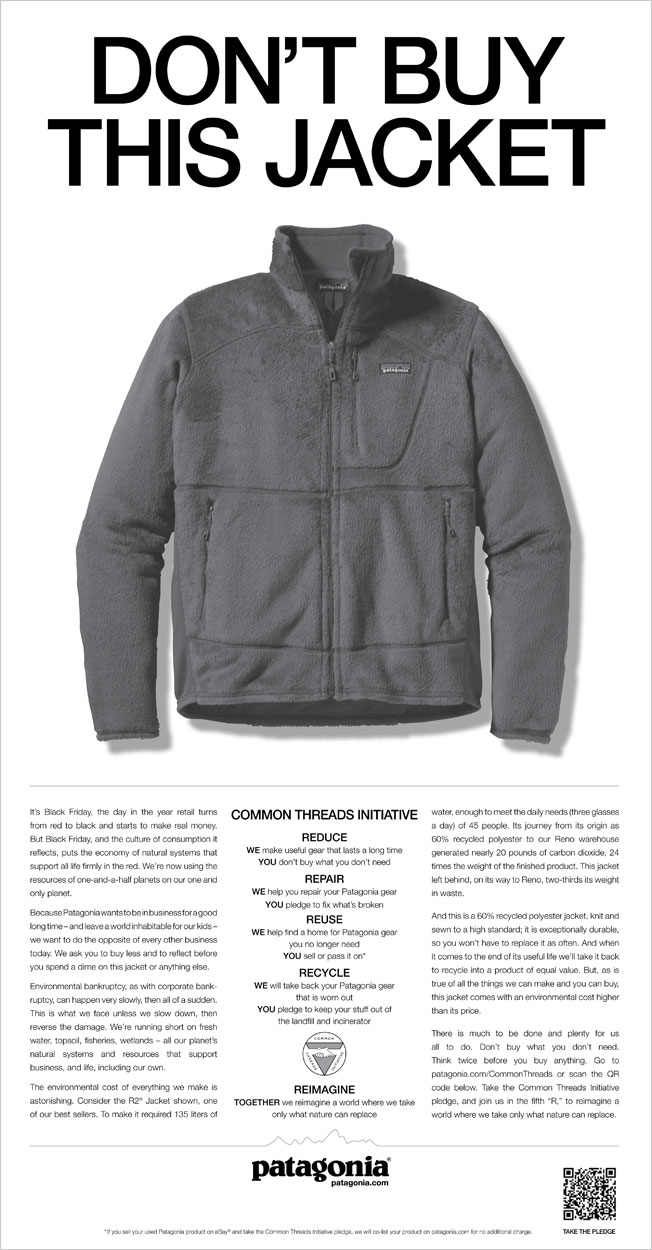
For a brand inspired by and dependent on the environment, Patagonia is asking customers to pledge to reduce the products they buy and only buy what they need. It also is asking consumers to repair what’s broken, pass the product onto someone else, and keep it out of landfills or incinerators.
In exchange for the pledge, Patagonia’s pledge is to make products that last a long time, help repair gear that needs it, find home for products you no longer need and will take back Patagonia products that are worn out.
In advertising placed on Black Friday in The New York Times and on-line on Cyber Monday, Patagonia calls itself on the carpet for the environmental impact of the products they manufacture.
“The environmental cost of everything we make is astonishing,” the ad reads. “Consider the R2 Jacket shown, one of our best sellers. To make it required 135 liters of water, enough to meet the daily needs (three glasses a day) of 45 people. Its journey from its origin as 60% recycled polyester to our Reno warehouse generated nearly 20 pounds of carbon dioxide, 24 times the weight of the finished product. This jacket left behind, on its way to Reno, two-thirds its weight in waste.
“And this is a 60% recycled polyester jacket, knit and sewn to a high standard; it is exceptionally durable, so you won’t have to replace it as often. And when it comes to the end of its useful life we’ll take it back to recycle into a product of equal value. But, as is true of all the things we can make and you can buy, this jacket comes with an environmental cost higher than its price.”
The ad concludes: “There is much to be done and plenty for us all to do. Don’t buy what you don’t need. Think twice before you buy anything. Go to patagonia.com/CommonThreads, take the Common Threads Initiative pledge and join us in the fifth R, to reimagine a world where we take only what nature can replace.”
Cheers to Patagonia for honest and authentic communication and for its call for balance and collaboration in a world of too much self-interest and scary levels of divisiveness.
This is world class sustainable branding.
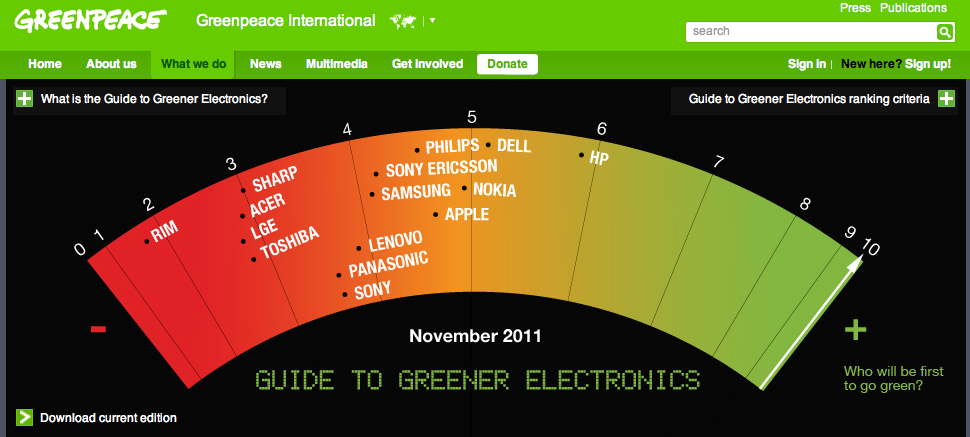
In releasing its latest guide to Greener Electronics, Greenpeace has ranked 15 leading technology companies and how they are performing on key measures around sustainability. The guide is intended to help consumers make better informed decisions when purchasing technology products and help businesses evaluate the performance of their technology vendors in helping them achieve their own sustainability objectives.
Download the Greenpeace Guide here
The comprehensive analysis will help consumers understand the impact of specific products, as well as the sustainability performance of the overall corporation. New criteria added to this edition of the Guide are based on the creation of truly sustainable electronics industry, Greenpeace said, and include a holistic examination of key supply chain issues.
“Right now, HP takes the top spot because it is scoring strongly by measuring and reducing carbon emissions from its supply chain, reducing its own emissions and advocating for strong climate legislation. However all companies we included in the Guide have an opportunity to show more leadership in reducing their climate impact”, Tom Dowdall of Greenpeace said in a statement.
Blackberry manufacturer Research in Motion (RIM) is ranked for the first time and scored well on conflict minerals and sustainable paper policy. But the company ranked bottom of the table because it needs to improve reporting and disclosure of its environmental performance, Greenpeace said. It is interesting to note that failure to communicate progress – the opposite of the idea of sustainable branding – was a key factor in RIM receiving such a low ranking.
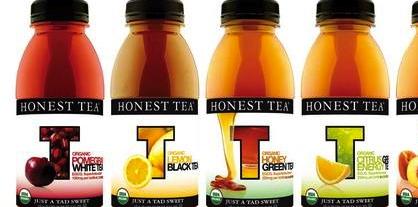
Honest Tea’s decision to expand to this new communication channel reflects a trend among sustainable brands to find the most effective way to leverage corporate social responsibility (CSR) reporting to increase dialogue and engagement with consumers.
The organic bottled tea company released the second edition of its annual Mission Report in combination with a new Tumblr site that will update regularly with posts about the company’s progress on social and environmental initiatives.
Honest Tea released a digital version of the report, which is becoming standard practice, and some companies – led by outdoor companyPatagonia’s example – are building entire microsites dedicated to tracking the sustainability of products and services. Others are choosing to incorporate CSR reporting into the traditional annual report, as Clorox did this year, indicating that sustainability performance is reaching the same level of importance as other corporate disclosures.

Honest Tea’s report, called Keeping It Honest, details the company’s initiatives related to products, packaging, people and partners. It highlights achievements, such as the conversion of all teas to Fair Trade Certified, the company’s first annual service day, and the launch of a new product, Honest CocoaNova.
The report also addresses sustainability challenges, such as packaging, providing consumers with an introspective look at how the company strives to scale a mission-driven business.
Acquired by Coca-Cola earlier this year, Honest Tea also will utilize its Facebook page to host a Keeping It Honest tab, during Honest’s “Mission Month”, where Honest fans can choose a personal mission each week, creating their own agenda for change, the company says.
Go to the Keeping it HONEST site here.
Since Honest Tea was founded in Bethesda, Maryland in 1998, the company has sustained an impressive double-digit annual growth rate. The company was listed as one of PlanetGreen.com’s Top 7 Green Corporations of 2010. It also received Greenopia.com’s coveted 4-Leaf Rating as “the greenest beverage company” for the third year in a row and was recently ranked by The Huffington Post as one of the leading “8 Revolutionary Socially Responsible Companies.”

In a press release, Sara de Dios, Global Head of Meaningful Brands at Havas Media said. “We believe that it is likely that the next generation of brands will flourish in emerging economies – they can, from the onset, create the context that promotes the growth of meaningful brands. Companies and brands operating in emerging economies can become active in transforming their roles; they are creating new lifestyles for millions of people and their communities while contributing to the overall progress of their societies. This will continue in the future with a growing middle class emerging within these markets.”
This innovative global undertaking is able, for the first time, to connect brands with our quality of life and wellbeing. It does this by measuring the perceived impact of brands on our personal wellbeing – their influence on factors such as our health, fitness, happiness, values, social relationships, financial security, lifestyles and habits – and our collective wellbeing, that is, how brands help to improve communities, societies and the environment.
The analysis includes a measurement called The Meaningful Brand Index (MBi) that uses consumer perception to compare and track the impact brands have on our lives. Based on the views of 50,000 people in 14 countries, the results show a direct relationship between a brand’s MBi score and the level of consumer attachment. That is, the greater the contribution the brand has to our wellbeing – measured by the value it creates for individuals, communities and the environment – the larger role it will have in people’s lives and the more meaningful it becomes.
Ikea, Google, Nestlé, Danone, Leroy Merlin, Samsung, Microsoft, Sony, Unilever and Bimbo are the top 10 global brands. These brands systematically improve our personal and collective wellbeing and are rewarded by stronger brand equity and attachment. Furthermore, the results show that we really care that these brands exist as we see that they are making a significant contribution to our lives and communities. Havas Media argues that many of the top 20 brands are helping us create a new lifestyle that’s more consistent with today’s challenges and consumer trends.
Top 20 global brands according to Havas Media’s Meaningful Brand Index:
Meaningful Brands also explains what makes things meaningful to us as consumers when it comes to specific brands and sectors. For instance, 65% registered a very strong attachment to Coca-Cola worldwide. However, only 35% think the brand improves our quality of life. In fact, some consumers worldwide think it is contributing negatively to our lives, mostly due to health concerns. However, Coca-Cola has, as with many other brands in the beverage sector, been a pioneer in connecting its brand to other personal issues such as happiness and positivity which has enabled it to successfully build a positive link to our emotional wellbeing.
When looking into brands’ impact on our sense of collective wellbeing (communities/ societies/environment), there is a general improvement. This is the case with the automotive and public transport sectors, driven by greater environmental and product innovation (such as the hybrid and electric cars and energy efficiency). Compared to last year, brands such as Volkswagen, BMW, Toyota and Peugeot have, according to consumers, improved the most in this area.
When it comes to our expectations of improving our personal wellbeing and quality of life, the results are not so good. A staggering 80% of brands across 14 countries are underperforming. This reveals a huge opportunity for brands. To some extent this is being realised by brands in sectors such as FMCG, retail, IT and consumer electronics. According to consumers, most brands in the financial, utilities and telecommunications sectors, underperform in helping us improve our daily lives and individual wellbeing.
Despite these trends, the analysis shows that some brands have been able to break free from these industry limitations. There are brands with exceptionally high MBi scores in low scoring industries that are learning to reconnect with consumers. This is the case for Fidelity Investments in the USA, the energy brand Petrobras in Brazil, EDF in France and the telco brands 02 in the UK and Free in France. All of these register significantly higher than average MBi scores for both their sectors and countries.
The analysis suggests that the next generation of brands will come from emerging economies. People in fast growing economies, such as Asian and Latin American markets, record a stronger and healthier relationship with brands. The proportion of brands making a notable positive contribution to our lives increases to around 30% in Latin America, compared to 8% in European markets, where people tend to be more sceptical and less engaged with brands. In the US it’s 5%.
By contrast, the situation in developed economies is the opposite. Brands in these regions are no longer seen to improve people’s quality of life. There is an aging and increasingly poorer middle class who are demanding that brands help them to lead and create new lifestyles that fit in to their new expectations and values. In order to survive, these brands must re evaluate their definitions of success and take up the challenge to make meaningful contributions to these people’s lives.”
Hernan Sanchez Neira, CEO Havas Media Intelligence, adds:
“It’s clear from our analysis that we need to take a new look at the relationship between brands and consumers. Nowadays we want so much more from brands than just promises or stories. Brands that manage to create better relationships dominate the marketplace.”
Meaningful Brands helps us to develop this type of relationship by understanding exactly what people expect from brands. It also helps us track how successful companies are responding to these needs by understanding how these companies are contributing to our wellbeing, both as citizens and individuals, and how they communicate these values to us. It also shows us that there’s a big business opportunity for brands who are able to satisfy consumers by creating wellbeing in the context of their new values, expectations and local market realities.”
The research was carried out from March to June 2011 across 14 markets – France, Spain, UK, Germany, Italy, USA, Mexico, Brazil, Colombia, Chile, Argentina, China, Japan and India. The research took into account the views of 50,000 consumers via online panels.
 About Havas Media
Havas Media is the global media network of Havas.
Havas Media represents one of the world’s fastest growing media networks and its agencies have grown from 10 markets in 1999 to 119 markets in 2011.
Havas Media services its clients through a portfolio of specialist global networks and agencies. The group is organised to maximise local market dynamics whilst leveraging the extensive global insight and strategic support within Havas Media. The range of companies within Havas Media include: MPG (Havas Media’s global media network), Arena Media (Havas Media’s network for tailor-made communication services), Havas Digital (Havas Media’s global interactive network) and Havas Sports & Entertainment (Havas Media’s global sports and entertainment communication network).
Further information can be found at www.havasmedia.com or follow us on twitter @HavasMedia

Congratulations to Coca-Cola with its appointment of former Chief Marketing Officer Beatriz Perez to Chief Sustainability Officer.
Under the vision of CEO Muhtar Kent, Perez will be responsibile for integrating sustainability initiatives into brand and marketing efforts and further demonstrate its monitoring and improving the commitment to the moderate impact of its products and operations on the environment.
We also find it notable that the new office of sustainability at Coca-Cola will include leaders responsible for corporate social responsibility, environment and water, external affairs and sustainability strategy and communication.
Read the news release below.
May 23, 2011 – The Coca-Cola Company (NYSE: KO) has appointed it first Chief Sustainability Officer (CSO) and created a new global Office of Sustainability in an effort to better integrate ongoing initiatives.
Beatriz Perez, who is currently Chief Marketing Officer for Coca-Cola North America, will serve as CSO beginning July 1. She will work to integrate Coca-Cola’s sustainability initiatives in the areas of water, climate protection, packaging and recycling.
“We have made significant progress with our sustainability initiatives, but our current approach needs focus and better integration to further accelerate our system sustainability agenda and meet our 2020 Vision goals,” said Muhtar Kent, Chairman and CEO, The Coca-Cola Company. “We are realigning this important work to create a unified team, strategy and business plan that connects our sustainability work and actions.”
Under Perez’s leadership, the Office of Sustainability will create and oversee Coca-Cola’s integrated global sustainability strategy; set goals and commitments; assess and drive scaled investments; and steward and track all global partnerships and key sustainability projects.
Reporting to Perez, the new team will include John Reid, Vice President, Corporate Social Responsibility; Charlotte Oades, Global Director, Women’s Economic Empowerment; Abby Rodgers, Vice President, Sustainability Strategy and Communication; Jeff Seabright, Vice President, Environment and Water; and Lisa Manley, Group Director, Corporate External Affairs.
Perez will report to Executive Vice President and Chief Administrative Officer Alex Cummings.
Kent said Perez is uniquely qualified for the role based on her passion for sustainability and deep experience at the Company, including the incorporation of sustainability initiatives into Coca-Cola’s North American marketing programs.
“If you are striving to be more sustainable, your actions need to demonstrate that in everything you do,
which means new ways of thinking about branding.”
Kudos to the Sustainable Branding Collaborative for their new research report surveying innovators and early adopters in the sustainable business environment. Some of the key interesting findings that stand out of the work include:
You can download a summary of their survey here.
The Sustainability & Branding Survey

In a new survey issued by StrategyOne, 82% of American’s gave a “C grade or lower” on how corporate America did in 2010, with 40% of Americans assigning Corporate America a “D” or an “F”.
The wake up call is that Americans are extremely frustrated and dissatisfied with the behavior of companies in America. Quite literally, if the leadership of American companies were politicians, there would be a landslide election of the American people voting them out of their corner offices.
“Let’s be clear, Americans are not dreaming up some far out vision of utopia,” said said Bradley Honan, senior vice president of StrategyOne. “Instead they are being realistic that Corporate America should – and indeed must – engage in important issues of the day where they can make a demonstrably positive difference. That means the economy and jobs for starters, but also ensuring their products are safe and not harmful to use, and that they simply conduct their day to day business activities in an honest, ethical, and transparent manner.”
Other interesting facts undercovered in the StrategyOne survey included:
Let’s hope company leaders make some serious New Year’s resolutions to improve their performance and more effectively communicate with the public to show how they are being more responsbile, sustainable and ethical. That is the only way to reduce the “trust gap”. And it is important for corporate leaders to recognize—once and for all—that their futures are dependent on their customers….who happen to be the American people, at the end of the day.
StrategyOne Survey Methodology:
StrategyOne conducted 1,081 online interviews among a representative sampling of Americans between December 6 and 8, 2010.

In an edited excerpt of his new book Aftershock: Reshaping the World Economy After The Crises, Phillpee Legrain writes about the need to embrace new approaches capitalism and consumerism. His point is that without consumption, there is no production, no income and no jobs. And in plenty of markets around the world, there are millions and millions of people with unmet needs. Responsible brands understand that they need to be serving those markets not only with sustainable products but with efforts that aid the public good. The balance is essential for the retention and recruitment of new audiences of prosperous consumers.
“The aftermath of the crisis opens up huge opportunities to reshape the world economy for the better. A fairer, richer, greener and more stable global economy is possible. But to achieve it, we need to rediscover the virtues of open markets, open societies and open minds that go hand in hand with progress: great opportunities for everyone to chase their dreams and fulfill their potentials.”

A new survey of corporate business executives by Deloitte identifies the gap that still exists between sustainability vision and execution. While most business leaders surveyed indicated knowledge of the benefits of developing a relationship between sustainability and the business, much more work needs to be done to make it a fundamental part of the operational, cultural and strategic performance of the company.
Thanks for Deloitte for making this research available to business leaders everywhere.

A very inspiring article by Peter Clark on 5 compelling branding commandents for marketers and agencies moving forward. His straightforward summary of branding principals for a post-recession era reminds us that consumer’s expectations for brand behavior are forever changed.
Peter’s commandants are:
1. Simplicity
2. Transparency
3. Responsibility
4. Sustainability
5. Affordability
Read the 5 Commandments Article Here.
Grass Image: Dennis Wong

Congrats to Creative Insurgent Alex Bogusky who has walked away from a 20 year career in advertising where he accomplished just about everything. Countless awards, new business wins, huge company growth, industry recognition. But now he has chucked it all to pursue a new mission of using the creativity that made him famous to promote all aspects of social responsibility.
In his profile of Alex in Fast Company, Robert Safian captures the vision; “Bogusky has made the FearLess Cottage something of a hub for people he deems, as he has inscribed on the cottage’s keys, “capable of pushing aside fear in pursuit of doing the right thing,” which is to “help define a new era of social responsibility.”
Read the profile of Alex in Fast Company
Visit Alex’s Fearless Cottage Here.

Kudo’s to Alex for the courage to do the right thing. Recognizing the art of fearless thinking and creativity can make a difference. He makes us proud and sets the new standard for 21st century challenges: for successful businesspeople to turn their energies to things that really matter.
“Sustainability reporting among corporate issuers is largely still voluntary, it is far from universal, and often inconsistent and incomplete.”
– Social Investment Forum letter to SEC Chairman Mary Schapiro
 Last week the 400 member Social Investment Forum called on the Securities and Exchange Commission to establish the mandatory reporting of corporate environmental, social and governance (ESG) or sustainability reporting. Citing the fact that corporate social and environmental performance can have material impact on portfolio performance, the proposal calls for sustainability performance to be reported on consistent measures and issued in an annual report along with standard financial disclosures.
The letter also pointed out that that similar regulation is being proposed by the United Nations and several individual countries. While relatively off the radar screens in mass media, this conversation is serious in nature and represents significant steps forward in regulating accountability for corporations on social measures beyond financial data.
 Eric Block On Responsible Branding
You must be logged in to post a comment.