Unilever: Partnership to help African Hand Washing Initiative

30 10 2012

Unilever and the Earth Institute have announced a new initiative to bring hand washing with soap – a lifesaving habit – to the Millennium Villages, a project that works with nearly 500,000 people in rural villages, across 10 countries in sub-Saharan Africa. 

”The big issues the world is facing require new approaches, new business models and new partnerships. Responsible businesses must take a more active leadership role.” said Paul Polman, Unilever CEO, “The memo of understanding with the Earth Institute partnering Lifebuoy with the Millennium Villages Project is one such example where working together will enhance our expertise of addressing hygiene in deep rural Africa and enable us to develop more effective solutions to reduce child mortality.”

The partnership supports Unilever’s goal to deliver on one of its commitment under its Sustainable Living Plan – to help more than one billion people take action to improve their health and well-being. Over the past two years, Unilever has successfully changed the hand washing behaviour of 50 million people in Africa and South-Asia, through its leading soap brand Lifebuoy and partnerships with Population Services International (PSI) and UNICEF established through the Unilever Foundation.

“It is unacceptable that two million children die every year from infectious diseases when we have easy and cheap lifesaving solutions, such as hand washing with soap, readily available. Innovative partnerships between governments, civil society and business have a critical role to play in promoting better hygiene practices and in tackling the world’s deadliest diseases.” said Polman.

Millions around the world are asked to pledge on www.facebook.com/lifebuoy. With every pledge, Lifebuoy and its partners will help more children receive hygiene education through their dedicated handwashing behavior change programs.

In a statement, Jeffrey Sachs, Director of the Earth Institute at Columbia University said: “Diarrhoea and pneumonia are the two leading causes of under-5 deaths, accounting for around 30% of children’s deaths globally – more than two million lives lost each year. More than 80% of these deaths occur in sub-Saharan Africa and South Asia. Addressing these challenges through improved hygiene is a vital and effective step towards saving lives and achieving the global Millennium Development Goal to reduce the child mortality rate by two-thirds by 2015.”

Consistent evidence shows that hand washing with soap at critical times – before eating or preparing food and after using the toilet – can reduce diarrhoeal risk by 45%  and acute respiratory infections such as pneumonia, by 23%.  Studies also reveal that primary school absenteeism due to diarrhoea and respiratory infections dropped between 20% and 50% as a result of better hand washing practices .

“We are looking forward to working with Unilever to ensure that straightforward solutions like hand washing reach the people that need them the most,” said Sachs who leads the Millennium Villages Project.  “The poor need solutions that are affordable, products that are highly effective, and information that is practical and accessible.  The benefits can be enormous.”

The partnership will be focusing on villages in Ethiopia, Ghana, Kenya, Malawi, Mali, Nigeria, Rwanda, Senegal, Tanzania and Uganda, and aims to: decrease incidence in diarrhoeal diseases, promote gender equality, increase school attendance, enhance productivity and well-being for all community members. The partnership will also focus on governments. Governments should integrate hand washing with soap into national health and education policy frameworks. Governments and aid donors should ensure adequate finance for hygiene facilities and water availabilities. Business must act too, ensuring their products are even more affordable, and varied so that handwashing with soap is done everywhere and by all. Public-private partnerships have role to play and can help governments harness the power of business for the benefit of their population’s health.

Looking to the UN’s post-2015 agenda, Polman said, “It will be important to ensure that hygiene takes its place alongside targets on water and sanitation. This partnership with Millennium Villages Project will provide further evidence to demonstrate to policymakers how hygiene public policy can be improved, and help bring to an end the scandal of children dying from preventable diseases.




Puma Again: Launching biodegradable shoes and apparel.

11 10 2012

The amazing German footwear and apparel manufacturer Puma is at it again.  This week they announced the launch of a new line of biodegradable shoes, shirts, backpacks and recyclable track jackets.  The products will be available for sale in 2013.  This adds to Puma’s track record of sustainability leadership that has led to it being named “the world’s most sustainable corporation” by EIRIS and has drawn praise as a corporate leader in environmental responsibility by the United Nations.

In an interview with Reuters, chief executive Franz Koch said, “We have decided that sustainability is a mega-trend.  We want to contribute to a better world. At the same time, we also want to carve out our competitive advantage.”

The new collection, going on sale in 2013, includes biodegradable sneakers and shirts and recyclable plastic track jackets and backpacks. At the end of their useful life, the products can be returned to stores for processing.

The sole of the new sneaker is made of biodegradable plastic and the upper of organic cotton and linen. After being shredded, it could become compost in six to nine months.  Puma has demonstrated that 100,000 pairs of biodegradable sneakers would fill 12 trucks of waste during production and disposal against 31 trucks-worth for the same number of normal Puma suede shoes.

A new biodegradable T-shirt would have environmental costs of 2.36 euros in terms of greenhouse gases, water, waste, air pollution, and land use associated with its production, compared to 3.42 euros for a conventional T-shirt.

The company also said it was starting to rate the environmental impact of individual products, narrowing the focus from a study last year that estimated the entire company caused 145 million euros in damage to nature in 2010.

In another interview with Reuters, Jochen Zeitz, chairman of Puma said, “In the long run I think all of this should be standardised, just like we are used to seeing calories on our food products.” , told Reuters. Zeitz conceded that “a lot of people call it a risk” to mention pollution when trying to sell a product. “I think it’s a risk not to talk about it,” he said. “It’s our opportunity as businesses to be transparent.”

In 2010, Puma and Yves Behar of Fuse Project, a global leader in design, announced the launch of its Clever Little Bag, reinventing the typical cardboard shoe box with a much more environmentally responsible package design.  You can see the design and appreciate its reduction in environmental impacts here.

Read the Reuters article here.


GfK Green Gauge®: Green is going mainstream, but don’t expect a premium.

24 09 2012

In their new Green Gauge research released today, GfK reports significant progress in the developing green culture in the United States, but also highlight findings that many consumers are increasingly resistant to pay more for “green products”.

In a statement, Timothy Kenyon–Director for the Green Gauge survey–said, “Green awareness is indeed pervasive – but consumers can perceive ‘green’ claims as a negative in some contexts.  For example, while terms like organic and recyclable have strong positive resonance, they are often associated with higher prices. Understanding consumers’ triggers and the limits of their commitment to green action is essential for marketers and researchers alike.”

The study shows that 73% of US consumers have purchased a product made from organic materials in the past 12 months. Categories that have seen notable increases since 2007 in organic buying include food, household cleaning, apparel, and pet food and supplies.

In addition, 93% of Americans say they have done something to conserve energy in their households in the past year, and 77% have done something to save household water during the same timeframe.

The study also reports that digital media are helping to amplify this green awareness:

29% of smartphone users have turned to an app in the past year to help reduce their environmental impact – a figure that jumps to 44% for Generation Z (ages 18 to 22) and 38% for Generation Y (ages 23 to 32).  Most-cited types of apps used include public transportation timetables and home energy monitors.

In addition, 18% of consumers say that social networking sites are a “major source” of green information for them (up four points from 2011), with another 33% citing it as a “minor source.”

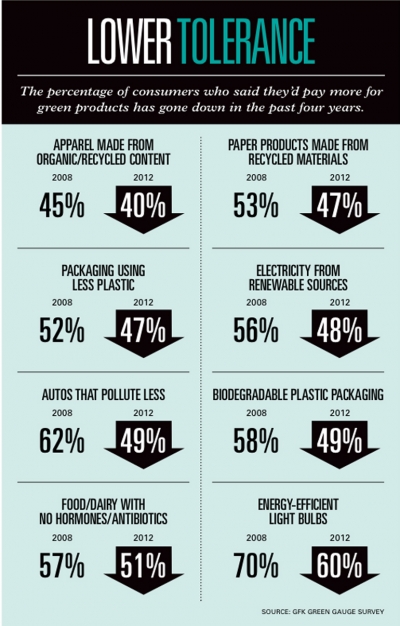
GfK points out that green awareness and engagement do not necessarily translate to green purchase. Compared to 2008, the proportion of US consumers willing to pay more for environmentally friendly alternatives has gone down in a variety of key areas — from cars that are less polluting to the air (down from 62% to 49%) to energy efficient lightbulbs (down from 70% to 60%).  (examples are cited below in this infographic from the Advertising Age article linked below).

According to GFK, The Green Gauge® Report is the only nationwide, long-term syndicated study of consumer attitudes and behaviors towards the environment. Green Gauge gives marketers an exclusive look at how America’s concern for environmental issues can affect brands and organizations.

Read a related article to the research in Advertising Age here.


Method: Progress On Ocean Plastic

24 08 2012

It has been almost a year since innovative and inventive household cleaning products manufacturer Method announced its campaign to utilize reclaimed ocean plastic for its packaging.  In a recent article on Greenbiz,com, Drummond Lawson, the director of sustainability at Method, provides a progress report on the sustainability initiative.

.Commercializing the rising tide of ocean plastic

Lawson writes:  “Method has participated in, alongside partners Sustainable Coastlines Hawaii and Kahuku Hawai’i Foundation, several beach cleanup days that resulted in collecting several thousand pounds of beach debris. The primary challenge encountered in these cleanups, aside from hauling hundreds of pounds of plastic from remote beach locations, has been retrieving the plastics before they degrade to tiny particles that are effectively impossible to collect in large quantities.

The range and quantity of plastic in the oceans is astounding. The debris collected from these beaches has varied from fishing baskets made of polypropylene to Russian shampoo bottles and Japanese bleach bottles made from HDPE, to car bumpers, ropes, water bottles, and buoys.”

Method product engineers are exploring ways to enhance the durability of their ocean plastic packaging.

“Method’s team of People Against Dirty love our work on the Ocean Plastic project because it brings together three things that characterize our company and how we work,” says Lawson.  “First, it addresses a real and material environmental problem — in this case, the accumulation of persistent plastics in the environment. Second, it relies on solid science and creativity to generate a solution. And third, it integrates sustainability into an innovative, effective, and engaging product design.”

Kudos to Method for this creative commitment to sustainability that enriches both the planet and people by repurposing plastic which represents so much damage to the environment and danger for ocean habitat.

Read the full article here.


Adidas DryDye: T-shirts made with less water.

9 08 2012

Adidas is rolling out an initial production run of 50,000 DryDye t-shirts – demonstrating their leadership in the production of apparel with less use of water.

The sportswear company has released a line of T-shirts made of fabric dyed with compressed carbon dioxide (CO2) rather than water.

Adidas says the DryDye technology – developed over the last five years with Thailand’s Yeh Group – uses zero water for dyeing, compared to 25 liters for a typical shirt. In addition, the process reduces chemical use by 50 percent, the company said.  In a commercial, Adidas claims the apparel industry uses the equivalent of the amount of water in the Mediterranean Sea each year.

For the summer season, Adidas has produced 50,000 DryDye tees with designs promoting the innovation. Using a traditional dyeing process would have required roughly 1,200,000 liters of water.

Adidas said it will begin using the DryDye process for more apparel pieces over the next few seasons.

Besides saving water, DryDye also uses 50 percent less energy and 50 percent fewer chemicals, according to DyeCoo, the Netherlands-based company that built the first commercial waterless textile-dyeing machine.  Adidas expects to save 1.2 million liters of water by using DryDye technology over conventional methods.

Together with Thailand’s Yeh Group, one of the first textile mills to implement the technology, Adidas will be rolling out 50,000 DryDye T-shirts over the summer. Because a single tee can require up to 25 liters of water during the dyeing stage, Adidas expects to save an estimated 1.2 million liters of agua over the usual route.

This is only the beginning, according to Adidas. The manufacturer expects to use the DryDye process with more apparel pieces over the next few seasons.


Ekocycle: will.i.am and Coke inspire sustainable behaviors

1 08 2012

Coca-Cola is collaborating with musician and producer will.i.am along with other iconic brands to inspire a global movement with the launch of Ekocycle, a brand initiative dedicated to help encourage recycling behavior and sustainability among consumers through aspirational, yet attainable lifestyle products made in part from recycled material.

The Ekocycle brand initiative was developed to educate consumers about everyday recycling choices and empower their purchasing decisions as part of a social change movement, The Coca-Cola Co. says. The initiative supports recycling by helping consumers recognize that items they consider waste today can be part of a lifestyle product that they can use tomorrow. The Ekocycle brand initiative will identify products, such as assorted plastic bottles and aluminum cans, that can be repurposed into recycled content for fashionable and valuable lifestyle products. It also will encourage demand and use of recycled materials, and reinforce the importance of recycling finished products, the company says.

“With the Ekocycle brand, I’m on a mission to educate and inspire consumers around the globe to seek out more sustainable lifestyle choices that will ultimately play a part in the movement toward a world with zero waste,” will.i.am said in a statement. “By making products that contain recycled materials more attractive to both businesses and consumers, everyone can do their part to keep the cycle going to turn discarded waste into cool, new items. The Coca-Cola Co. shares this vision and together working with local communities worldwide we will showcase the greater value of recycling, as well as selecting products that feature recycled materials.”

Beats by Dr. Dre and New Era are the first brand partners to join the Ekocycle brand initiative. As a part of the partnership, these collaborative efforts will produce on-trend products made partially from recycled materials. Consumers can purchase Beats by Dr. Dre headphones this fall. New Era hats and other yet-to-be-announced Ekocycle products will be available in early 2013.

“The Ekocycle brand initiative is a platform that aligns with our vision of zero waste and our focus on sustainability,” said Bea Perez, vice president and chief sustainability officer for The Coca-Cola Co., in a statement. “Together with will.i.am, we will promote recycling in a unique way with other well-known brands to create lifestyle products that consumers worldwide desire. Today’s generation of young consumers represents an active force and the Ekocycle brand aims to be a driver in rallying their support and efforts around a global sustainability movement.”

The Coca-Cola Co. will donate its portion of licensing profits from the Ekocycle brand initiative to support additional recycling and community improvement organizations. It also will make a minimum $1 million financial commitment in the next five years. This donation is in addition to, and separate from, the charitable commitments of 1 percent of operating profits made through The Coca-Cola Foundation, the company says.

Earth911, host of the one of the largest recycling directories in the United States with more than 1.5 million ways to recycle, will provide an interactive and searchable recycling directory for consumers accessible at ekocycle.com.

“Recycling is one of the easiest sustainable actions consumers can take, but without real-time access to local options, people are often left confused and frustrated,” said Raquel Fagan, vice president of media for Earth911, in a statement. “The Ekocycle brand initiative takes a forward-thinking approach and demonstrates how companies can play a role in eliminating this confusion and empowering consumers.”

On Aug. 1, the Ekocycle brand will premiere its first 60-second TV commercial that will air in the U.S. market during the telecast of the Summer Olympic Games. A full-scale marketing, advertising and online campaign will follow.

To learn more about the Ekocycle brand initiative, visit ekocycle.com.

Original article in Beverage Industry


Ha Ha Yes Men: Shell Arctic Ready Hoax Was Masterful.

17 06 2012

The elaborate hoax that the Yes Men created – a faux ad campaign and official looking website for a supposed Shell Arctic Drilling campaign – fooled this blogger…and thousands of others.  We congratulate the Yes Men for their energy and creativity in coming up with a public relations approach that seemed all too plausible.  But Shell’s response may be just as stupid as if the campaign was real.

The campaign was created by Greenpeace and the Yes Men.

go behind the scenes at the Greenpeace website.

According to Wikipedia, The Yes Men operate under the mission statement of telling the truth and exposing lies. They create and maintain fake websites similar to ones they intend to spoof, which have led to numerous interview, conference, and TV talk show invitations. They espouse the belief that corporations and governmental organizations often act in dehumanizing ways toward the public.

In this highly provocative and realistic campaign they created against Shell, they certainly got a lot of attention to the issue of oil drilling in the fragile Arctic environment.  One of our favorite “ads” follows:

However, what may be even more perplexing than the hoax was the lack of any detectable response from the victim – Shell.

Are any of their PR wags on-line?  Are they tone-deaf to the internet?  Silence is golden?  Any brand under such devious assault needs a plan to respond.  From now to years to come, the assets created by this Yes Men hoax will be circulating with apparently a “mums the word”  response from Shell.  I stand behind the original post:  a most stupid brand is Shell.


Puma: Bring It Back. Old Shoes RIP.

7 06 2012

Kudos once again to the folks at Puma – who IRIS named the most sustainable corporation in the world.

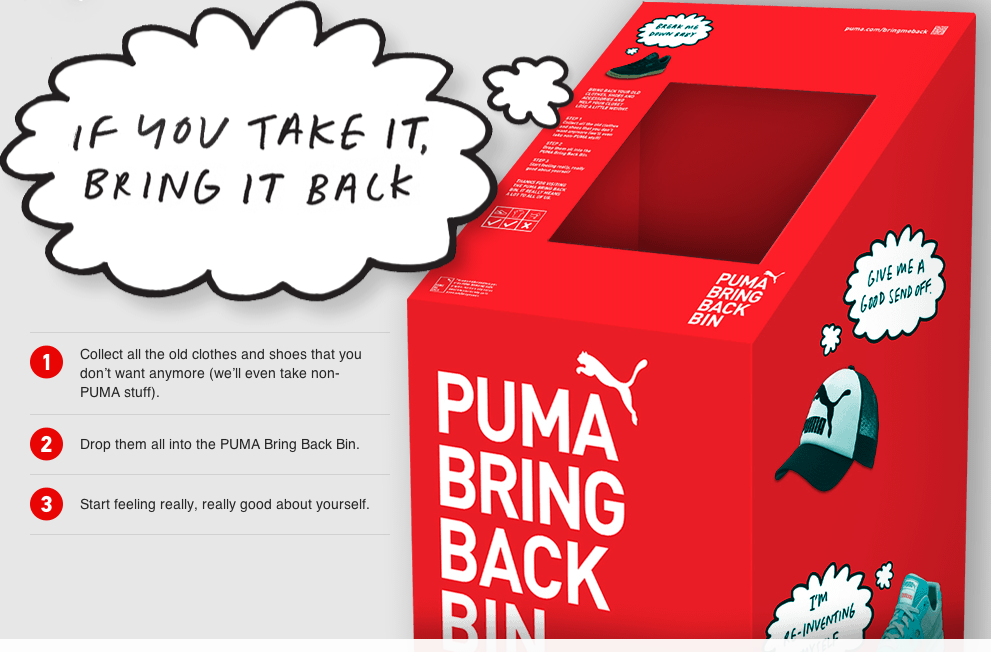
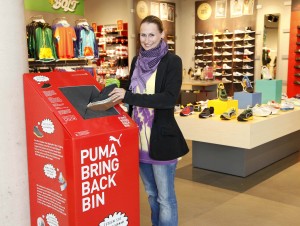
Puma has just launched Bring It Back – a new athletic shoe and sporting apparel recycling program.

In a statement, Franz Koch, CEO of Puma said, “On our mission to become the most desirable and sustainable sport lifestyle company in the world, we are constantly working on solutions that aim at reducing the environmental impact that PUMA as a company leaves behind on our planet. With our Bring Me Back Program, we are pleased to target, for the first time ever, the massive amounts of waste sport lifestyle products leave behind at their end-of-life phase when consumers dispose of them and they end up on landfills or in waste incineration plants.”

In a new twist, PUMA is encouraging people who return their non-longer desirable shoes and apparel to write and post their product’s obituary together with a picture of the shoes on its website. The company hopes its obituary option will finally get people excited about recycling their shoes.  May these shoes RIP.

Now that is smart sustainable branding.


Edelman Good Purpose Study: 87% of people believe business should place equal weight on business and society.

29 05 2012

In a massive global study surveying more than 8,000 adults in 16 countries, Edelman’s 2012 Good Purpose Study tracks people’s increasing belief that business bears a weight to contribute to society.

  • 76% of people believe it is ok for brands to support causes and make money at the same time (up 33% from 2008).
  • Yet only 28% of people believe business is performing well in addressing societal issues.
  • 53% of people believe Social Purpose is the most important decision criteria in buying a brand when price and quality are the same (up 26% from 2008).
  • 51% believe business should donate a portion of profits or products/services to address societal issues.
  • 80% of people believe it is critical for businesses to make the public aware of the efforts they are making to address societal issues.
  • 52% of people believe its equally important to address issues “that impact me personally and society overall”.
  • 89% of people worldwide report that they take part in activities to address social issues.

You can access a slide show summary of the survey here.


Gibbs & Soell: Only 21% of Americans Believe Business Is Committed To Going Green.

2 05 2012

In their 2012 Gibbs & Soell Sense & Sustainability study, the research demonstrates that public doubt that corporations are making a sincere commitment to going green continues to run high.

Despite their skepticism, the majority (71 percent) of consumers wants to know more about what companies are doing to become sustainable and green, and 75% feel the media are more likely to report on green business when the news is bad rather than good.

Read the summary report and news release announcing the results of 2012 Gibbs & Soell Sense & Sustainability Study at these links.

Key Findings:

  •  The general public and business leaders remain skeptical of corporate America’s commitment to sustainability. Only 21 percent of U.S. adults and 25 percent of executives believe that a majority of businesses (“most,” “almost all,” or “all”) are committed to “going green” – defined as “improving the health of the environment by implementing more sustainable business practices and/or offering environmentally-friendly products or services.”
  • While one-third of executives report having no green steward, up from years past, there is a trend toward dedicated teams for those who do. This year’s results show that 34 percent of executives indicate there is no one at their company who is responsible for sustainability or “going green” initiatives, up from 25 percent in 2011. More than one out of five (21 percent) corporate leaders report there is a team of individuals whose jobs are specifically and solely dedicated to sustainability, up from 17 percent in 2011 and 13 percent in 2010.
  • Most consumers and business executives also believe corporate sustainability activities are more likely to be covered by the media when the news is bad than good. The number is comparatively higher among consumers who are confident in corporate America’s commitment to “going green.” Three-quarters (75 percent) of U.S. adults and 69 percent of executives feel the media are more likely to report on “bad news” than “good news” when covering how companies are addressing efforts to “go green.” Specifically among the 21 percent of consumers who believe “most,” “almost all,” or “all” companies are committed to “going green,” 83 percent feel there is a bias for bad news in the media.

 Said Ron Loch, senior vice president and managing director, sustainability consulting, Gibbs & Soell. “The results reveal growing efforts by business communicators in relating their corporate responsibility stories, but also underscore a deficit in general understanding and trust.  It’s clear much more needs to be achieved in terms of relevant engagement with consumers and the media around corporate sustainability.”


Gfk MRI: Falling Behind On Buying Green.

16 04 2012

In new research issued by Gfk MRI, people’s interest in making small sacrifices for environmentally responsible products continues to slip away.  No doubt the punishing impact of the recession and stagnant employment market have forced many consumers to make a Sophie’s Choice over green products.  But the research further underscores the lack of inspiration that marketers have been able to generate for sustainable brands.

Data from the last five years reports that consumers are now less likely to give up convenience or pay more for green products.

  • The percentage of adults who report “I am willing to pay more for a product that is environmentally safe” declined 13%, from 60% to 52%, in the last five years.
  • The percentage of U.S. adults who agreed with the statement “I am willing to give up convenience in return for a product that is environmentally safe” declined 16% in the past five years, from 56% in 2007 to 47% in 2011.

Only Millennials (people aged 18-24) are the only adult age group whose willingness to give up convenience or pay more for green products has held steady over the past five years. In addition, 53% of consumers aged 18-24 recycle products and 4% participated in environmental groups/causes in the past 12 months.  At least there is some hope from this audience of young adults to accept responsibility for sustainable behavior moving forward.

While 65% of American adults agree with the statement “preserving the environment is very important,” according to the Survey of the American Consumer, evidently the job of preserving is for someone else.  Only 22% of consumers who remodeled their homes in the last 12 months said they used environmentally friendly/”green” products for their renovation.

The top three environmentally friendly products purchased by U.S. adults are light bulbs (18%), paper towels (12%) and laundry detergent (11%).  Big deal.

As more and more leading global companies invest in sustainable strategies and are adopting practices with long-term environmental health in mind, it is incumbent on marketers in those organizations to create consumer awareness, appreciation and adoption of these strategies.  This data suggests we are falling behind instead of moving forward.

Original post on Sustainable Brands


Nielsen: The Global, Socially Conscious Consumer

28 03 2012

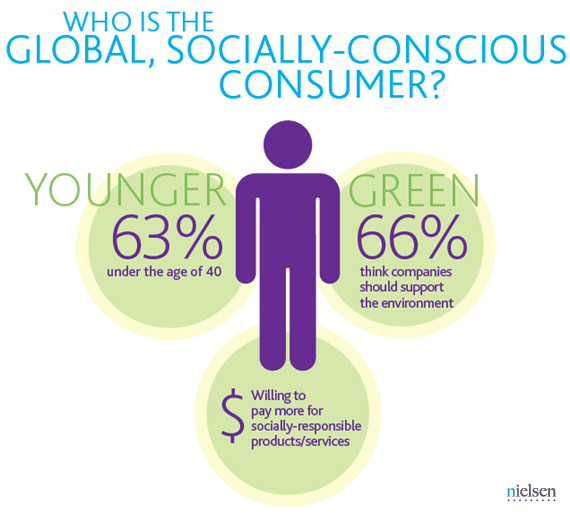
In a new global research report, Nielsen has identified a segment of the population they call the Global Socially Conscious Consumer.  

  • Two thirds (66%) of consumers around the world say they prefer to buy products and services from companies that have implemented programs to give back to society. 
  • They prefer to work for these companies (62%), and invest in these companies (59%). 
  • Still nearly half (46%) say they are willing to pay extra for products and services from these companies. 

In the study, respondents were asked if they prefer to buy products and services from companies that implement programs that give back to society. Anticipating a positive response bias, respondents were also asked whether they would be willing to pay extra for those services. For the purposes of this study, Nielsen defines the “socially conscious consumer” as those who say they would be willing to pay the extra.

According to Nielsen, “Cause marketing won’t work with all customer segments—some simply don’t care—but the research suggests that there is a segment of socially conscious consumers that cause marketers should pay attention to.”

New findings from a Nielsen survey of more than 28,000 online respondents from 56 countries around the world provide fresh insights to help businesses better understand the right audience for cause marketers, which programs resonate most strongly with this audience, and what marketing methods may be most effective in reaching these consumers.

Thanks to a tweet from our friend John Gerzema for pointing us to this research which he believes is in line with the findings in his book Spend Shift.


Ogilvy Earth. Mainstream Green. Bridging the Green Gap.

27 03 2012

A major new research report was issued this week from marketing agency Ogilvy Earth studying the barriers to mainstream consumers acceptance of sustainability behaviors and enlightened brands.

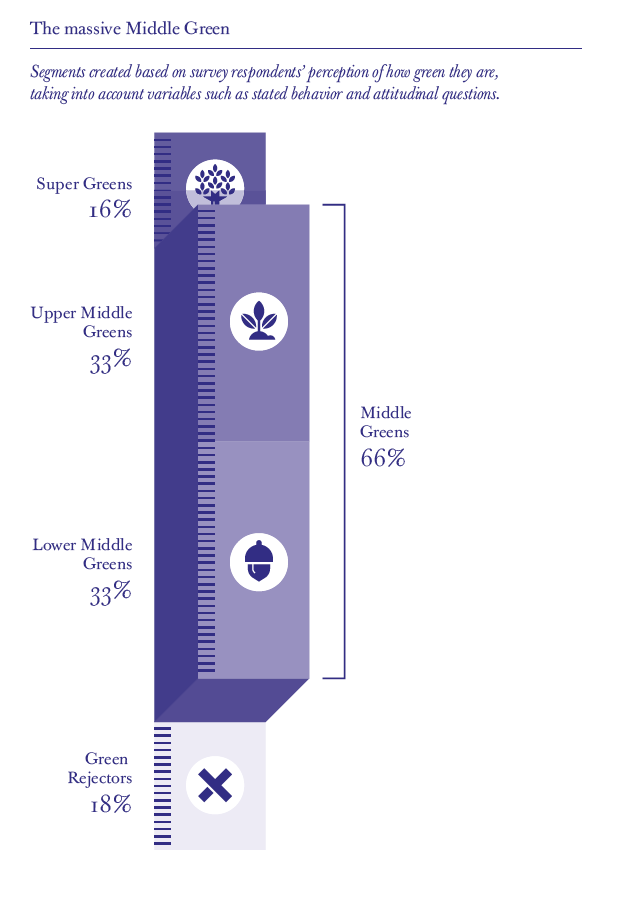
The focus of the study was both in the United States and in China, two of the most populated and carbon intensive countries in the world.  In the chart below, the report shows that the majority of people surveyed recognize the importance of living a sustainable lifestyle, a gap exists between knowledge of its importance and actual behavior.  The gap is 14% in China, and more than double that – 30% – in the United States.

In analysis of the research, Ogilvy Earth observed what this blogger has believed for 3+ years:

“The marketing communications industry knows how to do this. We popularize things; that’s what we do best.  But we need to embrace the simple fact that if we want green behaviors to be widespread, then we need to treat them as mass ideas with mass communications, not elite ideas with niche communications.”

In their analysis, the researchers found that “82% of Americans have good green intentions, but of those 82%, only 16% are dedicated to fulfilling those intentions, putting 66% firmly in this middle ground.”  As indicated in the chart about.

In their conclusions, the report’s authors identify 12 key ways they believe the Green Gap can be bridged.  They conclude:

1. Make it normal.

2. Make it personal.

3. Create better defaults.

4. Eliminate the sustainability tax.

5. Bribe shamelessly.

6. Punish wisely.

7. Don’t stop innovating.  Make better stuff.

8. Lose the crunch.

9.  Turn eco-friendly into male ego-friendly.

10. Make it tangible.

11. Make it easy to navigate.

12. Tap into hedonism over altruism.

For more detail and explanation on these intriguing and provocative gap bridging strategies, read the entire research report here.

Mainstream Green Report from Ogilvy Earth


Conference Board: What Board Members Should Know About Communicating CSR.

23 03 2012

In a significant white paper directed to corporate board members, The Conference Board has challenged directors to be aware of the benefits of corporate social responsibility (CSR) strategies and the challenges of communicating those actions to key stakeholders in the enterprise.

While the business benefits of CSR activities are now well-documented, the report says, “…communicating these activities are far from simple. If stakeholders perceive a lack of clarity regarding the company’s commitment to CSR, doubt the effectiveness of its CSR initiative, or miss the connection of a certain sociality activity to the core business, a backlash can occur.  CSR communication must overcome stakeholder skepticism to generate favorable CSR attributions.”

The report identified 6 key recommendations for board members to provide guidance for communicating CSR strategies:

1.  Seek CSR activities that fit into the business strategy.

2.  Emphasize CSR commitment and impact to foster consumer advocacy.

3. Seek credibility through the support of independent, external communication sources.

4.  Encourage employee and consumer word-of-mouth.

5.  Select social initiatives with high issue support.

6. Be mindful of stakeholder perception of business industry.

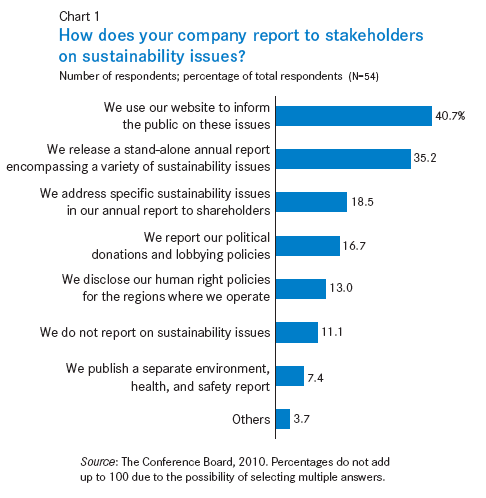
Here is a chart demonstrating how companies are

currently communicating CSR activities.

We are still surprised how passive and latent the CSR communications activities are.  The Conference Board recommends in their research that more consumer engagement is a critical next step to elevate CSR attribution and success.

The report says “a company’s CSR positioning can significantly amplify the effectiveness of CSR communication.  Stakeholders are likely to pay more attention to a comprehensive and coherent CSR message and believe in the authenticity of the social commitment.”

In other words, CSR should become a cornerstone asset in the brand’s equity and marketing focus.

The Conference Board Report Is Here.


Hertz Living Journey: Global Sustainability Initiative

13 02 2012

Hertz — the world’s largest general use car rental brand—introduced “Living Journey” last week… the Company’s corporate sustainability strategy. Living Journey positions Hertz to be the leader in Sustainable Mobility and Equipment Solutions through various strategic initiatives that integrate sustainability best practices throughout the Company including:

  • Smart Mobility—Hertz is committed to providing customers vehicle rental options that are fuel efficient and use clean, low-emissions technology such as Electric Vehicles (EVs) and hybrids.
  • Environment—Hertz’s goal is to minimize its environmental footprint and operating costs through efficiency improvements, resource management and renewable energy production.
  • Community—Hertz is dedicated to creating a positive impact and enhancing the communities it serves by giving back through philanthropic and volunteer efforts.

“We have a long-standing tradition of innovation and leadership that includes managing the environmental performance and social impacts of the Company alongside our fiscal responsibilities,” said Mark P. Frissora, Chairman and CEO of Hertz. “In 2011, we made tremendous progress on Hertz’s industry-leading solar generation and Electric Vehicle initiatives in addition to ongoing efforts to operate in an environmentally responsible manner at our corporate offices and rental facilities. As a continuation of our success, we are excited to introduce Living Journey which encompasses all of our efforts as an organization through partnerships, employee education and investments to reduce our impact on the environment, provide customer value, and manage our business sustainably.”

Through Hertz’s sustainability efforts, the Company has:

  • Recycled over 50,000 IT units since 2005 which diverted 2 million tons of e-waste from landfills,
  • Recycled approximately 680,000 gallons of used oil in 2011, and
  • Reduced paper use by 2.8 million pounds since 2006.

In addition, more than 80% of the water used at Hertz car washes is recycled. The Company is currently implementing energy audits and lighting upgrades across many of its facilities. Estimated results from recent lighting upgrades include 1.1 million kilowatt-hours and 776 tonnes of CO2 emissions saved annually (across 20 Hertz locations).

To communicate Living Journey to its stakeholders, Hertz has launched a sustainability website (http://www.hertzlivingjourney.com) which is the first of its kind for the Company. The site highlights Hertz’s achievements and plans in the sustainability arena, which includes energy-efficiency improvements such as lighting and HVAC upgrades, utilizing LEED certification standards for Hertz buildings, solar energy production, global recycling efforts, and delivering fuel-efficient fleet choices to consumers.

Last year, Hertz was recognized by the Global Business Travel Association for Sustainable Practice through Hertz On Demand, Hertz’s hourly car rental program.


50 Fastest Growing Brands Serve a ‘Higher Purpose’

8 02 2012


New research on the world’s 50 fastest growing brands found a cause-and-effect relationship between a brand’s ability to serve a higher purpose and its financial performance.

Brand consultants Millward Brown and former Proctor & Gamble marketing officer Jim Stengel developed the list of 50 brands, which they say built the deepest relationships with customers while achieving the greatest financial growth from 2001-2011. Furthermore, investment in these companies – the Stengel 50 – over the past decade would have been 400% more profitable than an investment in the S&P 500.

The list includes numerous brands with strong reputations for sustainability, such as Method, Seventh Generation, Stonyfield Farm and Chipotle.

The study forms the backbone of Stengel’s book GROW: How Ideals Power Growth and Profit at the World’s Greatest Companies (Crown Business; December 27, 2011).

“We wanted to uncover which brands grew the most over the past decade, both in terms of customer bonding and shareholder value,” said Millward Brown Optimor VP Benoit Garbe, who led the study. “Once we identified these brands, our burning question was what, if any, were the common principles that sparked and sustained their growth.”

To arrive at the Stengel 50, Millward Brown Optimor valued thousands of brands across 30+ countries. The list included both B2B and B2C businesses in 28 categories ranging in size from $100 million in revenues to well over $100 billion:

Ideals – The Ultimate Growth Driver

A research team – comprising Millward Brown Optimor brand strategists, Jim Stengel, Professor Sanjay Sood and MBA students at UCLA Anderson Graduate School of Management – uncovered that the most successful brands were built on an ideal of improving lives in some way, irrespective of size and category.

“We define ideal as the higher-order benefit a brand or a business gives to the world,” said Stengel. “Some companies are very explicit about their ideals, like Zappos – their ideal of delivering happiness is on their boxes, all over their offices, even on t-shirts employees wear. Other brands, like Louis Vuitton, are more implicit about it. But all their actions – throughout their products, stores and communications – amplify their ideal to luxuriously accentuate the journey of life.”

Added Garbe, “We found that this ideal is both a source of inspiration externally among customers, as well as a compass for internal decision making. So whether it’s Red Bull which seeks to Uplift Mind and Body or Pampers which is all about Caring for Happy Healthy Development of Babies, an ideal influences all facets of the business from HR and Marketing to R&D and Finance.”

Through case studies, GROW demonstrates how brand ideals aren’t simply about altruism or corporate social responsibility but a fundamental human value that is authentic to the brand and ultimately a driver for extraordinary growth. In fact, Millward Brown Optimor’s analysis discovered that those who centered their businesses on ideals had a growth rate triple that of competitors in their categories.

How Ideals Impact the Consumer Mind

Millward Brown’s team also determined that the 50 brands touch on five fundamental human values:

  • Eliciting Joy: Activating experiences of happiness, wonder, and limitless possibility
  • Enabling Connection: Enhancing the ability of people to connect with each other and the world in meaningful ways
  • Inspiring Exploration: Helping people explore new horizons and new experiences
  • Evoking Pride: Giving people increased confidence, strength, security, and vitality
  • Impacting Society: Affecting society broadly, from challenging the status quo to redefining categories

The list of companies is as follows:

Accenture, management and enterprise consulting services

Airtel, mobile communications

Amazon.com, e-commerce

Apple, personal computing technology and mobile devices

Aquarel, bottled water

BlackBerry, mobile communications

Calvin Klein, luxury apparel and accessories

Chipotle, fast food

Coca-Cola, soft drinks

Diesel, youth- targeted fashion apparel and accessories

Discovery Communications, media

Dove, personal care

Emirates, air travel

FedEx, delivery services

Google, Internet information

Heineken, beer

Hennessy, spirits

Hermès, luxury apparel and leather goods

HP, information technology products and services

Hugo Boss, luxury apparel and accessories

IBM, information technology products and services

Innocent, food and beverages

Jack Daniel’s, spirits

Johnnie Walker, spirits

L’Occitane, personal care

Lindt, chocolate

Louis Vuitton, luxury apparel and leather goods

MasterCard, electronic payments

Mercedes-Benz, automobiles

Method, household cleaners and personal care

Moët & Chandon, champagne

Natura, personal care

Pampers, baby care

Petrobras, energy

Rakuten Ichiba, e-commerce

Red Bull, energy drinks

Royal Canin, pet food

Samsung, electronics

Sedmoy Kontinent (“Seventh Continent”), retail grocery

Sensodyne, oral care

Seventh Generation, household cleaners and personal care

Snow, beer

Starbucks, coffee and fast food retailer

Stonyfield Farm, organic dairy products

Tsingtao, beer

Vente-Privee.com, e-commerce

Visa, electronic payments

Wegmans, retail grocery

Zappos, e-commerce

Zara, affordable apparel

Original post at Sustainable Brands


Unilever’s Bold Move: Launches Brave New Foundation.

1 02 2012

Unilever has announced the launch of The Unilever Foundation, dedicated to improving the quality of life through the provision of hygiene, sanitation, access to clean drinking water, basic nutrition, and enhancing self-esteem.

To help achieve the Foundation’s mission, Unilever has formed partnerships with five leading global organizations that are committed to creating sustainable change worldwide: Oxfam, PSI, Save the Children, UNICEF and the World Food Programme.

The Unilever Foundation is a key action that Unilever is taking to help achieve its goal of helping more than one billion people improve their health and well-being, and in turn, create a sustainable future.

“We live in a rapidly changing world. One where populations are growing, water is becoming increasingly scarce, and where food security is a growing issue. Unilever is committed to addressing the unmet social needs that our business can play a unique role in helping to solve. This is especially true in developing and emerging markets where we have deep roots,” said Keith Weed, Chief Marketing & Communications Officer at Unilever.

“We aim to double the size of our business while reducing our environmental impact and deliver increased social value. Together with our partners, we will deliver life-saving solutions as we work toward achieving these ambitious goals,” he added.

The challenges of the 21st century are increasingly complex:

  • Over 1 billion people do not have access to safe drinking water.
  • More than 3.5 million children under 5 die annually from diarrhoea and acute respiratory infections.
  • One child dies every four seconds from preventable and treatable diseases.
  • 2.6 billion people lack access to improved sanitation.
  • An estimated 925 million people suffer from chronic hunger.

“Two billion times a day, somebody, somewhere, uses a Unilever brand. Our global reach and scale, coupled with a deep understanding of what triggers consumer behaviours that can lead to a sustainable future, uniquely enable us to drive long-term scalable and systemic change,” added Weed.

The Unilever Foundation will be working with its Global partners on a number of life-saving initiatives:

  • The Unilever Foundation’s partnership with Oxfam will improve lives around the world through programmes designed to empower individuals and deliver good nutrition and clean, safe drinking water.  According to Barbara Stocking, Oxfam Chief Executive, “Unilever and Oxfam have been working together across the world for quite a number of years so we are pleased to be working with Unilever with the new Foundation as it is set up. The first way that we are going to work together is in the UK, providing food parcels to the very poorest people and helping them move from surviving to thriving. We are looking forward to extending that worldwide, focusing on two pillars core to Oxfam’s work on tackling poverty and inequality – the rights of women and access to clean drinking water.”
  • In supporting PSI, the Unilever Foundation is making a tangible contribution to improving the health of children and families through delivering behavioural change interventions focused on hand washing, clean drinking water and sanitation. “The launch of the Unilever Foundation represents the best of what is possible in Davos,” said Karl Hofmann, President and CEO of PSI. “By pooling ideas and resources, private companies and health organizations can improve the health of millions of children and families worldwide.  PSI is excited to be working with Unilever, a company that recognizes – and values – the economic impact of good health.”
  • The Unilever Foundation is working with Save the Children to save and improve the lives of children around the world. This will involve improving access to health workers and life-saving vaccines, and ensuring more children and mothers are reached with high-impact health and nutrition programmes. The partnership will also provide a platform to catalyse a global movement and generate the public and political will for a global breakthrough on child survival. Jasmine Whitbread, Chief Executive of Save the Children International, said “Save the Children is proud to be selected as a partner for the Unilever Foundation. This partnership will help us to deliver transformational change to millions of children’s lives around the world through our EVERY ONE campaign. Each year 7.6 million children die needlessly of preventable illnesses. The support from Unilever will bring us a step closer to ensuring that a health worker is within reach of every child, life-saving vaccines are available for all, and children have enough food to grow up healthy. Combining our global reach and joint mbition – we can give children the chance to fulfil their potential.”
  • The Unilever Foundation and UNICEF are partnering to improve sanitation in developing countries through UNICEF’s Community Approaches to Total Sanitation (‘CATS’) initiative, a behaviour change program that promotes good hygiene practices, helps create demand for access to toilets, and raises awareness of the sanitation crisis. “By investing with communities in sanitation, this  partnership is helping us break one of the last taboos in public health – open defecation – and demonstrating real leadership for the private sector,” said Anthony Lake, UNICEF’s Executive Director. “Improved sanitation could prevent the deaths of over one million children each year so these investments have enormous potential for the future health and strength of their societies.”
  • The Unilever Foundation is also partnering with the World Food Programme (WFP) in Project Laser Beam, a public-private partnership that aims to create a scalable and sustainable model to improve nutrition, health, and livelihoods in Bangladesh and Indonesia. “With millions of children around the world suffering from malnutrition, there has never been a better time to take action on this truly solvable problem,” said WFP Executive Director Josette Sheeran. “Project Laser Beam is investing in the next generation by ensuring that our children grow up healthy and strong. The knowledge and expertise of partners like the Unilever Foundation help make this goal a reality.”

Additionally, the Unilever Foundation is also working with other organizations worldwide by providing a combination of direct funding, expertise, products and employee support that help to help address country-specific needs primarily aligned with the Foundation’s mission.


PwC: 50% of CEOs prepared to change strategies based on customers’ environmental and corporate responsibility expectations.

27 01 2012

PwC released the results of its 14th annual Global CEO Survey focused on sustainable growth.  The research was conducted with 1,201 business leaders in 69 countries and also included further, in-depth interviews with 31 CEOs to gain a better understanding of those issues.

In this year’s survey, nearly half of CEOs said they would change their companies’ strategies within the next three years because they expect stakeholders to factor companies’ environmental and corporate responsibility practices into purchasing decisions (see figure). Companies are planning to adapt their offerings—or develop entirely new ones—to address society’s changing sentiments. They’re also planning to answer questions about their environmental and corporate responsibility practices—which includes the practices of their suppliers—to stay in their customers’ good graces.
“Most corporations want to do the right thing. They want to be responsive regarding energy use. The people we’re hiring expect us to be. They want to work for a company that has a value system built around sustainability. I don’t think you need government regulation to drive it.”

– Stephen A. Roell Chairman and Chief Executive Officer, Johnson Controls


New Report: 70% of people won’t buy a brand if they don’t like the parent company.

23 01 2012

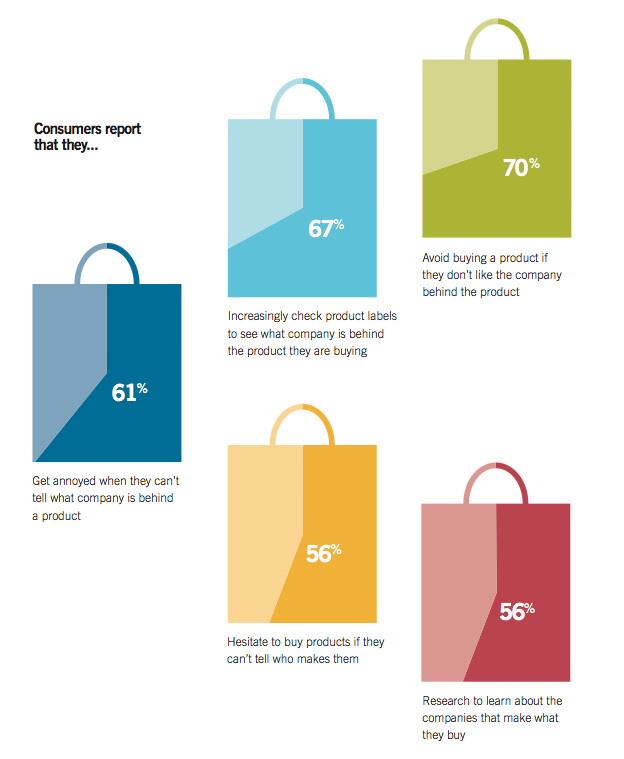
Weber Shandwick has released the results of “The Company Behind the Brand: In Reputation We Trust,” a study finding that 70 percent of consumers won’t buy into a brand if they don’t like the parent company. Among senior execs, 87 percent said that having a strong brand for the parent company is as important as having a strong product brand.

Responsible brand behaviors also influence purchase decisions.  57% of Americans said “more and more I try to buy products made by a company that does good things for the environment or community” – with 83% of Chinese consumers agreeing to the same statement.  57% of Americans say they “get annoyed when it’s not obvious what company is behind a product.” and 56 percent said they “hesitate” to purchase a product if they can’t tell which company makes it.

Says Micho Spring, Global Corporate Chair of Weber Shandwick, “In this always-on, multi-platform, uncertain world, corporate brands are more important than ever because they provide an anchor of trust and credibility in a sea of dynamic, continual change. A strong corporate brand is essential to unlocking the full value of the enterprise and strengthening its brands, products and services as a result.”

Implications from the report included: invest more time and energy in branding the parent company like making website improvements that go into greater detail, clear labeling (more than two-thirds of respondents said they’re checking labels), and use promotional campaigns as an opportunity to talk about the parent company and the individual brands.

The study concluded:

“Corporate reputation and brand reputation are now nearly indivisible. The importance of a firm’s reputation matters more than ever and is unified with the reputation of product brands to create one powerful enterprise brand. Consumers want assurance that their well-earned dollars, yuan, pounds or reais are spent on products produced by companies that share their values. They have higher expectations for the companies and the brands they like and are not hesitant to turn their backs when they are disappointed or fooled.”

Download a copy of the report here.

KRC Research, IPG’s market research firm, polled 1,375 consumers and 575 senior execs at companies with annual revenue of $500 million or more in October and November 2011. Research was conducted online in the U.S., U.K., China, and Brazil.

Original post on PR Newser


24/7 Wall St.: The Ten Most Hated Companies In America.

18 01 2012

Are you surprised?

24/7 Wall Street’s analysis was based on a rigorous study of two dimensions.  One is public research about consumer satisfaction, customer care, pricing of products and services, and brand impressions. Wall St. research takes into account another set of factors, which include present earnings, profit forecasts, product development and quality, and brand valuations.

Here is how they did their research.

“We examined each company based on several criteria. We considered total return to shareholders in comparison to the broader market and other companies in the same sector during the last year. We reviewed financial analyst opinions on those companies that are public. We analyzed data from a broad array of sources, including Consumer Reports, JD Power, the MSN/Zogby Poll, ForeSee and the University of Michigan American Customer Satisfaction Index. We also considered negative press based on 24/7 Wall St.’s analysis of media coverage and the Flame Index, which uses a proprietary algorithm to review more than 12,000 websites and ranks companies based on the frequency of negative words. Finally, we considered the views of taxpayers, Congress and the White House — where applicable.”

Read the article here.


BrandAsset® Valuator: Fewer trust brands but trust is key to building brand equity.

16 01 2012

Kudos once again to our friend John Gerzema and his team at BrandAsset® Valuator for another compelling report on the key trends related to trust, brands, and the rise of the what they deem “The Citizen Marketplace”.

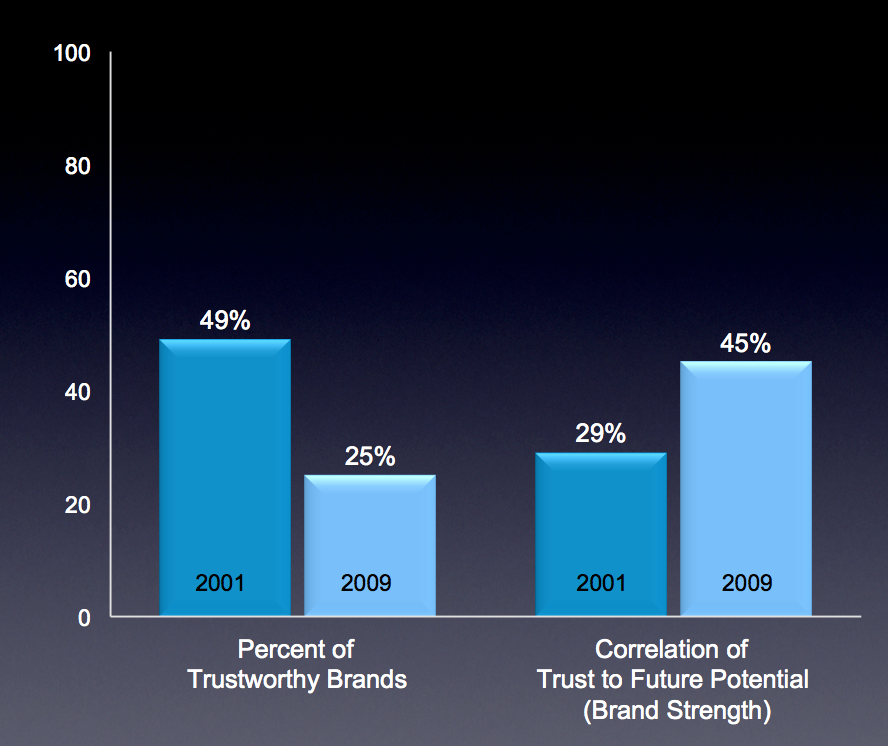
The headlines from their analysis and research demonstrate two inter-related factors as it relates to trust and brands:

That trust is the true, new brand differentiator.

  • 25% of people surveyed trusted brands in 2009, down from 49% at the beginning of the decade.
  • 45% cite trust as key to future potential or brand strength, up from 29% in 2001.

Other key findings in the research is the rise in social media as social contract with trust of social media outlets outpacing that of traditional media (and Twitter leading the trust game among social media outlets).

John and his BAV team conclude the following branding imperatives in the era of the Citizen Marketplace.

  • Trust is the new differentiator
  • There are numerous pathways to trust for companies and brands to pursue based on category requirements and their purpose and values
  • As communications evolve into conversations, social media is moving past social currency to social contract
  • Companies must not think social media, but ‘social as business model’.

Download a BAV presentation on the research here.

Thanks again BAV team for sharing this insightful work.


Asda UK: The new weird is to do nothing.

14 12 2011

The retailer Asda has 500 stores across the United Kingdom, serves more than 18 million customers a week, and has a home shopping busienss that serves over 98% of UK homes.

Adsa just released the results of research it did with over 6,000 Asda customers – who they affectionately have labeled Everyday Experts.

Results from the research are encouraging and revealing.  One of the most compelling findings is that levels of caring about sustainability issues did not vary among high, middle or low income participants.

Other key findings in the report included:

  • 80% said they plan to continue or increase the number of green products they buy.
  • 80% said they buy green products because they think it’s just the right thing to do.
  • 70% said they care about being green—no matter what their gender, age, location or income level, with more than a quarter (28%) saying they care very much indeed.

You can access the Asda research here.


The Enlightened Trend: Shared Value vs. Shareholder Value.

1 12 2011

93% of CEOs believe sustainability issues will be key to business success in the future.  The concept of creating shared value vs. shareholder value is beginning to penetrate the consciousness of many corporate boardrooms. This new report from FSG – the nonprofit consulting firm – gives best in class examples of social engagement strategies where corporate and social issues are aligned.

According to FSG, “the most advanced companies have begun to look at social engagement through a different lens entirely.  Rather than seeing business and society in opposition, they recognize the enormous potential of business to contribute to social progress.  At the same time, they understand that firms depend on healthy and well-functioning societies to thrive.  Such companies seek to create “shared value” – incorporating social issues into their core business strategies to benefit both society and their own long-term competitiveness.”

Says Harvard Business School professor Michael E. Porter, “What’s happening now is really a redefinition of the boundaries of capitalism.  Creating shared value is the next stage of evolution in the sophistication of the capitalist model.”

The report was sponsored by HP and features examples from global business leaders committed to creating shared value, including Alcoa, GE, Cisco, and Nestle among others.

You can download a pdf of the report here.

(Figure from FSG)


Consumer Environmental Behaviors Have Shifted For Good.

30 11 2011

In a recent survey revisiting consumer attitudes toward environmental issues vs. 20 years ago, GfK Roper and S.C. Johnson demonstrate how much progress has been made.


The research study reports that 73 percent say they know a lot or a fair amount about environmental issues and problems, up from 50 percent earlier. Compared to 20 years ago, twice as many Americans are taking proactive steps to help the environment. Today, 58 percent of Americans recycle, 29 percent buy green products regularly and 18 percent commute in an environmentally friendly manner.

And the impact can be dramatic.  According to Kelly M. Semrau, Senior Vice President of Global Corporate Affairs, Communication and Sustainability at SC Johnson, “Simply recycling one aluminum soda can yields enough energy to power my laptop for five hours or light up my office for 20 hours using a 60-watt energy-saving light bulb. These individual steps are made possible because individuals have a desire to modify their behavior, but also because businesses and governments have taken a leadership role in facilitating these changes by providing the right tools, products and processes.”


Three-in-four respondents agree that “a manufacturer that reduces the environmental impact of its production process and products is making a smart business decision.” Those are much higher marks than Americans gave business in 1990. Individuals place themselves higher at 38 percent and rank businesses lower at 29 percent when asked who should take the lead in addressing environmental problems and issues.

Said Semrau, “We all have a role to play to protect our earth, and 75 percent of American consumers say they feel good when taking steps to help the environment. That’s huge. Through increased environmental knowledge and with the right products and tools, we can all appeal to that sentiment to make smarter choices for a greener lifestyle.”

Green shopping photo via Shutterstock.


Don’t Buy This Jacket: Patagonia’s Common Threads Initiative

29 11 2011

In a daring and unprecedented move, the long respected Patagonia brand decries consumerism run amok and pledges to improve its own sustainability performance and asks for the same commitment from its customers.  

For a brand inspired by and dependent on the environment, Patagonia is asking customers to pledge to reduce the products they buy and only buy what they need.  It also is asking consumers to repair what’s broken, pass the product onto someone else, and keep it out of landfills or incinerators.

In exchange for the pledge, Patagonia’s pledge is to make products that last a long time, help repair gear that needs it, find home for products you no longer need and will take back Patagonia products that are worn out.

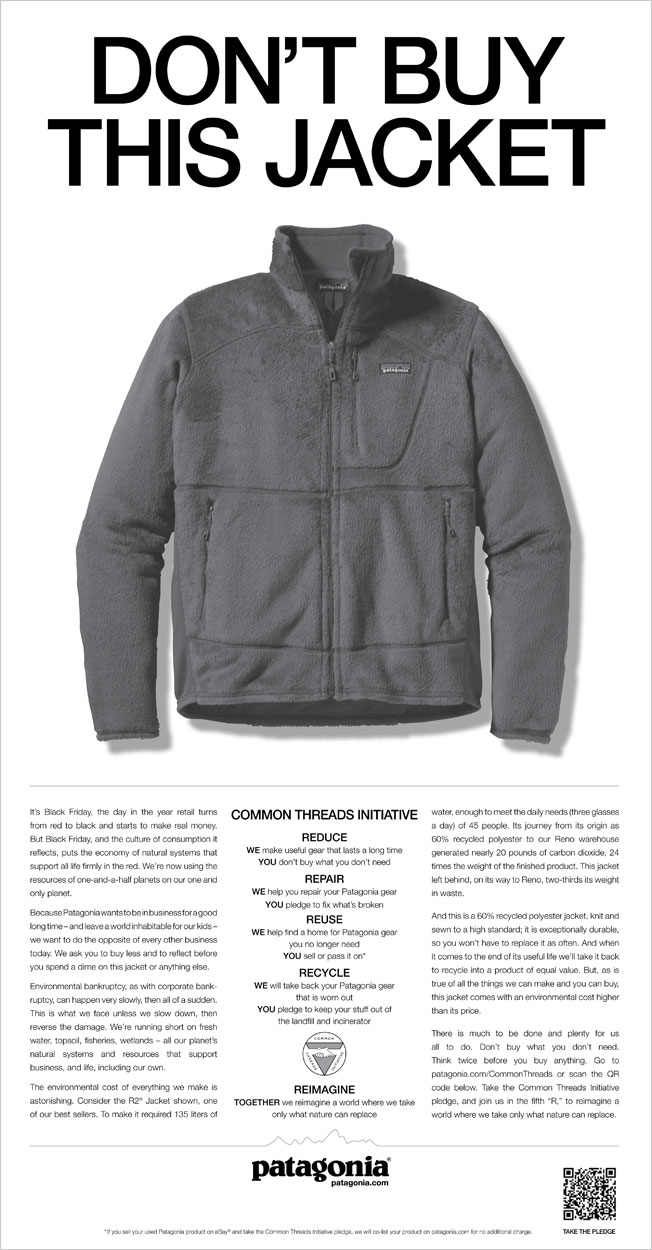
In advertising placed on Black Friday in The New York Times and on-line on Cyber Monday, Patagonia calls itself on the carpet for the environmental impact of the products they manufacture.

“The environmental cost of everything we make is astonishing,” the ad reads. “Consider the R2 Jacket shown, one of our best sellers. To make it required 135 liters of water, enough to meet the daily needs (three glasses a day) of 45 people. Its journey from its origin as 60% recycled polyester to our Reno warehouse generated nearly 20 pounds of carbon dioxide, 24 times the weight of the finished product. This jacket left behind, on its way to Reno, two-thirds its weight in waste.

“And this is a 60% recycled polyester jacket, knit and sewn to a high standard; it is exceptionally durable, so you won’t have to replace it as often. And when it comes to the end of its useful life we’ll take it back to recycle into a product of equal value. But, as is true of all the things we can make and you can buy, this jacket comes with an environmental cost higher than its price.”

The ad concludes: “There is much to be done and plenty for us all to do. Don’t buy what you don’t need. Think twice before you buy anything. Go to patagonia.com/CommonThreads, take the Common Threads Initiative pledge and join us in the fifth R, to reimagine a world where we take only what nature can replace.”

Cheers to Patagonia for honest and authentic communication and for its call for balance and collaboration in a world of too much self-interest and scary levels of divisiveness.

This is world class sustainable branding.

Read more about the campaign on Patagonia’s blog


newSKY: Shoes that re-imagine recycling from New Balance.

28 11 2011

New Balance has introduced newSKY sneakers—which are made from 95% recycled PET plastic bottles and developed a partnership with Coca-Cola’s bottled water brand Dasani.  Great example of companies who can collaborate to achieve mutually beneficial sustainability objectives.

newSKY shoes are available in both men and women’s styles in many different colors.  An interesting holiday gift for the eco-minded family member and friends.

Since its cyber Monday – shop on-line for newSKY here,


Fruitwash: Organic Soap Label for Fruit

26 11 2011

Here’s a bright idea from New York based electrical engineer and designer Scott Amron.  He has designed a fruit label that contains organic soap.  Just as the name suggests, the new label dissolves into organic fruit soap that helps remove water-resistant wax, pesticides and fungicides.

Amron Experimental is currently selling a 10 percent stake in the Fruitwash Label Intellectual Property (patents) and hopes to bring the labels to market within the next 6-9 months.

 “I’ve always been discontent with fruit labels and felt they could do more than just display product info and be difficult to peel off,” Amron told Gizmag. “We buy, wash and eat fruit. So, the wash step was the next thing the label should help with.”

Whilst the labels ingredients are currently being kept secret, they are designed to “outlast the fruit they label,” says Amron. The process of adding water and rubbing the label triggers the dissolving action, which transforms the label into a fruit wash. Alternatively, the stickers can be peeled off and thrown away.

“[The] best thing is the labels help make the fruit cleaner,” says Amron. “And, there’s no label to peel off and throw away unless you choose to peel the label off and throw it away.”

Original article at gizmag

photo credit: Amron Experimental


WindMade: First Consumer Label Attracts Leading Global Brands

26 11 2011

Major global companies including Motorola Mobility, Deutsche Bank, Bloomberg, Method and BD (Becton, Dickinson and Co.) have produced or have pledged to procure at least 25 percent of their operations’ power consumption from wind energy. They announced their commitment to become certified under the new WindMade consumer label at a Global Launch event in New York.

The companies pioneering the use of the world’s first wind power consumer label were unveiled today at an event hosted by WindMade and the UN Global Compact in New York.

The label allows participating companies to communicate the share of wind power and other renewable sources as part of the overall power demand of their operations. The objective behind WindMade is to drive demand in wind power, thereby boosting investment and growing the renewable energy market.

Here is a video that tells the story of the WindMade label.

“These companies are at the forefront of the global sustainability movement,” said Henrik Kuffner, WindMade’s CEO. “We are delighted to have them on board the unique WindMadeTM initiative, and are confident that many others will follow suit in the coming weeks and months.”

“Consumers are ready to act. 67 percent of 31,000 consumers globally have told us they would favor WindMade products, even at a premium,” said Morten Albæk, SVP Global Marketing and Customer Insight at Vestas Wind Systems, the company spearheading the WindMade initiative. “WindMade empowers people to choose brands that choose wind.”

“We believe clean growth is good economics,” said Sabine Miltner, Group Sustainability Officer for Deutsche Bank. “We are committed to leveraging our core business expertise towards a cleaner and more energy efficient global economy. We believe in leading by example and have increased our use of clean electricity from seven percent to 65 percent over the last four years. WindMade is an important step toward more market transparency and we are pleased to join this new partnership.”

“It is Motorola Mobility’s intent through our participation in the WindMade initiative to encourage greater use of renewable energy sources like wind and solar around the globe,” said Bill Olson, director office of sustainability and stewardship, Motorola Mobility.

“The supply side of the clean energy sector can clearly deliver, but now it is time to galvanize demand. Government has done their part, and it is now up to the corporate community to demonstrate leadership by committing to clean energy development. WindMade provides us with a roadmap for achieving this,” said Curtis Ravenel, head of sustainability, Bloomberg.”Corporations investing in wind energy technology need a global set of standards if they are to provide the transparency that’s critical to their stakeholders as well as gain the competitive advantage that such investments can mean for their businesses,” said Kathy Nieland, U.S. sustainable business solutions leader, PwC.

”Using wind power helps BD become a more sustainable organization, and the WindMade label sends a message to our customers and the industry that supporting clean sources of electricity is a sound business decision and an important choice in reducing a corporation’s environmental footprint,” said Glenn Barbi, vice president, Global Sustainability, BD.

For more information on the founders and pioneers, see http://www.windmade.org.

According to the WindMade requirements, companies using the label must source a minimum of 25 percent of the electricity consumed from wind power. The wind energy share can be procured through a company-owned wind power generation facility, a long-term power purchase agreement for wind power, or the purchase of high quality Renewable Energy Certificates approved by WindMadeTM. The exact percentage of the wind energy share will be stated on the label. Companies can choose to certify global, regional or facility level operations, a distinction that will be clearly communicated on the label itself.

WindMade, which was introduced to the world at this past year’s World Economic Forum in Davos, is backed by the UN Global Compact, Vestas Wind Systems, World Wildlife Fund, Global Wind Energy Council, Bloomberg (as the official data provider), and the LEGO Group. PwC is the official verification partner.

A separate label for products is in development and will be released during 2012.


GREENPEACE: HP Leads Greener Electronics Race. Research in Motion in the cellar.

17 11 2011

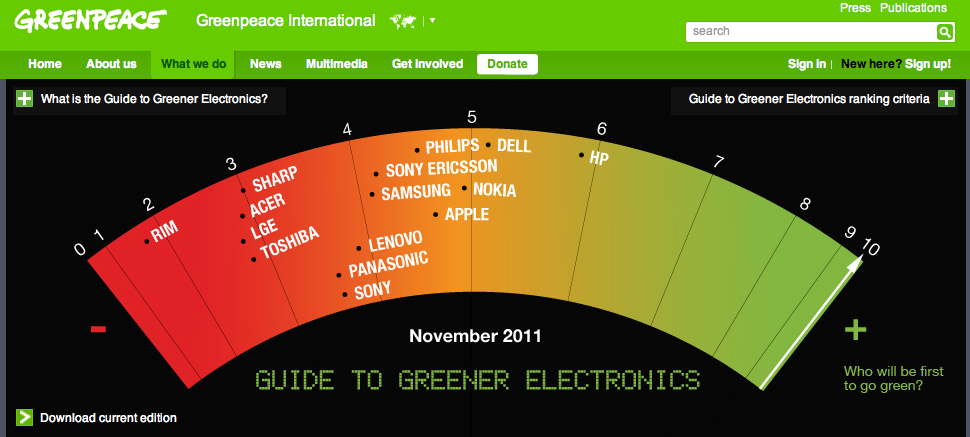
In releasing its latest guide to Greener Electronics, Greenpeace has ranked 15 leading technology companies and how they are performing on key measures around sustainability.  The guide is intended to help consumers make better informed decisions when purchasing technology products and help businesses evaluate the performance of their technology vendors in helping them achieve their own sustainability objectives.

Download the Greenpeace Guide here

The comprehensive analysis will help consumers understand the impact of specific products, as well as the sustainability performance of the overall corporation. New criteria added to this edition of the Guide are based on the creation of truly sustainable electronics industry, Greenpeace said, and include a holistic examination of key supply chain issues.

“Right now, HP takes the top spot because it is scoring strongly by measuring and reducing carbon emissions from its supply chain, reducing its own emissions and advocating for strong climate legislation. However all companies we included in the Guide have an opportunity to show more leadership in reducing their climate impact”, Tom Dowdall of Greenpeace said in a statement.

Blackberry manufacturer Research in Motion (RIM) is ranked for the first time and scored well on conflict minerals and sustainable paper policy. But the company ranked bottom of the table because it needs to improve reporting and disclosure of its environmental performance, Greenpeace said.  It is interesting to note that failure to communicate progress – the opposite of the idea of sustainable branding – was a key factor in RIM receiving such a low ranking.


Congrats Honest Tea. Will report sustainability progress on Tumblr.

10 11 2011

Honest Tea’s decision to expand to this new communication channel reflects a trend among sustainable brands to find the most effective way to leverage corporate social responsibility (CSR) reporting to increase dialogue and engagement with consumers.

The organic bottled tea company released the second edition of its annual Mission Report in combination with a new Tumblr site that will update regularly with posts about the company’s progress on social and environmental initiatives.

Honest Tea released a digital version of the report, which is becoming standard practice, and some companies – led by outdoor companyPatagonia’s example – are building entire microsites dedicated to tracking the sustainability of products and services. Others are choosing to incorporate CSR reporting into the traditional annual report, as Clorox did this year, indicating that sustainability performance is reaching the same level of importance as other corporate disclosures.

Honest Tea’s report, called Keeping It Honest, details the company’s initiatives related to products, packaging, people and partners. It highlights achievements, such as the conversion of all teas to Fair Trade Certified, the company’s first annual service day, and the launch of a new product, Honest CocoaNova.

The report also addresses sustainability challenges, such as packaging, providing consumers with an introspective look at how the company strives to scale a mission-driven business.

Acquired by Coca-Cola earlier this year, Honest Tea also will utilize its Facebook page to host a Keeping It Honest tab, during Honest’s “Mission Month”, where Honest fans can choose a personal mission each week, creating their own agenda for change, the company says.

Go to the Keeping it HONEST site here.

Since Honest Tea was founded in Bethesda, Maryland in 1998, the company has sustained an impressive double-digit annual growth rate. The company was listed as one of PlanetGreen.com’s Top 7 Green Corporations of 2010. It also received Greenopia.com’s coveted 4-Leaf Rating as “the greenest beverage company” for the third year in a row and was recently ranked by The Huffington Post as one of the leading “8 Revolutionary Socially Responsible Companies.”


Original article published at Sustainable Brands Weekly


Kudos to Red Wing Shoes For Crazy Horse.

10 11 2011

In the latest video in their “Work is Our Work” series, Red Wing Shoes presents this inspirational profile of 5 men against a mountain:  Crazy Horse Monument

In 1939, Chief Henry Standing Bear commissioned Korczak Ziolkowski to build a monument to the late Oglala Lakota hero, Crazy Horse. This arduous process and construction soon consumed Ziolkowski’s entire life. Watch as his son and four other dedicated workers look to preserve both his father’s legacy as well as that of Crazy Horse in this amazing and artfully done video.

Congratulations to Minneapolis, MN agency Brew for this amazing effort.  It is a great example of authentic branding and inspiring storytelling.

Visit the Brew team on-line here.


Global Opportunity: Tell It How It Is – according to Cone Echo Research

18 10 2011

In its newly released global research report, Cone Echo Research highlight the opportunity for business to build a stronger relationship with consumers by meeting their expectations that business will address social and environmental issues through their operations, their products and services and their unique expertise.  

The trend is global as evidenced by the results in ten countries and the 10,000 people who were surveyed.  And not surprisingly, communication is critical in bridging the gap between perception and reality.

  • 93% of consumers say they want to know what companies are doing.
  • 91% of people say they want to be heard as well.

This means that reciprocal communication is more than an expectation, its essential in building a strong connection with consumers.  And critical to overcoming the confusion, skepticism and even cynicism among consumers.  

  • 89% of consumers globally believe companies share only the positive information about their efforts, while withholding the negative.
  • 71% are confused by the messages companies use to talk about their efforts and impacts.
  • 61% of consumers believe a company is telling the truth about its social and environmental efforts and impacts, but this varies widely by nationality.

Trust is more complex.

The more trusting a country’s consumers are in business, the more confused they are by a company’s messages. These consumers are putting great faith in the words of business, even though they don’t necessarily understand the messages themselves. In return, they don’t ask for perfection, simply the truth. Nearly nine-in-10 (88%) say it’s ok if a company is not perfect, as long as it is honest about its efforts. This permission presents an opportunity for companies to speak candidly about tough CR issues to build trust.

Follow this link to access the Global CR Study


Men Unmoved By Green Marketing: Radius Research

14 10 2011

New research from global research firm Radius Global Market Research indicates that increased spending on product development and marketing aimed at environmentally conscious consumers may not be getting through to men.

Managing Director of Radius Chip Lister observed “More and more dollars are being dedicated to green marketing initiatives built to associate brands with environmental responsibility but our survey results show that in spite of this increase in spending, the majority of men are not significantly influenced by environmental responsibility when they make a purchase.”

Radius asked U.S. consumers to rate brand attributes across a broad range of products and services in terms of the amount of influence they had on their decision to purchase.

According to the survey, women place importance on a wider range of brand values than do men. Both men and women ranked the same three issues as having the most influence over purchases: (1) Value; (2) Quality; and (3) Trust. After that, however, men appear to be influenced little by any other brand values.

“We found that the value men and women place on environmental responsibility is part of a much broader pattern,” says Lister. “Men are influenced by a much smaller set of brand attributes when they make purchase decisions. Marketers that stray too far from these core attributes run the risk of not being heard. By contrast women seem readily affected in their brand decisions by issues that could almost be considered ‘bigger’, certainly well outside the more direct or tangible deliverables offered by the brand/product.”

Radius’s study was conducted in the third quarter of 2011 and surveyed U.S. households. The firm’s proprietary Know More(TM) panel represents over 3.4 million households, with over 6 million consumers in the U.S. and over 1.5 million consumers in Canada, the U.K. and Europe, Australia and Scandinavia.


Back to the Start: Inspiration from Chipotle

31 08 2011

Willie Nelson sings Coldplay’s riveting “The Scientist” as Chipotle and film-maker Johnny Kelly dramatically depicit how our food and farming system has spun out of control.  


Great effort of sustainable branding from this rare thought leader in the quick service restaurant industry.


Timberland & VF Corporation: New heights or swift decline?

15 06 2011

This week, VF Corporation (the mega holding company for apparel and active lifestyle brands such as Northface, Wrangler, Lee, EastPak) purchased the venerable Timberland brand of sporting footwear for $2 billion.

Of course, Timberland put this positive spin on the news.  Timberland Chief Jeff Swartz said in a statement:   “Timberland is proud of its rich heritage, its track record of success and its reputation as a responsible and environmentally-conscious global citizen, all of which will be preserved and enhanced by becoming part of the VF family of brands.  VF is known for its ability to acquire and grow authentic outdoor brands, while protecting a brand’s unique culture and DNA.”

The jury will be out but many eyes will be watching as the sustainable darling Timberland (ranked number 2 out of 150 companies for sustainability performance by the nonprofit group Climate Counts) will be inspiring to VF. or in the pursuit of stated 10% annual revenue growth – Timberland starts a rocky slide down from sustainability heights of greatness.

According to CSRHUB.com, VF Corporations current performance on sustainability and overall corporate social responsibility measures is hardly a pace-setter.

VF’s overall CSR ranking is 44 – below the averages for other apparel companies, the average U.S. company and all companies ranked.  Its performance on the environment was 20% below the average for U.S. companies.

Contrary to VF’s rather uninspiring CSR performance, CSRHUB.com gives Timberland an overall ranking of 63 – and a sterling 65 on environment performance measures (vs. 48 for the average U.S. Company).

Timberland’s track record of integrating socially responsible practices and community outreach into their brand marketing efforts make them a poster child for positive sustainable branding.  We worry VF’s leadership won’t cherish the vision and values that has made Timberland special and uniquely sustainable.  Stay tuned.

CSRHUB.com is a great resource for evaluating CSR performance of companies – go here.


Kudos to Coke: Appoints Global Chief Sustainability Officer

30 05 2011

Congratulations to Coca-Cola with its appointment of former Chief Marketing Officer Beatriz Perez to Chief Sustainability Officer.

Under the vision of CEO Muhtar Kent, Perez will be responsibile for integrating sustainability initiatives into brand and marketing efforts and further demonstrate its monitoring and improving the commitment to the moderate impact of its products and operations on the environment.

We also find it notable that the new office of sustainability at Coca-Cola will include leaders responsible for corporate social responsibility, environment and water, external affairs and sustainability strategy and communication.

Read the news release below.

May 23, 2011 – The Coca-Cola Company (NYSE: KO) has appointed it first Chief Sustainability Officer (CSO) and created a new global Office of Sustainability in an effort to better integrate ongoing initiatives.

Beatriz Perez, who is currently Chief Marketing Officer for Coca-Cola North America, will serve as CSO beginning July 1. She will work to integrate Coca-Cola’s sustainability initiatives in the areas of water, climate protection, packaging and recycling.

“We have made significant progress with our sustainability initiatives, but our current approach needs focus and better integration to further accelerate our system sustainability agenda and meet our 2020 Vision goals,” said Muhtar Kent, Chairman and CEO, The Coca-Cola Company. “We are realigning this important work to create a unified team, strategy and business plan that connects our sustainability work and actions.”

Under Perez’s leadership, the Office of Sustainability will create and oversee Coca-Cola’s integrated global sustainability strategy; set goals and commitments; assess and drive scaled investments; and steward and track all global partnerships and key sustainability projects.

Reporting to Perez, the new team will include John Reid, Vice President, Corporate Social Responsibility; Charlotte Oades, Global Director, Women’s Economic Empowerment; Abby Rodgers, Vice President, Sustainability Strategy and Communication; Jeff Seabright, Vice President, Environment and Water; and Lisa Manley, Group Director, Corporate External Affairs.

Perez will report to Executive Vice President and Chief Administrative Officer Alex Cummings.

Kent said Perez is uniquely qualified for the role based on her passion for sustainability and deep experience at the Company, including the incorporation of sustainability initiatives into Coca-Cola’s North American marketing programs.


Spring Planting: The Sprouting Of The Plant Bottle

27 05 2011

Marketers are recogizing the value of introducing alternatives to traditional plastic bottles.  We encourage continued innovation and adoption of these strong signs of a commitment to sustainability by consumer packaged goods marketers – and support from their customers.  It’s a great sign of spring and summer and the “growing season.”


The Heinz Ketchup Plant Bottle will begin arriving in stores in July.


Pepsi recently announced they have devleoped the worlds first PET plastic bottle

made entirely from plant-based renewable resources.

Pepsi’s bottle is made from bio-based materials including switch grass, pine bark and corn husks.  In the future, the company expects to broaden the renewable resources used to create the green botle to include orange peels, potato peels, oat hulls and other agricutltural byproducts from its food business.  Pepsi says the new bottle is expected to begin appearing on shelves in 2012.

The healthy sign of a race between arch rivals Pepsi and Coke is Pepsi innovation claims to be 100% renewable materials vs. the PlantBottle currently being deployed by Coca-Cola which is made of 30% renewable resources.


Coca-Cola was among the first to pioneer the plant bottle technology in 2009.


Fair Trade Certified Labeled Products Increases Sales.

28 04 2011
Researchers from Harvard, the London School of Economics and Massachusetts Institute of Technology Release Study on the Value of Ethical Labeling

Fair Trade USA, the leading third-party certifier of Fair Trade products in the United States, reports new findings which confirm that the prominent appearance of the Fair Trade Certified™ label increases sales  among coffee-buying consumers.

To investigate the topic of consumer demand for Fair Trade products, researchers Jens Hainmueller of the Massachusetts Institute of Technology, Michael J. Hiscox of Harvard University, and Sandra Sequeira of the London School of Economics, conducted a six-month research study in partnership with a prominent national grocery retailer. As reported this weekend in the Wall Street Journal, the team examined purchasing behavior among actual consumers at 26 stores and key findings show that:

  • The Fair Trade Certified label alone has a large positive impact on sales.
  • Sales of the two most popular bulk coffees sold in each of the 26 test stores increased by up to 13 percent when labeled as Fair Trade Certified.
  • The study also revealed that a substantial segment of consumers are willing to pay up to eight percent more for a product bearing the Fair Trade Certified label.

The findings are consistent with a Globescan study conducted in 2010, which revealed that 75 percent of consumers said Fair Trade certification makes them feel “very positive or positive” about products; 30 percent said Fair Trade is “likely to increase their purchase interest;” and over half said “independent third-party certification is the best way to verify” a product’s social and environmental claims.

Overall the findings suggest that there is substantial consumer support for Fair Trade,” said Michael J. Hiscox of Harvard University. “The Fair Trade label by itself had a large positive effect on sales, indicating that a substantial number of coffee buyers place a positive value on Fair Trade certification. In addition, a sizeable segment of coffee buyers were willing to pay a premium for coffee if the premium was directly associated with support for Fair Trade. The tests suggest that there are plenty of consumers ready to vote with their shopping dollars to support Fair Trade when it is offered as an option by retailers.”

The study can be referenced online at http://papers.ssrn.com/sol3/papers.cfm?abstract_id=1801942.


Green is Universal Reports Green Consumersim and Brand Loyalty Are On the Rise.

27 04 2011

A new report from Green Is Universal reports that 78% of consumers believing more than ever that buying green is a way to shop with their values and ethics (up 9 points vs. two years ago).  The poll also reveals that an overwhelming majority of consumers feel they have a personal responsibility to take care of the earth (93%), and believe that if we don’t do so, there will be negative consequences for future generations (91%).  Nine out of 10 consumers say companies have a social responsibility to protect the environment.

Sixty-eight percent (68%) of consumers say it’s worth paying more for a green product or service if it is a brand they trust (an increase of 8 points vs. 2 years ago).”These findings underscore that consumers are increasingly shopping with their values, particularly when it comes to the environment,” said Beth Colleton, Vice President, Green is Universal. “This is an enormous opportunity for marketers to communicate their brand’s commitment to green, as a way to build both loyalty and returns for their business.”

Not only do consumers hold themselves accountable when it comes to protecting the earth, but they believe companies should be held to the same standard. and three-quarters (77%) say they have a more favorable impression of companies that promote environmental causes. Putting their money where their mouth is, findings show substantially more consumers who say they have boycotted a company/product in the past year, because it had policies and practices that were not environmentally responsible (27%) (up 8 points from 2009).

Additional highlights from a related but separate Green is Universal poll on re-use, “From Trash To Treasure,” include the following:

  • 62% say they are making a conscious effort to purchase products made by environmentally responsible companies
  • 68% say they are paying more attention to whether products are made from recycled materials
  • 84% appreciate companies who make it easier for them to recycle
  • 78% appreciate companies who make using recycled materials a priority because it provides them with an easy way to help the environment
  • 57% say they are likely to encourage others to buy products that are made from recycled materials
Reposted from Sustainable Life Media.


Mainstream Green: Moving Sustainability from Niche to Normal

21 04 2011

Ogilvy Earth issues an important report on moving sustainability for niche to normal.

The report has some interesting insights into how marketers are creating more confusion and causing more harm than good in terms of getting people to adopt sustainable products into their everyday lifestyles.  To quote Oglivy Earth:

Topline: We’ve been getting the message all wrong

Our research shows that when it comes to motivating the American Mainstream, marketers, governments, and NGOs have been approaching messaging and marketing around sustainability all wrong. Indeed much of what we’ve been doing has actually been cementing the Green Gap by making green behavior too difficult and costly from a practical, financial, and social standpoint.

The study found that 82% of Americans have good green intentions but only 16% are dedicated to fulfilling these intentions, putting 66% firmly in what we’re calling the Middle Green.

Other highlights from the report.

  •  82% of our respondents said going green is “more feminine than masculine.” No wonder then that men clustered to the left, less- green side of our continuum while the greener, right side was dominated by women.
  • 80% of Americans would rather cure cancer than fix the environment.
  • 73% percent of Americans opted for the known, mainstream brand. A legacy of inferior performance prevents consumers from taking the leap to an unknown, eco brand.
Kudos to Ogilvy Earth for helping us better understand the barriers we need to overcome to move green to the mainstream.

Read the executive summary here.