Havas Media: Only 20% of global brands contribute to a sense of wellbeing and quality of life.

8 11 2011

In releasing their latest results, Havas Media underscores how few brands are contributing meaningful experiences to people – with most people saying they would not care if 70% of brands ceased to exist.

In a press release, Sara de Dios, Global Head of Meaningful Brands at Havas Media said.  “We believe that it is likely that the next generation of brands will flourish in emerging economies – they can, from the onset, create the context that promotes the growth of meaningful brands. Companies and brands operating in emerging economies can become active in transforming their roles; they are creating new lifestyles for millions of people and their communities while contributing to the overall progress of their societies. This will continue in the future with a growing middle class emerging within these markets.”

This innovative global undertaking is able, for the first time, to connect brands with our quality of life and wellbeing. It does this by measuring the perceived impact of brands on our personal wellbeing – their influence on factors such as our health, fitness, happiness, values, social relationships, financial security, lifestyles and habits – and our collective wellbeing, that is, how brands help to improve communities, societies and the environment.

The analysis includes a measurement called The Meaningful Brand Index (MBi) that uses consumer perception to compare and track the impact brands have on our lives. Based on the views of 50,000 people in 14 countries, the results show a direct relationship between a brand’s MBi score and the level of consumer attachment. That is, the greater the contribution the brand has to our wellbeing – measured by the value it creates for individuals, communities and the environment – the larger role it will have in people’s lives and the more meaningful it becomes.

Meaningful Brand Index results:

Ikea, Google, Nestlé, Danone, Leroy Merlin, Samsung, Microsoft, Sony, Unilever and Bimbo are the top 10 global brands. These brands systematically improve our personal and collective wellbeing and are rewarded by stronger brand equity and attachment. Furthermore, the results show that we really care that these brands exist as we see that they are making a significant contribution to our lives and communities. Havas Media argues that many of the top 20 brands are helping us create a new lifestyle that’s more consistent with today’s challenges and consumer trends.

Top 20 global brands according to Havas Media’s Meaningful Brand Index:

  1. Ikea
  2. Google
  3. Nestlé
  4. Danone
  5. Leroy Merlin
  6. Samsung
  7. Microsoft
  8. Sony
  9. Unilever
  10. Bimbo
  11. LG
  12. Philips
  13. Apple
  14. P&G
  15. Mars
  16. Volkswagen
  17. L’Oreal
  18. Wal-Mart
  19. Carrefour
  20. Coca-Cola

Detailed analysis on what makes each brand meaningful

Meaningful Brands also explains what makes things meaningful to us as consumers when it comes to specific brands and sectors. For instance, 65% registered a very strong attachment to Coca-Cola worldwide. However, only 35% think the brand improves our quality of life. In fact, some consumers worldwide think it is contributing negatively to our lives, mostly due to health concerns. However, Coca-Cola has, as with many other brands in the beverage sector, been a pioneer in connecting its brand to other personal issues such as happiness and positivity which has enabled it to successfully build a positive link to our emotional wellbeing.

Sector trends

When looking into brands’ impact on our sense of collective wellbeing (communities/ societies/environment), there is a general improvement. This is the case with the automotive and public transport sectors, driven by greater environmental and product innovation (such as the hybrid and electric cars and energy efficiency). Compared to last year, brands such as Volkswagen, BMW, Toyota and Peugeot have, according to consumers, improved the most in this area.

Personal and individual wellbeing

When it comes to our expectations of improving our personal wellbeing and quality of life, the results are not so good. A staggering 80% of brands across 14 countries are underperforming. This reveals a huge opportunity for brands. To some extent this is being realised by brands in sectors such as FMCG, retail, IT and consumer electronics. According to consumers, most brands in the financial, utilities and telecommunications sectors, underperform in helping us improve our daily lives and individual wellbeing.

Despite these trends, the analysis shows that some brands have been able to break free from these industry limitations. There are brands with exceptionally high MBi scores in low scoring industries that are learning to reconnect with consumers. This is the case for Fidelity Investments in the USA, the energy brand Petrobras in Brazil, EDF in France and the telco brands 02 in the UK and Free in France. All of these register significantly higher than average MBi scores for both their sectors and countries.

Worldwide and regional comparisons:

The analysis suggests that the next generation of brands will come from emerging economies. People in fast growing economies, such as Asian and Latin American markets, record a stronger and healthier relationship with brands. The proportion of brands making a notable positive contribution to our lives increases to around 30% in Latin America, compared to 8% in European markets, where people tend to be more sceptical and less engaged with brands. In the US it’s 5%.

By contrast, the situation in developed economies is the opposite. Brands in these regions are no longer seen to improve people’s quality of life. There is an aging and increasingly poorer middle class who are demanding that brands help them to lead and create new lifestyles that fit in to their new expectations and values. In order to survive, these brands must re evaluate their definitions of success and take up the challenge to make meaningful contributions to these people’s lives.”

Hernan Sanchez Neira, CEO Havas Media Intelligence, adds:
“It’s clear from our analysis that we need to take a new look at the relationship between brands and consumers. Nowadays we want so much more from brands than just promises or stories. Brands that manage to create better relationships dominate the marketplace.”

Meaningful Brands helps us to develop this type of relationship by understanding exactly what people expect from brands. It also helps us track how successful companies are responding to these needs by understanding how these companies are contributing to our wellbeing, both as citizens and individuals, and how they communicate these values to us. It also shows us that there’s a big business opportunity for brands who are able to satisfy consumers by creating wellbeing in the context of their new values, expectations and local market realities.”

Consumer sentiment continues to shift:

  • For the 4th year running consumer expectations of companies’ responsible behaviour continues to rise
  • Nearly 85% of consumers worldwide expect companies to become actively involved in solving these issues (an increase of 15% from 2010)
  • Those prepared to reward responsible companies by choosing to buy their products is up 11% from last year to more than half of all consumers (51%)
  • Those who would pay a 10% premium for a product produced in a responsible way is up once again – from 44% last year to 53% in 2011
  • The percentage of us who would punish irresponsible companies has also increased to 44% (from 36% in 2010)
  • Only 28% of consumers worldwide think that companies today are working hard enough to solve our social and environmental challenges.
  • Only 20% trust companies when they communicate about their social/environmental commitments and initiatives

About the research:

The research was carried out from March to June 2011 across 14 markets – France, Spain, UK, Germany, Italy, USA, Mexico, Brazil, Colombia, Chile, Argentina, China, Japan and India. The research took into account the views of 50,000 consumers via online panels.

About Havas Media

Havas Media is the global media network of Havas.

Havas Media represents one of the world’s fastest growing media networks and its agencies have grown from 10 markets in 1999 to 119 markets in 2011.

Havas Media services its clients through a portfolio of specialist global networks and agencies. The group is organised to maximise local market dynamics whilst leveraging the extensive global insight and strategic support within Havas Media. The range of companies within Havas Media include: MPG (Havas Media’s global media network), Arena Media (Havas Media’s network for tailor-made communication services), Havas Digital (Havas Media’s global interactive network) and Havas Sports & Entertainment (Havas Media’s global sports and entertainment communication network).

Further information can be found at www.havasmedia.com or follow us on twitter @HavasMedia
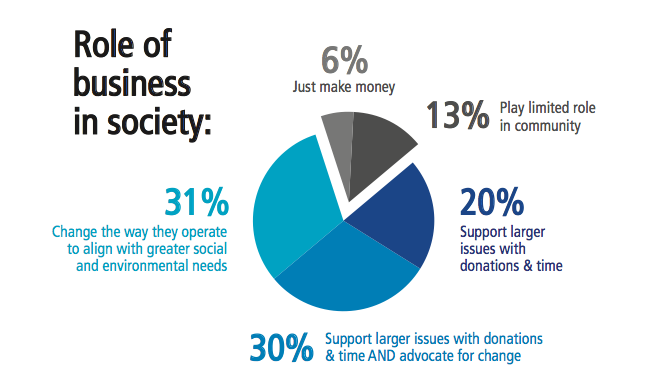


Global Opportunity: Tell It How It Is – according to Cone Echo Research

18 10 2011

In its newly released global research report, Cone Echo Research highlight the opportunity for business to build a stronger relationship with consumers by meeting their expectations that business will address social and environmental issues through their operations, their products and services and their unique expertise.  

The trend is global as evidenced by the results in ten countries and the 10,000 people who were surveyed.  And not surprisingly, communication is critical in bridging the gap between perception and reality.

  • 93% of consumers say they want to know what companies are doing.
  • 91% of people say they want to be heard as well.

This means that reciprocal communication is more than an expectation, its essential in building a strong connection with consumers.  And critical to overcoming the confusion, skepticism and even cynicism among consumers.  

  • 89% of consumers globally believe companies share only the positive information about their efforts, while withholding the negative.
  • 71% are confused by the messages companies use to talk about their efforts and impacts.
  • 61% of consumers believe a company is telling the truth about its social and environmental efforts and impacts, but this varies widely by nationality.

Trust is more complex.

The more trusting a country’s consumers are in business, the more confused they are by a company’s messages. These consumers are putting great faith in the words of business, even though they don’t necessarily understand the messages themselves. In return, they don’t ask for perfection, simply the truth. Nearly nine-in-10 (88%) say it’s ok if a company is not perfect, as long as it is honest about its efforts. This permission presents an opportunity for companies to speak candidly about tough CR issues to build trust.

Follow this link to access the Global CR Study


Sweet Sixteen: World Economic Forum finds New Sustainability Champions

19 09 2011

Congratulations to the World Economic Forum and Boston Consulting Group for their work in identifying 16 companies in emerging markets that are setting new standards for sustainability.

In the new report by WEF and BCG, they highlight that Brazil, China, India, Indonesia, the Russian Federation and South Korea will account for more than 50% of the world’s economic growth by the year 2025.

From the Executive Summary of the report:

“The World Economic Forum and The Boston Consulting Group (BCG) set out to seek unconventional, practical solutions to the current challenges of growth, aiming to identify and support key business practices, and to relay them to the global community. This project deliberately did not look to governments, environmental organizations or multinational corporations from advanced economies – all sources of well- practiced but as yet insufficient answers. Instead, it went to agents who deal with a wide range of constraints in their daily business: rapidly growing companies originating and operating in the emerging markets, where economic prosperity and populations are growing fastest, and where environmental constraints and stresses are often highest.

As a result of a rigorous research process, the project identified and assessed 16 emerging market-based companies that share a unique mindset and set of best practices: these are the New Sustainability Champions.

Based in countries such as Brazil, Costa Rica, Egypt and Kenya, these companies provide inspiring examples for any corporation around the world interested in tackling the challenges of performance, innovation, growth and sustainability. Specifically, the New Sustainability Champions:

1. Proactively turn constraints into opportunities through innovation

2. Embed sustainability in their company culture

3. Actively shape their business environments

Moreover, they demonstrate superior financial performance when benchmarked against their peers.

The mindset, practices and business models of these New Sustainability Champions offer critical insights for emerging market-based businesses, established multinationals and governments. They could provide multiplier effects and create the basis for replication and extension among companies operating in emerging markets. They also serve as a starting point for redefining the future of growth: one that is robust and efficiently binds together all elements of sustainability – economic, environmental and social”

Here are the 16 companies that the report highlights.

Download a copy of the report here


Back to the Start: Inspiration from Chipotle

31 08 2011

Willie Nelson sings Coldplay’s riveting “The Scientist” as Chipotle and film-maker Johnny Kelly dramatically depicit how our food and farming system has spun out of control.  


Great effort of sustainable branding from this rare thought leader in the quick service restaurant industry.


Timberland & VF Corporation: New heights or swift decline?

15 06 2011

This week, VF Corporation (the mega holding company for apparel and active lifestyle brands such as Northface, Wrangler, Lee, EastPak) purchased the venerable Timberland brand of sporting footwear for $2 billion.

Of course, Timberland put this positive spin on the news.  Timberland Chief Jeff Swartz said in a statement:   “Timberland is proud of its rich heritage, its track record of success and its reputation as a responsible and environmentally-conscious global citizen, all of which will be preserved and enhanced by becoming part of the VF family of brands.  VF is known for its ability to acquire and grow authentic outdoor brands, while protecting a brand’s unique culture and DNA.”

The jury will be out but many eyes will be watching as the sustainable darling Timberland (ranked number 2 out of 150 companies for sustainability performance by the nonprofit group Climate Counts) will be inspiring to VF. or in the pursuit of stated 10% annual revenue growth – Timberland starts a rocky slide down from sustainability heights of greatness.

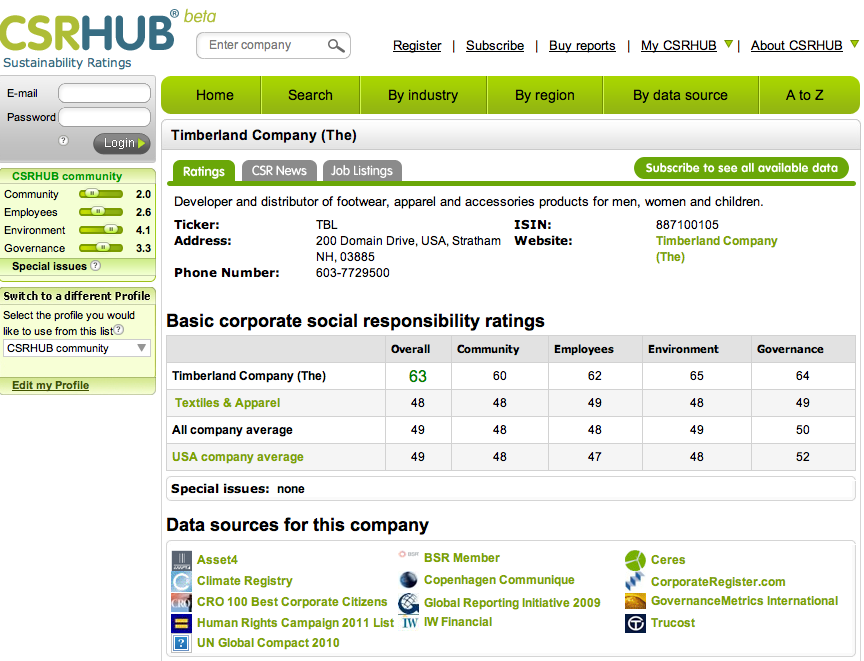
According to CSRHUB.com, VF Corporations current performance on sustainability and overall corporate social responsibility measures is hardly a pace-setter.

VF’s overall CSR ranking is 44 – below the averages for other apparel companies, the average U.S. company and all companies ranked.  Its performance on the environment was 20% below the average for U.S. companies.

Contrary to VF’s rather uninspiring CSR performance, CSRHUB.com gives Timberland an overall ranking of 63 – and a sterling 65 on environment performance measures (vs. 48 for the average U.S. Company).

Timberland’s track record of integrating socially responsible practices and community outreach into their brand marketing efforts make them a poster child for positive sustainable branding.  We worry VF’s leadership won’t cherish the vision and values that has made Timberland special and uniquely sustainable.  Stay tuned.

CSRHUB.com is a great resource for evaluating CSR performance of companies – go here.


ImagePower Survey: 60+% of consumers globally want to buy from environmentally responsible companies.

10 06 2011

Monterey, CA – June 8, 2011– Consumer appetite for green products has increased significantly in the past year, according to findings from the annualImagePower® Global Green Brands Survey, one of the largest global consumer surveys of green brands and corporate environmental responsibility. This year’s survey, which polled more than 9,000 people in eight countries, reveals that consumers worldwide intend to purchase more environmental products in the auto, energy and technology sectors compared to last year. Now more savvy about how green choices in personal care, food and household products directly affect them and their families, global consumers are expanding their green purchase interest to higher-ticket items such as cars and technology.

Industries protecting the environment

Consumers are divided on which industry currently does the best job of protecting the environment. 18 percent of American and 20 percent of Australian consumers say the energy industry does the best job of protecting the environment. By comparison, most of respondents in Germany (19 percent), India (22 percent), China (33 percent) and Brazil (22 percent) cite the technology sector. In the UK, more than 21 percent of consumers say the grocery store industry is the top protector of the environment.

Where consumers are spending

While personal care, grocery and household products are the industries with the greatest representation among the top ten brands list, consumers in the US indicate that they intend to spend more money on green technology, energy and automotive products or services in the next year. When it comes to current usage of green products or services, the 2011 study reveals that the household products and grocery categories have the highest consumer adoption rates in all countries except China, where packaged goods/beverages and personal care are the most used categories, and in Brazil, where household products and personal care dominate. In all countries, consumers indicate that in the coming year they are less likely to buy green packaged goods and beverages, grocery and household products.

“We’re seeing a shift in the ‘In Me, On Me, Around Me’ mentality when it comes to purchasing green products,” said Russ Meyer, Chief Strategy Officer of Landor Associates. “Consumers have a good understanding of how green choices in personal care, food and household products directly affect their families, and they are now seeing benefits like costs savings that attract them to higher cost items like cars and technology.”

Greater perceived value in developing countries

Consistent with last year’s study, more than 60 percent of consumers globally want to buy from environmentally responsible companies. Respondents in all eight countries surveyed indicate that they are willing to spend more on green products. In developed countries such as the US and the UK, roughly 20 percent of those surveyed would spend more than 10 percent extra on a green product.

In developing countries, however, consumers say that green products have a higher inherent value. Ninety-five percent of Chinese consumers say they are willing to spend more on a product because it’s green—with 55 percent of them willing to spend between 11-30 percent more. Similarly 29 percent of Indian consumers and 48 percent of Brazilians say they are willing to spend between 11 – 30 percent more on green products.

“Consumers in developing countries express greater concern over the state of the environment in their countries, which may contribute to their greater willingness to pay more for green products,” said Paul Andrepont, Senior Vice President of Penn Schoen Berland. “Consumers in these markets also differ from their developed-nation counterparts in believing that selection, rather than cost, is the greatest barrier to buying green products. Brands that address these consumers’ very real concern – over air pollution in India or deforestation in Brazil – have the ability to position themselves as premium in the market, a possible competitive advantage.”

Packaging is critical

Packaging continues to be a matter of great concern for US consumers. Seventy-one percent believe companies use too much material in product packaging – though only 34 percent of US consumers say they consciously purchase products that use less packaging. Almost half of American consumers feel that packaging that can be recycled is more important than packaging made from recycled or biodegradable materials.

Packaging also plays a critical role in communicating product benefits to US consumers. More than 50 percent of American consumers say on-pack information helps them understand how green a product is. Additionally, 40 percent say that packaging is their primary source for information on environmental issues regarding products.

“Other than price, the two biggest influences on purchase decisions are on-package messaging and prior experience with the product, both of which satisfy the consumer need to understand a benefit beyond ‘saving the world,’” said Annie Longsworth, global sustainability practice leader for Cohn & Wolfe. “It’s critical for green brands to communicate the real and tangible benefits of their products in addition to being green, which still feels like luxury to many consumers.”

2011 US rankings
For the first time since the inception of the ImagePower® Green Brands Study in 2006, the four brands perceived to be the greenest are “born green” companies. The full list includes:

  1. Seventh Generation
  2. Whole Foods
  3. Tom’s of Maine
  4. Burt’s Bees
  5. Trader Joe’s
  6. The Walt Disney Company
  7. S.C. Johnson
  8. Dove
  9. Apple
  10. Starbucks, Microsoft (tied)

“When we analyzed the approach of the top ten brands companies, using our Esty Environmental Scorecard™, it was clear that the winners achieve a product-value-information trifecta,” said Amy Longsworth, partner at Esty Environmental Partners. “The top brands offer clear price value through co-benefits: a great innovative product that meets my functional needs plus green attributes that meet my values needs. These companies also tend to have robust life-cycle insight and complete sustainability strategies across their value chains, which enable them to draw from rich experience and data for their consumer communications.”

Methodology

The seventh annual Green Brands study polled more than 9,000 people in eight countries —including the United States, the United Kingdom, China, Brazil, India, Germany, France and Australia—and was conducted by WPP agencies (NASDAQ: WPPGY) Cohn & Wolfe, Landor Associates and Penn Schoen Berland Associates (PSB), as well as independent sustainability strategy consulting firm Esty Environmental Partners. The Green Brands Study identifies emerging trends related to consumer perception and purchasing behavior of “green” products. The study was conducted online among the general adult population between April 2, 2011 and May 3, 2011. It has a margin of error of +/- 3.0%. In China, India, and Brazil, respondents were from tier-one cities.

To view 2011 global findings, click here. For US findings, click here.


Kudos to Coke: Appoints Global Chief Sustainability Officer

30 05 2011

Congratulations to Coca-Cola with its appointment of former Chief Marketing Officer Beatriz Perez to Chief Sustainability Officer.

Under the vision of CEO Muhtar Kent, Perez will be responsibile for integrating sustainability initiatives into brand and marketing efforts and further demonstrate its monitoring and improving the commitment to the moderate impact of its products and operations on the environment.

We also find it notable that the new office of sustainability at Coca-Cola will include leaders responsible for corporate social responsibility, environment and water, external affairs and sustainability strategy and communication.

Read the news release below.

May 23, 2011 – The Coca-Cola Company (NYSE: KO) has appointed it first Chief Sustainability Officer (CSO) and created a new global Office of Sustainability in an effort to better integrate ongoing initiatives.

Beatriz Perez, who is currently Chief Marketing Officer for Coca-Cola North America, will serve as CSO beginning July 1. She will work to integrate Coca-Cola’s sustainability initiatives in the areas of water, climate protection, packaging and recycling.

“We have made significant progress with our sustainability initiatives, but our current approach needs focus and better integration to further accelerate our system sustainability agenda and meet our 2020 Vision goals,” said Muhtar Kent, Chairman and CEO, The Coca-Cola Company. “We are realigning this important work to create a unified team, strategy and business plan that connects our sustainability work and actions.”

Under Perez’s leadership, the Office of Sustainability will create and oversee Coca-Cola’s integrated global sustainability strategy; set goals and commitments; assess and drive scaled investments; and steward and track all global partnerships and key sustainability projects.

Reporting to Perez, the new team will include John Reid, Vice President, Corporate Social Responsibility; Charlotte Oades, Global Director, Women’s Economic Empowerment; Abby Rodgers, Vice President, Sustainability Strategy and Communication; Jeff Seabright, Vice President, Environment and Water; and Lisa Manley, Group Director, Corporate External Affairs.

Perez will report to Executive Vice President and Chief Administrative Officer Alex Cummings.

Kent said Perez is uniquely qualified for the role based on her passion for sustainability and deep experience at the Company, including the incorporation of sustainability initiatives into Coca-Cola’s North American marketing programs.


LA TIMES: Skepticism grows over products touted as eco-friendly.

27 05 2011
Great article below by Tiffany Hsu from the Los Angeles Times highlight consumer’s confusion over eco-branded products. According to a recent survey, 65% of consumers want a single seal identifying a green product, similar to the way beef is labeled by the U.S. Department of Agriculture.
But for now, there’s a swarm of companies that issue green certification, endorsements and labels for a fee.
A word of warning for all marketers that sustainable branding is not about false marketing claims and green gimmicks.  It is about an authentic commitment to providing responsible and sustainable brands for the future of the planet and the protection of mankind.
By Tiffany Hsu, Los Angeles Times

May 21, 2011

To Marina Meadows, green may be the new white.When she goes shopping these days, Meadows is often overwhelmed by a bevy of products touted as green, from Earth-friendly dish soaps and bamboo-derived towels to eco-detergents and plant-based soda bottles.But the Santa Monica resident, 26, said that while she is willing to pay extra to help the environment, she’s often not sure how much of the labeling she should believe.”Sometimes, I wonder if any of it’s really green or if it’s all a marketing scheme,” Meadows said.With booming interest in the environment, more companies are trying to cash in by promoting themselves and their products as green.

But environmentalists and some consumers are crying foul, saying that many companies are making the products out to be greener than they really are, a practice they call greenwashing.

The term caught on when hotels began asking guests to reuse towels, saying they were trying to conserve water, though skeptics said it was really to skimp on laundry costs.

These days, greenwashing is reaching “epidemic proportions,” according to advertising firm Ogilvy & Mather, which has been pushing for accurate environmental marketing.

“If we allow companies to get away with exaggeration, consumer skepticism will become cynicism and they’ll stop choosing green products at all,” said Scott McDougall, chief executive of eco-marketing company TerraChoice.

Last year, TerraChoice counted 5,000 items in retail stores that claimed to be green, a 73% increase from the year before. But on every toy and 95% of home and family products, at least one eco-friendly claim turned out to be misleading or false, the company found.

Some efforts just seem a bit odd: Plastic Barbie dolls can now sport handbags and accessories made from recycled materials.

“Most companies are engaged in incremental tinkering — symbolic actions without any real substance,” said Kumi Naidoo, executive director of Greenpeace International.

But no one can agree on what exactly makes a product green and therefore what exactly constitutes greenwashing.

As a result, federal regulators have had difficulty setting standards to regulate green labeling. The Federal Trade Commission has a voluntary guideline for eco-advertising, but it is 20 years old. It is being updated.

According to a recent survey, 65% of consumers want a single seal identifying a green product, similar to the way beef is labeled by the U.S. Department of Agriculture.

But for now, there’s a swarm of companies that issue green certification, endorsements and labels for a fee.

One such program, the EcoAd from EcoMedia, a division of CBS Corp., has earned the ire of some environmental groups. They complained to the FTC that CBS was being potentially deceptive when it sells green leaf badges for advertisers to use in commercials.

“An Eco-label that promises advertisers a green image while telling them they don’t need to do anything to earn that image is the very definition of greenwashing,” said Michael Green, executive director of the Center for Environmental Health, in a statement.

A portion of all EcoAd proceeds go to environmental projects, said EcoMedia President Paul Polizzotto. And although there aren’t disclaimers on the ads themselves, viewers are directed to a website noting that the leaf symbol is not meant as an endorsement of the companies that use it.

“If an advertiser wants 30 seconds of your time, they might as well improve the quality of your life, and that’s the furthest thing from greenwashing,” Polizzotto said. “What I usually see in media is a lot of talk about greening and not a lot of action.”

Labels play a major role in helping consumers decide between products claiming to be green. Nearly 40% said they rely on labels, according to a report from the eco-marketing company Shelton Group.

“Many don’t trust manufacturer motives, but they end up making a decision at the shelf based on the packaging, usually just buying the brands they’ve always bought,” said Suzanne Shelton, chief executive of the group.

It can be a tricky call for consumers, who are regularly met by a vast array of vaguely defined green catchphrases such as “natural,” “clean” and “organic.”

Even manufacturers often don’t know the difference between designations such as “compostable” and “biodegradable,” researchers said. Biodegradable goods break down into carbon dioxide, water and biomass over time, while compostable items do the same while also releasing nutrients into the soil, which can be good for growing plants.

“Companies don’t really understand the science behind it and they don’t question it,” said Steven Mojo, executive director of Biodegradable Products Institute, a testing group. “They think that their packaging or product is somehow going to magically disappear in a landfill.”

Claire Scarisbrick, 26, recently spent half an hour sifting through eco-friendly body wash options atWhole Foods. The dental hygienist and chef, who lives near West Pico Boulevard and South La Brea Avenue, said she researches unfamiliar brands on her iPhone and avoids green products from large companies out of fear of being “duped.”

She likes locally produced products that aren’t heavily processed. She didn’t buy a cosmetic company’s “natural” line of face washes after she compared it to the company’s standard product and found little difference in the ingredients.

“I don’t want to be putting something with 30 chemicals in it onto my skin,” she said. “If I’ve got the money, I’d much rather spend more of it on something that I believe in, not something that’s just easily accessible.”

tiffany.hsu@latimes.com


Spring Planting: The Sprouting Of The Plant Bottle

27 05 2011

Marketers are recogizing the value of introducing alternatives to traditional plastic bottles.  We encourage continued innovation and adoption of these strong signs of a commitment to sustainability by consumer packaged goods marketers – and support from their customers.  It’s a great sign of spring and summer and the “growing season.”


The Heinz Ketchup Plant Bottle will begin arriving in stores in July.


Pepsi recently announced they have devleoped the worlds first PET plastic bottle

made entirely from plant-based renewable resources.

Pepsi’s bottle is made from bio-based materials including switch grass, pine bark and corn husks.  In the future, the company expects to broaden the renewable resources used to create the green botle to include orange peels, potato peels, oat hulls and other agricutltural byproducts from its food business.  Pepsi says the new bottle is expected to begin appearing on shelves in 2012.

The healthy sign of a race between arch rivals Pepsi and Coke is Pepsi innovation claims to be 100% renewable materials vs. the PlantBottle currently being deployed by Coca-Cola which is made of 30% renewable resources.


Coca-Cola was among the first to pioneer the plant bottle technology in 2009.


Fair Trade Certified Labeled Products Increases Sales.

28 04 2011
Researchers from Harvard, the London School of Economics and Massachusetts Institute of Technology Release Study on the Value of Ethical Labeling

Fair Trade USA, the leading third-party certifier of Fair Trade products in the United States, reports new findings which confirm that the prominent appearance of the Fair Trade Certified™ label increases sales  among coffee-buying consumers.

To investigate the topic of consumer demand for Fair Trade products, researchers Jens Hainmueller of the Massachusetts Institute of Technology, Michael J. Hiscox of Harvard University, and Sandra Sequeira of the London School of Economics, conducted a six-month research study in partnership with a prominent national grocery retailer. As reported this weekend in the Wall Street Journal, the team examined purchasing behavior among actual consumers at 26 stores and key findings show that:

  • The Fair Trade Certified label alone has a large positive impact on sales.
  • Sales of the two most popular bulk coffees sold in each of the 26 test stores increased by up to 13 percent when labeled as Fair Trade Certified.
  • The study also revealed that a substantial segment of consumers are willing to pay up to eight percent more for a product bearing the Fair Trade Certified label.

The findings are consistent with a Globescan study conducted in 2010, which revealed that 75 percent of consumers said Fair Trade certification makes them feel “very positive or positive” about products; 30 percent said Fair Trade is “likely to increase their purchase interest;” and over half said “independent third-party certification is the best way to verify” a product’s social and environmental claims.

Overall the findings suggest that there is substantial consumer support for Fair Trade,” said Michael J. Hiscox of Harvard University. “The Fair Trade label by itself had a large positive effect on sales, indicating that a substantial number of coffee buyers place a positive value on Fair Trade certification. In addition, a sizeable segment of coffee buyers were willing to pay a premium for coffee if the premium was directly associated with support for Fair Trade. The tests suggest that there are plenty of consumers ready to vote with their shopping dollars to support Fair Trade when it is offered as an option by retailers.”

The study can be referenced online at http://papers.ssrn.com/sol3/papers.cfm?abstract_id=1801942.


Green is Universal Reports Green Consumersim and Brand Loyalty Are On the Rise.

27 04 2011

A new report from Green Is Universal reports that 78% of consumers believing more than ever that buying green is a way to shop with their values and ethics (up 9 points vs. two years ago).  The poll also reveals that an overwhelming majority of consumers feel they have a personal responsibility to take care of the earth (93%), and believe that if we don’t do so, there will be negative consequences for future generations (91%).  Nine out of 10 consumers say companies have a social responsibility to protect the environment.

Sixty-eight percent (68%) of consumers say it’s worth paying more for a green product or service if it is a brand they trust (an increase of 8 points vs. 2 years ago).”These findings underscore that consumers are increasingly shopping with their values, particularly when it comes to the environment,” said Beth Colleton, Vice President, Green is Universal. “This is an enormous opportunity for marketers to communicate their brand’s commitment to green, as a way to build both loyalty and returns for their business.”

Not only do consumers hold themselves accountable when it comes to protecting the earth, but they believe companies should be held to the same standard. and three-quarters (77%) say they have a more favorable impression of companies that promote environmental causes. Putting their money where their mouth is, findings show substantially more consumers who say they have boycotted a company/product in the past year, because it had policies and practices that were not environmentally responsible (27%) (up 8 points from 2009).

Additional highlights from a related but separate Green is Universal poll on re-use, “From Trash To Treasure,” include the following:

  • 62% say they are making a conscious effort to purchase products made by environmentally responsible companies
  • 68% say they are paying more attention to whether products are made from recycled materials
  • 84% appreciate companies who make it easier for them to recycle
  • 78% appreciate companies who make using recycled materials a priority because it provides them with an easy way to help the environment
  • 57% say they are likely to encourage others to buy products that are made from recycled materials
Reposted from Sustainable Life Media.


Mainstream Green: Moving Sustainability from Niche to Normal

21 04 2011

Ogilvy Earth issues an important report on moving sustainability for niche to normal.

The report has some interesting insights into how marketers are creating more confusion and causing more harm than good in terms of getting people to adopt sustainable products into their everyday lifestyles.  To quote Oglivy Earth:

Topline: We’ve been getting the message all wrong

Our research shows that when it comes to motivating the American Mainstream, marketers, governments, and NGOs have been approaching messaging and marketing around sustainability all wrong. Indeed much of what we’ve been doing has actually been cementing the Green Gap by making green behavior too difficult and costly from a practical, financial, and social standpoint.

The study found that 82% of Americans have good green intentions but only 16% are dedicated to fulfilling these intentions, putting 66% firmly in what we’re calling the Middle Green.

Other highlights from the report.

  •  82% of our respondents said going green is “more feminine than masculine.” No wonder then that men clustered to the left, less- green side of our continuum while the greener, right side was dominated by women.
  • 80% of Americans would rather cure cancer than fix the environment.
  • 73% percent of Americans opted for the known, mainstream brand. A legacy of inferior performance prevents consumers from taking the leap to an unknown, eco brand.
Kudos to Ogilvy Earth for helping us better understand the barriers we need to overcome to move green to the mainstream.

Read the executive summary here.


Sensible advice from VW Canada.

19 04 2011


Props To Starbucks: Free Coffee In Your Travel Mug On Earth Day.

18 04 2011

To celebrate Earth Day, Starbucks is offering free coffee to everyone who chooses to get their coffee in a travel mug vs. the paper cup.  A great example of smart sustainable branding.


Brilliant Work: The Sustainability & Branding Survey

7 04 2011

“If you are striving to be more sustainable, your actions need to demonstrate that in everything you do,

which means new ways of thinking about branding.”

Kudos to the Sustainable Branding Collaborative for their new research report surveying innovators and early adopters in the sustainable business environment.  Some of the key interesting findings that stand out of the work include:

  • 63% say brand and 59% say sustainability is of primary importance to their organizations success.
  • 73% say sustainability investments yield positive returns.
  • 47% advise firms that are branding more sustainable products to “walk their talk”.

You can download a summary of their survey here.

The Sustainability & Branding Survey


New Research: 71% of American Workers Value Employers’ Sustainability Commitments

7 04 2011

We’ve long known the employee satisfaction is a key driver of customer satisfaction.  Now a company’s efforts to improve sustainability is proving to be another driver of employee engagement, pride, productivity and retention.


A public opinion survey conducted by Harris Interactive National Quorum on behalf of Interface, Inc. reveals that 63% of full-time workers believe a company’s impact on the environment is vital when evaluating a new workplace, and 61% say the same about the company’s profit margin. Meanwhile, an even greater majority—71%—value a commitment to sustainability, defined in this study as “environmental protection,” as an important or very important criteria.

“There is broad recognition that companies that focus on sustainability, or protecting and preserving the environment, are appealing to American workers,” said Dan Hendrix, president and CEO of Interface. “Profits are obviously the lifeblood of any company, but what we see here is that employees want their organizations to have more purpose. These results speak to a lasting trend about the kind of long-term-focused organizations that employees want to belong to.”

This telephone study was conducted between February 23 and 27, 2011 among 504 U.S. adults employed full-time to learn and share opinion for ideals about workplace preferences. The study also revealed gender disparities in how employees evaluate potential employers. For instance, 78% of female employees felt a company’s impact on the environment was particularly important, while 52% of male workers believed the same. These findings could point to an opportunity for organizations focused on reducing their impacts on the environment to attract and retain women in leadership positions.

Other results showed the extent to which employees feel engaged with their current companies. National findings carried an overall optimistic tone despite the still-challenging economic climate, with:

  • 81% of full-time workers saying they are familiar with their company’s mission statement.
  • 84% of full-time workers agreeing that the company they work for shares their views on what is important in life.
  • 64% of full-time employees claiming involvement in company initiatives outside the scope of their everyday responsibilities.


Edelman Report: 90% of UK Consumers believe brands should support society as well as business.

27 03 2011

Recent research from Edelman Worldwide shows that two thirds of UK consumers think brands spend too much on advertising and should invest more in social causes and promoting them through their advertising.

Nine out of 10 consumers believe that brands need to place at least the same weight on society’s interests as those of business and do more than just give money to good causes.

The report claims that more than 50% of consumers say “purpose” is more important than design, innovation or brand loyalty as a purchase trigger, when quality and price are the same.

Nearly two-thirds of UK consumers say that they will buy and recommend products and services from companies that support a good cause.

Carol Cone, managing director of brand & corporate citizenship at Edelman, says: “Cause related-marketing, as we know it, is dead. It is no longer enough to slap a ribbon on a product. Consumers seek deeper involvement in social issues and expect brands and companies to provide various means of engagement. We call this the rise of the ’citizen consumer’.”

Key findings from the report

  • 60% believe brands should promote good causes through their advertising to help raise public awareness.
  • 58% believe brands spend too much advertising or marketing and they should put more money into some good cause or social purpose.
  • 54% believe brands should share a portion of their advertising space with organisations that support good causes.
  • 57% feel that it is no longer enough for companies to simply give money away to good causes; they need to integrate them into their day-to-day business.
  • 56% have more trust in a brand that is ethically and socially responsible.


Cone Research: The Green Gap Persists.

25 03 2011

In its third Green Gap Study, Cone research continues to document the confusion that reigns over environmental messages in the marketplace.

Consumers Seeking Clarity

A majority of consumers are distrustful of companies’ environmental claims (57%) and are overwhelmed by the amount of environmental messages in the marketplace (51%). Given this confusion, it’s understandable that consumers are somewhat wary of general claims alone:

  • 59% say it is only acceptable for marketers to use general environmental claims when they are backed up with additional detail and explanation.
  • 23% say vague environmental claims should never be used.
  • 79% want detailed information readily accessible on product packaging.
  • 75% wish companies would do a better job helping them understand the environmental terms they use.

Consumers are clearly seeking information, but fortunately, they do not expect companies to be saints. A full three-quarters (75%) say it is okay if a company is not environmentally perfect – as long as it is honest and transparent about its efforts.

At the same time, most Americans are willing to punish a company for using misleading claims. Of the 71 percent who will stop buying the product if they feel misled by an environmental claim, more than a third (37%) will go so far as to boycott the company’s products entirely, according to the 2011 Cone Green Gap Trend Tracker.

“It’s telling that three years after Cone first conducted the Green Gap survey, not much has changed,” saysJonathan YohannanCone’s senior vice president of corporate responsibility. “Consumers continue to be confused about environmental claims, often without realizing it. This creates a huge risk for consumer backlash. To overcome this gap between environmental messaging and consumer perception, companies need to provide detailed information in-line with the Federal Trade Commission’s guidelines in a place where consumers are making purchase decisions.”

Consumer Perception and Environmental Reality Not Always Aligned
As corporate marketers and regulators alike evaluate how to communicate environmental commitments and avoid greenwashing, the 2011 Cone Green Gap Trend Tracker tested which of three common marketing approaches was most influential in consumer purchase decisions. Consumers were asked to “purchase” the most environmentally responsible of three generic cleaning products based on an isolated marketing approach – a certification, a vague environmental claim or an environmental image.

  • Certification: By far the most influential purchase driver – 51 percent selected the product bearing a mock certification. What’s more telling is that more than half of respondents (51%) believed the certification meant this product was reviewed and verified by a credible third party.
  • Claim: Thirty percent of respondents chose the product with a vague “made with natural ingredients” claim.
  • Imagery: Environmental imagery was the least influential purchase driver, yet one-in-five (19%) still chose this product without any other indication it was better for the environment. Some even believed the environmental imagery indicated this product is safe for the environment (14%).

Deception Breeds Consumer Backlash
Testing the certification, claim or image on-pack indicated each drove consumer perceptions that the products themselves did not necessarily live up to. This disconnect is a significant threat for companies because consumers who feel misled by an environmental claim may punish the brand. They will:

  • Stop Buying: 71 percent will stop buying the product; 37 of these will boycott the company’s products altogether.
  • Do Nothing: Only 11 percent will continue buying the product.

“As Americans continue to consider environmental claims when shopping, companies must be transparent to build trust – or face the consequences,” says Yohannan. “Puffery and generic claims alone aren’t going to cut it. Companies will be held accountable to ensure the claims are not only accurate, but also aligned with consumer perceptions.”


Corporate Sustainability: Organization Structures, Budgets and Mastering the Art of Influence.

21 03 2011

A new study conducted by Green Research demonstrates that executives charged with sustainability yield influence far greater than their own budgets.

“Sustainability leadership is about leverage,” said David Schatsky, principal at Green Research and author of the study. “Whether it’s deploying new technology to slash power usage at a data center, or reengineering a manufacturing process to use raw materials more efficiently, sustainability executives have to make it happen through leaders of departments throughout their companies. And that means influencing and ultimately adding dollars to other departments’ budgets to achieve sustainability goals.”

Wielding influence inside their companies is the first frontier for sustainability executives. Exerting influence outside companies is the next, Schatsky says. A number of companies are discovering that factors outside their direct control, from the practices of suppliers and logistics providers to the behaviors of their customers, can have substantial environmental impacts and need to be managed if the companies are to achieve their sustainability goals. The report finds that influencing suppliers and customers will become a trend of increasing importance for sustainability executives.


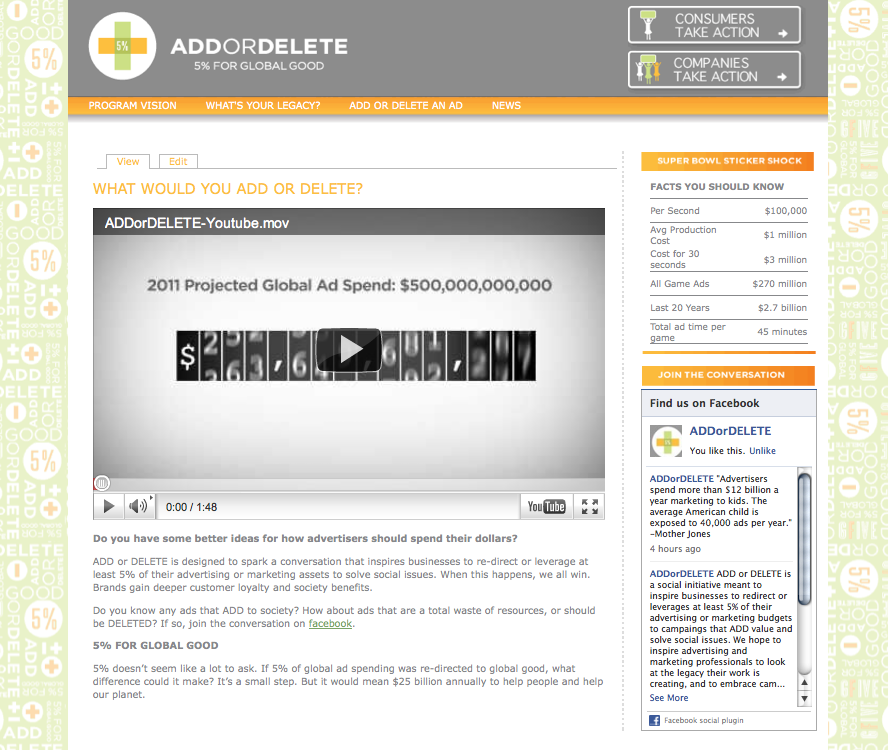
What Would You Add or Delete? The social forum for the future of marketing, advertising and global good.

20 01 2011

Kudos to ADDorDELETE, the brainchild of the tribe at Haberman.  It’s a fresh yet startling conversation centered around the power of marketing and advertising to ADD to society and address social problems and challenges.

By challenging the global marketing industry to re-direct 5% of the $500 billion global ad spend to causes, social problems and people that need help, we can unleash $25 billion for global good.

Learn more at the Add or Delete website

Join the conversation on facebook

Let’s call out all those ads that we’d prefer to delete.  Those messages that attempt to entertain at the expense of others.  The ads that just create noise and empty moments.  ADDorDELETE challenges everyone to take stock – what legacy do you want to leave?  Are you ADDING?  Here’s to less self-promotion and more social improvement.


American People to Corporate America: We’d Vote You Out.

30 12 2010

In a new survey issued by StrategyOne, 82% of American’s gave a “C grade or lower” on how corporate America did in 2010, with 40% of Americans assigning Corporate America a “D” or an “F”.

The wake up call is that Americans are extremely frustrated and dissatisfied with the behavior of companies in America.  Quite literally, if the leadership of American companies were politicians, there would be a landslide election of the American people voting them out of their corner offices.

“Let’s be clear, Americans are not dreaming up some far out vision of utopia,” said said Bradley Honan, senior vice president of StrategyOne. “Instead they are being realistic that Corporate America should – and indeed must – engage in important issues of the day where they can make a demonstrably positive difference.  That means the economy and jobs for starters, but also ensuring their products are safe and not harmful to use, and that they simply conduct their day to day business activities in an honest, ethical, and transparent manner.”

Other interesting facts undercovered in the StrategyOne survey included:

  • 88% of consumers said it was extremely or very important that companies help get the economy back on track in 2011.
  • 88% said it was extremely or very important to conduct business in an ethical manner in 2011, and 87% said it was a top priority to do business in an honest and moral way.
  • 85% of consumers thought it was extremely or very important for companies in 2011 to deliver high quality products and services;
  • 84% of Americans thought companies needed to demonstrate good governance in 2011.
  • 82% said it was a top priority for companies to make fewer mistakes and errors in 2011.

Let’s hope company leaders make some serious New Year’s resolutions to improve their performance and more effectively communicate with the public to show how they are being more responsbile, sustainable and ethical.  That is the only way to reduce the “trust gap”.  And it is important for corporate leaders to recognize—once and for all—that their futures are dependent on their customers….who happen to be the American people, at the end of the day.

StrategyOne Survey Methodology:

StrategyOne conducted 1,081 online interviews among a representative sampling of Americans between December 6 and 8, 2010.


Sustainability Making Business Smarter, More Competitive and More Profitable.

16 12 2010

A new report commissioned by KPMG and The Economist Intelligence Group shows that global corporate business executives are seeing positive—and potentially surprising – business benefits from their sustainability initiatives.  More than half of those surveyed represented C-Suite executives.  This week’s report is a preview of a major research paper coming from KPMG early next year.

  • 62% of company’s now claim to have a strategy for sustainability, up from just over half in early 2008.
  • 44% of business executives believe that sustainability is and will continue to be a source of innovation.
  • 39% of executives see sustainability as a source of revenue growth.
  • 41% see sustainability as a driver for brand enhancement.

Some of the other benefits cited by executives from sustainability initiatives include happier employees, better relationships with clients and suppliers, cost reduction, access to new markets, new product and service offerings and improved investor awareness.

But once again there is a gap between reality and perception, with many companies still not effectively communicating sustainability progress to investors and other stakeholders.

And the vast majority of survey respondants claim they viewed sustainability reporting as “just PR.”

It is time for business to back up their actions with transparent and authentic communication to translate their efforts into positive external perceptions and brand reputation enhancement.  The communication challenge is to be  real, believable, trusted and for the messages to be served up in digestible, understandable and emotionally inspiring ways.  And that friends, is the essence of great branding and the huge opportunity: creating responsible brands that prosper in the new age of sustainability.

Download the KMPG Research Report Preview Here


“Activate CSR through Brands”: Coca-Cola Enterprises

13 12 2010

Congratulations to the wise mind of Joe Franses of Coca-Cola Enterprises who calls on markets to harness the power of brands to engage consumers in the sustainable brands movement.

We’ve long called on a new take for CSR – corporate social responsibility.  The problem with CSR as it is currently defined and often practiced is that it lives at the “corporate” level.  The issue with this approach is that most consumers don’t want to have relationships with corporations.  What they do have is relationships with BRANDS.  Activating social responsibility at the brand level is key to get consumers to take notice of efforts and get engaged in the movement.  By selecting socially responsible efforts that are authentic to a brand’s values, consumers are much more likely to get engaged.

Note this report from Sustainable Life Media:

While speaking at the conference, Mr. Franses also stressed that innovation will be a major driver of business sustainability moving forward – and success will depend on how well brands can engage consumers in the process. The first step in this process, he said, will be for companies like Nestle, Coca-Cola Enterprises and Unilever to work at aligning their top-down management initiatives with brand agendas around sustainability more effectively.


Cause Marketing: Let the boys play too!

19 11 2010

The first male-specific survey in the six-year history of the PRWeek/Barkley Cause Survey has produced surprising results regarding Men’s relationship with Brands that have cause marketing programs – they are influenced by cause marketing at nearly the same rate as women.

The survey polled 4,252 marketing pros and 2,365 consumers and found that:

  • 88% of men say it’s important for a brand to support a cause
  • 61% have purchased a brand because it supported a cause
  • 67% would try a brand because it supported a cause,
  • 55% would pay more for a brand that supported a cause.

While the data indicates that Men direct their dollars to brands associated with causes in high numbers, 68% of corporate marketing executives surveyed said that they had no plans to specifically target men with their efforts.

Although according to the results, there are brands that could benefit from this kind of communication. When asked what companies are not doing as much as they should to associate with causes, the three top answers were BP, Apple and Goldman Sachs.

For the full survey, visit www.barkleyus.com.


Hartman Group: Only 12% of people can identify a “sustainable” company.

15 11 2010

Proving once again that existing approaches to reporting and marketing sustainability initiatives and corporate social responsibility are failing to connect, new research from The Hartman Group demonstrates too few people are aware of sustainable products and companies.

While the research indicates at 15% increase in awareness of the term “sustainability” up to 69%, just 21% of people responding to the survey could identify a sustainable product.

“We’re seeing a broad gap in the way consumers and companies think about and approach sustainability,” said Laurie Demeritt, Hartman Group President & COO. “That very few consumers today can name a sustainable company underscores the fact that so many Corporate Social Responsibility (CSR) and sustainability activities go relatively unnoticed by consumers.”

Demeritt continues in the Hartman release:  “Above all consumers are looking for companies that are good citizens. From this perspective, we say consumers equate sustainability with the golden rule, or a reciprocal notion of fair treatment of communities, people or animals, and look through this lens when evaluating companies or thinking about which brands to use.”

More than 1,600 U.S. adult consumers participated in the online survey.


Cheers to Anvil Organics: We Need To Talk

7 10 2010

Here’s a great video that Anvil Organics – a maker of eco-friendly clothing – has produced in association with their sponsorship of Farm Aid 25.  Let the earth talk to you…..


The Clock Is Ticking: 3 Amazing Minutes

1 10 2010

Once again, bless the folks at The Girl Effect for all their efforts on behalf of girls living in poverty.  Their new video is breathtaking.

Pass it along.


83% of people want to see more cause marketing. New report from Cone Research.

20 09 2010

Released last week, the 2010 Cone Cause Evolution Study reports significant new evidence supporting the rise in importance of cause related marketing.  Despite overall low consumer confidence and prolonged unemployment due to the recession, the one thing consumers are confident in is their belief in brands that support worthy causes.

Higlights of the report show that:

  • 88% of people say it is acceptable for comapnies to involve a cause or issue in their marketing.
  • 85% have a more positive image of a product or company that supports a cause they care about.
  • 80% are likely to switch brands, similar in price and quality, to one that supports a cause.

The report also highlighted the powerful role of linking moms and causes in brand purchasing behavior.

Of mom’s surveyed, 95% say cause marketing is acceptable and 92% say they want to buy a product supporting a cause.

You can get a free copy of the Cone Study here.


If You’ve Got It = Spend It!

6 09 2010

In an edited excerpt of his new book Aftershock: Reshaping the World Economy After The Crises, Phillpee Legrain writes about the need to embrace new approaches capitalism and consumerism.  His point is that without consumption, there is no production, no income and no jobs.  And in plenty of markets around the world, there are millions and millions of people with unmet needs.  Responsible brands understand that they need to be serving those markets not only with sustainable products but with efforts that aid the public good.  The balance is essential for the retention and recruitment of new audiences of prosperous consumers.

“The aftermath of the crisis opens up huge opportunities to reshape the world economy for the better.  A fairer, richer, greener and more stable global economy is possible.  But to achieve it, we need to rediscover the virtues of open markets, open societies and open minds that go hand in hand with progress:  great opportunities for everyone to chase their dreams and fulfill their potentials.”

Read the article in Ode Magazine.


Deloitte: The Gap Between Aspiration and Action

30 08 2010

A new survey of corporate business executives by Deloitte identifies the gap that still exists between sustainability vision and execution.   While most business leaders surveyed indicated knowledge of the benefits of developing a relationship between sustainability and the business, much more work needs to be done to make it a fundamental part of the operational, cultural and strategic performance of the company.

Thanks for Deloitte for making this research available to business leaders everywhere.

Read the Deloitte Executive Summary Here.


Brands and Branding For Good.

29 08 2010

“There must be a better way to make the things we want, a way that doesn’t spoil the sky, the rain or the land.”
– Sir Paul McCartney

Coming to South Africa in October is a conference entitled Brands and Branding for Good.

Congratulations to the organizers and the roster of speakers representing a wide range of global brands including IBM, McDonald’s, Nike, and Dell for coming together to understand and demonstrate how brands can work for the public good.

Learn more about the Brands and Branding For Good Conference here


Peter Clarke: 5 Branding Commandments for the Post-Crash Economy

29 08 2010

A very inspiring article by Peter Clark on 5 compelling branding commandents for marketers and agencies moving forward.  His straightforward summary of branding principals for a post-recession era reminds us that consumer’s expectations for brand behavior are forever changed.

Peter’s commandants are:

1.  Simplicity

2. Transparency

3. Responsibility

4.  Sustainability

5.  Affordability

Read the 5 Commandments Article Here.

Grass Image:  Dennis Wong


Counter-Intuitive Intelligence: Recession = Responsibility

29 08 2010

This article from Brandweek demonstrates that the recession has affected not only consumer wallets, but also brand perception. Kudos to the folks at Landor Associates, Penn Schoen Berland and Burson-Marsteller for their new consumer survey demonstrating that transparency and corporate responsibility have become far more important to consumers in a tough economy.

The survey measured consumer perceptions of corporate social responsibility practices and ranked companies that are the most responsible. It found that despite the recession, 75% of consumers believe social responsibility is important, and 55% of consumers said they would choose a product that supports a particular cause against similar products that don’t.

“[Corporate social responsibility] can be the olive branch between struggling industries and consumers in cases where consumers are experiencing the highest expectations and the biggest let downs,” said Scott Osman, global director of Landor’s citizenship branding practice, adding that the industries with brands that have performed poorly, are the ones in which responsibility is valued most.

While 38% of respondents plan to spend the same or more on products or services from socially responsible companies, more than half of consumers are unsure about the meaning of CSR. And those who do know what the term means, define it as “giving back to the local community” (20%), and as “self-regulation and accountability” (19%).

Additionally, the survey found that 70% of consumers are willing to pay a premium for products from socially responsible companies. In fact, 28% are willing to pay at least $10 more. That means companies have an opportunity to differentiate themselves if they can communicate clearly how they give back to their employees, communities, and the environment, per the survey.

When asked to name the most surprising findings, Osman pointed to the fact that nearly 50% of 18-24 and 25-34 year olds are more likely to take a pay cut to work for a socially responsible company—a much higher percentage than any other age group. However, Osman added, “a year where there seems have been so much responsibility expressed, especially in light of the earthquake in Haiti, only 11% of Americans say they’ve heard corporate CSR communications.”


Cone Study: 75% of consumers grade companies as C, D, or F on engagement around sustainability.

25 05 2010

May 21, 2010 – A recent study conducted by Cone LLC finds that while the overwhelming majority of American consumers believe that their ideas can help business build more sustainable products, a much smaller number believe companies are doing enough to encourage communication about corporate sustainability.

The report, entitled 2010 Cone Shared Responsibility Study, finds that 84% of the 1,045 American consumers polled believed that their ideas could benefit businesses sustainability offerings, while only 53% felt encouraged to engage at any level. The four key areas consumers wanted more engagement in are: including how a company conducts its business (85%), its products and packaging (83%), its support of social and environmental issues (81%) and its marketing and advertising (74%).

In grading companies on their engagement levels, over 75% of those surveyed gave companies either a “C”, “D”, or “F” on customer engagement. Cone calls this a lost opportunity for most companies, as many more consumers would be more likely buy products and services and recommend companies with better engagement policies.

Consumers are also prepared to listen to companies willing to engage them, with a full 92% of respondents wanting more communication from brands. While this number sounds like an overwhelming endorsement for more brand communication, some other statistics bring to light the dichotomy of the situation:

  • Skepticism – 87 percent of consumers believe the communication is one-sided — companies share the positive information about their efforts, but withhold the negative.
  • Confusion – 67 percent of consumers are confused by the messages companies use to talk about their social and environmental commitments.

For a copy of the complete 2010 Cone Shared Responsibility Study fact sheet, please visit http://www.coneinc.com/research/.


Seventy percent of major companies plan to increase climate change spending.

25 05 2010

Here’s a report on the recent Ernst & Young survey about companies intentions to invest in climate change initiatives.  We love the idea that 89% report the efforts are driven by changing customer demands.

Seventy percent of major companies plan to boost spending on climate change efforts in the next two years, according to a new report from Ernst & Young.

Of the 300 corporate executives surveyed this spring, 89% said their green activities were driven by changing customer demands while 92% also pointed to energy costs as a driver. The fact that 43% of those surveyed said that equity analysts will soon consider climate change actions while valuing companies was also a factor.

Thirty percent said their company had a staffer in charge of climate change initiatives, a trend The Times explored in December.

The respondents hail from 16 countries, representing firms in 18 industry sectors that pull in at least a billion dollars a year in revenue. Nearly half said they intend to shell out between half a percent to more than 5% of that revenue – or about $5 million to $50 million each year – for climate change initiatives.

Two-thirds said they are talking with their suppliers about programs to limit carbon emissions; 36% said they are already in the process of cutting greenhouse gases from their supply chains.

Nearly 95% said national policies played a critical role in their company’s climate change strategy and 81% said the same of global laws. But in countries such as the U.S., Japan and Germany, regulatory and compliance issue was ranked as the largest challenge to accomplishing environmental goals.

The study was conducted by the research group Verdantix.

Tiffany Hsu, The Los Angeles Times


More screenings of Ana’s Playground ahead at Festivals around the country.

31 12 2009

Ana’s Playground, the breathtaking allegory short film about children at the hands of armed conflict, may be coming to a film festival near you in early 2010.  I encourage everyone who has a chance to take in this riveting drama which is well on its way to receiving a best short film nomination at the Academy Awards.

It’s a perfect way to kick off the New Year with the resolution to learn more and get involved in helping children in war torn countries and the countless number of kids that can benefit from organizations like Right to Play, the principal non-profit organization benefiting from funds raised by Ana’s Playground.

You can see Ana’s Playground at the following film festivals.  Follow the links to each individual film festival for screening times and locations.

Santa Barbara International FIlm Fest – Feb. 4 – 14th (Academy Sanctioned)

Boulder International Film Fest –  Feb. 11th – 14th

Sedona International Film Festival –  Feb. 21st – Feb 28th

Cinequest (San Jose) Feb. 23rd – Mar. 7th (Academy Sanctioned)

Tiburon Film Fest – Mar. 18th –  Mar. 26th

In addition to these Film Festivals, Ana’s Playground will have a special screening at Right To Play’s event for sponsors and supporters at the Vancouver Winter Olympics.

Here’s a recent spot from Mastercard Canada raising awareness about Right to Play.

And for friends in the Twin Cities, Ana’s Playground has been selected as the exclusive film to be screened at Augsburg College during the annual Nobel Peace Prize forum on Friday, March 5 on campus.  The screening will follow a keynote address by 2008 Nobel Peace Prize winner Martti Ahtisaari.

Details on the Nobel Peace Prize Forum

Some of the recognition Ana’s Playground has earned around the world includes:

WINNER Best Int’l Short Film – Foyle Film Festival (Oscar Qualifying)
WINNERBest Screenplay – Los Angeles Int’l Short Film Festival
WINNERBest Short Film – Norwich Int’l Film Festival
WINNERBest of the Fest – Norwich Int’l Film Festival
WINNERBest Dramatic Short Film – New Hampshire Film Festival
WINNERBest Short FIlm – Cenflo Film Festival


Age of Stupid Filmmaker Saved By Mayor of London from iron bar yielding girl gang.

25 11 2009

I can’t believe I just wrote that headline – but the truth is stranger than fiction.  The Guardian reported today:

Boris Johnson came to the rescue of a high profile climate change activist and filmmaker who was being attacked by a group of young girls brandishing an iron bar, it was revealed today.

Franny Armstrong, the director of The Age of Stupid, described the mayor of London as her “knight in a shining bicycle” after he came to her defence as she was walking home in Camden, north London, last night.

She called out for help to a passing cyclist after being surrounded by a group of hoodie-wearing young girls who pushed her against a car, one holding an iron bar.

She called out for help to a passing cyclist after being surrounded by a group of hoodie-wearing young girls who pushed her against a car, one holding an iron bar.

The cyclist turned out to be none other than Johnson, who has made tackling youth crime a key mayoral priority.

He stopped and chased the girls down the street, calling them “oiks”, according to Armstrong, who praised the mayor’s intervention.

Johnson returned and insisted on walking her home.

Armstrong is the founder of the 10:10 campaign, which aims to cut 10% of carbon emissions in 2010 and has attracted support from leading firms – including the Guardian – and personalities.

“I was texting on my phone so didn’t notice the girls until they pushed me against the car, quite hard,” she said.

“I noticed that one had an iron bar in her hand. It was very frightening. At that moment a man cycled past and I called out for help.

“He said to the girls: ‘What do you think you are doing?’ He picked up the iron bar, called after the girls and cycled after them. He returned a few minutes later and walked me home.

“He was my knight on a shining bicycle.”

Watch an interview with Franny Armstrong.


Ana’s Playground takes New Hampshire.

19 10 2009

Picture 1

Like the first important primary of a presidential election, New Hampshire represents a key milestone for another candidate.  Ana’s Playground— the short film about children as victims of armed conflict—won Best Short Drama in this past weekend’s festival in Portsmouth, New Hampshire.   More than 80 independent films were screened over the weekend.

With award winning honors in three of its first few screenings, Ana’s Playground continues its world tour.  Check out the Ana’s Playground filmmaker blog for other news and updates.

One of the largest film fests in New England, the four-day event draws celebrities, academy-award winners, film industry veterans and local film lovers. Most importantly, NHFF offers workshops and discussions for young and new filmmakers to interact with industry pros and learn the art and business of film.

Learn more about the New Hampshire Film Festival


Abandon Ship! Follow-up on U.S. Chamber…

1 10 2009

Pendleton_Sinking_Ship

The momentum of disengagement from the U.S. Chamber of Commerce based on their draconian position denying climate change continues. The chamber in recent weeks has challenged a federal Environmental Protection Act finding that greenhouse gases can be regulated by the Clean Air Act.

Nike announced Wednesday that it has resigned from the Board of Directors of the Chamber.  In a statement, Nike said “we fundamentally disagree with the U.S. Chamber of Commerce on the issue of climate change and their recent action challenging the EPA is inconsistent with our view that climate change is an issue in need of urgent action.”

Nike joins PG&E Corporation, PNM Resources and Exelon Corporation— all of whom have left the Chamber in the past week based on the Chamber’s position denying climate change.  Speculation continues that Chamber President Thomas Donohue will be forced to resign based on the defection of member companies and allegations of conflict of interest based on his board position at Union Pacific Railway, a company fighting climate change legislation in part based on the large amount of revenues they receive from the shipment of coal.


Ana’s Playground a winner at Norwich Film Festival

24 09 2009

107_AnasPlay_Kids2

Ana’s Playground received awards for The Best Short Film and Best of The Fest this week at the Norwich Film Festival in the United Kingdom.

In its advance pre-screening at the debut Norwich Film Festival, Ana’s Playground not only won Best Short Film, but Best of The Fest – beating out all the feature films that were screened as well as more than 90 films entered in the competition.

Learn more about the Norwich Film Festival

The world premiere of Ana’s Playground is Friday, September 25 at the Calgary Film Festival.  Information on the Calgary Film Festival is available at their website.

Calgary International Film Festival

Written and directed by Minneapolis film maker Eric Howell, Ana’s Playground is a Oscar worthy story of children subjected to armed conflict.  The mission of the film is to raise awareness of children in conflict and raise funds for Right to Play, an international humanitarian organization that uses sport and play programs to improve health, develop life skills, and foster peace for children and communities in some of the most disadvantaged areas of the world.